BELL’S INEQUALITY

UPDATE: 18 December 2022:  Royal Swedish Academy of Sciences on 4 October 2022 awarded the Nobel Prize in Physics to: 

Alain Aspect
Institut d’Optique Graduate School – Université Paris-
Saclay and École Polytechnique, Palaiseau, France


Alain Aspect, winner of 2022 Nobel Prize in Physics

John F. Clauser
J.F. Clauser & Assoc., Walnut Creek, CA, USA

Anton Zeilinger
University of Vienna, Austria

“for experiments with entangled photons, establishing the violation of Bell inequalities and pioneering quantum information science”


UPDATE: September 5, 2019:  I stumbled across this research published in NATURE during December 2011, where scientists reported entanglement of vibrational patterns in separated diamond crystals large enough to be viewed without magnification. Nature doi:10.1038/nature.2011.9532


UPDATE: May 8, 2018: This video from PBS Digital Studios is the best yet. Click the PBS link to view the latest experimental results involving quantum mechanics, entanglement, and their non-intuitive mysteries. The video is a little advanced and fast paced; beginners might want to start with this link.


UPDATE: June 17, 2016:   Ali Sundermier published a description of quantum entanglement for non-scientists. Here is the link.

Another beginner’s overview of quantum mechanics by Cathal O’Connell is in this link.

UPDATE: February 4, 2016:  Here is a link to the August 2015 article in Nature, which makes the claim that the last testable loophole in Bell’s Theorem has been closed by experiments conducted by Dutch scientists. Conclusion: quantum entanglement is real.

UPDATE: Nov. 14, 2014:    David Kaiser proposed an experiment to determine Is Quantum Entanglement Real?  Click the link to redirect to the Sunday Review, New York Times article. It’s a non-technical explanation of some of the science related to Bell’s Theorem. 


Someone nominated Irish physicist, John Stewart Bell, (1928-1990) for a Nobel Prize during the year he died from a sudden brain hemorrhage. Nobel rules prevent the awarding of prizes to people who have died. Bell never learned of his nomination.

John Stewart Bell‘s Theorem of 1964 followed naturally from the proof of an inequality he fashioned (now named after him), which showed that quantum particle behavior violated logic.

It is the most profound discovery in all science, ever, according to Henry Stapp—retired from Lawrence Berkeley National Laboratory and former associate of Wolfgang Pauli and Werner Heisenberg. Other physicists like Richard Feynman said Bell simply stated the obvious.


Beta Barium Borate crystals can be used to ”down-convert” photons into entangled pairs.

Here is an analogy I hope gives some idea of what is observed in quantum experiments that violate Bell’s Inequality: Imagine two black tennis balls—let them represent atomic particles like electrons or photons or molecules as big as buckyballs.


The tennis balls are created in such a way that they become entangled—they share properties and destinies. They share identical color and shape.  [Entangled particles called fermions display opposite properties, as required by the Pauli exclusion principle.]

Imagine that whatever one tennis ball does, so does the other; whatever happens to one tennis ball happens to the other, instantly it turns out. The two tennis balls (the quantum particles) are entangled.

[For now, don’t worry about how particles get entangled in nature or how scientists produce them.  Entanglement is pervasive in nature and easily performed in labs.]


According to optical and quantum experimentalist Mark John Fernee of Queensland, Australia, ”Entanglement is ubiquitous. In fact, it’s the primary problem with quantum computers. The natural tendency of a qubit in a quantum computer is to entangle with the environment. Unwanted entanglement represents information loss, or decoherence. Everything naturally becomes entangled. The goal of various quantum technologies is to isolate entangled states and control their evolution, rather than let them do their own thing.”

In nature, all atoms that have electron shells with more than one electron have entangled electrons. Entangled atomic particles are now thought to play important roles in many previously not understood biological processes like photosynthesis, cell enzyme metabolism, animal migration, metamorphosis, and olfactory sensing. There are several ways to entangle more than a half-dozen atomic particles in experiments.


Imagine particles shot like tennis balls from cannons in opposite directions. Any measurement (or disturbance) made on a ball going left will have the same effect on an entangled ball traveling to the right.

So, if a test on a left-side ball allows it to pass through a color-detector, then its entangled twin can be thought to have passed through a color-detector on the right with the same result. If a ball on the left goes through the color-detector, then so will the entangled ball on the right, whether or not the color test is performed on it. If the ball on the left doesn’t go through, then neither did the ball on the right. It’s what it means to be entangled.

Now imagine that cannons shoot thousands of pairs of entangled tennis balls in opposite directions, to the left and right. The black detector on the left is calibrated to pass half of the black balls. When looking for tennis balls coming through, observers always see black balls but only the half that get through. 
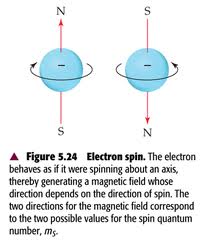

Spin is one of the characteristics of a quantum object, much like yellow is a characteristic of a tennis ball.

Spin describes a particle property of quantum objects like electrons — in the same way color or roundness describe tennis balls. The property is confusing, because no one believes electrons (or any other quantum objects) actually spin. The math of spin is underpinned by the complex-mathematics of spinors, which transform spin arrows into multi-dimensional objects not easy to visualize or illustrate. Look for an explanation of how spin is observed in the laboratory later in the essay. Click links for more insight.


Now, imagine performing a test for roundness on the balls shot to the right. The test is performed after the black test on the left, but before any signal or light has time to travel to the balls on the right. The balls going right don’t (and can’t) learn what the detector on the left observed. The roundness-detector is set to allow three-fourths of all round tennis balls through.

When round balls on the right are counted, three-eighths of them are passing through the roundness-detector, not three-fourths. Folks might speculate that the roundness-detector is acting on only the half of the balls that passed through the color-detector on the left. And they would be right.

These balls share the same destinies, right? Apparently, the balls on the right learned instantly which of their entangled twins the color-detector on the left allowed to pass through, despite all efforts to prevent it.

So now do the math. One-half (the fraction of the black balls that passed through the left-side color-detector) multiplied by three-fourths (the fraction calibrated to pass through the right-side roundness-detector) equals three-eighths. That’s what is seen on the right — three-eighths of the round, black tennis balls pass through the right-side roundness-detector during this fictionalized and simplified experiment.


Polarization is another characteristic of a quantum particle, much like roundness is for a tennis ball.
Polarization is a term used to describe a wave property of quantum objects like photons.  Polarizing filters are rotated in experiments to determine some of the properties of atomic particles, like spin.

According to Bell’s Inequality, twice as many balls should pass through the right-side detector (three-fourths instead of three-eighths). Under the rules of classical physics (which includes relativity), communication between particles cannot exceed the speed of light.

There is no way the balls on the right can know if their entangled twins made it through the color detector on the left. The experiment is set up so that the right-side balls do not have time to receive a signal from the left-side. The same limitation applies to the detectors.

The question scientists have asked is: how can these balls (quantum particles) — separated by large distances — know and react instantaneously to what is happening to their entangled twins? What about the speed limit of light? Instantaneous exchange of information is not possible, according to Einstein.

The French quantum physicist, Alain Aspect, suggested his way of thinking about it in the science journal, Nature (March 19, 1999).


Alain Aspect
Alain Aspect, French physicist, is best known for his work on quantum entanglement.

He wrote: The experimental violation of Bell’s inequalities confirms that a pair of entangled photons separated by hundreds of meters must be considered a single non-separable object — it is impossible to assign local physical reality to each photon.

Of course, the single non-separable object can’t have a length of hundreds of meters, either. It must have zero length for instantaneous communication between its endpoints. But it is well established by the distant separation of detectors in experiments done in labs around the world that the length of this non-separable quantum object can be arbitrarily long; it can span the universe.

When calculating experimental results, it’s as if a dimension (in this case, distance or length) has gone missing. It’s eerily similar to the holographic effect of a black hole where the three-dimensional information that lives inside the event-horizon is carried on its two-dimensional surface. (See the technical comment included at the end of the essay.)


Schematic of physicist Alan Aspect's experimental apparatus which verified that the act of measurement influenced distant entangled calcium electrons instantaneously.
Here is a drawing of an apparatus the French physicist, Alain Aspect, designed to quickly change the angle of polarity-measurements for emitted photons. In experiments, he used the logic of Bell’s Inequalities and the speed of his switches to show that it was not possible for photons to carry specific (or unique) polarity-angles until after they were measured by the polarization detectors.  Once measured, Alain showed that the new, narrowly defined polarity states of his photons always propagated to their distant entangled twins, instantly.  


Another way physicists have wrestled with the violations of Bell’s Inequality is by postulating the concept of superposition. Superposition is a concept that flows naturally from the linear algebra used to do the calculations, which suggests that quantum particles exist in all their possible states and locations at the same time until they are measured.

Measurement forces wave-particles to “collapse” into one particular state, like a definite position. But some physicists, like Roger Penrose, have asked: how do all the super-positioned particles and states that weren’t measured know instantaneously to disappear?

Superposition, a fundamental principle of quantum mechanics, has become yet another topic physicists puzzle over. They agree on the math of superposition and the wave-particle collapse during measurement but don’t agree on what a measurement is or the nature of the underlying reality. Many, like Richard Feynman, believe the underlying reality is probably unknowable.

Quantum behavior is non-intuitive and mysterious. It violates the traditional ideas of what makes sense. As soon as certainty is established for one measurement, other measurements, made earlier, become uncertain.

It’s like a game of whack-a-mole. The location of the mole whacked with a mallet becomes certain as soon as it is struck, but the other moles scurry away only to pop up and down in random holes so fast that no one is sure where or when they really are.

Physicists have yet to explain the many quantum phenomena encountered in their labs except to throw-up their hands to say — paraphrasing Feynman — it is the way it is, and the way it is, well, the experiments make it obvious.
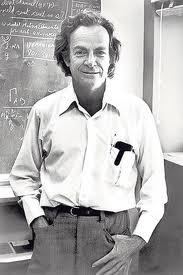

Feynman
Richard Feynman (1918-1988) downplayed Bell’s Inequality because, he said, it simply pointed out what was already obvious from experiments.

But it’s not obvious, at least not to me and, apparently, many others more knowledgeable than myself. Violations of Bell’s Inequality confound people’s understanding of quantum mechanics and the world in which it lives. A consequence has been that at least a few scientists seem ready to believe that one, perhaps two, or maybe all four, of the following statements are false:

1) logic is reliable and enables clear thinking about all physical phenomenon;

2) the universe exists independently of any conscious observer;

3) information does not travel faster than light.

4) a model can be imagined to explain quantum phenomenon.

I feel wonder whenever the idea sinks into my mind that at least one of these four seemingly self-evident and presumably true statements could be false — possibly all four — because repeated quantum experiments suggest they must be. Why isn’t more said about it on TV and radio?


Quantum mechanics (1)
Some scientists think non-physicists cannot grasp quantum mechanics. This little girl disagrees.

The reason could be that the terrain of quantum physics is unfamiliar territory for a lot of folks. Unless one is a graduate student in physics — well, many scientists don’t think non-physicists can even grasp the concepts. They might be right.

So, a lot is being said, all right, but it’s being said behind the closed doors of physics labs around the world. It is being written about in opaque professional journals with expensive subscription fees.

The subtleties of quantum theory don’t seem to suit the aesthetics of contemporary public media, so little information gets shared with ordinary people. Despite the efforts of enthusiastic scientists — like Brian CoxSean M. CarrollNeil deGrasse Tyson and Brian Greene — to serve up tasty, digestible, bite-size chunks of quantum mechanics to the public, viewer ratings sometimes fall flat.

When physicists say something strange is happening in quantum experiments that can’t be explained by traditional methods, doesn’t it deserve people’s attention? Doesn’t everyone want to try to understand what is going on and strive for insights?  I’m not a physicist and never will be, but I want to know.

Even me — a mere science-hobbyist who designed machinery back in the day — wants to know. I want to understand. What is it that will make sense of the universe and the quantum realm in which it rests?  It seems, sometimes, that a satisfying answer is always just outside my grasp.

Here is a concise statement of Bell’s Theorem from the article in Wikipedia — modified to make it easier to understand: No physical theory about the nature of quantum particles which ignores instantaneous action-at-a-distance can ever reproduce all the predictions about quantum behavior discovered in experiments.


laser-controlled-polarization
Familiarity with concepts like wave polarization and particle-spin can help demystify some aspects of quantum mechanics. One aspect that can’t be demystified: in experiments quantum objects display the properties of both waves and particles.

To understand the experiments that led to the unsettling knowledge that quantum mechanics — as useful and predictive as it is — does indeed violate Bell’s proven Inequality, it is helpful not only to have a solid background in mathematics but also to understand ideas involving the polarization of light and — when applied to quantum objects like electrons and other sub-atomic particles — the idea of spin.  Taken together, these concepts are somewhat analogous to the properties of color and roundness in the imaginary experiment described above.

This essay is probably not the best place to explain wave polarization and particle spin, because the explanation takes up space, and I don’t understand the concepts all that well, anyway.  (No one does.)

But, basically, it’s like this: if a beam of electrons, for example, is split into two and then recombined on a display screen, an interference pattern presents itself. If one of the beams was first passed through a polarizer, and if experimenters then rotate the polarizer a full turn (that is, 360°), the interference pattern on the screen will reverse itself.  If the polarizer-filter is rotated another full turn, the interference pattern will reverse again to what it was at the start of the experiment.

So, it takes two spins of the polarizer-filter to get back the original interference pattern on the display screen — which means the electrons themselves must have an intrinsic “one-half” spin. All so-called matter particles like electrons, protons, and neutrons (called fermions) have one-half spin.

Yes, it’s weird. Anyway, people can read-up on the latest ideas by clicking this link. It’s fun. For people familiar with QM (quantum mechanics), a technical note is included in the comments section below.

Otherwise, my analogy is useful enough, probably. In actual experiments, physicists measure more than two properties, I’m told. Most common are angular momentum vectors, which are called spin orientations. Think of these properties as color, shape, and hardness to make them seem more familiar — as long as no one forgets that each quality is binary; color is white or black; shape is round or square; hardness is soft or hard.


Crystals can be used to “down-convert” photons into  entangled pairs.

Spin orientations are binary too — the vectors point in one of two possible directions. It should be remembered that each entangled particle in a pair of fermions always has at least one property that measures opposite to that of its entangled partner.

The earlier analogy might be improved by imagining pairs of entangled tennis balls where one ball is black, the other white; one is round, the other square; add a third quality where one ball is hard, the other soft. Most important, the shape and color and hardness of the balls are imparted by the detectors themselves during measurement, not before.

Before measurement, concepts like color or shape (or spin or polarity) can have no meaning; the balls carry every possible color and shape (and hardness) but don’t take on and display any of these qualities until a measurement is made. Experimental verification of these realities keep some quantum physicists awake at night wondering, they say.

Anyway, my earlier, simpler analogy gets the main ideas across, hopefully. And a couple of the nuances of entanglement can be found within it. I’ve added an easy to understand description of Bell’s Inequality and what it means to the end of the essay.

Here are two additional links with more depth: CHSH Inequality; Bell Test Experiments.
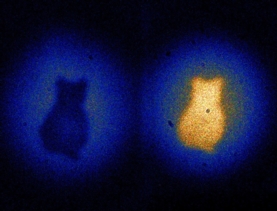

A carbord cut-out of a cat imaged by photons that never went through the cut-out itself. Credit: Gabriela Barreto Lemos
This cardboard cut-out of a cat was imaged by entangled photons. Lower energy photons interacted with the cut-out while their higher energy entangled twins interacted with the camera to create the picture.
Credit: Gabriela Barreto Lemos

In the meantime, scientists at the Austrian Academy of Sciences in Vienna recently demonstrated that entanglement can be used as a tool to photograph delicate objects that would otherwise be disturbed or damaged by high energy photons (light). They entangled photons of different energies (different colors).

They took photographs of objects using low energy photons but sent their higher energy entangled twins to the camera where their higher energies enabled them to be recorded. New technologies involving the strange behavior of quantum particles are in development and promise to transform the world in coming decades.

Perhaps entanglement will provide a path to faster-than-light communication, which is necessary to signal distant space-craft in real time. Most scientists say, no, it can’t be done, but ways to engineer around the difficulties are likely to be developed; technology may soon become available to create an illusion of instantaneous communication that is actually useful. Click on the link in this paragraph to learn more.

Non-scientists don’t have to know everything about the individual trees to know they are walking in a quantum forest. One reason for writing this essay is to encourage people to think and wonder about the forest and what it means to live in and experience it.

The truth is, the trees (particles at atomic scales) in the quantum forest seem to violate some of the rules of the forest (classical physics). They have a spooky quality, as Einstein famously put it.


remu warrior night scene 3
The quantum forest is a spooky place, Einstein said. 

Trees that aren’t there when no one is looking suddenly appear when someone is looking. Trees growing in one place seem to be growing in other places no one expected. A tree blows one way in the wind, and someone notices a tree at the other end of the forest — where there is no wind — blowing in the opposite direction. As of right now, no one has offered an explanation that doesn’t seem to lead to paradoxes and contradictions when examined by specialists.


Henry Stapp, Amazon.com

John Stewart Bell proved that trees in the quantum forest violate laws of nature and logic. It makes me wonder whether anyone will ever know anything at all they can fully trust about fundamental, underlying essence of reality.

Some scientists, like Henry Stapp (now retired), have proposed that brains enable processes like choice and experiences like consciousness through the mechanism of quantum interactions. Stuart Hameroff and Roger Penrose have proposed a quantum mechanism for consciousness they call Orch Or.

Others, like Wolfgang Pauli and C. G. Jung, have gone further — asking, when they were alive, if the non-causal coordination of some process resembling what is today called entanglement might provide an explanation for the seeming synchronicity of some psychic processes — an arena of inquiry a few governments are rumored to have incorporated (to great effect) into their intelligence gathering tool kits.

In a future essay I hope to speculate about how quantum processes like entanglement might or might not influence human thought, intuition, and consciousness.

Billy Lee

P.S.  A simplified version of Bell’s Inequality might say that for things described by traits A, B, and C, it is always true that A, not B; plus B, not C; is greater than or equal to: A, not C.  

When applied to a room full of people, the inequality might read as follows: tall, not male; plus male, not blonde; is greater than or equal to: tall, not blonde.

Said more simply: tall females and dark haired men will always number more than or equal to the number of tall people with dark hair. 

People have tried every collection of traits and quantities imaginable. The inequality is always true, never false; except for quantum objects.


wave equation schrodinger
Schrödinger’s Wave Equation describes how the quantum state of a physical system changes with time. It can be used to calculate quantized properties and probability distributions of quantum objects.

One way to think about it: all the ”not” quantities are, in some sense, uncertain in quantum experiments, which wrecks the inequality. That is to say, as soon as ”A” is measured (for example) ,”not B” becomes uncertain. When ”not B” is measured, ”A” becomes uncertain.

The introduction of uncertainties into quantities that were — before measurement — seemingly fixed and certain doesn’t occur in non-quantum collections where individual objects are big enough to make uncertainties not noticeable. The inability to measure both the position and velocity of small things with high precision is called the uncertainty principle and is fundamental to physics. No advancement in the technology of measurement will ever overcome it.

Uncertainty is believed to be an underlying reality of nature. It runs counter to the desire humans have for complete and certain knowledge; it is a thirst that can never be quenched.

But what’s really strange: when working with entangled particles, certainty about one particle implies certainty about its entangled twin; predicted experimental results are precise and never fail.

Stranger still, once entangled quantum particles are measured, the results, though certain, change from those expected by classical theory to those predicted by quantum mechanics. They violate Bell’s Inequality and the common sense of humans about how things should work. 

Worse: Bell’s Theorem seems to imply that no one will ever be able to construct a physical model of quantum mechanics to explain the results of quantum experiments.  No ”hidden variables” exist which, if anyone knew them, would explain everything. 

Another way to say it is this: the underlying reality of quantum mechanics is unknowable.  [A technical comment about the mystery of QM is included in the comments section.]

Billy Lee

FINDING LIFE IN THE UNIVERSE

Twelve launch-capable space agencies  (having as members about thirty countries) are, among other tasks, looking for alien life inside the solar system. They are exploring the four planets closest to the Sun: Mercury, Venus, Earth and Mars, which have three moons among them, and the five outer planets: Jupiter, Saturn, Uranus, Neptune and Pluto, which have one-hundred-and-sixty-three

With so many moons and planets, the hope is that one of them will harbor life. 


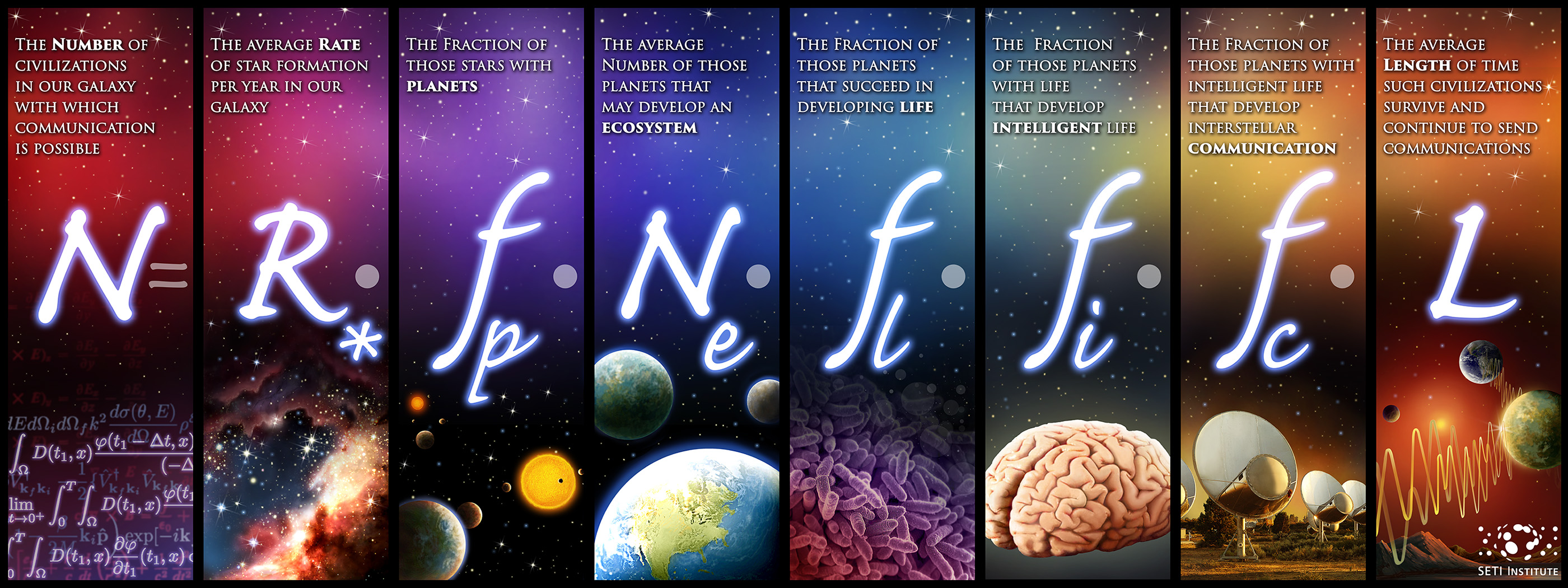
(Click pic to enlarge in new window.) Some recommend the Drake Equation to calculate odds that intelligent life which can communicate across space might exist elsewhere in the Milky Way Galaxy where our solar system is located.

Of the 166 moons and nine planets in the solar system, probes have managed to land on only five: Venus, Mars, Jupiter, Earth’s moon, and Titan (a moon of Saturn).

Just three moons are located in the Goldilocks zone where most scientists believe life has the best chance to take hold. Two orbit Mars at the outer edge of the habitable zone and are probably too cold and irradiated for life. The third moon orbits Earth.


solar system moons 1
(Click pic to enlarge.) Each column contains the orbiting moons of each planet (and a few other objects) inside the solar system.

Six moons in the solar system are comparable in size to the moon of Earth: Ganymede, Titan, Callisto, Io, Europa and Triton.  All the rest are tiny with very little gravity — the force that can hold an atmosphere. 

The twelfth largest rocky object in the solar system after Earth is Titania of Uranus, named for the Queen of the Fairies in Shakespeare’s Midsummer Night’s Dream. The moon is nearly a thousand miles in diameter. A 175 pound person on Titania takes on the weight of a newborn baby — a mere six pounds twelve ounces. 

Few places in the solar system have enough gravity to hold a human securely, let alone an atmosphere. 

No life has been found on any moon — or on any planet (except Earth) thus far. During the next several hundred years, humans will continue to look for life in the solar system should technology and civilization survive and  advance.

The Kuiper Belt — which starts at Neptune and extends past Pluto — is a region that is home to an estimated 100,000 bodies of frozen methane, ammonia, and water.

Editors’ Note: (August 2016) The explorer spacecraft, New Horizonsflew by Pluto on July 14, 2016; it will fly by a Kuiper Belt object in January 2019.  

Freeman Dyson — physicist, mathematician, and astronomer — has suggested that life might be pervasive in the Kuiper Belt and be easily detected once spacecraft get there. People wait and wonder.

Editors’ Note: (December 2018) Current analyses of data from the Pluto flyby describe a living, dynamic planet with a nitrogen atmosphere and a subsurface ocean. Portions of the surface are smooth with no signs of meteor impacts. Water-gushing volcanoes are  common. 

The solar system lies within a large disc-shaped galaxy called the Milky Way, which folks can see edge-on in the night sky should they travel out into the countryside away from well-lit cities, which tend to wash out vision.

It might surprise some readers to learn that no one really knows how many stars are in our galaxy. Credible astronomers believe the number to be somewhere between one-hundred and four-hundred billion — a huge range of uncertainty.

No one knows how many stars are similar to the sun. No one knows how many planets there are, or how many moons. Despite a lot of reporting and speculation, humans know almost nothing about the Milky Way.  

Space is vast, and astronomers have few telescopes and satellites to accomplish the enormous job of taking it all in and cataloguing what they discover.


galaxy 4 Earth's night sky 3.75 billion years from now
3.75 billion years from now, the Andromeda galaxy will collide with our own Milky Way. In this artist’s conception, Andromeda Galaxy is on the left; the Milky Way Galaxy is to the right.

Lack of knowledge about the details of our own galaxy helps to explain why it is difficult to understand the universe as a whole. When I first published this essay in late summer 2014, astronomers estimated that between a hundred and two-hundred billion galaxies populated the visible universe (the estimate is now known to be wrong).

Editor’s Note: On October 1, 2017 CBS News was among the first to report to the public that the Hubble space telescope had detected as many as two trillion galaxies — ten times more than previous estimates.

Two-trillion galaxies — and all the other objects in the universe that lie outside the local area of our own galaxy —are far away and too fuzzy for astronomers to know almost anything about them. The galaxies are out there, true, but the numbers are staggering. The small amount of data astronomers have already gathered is overwhelming scientists’ abilities to process and make sense of it all. And they are just getting started.


The Webb Telescope is scheduled for launch on 30 March 2021. Image is an artist’s rendition featured on Wikipedia. 

Civilization is in the very first stages of placing sensors into space which eventually will help astronomers to learn more. One — the James Webb space telescope — is scheduled to launch sometime during the 2020s. Its purpose? — to tear down the 400-million-light-years-after-the-Big-Bang limit of the Hubble telescope.

Humans are going to be able to look back to the beginning of time, at long last. Understanding the process that brought us here is going to expand dramatically. Until then, the Drake equation (see illustration at beginning of the essay) and other speculative tools remain not much more than intriguing diversions.

New sensors like the Webb telescope will upgrade human understanding and bring a new realism that promises to sweep away much of the science-fiction people drink to satiate their thirst for ultimate knowledge.

Most articles, television shows, and movies that purport to portray the universe are (to risk overstating it) kind-of scammy. They seduce a gullible and curious public, which is hungry for answers about the universe that no one yet has.  

The science community has a vested interest in public funding; they tend to go-along with dubious depictions to pander popular support. Claims that astronomers today understand fully the nature of the universe are ludicrous. The universe is vast.  Much of its matter and energy that  scientists believe is “out there” can’t be found — not yet anyway.

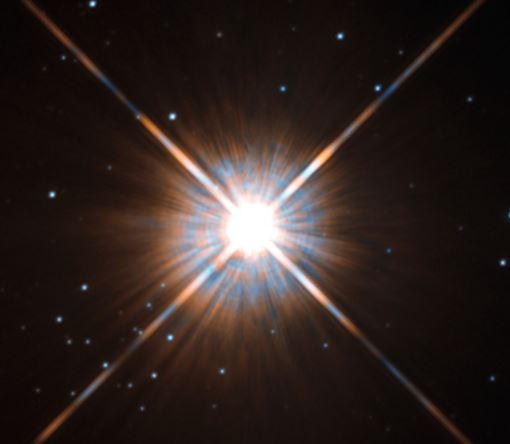
Most stars are too faint to see with unaided eyes. The closest star system to our Sun, Proxima Centauri, is too faint to see without a telescope.

Three out of four stars in the galaxy are probably red dwarfs.  Red dwarfs burn essentially forever but are smaller and much cooler than the Sun, which makes them impossible to observe without special infrared detectors.

These infrared detectors are launched into outer space beyond Earth’s atmosphere to avoid being blinded by the infrared heat radiating off Earth’s surface.


Proxima Centauri main star.  Image by Hubble Telescope.


Red dwarfs seem to be emitting solar flares that are a thousand times more energetic and frequent than those generated by stars like the Sun. They emit light in frequencies not useful for plant photosynthesis — the basic life-support process on Earth.

Worse, red dwarfs are often found in pairs gravitationally bound and rotating around each other. They make stable orbits for third body objects like planets nearly impossible. Without stable orbits lasting billions of years, odds that life evolves to civilization on planets in two-star solar systems is probably zero, some argue.  

It’s difficult to see how Earth-style life could get started and survive to civilization inside red dwarf planetary systems. No one knows what percentage, if any, of red dwarf stars have planets suitable for life.


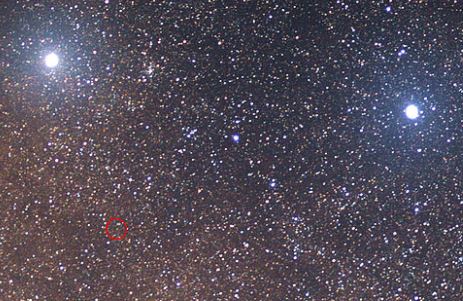
Canon 85mm photo of Proxima Centauri three-star system by Skatebiker on English Wikipedia.

Red dwarfs live for thousands-of-billions of years. The Sun’s lifespan is eight to ten billion years — a tiny fraction of a red dwarf’s.  

The Sun is similar to — who knows? — maybe one in five stars in the galaxy. It’s an optimistic guess, based on sampling and wishful hoping. Astronomers seem to agree that the Sun ranks as one of the largest stars in the Milky Way.

Statistical sampling of two-trillion galaxies argues that the Milky Way galaxy is also among the largest. A full 90% of all galaxies are smaller.

Calculations involving galaxy-motion and gravity suggest that when astronomers look at the cosmos, they aren’t seeing ninety-five percent of what’s out there. Physicists call the missing stuff dark energy and dark matter. Something that no one has yet been able to detect seems to be distorting the rotation of galaxies and disrupting the metrics of space-time.

The universe seems to be expanding, and the expansion is accelerating. Where is the missing mass and energy that drives the expansion? No one knows.

Perhaps parallel universes are stacked on every side against our own. They might swarm like bees around a hive. The gravitational pull of their enormous masses might be pulling our own universe apart. Galaxies inside our universe might be falling toward massive structures that lie outside our field of vision beyond a kind of event horizon. 

Again, no one knows. It’s speculation. Today the expansion is described by a simple constant added into Einstein’s equation for General Relativity. A constant seems too simple, at least for me. It describes but doesn’t explain.


Einstein’s equation accounts for the accelerating expansion of the universe by including a term called the ”cosmological constant”. It is the Greek letter lambda ( Λ), which is multiplied against every member of the metric tensor, ”g” and then added to the left side of the equals sign, which is the side of the equation that describes the shape (curvature) of spacetime. The right side describes the distribution of mass / energy in spacetime.

Many of the galaxies that are visible from Earth are tens-of-thousands of times farther away than the farthest stars in our own galaxy, the Milky Way, which astronomers say is at least 100,000 light years across — a distance of six-hundred-thousand trillion miles. The galaxy is perhaps 200 light years thick, but its center is thicker still — about 10,000 light years.

If the Milky Way was shrunk to the diameter of a ten-inch plate, the plate would assume a thickness of a few human hairs but at the center it would thicken to the size of an egg-yolk.

To put these distances into perspective, the latest space probes, which travel at roughly twelve miles-per-second, are not capable of escaping the gravity of our solar system until they are mechanically slung by multiple encounters with planets to a velocity greater than 27 miles per second.  At that speed, crossing the Milky Way takes nearly 700 million years.


What the Milky Way might look like if photographed by an extremely powerful telescope from the galaxy Andromeda, which is two-and-a-half million light-years from Earth.

The Milky Way is one galaxy in what astronomers have learned is a universe of two trillion.

Until scientists know more — and it could be decades or even centuries from now — prudence and the scientific method advise odds-makers to use the most conservative estimates, not the most optimistic, to speculate about intelligent life in the cosmos.

Until evidence accumulates that is more compelling than what is available today, plugging conservative numbers into the Drake equation, or any other speculative tool, always seems to give the same discouraging result — a number so small it might as well be zero.

No intelligent life that can communicate across space should exist in our galaxy or anywhere else in the universe. None. Yet, here we all are. It’s kind of mysterious, at least to me.

Substituting less conservative numbers yields a different result. Intelligent civilizations could number in the thousands or even millions. No empirical evidence supports such optimism, at least not yet.


Solar System with Sun to scale
Planets and Sun are shown to scale in this model. Distances are not. From left to right, largest to smallest: Jupiter, Saturn, Neptune, Uranus, Earth, Venus, Mars, Mercury, and Pluto.  Pluto — recently demoted to the status of a ‘’dwarf planet” —  has been re-argued for planet-hood by some cosmologists because the recent NASA fly-by showed Pluto slightly larger and more planet-like than previously thought. 

Looking closer to home within our own galaxy, astronomers in 2003 discovered Sedna, which some think is another dwarf-sized planet orbiting far beyond Pluto.

Astronomers seem to discover new planet candidates every other month — Eris and Makemake are two more Pluto-sized objects out of hundreds that come to mind.  

In 2014 Caltech astronomers presented evidence for another planet they called the ninth planet, which might be an object ten times the mass of Earth orbiting in a highly elliptical orbit at the farthest reaches of the solar system.

Regardless of what astronomers continue to discover, it seems likely that the Sun will always contain at least 99% of the mass in the solar system.

Earth is fortunate to orbit a star that is located in a less active region of space than many other stars in the Milky Way. The Sun lies safely between two spiral arms that are bright because of ongoing birthing of new stars. The location lies halfway from the center of the galaxy to its outer edge.


Click pic for better view of Earth’s position inside Milky Way galaxy.

Although stars are spread more or less evenly throughout the Milky Way, life-destroying cosmic events are less likely in regions where stars aren’t being born. Earth lives between bright spirals in a zone of relative inactivity, which has enabled the evolution of eukaryotic one-celled life to progress to intelligence, then civilization, and finally to space exploration over the past billion-and-a-half years.

Earth has a number of unusual features that make it a good candidate for highly evolved life. One important feature is its nearly circular orbit around the Sun, which helps Earth avoid the catastrophic temperature variations characteristic of the more egg-shaped (elliptical) paths of some of the other planets, like Mars.

Only the orbits of Venus and Neptune are more round than Earth’s. Mar’s orbit is five times less round. Of all the solar objects, only Neptune’s moon Triton is known to have for all practical purposes a perfectly circular orbit.

Another advantage for Earth is its 300-mile thick atmosphere of nitrogen and oxygen, 80% of which lies within 10 miles of its surface. Nitrogen and oxygen make up 99% of Earth’s atmosphere. These gases are opaque to non-electrically-charged, high-frequency light.

Nitrogen molecules block high-frequency, ultra-violet light while oxygen molecules, slightly smaller, block higher-frequency (shorter wave-length) x-rays and gamma-rays, which can be lethal to living organisms.

A three-atom form of oxygen molecule known as ozone helps to absorb in the upper atmosphere a dangerous-to-life, lower-frequency-band of ultra-violet light that nitrogen can’t block.

In the distant past — during the Carboniferous Period 300 to 360 million years ago — Earth’s atmosphere held 60% more oxygen than it does now, which provided more shade against damaging high-energy light. Dinosaurs and large insects — like dragonflies with three-foot wing-spans — thrived in the highly-oxygenated air they breathed.

It is one of the wonderful ironies of our planet that the oxygen which empowers the biology of life also defends it against the physics of life-destroying high-energy light and cosmic rays that are always raining down from outer space.


atmosphere
Without atmospheric moisture and greenhouse gases, Earth’s average temperature would fall to 100°F below zero.

In contrast to nitrogen and oxygen, which block high-frequency light from reaching Earth’s surface, carbon-dioxide, methane, and water vapor trap low-frequency light (infra-red light, or heat) and prevent it from radiating (or escaping) into space.

These green-house gases work like a blanket to help keep Earth at a constant temperature. Carbon dioxide, though rare, is heavy compared to oxygen and nitrogen. It tends to cling close to Earth’s surface where it is respirated by plants. Without atmospheric moisture, methane, and carbon dioxide the temperature of Earth would average 100°F below zero and vary widely between day and night as it does on the Moon.

Although water vapor and carbon dioxide make but a tiny fraction of the atmosphere, they have a significant impact on the planet’s ability to retain heat when their concentrations increase in the atmosphere. Exhaust from commercial jet aircraft, believe it or not, contributes greatly to the concentration of carbon dioxide and water vapor in the eight-mile highs of the atmosphere where these jets fly.

After the terrorist attack on 911, the government suspended all flights over the United States — including those by commercial aircraft — for four days. The skies over America cleared themselves of clouds and turned deep blue. Temperatures dropped.

I was amazed to observe these changes develop so quickly after all flying was suspended. It took about two weeks for aviation to return to pre-attack intensity. With the return of aviation, familiar weather patterns followed.

Unlike Earth, the planet Venus has so much carbon dioxide that its surface broils with heat. An explorer would have to hover thirty-seven miles above its surface to experience atmospheric pressures and temperatures similar to those on Earth.

By contrast, the atmosphere of Mars, though almost entirely carbon dioxide, is thin — only 1% as thick as Earth’s. Even so, near their surfaces the density of carbon dioxide is 15 times higher on Mars than on Earth — enough to grow plants and — if poisons in the soil can be avoided — terraform the surface should humans decide.

Although Mars is cold, especially at night, its carbon dioxide atmosphere enables daytime temperatures to sometimes reach 85° F during summer in its southern latitudes. The problem is that any plants that might grow in Martian soil must endure bombardment by dangerous-to-life high-frequency light and cosmic particles.  Also, Martian soils are poisoned by perchlorates. The soil is useless for agriculture though perchlorates could be broken down to provide a source of oxygen. 

I should mention argon, which is 1% of Earth’s atmosphere. It is formed by the radioactive decay of a rare isotope of potassium in Earth’s crust. It is transparent to infra-red heat, so it has no effect on global warming. It is heavy — like carbon dioxide — so it clings to the surface, but its small atoms, widely spaced, do little to prevent the escape of infra-red radiation.

Another asset that gives Earth an advantage for life is its large moon whose gravitational field acts like a vacuum cleaner to suck up cosmic-debris like asteroids and comets that might threaten to strike. Only Jupiter, Saturn and Neptune are similarly equipped.


Image courtesy of NASA

The moon stabilizes Earth’s tilt as it orbits the sun.  The tilt is about 23.4°, which is why Earth has seasons. The tilt swings back and forth a few degrees over periods of 41,000 years. This variation is stable enough to permit life to survive and evolve despite the periodic generation of ice-ages.

Computer simulations of a moonless Earth show that with no moon to stabilize it, tilt variations could approach 90°. Dramatic destabilization has emerged in some simulations that make it difficult to imagine how advanced life could evolve and survive the climate extremes that might result from chaotic wobbling.

The Moon is receding away from Earth at a rate of almost two inches per year. It will take at least a billion years for the motion of Earth to destabilize. It seems that humans have time to figure something out.

Sadly, the sun gets brighter and less massive with each passing day. Over the course of a billion years, Earth will move farther from the sun to conserve its angular momentum. Meanwhile, the warming sun will overtake Earth’s great escape to evaporate its oceans and make the planet uninhabitable. 

Looking at coming events from a more optimistic perspective, people can probably agree that a billion years is a long time. The species-human is likely to be extinct by then anyhow. So why worry?! 

Another life-enhancing feature of Earth is its large, open, ice-free, salt-water oceans. Most scientists believe salt-water oceans provide safe habitat for evolving life.

Earth’s oceans make up three-fourths of the planet’s surface. In addition to providing a vast incubator for life, oceans reduce the probability that space-debris will fall onto land.

Odds are that debris will fall into the oceans where it is rapidly cooled and rendered harmless. Should debris strike land and throw up clouds of dust and ash to block the sun, the oceans provide a safety-blanket of thermal protection.


Titan surface photo Huygens_surface_color_sr
This photo of Titan’s surface is the only picture taken at the surface of a moon or planet that is farther away than Mars.

Besides Earth, only Titan — one of Saturn’s many moons — has open oceans (of liquid methane and ethane) on its surface. These oceans are more like shallow seas or lakes, estimated to be about five-hundred feet deep. Scientists think Titan has a salty sub-surface water ocean, as well.

NASA reported this year that another moon of Saturn, tiny Enceladus (310 miles in diameter), holds a six mile deep subsurface ocean — confirmed from Cassini fly-bys. Its over one-hundred geysers are what is populating Saturn’s E-ring. Data from the geysers indicate that the ocean is warm and salty and saturated with organic molecules. Analysis by Cassini instruments is on-going.

Of the moons of Jupiter, only Europa, Ganymede, and Calisto are thought to harbor salt-water oceans.

Europa is known to have a salt-water ocean, but it is covered by miles-thick ice.

Ganymede, the largest moon in the solar system, is believed to have a 500 mile deep salt-water ocean that lies beneath a crust 125 miles thick. The crust is thought to be a rock and ice mixture.

Scientists suspect that Callisto has a salt-water ocean, but it might be sandwiched between ice layers sixty or more miles beneath its surface.

Only the oceans of Earth are open, un-frozen, and deep enough (averaging three miles) to protect Earth against most encounters with meteors and other space-debris.

Fortunately for Earth, the solar system itself contains a massive structure that helps to protect and shield it from danger. It is Jupiter, the large and strongly gravitational planet, which like the moon pulls away space-debris that might otherwise zoom toward Earth to imperil all life. Observations suggest that comets strike Jupiter every couple of years. Comets that don’t strike are gravitationally deflected out of the solar system more often than not.

Another fortunate feature: Earth has, geologists say, a molten iron-core that emits a strong magnetic field to deflect life-destroying, electrically-charged cosmic particles, that have energies, some of them, approaching those of baseballs traveling sixty miles-per-hour.  Cosmic particles accelerated  the process of ripping away Mar’s atmosphere. Without a magnetic field the Mars atmosphere is defenseless against cosmic erosion. 

As for Earth, high energy particles that do manage to blast through it’s magnetic shield (magnetosphere) are often scattered and rendered harmless — fortunately — by collisions with the oxygen molecules in Earth’s dense atmosphere.

One exception is muons, which are byproducts of particle collisions high in Earth’s atmosphere that are energetic enough to burrow down to hundreds of yards beneath Earth’s land surfaces and oceans. In rare heavy bombardments at high altitudes, muons can increase risks of cancer and cataracts to pilots and their passengers. Muons are like electrons except that they are 207 times heavier and much shorter-lived.


Sun’s solar wind deflected by Earth’s magnetosphere. NASA art. 

The magnetosphere is strong enough to deflect the solar wind, which can strip away all or part of the atmosphere of any planet that lacks one (like Mars).

The magnetosphere is effective and strong, because it is huge and surrounds Earth out to five Earth-diameters on the side facing the sun; one-hundred Earth-diameters on the side opposite. In any small area of space, though, a simple bar-magnet is fifty times stronger.

The solar wind isn’t all bad. As it radiates outward from our Sun, it forms a huge magnetic bubble called the heliosphere that extends 3.5 billion miles past the Kuiper Belt

Inside this Sun Bubble the rest of the solar system is protected from massive cosmic particles that pour in from the two trillion galaxies of stars that make the universe. The Sun bubble deflects to shade our solar system in relative safety.

The heliosphere of the Sun works together with the magnetosphere of Earth and its oxygenated atmosphere to break up and knock away the vast majority of cosmic particles (high-speed protons and atomic nuclei) that would otherwise rip Earth-life to shreds.

Absent the magnetosphere, life could evolve safely only in the deep oceans or far below the surface of Earth. Stated differently: a strong, protective magnetic field is essential for the survival of surface life on any planet.

Large solar flares are known to have enough energy to kill exposed astronauts. It’s one of many reasons NASA doesn’t send people to Mars, which lacks a magnetosphere. Mars is under relentless bombardment of atomic particles that can damage the atoms and molecules in the cells of a human body.

All planets have magnetic fields of various strengths except Venus and Mars. The iron in the core of Mars is believed to have frozen solid, or nearly so, hundreds of millions of years ago, which helped force its protective magnetic field to collapse.

Venus retains its molten iron-nickel core, but the planet lacks tectonic action in its crust. The heat of its core can’t escape through its surface, which prevents in its molten center the emergence of the turbulence essential to make a planetary dynamo of sufficient power to rev-up a magnetosphere.  

It’s a shame that both Mars and Venus lack magnetospheres, because both planets have attributes that might otherwise make them good candidates for life.

Earth’s core is huge — it rivals the entire planet of Mars in size. The inner third of the core — the center — is already frozen solid. It is believed to be pure iron. The core is freezing itself solid from the inside out.

The rest of the core is hot liquid iron and nickle, mostly, with some sulfur and other impurities mixed in. It circulates in complex eddies, which generate the magnetic fields that protect Earth by deflecting the solar wind.

The flow of currents in the molten metal is made stable and more reliable by the unusual plate tectonics peculiar to Earth. Gaps in Earth’s crustal plates allow heat to escape from volcanic valves, which help to maintain a controlled  roil in the eddy currents to produce the dynamo that drives its magnetosphere. 

The only moon known to have a magnetic field is Jupiter’s Ganymede. Jupiter itself harbors a field fourteen times more powerful than Earth’s. The giant planet’s four largest moons orbit inside it, where they are protected from the solar-wind and low frequency (low-energy) cosmic particles. By contrast, Mercury’s magnetic field is one-hundred times less powerful than Earth’s.


ice age earth
 Artist’s rendering of an ice age.

Despite these several advantages for sustained evolution of life, Earth has the apparent disadvantage of a volatile climate which, scientists believe, has turned cold and icy during several extended periods. I mention this volatility to remind people that the circumstances that have enabled life to advance to the technological civilization of today are complex and not obvious.

Until scientists are able to tease out of history what is actually important and significant for the development of advanced life, no one can know what the rest of the universe may have in store — unless we travel out into space and explore it.


I want to believe: we will find the way.

Here’s the problem. The closest stars to the Sun are twenty-five trillion miles away. To escape the solar system, engineers must build spacecraft that can accelerate to 27 miles per second. At that speed the nearest stars, Proxima Centauri, and the binary star system, Alpha Centauri, are 30,000 years distant.

How are humans going to explore the universe? How are we going to answer the questions about our place in the cosmos, when we can’t travel to the nearest stars?

There are trillions of stars, most of them many millions of times farther away than these, our closest neighbors. It seems hopeless that anyone will ever know the answers to the basic questions about the universe that so many are asking.

Still, in my heart of hearts, I want to believe we will find a way.

Billy Lee


Editors Note: November 2017; NASA announced that the latest count of galaxies might be as high as two trillion. The velocity required by spacecraft to escape the Milky Way galaxy from Earth (our planet is 25,000 light years from the galaxy center) is 342 miles-per-second. At this velocity the nearest galaxy — Andromeda — is a flight of 2.28 billion years. There are two-trillion galaxies more!

It doesn’t really matter. Here’s why:


The Parker Solar Probe scheduled for launch in 2018 will require seven gravity-assists from Venus over a period of six years to reach a velocity of 120 miles-per-second before it embarks on a 2024 suicide mission into the outer atmosphere of the Sun.

Venus and the Sun combined can’t accelerate the Parker Solar Probe to the galaxy-escape velocity of 342 miles-per-second. 

Minus gravity-assists, the fastest vehicles in development today by space-flight engineers will accelerate to speeds less than 27 miles-per-second — the escape velocity required to exit the solar-system. Without gravity assists that take years to rev-up, we humans can’t leave our own solar system, which is arguably the tiniest imaginable fraction of the Milky Way galaxy.

The good news is that life-forms in far-away solar systems face the same obstacles. If they are hostile, humans can be assured that they will have a difficult time getting here.  

The bad news is that humans are trapped. The Milky Way Galaxy is a prison. We can’t escape, at least not yet; most likely, not ever.  The escape velocity of the Milky Way Galaxy from Earth exceeds 340 miles-per-second — nearly three times the velocity that the Parker Solar Probe will be traveling when it is finally able to bury itself inside the Sun.