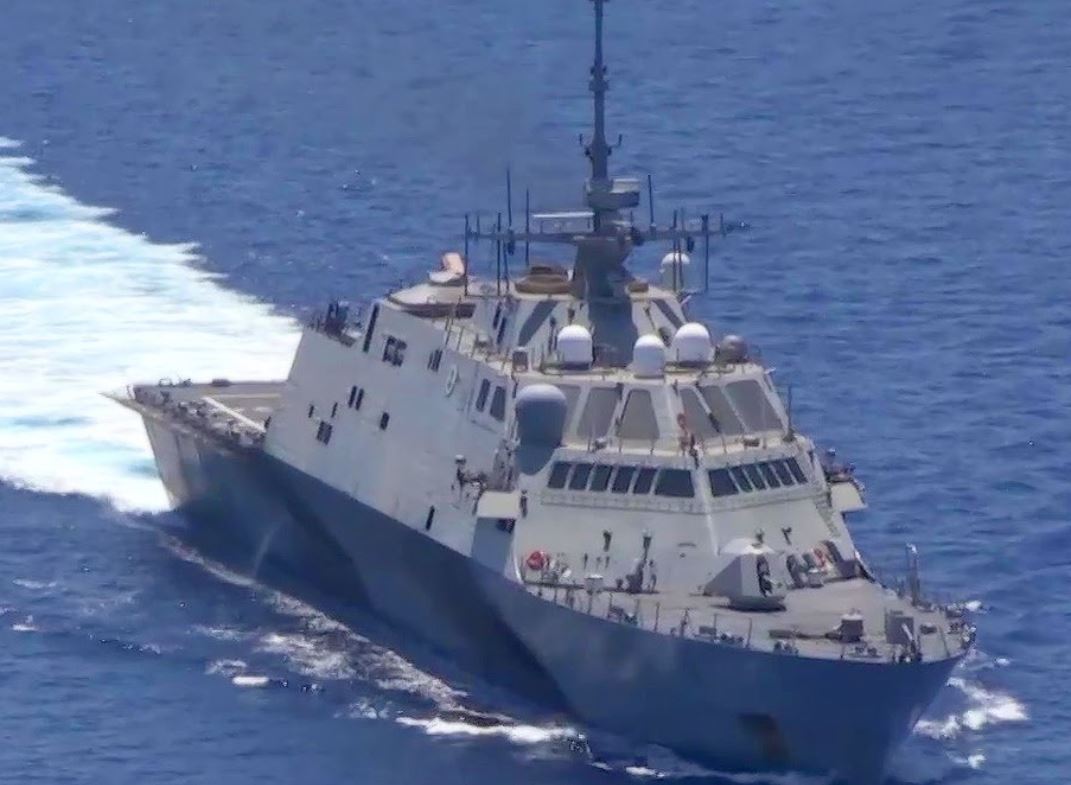

UPDATE BY THE EDITORS: 5 AUGUST 2021; The Associated Press reported yesterday the following: A prospective Russian hypersonic missile has been successfully test-fired from a nuclear submarine for the first time, the military said Monday. The Russian Defense Ministry said that the Severodvinsk submarine performed two launches of the Zircon cruise missile at mock targets in the Barents Sea.
Editors Note: The January 16, 2018 edition of the New York Times reports that five Naval officers are being charged with negligent homicide related to the incidents described in this essay where seventeen sailors lost their lives, others were injured, and ships were damaged. The decision to take these officers to trial or court-martial is imminent.
The United States Navy insists that it has 277 ships on active-duty. About 132 are combat surface vessels; 75 or so are submarines. About 70 are logistical craft designed to supply the fleet.
Do the math. 132 surface ships patrol the oceans. Yes, the Navy says they have a fleet of 160 or so non-commissioned ships held in reserve, but they are unavailable and ineffective during first strike scenarios.
The New York Times agrees with the Navy. Everyone agrees — we have 277 ships. I hope the Navy and the New York Times are lying, because if they aren’t, we are in big trouble. We don’t have enough boats.
132 surface ships can’t control the Great Lakes, let alone the world’s seven oceans. Submarines, everyone knows, are almost useless except when used for nuclear deterrence.

The Navy’s Seventh Fleet is headquartered in Yokosuka, Japan. The fleet is responsible to cover 48 million square miles — from Japan to South Korea to Singapore, unless the faraway reaches of the South China Sea are included; then the square miles are too confusing for anyone to compute.
China claims the whole of the South China Sea as its sovereign territory, including all reefs, atolls, and islands.
How many ships bear the awesome duty to keep the sea-lanes open and safe from pirates and hostile powers like North Korea? The Navy says, 70. The USA deploys one aircraft carrier and 69 ships.
Some news outlets have reported that an additional carrier group has been sent into the Sea of Japan to augment the current force configuration. A typical carrier strike group consists of eleven vessels, two of which are submarines. So, the total on the date of this essay might be as high as 81.

Sorry, but someone is ordering our sailors to do an impossible job. The job is too big, the resources are too thin, and guess what?
A flotilla of 81 vessels scurrying about the South China Sea to keep a lid on China, which is seizing islands that belong to Vietnam, Taiwan, and the Philippines as they build and fortify new ones wherever they want is more than enough problems to exhaust any navy. People get tired. Accidents happen.
We have 70 ships in theater, the Navy says. We probably have 81. What does the other side have?
Well, we don’t really know. They lie. So do we. But we and they both watch; and we and they both spy and calculate.
Hillary Clinton — once upon a time (anyone remember?) she had the security-clearance to know — during a 2016 presidential debate let slip that Russian drone submarines are patrolling our coasts. These are cheap subs that sail apparently with no crews on board.
She said it once. Her assertion was never repeated in the press or public media. Everyone pretended they didn’t hear, for good reason. The number and types of ships in the Russian and Chinese fleets that are arrayed against our tiny arsenal of boats are state secrets. It’s all classified — out of reach of everyone except those with a clearance and a need to know.
It seems clear to more than a few casual observers of Chinese shipping that the Chinese are building the most high-tech navy the world has ever seen. They have been building it for a few decades now.
The Chinese have practiced their sea-going skills in coordination with the Russian navy since 2012. Last year the Russians and Chinese held joint naval exercises in the South China Sea, of all places. Joint land-based military exercises started in 2007.
China is selling its naval technologies and hardware to smaller countries that don’t normally threaten us. Thailand is buying Chinese subs. With military hi-tech weapons spread among a dozen or more countries in secret alliances with China… well… if it’s happening more than we know, does anyone think it’s good for our side?
But really, what would any reasonable person suspect are the forces arrayed against us? Look around. Hundreds-of-thousands of Russians live on the island of Cuba ninety miles from the United States.

Go on Google Earth and look at the Cuban neighborhoods. Some nice ones have Russian street names. It’s true. The Russians have a number of wonderfully designed, modern military bases for both subs and ships; and — oh yeah — they have fighter jets and missiles, as well.
Does anyone disagree? Go look.
Am I trying to scare people?
Doesn’t the public have enough to fear? Isn’t terrorism, immigration, climate change, distant war, disease, and precarious health care that could collapse now that the GOP is in charge enough to worry about? Of course it is.

Besides, our country has thousands of nuclear weapons buried hundreds of feet below the cornfields and deserts of the heartland to extinguish any threats, should we lose our Navy. Until the missiles rot and their plutonium payloads leech into our soils, why worry?
Everyone should sleep well at night, right? Who wants to alarm anyone? I don’t.
Secretary of State Tillerson said we should sleep well, so why not? He knows all about the Russians, having helped them build their oil industry over many decades.
Depending on when anyone takes its measure, Russia’s energy industry is the world’s largest and most productive — bigger than Saudi Arabia’s. People don’t believe it, but it’s true.
Russia is the world’s biggest oil and natural gas producer and exporter. Secretary Tillerson must know what he’s talking about, right?
Well, here is some stuff that is not so comforting. It might scare some people. Between 1975 and 2016 (41 years) our Navy experienced nine accidents, mostly between our own ships. Only two accidents involved the boats of foreign countries. That’s not bad. That’s not the scary part. But hear me out.

In 2001 a Japanese fishing-training boat, the Ehime Maru, with thirty-five Japanese citizens aboard, was obliterated near the Hawaiian island of Oahu when the commanding officer of one of our attack submarines allegedly hot-dogged the craft for civilian joy-riders.
Our new president, George W. Bush, went on national TV to apologize to the Japanese, and the United States paid huge fines and compensation to the Japanese government and the grieving families of the nine who died, which included four high school students.
In 2004, the aircraft carrier U.S.S. John F. Kennedy ran over an Arab sailboat in the Persian Gulf. 15 people died, but the Navy didn’t identify who they were it seems, and no one was compensated, as far as I know. Two jet fighters parked on deck were damaged. The Navy relieved the commanding officer.

The most serious accident was in 1975 when the same U.S.S. John F. Kennedy hit one of our own guided-missile cruisers, the USS Belknap, off the island of Sicily. The Belknap was completely destroyed; seven sailors died.
A fire burned on the Belknap for twenty hours just a few yards from the magazine where Terrier surface-to-air missiles were stored. The ship was constructed with aluminum, which caught fire. The entire above deck structure melted. It took nearly five years to reconstruct the ruined cruiser. In 1995, the Navy struck it from the Naval Registry and began using it for target practice. They sunk it during a live-fire exercise in 1998.
A year after the Belknap accident, the USS John F. Kennedy collided with another ship, this time the aging USS Bordelon destroyer during a refueling. The Navy struck the ship from its registry and sold it to Iran for parts in 1977. No one died.
So, during the forty-one years between 1975 and 2016, the US Navy had nine peacetime accidents, seven of which were friendly-fire and self-inflicted. 24 foreign nationals died; 7 U.S. sailors; 1 U.S. civilian. Ship losses: one cruiser and one obsolete destroyer. Maybe other losses occurred. I haven’t heard about them, if there were any.

And now comes the scary part; hold onto your pants: In the seven months since the inauguration of our comb-over commander-in-chief (and keeper of nuclear codes), the U.S. Navy has suffered four major accidents, which killed 17 sailors and injured scores more.
It’s lost two of its most powerful missile-guided destroyers — the U.S.S. Fitzgerald and the U.S.S. John S. McCain. It might be years before they are back in service. Readers can read about the fates of the USS Antietam and the USS Lake Chaplain in the links below.
At least two dozen sailors and officers have been disciplined, including a Vice-Admiral, a Commander, and a Lieutenant Commander. Admiral John Richardson, chief of Naval operations, has ordered an “operational pause” to all fleet commanders. He’s ordered a months-long review of protocols, because, he says, “there’s something out there that we’re not getting at.”
All this commotion is happening during a time when we’re planning to conduct war games against North Korea and are daily challenging the Chinese in the South China Sea.
Can I put things into perspective? If the accident rate of the past seven months was applied to the past forty-one years, the U.S. Navy would be short another 85 ships and 800 sailors. Thousands more young men and women would be maimed and wounded, and 250 promising Naval careers would be wrecked.
In peacetime, essentially, the U.S. Navy might have lost one-third of its fleet and some of its best sailors and officers at a cost of hundreds of billions of dollars.

Here are a few of the headlines from our country’s newspaper of record, the New York Times. All headlines are from articles written in 2017. I’ve read every single one of them. Readers can access their content by clicking on the links. The remainder of my essay is written below these headlines:
China and Russia Hold First Joint Naval Drill in the Baltic Sea
Naval Collision Adds to Fears About U.S. Decline in Asia
After U.S. Destroyer Collision, Chinese Paper Says U.S. Navy a Hazard
Filipino Officials: Chinese Navy Stalked Philippine Area
4 Accidents, 2 Deadly, Raise Questions About Navy Operations
USS Lake Champlain Collision at Sea
Bodies of Several Sailors Are Found Aboard Damaged U.S. Destroyer
Sleeping Sailors on U.S.S. Fitzgerald Awoke to a Calamity at Sea
Japan Says Deadly Ship Collision Happened Earlier Than Reported
Maritime Mystery: Why a U.S. Destroyer Failed to Dodge a Cargo Ship
Navy Ship in Collision Named for McCain’s Dad, Grandfather
Previous Collisions Involving U.S. Navy Vessels
After Dangerous Collisions, Navy Will Pause for Safety Check
U.S. Admiral Says Remains Found Inside Damaged Destroyer
Commander of Naval Fleet Relieved of Duty After Collisions
Top Two Officers on Navy Ship in Deadly Collision Off Japan Are Relieved of Duties
10 Missing After U.S. Navy Ship and Oil Tanker Collide Off Singapore
Navy Dismisses 7th Fleet Commander After Warship Accidents
Mississippi Shipyard to Fix Destroyer Hit in June Collision
U.S. Navy Relieves Seventh Fleet Commander in Wake of Collisions in Asia
Wreckage of U.S.S. Indianapolis, Lost for 72 Years, Is Found in the Pacific*
*Some readers may have noticed that the last headline seems to have no connection whatsoever to this essay. But they would be wrong.
Recall that the battleship USS Indianapolis was the fiercest war machine we had during World War II in the Pacific. We used that ship to deliver the atomic bomb Little Boy (dropped on Hiroshima) to Tinian Island in the western Pacific Ocean sometime during July, 1945. It would be assembled and delivered to the Japanese people with terrifying effect on August 15.
From Tinian the Navy ordered the Indianapolis to advance to Leyte Island in the Philippines to prepare for an all-out assault and invasion of Japan scheduled to follow the atomic blasts that were soon to occur.
On July 30 the lumbering battleship encountered a Japanese submarine which delivered six torpedoes in the wee hours of the night. The sub commander later said that the clouds parted, which permitted the Indianapolis to be silhouetted by moon-light. It made targeting easy. Two torpedo struck the Indianapolis.
The ammunition on board caught fire and blew-off the front quarter. It took twelve minutes for the battleship to sink below the surface. The ship sucked four hundred men to the bottom and left behind an oil slick that would sicken and blind many of the nearly one-thousand sailors and marines who survived to face death by dehydration, drowning, and sharks.

The Navy didn’t notice that their prized battleship was missing. After five days of vomiting, diarrhea, hallucinations, and shark attacks, three hundred men were still alive (some in lifeboats, including the Commanding Officer) when an aircraft on an unrelated mission saw something suspicious and flew down to take a closer look.
Twenty-two men who were pulled from the water remain alive today. The Navy court-martialed the commander, Captain McVay, and convicted him for not zig-zagging as he sailed. The Japanese sub-commander testified that zig-zagging would not have mattered. The Indianapolis was going to the floor of the ocean, in any event, he insisted. Nothing could have stopped what happened.
Losing a ship, even in war, is a big deal in the Navy. It’s not something that anyone takes lightly, even when there are extenuating circumstances and good reasons for failure. Captain McVay committed suicide in 1968—clutching a toy sailor in one hand and his service revolver in the other.
The Navy has a history of not being able to keep track of its ships. The earth’s oceans are vast, and we don’t have that many boats on them. Hiding ships from our enemies means we sometimes hide them from ourselves.
Civilian boats are another matter. Merchant fleets deploy 51,405 ships on our oceans. Most of them are bigger and longer and heavier than our 277 Navy ships. Almost all run on auto-pilot most of the time, especially at night when the crews sleep. If the computer directs the tanker to ram a boat like the Fitzgerald, that’s what is going to happen. In collisions, chances are Navy ships will lose.
Collision avoidance should be easy. Crews need only have situational awareness and the ability to steer the boat. The problem is that to perform these tasks crews rely on a complicated matrix of technologies that always seem to fail in critical situations like combat or rule violations by other boats.
These technologies should be used to confirm human observation and decisions; instead sailors confirm what the technology tells them, but only when something goes wrong, which is almost always too late. An alarm sounds and a glance at a computer screen shows that a tanker is 500 meters to starboard, so a crew member looks out a window to see if it’s there. No! That’s bassackwards and will get someone killed.
Officers might better demonstrate proficiency in the absence of high-tech aids for situational awareness and steering, then add high-tech proficiencies one skill-set at a time. Maybe they wear merit badges to enable COs to tell at a glance who can handle hydraulic controls and who is good at computer-aided navigation, for example.
Every officer doesn’t have to master every skill-set, and the least skilled officer should be able to turn off the high-tech systems they haven’t mastered in order to steer the boat and stop it using the skills they do have, when necessary.
Laser distance finders (like those used by golfers) and wide-field-of-view night vision binoculars should be standard issue. A half dozen or more sailors should be stationed around the perimeter of every boat and be required to report what they see or don’t see every five minutes or so. No snoozing!

Anyway, one thing about the four accidents this year (January 31, the USS Antietam; May 9, the USS Lake Champlain; June 17, the USS Fitzgerald; August 20, the USS John S. McCain) bothers me: the destroyer McCain was nearly sunk just two weeks after it challenged the Chinese at a contested atoll named Mischief Reef, which the Chinese have in recent years built-up into a military base.
I have a problem with coincidences that turn out bad for our side. Malevolent intent by an adversary is always possible. Every bridge officer should understand the protocols to avoid intentional (or unintentional) collisions initiated by rogue (or wayward) boats.

Our Navy is a mess. Everyone knows it. The optics of powerful warships limping into port under the power of a dozen or so tugboats emboldens our enemies and demoralizes our patriotic fighting men and women.
We have the wrong ships, designed the wrong way, for the wrong wars, for the wrong reasons. And our Navy is overworked to the max. We all know it’s true. It doesn’t have to be. It’s good to have high-tech systems, but they are useless during a crisis. Everyone must be proficient at low-tech and know how to enable it. Seriously.
Politics and corruption, profiteering and greed, laziness and lack of zeal are going to kill us all if we don’t wake up. It’s time for civilians to step up and defend our way of life. It’s time for corporations and billionaires to do what’s right — not what makes them wealthy at the expense of our country’s defense and the prosperity of our citizens and the people of the world who are looking to us for leadership.
We are going to regret privatizing our military and using contractors instead of citizens to fight our battles. We are going to lose our freedoms and our country if we don’t fight for both. Everyone must do their part. Corruption can have no role in the process.
We must use our power to make the world safer, freer, and better for everyone, not just ourselves. People are sick and tired of “America first.” We have so much, already.
It’s time to share our advantages, with love. If we do what’s right, if we embrace public service and reach out to the disadvantaged in the world (the military, after all, doesn’t have the room or the money for every citizen), we won’t need to kill everyone who hates us like we’ve been doing for hundreds of years.
A year or two of public service by every American in impoverished neighborhoods and blighted communities might make a big difference in the why, how, and who we fight.
Billy Lee