EYE TO EYE

What are complex numbers? What does “i” mean, anyway?  How can a number be “imaginary“?   What does it mean to multiply “i” exactly “i” times?  Why is math hard?

For me, math is difficult because it’s interesting.  I learn things from equations that aren’t obvious when I think about the world using words and images. Some things can’t be put into words. Some things can’t be pictured.

It’s true.

What makes i^i interesting is the four real numbers it generates. (The numbers are +.2078… , -.2078… , +4.8104… , and -4.8104… .)

Can anyone give a geometric reason why an imaginary number raised to the power of an imaginary number generates four real numbers and no imaginary ones?

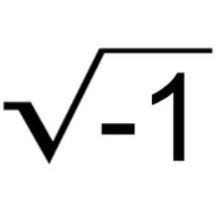
What does \sqrt{-1}^{\sqrt{-1}} even mean? Is there anyone who can visualize a reason why the answers make sense? Are all the answers even correct? Or is only one correct, as any calculator that can do the calculation will tell?


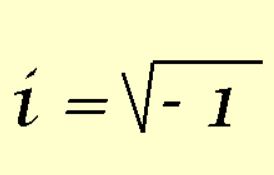
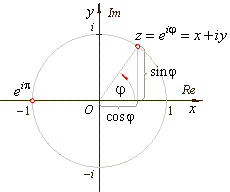
Complex numbers are two-dimensional numbers that are made by raising the number ”e” to the power of an imaginary number — called ”i” — times an angle in radians. Complex numbers lie on a circle in the complex number plane. Unless ”e” is preceded by a number that stretches or shrinks it, the numbers always lie on a unit circle like the one in the picture. Recall that ”i” is the square root of minus one. When ”i” is raised to the power of ”i”, the result collapses onto the real number line — in one of four possible places. Which one? The numbers don’t land on the unit circle. The process can be demonstrated mathematically, but any physical intuition about why imaginary numbers with imaginary exponents behave the way they do can be elusive.

Abstract math that hides no model that anyone can visualize makes results startling, even unnerving. It’s a lot like the quantum mechanics of entanglement or the physical meaning of gravity. They can be mathematically described and their effects accurately predicted, but no one can explain why.   

Mathematics alone can sometimes describe (or at least approximate) realities of the universe and how it seems to work, but as often as not when humans dive deep into the abyss of ultimate knowledge, math is unable to provide a picture that anyone can understand. 

How can that be? Things seem to happen that cannot be thought about except by playing around with numbers and being taken by surprise. Intuition is difficult, if not impossible.

Here is the solution of  i^i. Perhaps clues exist in the math that I’ve overlooked. If a model exists in the mind of a reader somewhere, I hope they will share it with me.


(1)       i^i = e^{\ln(i^i)} = e^{i\ln(i)} = cos (ln i) + i sin (ln i)

By definition:  e^{i\frac{\pi}{2}} = i

Also:  ln {(e^{i\frac{\pi}{2}})} = ln i

Therefore:     ln i =  i (\frac{\pi}{2})

It should now be obvious to anyone who has taken a basic course in complex variables that multiplying i (\frac{\pi}{2}) by i equals the exponent on e in line (1).

Right?

It’s a real number that returns a real result when used as the exponent of e and plugged into a calculator.  The answer is completely abstract, though. We might learn more if we take a different path to the result.   

By substitution into line (1):    i^i = cos (i\frac{\pi}{2}) + i sin (i\frac{\pi}{2})

By half angle formulas:             i^i  = (\sqrt\frac{1 + cos (i\pi)}{2}) + i (\sqrt\frac{1 - cos (i\pi)}{2})

Convert 2nd term i to  \sqrt -1 :

i^i  = (\sqrt\frac{1 + cos (i\pi)}{2}) + \sqrt -1 (\sqrt\frac{1 - cos (i\pi)}{2})

(2)     Simplify the 2nd term:     i^i  = (\sqrt\frac{1 + cos (i\pi)}{2}) + (\sqrt\frac{cos (i\pi)-1}{2})

Euler’s cosine identity is:   cos θ =  \frac{e^{i\theta} + e^{-i\theta}}{2}

Therefore:                          cos (iπ) =  \frac{e^{i(i\pi)} + e^{-i(i\pi)}}{2}

(3)     Simplifying:               cos (iπ) =  \frac{e^{-\pi} + e^{\pi}}{2}

Substitute line (3) into line (2) and simplify:

i^i  = \sqrt{{\frac{1}{2} + \frac{e^{-\pi} + e^{\pi}}{4}}} + \sqrt{{\frac{e^{-\pi} + e^{\pi}}{4}} - \frac{1}{2}}

Now it’s just a matter of pulling out an old calculator and punching the keys.

e^{-\pi} = .043214;  e^{\pi} = 23.140693. 

I rounded off both numbers, because they seem to go on forever like π and “e”; they prolly are irrational, because they don’t seem able to be formed from ratios of whole numbers. [In fact, they are transcendental numbers, because they transcend algebra. In addition to being irrational, they are not roots of any finite degree polynomial with rational coefficients. Take my word.] Using these numbers will enable anyone to compute {i^i} who has a simple calculator with a square root key.


When square roots are calculated the answers can be positive or negative. Two negatives make a positive, right? So do two positives. So doing the math gives four numbers. See if your numbers match mine: .2078… , -.2078… , 4.1084… , and -4.1084… .

I don’t know why. The answers aren’t intuitive. Who would guess that imaginary numbers raised to powers of imaginary numbers yield real numbers? — not a solitary number like anyone might expect, but four. Pick one. In nature a unique answer can be arbitrary — determined by chance, most likely.

In this case, no.


It feels to me like the imaginary fairies flying around in complex space are destined to collapse onto the real number line for no good reason, except that the math says they must collapse (maybe from exhaustion?) in at least one of four places. Can anyone make sense of it?

The ln i is well known. It is —   i\frac{\pi}{2}  — which equals (1.57078… i ). The ln of —   i^i   — can be rewritten by the rules of logarithms as i ln i, which is i times (1.57078…i ), which equals -1.57078… (a real number).  Right? The ln of the correct answer must equal this number. Only one of the four results listed above has the right ln value: .2078… .

It seems odd that a set of equations I know to be sound should return a set of results from which only one can be validated by back-checking. Maybe there is something esoteric and arcane in the mathematics of logarithms that I missed during my education along the way.

Then again square roots can be messy; there are two square roots in the final equation, each of which can be evaluated as positive or negative. Together they produce four possible answers, but just one result seems to be the right one.

Adding the four numbers is kind of interesting. They sum to zero. That is so like the way the universe seems to work, isn’t it? When everything is added up, physicists like Stephen Hawking claim, there’s really nothing here. Everything is imaginary. Some philosophers agree: everything that is real is at its core imaginary.

Are there clues in the pictures and models of complex number space that would ever make anyone think? Sure, I totally get it. Yeah, I’ve got this. Real numbers cascading out of imaginary powers of imaginary numbers make perfect sense — like snowflakes falling from a dark sky.

A mathematician told me, Rotating and scaling is all it is. The base must be the imaginary ”i” alone; ”i” is the key that unlocks everything. The power of the key can be any imaginary number at all; ”i” is why the result of every imaginary power of ”i” becomes real. 

The explanation calms me; but it seems somehow incomplete; it’s missing something; in my gut I feel like it can’t be entirely right, though it purports to persuade what the math insists is truth

Believe, for now at least, and move on.

Billy Lee
WHAT IS e exp (-i π) ?

What is e^{-i\pi} ?

I posted a long answer on Quora.com where it sort of didn’t do well.

Answers given by others were much shorter but they seemed, at least to me, to lack geometric insights. After two days my answer was ranked as the most read, but for some reason no one upvoted it. It did receive a few positive replies though.

I can’t help but believe that there must be nerds in cyberspace who might enjoy my answer. Why not post it on my blog? Maybe someday one of my grandkids will get interested in math and read it.

Who knows?

Anyway, below is a pic and a working GIF, which should help folks understand better. Anyone who doesn’t understand something can always click on a link for more information. 

Here is the drawing I added and the answer:


This diagram is excellent but contains a mystery point not on the unit circle — {i^i}. The point is shown at .2078… on the real number line.  An imaginary number raised to the power of an imaginary number yields a result that is a real number. How can that be? It’s something to ponder; something to think about. The Editorial Board 

What is e^{-i\pi} ?

The expression evaluates to minus one; the answer is (-1). Why?

Numbers like these are called complex numbers. They are two-dimensional numbers that can be drawn on graph-paper instead of on a one-dimensional number line, like the counting numbers. They are used to analyze wave functions — i.e. phenomenon that are repetitive — like alternating current in the field of electrical engineering, for example.


A simplified explanation of {i^i} starts at 02:30.


“e” is a number that cannot be written as a fraction (or a ratio of whole numbers). It is an irrational number (like π, for instance). It can be approximated by adding up an arbitrary number of terms in a certain infinite series to reach whatever level of precision one wants. To work with “e” in practical problems, it must be rounded off to some convenient number of decimal places.

Punch “e” into a calculator and it returns the value 2.7182…. The beauty of working with “e” is that derivatives and integrals of functions based on exponential powers of “e” are easy to calculate. Both the integral and the derivative of e is ex  — a happy circumstance that makes the number “e” unusually curious and extraordinarily useful in every discipline where calculus is necessary for analysis. 

What is “e” raised to the power of (-iπ) ?


A wonderful feature of the mathematics of complex numbers is that all the values of expressions that involve the number “e” raised to the power of “i” times anything lie on the edge (or perimeter) of a circle of radius 1. This feature makes understanding the expressions easy.

I should mention that any point in the complex plane can be reached by adding a number in front of e^{i\theta} to stretch or shrink the unit circle of values. We aren’t going to go there. In this essay “e” is always preceded by the number “one“, which by convention is never shown.

The number next to the letter “i” is simply the angle in radians where the answer lies on the circle. What is a radian?  It’s the radius of the circle, of course, which in a unit circle is always “one”, right? 

Wrap that distance around the circle starting at the right and working counter-clockwise to the left. Draw a line from the center of the circle at the angle (the number of radius pieces) specified in the exponent of “e” and it will intersect the circle at the value of the expression. What could be easier?

For the particular question we are struggling to answer, the number in the exponent next to “i” is (-π), correct?

“π radians” is 3.14159… radius pieces — or 180° — right? The minus sign is simply a direction indicator that in this case tells us to move clockwise around the unit circle — instead of counter-clockwise were the sign positive.

After drawing a unit circle on graph paper, place your pencil at (1 + 0i)—located at zero radians (or zero degrees) — and trace 180° clockwise around the circle. Remember that the circle’s radius is one and its center is located at zero, which in two dimensional, complex space is (0 + 0i). You will end up at the value (-1 + 0i) on the opposite side of the circle, which is the answer, by the way.

[Trace the diagram several paragraphs above with your finger if you don’t have graph paper and a pencil. No worries.]

Notice that +π radians takes you to the same place as -π radians, right?  Counter clockwise or clockwise, the value you will land on is (-1 + 0i), which is -1. The answer is minus one.

Imagine that the number next to “i” is (π/2) radians (1.57… radius pieces). That’s 90°, agreed? The sign is positive, so trace the circle 90° counter-clockwise. You end at (0 + i), which is straight up. “i” in this case is a distance of one unit upward from the horizontal number line, so write the number as (0 + i) — zero distance in the horizontal direction and “plus one” distance in the “i” (or vertical) direction.

So, the “i” in the exponent of “e” says to “look here” to find the angle where the value of the answer lies on the unit circle; on the other hand, the “i” in the rectangular coordinates of a two-dimensional number like (0 + i) says “look here” to find the vertical distance above or below the horizontal number line.

When evaluating “e” raised to the power of “i” times anything, the angle next to “i”—call it “θ”—can be transformed into rectangular coordinates by using this expression: [cos(θ) + i sin(θ)].

For example: say that the exponent of “e” is i(π/3).  (π/3) radians (1.047… radius pieces) wraps around the circumference to 60°, right? The cosine of 60° is 0.5 and the sine of 60° is .866….

So the value of “e” raised to the power of i(π/3) is by substitution (0.5 + .866… i ). It is a two-dimensional number. And it lies on the unit circle.

The bigger the exponent on “e” the more times someone will have to trace around the circle to land at the answer. But they never leave the circle. The result is always found on the circle between 0 and 2π radians (or 0° and 360°) no matter how large the exponent.

It’s why these expressions involving “e” and “i” are ideal for working with repetitive, sinusoidal (wave-like) phenomenon.


In this essay Billy Lee uses θ in place of the Greek letter φ shown in this GIF.  Remember that ”r” equals ”one” in a unit circle, so it’s typically not shown. The Editorial Board

In case some readers are still wondering about what radians are, let’s review:

A radian is the radius of a circle, which can be lifted and bent to fit perfectly on the edge of the circle. It takes a little more than three radius pieces (3.14159… to be more precise) to wrap from zero degrees to half-way around any circle of any size. This number — 3.14159… — is the number called “π”.   2π radians are a little bit more than six-and-a-quarter radians (radius pieces), which will completely span the perimeter (or circumference) of a circle.

A radian is about 57.3° of arc. Multiply 3.1416 by 57.3° to see how close to 180° it is. I get 180.01… . The result is really close to 180° considering that both numbers are irrational and rounded off to only a few decimal places.

One of the rules of working with complex numbers is this: multiplying any number by “i” rotates that number by 90°. The number “i” is always located at 90° on the unit circle by definition, right? By the rule, multiplying “i” by “i” rotates it another 90° counter-clockwise, which moves it to 180° on the circle.

180° on the unit circle is the point (-1 + 0i), which is minus one, right?

So yes, absolutely, “i” times “i” is equal to -1.  It follows that the square root of minus one must be “i”. Thought of in this way, the square root of a minus one isn’t mysterious.

It is helpful to think of complex numbers as two dimensional numbers with real and imaginary components. There is nothing imaginary, though, about the vertical component of a two-dimensional number.

The people who came up with these numbers thought they were imagining things. The idea that two-dimensional numbers can exist on a plane was too radical at the time for anyone to believe.  Numbers, they believed, only existed on a one-dimensional number line of one dimension and no place else.

Of course they were mistaken.  Numbers can live in two, three, or even more dimensions. They can be as multi-dimensional as needed to solve whatever the mysteries of mathematical analysis might require.

Click the link, “What is Math?” for another explanation.

Billy Lee

ILLUSIONS

I read a report about the lunatic in Las Vegas; he was a multi-millionaire who owned nearly 50 high-powered guns plus a lot of other scary stuff. His dad graced the FBI’s ten most wanted list—ten years a fugitive.

These guns, which many civilians now own, were designed to shatter the bones and scramble the internal organs of victims—violating the spirit of international norms, agreements, and treaties agreed to by all countries before and after World War II. 

These Geneva Convention prohibitions (and others) were crafted to make hollow-point style ammunition illegal. To evade these restrictions, US gun-makers designed weapons to fire high-velocity bullets that tumbled—to inflict crippling injuries with more ferocity than the banned hollow-points.

Billy Lee has never visited Las Vegas nor does he plan to. It was built as a stopover during WWII for GIs on route to the west coast, where they boarded ships to fight their way to Japan. According to legend, criminal syndicates built “Sin City”. People say the bad guys moved out. The president owns a hotel there. The Editorial Board 

During combat officer training in the Vietnam era, I fired one of these weapons (an M16 rifle) at a bucket of water. The bullet went in clean but blew out the back. Shards of metal and water flew everywhere. The container exploded, basically.

Every massacre involving these weapons reaps what we sowed. The USA violated both the spirit of the international consensus and basic common sense nearly six decades ago. Our country put the lethality of heavy weapons into rifles that handled like toys. Weapon manufacturers created bone smashing ammo.

People shot by these guns don’t recover. Survivors carry their wounds to the grave.

Modern high-tech guns and ammunition are inhumane, lethal, and crippling. The military shouldn’t use them; neither should civilians; especially civilians who aren’t properly trained or supervised; some civilian gun owners have an unhealthy obsession with these kill-sticks; some are lunatics.

Flags are set at half-mast across the USA to honor the fallen in the Las Vegas attack. This pic was taken by Billy Lee in a Belle Tire parking lot. The Editorial Board

As for hollow-point ammo, police inside the United States ignore the international prohibitions. Many agencies use black-talon style hollow-points to reduce the penetrating power of tumbling slugs (that can kill bystanders) while dramatically increasing debilitation to the person shot.

Misunderstanding of the second amendment has put four million tumbling-slug killing tools into the hands of ordinary people who have no accountability and who are in some cases insane.

After all these years only God knows where these weapons are. What could possibly go wrong?

Despite being a pontificator who by definition lacks expertise, I don’t generally speculate about things I know nothing about. I really don’t. I try to not think about the hundreds of mass shootings that have taken place during past decades, because it is depressing and demoralizing (and scary) to believe that going to public venues is dangerous.

It’s hard to say who is worse off during these mass-casualty events, the dead or the wounded or those who witness the violence up close and personal. So many people are traumatized for no good reason. I suspect that even viewers of television coverage get a sick feeling in their stomachs when these horrors occur. I know I do.

The recent attack in Las Vegas was strange. A number of active duty U.S. military personnel — recently returned from Afghanistan, plus their wives and partners — attended the Route 91 Harvest country music festival.  Daesh — called ISIS or ISIL in the U.S. — claimed that the shooter, Stephen Paddock, was a contractor who worked for them. He was a kind of highly-paid sleeper mercenary; he did what he was told when his time came apparently. 

His handlers—who may have helped to set up the killing zone—occupied the hotel suite alongside him during the attack. They might have killed him to make it look like suicide and exited the building via a service elevator disguised as hotel workers—maybe. It’s possible.

Another disturbing possibility is that they let the shooter live expecting that he would escape and join them in another attack. He might have been disabled by gas — perhaps injected under the door by police. If so, he is now in custody.

Anything is possible, when conspiracy theories start percolating. The shooter might have been a kind of patsy, like Lee Harvey Oswald claimed to be (for those readers who have convinced themselves that Oswald did not conspire alone).

If the Las Vegas massacre was an ISIS attack (as ISIS claims) it’s not likely that the United States will give the group the satisfaction of an acknowledgment. Disclosure would undermine confidence in law enforcement’s capability to protect the public from terrorist attacks. [Editors Note: As of January 2018 the number of casualties stands at 58 killed and over 500 wounded.]

Agencies will instead work behind the scenes to uncover, debrief, and terminate with extreme prejudice all the players. Justice will be served. It will be methodical and relentless. It could take time — months or even years.

This vehicle is being tested for battle-worthiness.

Most Americans never fully understood the Iraq War that spawned ISIS and filled its ranks with experienced and ruthless fighters; nor have they grasped how powerful is Saddam Hussein’s family, his friends, and his army — once one of the world’s largest and most formidable. I’ve heard people say some dumb things about what all that fighting in the Middle East was about those many years ago.

Before the Iraq War Saddam’s family was one of the world’s wealthiest; they owned a lot of stuff — popular media and franchises, magazines and food networks, even sophisticated enterprises, some with international reach.

Izzat Ibrahim al-Douri, second in command in Saddam’s Iraq and founder of ISIS.

Saddam’s closest advisor and deputy — who President Bush called the King of Clubs — was never apprehended. His name is Izzat Ibrahim al-Douri. Some believe he is the mastermind behind the formation of ISIS.

A few years ago reports appeared in the press that Ibrahim died during an attack on his security detail. But no one saw him die. No one attended his funeral. His body (including DNA evidence of his death) is missing.

Some say that ISIS agents planted these stories of al-Douri’s demise. Ibrahim faked his own death. Saddam’s allies own a significant chunk of the world’s media.

Who knows?

Anyway, my understanding is that ISIS was formed by members of Saddam’s family and loyal remnants of his army who are trying to take back what they lost during the Bush presidency. That’s how many see it, including reporters at Haaretz, an Israeli news organization.

When the USA conquered Iraq, Saddam’s army (and leadership) melted away, but they had billions of dollars stashed in banks, the walls of buildings, and in holes underground. They have not been afraid to spend it.

ISIS travels first class. It has the best of everything, including trucks, cars, weapons, and drones. It captured an astounding amount of USA war fighting machinery in fights with Iraqi Shiites (ISIS is Sunni) after the USA exited Iraq.

Some of the captured equipment included MRAPs (see earlier illustration). It seems unbelievable, but its true. (Note from the Editorial Board: Billy Lee helped design the run-flat wheel that permitted fighting vehicles in the Gulf wars to stay mobile after their tires were shredded, punctured, or shot through.)

Billy Lee helped develop for Chrysler the run-flat technology used by combat vehicles like this one. The Editorial Board

The way I understand the conflict, the Sunnis of Iraq could reasonably be compared in some ways to the southern whites who served the confederacy during America’s Civil War. The Shiites in this analogy would be the negro slaves.

Think about it. After the Iraq War, the downtrodden Shiites (with help from the USA) took control of Iraq from the entitled Sunnis, much like blacks took control of the southern states after the Civil War with help from the north’s military occupation (called Reconstruction).

Southern whites eventually wrested control from their former slaves, but it took twenty years of terrorism by the Ku Klux Klan to make it happen. A similar dynamic is underway in the Middle East today, it seems. The Sunnis are reestablishing their control through terror, for the most part.

Eventually the Sunnis might win — like the Ku Klux Klan won their fight. In the meantime, a lot of innocents are getting hurt and worse.

The territory that ISIS controls in the Middle East is vast. It is comparable in size to the country of Egypt. Yes, USA backed forces have recaptured some ISIS cities and towns in recent months, but the fights are costly in lives and treasure; the victories do not seem to have turned the tide of the war, at least not yet.

Every time the USA hits ISIS hard, as it has in recent months, ISIS seems to find a way to hit back. In the meantime, we destroy towns and cities in order to “save” them. The cities aren’t coming back — not for a long time. 

It’s difficult (some would say, impossible) to defeat a determined foe in their own country. We learned this lesson in Korea, Vietnam, and Cuba. The fight against ISIS is going to be a long one. Our country might go bankrupt before victory comes. It’s possible.

No one wants to admit it, but the USA is teetering on the edge of financial collapse right now, as this essay is being written. Our last president, Barack Hussein Obama, (now called Barry Obama by friends) worked out some fixes to stave off an economic crisis, but the current president seems hell-bent on bringing our country to ruin.

The president and his wealthy friends seem to want to eliminate the estate tax so that they can leave thousands of millions of dollars (they call them billions) to their crazy kids who can flee with our national treasure to whatever solvent country will welcome them after the dust settles.

I’m told that the people around the president are Christian patriots who are determined to prevent really big screw-ups from being implemented. The country is safe.

More importantly, Christians don’t do genocides. They don’t do mass killings of civilians like that lunatic in Las Vegas. Yes, Hitler said he was Christian, but history has judged him differently.

The Christian patriots in the White House won’t permit the president to first-strike North Korea, for example, with nuclear weapons. They won’t kill ten to twenty million people over a few missile tests, which many countries conduct without threat of retaliation, including the United States.

Atomic bomb test at Bikini Atoll. Hydrogen bombs are much larger.

The USA dropped dozens of hydrogen bombs in the Pacific Ocean, remember, and no one did anything about it. Countries around the world have conducted 520 atmospheric nuclear explosions and 1,352 underground detonations. We aren’t going to exterminate an entire country like North Korea over a few low-level, underground atomic tests. No rational, humanity-loving civilization would even contemplate such an atrocity.

So far, so good, I guess. Yes, we are in good hands, I’m told. No one is insane — not here; not there.

In time, no one will remember the killings in Las Vegas, anyway. No illusions. Everyone knows the truth when they see it, right?

When given a choice, decent people do what’s right, don’t they? Of course, they do. They show mercy; it’s what the Bible says God wants.

Billy Lee