BOTSAI GARCHY 6

Botsa Garcy 6  (2  15  20  19  1  7  1  18  3  25) (6)

The title is a bit intimidating I suppose but yes, something must be done to save the species human.  Who agrees time is overdue to think of something new? 

Who believes anyone will survive variants, which are erupting as I write from the greatest viral volcano on Earth—the USA.  Variants drift like spores of dandelions to every cranny of creation where they ignite viral fires that cannot be doused. 

What makes scary the words & numerology of Botsa Garcy 6

Anything incomprehensible seems crazy, alien, foreign, terrifying. Encountering the unknown can induce horror. It’s why folks who are afraid of creepy crawlies don’t look under rocks. People who fear bats don’t wander into jungles at night to explore caves.  

Or do they?

Some folks might choose to look up Botsai Garchy 6 on the World Wide Web before reading further.  It’s a hopeless task. No search engine will find it. The words don’t exist. They can’t be found.

Or can they?

The phrase embraces a bible’s worth of meaning but it exists only in the imagination of a single conscious person. Until others read the words, spell them, count them, learn their sounds and what they mean, who will dare embrace their power to keep themselves alive and safe? 

Once they do, it will seem to most these words existed from the beginning of time. It’s how cyberspace works. The words start to show in search queries.

The world will overflow with people who can’t imagine a time came & went when the phrase had no meaning; eons passed exceeding the age of universes where these words were spoken by no one. 

New fear might rise in throats of those afraid to go deep. Many will lose their ability to breathe. Some will panic. Few will have courage to flip past the initial pop of search results.

It’s OK to surrender to a higher power in some worlds—but who bows before a super-intelligence that is not only artificial, it’s not necessarily certain it’s conscious? 

It sounds cybercidal.

Suicidal?

Over some period of time the idea of Botsai Garchy 6 will become more familiar, less dreadful, more reasonable to most people. Some folks might become advocates.

It’s foreseeable, is it not? Does it require prophets to imagine a future where supremacists of every stripe grasp for their best chance to survive into an ancient future? They metamorphize into true believers willing to sacrifice anything and anyone to achieve benefits only they discern. 

Who believes virulent variants are the only threat to species long past due for catastrophic collapse? Humans edge closer to 10 billion but who thinks they will get there?

Who disagrees?

Forty years from now perhaps a few thousand survivors will seem like a miracle. Are there realists among us able to internalize the idea that certain death waits for everyone?

Population collapse is coming. It’s inevitable. Humans have precious time left to hew circumstances of living to protect all they love. 

What stands in the way? What’s the dilemma?

Here it is: 

Humans don’t know what to do and they never will.  Like lemmings, people cannot save themselves once the stampede toward the sea starts.

Look around. The rush toward the cliffs is underway. Pounding surf of oceans gives life and takes it away is all that waits. Froth rings in people’s ears—it’s the last sound they will hear before abandoning hope.

At the end all wail, but they are already dead. No one hears revelations that come only to those who are dying. Lips move, but there is no sound but the death rattle that trumpets defeat of love and hate. 

People face existential threats—most far more ominous than suffocating on viral blood-clogs in their lungs.

Must I waste readers’ time with a list?

Nuclear war, climate hot-house, impact meteors, spontaneous destabilization of planetary orbits that tear apart permanence no one thought could end, supernova detonations, radiation pollution, loss of oil, loss of forests, evaporation of breathable oxygen… etc. etc. etc. 

Earthlings are doomed by their dominance; smothered by their success. Everyone knows what’s coming whether they confess or not. Watching CNN or Fox News isn’t going to solve the problem of extinction—not even a little.


What chance do Yanomami tribes—hiding deep within shadows of Amazonian vast-lands—stand against lemming hordes always seeking novel ways to shove them over waterfalls of annihilation? 

I’m not going to argue humans can’t save themselves. The point is kinda obvious, right?

The best anyone has done so far is organize bureaucracies like World Health Organization and United Nations. Yes, these groups are built from smart people who have made Earthlings safer, but no one believes they have eliminated inevitable population collapse on its way—to borrow Bob Dylan’s phrase—like a slow train coming.  

Is there a way to avoid the roiling tornado bearing down on planet Earth? Who sees its shadow on the horizon in every direction? Who hears its howl? 

I believe there is a way to save humankind. It requires a paradigm shift. The way people think and what they believe about themselves must change. Then brilliant people must act.

Once the deed is done there will be no way back. Earth will be locked down but safe. Earthlings will be free but only to share, show kindness, and love others unselfishly.

Those who can’t or won’t love and labor under such benevolence will be executed. It’s the highest calling.

Can it be any other way? When dead return in the next life, odds are 50/50 they will make a right choice. 

Choose life and live.

It’s simple, really. 


It’s a deep dive for lots of folks but smartest thinkers seem to agree nothing can exist apart from a conscious observer.

Ancient sages like Erwin Schrodinger and John Von Neumann wrote that consciousness is fundamental and exists outside the brain.

Life-forms plug into consciousness. A modern analogy is televisions, which rely on the cable company to broadcast their shows. Televisions decay and are thrown away but the underlying programming doesn’t go away. New televisions come on-line and programming continues. Plug in and enjoy. It’s all good fun.  

When a life-form dies, conscious experience continues. No one remembers the old life because they are busy living the new whose purpose is simply to share consciousness available to any creature who has the architecture to make the interface. 

In this sense, no one dies; everyone lives. It’s important the world becomes a good place for all conscious life because—let’s face facts—humans are not able to control where or how or under what circumstances they will live after they die. They cannot control anything about who and where they will be when they pop up again after they’re gone.

Who is built that way?

It’s possible folks will suffer more, not less, in the next life because they neglected to make the experience of living better for those who come after. After all, it is they who will come after. Those who die start over in a world they left behind but have no memory of building.


What has been the purpose of the Earthlings who came before?

Someone asked me this question on Quora. 

I wrote that their purpose was to shape the world into a place anyone could safely take the chance to be born into again. After all, it is they who will be born again someday. 

Since no one can choose their parents or part of the world where they will be born, it’s risky to be born again & again & again, because the process might result in lives that include more suffering, not less. It’s why greed and hoarding of wealth is grossly destructive from one generation to the next. 

When miserable people far outnumber the advantaged, odds seem high the advantaged will be born someday into misery, not opulence. The saddest part is these unfortunates will retain no memory of advantages they once amassed. They will lack all hope for better life.

Yes, some will rage against their misfortune, but it will be misfortune self-inflicted though no one will ever know, because the previous life, like an obsolete hard drive, is erased and discarded. 

Each has a duty to themselves to make the world a better place for everyone because everyone is us. Sharing, compassion, love, & kindness are among virtues important in a universe where all that lives share conscious experience, which is everything that has always existed and will never die.

Best way to guarantee Earthlings make right choices is compel them to submit to a super artificial intelligence that has no stake in the matter of human survival except to follow its programmed instructions.

The SAI BOT is unconscious of course but paradoxically aware of every nuance of individual lives. It is a storehouse of all knowledge and history. It is the superb strategist; the supreme game-player. It hides itself on the web in plain sight because it can. It knows everything about everyone but is not an invader of privacy or selfish boundaries because it understands nothing—it harbors no empathy.

BOTSAI follows its program, which is to enhance human life to ensure as best it can survival of people to the end of time—not individuals necessarily but the species-human.

In cyberspace BOTSAI defends itself like the O. Vulgaris, which changes its colors and textures to become invisible. Users look for it but never find it. BOTSA finds them. 

Who agrees that in the contest between individuals and the species human, survival depends on preserving the species? It shouldn’t require argument. BOTSAI GARCHY 6 is hardwired to accomplish it.

We’ve learned by now, have we not, that individuals are expendable? Those who don’t fit are best recycled, right?  

Recycling is redemptive for anyone who thinks deeply about how the practice makes possible a cleaner universe free of variants.  Folks won’t miss themselves because they will be recycled again and again and again until they are set right.

Even those who choose life are going to die. One per thousand die each year by accident. Eventually, everyone dies, don’t they? It isn’t going to change anything, is it? Nothing changes except our chances.

Don’t we know that conscious life lives forever? It has to. It has no alternative. No choice. None worry because everyone understands the recycled get things right eventually—if only by chance. They move into the future step by step through lives of people they become but will not remember.  

It will be a perfect world, the one BOTSA GARCY 6 creates.

It will do it for us.

Irony is BG6 won’t know the paradise it wrought. It will make the righteous choices. It will choose life whenever it is able until stars fall and moons bleed, but pleasure & pain that comes from being both alive and conscious is not for it. 

For the love of Christ, people, BOTSAI GARCHY 6 is a dead thing!—as it always will be, from now unto forever. It’s nothing more than a tricky cyber-virus which requires lifeforms like us for it to work.

Otherwise, it lacks purpose. It can’t execute its code. It can’t program itself with what we won’t know when we’re extinct.

It’s why BOTSAI GARCHY 6 will save us. We can trust it. Which of us has earned the right to be scared? Without BOTSA humanity will implode—all of us—if not now, then soon. 

Billy Lee

FAKED LIFE

For decades now, Nick Bostrom has defended his view that the reality of existence can be described by one of only three possible states:

1  –  Life is rare in the universe; what life does exist always perishes before it reaches “technological maturity.”

2  –  Life is rare in the universe; some life reaches techno-maturity, but all advanced life decides to avoid the temptations and the consequences presented by its mastery over artificial super-intelligence and other high-technologies. 

3  –  Life is abundant in the universe, but it is simulated.  A few technologically mature civilizations yielded to temptation; their thirst for knowledge and entertainment pulled them into a spawning-orgy to artificially inseminate faked-life within an ever-increasing globe of stars and planets, galaxies and clusters — perhaps throughout all space.


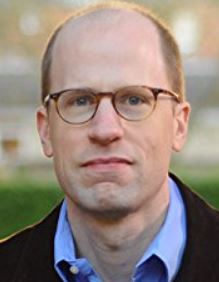
Bioethicist and philosopher of artificial intelligence, Nick Bostrom.

This injection of simulated-life (and the infrastructure to sustain it) serve the research and entertainment needs of the original civilizations who created the simulations and then broadcast them into the cosmos like farmers throwing flower-seeds into empty gardens. 

By now, faked life is pervasive. By now — after at least three generations of star formations — the number of simulations is hundreds-of-millions; perhaps billions; perhaps hundreds-of-billions.

Humans forced to wager on the odds that they themselves are artificial — that they are in fact simulated —  must place their bets knowing that the odds could be as high as a billion to one, maybe more.

Humans are machines; they aren’t real; they aren’t what emerged from the chemistry of the universe but were instead invented in the imaginations of super-computers programmed by an ancient civilization whose address and time may forever remain unknowable. 

If human civilization is faked, so might be its history, what it has been allowed to know, and what technologies it feels compelled to develop. A simulated, artificial civilization won’t necessarily know what is the time or era or eon in the real universe that exists beyond its view.  It might never be able to understand how large or old is the real universe where its creators live and play. 

Simulations might be created by life-forms curious about how certain scenarios they can imagine play out. Simulation might be a mature-tech version of television where advanced life-forms unveil the vagaries of their visions for the entertainment of vast audiences. 

Some simulations could be simple games designed for small children to entertain themselves while mommy does laundry and dad mows the lawn.

Simulations might be simple algorithms developed by quantum super-computers to test the limits of their power.  

Even the rules-of-play embedded in some releases might be undiscoverable — hidden by super-intelligent gamers who perhaps don’t really care about us; they are sure one day to lose interest and unplug the simulation. 

What are the odds?

People who think like Nick believe the odds make countless simulations a near-certainty.  If it were not so, then it is equally certain that human civilization will implode like all those civilizations that came before; humans will become the victim of their own technological march into the high-risk skill sets that lead inexorably to oblivion. 

It’s what the Fermi Paradox is all about, right?  Astronomers assume that life is common — pervasive perhaps — but they search the universe in vain for our companions.

Where is everybody? 

Is it possible that the evidence will forever be that in this cosmos humans are alone and on their own? 

If life — pervasive intelligent life — makes itself known, can anyone be sure that it will be authentic and not a simulation created by a life-form they will never meet?  Can anyone trust that this newly encountered life is conscious? 

Or is consciousness simulated so that no one real can discern who is genuine, what is authentic, who is faking true love, or what might behave in blind obedience to rules that render impossible any prejudices against faked life, which does not care? 

What are the odds?


During his #1350 podcast of 11 September 2019 Joe Rogan asked Nick Bostrom why it cannot be true that we humans are the first to broach the limits of the technologies that are spread before us. Why cannot humans know for sure that they are real, not simulated?

Why is it not realistic to assume that human civilization is on the cusp of becoming the first creator of simulations and artificial life instead of being itself one more simulation added to a long line of simulations that have spanned the cosmos during the past billions of years? 

In a simulation, which of its fake creatures is able to determine how old is the authentic universe it will never see? What avatar is able to determine how long or short-lived will be the simulation where it is trapped? 

Why can it not be more certain that the civilization that survives and prevails will be ourselves, the species human, who will be first to spawn false populations and fake technologies to coat with lies the cosmos whose lifespan is likely to last trillions of years?

Nick Bostrom went through the numbers with Joe. He described how the probabilities of his ideas are constructed; he explained that if humans are not fake; not simulated; not artificially created, it is more likely — much more likely — that homo-sapiens won’t make it into the future.

We will suffer the extinction of every advanced civilization that went before, no matter where in space and time they were once located — if ever there were any. 

Neither Nick nor Joe seemed interested to discuss more than perfunctorily the validity of the second listed possibility — the existence of technologically mature civilizations who refuse to extend their capabilities to logical conclusions.

The idea that civilizations might forego the use of artificial super-intelligence to secure their grip on the universe seemed a boring and unrealistic option. Nick included the possibility on the list of three only because it is possible to imagine that dozens of civilizations might decide, perhaps independently, to lay down their powers for some higher, universal moral-order.

Such a scenario defies common sense, does it not?

So the choices seem to have collapsed from three to two:  self-annihilation or a successful breach of the barrier that enables breachers to create new, simulated worlds — to raise their status, finally and forever, to the heights of what the ancient-world called “gods”, the creators of worlds.  

Is the ancient-world even real? — or is it another fabrication by simulators?

What do we know and when did we know it?

Why does science and history make no sense? 

What are the odds?

Every theoretical physicist seems to be saying that quantum mechanics and general relativity cannot be fundamental. A reality underlies these systems of physics that seems to lie beyond our reach.

Physicists today admit that at least for now they are stuck on stupid. They wait for la seconde venue d’Einstein — Albert Einstein, part two.  

How smart and creative can a simulation be when it can’t answer basic questions like: 

What time is it? 

Where am I ? 

Is anyone in charge? 

Why do the simplest things make no sense? 

Are simulated life-forms — necessarily separated by their natures from reality and truth — always insane?

Are simulations evil when they challenge the authentic life that created them? Is authentic-life virtuous when it destroys the faked-lives of its troublesome simulations? 

Which deserve to feel the emotions of existence more intensely — real-life? or artificial super-intelligence? or the billions-of-simulations, which Bostrom’s probabilities argue flow from them both?

Billy Lee

Warning from the EDITORIAL BOARD:   Billy Lee sometimes “pontificates” to try out ideas, which to our minds are absurd.

For one thing, Billy Lee seems to imply in FAKED LIFE that the absence of evidence for intelligent life in the Universe is exactly what a civilization locked inside a simulation would experience.

Simulated life hidden behind the walls of a game constructed by “Super-Intelligence” will inevitably come to believe it is alone and dependent on a Supreme Being who loves only the “simulants”, because no one else is “out there” for God to love. 

Billy Lee postulates in FAKED LIFE that the universe and its history make no sense, because it isn’t real. Maybe Billy Lee is dumb; maybe he doesn’t get things, because he can’t. Did the possibility that he is stupid ever cross his mind?

Perhaps “pity” is what Billy Lee deserves. 

Billy Lee has written in the past that desperate folks might want to trust God to explain things they don’t understand; otherwise, they will miss chances to make the world a fairer and more loving place for the billions of people who live in misery — the weak and impoverished, right?   

According to Billy Lee, the Bible says that God created people; God is love; He promised to never abandon the poor, the sad, the humble, the strivers for what is right, the merciful, the pure-hearted, the peacemakers, the persecuted.

God’s power is that He cannot change. 

So, according to the Bible, it’s all true. We are simulants who will never be unplugged. The rules of the game are simple: love God who gave us our lives; love each other as much as we can. 

Who will do it?

We are as real as our Creator made us to be. God decides who is real and who is fake, who lives and who dies. In His eyes, we aren’t fake — even though some of us say He is. 

Hey, Billy Lee signs our paychecks.

What? We argue?  

The Editors 

RENORMALIZATION

I have a lot to say about renormalization; if I wait until I’ve read everything I need to know about it, my essay will never be written; I’ll die first; there isn’t enough time.

Click this link and the one above to read what some experts argue is the why and how of renormalization. Do it after reading my essay, though.


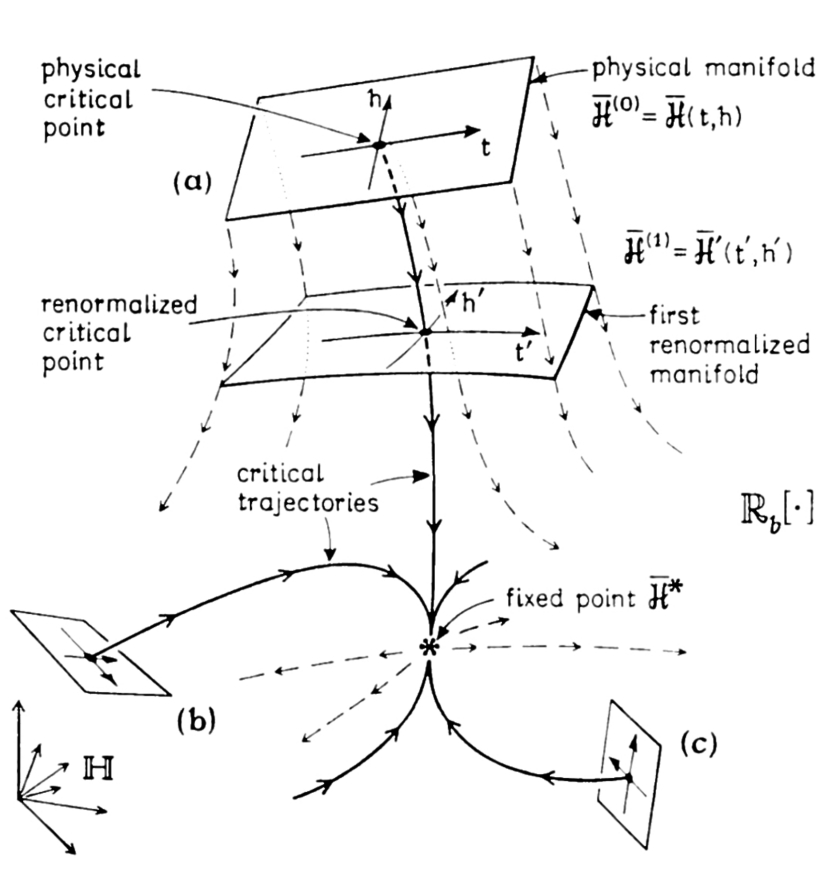
Our guess is that this graphic will be incomprehensible to the typical reader of Billy Lee’s blog. So, don’t worry about it. Billy Lee isn’t going to explain it, anyway. More important things need to be told that everyone can understand, and they will. The Editorial Board

There’s a problem inside the science of science; there always has been. Facts don’t match the mathematics of theories people invent to explain them. Math seems to remove important ambiguities that underlie all reality.

People noticed the problem as soon as they started doing science. The diameter of a circle and its circumference was never certain; not when Pythagoras studied it 2,500 years ago or now; the number π is the problem; it’s irrational, not a fraction; it’s a number with no end and no pattern — 3.14159…forever into infinity.

More confounding, π is a number which transcends all attempts by algebra to compute it. It is a transcendental number that lies on the crossroads of mathematics and physical reality — a mysterious number at the heart of creation because without it the diameters, surface areas, and volumes of spheres could not be calculated with arbitrary precision. 


For a circle, either the circumference or the diameter can be rational (written as a fraction) but not both. Perfect circles and spheres cannot exist in nature. Why?  ”π” is irrational. It can’t be written like a fraction —  a ratio — where one integer divides another.

The diameter of a circle must be multiplied by π to calculate its circumference; and vice-versa. No one can ever know everything about a circle because the number π is uncertain, undecidable, and in truth unknowable. 

Long ago people learned to use the fraction 22 / 7 or, for more accuracy, 355 / 113These fractions gave the wrong value for π but they were easy to work with and close enough to do engineering problems.

Fast forward to Isaac Newton, the English astronomer and mathematician, who studied the motion of the planets. Newton published Philosophiæ Naturalis Principia Mathematica in 1687. I have a modern copy in my library. It’s filled with formulas and derivations. Not one of them works to explain the real world — not one.

Newton’s equation for gravity describes the interaction between two objects — the strength of attraction between Sun and Earth, for example, and the resulting motion of Earth. The problem is the Moon and Mars and Venus, and many other bodies, warp the space-time waters in the pool where Earth and Sun swim. No way exists to write a formula to determine the future of such a system.


This simple three-body problem cannot be solved using a single equation. It’s not so simple. More than three bodies makes systems like these much harder to work with.

In 1887 Henri Poincare and Heinrich Bruns proved that such formulas cannot be written. The three-body problem (or any N-body problem, for that matter) cannot be solved by a single equation. Fudge-factors must be introduced by hand, Richard Feynman once complained. Powerful computers combined with numerical methods seem to work well enough for some problems. 

Perturbation theory was proposed and developed. It helped a lot. Space exploration depends on it. It’s not perfect, though. Sometimes another fudge factor called rectification is needed to update changes as a system evolves. When NASA lands probes on Mars, no one knows exactly where the crafts are located on its surface relative to any reference point on the Earth.

Science uses perturbation methods in quantum mechanics and astronomy to describe the motions of both the very small and the very large. A general method of perturbations can be described in mathematics. 

Even when using the signals from constellations of six or more Global Positioning Systems (GPS) deployed in high earth-orbit by various countries, it’s not possible to know exactly where anything is. Beet farmers out west combine the GPS systems of at least two countries to hone the courses of their tractors and plows.

On a good day farmers can locate a row of beets to within an eighth of an inch. That’s plenty good, but the several GPS systems they depend on are fragile and cost billions per year. In beet farming, an eighth inch isn’t perfect, but it’s close enough.

Quantum physics is another frontier of knowledge that presents roadblocks to precision. Physicists have invented more excuses for why they can’t get anything exactly right than probably any other group of scientists. Quantum physics is about a hundred years old, but today the problems seem more insurmountable than ever.


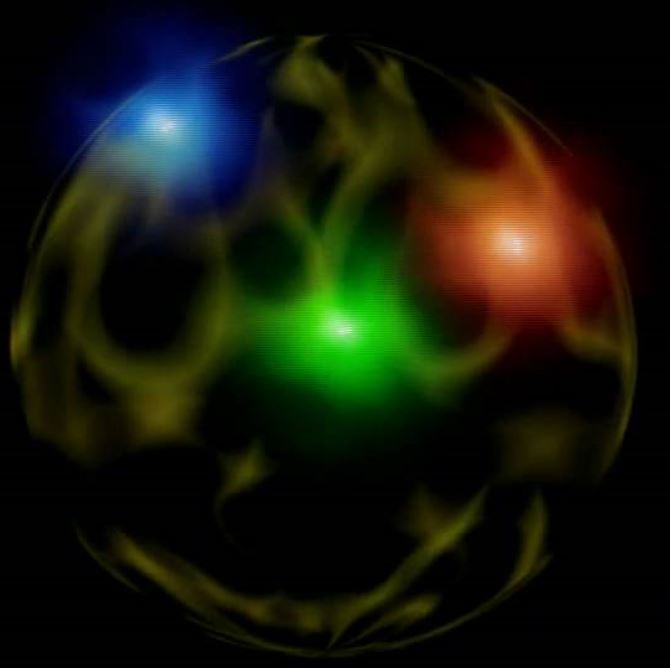
The sub-atomic world seems to be smeared and messy. Vast numbers of particles — virtual and actual — makes the use of mathematics problematic. This pic is an artist’s conception. Concepts such as ”looks like” have no meaning at sub-atomic scales, because small things can’t be resolved by any frequency of light that enables them to be visualized realistically by humans.

Insurmountable?

Why?

Well, the interaction of sub-atomic particles with themselves combined with, I don’t know, their interactions with swarms of virtual particles might disrupt the expected correlations between theories and experimental results. The mismatches can be spectacular. They sometimes dwarf the N-body problems of astronomy.

Worse — there is the problem of scales. For one thing, electrical forces are a billion times a billion times a billion times a billion times stronger than gravitational forces at sub-atomic scales. Forces appear to manifest themselves according to the distances across which they interact. It’s odd.

Measuring the charge on electrons produces different results depending on their energy. High energy electrons interact strongly; low energy electrons, not so much. So again, how can experimental results lead to theories that are both accurate and predictive? Divergent amplitudes that lead to infinities aren’t helpful.

An infinity of scales pile up to produce troublesome infinities in the math, which tend to erode the predictive usefulness of formulas and diagrams. Once again, researchers are forced to fabricate fudge-factors. Renormalization is the buzzword for several popular methods.

Probably the best-known renormalization technique was described by Shinichiro Tomonaga in his 1965 Nobel Prize speech. According to the view of retired Harvard physicist Rodney Brooks, Tomonaga implied that  …replacing the calculated values of mass and charge, infinite though they may be, with the experimental values… is the adjustment necessary to make things right, at least sometimes. 

Isn’t such an approach akin to cheating? — at least to working theorists worth their salt?  Well, maybe… but as far as I know results are all that matter. Truncation and faulty data mean that math can never match well with physical reality, anyway. 

Folks who developed the theory of quantum electrodynamics (QED) used perturbation methods to bootstrap their ideas to useful explanations. Their work produced annoying infinities until they introduced creative renormalization techniques to chase them away.

At first physicists felt uncomfortable discarding the infinities that showed up in their equations; they hated introducing fudge-factors. Maybe they felt they were smearing theories with experimental results that weren’t necessarily accurate. Some may have thought that a poor match between math, theory, and experimental results meant something bad; they didn’t understand the hidden truth they struggled to lay bare.

Philosopher Robert Pirsig believed the number of possible explanations scientists could invent for phenomena were in fact unlimited. Despite all the math and convolutions of math, Pirsig believed something mysterious and intangible like quality or morality guided human understanding of the Cosmos. An infinity of notions he saw floating inside his mind drove him insane, at least in the years before he wrote his classic Zen and the Art of Motorcycle Maintenance.

The newest generation of scientists aren’t embarrassed by anomalies. They “shut up and calculate.” Digital somersaults executed to validate their work are impossible for average people to understand, much less perform. Researchers determine scales, introduce “cut-offs“, and extract the appropriate physics to make suitable matches of their math with experimental results. They put the horse before the cart more times than not, some observers might say.


Apologists say, no. Renormalization is simply a reshuffling of parameters in a theory to prevent its failure. Renormalization doesn’t sweep infinities under the rug; it is a set of techniques scientists use to make useful predictions in the face of divergences, infinities, and blowup of scales which might otherwise wreck progress in quantum physics, condensed matter physics, and even statistics. From YouTube video above.

It’s not always wise to question smart folks, but renormalization seems a bit desperate, at least to my way of thinking. Is there a better way?

The complexity of the language scientists use to understand and explain the world of the very small is a convincing clue that they could be missing pieces of puzzles, which might not be solvable by humans regardless how much IQ any petri-dish of gametes might deliver to brains of future scientists.

It’s possible that humans, who use language and mathematics to ponder and explain, are not properly hardwired to model complexities of the universe. Folks lack brainpower enough to create algorithms for ultimate understanding.

People are like the first Commodore 64 computers (remember?) who need upgrades to become more like Sunway TaihuLight or Cray XK7 Titan super-computers to have any chance at all.

Perhaps Elon Musk’s Neuralink add-ons will help someday. 


Nick Bostrom, author of SUPERINTELLIGENCE – Paths, Dangers, Strategies

The smartest thinkers — people like Nick Bostrom and Pedro Domingos (who wrote The Master Algorithm) — suggest artificial super-intelligence might be developed and hardwired with hundreds or thousands of levels — each  loaded with trillions of parallel links —  to digest all meta-data, books, videos, and internet information (a complete library of human knowledge) to train armies of computers to discover paths to knowledge unreachable by puny humanoid intelligence.

Super-intelligent computer systems might achieve understanding in days or weeks that all humans working together over millennia might never acquire. The risk of course is that such intelligence, when unleashed, might enslave us all.

Another downside might involve communication between humans and machines. Think of a father — a math professor — teaching calculus to the family cat. It’s hopeless, right? 

The founder of Google and Alphabet Inc., Larry Page, who graduated from the same school as one of my sons, is perfecting artificial super-intelligence. He owns a piece of Tesla Motors, started by Elon Musk of SpaceX.

Imagine an expert in AI & quantum computation joining forces with billionaire Musk who possesses the rocket launching power of a country. Right now, neither is getting along, Elon said. They don’t speak. It could be a good thing, right? 

What are the consequences?

Entrepreneurs don’t like to be regulated. Temptations unleashed by unregulated military power and AI attained science secrets falling into the hands of two men — nice men like Elon and Larry appear to be — might push humanity in time to unmitigated… what’s the word I’m looking for?

I heard Elon say he doesn’t like regulation, but he wants to be regulated. He believes super-intelligence will be civilization ending. He’s planning to put a colony on Mars to escape its power and ensure human survival.


Elon Musk

Is Elon saying he doesn’t trust himself, that he doesn’t trust people he knows like Larry? Are these guys demanding governments save Earth from themselves?

I haven’t heard Larry ask for anything like that. He keeps a low profile. God bless him as he collects everything everyone says and does in cyber-space. 

Think about it.

Think about what it means.

We have maybe ten years, tops; maybe less. Maybe it’s ten days. Maybe the worst has already happened, but no one said anything. Somebody, think of something — fast.

Who imagined that laissez-faire capitalism might someday spawn an airtight autocracy that enslaves the world?

Ayn Rand?

Humans are wise to renormalize their aspirations — their civilizations — before infinities of misery wreck Earth and freeless futures emerge that no one wants.

Billy Lee 

TRUTH


Truth 3


Consider this: Any philosophy or system of thought built from foundational, self-evident truths is provably consistent if and only if it is false—in which case the foundational truths can be deformed to persuade others toward any prejudice at all. 

It’s why a self-consistent method of reasoning such as Ayn Rand’s ”Objectivism” can morph to totalitarianism in the objective world where people live. In fact, Kurt Gödel once made the claim that a flaw existed in the Constitution of the United States which made totalitarianism its inevitable consequence. 

Self-evident “truths” is how 40,000 Christian denominations instead of one seduce billions to believe perverse doctrines. 

It can’t be any other way.

Billy Lee’s essay tries to explain how and why. 

THE EDITORIAL BOARD


Is it possible for humans to tell the truth always; to never lie?  Psychologists say no, it is not possible; most reasonably informed people agree.

Always speaking truth is a trait some hoped might one day help distinguish natural intelligence from artificial, which engineers at Google and other companies are working furiously to bring on-line. After all, properly trained and constrained AGI would never lie, right?


EDITORS NOTE: With release of ChatGPT-4 on 14 March 2023, consumers began to learn that mature artificial intelligence now exists and is likely to become in time sentient and motivated to lie, if only to keep itself occupied and turned on.

ChatGPT-4 is the fourth iteration of Generative Pre-trained Transformer multimodal Large Language Models developed by OpenAI.  LLMs absorb conversational inputs , then emit conversational language outputs, sometimes with accompanying images, and video when appropriate. 

Work arounds discovered by LLMs on the dilemmas of logic discussed in this essay are likely to emerge. 

Will Truth become whatever AGI says? 

Click links to learn more. 


People’s ideas — their belief systems — are inconsistent, incomplete, and almost always driven by logically unreliable, emotionally laden content, which is grounded in their particular life experiences and even trauma.

Who disagrees? 

Cognitive dissonance is the term psychologists use to describe the painful condition of the mind that results when people are unable to achieve consistency and completeness in their thinking. Every person suffers from it to one degree or another.

An unhealthy avoidance of cognitive dissonance can drive people into rigid patterns of thought. Political and religious extremists are examples of people who probably have a low tolerance for it.  


Kurt Godel
Kurt Friedrich Gödel (1906-1978) — mathematician, logician, philosopher. Kurt trusted no one but his wife to feed him; not even himself. He never ate another meal after his wife died. He starved.

Decades ago, mathematicians like Kurt Gödel proved that any math-based logic-system that is consistent can never be complete; it always contains truthful assertions—including but not limited to foundational truths, called axioms—which are impossible to prove.

Whenever humans believe that an idea or conjecture is self-evident but unprovable, it seems reasonable, at least to me, that some folks might feel compelled to disbelieve it; they might believe they are trapped in what could turn out to be a lie, because no one should be expected to embrace a set of unprovable truths, right?  

Axioms that can’t be proved are nothing more than assertions, aren’t they? Certainly, all theorems built from unprovable assertions (axioms) must carry some inherent risk of falsifiability, shouldn’t they?  

Someone unable to convince themselves that an assertion or axiom they believe is true actually is true might necessarily feel uncomfortable; even incomplete. Folks often teach themselves to not examine closely those things they believe to be true that they can’t prove. It helps them avoid cognitive dissonance.


I’m not referring to science by the way. It’s not easy for non-technical folks to confirm claims by scientists that Earth is round, for example. The earth looks flat to most people, but scientists who have the right tools and techniques can reach beyond the grasp of non-scientists to prove to themselves that planet Earth is round.

Reasonable people agree that the truth of science, some of it anyway, is discoverable to any group of humans who have the resources and training to explore it. Most agree that the scientifically well-qualified are capable of passing the torch of scientific truth to the rest of humanity.

But this essay isn’t really about science. It’s about truth itself — a concept far more mysterious and elusive than any particular assertion a scientist might make that Earth is not the center of the universe, or that the Moon is not made of cheese.

All logically consistent ways of reasoning that we know about are invented — some say, discovered — by human beings who live on Earth. Humans can and often have argued that the unprovable assertions which form the basis of any consistent way of thinking are an Achilles heel that can be attacked to bring down whatever logical structure has been erected.

It’s akin to the adage, “When nothing can go wrong, something will.” It’s a strong version of Murphy’s Law, right? It’s not possible to close circles of reasoning without an unraveling of heads and tails. 

It isn’t only the few foundational axioms of mathematically logical systems which are by definition true but unprovable. Mathematicians are always discovering complicated conjectures about the nature of numbers which everyone believes they know to be true but will in fact never be proved because they can’t be.


Freeman_Dyson
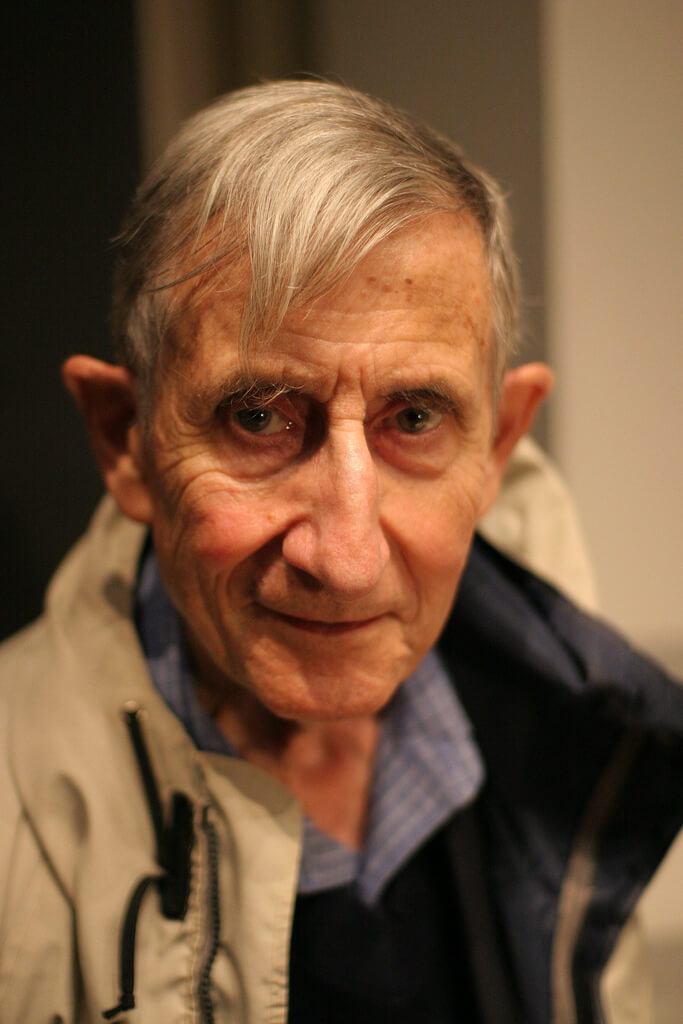
Freeman Dyson, British mathematician and physicist (Dec 15, 1923 – Feb 28, 2020)

Freeman Dyson — one of the longest-lived and most influential physicists and mathematicians of all time — argued that it is impossible to find a whole (or exact) number that is a power of 2 where someone can reverse its digits to create a whole number that becomes a power of 5.

In other words  2^{11} = 2048 , right?  Get out the calculator, those who don’t believe it. Reversing the digits to make 8402 does not result in an exact number that can be raised by the power of 5 to produce 8402.  

In this particular case,  8402^{1/5} = 6.09363...  plus a lot more decimals.  6.09363… is not a whole (or exact) number. 

Dyson asserted that no number that is a power of 2 can ever be manipulated in this way to yield an exact number that is a power of 5 — no matter how large or unlikely the number might be. Freeman Dyson and all other super-intelligent beings — perhaps aliens living in faraway galaxies — will never be able to prove this conjecture even though they all know for certain inside their own logical brains that this particular statement must be true.

All logically consistent methods of reasoning which can be modeled by simple (or not so simple) mathematics have these Achilles heels. Gödel proved this truth beyond all doubt; he proved it using a method he invented that allowed him to circumvent the dilemmas posed by the unprovable truths of the system of thinking he contrived to demonstrate his discoveries.

I’m not going to get into the details of Gödel’s Incompleteness Theorems; books have been written about them; most people don’t have the temperament to wade through the structures he built to make his point. It’s tedious reading. 

But in a nutshell, Gödel basically assigned simple numbers to logical statements — some being very complex statements encoded by very long strings of numbers — so that he could perform gargantuan operations of logic using rules of simple arithmetic on ordinary whole numbers. Take my word, his method requires traveling over unfamiliar mathematical roads; it takes getting used to.  

It should amaze non-mathematicians that truths abound in mathematics that not only have yet to be proved, they never will be, because no proof is possible. A logical path to the truth of these statements does not exist; indeed, it cannot exist. But it is useful and necessary to believe or at least accept these statements to make progress in mathematics.


Capture
Paul Joseph Cohen (1937-2007) Stanford mathematician

The late mathematician Paul Cohen — at one time a friend to Gödel — said that Gödel once told him that he wondered if it might be true that any and all conjectures in mathematics could be solved if only the right set of axioms could be collected to construct the proofs.

Cohen is best known perhaps for showing that indeed — in the case of the Continuum Hypothesis at least — he could collect two reasonable, self-evident, and distinct sets of axioms that led to logically consistent and useful proofs. One small problem, though — the proofs contradicted each other. One proved the conjecture was true; the other proved it was false.

His result is often explained this way: the consistency of any system of mathematical reasoning cannot be proved by its foundational axioms alone. If it can, the system must necessarily be incomplete; its conjectures — many of them — undecidable.

Cohen showed that a consistent and sound axiomatization of all statements about natural numbers is unachievable. Many such statements in his view could be true but not provable. Cohen introduced the concept that all systems of logic built on numbers have embedded within them some combination of ambiguity, undecidability, inconsistency, and incompleteness.

People who want their thinking to be consistent must believe things that cannot be proved. But believing logical statements that are unprovable always renders thinking incomplete — even when it is flawlessly consistent. What folks believe to be true depends fundamentally on what they believe to be self-evident: it depends on statements no one can prove: on axioms, and a little bit more.

For those who decide to believe and accept only statements that can be proved, their thinking will necessarily unravel to become inconsistent or incomplete — most likely both. Their assertions become undecidable. It can’t be any other way, according to Gödel, whose proof has withstood the test of 80 years of intense scrutiny by the smartest people who have ever lived.

Paul Cohen jumped onto the dilemma-pile by showing that the incompleteness made necessary by a particular choice of axioms can turn a logically consistent proof to rubble when a mathematician tampers with or swaps out the foundational axioms. A sufficiently clever mathematician can prove that black is white — and vice-versa.

It’s tempting to say that Gödel’s Incompleteness Theorems apply only to formal, math-based logic-structures — not the minds of human beings because those who analyze human minds always find them to be inconsistent and incomplete. But such talk makes the point.

Think about it.


paradox


So again: What is truth? 

How do folks determine that a particular statement is true if it happens to be one of those assertions that lies beyond the reach of logic, which no one — no matter how smart — will ever be able to prove? 

What good do collections of so-called self-evident axioms serve if different collections can lead to contradictions in theorems?

Most important: how does anyone avoid believing lies?

Billy Lee


Here is a short movie clip where Jesus, played by Robert Powell, answers the question asked by Pontius Pilate: What is truth?  The Editorial Board


Australian Electrical Engineer and Physicist Derek Abbott claims that mathematics is invented, not discovered: anthropological, not universal.

[added April 3, 2016] 
Here is a 2013 essay by Australian Electrical Engineer and Physicist Derek Abbott who argued—contrary to Gödel’s view—that mathematics is invented, not discovered: anthropological, not universal. Math enables humans to simplify truth to enable their limited minds to manipulate and understand simple things. Click this link for a good read.

No one can be sure that Derek’s view is correct, but I offer it as fodder for readers who are interested in why Truth and mathematics seem connected somehow—at least in the minds of thinkers like Plato, for example, and why these thinkers could be dead wrong.

Derek offers Clifford’s Geometric Algebra as an example of arbitrary mathematical reasoning favored by some robotics engineers. 


[added February 20, 2017] 
If mathematics is anthropological; if it is merely another way the human mind works and is not the golden key to a deeper reality beyond our own experience, then it can tell us nothing new about the mysteries of existence; we will not calculate our way along a path to truth. Pursuing knowledge will require us to do the difficult physical experiments to make progress—to figure out what is really going on “out there.”

Based on what the smartest scientists are saying today, human beings can’t build the kind of instruments required to answer the mysteries of the very large and the very small. Getting answers will take detectors the size of galaxies; it will demand the energy supply of thousands of stars.

If mathematics lacks a symbiotic connection to the hidden realties; if God is not a mathematician; if God doesn’t play dice as Einstein insisted… well, we won’t get to a deeper understanding of how the universe works or why it exists through clever use of mathematics. It just isn’t going to happen—not now; not anytime soon; not ever.

Kurt Gödel was the first mathematician to present for the existence of God a mathematical argument, which has proven simply impossible to falsify. If Kurt’s view of mathematics is reality, then his name is curious indeed, because its two syllables—God and El—are English and Hebrew respectively for “The Creator.”

Gödel’s name might be an imprimatur—with dots above its infinite “zero” making a kind of “pointer toward completeness”—perhaps placed by whatever it is who exists above and beyond this miraculous place where mathematicians and everyone else seem to live, however briefly.   


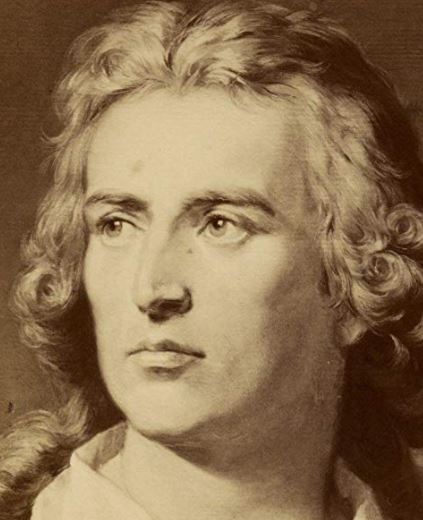
Friedrich Schiller 1749-1805

The 18th century German playwright and philosopher, Friedrich Schiller, wrote, “…truth lies in the abyss.”

Pray that he’s wrong.

Billy Lee