How do I write a confession when I don’t know how to write?
I was tortured. I confessed to everything. As I write I am unsure I have courage enough to publish. For one thing, odds seem good I may have actually done some version of the shameful things I confessed.
Shame is a powerful motivator. It drives a person to hide, to cover-up, to deny, to forget. It can induce a form of stress psychologists call cognitive dissonance. The chasm between what I think I am and what my tormentors tell me I am becomes too wide. The personality begins to unravel.
N-no. M-my eye doesn’t itch.
Fear, on the other hand, drives a person to act, to survive, to do whatever it takes to reach safety.
Or it can induce a state of paralysis.
Either way, fear intensifies cognitive dissonance to a level where the accused becomes intolerant. Dissonance becomes painful. The sufferer must find release. One way is to confess — confess and become compliant.
This dynamic works well when a person believes they’ve done wrong, and not so well when they don’t. Inducing fear to intensify shame is one thing torturers do. When managed skillfully, guilty people confess their crimes. The innocent don’t — most times, anyway.
It’s why torture works. Confessing reduces shame through cathartic admission of guilt. And it offers hope of freeing the confessor from further physical discomfort.
If torture is not overly arduous, an accused person has a chance to resist with enough vigor to establish their innocence.
”You stole my contacts,” Wild-Man said.
I’m not going to detail what authorities did to get me to write a four-page signed confession. But the gist is, they threw a psychotic arrestee into my cell. First thing he did was grab my shoes and hurl them against the wall. (The authorities had told me to tie them together to use as a pillow.)
Wild-Man accused me of stealing his contact lenses. I looked him in the eyes and told him as carefully and with as much love as I could muster, it was good he came to my area because now we could look for his contact lenses together.
We spent the next twenty-five minutes on our hands and knees searching every square inch of my tiny cell.
When the authorities realized I had taken control of Wild-Man, they came into the cell and led him away. After a few minutes passed, a uniformed woman brought me a legal pad and asked me to write my confession.
Unsure of what was coming next, I sat on the cold floor and started to write. Forty-five minutes later on page three I began spilling my guts; I confessed to everything I thought they thought I did.
Many unnerving things occurred after I “confessed.” As I struggled to sleep, someone slammed a steel door over and again to keep me awake. Someone pumped bone chilling cold into my cell. The frigid air made me shake and induced arthritic pain which pains me to this day.
After a night of no sleep someone served a breakfast of curdled milk and soggy hamburger.
Eventually a judge released me. I learned then that the city newspaper had published parts of my confession on its editorial page.
I was doing OK, until they fed me bad hamburger.
I decided to fully cooperate with the various authorities who handled me during the following months or years, whatever it was going to be. After pleading guilty, a judge noted that I had no priors, so he sentenced me to probation and community service.
I worked hard. Case workers reported I was remorseful and repentant. They added, I was cooperative and helpful. During community service, people I served reported I was conscientious. I fixed their broken things. I looked for novel ways to help needy people who relied on folks in trouble to assist them for no fee.
After community service, authorities expunged my crime from public records. The judge set aside my guilty plea. Torturers said they would protect my anonymity as long as I remained the model citizen I always was before my arrest.
Best of all, they will confirm if asked that I have not committed even a single crime since. Their modification of my behavior is a complete success.
Aging is taking a toll on me. I had warning. Mom and Dad lost everything as they aged. It wasn’t what they expected.
Billy Lee celebrates another year closer to death.
They imagined they’d lose some friends, have health issues, lose some mobility. They didn’t expect to lose their entire family, all their friends and all their power. They lost their beauty, their charisma, their common sense and, finally, their minds.
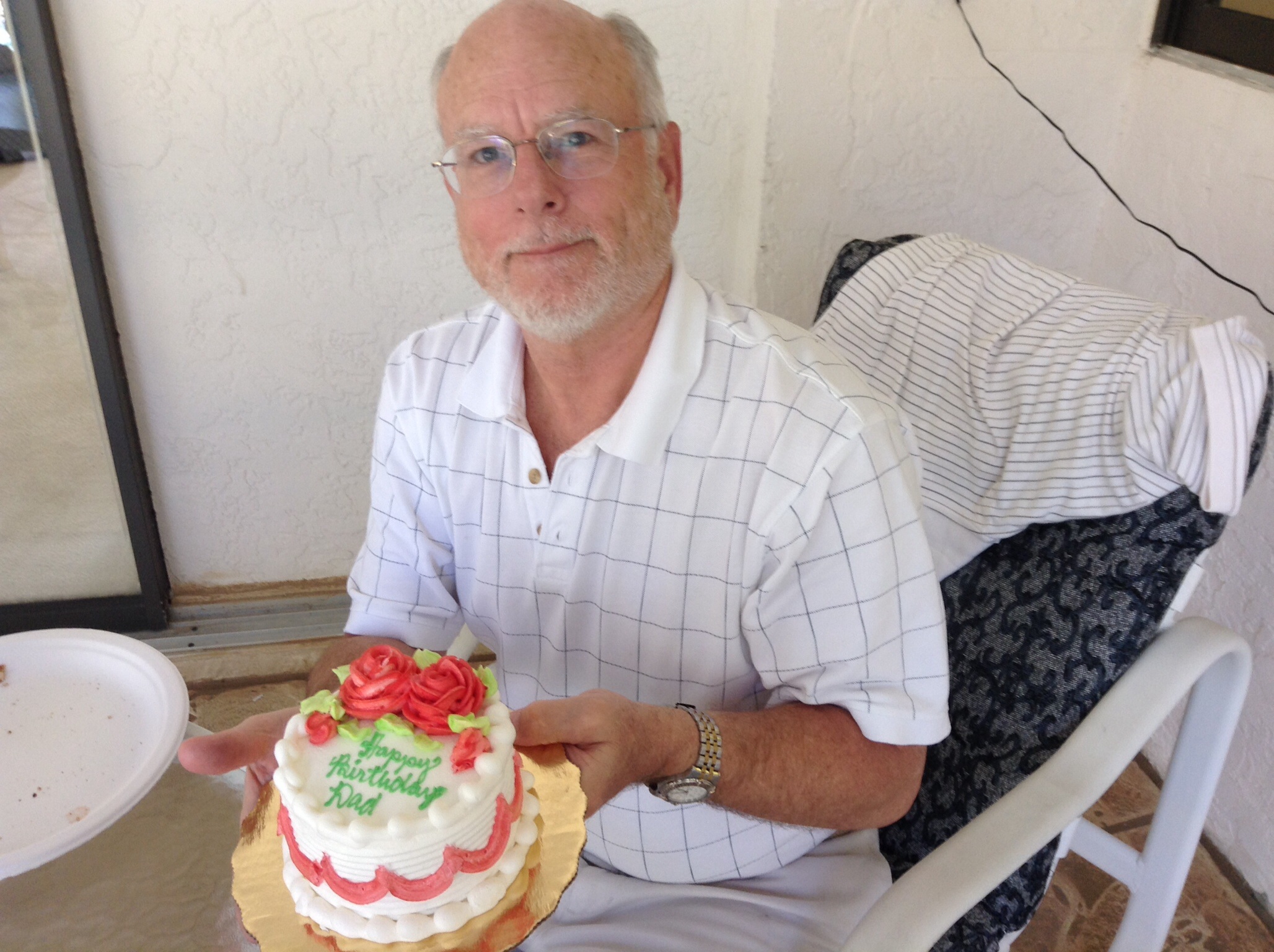
Dad’s 85th birthday. Within eight years both he and mom died.
One thing my dad tried was to keep his losses to himself. On some level he wanted to spare his children the fear of knowing; on another level he may have believed a positive attitude would lift up those people around him still left. But in the end futility seized him. He could no longer play golf or read or drive a car. He got depressed and took pills to keep going. Aphasia robbed his ability to speak.
My mom was devoted to my dad. Whatever he said or didn’t say was fine with her. She developed a brain disease that took her memories, short term and long, but she remembered Dad to the end. She never stopped asking where he went and when was he coming home.
Dad, 48 hours before he died.
My journey down this tunnel to hell is just beginning. My kids want me to go quietly without complaint — no whimpering, no crying, no embarrassing emotional displays or theatrical grand-standing, like I do in my blog — whatever.
I’m not built that way.
Billy Lee
Click here for Final Thoughts before life is gone for good…
The visible universe is big. Most scientists believe the invisible universe — the universe no one can see — is really big.
If the Universe shrunk down to where Earth became the size of a period at the end of a sentence, how big would it be?
When I was a kid, questions like this one fascinated me; what harm is there to revisit a few?
About 100 dots the size of the period at the end of this sentence must be strung together to make an inch. We can imagine shrinking Earth to the size of one of these dots, then plugging-in the numbers to calculate the scale of everything else. It turns out that the observable universe shrinks to a diameter of about two light years.
Since a light year is nearly six-trillion miles, the universe is fantastically big. At this reduced scale, the size of the universe remains pretty much incomprehensible.
In this pic, the Sun sits directly behind Saturn, which is backlit by it. Earth is the tiny dot inside the illustrator’s circle to Saturn’s left. Earth is hundreds-of-millions of miles into the page—behind the gas-giant and its rings. Click pic to enlarge in new window.
When Earth becomes a period (or dot), the Sun shrinks to close to an inch in diameter — or 2/3 the diameter of a ping-pong ball. [regulation ping-pong balls are 1.575″ in diameter] The dot-sized Earth orbits 10 feet away. Neptune, the farthest planet, is smaller than a BB — a tiny ball of methane ice almost one football field distant (97 yards).
The distance light travels in a year shrinks to 120 miles — a speed approaching ¼ inch-per-second. The distance to Alpha Centauri, the nearest Sun-like star, shrinks to 500 miles. The star Alpha Centauri shrinks to a ball that is only slightly larger than our under-sized ping-pong ball-sized Sun.
Think about two 1″ diameter ping-pong balls separated by 500 miles. Imagine trying to commute between these balls when the top speed is less than ¼ inch-per-second. Of course, nothing travels at the speed of light. At speeds typical of spacecraft today, it takes 100,000 years to reach Alpha Centauri.
At the scale where Earth is a dot, one might wonder what is the size variation of stars. It turns out that most suns (stars) in the universe range in size from a grapefruit to a pea.
Of course, outliers exist like Deneb, the blue-white supergiant visible in the Summer Triangle. At 203 times the size of the Sun, it shrinks to 17 feet or so in diameter depending on how accurately anyone cares to scale things. Rare super-giants are larger; some are 75 feet or more in diameter at this scale. But in the Milky Way Galaxy, our undersized ping-pong Sun is one of the larger stars.
Is there another way to grasp how large the universe is?
The Milky Way Galaxy — the Sun orbits its center in the space between two of its outermost spiral-arms — is 100,000 light-years across. If the Milky Way was reduced to the dimensions of a coin the size of a quarter, the visible universe (the universe that can be seen with telescopes) would collapse into a sphere of space 15 miles in diameter.
In such a reduced sphere of space, large galaxies become the size of Frisbees but outliers like the mammoth IC1101 are the size of truck tires. The smallest galaxies shrivel into mere grains of sand. Distances between galaxies diminish to 100 feet or so but variations are huge because galaxies tend to cluster together to form groups, which are separated from one another by vast distances.
At this scale, astrophysicists say that the presence of galaxies that cannot be seen (because the distances between our Milky Way Galaxy and the farthest-away galaxies recede faster than the speed-of-light) makes the entire universe, visible and beyond, a minimum of 50 miles in diameter. Light, believe it or not, stands still at this scale. No human observer during their lifetime would notice any movement at all of light or any other phenomenon.
Even the faster-than-light expansion of the universe would be unobservable.
According to physicist, Stephen Hawking, it takes a billion years for the universe to expand by 10%. Five miles (10% of 50) during a period of one billion years is 7 billionths-of-an-inch per day. During a human lifetime the expansion adds to 2 thousandths-of-an-inch (.002″) — less than half the width of a strand of hair.
At the scale where the Milky Way Galaxy is the size of a quarter, the entire universe would appear to be frozen solid during the span of a human lifetime.
Artist’s view of water molecules. Molecules are the smallest structures that can be directly observed (with the help of special sensing instruments and computer generated enhancements). Molecules are the building blocks of all things.
What about tiny things?
To examine the scale of the very small we can imagine enlarging molecules, the building blocks of all things, to the size of the same period-sized dots.
How tall might an average person be? After again plugging in the numbers and calculating, it turns out that a human stretches to a height of 1,000 miles. The eye expands to an orb 15 miles across.
Molecules are small. But at this imagined scale — a scale that requires sophisticated instruments to discern — individual molecules become visible. They grow to look like little dots separated by distances only a bit larger than the dots themselves. Sadly, no one can see the individual atoms that make up the molecules. Even at this enlarged scale, they are too small.
No instruments or microscopes can be constructed to enable anyone to “see” atoms. Physicists believe atoms are real because they see the evidence left behind as their debris moves through the detection mediums of cyclotrons, colliders, and other sensors.
Since 1981 physicists have used scanning tunneling microscopes (STMs) to “feel” the forces of atoms with “nano” probes. A computer algorithm plots the forces and creates pictures of atoms, which with this method look like stacked billiard balls.
Billiard balls is not what quantum objects “look” like because quantum objects can’t be seen using human vision but at least scientists can prove that lumps of energy exist and are arranged in patterns that can be analyzed. It’s a start. It’s something.
Models of atoms studied in science class at universities around the world are contrived to help make sense of the results of many experiments. They are somewhat fanciful.
As for living cells — the basic building blocks of all biology — people are able to observe them under magnification because every cell is built-up from many billions of molecules. Some human cells have trillions. The size of a typical cell at the scale where molecules are expanded to about the size of three-dimensional dots is about 60 feet across.
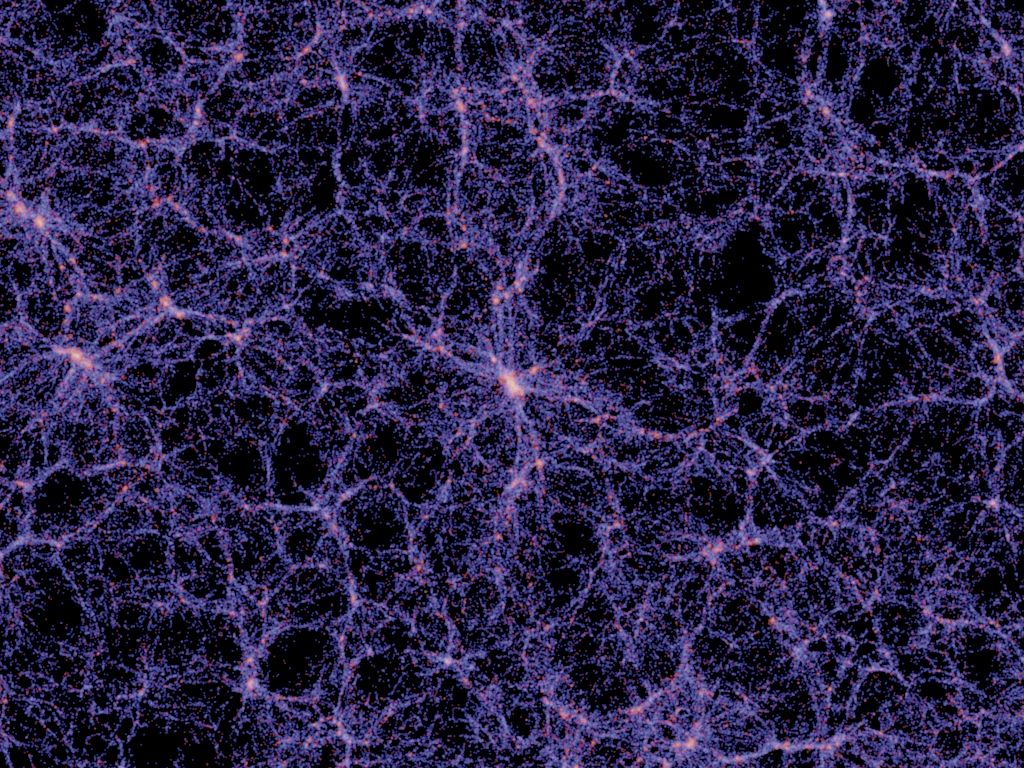
Artist’s large scale view of the universe.
The gulf between the very large and the very small strains credulity but science says it’s real. When thinking about it, I am overcome by wonder and despair of not knowing why or how.
Theoretical physicist Nima Arkani-Hamed has said that the gulf between the very large and the very small is required to balance the force of gravity against electrical forces in celestial objects like planets. He has pointed out that the ratio of the surface area of a typical atom and the surface area of a typical planet mirrors the difference between the two forces.
Nima Arkani-Hamed, one of the world’s top theoretical physicists, makes a point.
The huge difference between the force of gravity and the force of electricity makes the gap between the very large and the very small essential in a universe that works like ours; the difference in scale is necessary and inevitable, Nima has said.
If the ratio moves too far from this balance — if the surface area of an object gets too big — gravity will overwhelm the electrical forces that hold the atoms apart to cause the object to light up from a process called fusion, which can leave behind a shining star. A much larger object will collapse to become a black hole.
Why is the gap between the force of gravity and the electrical force as vast as the difference in surface area between a typical planet and a hydrogen atom? How did the ratio get that way?
No one knows. The values of the forces seem as finely tuned as they are arbitrary. Nima Arkani-Hamed and others are working to understand why.
Another mystery: Why is the universe so big?
Even Nima Arkani-Hamed admits he doesn’t have the answer — not yet, anyway. Perhaps the answer lies in the geometry of spheres, which is the basis of the Billy Lee Conjecture discussed in the essay Conscious Life.
Speaking of spheres, everyone knows that billiard balls are polished smooth, right? Earth, after being shrunk to the size of a pool ball, is smoother and less blemished; more perfectly round. Exhale on a pool-ball to create a mist that is 10 times deeper at scale than the deepest ocean on Earth.
Do the math.
It’s true.
As a child my nightmare was of an enormous whale crushing a tiny flower. A psychologist told me that the whale was a parent; I was the flower.
Maybe.
But the universe captures my nightmare. It’s really big, and I am so very small — helpless, lost, and crushed within its vast expanse.