Aging is taking a toll on me. I had warning. Mom and Dad lost everything as they aged. It wasn’t what they expected.
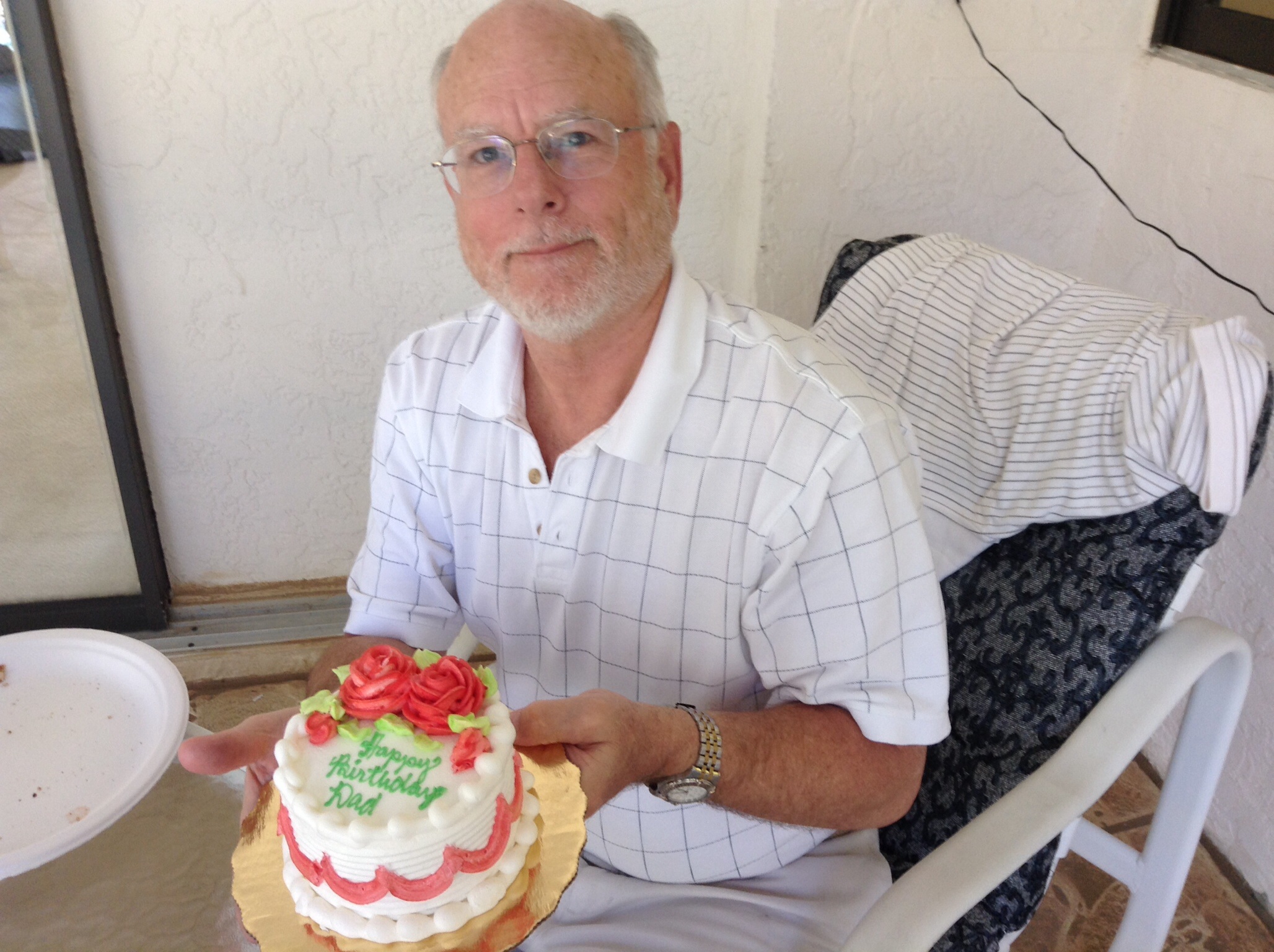
Billy Lee celebrates another year closer to death.
They imagined they’d lose some friends, have health issues, lose some mobility. They didn’t expect to lose their entire family, all their friends and all their power. They lost their beauty, their charisma, their common sense and, finally, their minds.
Dad’s 85th birthday. Within eight years both he and mom died.
One thing my dad tried was to keep his losses to himself. On some level he wanted to spare his children the fear of knowing; on another level he may have believed a positive attitude would lift up those people around him still left. But in the end futility seized him. He could no longer play golf or read or drive a car. He got depressed and took pills to keep going. Aphasia robbed his ability to speak.
My mom was devoted to my dad. Whatever he said or didn’t say was fine with her. She developed a brain disease that took her memories, short term and long, but she remembered Dad to the end. She never stopped asking where he went and when was he coming home.
Dad, 48 hours before he died.
My journey down this tunnel to hell is just beginning. My kids want me to go quietly without complaint — no whimpering, no crying, no embarrassing emotional displays or theatrical grand-standing, like I do in my blog — whatever.
I’m not built that way.
Billy Lee
Click here for Final Thoughts before life is gone for good…
The visible universe is big. Most scientists believe the invisible universe — the universe no one can see — is really big.
If the Universe shrunk down to where Earth became the size of a period at the end of a sentence, how big would it be?
When I was a kid, questions like this one fascinated me; what harm is there to revisit a few?
About 100 dots the size of the period at the end of this sentence must be strung together to make an inch. We can imagine shrinking Earth to the size of one of these dots, then plugging-in the numbers to calculate the scale of everything else. It turns out that the observable universe shrinks to a diameter of about two light years.
Since a light year is nearly six-trillion miles, the universe is fantastically big. At this reduced scale, the size of the universe remains pretty much incomprehensible.
In this pic, the Sun sits directly behind Saturn, which is backlit by it. Earth is the tiny dot inside the illustrator’s circle to Saturn’s left. Earth is hundreds-of-millions of miles into the page—behind the gas-giant and its rings. Click pic to enlarge in new window.
When Earth becomes a period (or dot), the Sun shrinks to close to an inch in diameter — or 2/3 the diameter of a ping-pong ball. [regulation ping-pong balls are 1.575″ in diameter] The dot-sized Earth orbits 10 feet away. Neptune, the farthest planet, is smaller than a BB — a tiny ball of methane ice almost one football field distant (97 yards).
The distance light travels in a year shrinks to 120 miles — a speed approaching ¼ inch-per-second. The distance to Alpha Centauri, the nearest Sun-like star, shrinks to 500 miles. The star Alpha Centauri shrinks to a ball that is only slightly larger than our under-sized ping-pong ball-sized Sun.
Think about two 1″ diameter ping-pong balls separated by 500 miles. Imagine trying to commute between these balls when the top speed is less than ¼ inch-per-second. Of course, nothing travels at the speed of light. At speeds typical of spacecraft today, it takes 100,000 years to reach Alpha Centauri.
At the scale where Earth is a dot, one might wonder what is the size variation of stars. It turns out that most suns (stars) in the universe range in size from a grapefruit to a pea.
Of course, outliers exist like Deneb, the blue-white supergiant visible in the Summer Triangle. At 203 times the size of the Sun, it shrinks to 17 feet or so in diameter depending on how accurately anyone cares to scale things. Rare super-giants are larger; some are 75 feet or more in diameter at this scale. But in the Milky Way Galaxy, our undersized ping-pong Sun is one of the larger stars.
Is there another way to grasp how large the universe is?
The Milky Way Galaxy — the Sun orbits its center in the space between two of its outermost spiral-arms — is 100,000 light-years across. If the Milky Way was reduced to the dimensions of a coin the size of a quarter, the visible universe (the universe that can be seen with telescopes) would collapse into a sphere of space 15 miles in diameter.
In such a reduced sphere of space, large galaxies become the size of Frisbees but outliers like the mammoth IC1101 are the size of truck tires. The smallest galaxies shrivel into mere grains of sand. Distances between galaxies diminish to 100 feet or so but variations are huge because galaxies tend to cluster together to form groups, which are separated from one another by vast distances.
At this scale, astrophysicists say that the presence of galaxies that cannot be seen (because the distances between our Milky Way Galaxy and the farthest-away galaxies recede faster than the speed-of-light) makes the entire universe, visible and beyond, a minimum of 50 miles in diameter. Light, believe it or not, stands still at this scale. No human observer during their lifetime would notice any movement at all of light or any other phenomenon.
Even the faster-than-light expansion of the universe would be unobservable.
According to physicist, Stephen Hawking, it takes a billion years for the universe to expand by 10%. Five miles (10% of 50) during a period of one billion years is 7 billionths-of-an-inch per day. During a human lifetime the expansion adds to 2 thousandths-of-an-inch (.002″) — less than half the width of a strand of hair.
At the scale where the Milky Way Galaxy is the size of a quarter, the entire universe would appear to be frozen solid during the span of a human lifetime.
Artist’s view of water molecules. Molecules are the smallest structures that can be directly observed (with the help of special sensing instruments and computer generated enhancements). Molecules are the building blocks of all things.
What about tiny things?
To examine the scale of the very small we can imagine enlarging molecules, the building blocks of all things, to the size of the same period-sized dots.
How tall might an average person be? After again plugging in the numbers and calculating, it turns out that a human stretches to a height of 1,000 miles. The eye expands to an orb 15 miles across.
Molecules are small. But at this imagined scale — a scale that requires sophisticated instruments to discern — individual molecules become visible. They grow to look like little dots separated by distances only a bit larger than the dots themselves. Sadly, no one can see the individual atoms that make up the molecules. Even at this enlarged scale, they are too small.
No instruments or microscopes can be constructed to enable anyone to “see” atoms. Physicists believe atoms are real because they see the evidence left behind as their debris moves through the detection mediums of cyclotrons, colliders, and other sensors.
Since 1981 physicists have used scanning tunneling microscopes (STMs) to “feel” the forces of atoms with “nano” probes. A computer algorithm plots the forces and creates pictures of atoms, which with this method look like stacked billiard balls.
Billiard balls is not what quantum objects “look” like because quantum objects can’t be seen using human vision but at least scientists can prove that lumps of energy exist and are arranged in patterns that can be analyzed. It’s a start. It’s something.
Models of atoms studied in science class at universities around the world are contrived to help make sense of the results of many experiments. They are somewhat fanciful.
As for living cells — the basic building blocks of all biology — people are able to observe them under magnification because every cell is built-up from many billions of molecules. Some human cells have trillions. The size of a typical cell at the scale where molecules are expanded to about the size of three-dimensional dots is about 60 feet across.
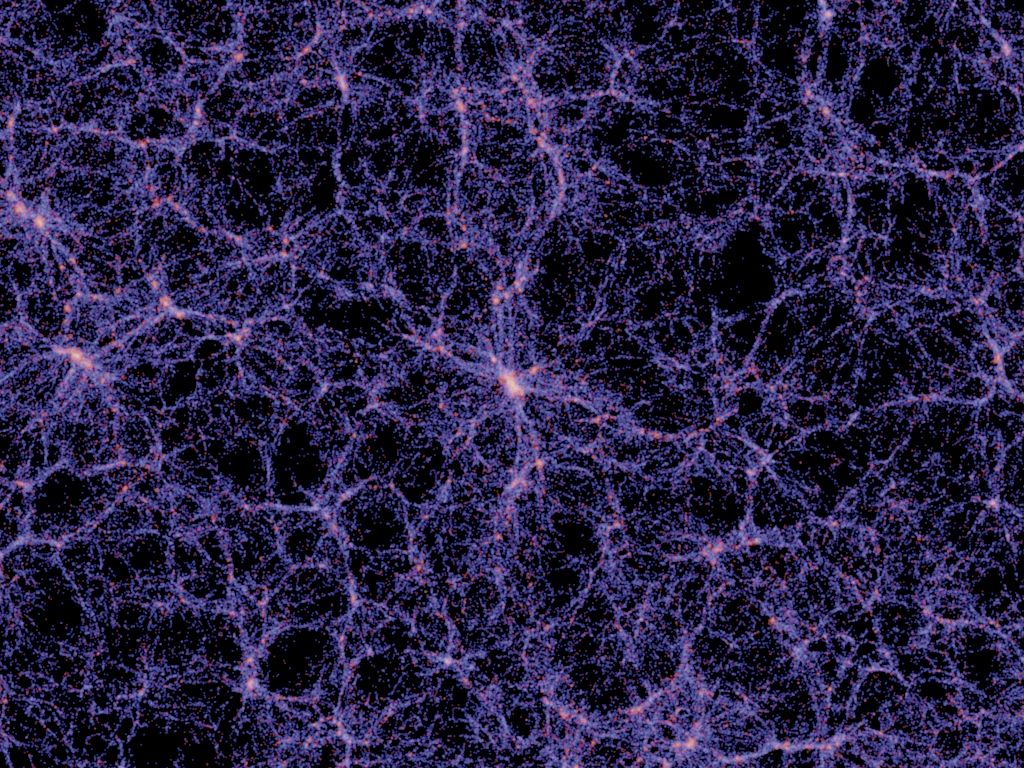
Artist’s large scale view of the universe.
The gulf between the very large and the very small strains credulity but science says it’s real. When thinking about it, I am overcome by wonder and despair of not knowing why or how.
Theoretical physicist Nima Arkani-Hamed has said that the gulf between the very large and the very small is required to balance the force of gravity against electrical forces in celestial objects like planets. He has pointed out that the ratio of the surface area of a typical atom and the surface area of a typical planet mirrors the difference between the two forces.
Nima Arkani-Hamed, one of the world’s top theoretical physicists, makes a point.
The huge difference between the force of gravity and the force of electricity makes the gap between the very large and the very small essential in a universe that works like ours; the difference in scale is necessary and inevitable, Nima has said.
If the ratio moves too far from this balance — if the surface area of an object gets too big — gravity will overwhelm the electrical forces that hold the atoms apart to cause the object to light up from a process called fusion, which can leave behind a shining star. A much larger object will collapse to become a black hole.
Why is the gap between the force of gravity and the electrical force as vast as the difference in surface area between a typical planet and a hydrogen atom? How did the ratio get that way?
No one knows. The values of the forces seem as finely tuned as they are arbitrary. Nima Arkani-Hamed and others are working to understand why.
Another mystery: Why is the universe so big?
Even Nima Arkani-Hamed admits he doesn’t have the answer — not yet, anyway. Perhaps the answer lies in the geometry of spheres, which is the basis of the Billy Lee Conjecture discussed in the essay Conscious Life.
Speaking of spheres, everyone knows that billiard balls are polished smooth, right? Earth, after being shrunk to the size of a pool ball, is smoother and less blemished; more perfectly round. Exhale on a pool-ball to create a mist that is 10 times deeper at scale than the deepest ocean on Earth.
Do the math.
It’s true.
As a child my nightmare was of an enormous whale crushing a tiny flower. A psychologist told me that the whale was a parent; I was the flower.
Maybe.
But the universe captures my nightmare. It’s really big, and I am so very small — helpless, lost, and crushed within its vast expanse.
Here is an excerpt from a 1975 resume about my experience in the nuclear power industry:
Engineering Technician at Ingersoll-Rand Company. Designed and serviced pumps and condensers for nuclear power plants; assisted engineers on service calls; toured and worked inside nuclear power plants; trained in construction and operation of nuclear power plants.
I didn’t last long at Ingersoll-Rand before they fired me for incompetence. But during the six months before my meltdown they sent me inside nuclear power plants to learn how to operate and maintain the pumps and condensers used to move and cool liquids inside the plants. Under the supervision of licensed nuclear engineers I learned how to inspect and fix pumps — some of them the size of little houses.
The plant executives had the habit of inviting visiting engineers and technicians to lunch, where their supervisors would present short overviews of plant operation, describe safety features, and speculate about the future of nuclear energy in the United States.
They promised that the government planned to approve the construction of a thousand nuclear power plants by the year 2000. The facilities would be “fail-safe” due to their many redundant safety features. As it turned out, their enthusiasm was misguided.
As of today, 438 nuclear power plants have been built in the entire world. The United States operates 61. The safety record is abysmal.
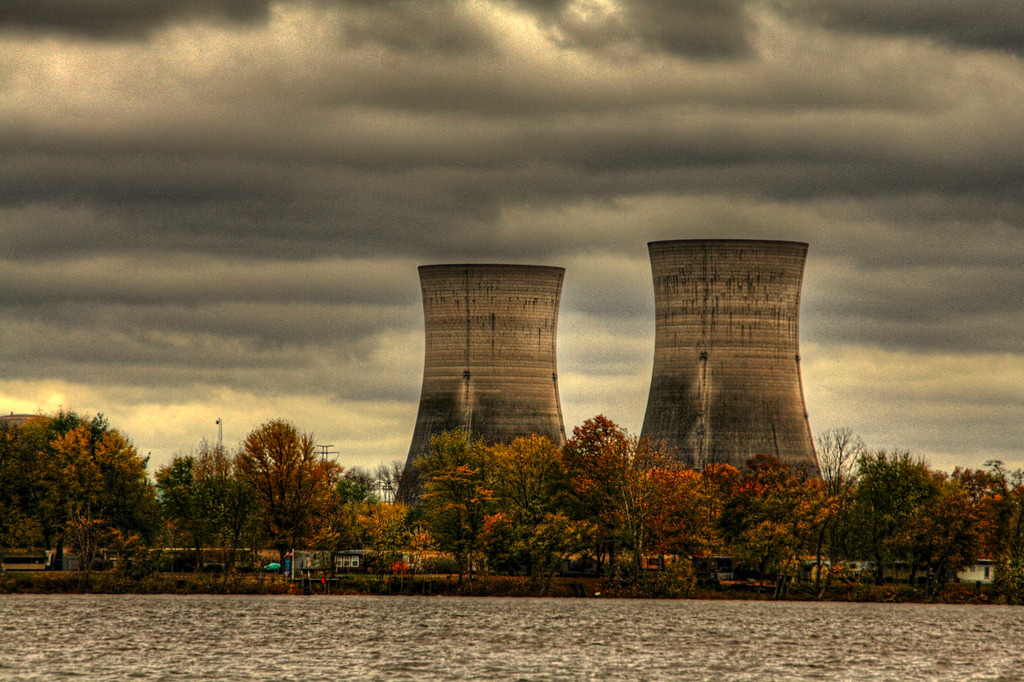
The Three Mile Island Nuclear Power Plant in Pennsylvania suffered a partial meltdown in March 1979 — twelve days after Michael Douglas released the movie China Syndrome. The meltdown catapulted the movie to international success as people struggled to understand what happened. After the accident, cancer rates within ten miles of the plant increased 64% according to a team of Columbia University researchers.
Currently, there are 30 operating nuclear reactors at 12 generating stations on 11 sites in the Great Lakes basin. Almost all are located on the banks of our great fresh-water lakes. Radioactive waste-products are stored in cooling-ponds at each of these sites yards away from the purest fresh-water on planet Earth.
Highly radioactive, spent-fuel rods are collected and dry-stored at Chicago’s Lake Michigan Zion facility, which experts warned in 2015 pose risks not only to the Great Lakes but to the entire region. The lethal dry-storage facility and the contaminated ponds at power-plants located on the shores of the Great Lakes grow in size and radioactivity year after year after year.
Editors note: On 25 October 2016, Energy Solutions announced that the Zion plant is 88% shut down and that all of its high radiation fuel rods are now contained inside an on-site ISFSI (Independent Spent Fuel Storage Installation) where they will remain until someone figures out what to do with them. The entire facility is scheduled for closure by January 1, 2027 at a cost of 1 billion dollars.
We are one earthquake away from catastrophic contamination of up to ten percent of the world’s freshwater supply.
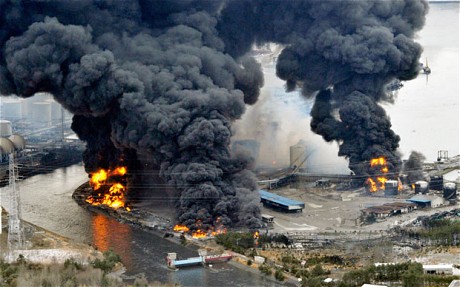
31 people died at the Russian Chernobyl Nuclear Power Plant in April 1986. Today the number of deaths stands at nearly 100,000. The plant released 400 times the radioactive material of the bomb dropped by the USA on the Japanese city of Hiroshima. Authorities evacuated the city; it remains uninhabited. Click this link for a drone-video of the site.Fukushima Nuclear Power Plant in Japan experienced catastrophic failure during the March 3, 2011 tsunami, which swept away nearly 20,000 people. The accident irradiated over 300 workers and killed six. The site will never recover.
Editor’s Note added 3-11-2021: The Japanese government announced this week that 3,775 people died during the past decade from health problems caused by what officials now admit was a “triple meltdown” at Fukushima. 41,000 remain forced to live outside their hometowns.
Several districts near the plant continue to be off-limits to everyone. The government hopes to decommission the power plant by 2051.
The ruined facility houses 900 tons of highly radioactive debris and 1.2 million tons of radioactive water that must be removed and isolated before the plant can be safely closed. The coronavirus pandemic slowed progress at the site, according to NHK News.
Anyway, after the lectures — which were accompanied by short films and slide presentations — executives opened the sessions for questions from the audience. I was one of those nerds who believed they were serious so I did ask a lot of questions. (I was a pontificator even then).
I asked: What is the half-life of the radioactive waste produced in this plant? Where is waste stored? How much of it will this plant produce over the next 30 years? What happens during an earthquake? How are meltdowns prevented? What are the consequences of operator errors? What happens when the plant gets old and comes to the end of its useful life?
It wasn’t long before my supervisor called me into his office and advised me to keep my questions to myself and do my job better. But it was not to be. I learned a life lesson: when the boss tells you to be quiet and just do your job — hold on to your hat. It’s too late. You will be fired as soon as the permissions and the paperwork are done.
Maybe I was incompetent. I don’t know. After being fired I went into counseling for depression. I re-entered MSU and studied mathematics and electrical engineering. I ended up designing machinery — mostly in the food and beverage industry — until I retired six years ago in 2008.
Everyone uses tear-spout coffee lids on foam coffee cups. Folks drink their coffee without removing the lid. Yeah, I designed the first one and the tooling to produce it; it was a team effort, of course. Everyone buys orange juice and milk cartons with tamper-proof safety caps. Yeah. I did those too. I share a patent, which proves it.
What am I most proud of? I didn’t design a damn thing on that Fukushima disaster, which is contaminating the Pacific Ocean and its fish stocks, perhaps to the end of time.
Billy Lee
NOTE from the EDITORIAL BOARD:In May 2019, HBO released its award nominated series on the Chernobyl disaster of April 25, 1986. The producers speculate that up to 93,000 Russian citizens died in the aftermath from radiation poisoning. The video below is a promo of the series.
When I was 4 years old, our family lived in Japan.
I have a vivid memory of a dark night when the maid took my brother and me out for a rendezvous with our parents. We stood on concrete steps outside a brick building waiting for them to show up.
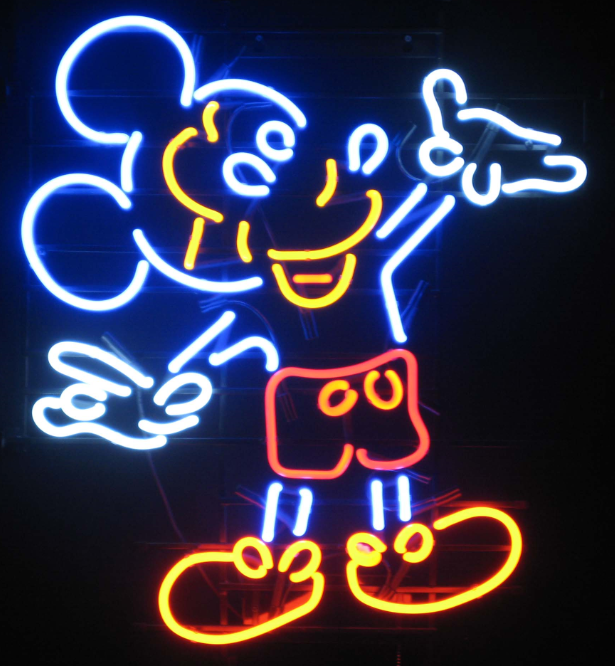
The neon sign emitted a bright glow of colors. I’d never seen anything like it.
Beneath the starless sky, almost at eye level, a neon sign emitted a glow of colors. I’d never seen anything like it. I asked our Japanese maid what it was. It’s television, she said.
The year was 1952. Four years earlier, the first television stations in the United States started to broadcast. But Japan then was a primitive, conquered country. It would be years before television arrived. Our maid didn’t know what she was looking at. Neither did I. For me televisions continued to be bright neon signs for quite some time.
True regular commercial television network programming did not begin in the U.S. until 1948. During that year legendary conductor Arturo Toscanini made his first of ten TV appearances conducting the NBC Symphony Orchestra;Texaco Star Theater, starring comedian Milton Berle, became television’s first hit show. Since the 1950s, television has been the main medium for molding public opinion.
[Not to digress into weeds that might choke a winding river, but during World War II, Italian composer Arturo Toscanini’s daughter Wally Castelbarco (friend to Russian-born actress Marianned Pistohlkors) and Allen Dulles (CIA director, 1953-1961) engaged in a ”forbidden” sexual affair in Bern, Switzerland (check the correct location and dates). President Kennedy fired Dulles after the failed 1961 Bay of Pigs invasion of Cuba. Following Kennedy’s murder in 1963, Allen Dulles sat on the Warren Commission. He died from complications of flu in 1969. Wally is the woman at the far left standing next to her parents.]
Like almost everyone else in America, our family missed the first seven years of broadcast television, including Toscanini’s series. I was born in San Diego in 1948, the year commercial television made its debut. At the time, Americans owned 45,000 television sets — three-quarters of them in the New York City area. (Americans owned 44 million radios.) In San Diego, what few televisions there were lay locked, most of them, behind laboratory doors.
Mom and Dad didn’t buy our first television until 1955. I was seven. By then we were living in Bethesda, Maryland where Dad worked for the National Security Agency. At the time, no one knew the NSA existed. It was television, many years later, that brought the secret agency to the public’s attention.
Touching the television could get you sent to your room, or worse.
Our first television looked a lot like the one pictured above. It was a magical box that, at first, we were not allowed to touch. Touching the television got us sent to our rooms, or worse. Dad delivered a painful nip with his finger to the back of any hand that dared to touch the keen knobs that controlled the TV’s mysterious features. But eventually, especially when Dad wasn’t around, the rest of the family, myself included, became adept at the controls.
The television-set broadcast two channels crisp and clear and one channel with a lot of “snow.” The picture was always black and white, and the stations went dead after 11:30 PM. Of course, we were all in bed well before then. Our parents wouldn’t dream of staying up later. They worked, after all.
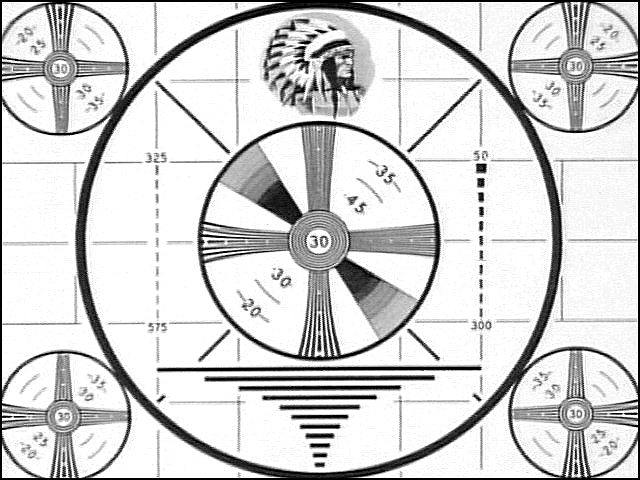
After 11:30 PM each television station would display a graphic like the ones below and issue forth a loud hum or ringing noise. Sometimes I got up way too early and would observe these mysterious symbols and their humming on all three channels. They reminded me of what we might see and hear if Russia attacked us with atomic rockets.
After hours, mysterious symbols hummed on all three channels.
Our favorite shows were on early Saturday morning. In addition to cartoons like Mighty Mouse, we watched The Lone Ranger, the Howdy Doody Show, Buffalo Bill, and Captain Kangaroo.
On weekdays after school, we rushed home to watch the Mickey Mouse Club starring Annette Funicello. I loved Annette completely. She was the only female Mouseketeer to have boobs.
Annette Funicello
Next to Marilyn Monroe — who everybody knew about but no one had ever seen (she wasn’t allowed on television) — Annette Funicello was the most desirable female on planet Earth at that time. But, by fourth grade, a terrible tragedy struck. Though not reported by television or newspapers (kids didn’t read newspapers, anyway), every child somehow learned that Annette had died from bubblegum asphyxiation — a tragedy to rival the Kennedy assassination years later.
Much later — in college during the 1960s — we learned Annette Funicello didn’t die. Media reported that she was alive and well and living somewhere in California.
The knowledge helped to ameliorate the pain of other deaths that were reported in the newspapers and on television back then — John and Bobby Kennedy; Martin Luther King; Malcolm X; Otis Redding; Jimi Hendrix; Janis Joplin; Marilyn Monroe; Che Guevara — and many others. Maybe it was possible, just possible — we hoped against hope — someday, someway — we would learn that these unusual people didn’t die, either.
By my third-grade year, the biggest event in everyone’s lives was the night Elvis Presley appeared on television for the first time — on the Ed Sullivan Show. Everyone — adults and kids alike — dropped everything to see Elvis. Words cannot express how huge this event was in the history of America. Those who didn’t have a television went out and found one. The entire country watched.
Everyone knew about the controversial movements Elvis Presley made with his legs and hips — they were reported in all the magazines and newspapers — but no one could imagine what these moves actuallylooked like. We needed television to show us.
Elvis Presley, 1956
And what did television do? In a spectacle that would be repeated again and again for decades after, television dropped the ball and disappointed its huge viewing audience. The camera focused on Presley’s face and upper body. No one saw his infamous lower-body machinations. After all the psychic energy invested by everyone to finally learn the secrets of this unusual man’s success, television left us wondering.
Elvis sang a song that night we had all heard many times before on the radio: Hound Dog. Seeing the song performed — not just hearing it, like on the radio — was exciting enough to make most everyone forget about what they had missed.
You ain’t nothing but a hound dog — cryin’ all the time. You ain’t nothing but a hound dog — cryin’ all the time. You ain’t never caught a rabbit, and you ain’t no friend of mine. When they said you was high class, well that was just a lie. When they said you was high class, well that was just a lie. You ain’t never caught a rabbit, and you ain’t no friend of mine.
No one who experienced the magic of his television appearance could imagine in their darkest nightmare that someday Elvis would die, too.
On a brighter note: advertising revenue for the show set an all-time record; viewership set an all-time high. It seemed clear to all that television was here to stay.
The word community sounds egalitarian to most people. And gated? No word yields a fairer portion of safety to airy openness in the image it conveys to the mind.
Gated community near Orlando, Florida.
Florida is a land flowing with gates and communities. It is a Promised Land of sun, leisure, warm pools, and exclusivity. For the past month Bevy Mae and me have been vacationing inside this paradise at a house in one such community near Naples, Florida. It took three references, photo ID, and all cash up front to get in here.
We are grateful for our good fortune. And we are in a really safe place. But when thinking about the state of affairs which has excluded as many as 94% of all Americans from the possibility of living here — if only for a few weeks — it makes me sick to my stomach.
Of course, if you don’t live here, you can’t be here — not even to drive through.
The compound we live in is huge. While biking in it the other day I was amazed to stumble on anothergated community inside ours. It’s blessed by God with a lake and huge houses.
What’s strange is the gated occupants of our community aren’t allowed in their gated community even though their community is inside our community. Apparently, there are layers of gated-ness. I never knew that.
As teenager, I lived two years in Key West, Florida. It was before Civil Rights Act of 1964. It was totally segregated there. The only Negro I ever saw was our maid.
Our housekeeper was an articulate thirty-year-old woman and really beautiful. I liked her a lot and talked with her every chance I got, usually about politics. From her, I learned how difficult life was for black people in Key West at that time — and maybe as important, that a lot of Negroes actually lived on the island. Never knew that, either. Somehow, they managed to keep an extremely low profile.
She said she supported the incumbent Democrat for Congress who was then running against an upstart Republican — a young guy always on the radio complaining about how rich his opponent was. She liked the Democrat, she said, because he once bought park benches for her neighborhood.
At Key West High School, the powers-that-be were considering the admission of a black kid from a “good” family. His dad was an officer in the U.S. Navy. Over lunch in the school cafeteria, I made the mistake of saying I saw nothing wrong with going to school with “Negroes” (as polite people referred to them).
“What!” some kid yelled. “You want to eat with niggers?” Soon a crowd gathered. I stood my ground, and no one beat me up. The South was changing, I guess, but only a little.
One thing Key West didn’t have back then — no town did in those days — was gated communities. We had a military base that was gated — I lived on it — but the gates were for security against the hated Communists. We didn’t have terrorists or any other sort of enemies of the state. All that was to come later.
After World War II, the South and some parts of the North enforced segregation with a civilian militia called the Ku Klux Klan. It was a quasi-religious/military-style organization self-tasked with extra-judicial punishments of Negroes who violated the unwritten codes of the South.
I know something about it. My grandfather belonged to the Klan for some years, which he said he regretted. He told me things. Everyone he knew then was in the Klan, and yes, they did things they believed righteous but weren’t.
If a black family bought a house in a white neighborhood, the militia would burn it down. Sometimes, so as not to smoke-damage nearby homes, the KKK bombed the house; or if white children lived close by, they might burn a cross in the front yard to scare occupants into leaving.
Lynchings — common after the First World War — were, by the 1950s, less common.
After dozens of documented actions against Negroes — and perhaps hundreds or thousands of undocumented ones — white neighborhoods did not need gates, or walls, or fences to remain segregated.
Eventually, after years of separation, white people who lived in these communities came to believe — many of them — that black people chose not to live next to them, because they preferred “their own kind.”
Terrorism? It didn’t exist in the United States of America in those days. First time I heard the word was in college. Terrorism, then, was always directed at Israel, for some reason, almost always by Palestinians. Reasons why were never clear.
I don’t know what white people say today is the reason black people don’t live in gated communities of Florida. I haven’t vacationed here long enough to learn.
I would bet that in some town somewhere in this huge state a black family probably lives in a gated community. Maybe more than one, right? I can imagine people pointing to those folks as proof of my being uncharitable to the good people of Florida and to people everywhere who live in these spaces.
But it seems plain to me — fifty years after Congress, the President and the Supreme Court declared segregated housing illegal — black people don’t live in these desirable places.
Why is that?
I don’t know.
I met a black man down here the other day. He told me he had been a Marine who helped liberate Kuwait during the first Gulf War.
Inside the shadows of the lanai next door lurks a loquacious parrot. Bevy Mae and me can’t see him, but we know he’s in there, because he talks — a lot.
We want to meet him. But we are visitors on vacation, and it doesn’t seem quite right to walk up to the neighbor’s front door and announce, “Hi, we’re the neighbors from up north. Can we see your talking parrot?”
It seems a little forward, like something kids might do, right?
Every morning the parrot wakes us up with cries of “Lisa!” and “Chuck, Chuck!” When Chuck and Lisa don’t come running (and so far they haven’t) he can throw a bit of a hissy-fit and bang his cage like a tin can. Sometimes he hurls what sounds like obscenities.
I don’t want our neighbors — who I’ve met by the way; sweet folks from South America — to imagine that my wife and I don’t anything but adore their bird. We really do.
The parrot has an astounding repertoire of words and phrases that are nothing short of amazing. His Burt Lancaster accents and phraseology make me believe he may have been in the movies.
We will keep you posted on all the cute things he says and does.
4:30PM The talking parrot was well behaved this afternoon. He said the following:
The title of this post is CAPITALIZED SO YOU CAN HEAR IT!
As many approach their “Golden Years” (we never quite get there, if you know what I mean) some begin to experience the annoyances of aging.
One annoyance is the way folks mumble; who can understand them? To encourage folks to speak more clearly, I have included actual verbal exchanges — recorded over the past months — between Grandma Bevy and me.
I hope readers will take the hint and learn to enunciate!
Grandma Bevy: I think it’s bean soup.
Grandpa Billy: What’s been sued?
Grandma Bevy: Julian’s mom worked at Eyde.
Grandpa Billy: Julian’s mom worked and died?
Grandma Bevy: Oh look, my pill is scored.
Grandpa Billy: I got gored? I don’t think so.
Grandma Bevy: Put your hat in the closet, like a that.
Grandpa Billy: Like a bat?
Grandma Bevy: Like a that.
Grandpa Billy: Like a vat?
Grandma Bevy: Like that!
Grandpa Billy: What?
Grandma Bevy: Do you want one egg or two?
Grandpa Billy: I want new.
Grandma Bevy: I said, one or two. Turn up your hearing aid!
Grandpa Billy: OK. An old one, then.
Grandma Bevy: So, Chuck got the take out and…
Grandpa Billy: Chuck got the tank out?
Grandma Bevy: Take out… take out!
Grandma Bevy: I guess my group won’t be meeting for another two weeks.
Grandpa Billy: You aren’t eating for two weeks? Bev, you don’t have to do that for me.
Grandma Bevy: Now is a good time to take your blood pressure.
Grandpa Billy: Take my butt pressure?
Grandma Bevy: Yes, your blood pressure.
Grandpa Billy: Sounds good.
Grandma Bevy: You can have some turkey later.
Grandpa Billy: I have a turkey flavor?
Grandma Bevy: If you want to.
Grandma Bevy: Our kids are traveling in Europe this summer. We’ll probably be at home.
Grandpa Billy: We’ll be in a home?
Grandma Bevy: You might be.
Grandma Bevy: There are some real egos in that neighborhood.
Grandpa Billy: Eagles? No way.
Grandma Bevy: I said egos. There are some big egos in those big houses.
Grandpa Billy: Maybe some hawks. No eagles.
Grandma Bevy: Oh look! A new dishwasher.
Grandpa Billy: A nude dishwasher?
Grandma Bevy: I texted Doug for his birthday.
Grandpa Billy: You hexed Doug on his birthday? That’s not right.
Grandma Bevy: I have to call Perry’s office to get a refill on my prescription.
Grandpa Billy: Call your parent’s office?
Grandma Bevy: Perry’s office. Perry’s office! Clean your ears!
Grandma Bevy: Am I in your way?
Grandpa Billy: Am Miami way?
Grandma Bevy: No. Am I?
Grandma Bevy: Mary has been placed in hospice care.
Grandpa Billy: Mary hasn’t paid her hospice care? She was always so responsible.
Grandma Bevy: You put the shades down in the bedroom. Afraid someone’s going to see your body?
Grandpa Billy: Seize my coffee? I don’t drink coffee in the bedroom. Never have.
Grandma Bevy: We haven’t seen the neighbors in their hot tub lately.
Grandpa Billy: In their hot dog?
Grandma Bevy: You can put the plates and silverware on the table.
Grandpa Billy: I can put the plastic silverware on the table?
Grandma Bevy: Plates, PLATES!!! (Throws up hands)
Grandma Bevy: I’m going to physical therapy now.
Grandpa Billy: Hysterical therapy?
Grandma Bevy: Oh, for crying out loud.
Grandma Bevy: Guess what? I have a urinary tract infection.
Grandpa Billy: You have a yearning for a track infection? Why, Bev, why?
Grandma Bevy: My sciatic nerve is killing me.
Grandpa Billy: Your psychiatric nerve is bothering you?
Grandma Bevy: You certainly are. (Glares, rolls eyes)
Grandma Bevy: I thought you said you were going to e-mail her.
Grandpa Billy: Female her?
Grandma Bevy: Billll…Y.. !?!
Grandma Bevy: Did you know that tea, coffee, and cocoa contain different stimulants? I’m a nurse, right? I studied dietetics.
Grandpa Billy: Diuretics? Heh! I studied beer-drinking. ‘Course, that was a long time ago — before my prostrate swoll and nearly killed me.
Grandma Bevy: You don’t drink much now.
Grandpa Billy: I think plenty. I’m sharp as a tack.
Grandma Bevy: Don’t hear so good either.
Grandpa Billy: Donneer soggy ether?
Grandma Bevy: Here’s a straw. Finish your soup, dear.
Grandma Bevy: You dropped a glob of jelly on the table cloth.
Grandpa Billy: … on the tuna cloth?
Grandma Bevy: [starts singing to herself]