WHAT HILLARY DID

Hillary Clinton 6
Hillary Clinton sometimes shares stories with people about her late mother Dorothy Rodham who was born on 4 June 1919 — the same day that the women’s voting rights amendment cleared its final legislative hurdle in the US Congress.

People have a difficult time grasping a simple truth: every time the right of women to vote in national elections has come before the Supreme Court, the Court has voted against it. Despite a national movement that started in 1848 at Seneca Falls and continued with annual meetings of National Women’s Rights Conventions from 1850 onward, courts in America have rarely ruled in favor of women’s rights; the Supreme Court has never ruled in favor of a woman’s right to vote; never.

Even when women were arrested and imprisoned; when they went on hunger strikes and guards force-fed them like modern day prisoners at Guantanamo Bay, the courts remained harsh and unforgiving.

It took a constitutional amendment (the 19th) passed by the votes of loving brothers, fathers, grandfathers, husbands, sons, and boyfriends in state legislatures across the country for women to make their successful end-run around the opposition to female voting that infused the Supreme Court; it wasn’t until 1920 that every woman in America secured the right to walk into polling places to vote in national elections. They never looked back.

Voting rights for women became a settled legal matter in 1922 when the Supreme Court ruled unanimously that the procedures demanded by the Constitution were properly followed. The 19th amendment would never be reversed — short of another constitutional amendment. That amendment can never come now that women are voters.

It’s been ninety-six years. There are women walking around today who were alive when their right to vote was granted. It wasn’t that long ago. Hillary Clinton has sometimes reminded us that her late mother was born on June 4, 1919 — the same day the voting amendment passed its final legislative hurdle in the United States Congress.

Before I explain just what it was that Hillary did, here’s some background; a little history, Billy Lee-style:


Alfred_A._Stratton civil war amputee
Union soldier Alfred Stratton lost both arms to cannon fire at age 19. One of every thirteen soldiers lost limbs in the Civil War. After his discharge Sgt. Stratton sold pictures of his wounds to support his family. He died at age 29 leaving behind his wife and two children. For me his eyes convey the heartache of a soldier who won at war and lost everything.

After the end of the Civil War, which traumatized the nation with its toll of 750,000 deaths and millions maimed and wounded — 1 of every 13 soldiers who served became an amputee — something worse happened. The men in America who survived but lost their way of life to war, many of them, became demoralized and angry; they spiraled downward. Some who managed to keep their limbs continued to fight; they went to war against the ”redskins” in genocidal campaigns that decimated our native populations.

But other men — I would say most of the survivors — went on a drinking binge. The binge lasted decades. Some men drank themselves to death. The tranquilizers and antidepressants that might have saved many hadn’t yet been invented.

Opiates were available, yes, and many ex-soldiers purchased them in bottled elixirs sold by traveling salesmen. But alcohol was the remedy of choice for men whose minds and missing limbs exuded the chronic, excruciating pain of amputations and the memories of horrors. Alcoholic spirits were cheap and easy to buy. The excessive use of alcohol and the inevitable abuse of women that always seemed to follow became a national epidemic; a cultural disgrace. It lasted decades; some say it has never really ended.

The bullying of minorities, native people, and women — cruelty often directed against the weak and defenseless — became a way of life for many veterans who suffered post-traumatic-stress-disorder, which no one understood at the time. The vocabulary folks needed to even discuss the dynamics of this personal degradation by war was not available like it is today. For southern soldiers, the trauma of a lost way of life; the shock of watching former slaves ascend to leadership positions once reserved for whites-only became too much to bear.

Violence against women — their vulnerability in the face of drunk husbands and boyfriends — reached a level that women simply couldn’t take anymore. Many women believed that if they could just get their husbands to stop drinking, the abuse they experienced at home might come to an end.

No one understood at the time that the drinking and abuse were symptoms of an underlying psychological distress, not the cause. A hundred-and-fifty years of fear and paranoia was erupting out of the guilt and shame of seizing lands that belonged to others; of kidnapping, enslaving, and vilifying millions of Africans; murdering tens-of-thousands of women and children during wars with the Indians; and blood-letting in the war between north and south where brothers killed their own brothers.

Americans wasted the lives of other Americans in the Civil War at a rate that has never been equaled since by any external enemy or foe. Americans suffered more casualties during the Civil War than in all other wars combined.

All this evil bubbled up out of the badlands of America — America was arguably the world’s largest and most isolated island at the time. The men who witnessed war; who lived it; who perpetuated it and became its victims held onto their minds and emotions by clinging to desperately delicate threads. Many lost their grip — emotionally and physically — and died early; some took their own lives.  

By the beginning of the twentieth century, most women had had enough. By 1914 (the start of World War I) they were fed up, vulnerable, and powerless. Their men were going off to fight another senseless war where a third of the dead would expire by poison gas while hiding helpless in the muck of trenches. The government passed the Selective Service Act of 1917 (the draft) because in this war young men, many of them, lost their will to fight. 

Women had a big stake in the new war. Most women, despite the abuse, had male friends and relatives. They were mothers; sisters; daughters; grandmothers; even great-grandmothers. They nurtured the men in their lives who weren’t coping well with the nightmare-world into which the USA morphed after terrible decades of slavery, endless war, cruel repression that followed Reconstruction, and the extermination of the native peoples (who they called Indians).

Men, some of them, began to see that women might be right. As a country, what we were doing wasn’t working. People were going to have to change the way they lived and conducted the nation’s affairs.

Most folks know what happened. Women — who couldn’t vote — organized. Men joined them. Everyone seemed to agree on the underlying problem: it wasn’t so much the wars or racial violence or even the rise of robber barons and corrupt governance; what was wrong with America — it was so plain to see for anyone who made the effort to open their eyes — was the alcohol.

Get rid of alcohol, the Devil’s drink, and God would heal our land. God would make right the terrible things we had done. Citizens would all enjoy together at long last the peace of mind that comes with the forgiveness of sin and the love that only Jesus brings to every man who murders and rapes because he can’t stop drinking.

In January 1919 — led by women from the suffrage and temperance movements among others — the 18th amendment passed, which put commercial restrictions on the manufacture and sale of alcohol. The amendment took full effect in January 1920. The public consumption of alcohol — with all its problems — was now in the past.


Let women vote poster


Emboldened and buoyed by their power to pass almost simultaneously — and in the face of judicial opposition — two constitutional amendments: one that allowed women to participate in the nation’s democracy; the other that corralled the wicked impulses unleashed by alcohol in their war-weary men (World War I ended in November 1918), the women of 1920 felt the stirrings of a new optimism about life in the United States and their future.  

With the help of the men who leaned on them for comfort and emotional support, 75% of the states agreed to ratify the two amendments certain to set things right; amendments that would most assuredly lead the way forward to the salvation of America.

Thus began the walk on the pathway toward righteousness. Citizens basked in the light of greatness; they had won the war in Europe; men marched home in the glow of favor that comes to every repentant people by the forgiveness of Almighty God.

The nation was being transformed into a people; a united people, a nation of both men and women who turned their backs on the devil; who put behind them his corrupting spirits and ales.

Americans — all of us together — at last embraced liberty and freedom and voting-rights for women. After all was said and done — campaign posters explained it beautifully — it was women who brought every single voter into the world. 

And indeed alcohol related crimes fell fast after 1920.

There was a little problem, though.

Despite widespread support for the right of women to vote and for the prohibition of the public consumption of alcohol, it turned out that not everyone in America wanted to climb on board the choo-choo train of righteous-living.

Again, we know what happened. Men formed gangs from which they drew the power to circumvent Prohibition. They continued manufacturing and distributing alcohol, which they sold in clubs they called speakeasies and blind pigs.

Although the 18th amendment did not forbid drinking by private individuals in their own homes, the Constitution of the United States now forbade the commercial production and sale of spirits and ales in public spaces like clubs and liquor stores.

Like the forbidden fruit of a modern Garden of Edenblind pigs became the rage in every major city in America. By the 1930s, the revenues generated by illegal clubs were so enormous that the gangs who merchandized alcohol were able to wrest control over whatever businesses or local and state governments they chose.


Inequality is never good. Neither is packing a family into a car with no seat belts.


What happened? Crime cartels took over and basically ran our country into the ground. By 1930 our economy collapsed. The Great Depression began. By 1933 ordinary people had enough. Voters — women and men — repealed Prohibition. Voters hoped repeal would stimulate the economy, emasculate the crime-bosses, and reverse the rot that was infesting like a plague of sewer-rats every city and municipality.

It wasn’t to be. By 1933 the iron grip of organized crime was entrenched and intractable. It wasn’t going to let go. Despite massive government spending, new social programs, and numerous public-works projects, unemployment, poverty, and despair continued to demoralize society. The USA spiraled downward; it seemed to never end; maybe it would last forever. 

World War II changed everything. The cartels went into the munitions business. They took control of the factories that built bombers and guns. We’ve been at war ever since. We’ve waged war against one out of every four countries on Earth during the past 75 years. Business has been good.

In the 1980s the cartels decided to try their hand at pharmaceuticals; medical care would come later. It was challenging; pharma was technical; it was hard to understand. What they learned was this: Americans were open, even eager, to try new drugs; to adopt new treatments. The treatments and drugs offered hope. It didn’t seem to matter if they worked all that well.

The drug cartels lobbied Congress for regulatory relief so they could advertise their ”medicines” on television. The rest as they say is history. The people of the United States are now the most drug dependent civilization ever. We may not be that healthy compared to people in a lot of other countries but with the right medications we sort of feel like we might be.

We all know the results. Americans spend more on heath care and drugs than on their houses and food. USA health care is a mess — who will argue with me? But it’s lucrative.

Health care is today the biggest cash cow for the most heartless group of wise-guys ever to take control of American institutions; let’s give this group of con-artists some respect and refer to them as “the medical profession“.

Why not?

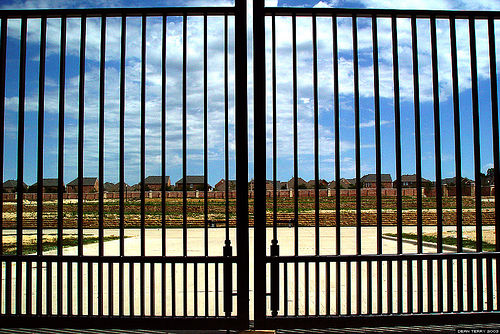
Even if folks were able find out the address of their local hospital administrator and a few of his surgeons, they would never be able to visit to drop-off their complaints because these high-rollers live in a hidden world behind gates, most of them. They live like the heads of caliphates, many of them. Yes, these individuals are clever. But Americans are paying too high a price for cleverness.

So… readers who’ve read this far might be asking,

Well… are you going to tell us what Hillary did?

Of course I am. Would I let readers down?

Never!

Hillary’s husband, Bill Clinton, became president of the United States in January 1993. One of the first things he did was appoint his wife to help create a healthcare plan to cover every American — detractors would come to call it HillaryCare.
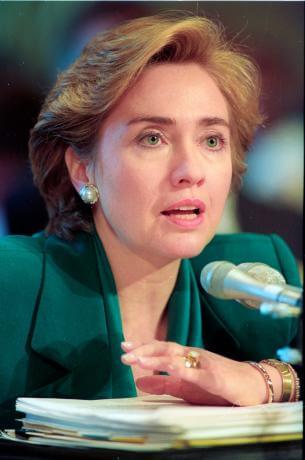

First Lady Hillary Clinton testifies for the final day before the Senate Finance Committee on Health Care September 30, 1993. REUTERS/Mike Theiler
First Lady Hillary Clinton testifies for the final day before the Senate Finance Committee on Health Care 30 September 1993.  REUTERS/Mike Theiler

The techniques used by the healthcare industry to crush universal health care are a case-study in Evil — for anyone who has the stomach to examine what its leaders did. Anyone can click on links in this essay to learn more if they want.

I don’t really care to get into it; the details, that is. The whole episode disgusts me as it should any fair-minded person who cares about ordinary people and their health.

The bottom-line is this: Hillary walked into a snake pit, then hit a brick wall. The healthcare industry chose to demolish the wife of a sitting president in the first year of his first term. They made an example of her.

People would think twice before pulling a stunt like healthcare reform again. It worked — for 15 years anyway — until the Kenyan usurper with no birth certificate, President Barack Hussein Obama, showed up.

The bad-actors who administer the health delivery system in America today consider Hillary Clinton a clear and present danger to their trillion-dollar cash cow. They intend to regain control of Health Care as soon as the GOP wins the presidency this fall. That’s their plan, anyway.

After defeating Hillary’s efforts in 1993, the industry and their buddies began a CIA-style disinformation campaign against her which has continued for the past 23 years — in case she might rise from the ashes of defeat to come after them one more time.

Guess what? She’s on her way. This time she is not one person — the eager-to-please wife of a new president. This time she is 120 million voters strong and counting. If current polling holds, she will be the next president. 

Look at what these yahoos said about President Obama after he tried to fix our casino-style healthcare system during his first term. Does anyone think these folks are not able to discredit others while maximizing their own considerable advantages?

They’ve thrown up roadblock after roadblock. They’ve arranged things so that the new healthcare options can’t be fully implemented until Obama has left the White House. With the election of a Republican president, they plan to dismember and discard ObamaCare  — quickly. Most Americans will never fully understand what they missed or what was taken from them.

Before ObamaCare, when people got sick, insurance administrators sometimes kicked them out of the healthcare casino, altogether. People were on their own. Good luck, and God bless. 

The people who enforced these heinous policies are the same people who call Obama incompetent and a failed president. These are the people who have inflicted the nightmare of the current Republican contender on America; who are willing to scare the whole world to prove they are serious.  

These insurance folks and their  allies aren’t the government; they are civilians with the money to hire experts; they believe themselves fully capable of discrediting even the Crucifixion of Jesus should it ever become necessary. 

During the next six months they are going to use every technique in the army psyche manual to convince voters that Hillary Clinton is a witch who deserves to be burned on a phallic stake.

Watch and learn. They don’t want ObamaCare fixed. They want it wrecked.

Read my essay, Why This Time Women Will Win, to learn more.

Character assassination is just another way to kill someone, to my way of thinking. It’s murder. The Bible says it is, anyway.  I’m intrigued by the possibility that when Jesus said anything at all — even in a Book as discredited by the wealthy and powerful as the Bible apparently is — it might actually be God who is doing the talking.

Our self-described healers of broken bodies (I’m not going to name them because I don’t want them showing up at my house) cooperated with insurance company executives and drug company titans to destroy Hillary Clinton’s reputation. Their lavish lifestyles give them away.

People believe crazy stuff because they’ve listened to these creeps — sometimes on Fox News, the GOP propaganda mill. One guy on my Twitter feed called Secretary Clinton, Killary. He wasn’t smart enough to make up this epithet on his own, believe me. If this guy is the Christian he claims to be, Jesus is going to ask him someday why he would say such a thing. It could get awkward.

People on the right seem to believe that if they hate somebody, they can make stuff up to tear them down. It’s the way the game is played. 

There is an irony of wickedness here that almost defies explanation. It’s all because when she was young and naive Hillary believed that even the bad guys would do the right things when given the right opportunities; she dared to challenge the way health care is delivered in America — to make it fair and accessible to the 80% of Americans who could not afford it.

She learned the hard lesson many Americans now know is true. It isn’t about health care. It’s about protecting the golden cash-cow.

Who wants to work for $25 per month? they are always telling us about Cuban doctors. People who feel called to help the suffering multitudes will be the only takers in a system like that. People who value money will find something else to occupy their time.

Anyway, with a Hillary Clinton win this fall — should the Democrats take majorities in the House and Senate — our citizens will finally have a government with the right people in place to better defend us against being used for prey by the predators who presently plunder us.


Sandy Hook parents grieve
Victims of Sandy Hook massacre Christmas Season 2012. CBS News reported that the shooter’s parents were NRA members because NRA certificates and pamphlets were found in their homes. The NRA forced CBS to retract the story.  (Photo by Reuters / Andrees Latif — 2012)

Hillary has also taken on the NRA, in case anyone forgot; it’s another (some would argue) bad-boy organization that scares the daylights out of its opposition because a lot of crazy people with guns seem to be among its members. They defend the Second Amendment, which they think permits them to scare the crap out of people by carrying their guns into churches, hospitals, libraries, and schools.

NRA family members are numbered among the crowd of people who have ”gone postal” during the past few years; people who massacred politicians, children, and theater-goers. Hillary challenged this monster-cult. Its a group of men mostly who intimidate congressional leaders to vote against their own common sense.

Children die every week because the gun-makers sell unsafe firearms to an irresponsible public. It’s not right. It’s not safe. It’s not freedom. It’s manufactured fear, plain and simple.

The right to bear arms described in our Second Amendment was included to keep Americans safe and free, not scared and intimidated. It was written to save time when raising an army should foreigners like France or England choose to invade. The NRA has turned the amendment on its head into a money-making scheme for gun panderers who play to people’s paranoia and hate. It’s that simple, at least to me.

So yes, Hillary is a threat to people who are used to getting their way while they live like the cold-hard oligarchs they have become. Do these bad people have nice smiles? Do they wear beautiful clothes? Of course they do. They are billionaires. Their smiles cost hundreds-of-thousands of dollars, some of them. Their clothes cost more.

Hillary is not a billionaire. She never will be. For those readers not good at numbers, let me remind everyone: a billion is 1,000 millions. The man who is running against her; who calls her crooked Hillary — claims to possess 14,000 piles of a million dollars each.

Is it possible to earn and keep billions while working honestly and playing fair? I might believe him if someone I trust analyzed his tax returns, his company balance sheets, and income statements. Until he agrees to release them like everyone else who runs for president, I’m more than skeptical; I’m incredulous. 

In any event, it is the policy of theBillyLeePontificator.com to advocate for income and estate maximums based on agreed-upon and reasonable ratios tied to the minimum wage. These maximums can be very high and do no harm. Please read my essay, Capitalism and Income Inequality, to learn more.

We at theBillyLeePontificator.com do not believe we need a revolution to achieve simple changes to our tax codes that will impact less than one-hundred thousand privileged people.

We are 324 million people living in a democratic republic. It can’t be that hard to raise taxes on the greedy who are distorting our democracy and driving our country off a cliff to protect their power and privilege. Please read my essay Is Something Wrong With America? to learn more.

Something else Hillary did this week while challenging some of the most powerful people on Earth: she clinched the Democratic nomination for president; she’s the first woman of a major political party to do it.

What Hillary achieved cannot be overstated. It’s pretty darn incredible given the negative attitudes toward women-in-leadership espoused by many church and corporate leaders — behind closed doors, of course.  

Here are the election results; they might amaze some readers. The numbers say that mama Clinton has a fighting chance to win this election. My wife prays for her safety and success every single day.

So do I.

Billy Lee


2016 06 07 primary results popular vote
These results are from the 35 states where both parties held a popular vote contest. DC Democrats vote on June 14. Bold black ink indicates the winner. Blue ink indicates a second place finish.


2016 06 07 primary results mixed and caucus
These results are from the 11 states and 4 territories where both parties held caucus contests; and the 5 mixed primaries where one party held a popular vote, the other a caucus.


Editors Note: In the November election of 2016, Hillary Clinton beat Donald Trump in popular votes by nearly 3 million. Third-party candidates polled 8 million more. Donald Trump lost the popular count by 11 million votes — one of the largest popular defeats in the nation’s history. Manipulation of vote counts in Michigan and a few other states secured his win in the Electoral College. All courts everywhere refused to hear a single challenge to the results, which were razor thin in three states

ELEPHANT ON THE ISLAND

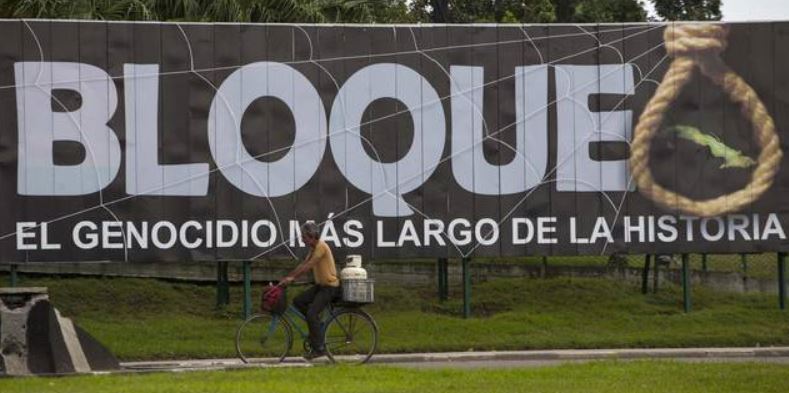
When President Barack Obama visited Cuba in March 2016, the USA-imposed blockade or embargo or quarantine or whatever-else one wants to call it was the elephant on the island. It was the elephant in the room at every meeting between our officials (who numbered close to twelve-hundred) and theirs. We owe Cuba a huge apology. Of course, we didn’t offer one. 


This billboard can be found in various places on the island of Cuba. In English it might be interpreted this way: The USA-organized embargo is the longest-lived genocide in world history. They intended to lynch us, but look; the noose is empty; Cuba swims free, beyond the yank of their rope.


Yes, Cubans once-upon-a-time tried to protect themselves from our overwhelming military power; our subversion; our unrelenting sabotage; our many plots to undermine and demoralize the Cuban revolutionary movement, which had overturned the Batista cartel and drove its Mafia friends off the island way back in 1959, a long time ago. We didn’t like it when the Cubans turned to the Soviet Union for help to defend themselves.

Let’s face some facts: It was 6 million of them against 220 million of us. It wasn’t going to be a fair fight. The Cubans were going to lose, and they knew it. 


El Encanto in 1955 Cuba
Terrorists fire-bombed El Encanto (a Havana department store) in 1961, just four days before the CIA-organized (and financed) Bay of Pigs invasion. This pic is from 1955.

Fifteen months after the revolution, in March 1960, someone blew-up a French ship in the Havana Harbor, which killed and wounded hundreds of civilians. Cuban police arrested a suspect who, it turned out, was an American with ties to organized-crime and CIA operatives; his team managed to infiltrate harbor-security, police said. 

Strange people started flying airplanes over the island on a daily basis to bomb sugar refineries and drop napalm on sugar cane fields. The Cubans managed to shoot down one aircraft and rescue the pilot. He turned out to be an American. Authorities blamed the CIA.

Then, just a few days before the Bay of Pigs invasion, terrorists bombed and burnt to the ground El Encanto, one of Havana’s upscale department stores.    


El Encanto department store after fire Cuba
The destruction of El Encanto was part of an extensive campaign to destabilize the island of Cuba. A few days after the terrorist attack, the Bay of Pigs invasion began. The USA public would learn years later that the invasion force had been organized, trained, and paid for by the CIA. The invaders killed and wounded 5,000 Cuban citizens before they exhausted their ammunition and surrendered to Fidel Castro, who led the island’s defenders.

Cubans had no clear idea, even as late as April 1961, that the USA was systematically destabilizing the island and had already finalized plans to invade Cuba and assassinate its leaders. 

A few days after the El Encanto firebombing, the invasion-force launched its assault — on Monday, April 17. It included close air-support, a squadron of B-26 bombers, and ships standing off-shore. The assault would come to be called the Bay of Pigs fiasco, mostly because the invaders ran out of ammunition and were forced to surrender.

Fidel himself led the island’s defense; Soviet intelligence informed him a few days in advance of the exact time and place; by some miracle related to our own incompetence, Fidel and his Cuban fighters repulsed the invasion. 

Castro’s Cubans managed to capture 1,200 invaders, mostly CIA-trained expatriates, who they later traded for medicine. Afterwards, they begged the Soviet Union to get more involved, because they believed the USA would attack again. Maybe the next time the USA would send more ammo and a bigger air-force, and Cuban defenses wouldn’t hold up.

Our government wasn’t too happy about the deal Cuba made with the USSR. The Soviets took advantage of Cuba’s weakness, Che Guevara would later claim. Che told Fidel and the Soviets that the deal was one-sided and not good for Cuba.

The alliance between Cuba and the Russians almost started a nuclear war, because the Soviets insisted on putting nuclear missiles on the island and basing nuclear-tipped submarines in Cuba’s harbors.

The Russians believed that the island could not be successfully defended against a full-on USA invasion using conventional weapons alone. Had a nuclear-missile exchange occurred, neither Florida nor Cuba would be habitable places even today, fifty-four years later. Millions of Cubans and Americans would have died.

Fortunately, deals were made and tensions de-escalated. The Soviets loaded up their weapons and took them home.

For the United States the fight was just beginning. Although the USA promised the Soviet Union that it would not militarily invade Cuba again (rendering nuclear defense unnecessary), it did not promise anything about an embargo. The United States talked and threatened every country in the Western Hemisphere into imposing one. The only country that refused was Mexico.


Cuba frozen in time
The USA-led embargo has turned Cuba into a land frozen in time; a time-capsule from the 1950s, which has transformed the island into one of the world’s most sought after tourist destinations. Travel restrictions by the USA make visits by Americans difficult, but not impossible. 

The embargo has never ended. It has lasted fifty-four years and turned Cuba into a time-capsule from the 1950s, which in one of the great ironies of world history has propelled Cuba into an elite group of the most-in-demand tourist attractions of modern times.

The Cubans have complained vociferously about the embargo at the United Nations, but they have never fought back in kind; even after we poisoned their sugar; even after we sunk the ships of their trading partners; even after the Bay of Pigs invasion, when we killed and wounded five-thousand Cuban citizens; all they asked was to be left alone.

Che Guevara resigned his Cuban citizenship in October 1965 and left the island never to return. He hoped to inspire revolutions closer to Argentina, his native country, but he also may have believed that his departure would help to take USA pressure off the Cuban people. It didn’t work.

A fifteen-hundred man force trained by the CIA in Guatemala hunted down the beloved hero of the Cuban revolution, shot him in the legs a few times just to hurt him, then they executed him. They cut off his hands and sent them to Fidel Castro. A CIA agent who witnessed the murder has been quoted as saying that Che never cried out in pain before he died. He died as brave as he lived, without fear, the agent said. 

Cuba refused to even consider assassinating our leaders, even as we worked overtime in every depraved way we could think of to assassinate theirs; the assassination plots against Fidel Castro are in the public record and make a wicked read, if anyone wants to look them up. 

People who visit Cuba will tell anyone who will listen that the Cubans are a friendly, peace-loving people who were brutalized by a ruthless cartel in alliance with powerful crime syndicates; crime syndicates which would years later come to be called the Mafia.

Everyone on the island (90%, anyway) joined in the effort to get rid of the thugs who were abusing the population on a daily basis. People who fought the Batista family and his cartel and were unlucky enough to be captured were routinely tortured, some to their deaths.


Soroa waterfall, Pinar del Rio, Cuba 2
The island of Cuba is a kind of unspoiled paradise. May God bless and protect Cuba as the haters try to keep our fight with them going and going and going.

What kind of country keeps an embargo going for 54 years against another country that is no longer a threat?

The only threat Cuba poses to our billionaires is the example it has set; the lessons it has taught the world that it really is possible to create wealth cooperatively and share it; it really is possible to survive an assault by the most militarized and corrupt nation on planet Earth; it really is possible to choose a different path — a path that doesn’t involve capitulation to cartels and billionaires.

Is Cuba perfect? No; not even close. Of course they aren’t perfect. No nation, no individual, no organization that is shunned and impoverished for fifty-four years by a country as powerful and connected as the United States has any chance at all. How would anyone of us in the USA turn out if the full power the United States turned against us?

I will tell you. If you are lucky enough to survive, as Cuba has, you could turn old and sad. Maybe bitter. We have hurt the Cubans far more than they ever hurt us.

It’s time for this fight to be over. It’s time to make amends. Dispatching on Good Friday four men in their seventies to belch out songs about sex with girls before a modestly attended concert crowd isn’t a good way to start.

It’s time for us to say we are sorry, and mean it. It’s time to be friends. It’s clear to visitors that the Cuban people have in their hearts the desire to forgive us.

I believe that many Cubans want to forge their own path without their vision being twisted by the fear of subversion by U.S. spies and agents. They want to have fun and to be our friends; someday — hopefully sooner rather than later — they will.

Billy Lee

HEY, GUEVARA…

Che Guevara and Fidel Castro, more than any other two people, were responsible for throwing the Mafia out of Cuba in 1959. White (i.e.non-black) gangsters ran Cuba, some may recall. Watch the second Godfather movie, anyone who doesn’t believe it.


Cuban attorney Fidel Castro and Argentine physician Che Guevara expelled organized-crime bosses from Cuba in 1959. The 1974 movie The Godfather Part Two featuring Al Pacino conveyed some of the dangers these men faced and had to overcome, not only in 1959 but for years after when the CIA and organized-crime joined forces on behalf of the United States to kill them both and undo their revolution.

Race relations were terrible. One-third of Cuba’s six-million people were non-white, poor, and disenfranchised. Beaches were whites-only. Restaurants, clubs, casinos, hotels, and other businesses were off-limits to black families.

Castro racially integrated the Revolution by asking blacks to play prominent roles, which some did — like the military commanders Juan Almeida Bosque and Calixto Garcia. Non-whites made up one-half of the volunteer-soldiers in the Revolutionary Army. Cuba became the first predominately non-black country in the Western Hemisphere to include black people in leadership.


Juan Almeida and Che Guevara
Juan Almeida Bosque stands next to Che Guevara. Juan Almeida was a Havana-born freedom fighter (and popular song-writer) who rose to the rank of General in the Cuban Army. He died on 11 September 2009 at age 82 of heart failure.

In the United States, the civil-rights movement lagged Cuba’s by many years. It was five years after the Cuban Revolution before black Americans got legislation to guarantee their right to move freely in public spaces and to vote. Some think our elites pushed the USA toward racial-integration to undercut propaganda advantages the issue provided the new Cuban government within the international community.

The move toward integration in the USA stalled after James Earl Ray assassinated Martin Luther King on April 4, 1968. One hundred and twenty-five cities erupted into racial violence during that summer. Today, 47 years later, large swaths of the United States of America remain largely segregated. Florida is the most egregious example. Florida owns the distinction for being home to the largest number of white Cuban refugees. It also protects the largest number of racially gated communities in the USA.

But Che had a different attitude than the present-day leaders of the state of Florida.  According to historian Jon Lee Anderson, Che Guevara surrounded himself with peasants and black people. He embraced racial, social and intellectual diversity and never let go of this fundamental principle of equality, which undergirded the Cuban Revolution.

Che Guevara, the Cuban doctor-poet, is the one person besides Fidel Castro whose leadership made the Cuban victory possible. An argument can be made — were it not for Che, the Mafia would still run things in Cuba and be stronger internationally than it is now.

It’s possible that without Che and the Cuban Revolution, our elites would not have felt the same urgency to address the problem of racial segregation in the USA, and we would be even more divided today than we still are. It’s possible that the feudal-system in the Americas practiced during the past century would have remained in place.

Anyway, the Cuban Revolution succeeded and the rest, as they say, is history.


guevara-02
Che” as a child. Ernesto Guevara’s parents were members of Argentina’s ”royal” class.


Che Guevara in suit and tie
Ernesto Guevara spent the first twenty-five years of his life preparing for a career in medicine. He traveled the Americas and networked extensively. Through family connections and his personal charisma, Che was able to meet and interact with anyone he chose from the most exalted public figures to the most downtrodden peasants.

Who was Che Guevara?  Most Americans have no clue because they don’t read about Che, and television doesn’t do shows about him.

People point out that Che is better known and understood outside the United States. The reason is this: Che thought that the answer to why the people of Cuba, the Caribbean, Central America, and South America were destitute was because powerful people — many of them, citizens of the USA — impoverished poor people on purpose to enrich themselves. It was a simple idea, unacceptable to our elites.

Greed is an easy concept to understand and compelling to anyone who thinks about it for very long. It’s an idea our leaders don’t want ordinary people in the USA to think about too much. The memory of Che Guevara will never be celebrated inside the United States as it is in some other places in the world. In fact, our media has successfully trained most people to forget all about him.

Billionaires, like some members of the Kennedy family, sensed that Che was right (and said so), but they also knew from the inside what it took to create wealth. They understood both the technical and political sides of wealth-creation. Generating and accumulating vast wealth is a complicated, fragile, and sacred process, apparently. 

Revolution, they were sure, would screw things up big time. 

It took energy, planning and cunning to protect fortunes from governments, but it could be done because governments can be bought for a price. On the other hand, it seemed to the wealthy that protecting their empires from communists, if they ever took over, might be impossible. 

Communists believed wealth should be created cooperatively and then shared. It was a point of view opposite to that of our elites who believed wealth was best created by individuals motivated by profit. Riches were to be accumulated to purchase privileges, advantages, and the material pleasures of life for individuals, not society as a whole. 


Joseph_and_Rose_Kennedy_1940
Joseph and Rose Kennedy pose in the lobby of the Colonial Hotel in 1940. Joseph was Ambassador to the Court of Saint James (the United Kingdom). His 23 year old son John would become our 35th President; his 15 year old Bobby would become Attorney General. Ernesto Guevara, 12 at the time, and Fidel Castro, 14, would grow up to confront John Kennedy** and his brother Bobby in the nuclear show-down known as the Cuban Missile Crisis

The hatred some rich-folks felt for men and women who thought like Che Guevara was visceral. Ted Kennedy described in his book True Compass how his dad Joseph P. Kennedy, Sr.  — who made his fortune in movies, then liquor imports — hated communists with a passion that seemed at times unreasonable bordering on insane.

Many wealthy individuals feared that someone who possessed the trustworthiness of a doctor — a physician, for example, who had healthy hair, white teeth and the sparkle of truth in his eyes — might persuade ignorant people to believe pretty much anything.

Che Guevara was that kind of person — a gorgeous communist who believed that any economic system that prevailed because rich people dominated and hurt poor people was an abomination; an evil, which led to a kind of hell-on-earth for just-plain-folks.

Che was dangerous, they decided; truly dangerous.


Che drinking tea
Che Guevara was a yerba mate tea-drinker.

It’s probably correct to suggest that folks in the USA know very little about Ernesto Guevara Lynch de la Serna because no one in leadership wants to feed Americans information about Che that can be easily understood and digested. Our billionaires would rather we forget all about Ernesto Guevara. I get that.

But a lot of time has passed. Yes, some old people are still left who knew Che. But most who knew him are now dead. Che has passed into the lore of ancient history, he really has.

The United States and Cuba established full diplomatic relations on July 1, 2015. The war between them and us is over. Yes, there are the details of making peace, like the embargo, yet to be unwound. But the war is over, it really is. 

Are there hard feelings about how things turned out? Yes, of course there are; on both sides. Some wounds may never heal. War is like that. It’s cruel.

It’s sad that so many got hurt on both sides. But it’s time, we all know it, to allow ourselves to understand better this historical figure, this man, Che Guevara; who he was, what he did, what he stood for, and what he believed.

What follows is a bullet-list of facts we collected about ”Che.”  Some facts, encountered for the first time, might surprise some people. Let’s hang onto our hats and keep an open mind. We are all adults here. We can handle the truth if we take the time to breathe deeply and not give in to fear or hate.

[For readers who may want to learn more about modern day Cuba from someone who travels there, click on this link. The Editorial Board]


Che
Che Guevara with his second wife Aleida March. Aleida was an urban guerilla who worked as a courier for the Cuban Revolution. Batista’s secret police referred to her as ”Scarface.”  An informer told them she had dog-bite wounds on her face.

Che was a human being — like everyone else. The difference is, he was a rare version of a human being; unusual and unique. His mother and his father, his wives and children have all insisted, Che was special. Aleida, his widow, said he was a perfect man. The people who would eventually murder him hoped to ensure that the world would never see another like him, perhaps to the end of time.

So let’s get started. These glimpses into the personality and skill-set that was ”Che” Ernesto Guevara Lynch de la Serna are in no particular order.


Antonio Nico Lopez showing how tall he was
Cuban ”Nico” Antonio Lopez gave Guevara his nickname: ”Che.”

— Ernesto Guevara’s close friend — known to many as the happy Cuban, ”Nico” Antonio Lopez — gave Ernesto his nickname because he thought it was funny that Ernesto always asked for people’s attention by calling out, che! — a Paraquayan Guarani word, which means something like hey you!  or better translated perhaps, hey, bro!

It should be mentioned that Nico — ebullient and larger than life — made the initial landing with Che and eighty other fighters near Cabo Cruz lighthouse, which marked the beginning of the military phase of the Cuban Revolution.

During the following week, Batista’s army hunted down and killed 60 members of the landing party. Che, who was shot in the neck, found refuge in a cave. Nico did not survive. Two years later, Che led the survivors and the peasant army he helped build into Havana. The revolution was won.

— Che once worked as a professional photographer. He covered the Second Pan American games in Mexico City in 1955 for Agencia Latina, the Argentine international news agency at the time.

— Che, during his med-school years, flew glider-planes to relax with his uncle Jorge de la Serna.


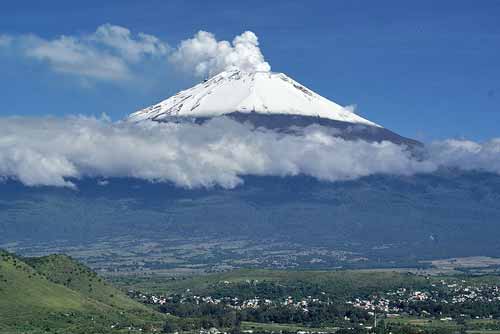
Mount Popocatepetl, a volcano
Che climbed Mexico’s Mt. Popocatepetl three times. He planted the flag of Argentina at its summit in 1956. He was 28 years old.

— Che was an accomplished mountain climber. He climbed Mexico’s Mount Popocatepetl (altitude: 17,900 ft.), three times. He planted the Argentinian national flag at its summit in 1956. He was twenty-eight years old.

— Che, it seems, could walk a tight-rope. He wasn’t afraid of heights, anyway, or of taking risks. A photo exists of him crossing high above a river-chasm spanned only by a connected series of drainage-pipes.

— Che traveled extensively. He took three trips on different routes from south to north through the Americas by horse, motorized-bicycle, motorcycle, truck, bus, train, boat, raft, commercial tanker, cargo-ship, and airplane before his 25th birthday. He even hitch-hiked when necessary.

The hopeless poverty of the common people he met shocked him. Eventually, he would vow to do something to try to change the unfair way things were administered by people of wealth who he also met and spent time with during his journeys.

— Che’s first traveling adventure was during the winter of 1951 at age 22, when he took a job as ship’s nurse and traveled 5,000 miles by tanker along the east-coast (the Atlantic side) of South America making stops along the way from a port in Patagonia in the south to the tiny island nation of Curacao in the north near the coast of Venezuela.

— Che, during extended trips in 1952 and again in 1953, explored the Amazon, Inca and Mayan ruins, and Machu Picchu. He toured copper and titanium mines and visited remote, hard to find leper-colonies where he sometimes stayed for weeks to provide sufferers with needed medical attention.


Machu Piccuh aerial view
Che loved archaeology and anthropology almost as much as medicine. He visited Machu Picchu in Peru several times as well as other Inca and Mayan sites. He wrote and published articles in magazines about what he learned.

— Che wrote daily in his diaries and journals for many years. He left behind an extensive and introspective record of his internal world as he developed his point of view and his place in history.

— Che published his first magazine article before age 23.  Later, he published research in medical journals.


University of Buenos Aires Medical School where Che Guevara graduated 2
University of Buenos-Aires Medical School where Che graduated April 11, 1953 at age 25. He specialized in allergy-medicine and pediatrics.

— After graduating from medical school at the University of Buenos-Aires in Argentina, Che completed his internship in Mexico at the Mexico City General Hospital where he worked in the Department of Immunology. He also worked as a researcher at the nearby Pediatric Hospital.

— Che’s second love after medicine was archaeology; he was an expert in the Mayan and Incan civilizations. He visited Palenque and scoured sites at Chichen Itza and Uxmal, which he wrote about extensively. He published articles describing the dig-sites he visited.

— Che vacationed in Miami, Florida for three weeks during his twenties.

— Che was a talented writer and poet. He published several best-selling books during his lifetime. He also authored several unpublished works, which some hope will be published after Fidel Castro and his brother Raul retire from politics.

— Che visited Guatemala in 1954 and witnessed first-hand the CIA overthrow of its popularly elected government. CIA seizure of media enabled it to create in Guatemala an Orwellian aura of inevitability, which disturbed Che and depressed him.  

Not to stray too far afield, but psy-ops in Guatemala should be of interest to US citizens for the simple reason that they were coordinated by CIA field officer David Atlee Phillips—later accused by discredited writers and some agency insiders of meeting with Alpha 66 founder Antonio Veciana Blanch and double-agent Lee Harvey Oswald to discuss details of possible assassination plots against both Fidel Castro and John Kennedy.  

Anyway, CIA contractors, in a final humiliation, forced the popular President Jacob Arbenz to strip naked in front of reporters before they expelled him from the country. Sickened by the incident, Che wrote: The United States is the enemy of humanity.

— Che’s mom and dad were both members of Argentinian ”royal” families.


Che Guevara reading a book 2
Che read constantly from an early age. Released CIA documents noted the depth and diversity of his literary interests.

— According to released CIA documents, Che was unusually well-read, especially in politics, history, philosophy, geography, medicine and psychology. A favorite book was the classic Argentine masterpiece ”El Gaucho Martin Fierro” by Jose Hernandez, published in 1872.

— After high school, Che read the entire 25 volume Contemporary History of the Modern World.

— Che spoke French and Spanish. He had an easy familiarity with English, though he refused to be interviewed using it. He also picked up a limited ability in Swahili, the lingua franca of Africa’s Great Lakes region, when he spent time there on assignment for Cuba. And the Soviet Union provided Che with a tutor who helped him become more proficient in Russian.

— Che was a skilled rugby player and coach. He founded and edited the short-lived (eleven issues) rugby magazine, Tackle.

— Che was a tournament-playing chess enthusiast.

— Che spent his high school years in Cordoba, Argentina, where his family belonged to the exclusive Lawn Tennis Club where Che learned to swim and play tennis.

— Che was a good golfer.

— Che passed a certification exam in civil engineering during high school. His first job after graduating was as a ”soils specialist.”  He analyzed soils for road building companies.

— Che’s asthma enabled him to avoid Argentina’s military draft.

— In 1956, Fidel Castro — the well-connected Cuban attorney who belonged to a wealthy land-owning family — shared a cell in a Mexican prison with Che that lasted a month. Fidel and Che — close acquaintances before — bonded; they suffered together as political prisoners.

— After Castro’s release, Che and Calixto Garcia (a black freedom-fighter who would rise to the rank of Brigadier General in the Cuban defense forces) remained in prison for another month.

Che’s uncle, the Argentine ambassador to Cuba, wanted to use his influence to free his nephew but Che refused the help until Mexico agreed to release his friend. In a case of truth-is-stranger-than-fiction, Fidel paid for the two men’s release with funds he unwittingly received from the CIA.

— Fidel soon realized that Guevara could be far more than the physician-poet he had hired to care for his men. On 12 July 1957, Fidel asked Ernesto to command the army he was building. His decision to promote Che created the momentum necessary to secure victory for the Cuban Revolution.


Che Guevara, 1959
This colorized photo shows a showered and cleaned-up Che following his triumphant entry into Havana, Cuba in January, 1959. He was thirty years old.

— Che was directly responsible for the success of the Cuban Revolution in this way: on 29 December 1958, his battle-group (the Eighth Column) ambushed and de-railed a key armored supply train loaded with weapons, munitions and troop reinforcements belonging to General Fulgencio Batista’s national army. Che and his guerilla fighters then took the city of Santa Clara, which was defended by a force more than ten times the size of their own.

This unexpected loss scared the Cuban dictator who fled the country two days later on New Years Eve (taking an entourage of over two-hundred people and the entire Cuban treasury with him).

On 2 January 1959, Che and his soldiers walked into Havana with their captured weapons and took control of government buildings and military bases without firing a shot. They seized a government that was 1.2 billion dollars in debt and running huge yearly deficits due in part to looting by Batista’s cartel.

— Che published the classic book Guerrilla Warfare in 1961. John Kennedy immediately read it.  Based on what he learned, he organized a few weeks later the Green Berets from units of the 77th Special Forces Group, which he renamed the 7th Special Forces Group.

— Che married twice. He fathered one child by his first wife, four by his second.

— After the revolution, Che became the object of a CIA manhunt. Che continued to travel freely because of a disguise he designed that fooled even Fidel Castro and his closest advisors.

— Che felt that Cuba’s relationship with the Soviet Union was one-sided. The Soviets didn’t provide the support in personnel and financial aid needed to offset the international embargo coordinated against Cuba by the United States. Che complained, and it created a flap between the two governments.

— After the Revolution, the new government lowered the age requirement for ministerial service from 35 to 30 and granted Cuban citizenship to Che (who was 30 and Argentinian) so he could legally hold a number of administrative posts. One of the most important was Minister of the Cuban banking system — a position he earned by his reputation for integrity.

Fidel once said that Che Guevara was honest to a fault. True to his reputation, the first thing Dr. Guevara did as Central Bank Administrator was halt the scheduled construction of a new Central Bank complex and use the money saved to build a badly-needed hospital.

— Che, after visiting the Soviet Union, expressed outrage to confidants about the lavish lifestyles of the Russian leaders. 

— When Cuba went to rationing after the United States impeded its right to buy food, Che insisted that his family receive the same food-coupons as every other family in Cuba. Despite his efforts, Russian officials later admitted that they smuggled food to his wife, Aleida, when he traveled outside the country.

— Che wrote privately to the Cuban minister of sugar, Orlando Borrego, that he believed — based on his observations of Russian society while visiting there — that the Soviet Union would fall back into Capitalism one day.

— Che returned all gifts showered on him and his family by foreign leaders while serving in Cuba’s ministries. Although the Cuban government provided him with a car, he used it for official duties only. He insisted his family use public transportation.

— When Che entered Havana for the first time, he wore a cast on one of his elbows; he broke it ten days earlier after falling off a wall in the city of Cabaiguan, one of the many towns that fell to his forces before the decisive battle of Santa Clara, which ended the military phase of the revolution.

Che drank yerba mate, a popular tea in Argentina.
Che drank yerba mate, a tea popular in Argentina.

— Although Che is often portrayed as a cigar-smoker, and sometimes posed with cigars, he suffered from chronic and severe asthma. He rarely smoked, or drank alcohol, because his health would not permit it. 

During the most dangerous phase of the fighting when Che wasn’t sure each day whether he would live or die he did smoke according to at least one credible historian. When victory came, he was hospitalized for pulmonary distress and spent several months recuperating.

— Che was allergic to seafood.

— Che’s favorite beverage was yerba mate, a caffeinated drink brewed from the leaves and twigs of a rainforest tree in the holly family. Popular in Argentina, it was thought to have medicinal properties at the time. Che may have used it to treat his asthma.

— Che was a good swimmer. He used vigorous swimming to help strengthen his lungs.

— The Cuban government gave Che an airplane and a personal pilot to use for government business. He often flew the plane himself because he loved to fly.

— Che taught French to the current president of Cuba, Raul Castro, during their time in the Sierra Maestra, before the Revolution was won.


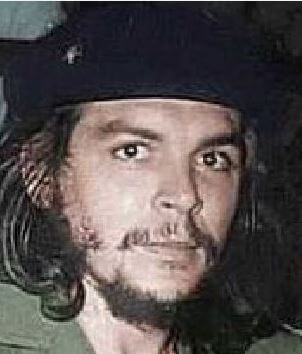
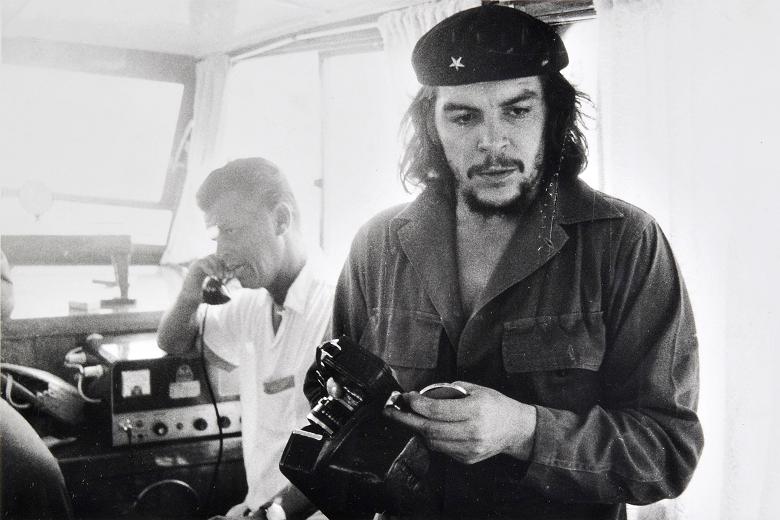
Alberto Korda took the iconic photo above of Che (by which the world now identifies him) on March 5, 1960. It followed the state memorial service for the one-hundred people who died in the terrorist attack on the French freighter La Coubre in Havana Harbor the previous day. Two-hundred people were severely injured.)

Because Americans were napalming sugar-cane fields and sugar refineries to wreck the Cuban economy (one plane had been shot down and the pilot, an American, captured), Fidel Castro in his address to the mourners blamed the CIA for the attack on the French ship while Che Guevara stood next to him wearing the iconic expression on his face that became his brand. 

Neither man knew at the time that in 13 months the United States would escalate the conflict by conducting a full-scale military assault on the island of Cuba at the Bay of Pigs.

The CIA continued to attack Cuban shipping through 1964 before international outrage over the killing of the captain and two crew members of a misidentified Spanish freighter — it was also set on fire and almost sunk — brought sufficient pressure on the agency to change its policies.


Che Guevara a few hours before his execution murder
Che Guevara — a few hours before they killed him.

— In 1967, an 1800 man Bolivian Ranger Force trained in Guatemala by the USA hunted down Che in Bolivia and captured him. A small unit from this force tortured him by firing a half-dozen rounds into his legs, then executed him.

Those who murdered Che reported that he measured 5’8″ and weighed 155 pounds. These numbers are widely repeated on the Internet. The killers cut off his hands and sent them to Fidel Castro, then hid his body among six of his fighters in an unmarked grave. Some have wondered if truth was one of their core-values.

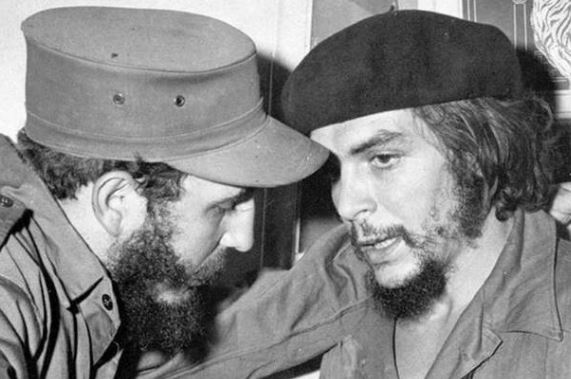
According to the killers, Che would have been seven inches shorter than Fidel, which doesn’t seem to match-up with the many photos of the two men together, including the lead photo in this essay.  Based on photos I’ve reviewed, Che appears to be 4 to 5 inches shorter than Fidel, who was 6’3″.  After reviewing photographs, my opinion is that Che was 5’10”.

Why Che’s executioners would misrepresent his height is anybody’s guess.

— The woman who fed Che a bowl of soup before his execution, Julia Cortez, said this about his appearance: He was an extraordinarily handsome man. He wasn’t the man depicted to us: black, ugly, evil.  His eyebrows, his nose, his mouth — all of his features were perfect.

— Captain Gary Prado of Bolivia asked Che: Why didn’t you give up?  Why didn’t you disband your unit and go home when you had the chance?  Che answered: Where would I go? 

According to Prado, that was Che’s dilemma in Bolivia. He was isolated, shunned by the international community of nations, and trapped. He had no place else to go.


Neill W. MacCauley
Neill W. MacCaulay, Citadel graduate, Korean War Veteran, and trainer of the Cuban expeditionary force led by Fidel Castro.

— Fidel Castro hired a number of American Korean War veterans — among them Neill W. MacCaulay and Miguel Sanchez — to train his expeditionary force. In 1956, MacCaulay evaluated Che, writing that he was an ”excellent” marksman with ”excellent” discipline, leadership abilities, and physical endurance. The only negative: Che smiled a lot, which MacCaulay felt was an inappropriate facial expression for a guerrilla warrior.

Neill W. MacCaulay, Jr. entered Havana at Che’s side in his moment of total victory. Years later he would teach Latin-American history at the University of Florida as professor-emeritus. Before he passed in 2007,  Professor MacCaulay said in a filmed interview: Che’s troops knew what they were doing. They knew they had a good commander. They had Che, who was top of the line. They trusted him. 

As for the victory parade into Havana, Neill said, We were received as liberators; celebrated; I mean people ran out with bottles of rum. People went wild. 

— Six years and ten months after the Revolution on 3 October 1965, Che Guevara resigned his post as Minister, his rank of Commander, and his Cuban citizenship. He severed all ties to Castro and the country of Cuba. He followed the lead of every country in the Western Hemisphere except Mexico, which alone among countries resisted pressure from the United States to sever relations. Che turned his back on the protection offered by Castro and the Soviet Union.

No one to my knowledge knows for sure why Che made this break. What we do know is that Castro read Che’s confidential resignation letter on Cuban radio and television, perhaps without Che’s consent, and that two years later almost to the day — October 9, 1967 — Che lay dead in a Bolivian school house.

— Before the Revolution, Che’s fellow ”boot-camp” trainees, in a peer-review conducted by MacCaulay, agreed unanimously that Che possessed the skills and talents required to lead effectively at the highest level. His subsequent performance in the Cuban Revolution confirmed their judgment and propelled Che Guevara into the ranks of legendary warriors like Spartacus and Geronimo, who lost their lives fighting for hopeless causes and changed the world.

Billy Lee

Post Script:  Cuba buried Che Guevara with full military honors on 17 October 1997 after his remains and the remains of six of his fighters were discovered in Bolivia and returned to Santa Clara, the site of the battle he conducted to win the Cuban Revolution. Che’s wife, Aleida, and his children — at the sides Raul and Fidel Castro — grieved in a more private ceremony three month’s earlier in July.

Although the CIA had an agent present and trained and equipped — in Guatemala, of all places — the Bolivian Special Forces unit that killed Guevara, the agency has always insisted it tried to save Che’s life. The President of Bolivia at the time, Rene Barrientos, demanded Che’s execution; it was Bolivia’s war, the CIA argued, and not their call. 

They were powerless to save him.  

On April 27, 1969, Rene Barrientos died in a helicopter crash.
The Editorial Board


Che Guevara as clean cut James Bond 2
Ernesto ”Che” Guevara
James Bond in Che Guevara pose
Sean Connery


— Some say that Sean Connery parodied Che’s personality and adopted one of his ”looks” to create the movie character, James Bond, in the 1960s movie-series.*


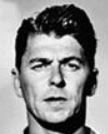
Ronald Reagan Before
Ronald before.
Ronald Reagan After 2
Ronald after.


No one ever suggested that Ronald Reagan used plastic surgery to make himself appear more Che-like. But look at Ronald’s before and after pictures. You decide.


* We investigated the assertion that Sean Connery’s James Bond is a caricature of Che Guevara. It turns out Billy Lee said this, and maybe a couple of his imaginary friends. The Editorial Board 

Billy Lee’s Acknowledgement:
The most important source of information for this essay was Jon Lee Anderson‘s Che Guevara, a Revolutionary Life, published in 1997. The New York Times called it, the complete and definitive biography of Che Guevara

I cut the disturbing cover off the book in order to read it (it scared me), and willed myself to peer through the negative colors its author used to paint Che’s portrait on its 780 pages. I believe I found the truth Anderson buried there. 

Billy Lee


image
John F. Kennedy, 35th President of the United States. Here is a link to the quote below.

** October 24, 1963
I believe that there is no country in the world…where economic colonization, humiliation and exploitation were worse than in Cuba, in part owing to my country’s policies….  In the matter of the Batista regime, I am in agreement with the first Cuban revolutionaries. That is perfectly clear.

… In any case, the nations of Latin America are not going to attain justice and progress…through communist subversion. They won’t get there by…a Marxist dictatorship.

U.S. President John F. Kennedy
35th President of the United States
Assassinated November 22, 1963

IS SOMETHING WRONG WITH AMERICA?

If might makes right, America is the most righteous nation to ever exist.

Most Americans — if asked before 911would say that nothing is wrong with America. America is where everyone wants to be. People risk everything to come here. End of story. And by the way, if you don’t like it, leave.

The attitude of most Americans before September 11, 2001 was to willfully and blissfully ignore the many blunders for which the United States is renowned in the rest of the watching world.

These screw-ups include but are not limited to:

America 4
Codifying slavery in our Constitution (Article IV, Sec. 2)
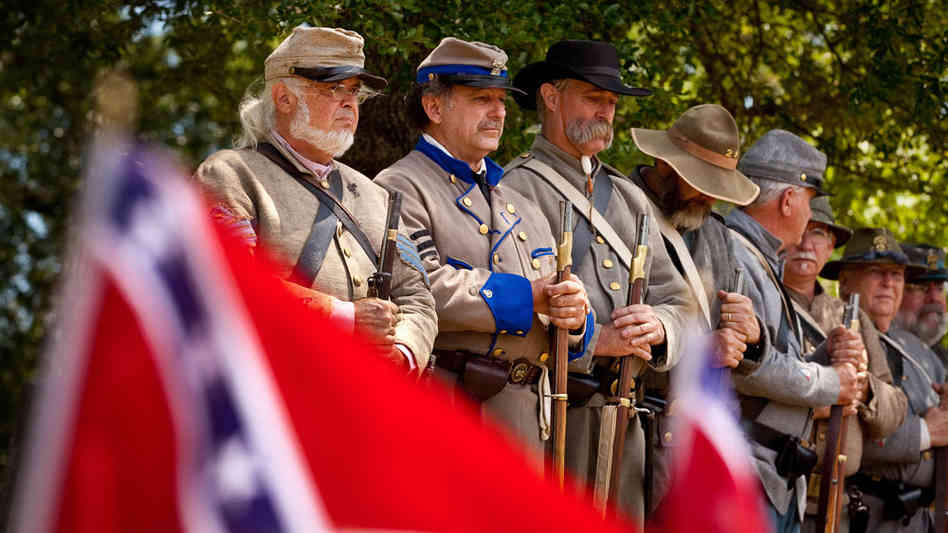
America 5 Confederate Civil War soldiers reenactment
Southern States fighting the Civil War to preserve slavery.
America Apache_chieff_Geronimo_(right)_and_his_warriors_in_1886
Conducting genocidal wars against native Americans.
Colored Only
Depriving Negroes of their freedom after fighting a bloody civil war to give them their freedom.
America depression_lrg
Permitting our country to slide into a Great Depression while doing almost nothing to fix it.  (Free coffee and donuts?)
America hist_us_20_ww2_hiroshima_aerial_buildings_river
Dropping atomic bombs on Japanese cities.
America 2_61_070608_koreaUSExecutions
Killing 20% of the population during a senseless war in Korea.
America Al Capone
Allowing gangsters to run our cities.
WK.0103.Getty.08
Unleashing a bloodbath of assassinations against politicians and entertainers in the nineteen-sixties and seventies.
America Che Guevarra
Executing foreign leaders (among them, Che Guevara, pictured above) while launching Bay-of-Pigs style military operations against small countries like Cuba, Nicaragua, Guatemala, and Chile.
America vietnam hanoi-jane fonda
Conducting a genocidal war in Vietnam — simply to test a new generation of weapons. Jane Fonda, pictured above, was among the first who said it wasn’t right.
America migrant workers california
Exploiting migrant agricultural workers.
America wealth
Overturning sixty years of tax law in the 1980s to allow undemocratic concentrations of wealth.

and on and on and so on.

America what, me worry alfred_e_neuman
Alfred E. Neuman of Mad Magazine

In 2001 Americans believed these idiocies lay in our past; our distant past. They were symptomatic of nothing; not worth noticing, analyzing or fixing. They had nothing to do with now. Nothing was going on now that we needed to fret about or repair. Like Alfred E. Neuman of Mad Magazine, Americans could say, What, me worry?

America World trade center gold
World Trade Center Twin Towers.

In 2001 the Twin Towers came down. Buried in the rubble lay two-hundred billion dollars of 99.997% pure gold ingot (allegedly recovered).

The oil-rich Bush family‘s first reaction was to take the world to war. The ramp-up was egged on by profiteers, as war always is. And Wall Street insiders, under the cover of the War on Terror, began to deploy contrived financial instruments like bundled sub-prime mortgage derivatives (which obfuscated risk) to better suck dry the deep pools of the world’s wealth unaware.

America the great recession chart_net_worth_line.03

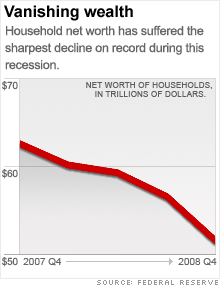
Blunders came fast and furious. By 2008 the leaders of the United States had made so many mistakes they created a financial meltdown. Millions of people lost their homes and jobs. The middle class lost fifty-five percent of its accumulated wealth — much of it in retirement accounts. The situation became dire, causing some people to believe God was punishing the USA for its sins.


America wright_jeremiah_0
Before he made his Nobel Prize winning run for the presidency, Barack Obama’s pastor was Jeremiah Wright. During the early years of Obama’s term, hundreds of retired Chicago police officers set up a perimeter defense around Jeremiah’s church each week to protect congregants from death threats. Obama eventually resigned his membership to protect from harm his friends-in-Christ. It worked. Over the years the threats decreased; the church survived.

People decided to turn around and do the unthinkable: elect the nation’s first black president. His pastor, Jeremiah Wright, screamed, the chickens have come home to roost, on all the news shows. Some people thought, maybe Barack Obama can calm down our angry God.

But as of 2014 — six years after the near-fatal financial meltdown — the USA continues to hover on the precipice of a Soviet Union style collapse.

It’s time to ask the question: Is something wrong with America?  And maybe one more: Is something wrong with Americans?

Before we ask or answer questions like these, perhaps we should ask an even larger question. Is America a place where people have any chance at all to do well over time?

It might be that geography and geology on this side of the globe are not suitable for civilization or sustained human activity. Whoever lives on this side — whatever their values or culture — may, in the long run, not matter.

image
Historically, large populations of humans have been unable to establish themselves for long periods on our hemisphere.
America Hurricane-Irene-NOAA-pic_4
Hurricane Irene, 1999

The Americas have been inhospitable to humankind. Looking back over the eons, a case can be made — due to earthquakes, volcanoes, meteor hits, frequent ice ages, predatory animals, mosquito and insect bred diseases, droughts, floods, wild fires and hurricanes — that large populations of humans have simply not been able to establish themselves on our hemisphere for long periods; nor will they, ever.

America yosemite eruption hqdefault
This disturbing graphic is one artist’s depiction of volcanic eruptions 100 miles southeast of Yosemite National Park — now a hundred years overdue. 

The United States endures, on average, a thousand tornadoes each year. This number is greater than all the tornadoes that occur in the rest of the world added together.

It wasn’t until 1920 that the population in North America reached a hundred million people. It is conceivable — under reasonably imagined scenarios — that the population of North America will soon collapse.

Some geologists believe the mammoth super volcano buried beneath Yellowstone National Park will erupt someday — perhaps soon.  If they are right, surviving humans will have to start over.

America continental shelf off los angeles
Coastal shelf off Los Angeles, California

Other geologists believe seismic activity in the west may one day cause the loss of sizable portions of our continental shelf, perhaps precipitating a cataclysmic flood. Earthquakes in the Cascadia subduction zone have wiped-out huge swaths of our Pacific Northwest forty-one times during the past ten-thousand years. The next earthquake/tsunami is a hundred-and seven years overdue.

It is often said California is the eighth largest economy in the world. Should California or the Pacific Northwest slide into the Pacific Ocean, it would be hard for the rest of North America to keep going.

America Diablo Canyon Power Plant California
Diablo Canyon Nuclear Power Plant, California

In addition to the deaths of forty million people, intensive seismic activity and floods could destroy California’s four civilian nuclear reactors (one active, but all storing dangerous quantities of radioactive waste) and the military’s nuclear sites, nuclear powered ships, and submarines. High-level radioactive waste would then pollute the Pacific Ocean and our coastal areas for many thousands of years (much like the disaster now unfolding in Fukushima, Japan).

The question of whether our continent is suitable to support an advanced civilization for more than a few hundred years remains to be answered. It’s not clear to me that it can.

But let’s return to the original question: Is something wrong with America?  

America occupy-oakland-stephen-lam-reuters-nov-3-2011
Oakland, California Occupy Wall Street Riots, November 2011

Why does a country with our values do bad things? Why so much inequality, crime and perversion? Why so much addiction, pervasive drug use, bullying, child abuse, domestic violence and murder?

Why generational wars, gated communities, blighted inner cities, militias, and political extremism? Why concentration of wealth for the few and debt and despair for the many? Why the increase in home schools and private academies in a nation whose founding virtue was public education for every citizen?

Why so much hatred directed against a people whose only crime was hating slavery, Jim Crow segregation, and the current hardships of discrimination in hiring, housing, health care, and policing?

America violent_crime
Why so much inequality, crime, and perversion?
Fortress America
Fortress America

Why can’t black people, for example, catch a  break after everything they’ve put up with, from lynchings to (for one black man, at least) being ridiculed on national television for mispronouncing correct answers on Jeopardy?

When we ask questions like these, it seems clear (to me at least) that something sinister is wrecking havoc on our dreams and aspirations. Something fundamental about the way we think and problem-solve is not serving us well.

Europeans like to point out that Americans solve problems by selecting and working through all the wrong solutions first. It’s what makes us so sure we’re right, when we finally stumble on the correct solution.

But how about another view? We live in a country where powerful people once owned slaves. Industrial tycoons operated private militias to control restless employees.

We live in a country where an entitled, strong-willed aristocracy has ruled for centuries a population who believes itself to be free; a democracy.

Old habits of thought and action have been handed down from each generation to the next on both sides.

America meet-the-lauders-the-cosmetics-tycoons-who-just-gave-away-a-billion-dollars-in-art
Cosmetic industry tycoons, Mr. & Mrs. Lauder

The powerful and wealthy have learned they can hire spokesmen (like Rush Limbaugh and Tom Brokaw, for example) to play on the fears, aspirations, and assumptions of common people to better confuse and seduce them into serving their interests. This manipulation of one class of people by another has led to a schizophrenic dynamic, which is one of the reasons people in other countries and cultures think Americans are crazy.

image
Possible future if we don’t secure our democracy.

The lunacy will not end anytime soon. It seems our country is determined to follow its aristocracy wherever it leads. History is full of examples of elites who — deluded, depraved, and out of touch — led their civilizations into the abyss. It’s why our ancestors invented democracy — so cliques of wealthy, well-connected power-trippers couldn’t harm us.

Alas, democracy is not a form of government the elites of the world favor. And we may have lost our democracy a long time ago. Perhaps we never had one. We simply imagined we did, because our rulers told us so.

Billy Lee

Post Script — 19 October 2017 — from the EDITORS:  Nineteen months after the publication of this essay, Americans elected a self-proclaimed billionaire and entertainer who was unvetted as to his physical and mental health; unvetted as to his financial status; unvetted in his foreign entanglements; and who lacked any experience whatever in the art of politics.

He lost the popular election by eleven million votes to Hillary Clinton (3M votes) and third-party candidates (8M votes). 

Bernie Sanders, Jill Stein, Gary Johnson, and Evan McMullen garnered the lion’s share of third-party voting. 

The new president blamed his 11 million vote deficit on illegal voting by immigrants. He is now being investigated by the Justice Department and committees in both the Senate and the House of Representatives for conspiring with foreign powers to rig the outcome.

He didn’t serve in the military, yet threatens to take America to war against Korea and Iran. Something is wrong with this picture. He is dismantling health-care and unleashing immigration pit-bulls like ICE on a population of young people who have no memory of having ever lived outside the United States.

It seems like an angry, racist pit-bull is loose in the china-shop. Maybe Billy Lee is right. If so, the United States is screwed. It really is. When this nightmare is over, a lot of broken glass is going to be lying around that everyone will somehow have to clean-up.

The good news? America has a way of surviving catastrophes of its own making. We’re good at managing unnatural disasters that we inflict on ourselves. Maybe to some the chances seem this time to be as low as one in a million.

Jim Carey said in the movie Dumb and Dumber, one in a million means we still have a chance. We might survive the mess of a failed presidency. It’s possible. Who knows? Many are ready to sit on the sidelines to “wait and see” what happens.

During WWII, millions boarded trains in Europe to travel to God knows where. What’s the worst that can happen? many thought to themselves as they watched German soldiers with dogs push families into rail cars.

Maybe waiting to see what happens is not the best strategy for survival..

THE EDITORIAL BOARD

Note: On Tuesday September 24 2019 the House of Representatives opened an impeachment inquiry against Donald Trump. 

OBAMACARE AND THE LAW OF UNINTENDED CONSEQUENCES

Opposition to Barack Obama’s health care law began six years ago, before he was even elected President. Opposition has continued through his presidency — Intense, persistent, unabated. As I write this article, advertising against “ObamaCare” is running around the clock in every state.


In June 2013 the Supreme Court overturned part of the new law to allow states to opt out of Medicaid expansion. All the Confederate states except Kentucky opted out, as did Maine and Wisconsin in the north, and the eight central states that divide the country down its middle, north to south.

One-half of the Medicaid-eligible uninsured live in these twenty-one states — five million people. Because their states opted out, these five million folks will continue to lack health insurance long after the rest of us are fully enrolled.

In addition, twenty-eight states refused to set up health care exchanges. This lack of cooperation continues to complicate the roll-out process and adds an unplanned-for burden to the new health plan.


racism makes me sick girl


What’s going on here? Anyone with common sense and a knowledge of history knows exactly why the opposition is relentless. Racism is at the heart of our politics, and we have a black president who proposed a universal health care law that enables Negroes in America to finally get health insurance like the rest of us. It’s that simple.

I am sure that only a very few of those who oppose “ObamaCare” would agree that their opposition is racially motivated. People don’t generally examine themselves or their motives. Nor do most people want to change. It’s the part of being human to which the writer of Genesis alluded when he wrote, The Lord saw that the inclination of the thoughts of the human heart was only evil all the time.  

Few people believe they are evil or even capable of it. No one believes they’re racist, even when it’s obvious to everyone else. Just because messing with the Affordable Care Act has wrecked havoc on minorities and the poor in the states that opted out doesn’t mean we’re mean-spirited, opponents say. We have our reasons.

Are there other reasons people despise “ObamaCare” that aren’t racist? Of course. Some have to do with greed. The USA has the most expensive health care in the world. People who care have to ask: why?

One possibility is that the USA — unlike most countries — no longer limits incomes.

In the 1980s Congress removed caps on incomes by lowering top-bracket federal tax rates from 92% to 28% (later adjusted to 35%). For the first time since before the Great Depression people could make and keep as much money as they could get their hands on. Owners and executives began to pay themselves as much cash as they could squeeze out of their companies.


bankers looting
Artist’s conception of greed gone wild. Some Americans consider selfish greed a virtue.

Driving down wages, overcharging customers, and misrepresenting company assets & income to accrue additional tax advantages can and does result in huge windfalls, which leaders are now able to keep — under the new tax codes — for their personal enrichment.

Business owners who once spent money to strengthen their company’s infrastructure — or to bolster wages and benefits for employees — now divert it into ridiculous pay packages for themselves and their executives.

In 1990 the USA spent five hundred billion dollars on health-care. Today it’s two-and-a-half trillion — five times as much. Most of the money has gone into increased compensation for “top” doctors and health care company owners and executives.

Excessive compensation of “specialists”, owners, and high-level executives is an embarrassment to our country and a disgrace. It is the reason USA health-care is notoriously expensive and has, during the past few years, soared beyond the grasp of most median-income families.

The wealthy custodians of America’s most lucrative cash cow — the vast health care industry — are in the fight of their lives to keep government as far away as possible from their private treasure trove.


jimmy fallon obamacare
People laughed at this joke. Is it funny?

Under Obama’s presidency racism and greed have joined forces to deny tens of millions of Americans affordable health care. The national campaign to smear the ACA and degrade support by labeling it “ObamaCare” (after the hated Negro president) has been successful enough that people actually laughed at the joke illustrated above when it played on late night television. The put-down went viral on the Internet.

Let’s be clear. Buying health insurance is not mandatory. People who choose not to buy health insurance forfeit a tax deduction — same as when they choose not to buy a house. Why is this hard to understand?

And by the way, deadlines and cut-off dates don’t increase enrollments. They decrease them. They were a concession to opponents in exchange for votes of support.

What have been the unintended consequences of the campaign to destroy the Affordable Care Act? This is where Jimmy Fallon got it right. It has been a Cinderella story.


opposition debate
When this debate is over the blue shirt will know more than the green shirt. Why?

Opposition has worked the way competition between companies sometimes does. It forced advocates to confront errors and mistakes. It compelled the builders of the ACA to address problems sometimes overlooked during roll-outs of big national programs like Social Security and NASA.

Opposition sharpened wits and forced clear thinking from people who might have been tempted to overlook issues until after the roll-out. It mandated an all-hands-on-deck approach to solving the problems of the Health Exchanges after opponents pointed them out.


kiss opposition
Love overcomes hate. Believe it.

When people write the history of the Affordable Care Act a hundred years from now, I believe they will say the ACA had a smoother roll-out than many of the successful government projects introduced during the twentieth century.

They will point out that the ACA became the model for the programs of the twenty-first century. They will remember Barack Obama as one of our best and most beloved Presidents.

And once again history will teach people the age-old lesson.  Love is more powerful than hate.

And what is love if it’s not helping suffering people who stand helpless before diseases they don’t understand, which will kill them if those who are healthy turn their backs?

May those Americans given much always be a grateful people who offer hope and comfort to the sick and disadvantaged who live all around.

God is counting on us.

Billy Lee

CIVILIZATION AND INEQUALITY


divestiture 3


If the United States divested the wealth of the 100,000 wealthiest Americans but allowed divested persons to keep one million dollars to sustain themselves, what could it do with the money?

The question deserves an answer.

The answer may surprise people. Some say the United States could completely pay off the national debt of 17.4 trillion dollars and run the government at current spending levels (5.6 trillion dollars per year) for the next five years.  Taxes on everyone, including the wealthy could be completely eliminated for half a decade — until 2020.


divestiture 1
Tools of a typical tax accountant: calculator; complicated forms; toy blocks.

As a practical matter, the United States can’t divest 100,000 of its wealthiest citizens — not without crashing the economy. And, sadly, information about wealth and its distribution is frustratingly opaque. Economists can’t trust what they think they know.

Nevertheless, the United States can put in place tax policies that lift the burdens of filing and paying taxes from the backs of the vast majority of citizens. It can easily pay for things like education, health care, research, and retirement while stimulating economic investment and growth. And it can protect our freedoms and egalitarian way of life from individuals who have sequestered an unreasonable share of our resources. (Read Capitalism and Income Inequality elsewhere on this site.)


invisible hand
This is the visible hand.

The wealthy, and those who support them, tell us that the closer a civilization resembles the natural order of things — that is, a state with the least amount of government possible — the better off that civilization will be. The invisible hand of free markets will enhance the destinies of all. Free markets, fewer taxes, fewer regulations — policies like these take the brakes off the economy and improve everyone’s lives.

Since we all plan to be wealthy someday, what could possibly be wrong with reasoning like that?


bullying 2
Bullies rule on unregulated playgrounds.

Well, for one thing, it ignores why folks create civilizations in the first place. In the eons before civilization, humans made little progress. Think of an unregulated school yard or imagine a jungle with no rules. What always happens? Bullies and predators end up running everything. The meek and the fragile have to hide or be eaten. Whatever ideas or contributions they might make to enhance the quality of life get lost.

It’s been like this in jungles and on playgrounds for as long as jungles and playgrounds have existed. It’s never going to change. It’s why folks need playground teachers and yes, civilization. With civilization we can organize ourselves. We can make rules to protect the weak and improve the lives of both predators and prey.


Civilization 1
For Genghis Khan, civilization was all about him.

We know from history, it’s the powerful who create civilizations to protect their advantages. For thousands of years bullies in expensive garb have run the show on every continent on Earth.


constitution
Our nation’s founders said that all people were created equal before God.

Two-hundred-and-forty years ago something new came along. Our ancestors won a revolution. They organized a civilization that would eventually empower the powerless and give voice to the weak.

Yes, they codified slavery, because what else could they do? Africans had been slaves in America for a hundred years already. For a hundred-and-fifty years two-thirds of whites had come to America as indentured servants, a temporary form of slavery that ended, typically, after seven years of servitude.

The habits of history weighed heavily on our founders, and being unsure of their steps, they gave-in to the pressures of greed to better form the consensus that would permit the birth of something new in the world. And guess what? Our new-born civilization grew up, matured and ninety years later ended slavery in the United States of America.

Earth needed a new way — a way based on the dignity of people, their rights before God, their need to be free from humiliation by others more powerful and crafty than themselves. They needed a new kind of civilization, and our founders found a way to build it, blemished and imperfect as it was.

It took time; it didn’t happen overnight. I was twenty years old before black folks got the right to shop freely; to buy a soda in a drugstore; to buy a house; to get a loan. Maybe two-hundred years seems like a long time for a constitutional republic to get serious about freedom for individuals and families. It is a long time. We might as well admit it.


American flag
The flag should stand for what is right, just, and fair. It is the symbol of our civilization.

Today, as the civilization we built slides into the shadows of an unregulated jungle, people need to stand up and shout, No! This can’t be right.  In a civilization built by hundreds of millions, we can’t let a few thousand of the most clever humans sequester twenty-five percent of the wealth. It’s an unreasonable reward for cleverness, and it’s unfair.

Why did our ancestors build the civilization we call America? Why did they take hundreds of years to shape and change our way of governance?

It’s because they intended to make America succeed for everybody. I’d like to believe that they didn’t want it looted and plundered by the powerful. They didn’t intend for average people to be “gated” out of the desirable places to live, or for the disadvantaged poor to be locked away to rot deep inside our inner cities.

We still have work to do. The work falls on each generation to make the world a fairer, safer, more loving place for every person who lives and breathes.


Thomas Piketty
Thomas Piketty was an instructor of economics at MIT during the 1990s; he is the founder, Paris School of Economics; Director, Department of Social Sciences, Ecole Normale Supérieure; and Director of Studies, École des Hautes Études en Sciences Sociales.

Fortunately, America has allies around the world ready and able to help do what’s right, if we only listen. One is Thomas Piketty, the French economist.

In March, 2014 he published in America his critically acclaimed Capital in the Twenty-First Century. It is a sweeping account of the rising inequality in our world, according to New Yorker Magazine’s John Cassidy.

I’m excited about this book. Many reviewers say it’s important. It is the culmination of years of research by a brilliant scholar. It presents, I’m told, a paradigm shift in thinking about the problems economies have delivering fairness to average people.

If Piketty’s book strengthens the courage of economists in the United States to speak openly about the touchy subject of inequality, he will have done our country and its people an enormous favor.


image
Gold jewelry and coins held in an overseas bank.

The United States, though proud of its wealth, seems to go to great lengths to under-report it. It’s primary focus is to collect taxes, I guess.

Assets not subject to taxation hold little interest for government accountants. The Feds limit their count to households and tell us that our total wealth is 54 trillion dollars. Other economists say it is higher — maybe as much as 188 trillion; they include in their tally many assets not normally taxed.

The subject of how wealthy America really is — who holds the wealth and in what amounts — is murky at best. According to John Cassidy, Thomas Piketty’s call for households to declare their net worth and be taxed on it will provide the reliable statistics needed to un-muddy the waters and enable policy makers to fashion the sound and fair tax policies required to protect the benefits of civilization for everyone.

Billy Lee

Post Script: Billy Lee advocates for a standard of maximum personal-incomes and estate-sizes established by the United Nations as ratios pegged to each country’s minimum wage. Violations would be treated as felonies by international courts.

Billy Lee’s proposal and some of its economic and moral advantages are described in the article, Capitalism and Income Inequality.
The Editorial Board

CAPITALISM AND INCOME INEQUALITY


Pele’ with Bobby Kennedy in Rio, 1965. Pele’ died 29 Dec 2022 of complications from colon cancer. He was 82. 

Our gross national product…counts air pollution and cigarette advertising, and ambulances to clear away…carnage. It counts…locks…and jails…. It counts napalm and the cost of a nuclear warhead, and armored cars for police who fight riots in our streets….

Yet the gross national product does not allow for the health of our children, the quality of their education or the joy of their play. It does not include the beauty of our poetry or the strength of our marriages, the intelligence of our public debate or the integrity of our public officials…. It measures everything in short, except that which makes life worthwhile. 

Bobby Kennedy 1968


Capitalism is a system of wealth creation characterized by private ownership of the means of production (land, buildings, factories, labor, patents, intellectual property, etc.), where products are made and sold in unregulated markets to generate the revenues that sustain production and provide profits for the owners to use as they see fit.


capitalism


Capitalism works best in a stable legal environment, where laws protect owners sufficiently that their ability to produce products is unimpeded.

Under this definition, Capitalism differs little from Slavery until the legal environment secures certain rights to labor.

In the USA, the legal environment takes the form of a constitutional republic undergirded by a bill of rights. The bill-of-rights secures certain safeguards to labor in the arenas of religion, speech, arms, assembly, petitions and so on. The constitutional republic secures representative government, which enables labor to choose its political leaders.

The owners of businesses make up a small percentage of the population and would be insignificant players in the parts of the legal environment where voting majorities determine the operation of government if they were not protected by privileges which, as a practical matter, are not enjoyed by labor.

In the United States the powers of government are divided into the three branches to provide checks on usurpation of powers. Further checks on government power are provided by business owners—specifically those individuals who own media and entertainment; individuals who direct cartels in certain industries like defense, medicine, agriculture, transportation, information technology, and pharmaceuticals; and those individuals who own and operate private militias.


Cartel money


It is understood and admitted by independent economists and historians (those who don’t work for the cartels) that without intervention by government, Capitalism tends to concentrate wealth in the hands of business owners—even in those rare circumstances when owners show little interest in manipulating the system to maximize their advantages.

The inability of Capitalism to generate a vigorous and sustainable middle class creates problems of poverty and is one reason why economists tend to advocate for government programs to redistribute wealth to the lower-earning labor sector.


tank production world war II


An important historical example followed the aftermath of World War Two. Millions of GIs returned home to the United States after defeating Germany and Japan. Business owners tied to the war profited well and wanted to give something extra to the families of soldiers who fought to protect them. 


woman stacking artillery shell world war II


Because the tax code at that time limited how much revenue owners could keep, they looked for ways to dump windfalls into worthy causes. They worked with government to fashion programs for low-cost education, home loans, and other perks for returning GIs. Windfalls permitted the USA to build highway systems and inexpensive cars for ordinary people to enjoy. Within a few years of the start of these initiatives America built a middle class.  

So, what eventually happened?

In the years after 1980 a new generation of business-owners took power and convinced Congress and the president that taxes on large incomes should be reduced from 92% to 28%. These capitalists were sons and grandsons, for the most part, of the same men who helped build the middle class in the first place.

What is the effect of these tax rate changes? What do tax changes mean for society and labor, where most Americans live?

And let’s be clear. The 92% tax rate on earnings above $250,000 during the Roosevelt-Truman-Eisenhower-Kennedy-Nixon-Carter years was a de-facto cap on high-incomes. Workarounds did exist for those lucky few who had access to stockbrokers — men mostly who opened doors to low tax rates for privileged elites — but all non-stock market income was capped.

One good example is the medical profession. After 1980 the dramatic reduction of top tax-rates eliminated what had been a practical limit on incomes. Doctors — many operated as business owners — learned that income limits were gone; minus a small tax fee, they could keep as much money as they could collect. 

What happened?

Doctors increased fees at a frenetic pace.


Medical Professioin


Medical care costs became prohibitive for the majority of workers. As a result, some migrated into programs like Medicaid and Medicare. Others found themselves locked into jobs they disliked because quitting meant losing insurance.  Today medical care is so expensive that Congress felt compelled to pass the Affordable Care Act (Obamacare) to avert systemic collapse of public access to healthcare.

With limits on incomes now gone, doctors, some of them, seem to be overcharging government healthcare programs for services; a few have been arrested for committing crimes to maximize their incomes. The temptations of unlimited Benjamins have ignited a frenzy for dollars that shows no signs of abating.

In the USA, chasing after unlimited wealth seems to have overtaken every profession and institution. Businesses and public institutions are being looted by the professionals who run them.

Owners drive down wages because they can keep the difference for themselves. Operators drive businesses nearly into bankruptcy to skim as much money as they can in as short a time as possible—so they can retire to a private island, perhaps. Who knows?


bankers looting


Concentration of wealth can be a bad thing because it influences what society produces to the disadvantage of labor and the poor. Expensive luxury items (like $500M homes) are built to satisfy the appetites of the wealthy while products and services like schools, clean water, and nutritious food needed by labor are neglected.

These trends (and anyone could list dozens more) are not new. Every civilization that has allowed unreasonable concentrations of wealth has come to a bad end. Ordinary citizens are demoralized, excesses are committed, cynicism and cruelty increase.


gated community


An example is gated neighborhoods. It is humiliating to be ostracized by the privileged. Humiliation of citizens without redress breeds despair, which leads to pathologies destructive to society.


segregation forever


Segregation is an impulse strongly felt by a slave state with a long history of income inequality. It behooves those of us who live in the USA—a country with the reputation for promoting the cruelest form of slavery—to guard against trends (like gated-living) that reek of segregation and slavery.

Another problem with unlimited wealth is that it tempts those who have it to buy hi-tech weapons. Many wealthy individuals have created militias to enhance their power.

Everyone knows about the Mafia but respected individuals with good public relations have established private militias as well. A family in Michigan owns an air force and drones plus soldiers who work under contract with the US military to fill in gaps overseas.


militia


A concentration of wealth combined with military power in the hands of an entitled few can become a clear and present danger to the liberty and way of life of ordinary citizens.

Now… a few sentences about Ayn Rand who, more than any other public figure I know, provided the moral justification for the rapid sequestration of wealth by our elites.

I met this squat, chain-smoking, thick-accented Russian woman 50 years ago after having read every book and newsletter she had published at the time. She wrote with seductive logic that appealed to me and I suppose other average people and probably a lot of billionaires as well. The utopian vision described in her book The Virtue of Selfishness undergirds extremist groups like the Tea Party and their spin-offs. 


virtue of selfishness cartoon


Like most utopian thinkers, her logic was flawless yet led to ridiculous conclusions false on their face. As fantasy her fiction has a certain appeal but to advocate for turning a country over to its richest citizens to do as they please is folly and counter to every form of democracy and free society.

Consider these questions. Who spies more—government or the companies we work for? Who looks at social media sites, credit ratings, where we live, or what our hobbies are—government or the companies we work for?

Who discourages us from speaking our minds? Who stops ordinary people from discussing religion and politics? Who intimidates folks from protesting social injustice? Who blacklists professionals when they “go-rogue” ? Who controls how much money anyone makes?

Clearly, private companies exercise these powers.

What about government? 

It collects taxes and arrests bad people who commit crimes.

Companies? They control our lives.

Think about it.

What are we? Slaves?

The answer is, yes, kind-a. 


team player


Under Capitalism business owners are an existential threat to people’s freedom. But we have a representative government, don’t we?

In theory at least, folks can use the government to their advantage—not only to limit the powers of business owners over their personal lives but to limit the incomes and estate sizes of private individuals through appropriate tax policies.

And they can forbid the acquisition of military-style powers by civilian elites. It’s important. Read the Second Amendment to convince yourself that it’s true. Outside of the limits of a well-regulated militia, gun-runners are anathema to freedom.  Limiting military powers to well regulated militias is the reasonable prerogative of free people in democratic republics like the United States. 

How do we preserve the best elements of Capitalism—a proven wealth generator—while eliminating threats it can impose on our liberties and, for most people, their standard of living?


Video added 27 October 2025. Explains how USA tax law drives gross inequality. Billy Lee’s proposal (below) caps inequality & is easier to enforce fairly. 
The Editors


My proposal is this: pass a maximum-income law. This law would set the maximum income from all sources as a multiple of the minimum wage.

Let’s say the multiple is set to 1,000. When the minimum wage is set to $20,000 per year, the maximum income from all sources would be pegged at 1,000 times that—$20 million.

In the same way, the maximum size of estates could be set at some multiple of the maximum income. The multiple might be set by Congress at 20, for example. Then the maximum size of an estate would be 20 times $20M—a $400M maximum. 

Now these multiples are simply one example. It might be that folks decide a multiple of 1,000 is too high or too low; they might decide to set the multiple at something lower—say 100 or 50—like it was during the 1950s and 60s. Then again, folks might agree that a figure of $400M isn’t enough for high achievers in the modern age and set maximums higher. 


image


What’s important is to set maximum incomes high enough to preserve incentives to create wealth while at the same time reducing the incentive to loot that unlimited incomes encourage. Unreasonable profits which might end up in owners’ pockets would then more likely be distributed inside companies to workers or to the existential needs of the companies themselves.

Wealth not distributed inside companies could be given to charity or society (e.g. through the mechanism of taxes) to be spent on programs beneficial to labor.

Of course, concentrations of wealth are necessary for economic development. This need for capital is where well-regulated public corporations and public banks come into play.

I hope to write an essay about the role of corporations in society sometime in the future. Hopefully, someone else will write the essay before I get around to it. For now let me suggest that the United States might be better off if corporations and financial institutions were made truly public and regulated like public utilities.

A challenge presented by this proposal is to apply these income and estate-size limits internationally to prevent individuals and cartels overseas from gaining advantages that would threaten our country and its citizens.


UN world a happy place


The United Nations International Court of Justice and the International Criminal Court could be enlisted in this effort. The United States government has the influence and power within the international community to make it happen.

Another challenge worth mentioning is that although this proposal puts limits on only a few thousand, or perhaps a few tens-of-thousands of individuals and their families, these are the folks who actually control governments by the power of their concentrations of wealth.  It might be problematic, at least at first, to convince the truly wealthy to go along.


UN tank


But we should try. They are tens-of-thousands. We are billions. Think about it. The grandfathers of the current generation of the wealthy shared their wealth to benefit ordinary people. I don’t believe that any billionaire thinks that their sharing after World War II hurt any of them in any way that counts for anything.

Billy Lee

Click Watch on YouTube link below to view Michael Moore’s award winning movie, Capitalism: A Love Story. 


Postscript added 3 December 2022:
During the past two years of pandemic, oligarchs increased their wealth by five trillion dollars. The gap between wealthy and poor, in both resources and power, increased dramatically worldwide. The predicament of ordinary people changed. To help readers understand, the Editors agreed to include the following video.