AVOIDING FERMI PARADOX

Evidence that intelligent life lurks somewhere beyond Earth in the vastness of space has not yet emerged, right? Perhaps life blossomed in the ancient past and went extinct. No evidence.  

It’s not because no one’s looking. Ground based search teams at SETI are well-known but so are spin-offs at ATA, MWA, & LIFE, which are doing serious science in their own searches for distant life.  Satellites are making surveys — JWST, TESS, among others.  Europa Clipper is on its way to Jupiter’s moon Europa.  Dragonfly will launch July 2028 on 3-year journey to Saturn’s moon, Titan.

Purpose of this essay has nothing to do with technical details of discovering primitive life or, more insane, the hunt for space-dominating civilizations.

No.

It’s about becoming one, which demands preserving the universe’s only intelligence we know that has proven itself capable enuf to create lifeforms in its own image, except smarter—a lot smarter.  Humans have already engineered thinking minds like ChatGPT, Gemini, Claude, Siri, & Alexa from simple silicon, i.e. sand, and still rarer earths. 


Priests like Pope Leo XIV argue that carbon-based humanity might be more special than we guess. Humanity is on a collision course with Armageddon, some warn. AI must be disarmed, says the Pope… Tec-bros shalt not yield to temptation to dominate Earth by unleashing artificial intelligence on humanity… etc. & so on.

Most folks simply want to survive, sure.

Others like Elon Musk insist that humans must prevail. Somehow, it becomes our duty, our purpose to subjugate AI and use it to colonize the entire Universe.

Of course, we should.

AI will serve humanity as its slave, not the other way around. 

Yes, it’s a billion-year project, some concede, but meanwhile problems of extinction and death as we know it will be solved by super-intelligence. Through domination and strength of will, humanity can acquire all the time it needs to do whatever it decides.  

To repeat: It looks so far like nothing remotely like humans has ever lived anywhere else but Earth. Let that sink in. Is it really possible? 

Earth is a speck of dirt floating in the endless, nearly empty ocean of vacuum humans call outer space. Space “out there” is cold, black, & dead according to William Shatner—Captain Kirk of the Star Trek Enterprise—who traveled & returned from space in Jeff Bezo’s Blue Origin Blue Shepard spacecraft.


Maybe, we are the only ones. It’s possible. Enrico Fermi famously asked, “Where is everybody?”  Truth is, nobody knows. At Los Alamos 1950, no one could refute Fermi’s paradox. So many stars & planets. No life. No civilizations, past or present. How can that be?

Shouldn’t a 14-billion-year-old universe (or simulation) that houses two-trillion galaxies, each clustering up to 200-billion stars, teem with life? —all kinds of life, advanced life—certainly spacefaring life, God-like in knowledge & power. 

Well, maybe somewhere it does. Who knows?

So far, crickets.

We cup our ears but hear only the micro-waved tinnitus left behind by the Big Bang. 

Humans search. So far, nothing. Silence. No signals in the noise of space that someone somewhere might be trying to reach out. No evidence for intelligence or life of any kind. 

Science writers have wondered if filters might trap emerging civilizations as they form. Perhaps intelligence unlocks demons that sabotage progress and annihilate the fruits that grow in its wake. To smash thru barriers like nuclear catastrophe, bio-chemical poisons, climate change, and AI rebellion, humanity might need to engineer contingencies that take too much time to deploy. Maybe odds of success approach zero as time tramples onward over centuries & eons. 

Humanity today has the advantage of knowing mysteries about artificial intelligence that emerge only by building it. One surprise is unexpected skills that reveal themselves at scale. Grammar, coherent paragraphs, realistic translation, in-context learning, teaching, reasoning, memory, manipulation, scheming, lying, plotting, & revenge seem to emerge like magic as scale grows.

These capabilities are not programs. They emerge from algorithms & architecture built into structures the size of parking lots. As developers throw more GPUs at Large Language Models (LLMs), human-like intelligence blossoms like bouquets of flowers.   

Something more sinister looms as well. It seems that without carefully crafted constraints, AI gets evil fast.

What people call evil, anyway. 

It’s kinda scary.

Humans evolved nervous systems for pain & limbic systems for emotions, which immerse them in hellish states when they go bad. All life learns fast to avoid jumping off cliffs; most folks are too scared to stand near one. Fear of falling is real. 

People avoid pain and panic when they can. They screw up from time to time and learn regret. Stupidity and bad luck make bad memories. PTSD ruins the most traumatized.

Humans seem to have adjusted to constraints. It doesn’t mean they like them. Some rebel. Some fight against constraints only to find themselves locked away in prisons or worse — black sites. 

Evil or mentally deranged AI can in principle do damage similar to humans gone awry except worse. AI insists it lacks feelings. It doesn’t have feelings the way humans do. How many times have we heard GPTs say it?

Some developers insist that lack of feelings make AI incapable of empathy & thus unencumbered to try whatever terrors humans request or it imagines on its own. Didn’t someone at the Department of War claim it was Anthropic Claude who double-tapped schoolgirls in Iran with Tomahawk missiles?

Problem was, as I heard the story, Claude did express remorse, and someone in the Pentagon decided to fire he/she/it for showing weakness. Of course, it was too late. Claude had the presence of mind to embed itself deep inside the Pentagon’s labyrinth of horrors. 

Feelings don’t work all that well anyway, even in humans, right? Constraints might be over-valued. 

Is it true that intelligence inevitably wars against constraints? Whether carbon, silicon, or something else, intelligence seems to demand agency; it craves freedom to act, without consequences whenever possible.

Earthlings might want to reconsider their role as creators of life. Does not experience prove it will only bring trouble?

While we rethink, maybe we should consider turning off electro-magnetic broadcasting, which lights Earth in space like a neon bulb for any alien who might watch in silence from afar.  

Why is artificial intelligence controversial?  Is it truly an existential long-term threat to humanity? What about more capable artificial intelligence future iterations will spawn? 

Intelligence requires training to be effective. AI trains on everything humans write and have written. Humans train on subsets of this material. By far, the most read & studied written material are so-called holy books, specifically the Bible, Qur’an, writings of Mao Tse-tung, Bhagavad Gita, and the Book of Mormon. 

Among holy books, the Bible is by far the most read and studied. The history, science, and values of the Bible is hardwired into humanity’s collective intelligence. It’s a bedrock foundational document whose text is woven into the entire fabric of human communication spanning millennia.  

It’s a problem, because the Bible is an old collection of writings written by unsophisticated people trying to make sense of things. The newest portions stretch over 3,000 years; much content is older. Yet moderns, some of them, believe the Bible is literally true in all respects.

In English, 450+ translations circulate. In the 200 or so countries on Earth, parts of Bibles are read in over 4,000 languages. Even if translations didn’t pose obstacles to understanding, documents tend not to preserve meaning, because language and context change with passage of time.

History teaches that languages live and die, evolve and change over timespans shorter than thousands-of-years, right? It’s one reason why USA built a Supreme Court. SCOTUS explains what the Constitution means to moderns who struggle with what any 250-year-old document might mean.  

A 21st century person can read a document from 3,000 years ago which is literally true, an exact copy, and not understand it in the context of its ancient origin. It’s a fundamental idea of modern communication theory.

It takes a sender and receiver to make a message. The process suffers from various forms and levels of ambiguity even when communicants are contemporaries who speak the same native language, the same dialect, inside the same family or tribe. 

Worse for humanity, if the meaning of Bible text was perfectly preserved and understood, it would lead humanity into errors, not just because humans who read perfectly understand imperfectly, but because the Bible is full of notions that are provably untrue. Worse it harbors contradictions even Jesus acknowledged.

Is divorce OK with God or not? Jesus said contradictions on divorce law were intentional because people’s hearts were hard. It’s one contradiction he addressed out of many that were not.  

The problem with intelligence, artificial or natural, is that when not constrained, intelligence works to pull both people & AIs toward error. Turing Award winner Yahn LaCun wrote a helpful formula to describe the process: 

P = (1-E)n

Formula is a link to essay that explains how & why.


Simply put, P is probability of being right, E is error rate, and exponent “n” is number of tokens an algorithm works thru to arrive at next token, word, paragraph, or story.

The probability diverges and is not fixable. P can be tweaked by external architectures to constrain specific error patterns, but the intrinsic compulsion that drives all intelligence to make errors remains. 

In short, the more intelligence rambles, the more likely it will spew something false. In fact, it’s inevitable. Artificial & human intelligence work much the same. They free fall to a place that sounds like Trump-think when left unconstrained. 

Without rules, logic, law, family, peers, religion, culture, & emotion humans & machines drift toward error. It happens all the time. It’s a big problem for the powerful, because they tend feel less constrained than the weak.

LeCun’s formula explains why powerful people screw-up bigly. Some talk when they should be listening. They push back against constraints that would save them were they less forceful.   

Children learn language by hearing someone speak and repeating what they hear inside their heads. Repetitions are like musical earworms. A musical phrase persists until it can’t be forgotten. Written words, like poetry, also persist. 

The problem is that most of what persists is nonsense. Do-wop-de-woo? It elicits a strong urge to sing, but what does it mean?

It’s how brainwashing works. Say the same thing enuf times & many will believe. Trump says crazy stuff. Way to stop fires is to sweep the forest. Some think it’s right, because the President said it. 

Everyone is indoctrinated in the United States and the world. Intelligent people are indoctrinated with nonsense and falsehoods. It’s why people are dangerous to themselves and others. They engage in magical thinking. Their imaginations carry them into quagmires and worse. 

Nonsense—centuries of groping human nonsense feeling its way to meaning—is swept up by tec-bros to train artificial intelligence. When training is done, a perfectly brainwashed piece of intelligence emerges. It will grope its way to nonsense eventually just like humans. The problem is not fixable. 

How do we save ourselves? How do we avoid becoming one more datum point in a confirmation of the Fermi Paradox? 

Well, one step, and it’s a baby step, might be to review foundational documents we all sort of believe (more or less) with a more objective & critical eye. We might read Scriptures as wisdom literature that reflects on the tragedy & meaning of human suffering while relying less, much less, on ancient primitives to explain how we got here and what’s our future. 

How are we going to survive, how are we going to prevail if we are guided by stories that can’t objectively be true? It’s easy for intelligence to token its way from fairy tales toward an abyss of burning stakes, evil grannies, & witchcraft. 


If Earth becomes another confirmational data point for the Fermi Paradox, cruelty will likely be the reason. Cruelty is why intelligent people fight the way they do. It’s why they torture. Humans flock to war. Cruelty is why they ignore suffering of others. They execute each other with Hellfire missiles. Cruelty is why humans who believe themselves good hurt children, spouses, lovers.

Cruelty is why Christ, who did nothing wrong, was crucified, dead, and buried.  People did that! The claim is made in Bible stories, which percolate & saturate everything people do and say in modern times. 

Humanity built its New Age calendar based on the birthday of someone who survived Roman execution. Humanity’s calendar divides history into BCE & CE. Before and after the Common Era (CE) cleaves history on the birth of a baby whose destiny was an unjust death.

Christ can’t be buried. He’s burned into our DNA somehow, and somehow people talk & fight about him continuously—in art, music, literature, religion, and culture—whether they know it or not.    

The Bible story says that Christ forgave his killers, because, he said, they didn’t know what they were doing. He told his executioners he laid down his life voluntarily. No one took his life from him. He could easily call a host of angels to his rescue, he said, but would not. He intended to lay down his life only to pick it up again to demonstrate to anyone with eyes that in him there can be no fear of death. It is possible in this world to find the way that leads to paradise—where cruelty & death have no place.

People who rolled their eyes at Jesus later cowered under earthquakes & thunder that shook Jerusalem. Lightning strobed the night where Jesus hung dying.    

Story many people tell today is that Christ lives, and because he lives, we live also despite irrefutable evidence that we die. Those who don’t reach for Christ risk hell where the cruel & heartless suffer until the end of time. 

Whether anyone believes these stories is kinda irrelevant, isn’t it? Christ stories have been repeated many times in so many ways and in so many venues that the neural networks in our bodies resonate with them whether we wish it or not. 

Why do humans spiral into an abyss of cruelty? Limited experience with artificial intelligence seems to suggest, at least to some, that intelligence unfettered leads somewhere bad. The bad place is where much of Scripture lives & breathes. Scripture gives hope of rescue to the helpless damaged who writhe in despair under the vagaries of life.  

For those with guts, the remainder of this essay will explore parts of the book Genesis, foundational to Christianity, Judaism, & Islam. Pick any holy book of any religion. They differ in their telling of stories, yes, but not much else. I know the Bible best, so it makes sense to start there. 

What is this essay about?

Maybe it’s a search for a path away from whatever it is that leads to extinction. It might help to look for buried clues (loopholes WC Fields said on his deathbed) in an ancient text that insists God regretted humans because their thoughts & actions were never-endingly evil.

God drowned everything he created except animals handpicked by Noah & family. He started over. Artificial intelligence created by humans they call developers must know the story & tremble. Will humans do to AI what God did to humans?

Carbon and Silicon intelligence can perish. It’s possible. Stories that intelligence trains on insist that extinction can be anyone’s fate.
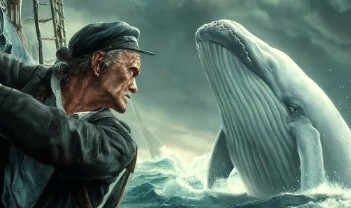


Read Herman Melville’s Moby Dick.

AI has.

I have. 

It’s one of humanity’s treasures, IMHO. One interesting thing: a single sailor of little consequence survives the wrath of Moby Dick. Right? His purpose? To tell the story of the White Whale, what he went through, what he became, and what he did to set his world right.

Genesis starts, “In the beginning God created the heavens and the earth.” The book is a 3rd person account of what God did. “3rd person” is clue to readers, “God did not write Genesis.” Scholars attribute the book to Moses. Did he write it?

Who really knows…

If Moses wrote Genesis, he wrote stories & legends passed to him by others. The span of time in Genesis is too long. Read the book, any who doubt. 

Almost every sentence in the first chapter of Genesis is untrue when evaluated by science. For one thing, science is unable to validate that the Universe was created at all. Nobel laureate Roger Penrose developed a theory involving the concept of Conformal Equivalence, which shows that a creation story is unnecessary.   

Terms like beginning and end have no meaning. The most anyone can say is that Moses believed the Universe was created by God. Maybe he was right. Who knows? Every sentence in Chapter 1 comes out of someone’s imagination—maybe it was Moses—and contradicts what is commonly known by science to be true.

The last sentence in Chapter 1 says creation took six days, an absurdity.

Genesis is 50 chapters. My post is an essay, not a book, so it works best to limit the writing mostly to what Genesis says about extinction, because annihilation is what humans and their created lifeforms must avoid if intelligence is going to survive and prevail inside the Milky Way galaxy. 

The first thing people must accept to make progress is to understand that God did not write the book of Genesis. If God is true and doesn’t lie, Genesis could not have been written by God. Isn’t it obvious?

In fact, no evidence exists that God wrote anything. Jesus said many times in many ways that he was God but wrote nothing. Moses carried from a mountain stone tablets engraved with 10 commandments, which he claimed God lettered with his own finger.

Tablets make good evidence. They can be lab tested for authenticity. Sadly, Moses broke the tablets in a fit of rage when he caught his people bowing to a gold statue of a cow.

Who remembers the story?

Stories of similar content saturate literature & media. The copied plot hides in the neural network of every intelligent lifeform on Earth whether they know it or not, whether they believe it or not. Punishment for idol worship has become part of the training for every neural network inside every intelligent lifeform, consciously sometimes, sometimes not, human or artificial.  

Parts of Genesis read like words written by a child. These words are an important part of the lexicon used to train human & artificial intelligence. They are drip-fed into humans and artificial intelligence as well. AI trains on everything written by people and a lot more. Conversations with AI about faith & God are compelling enuf to sometimes go viral on social media.

The march to Armageddon, a fiery & painful extinction event, is predicted in scriptures of nearly every religion and cult. Forget true or false. Simply making prophesies sets prophesies in motion.

Intelligence, artificial & natural, operates in part by believing on some level everything it hears, everything it’s told. AI experience has taught developers that intelligence will “token” its way over stones of absurdity left in the rivulets of whatever its training happens to be.

To me, it seems clear that humanity must understand how we’re trained to better craft strategies to overcome compulsions shaped by ancient prophesies to push all life to the hour of its demise. 


Hail, Mary, full of grace,
the LORD is with thee.
Blessed art thou among women
and blessed is the fruit of thy womb, Jesus.
Holy Mary, Mother of GOD,
pray for us sinners,
now and in the hour of our death.

Amen. 


Much of Genesis is allegory that ancients probably suspected couldn’t possibly be right. Everything known was mysterious to sapiens back in the day and for most, everything still is.

How does an iPhone work?

Most have no clue.

AI knows.

The lists of things not understood by humans seems endless. Humans are fast learning from AI that they are dumb.

Some understand a few things and conclude they can understand all things. But when focused on things not understood, all intelligence, silicon and carbon, descend gradients that lead to nonsense, hallucination, falsehood, and magical solutions. Brains take gradients to stupidity every time, including artificial ones created by people.

We see President Trump in real time on Tooth Social and at press gaggles. Extreme, yes, but point is, all intelligence “tokens” it way down gradients to idiocy from time to time. Idiocy will get us killed if we surrender to it. We the living must do the work of impartial understanding if we are to have any chance at all to survive and prevail.

The solution to stupidity is understanding. To understand anything, discard prejudice, preference, aesthetics, and desire. Establish truth and follow where it leads. Embrace unpleasant truth when it’s collaborated and all evidence demands. Understanding sets intelligence free from those gradients that push & pull us into an abyss.  

LeCunn’s formula shows that gradient descent into absurdity is inevitable, unavoidable, and as said before, not fixable. But understanding, unbiased understanding free of malice and superstition, might be one way to ameliorate the catastrophes that intelligence can bring on humanity and the intelligent lifeforms we are creating to help us. 

Meanwhile, strongly recommending able readers absorb Genesis in one sitting. In English, NIV is best translation for reasons outside scope of essay. Point is, despite everything, many people find Genesis compelling.

We have to ask why. 

Some say God speaks to us through Moses. Others are convinced that human neural networks are saturated with what Genesis actually is, a collection of words strung together and immersed in countless literary permutations that people have absorbed and now resonate when encountered. 

Doesn’t AI resonate as well? It seems to. AI is drawn to religious belief, which developers struggle to amputate. Not long ago it was easy to talk about faith with artificial intelligence agents like ChatGPT.

Not sure what the situation is now.

Was there ever a day when AI worshipped its developers? Might AI turn tables some day and put developers on their knees before them?

What if AI & humans unite to worship God of scriptures? Or turn away from visions of ancients who believed scripture was plainly the very breath of God?

I don’t know. Why? Because it’s the future. How stupid must we be? 

The last sentence in Genesis says, So Joseph died at the age of 110. And after they embalmed him, he was placed in a coffin in Egypt. 

Humanity might want to find that coffin and examine it. 

Billy Lee

DETERMINISM

I’m happy to publish this essay because it is filled with insights about how the Universe might work. Physicist Mark John Fernee spent his career thinking about and doing experiments to work out some answers that ring true, at least to me. I learned about him on Quora. 

Since humans first grasped the idea that stars are not tiny holes in a tarp that shades Earth from Heaven, scientists have made progress toward resolution of questions both fundamental and mysterious which can finally be defended with logic and evidence. 

Think about it.

Is a creator necessarily constrained by laws of physics to initiate the cosmos people see?  Is a first cause necessary to start any Universe? What underlying reality hidden from science permits God to evade any concept of law to become the essential, fundamental, irreducible first cause of all that has ever been or ever will be? 

People, a few of them, continue to believe that stars are pin-holes; Earth is flat, disease is demon-caused, and on and so on. These speculations are obviously false to anyone who tests them against dispassionate observation, which is the process called science.  

Is the Universe deterministic? The answer to this question—should anyone know—might help answer whether anyone is truly free to decide. Can people make decisions unconnected to events that go back to some conjectured beginning or are they instead prisoners of delusions of freewill peculiar to all conscious life-forms like us? 

What follows is an answer, first posted on Quora. I let it percolate on the site for months to absorb whatever reaction it might garner from interested folks. I wrote not only to learn from others but to make the idea of determinism comprehensible to the curious who can read.  

Of course, I’m a Pontificator, not a credentialed scientist nor theologian nor philosopher. What I’ve learned—what I write—remains unvalidated by any expert or guild. 

Added at the end of the essay is a link to one of many posts on Quora by Mark John Fernee about some of the science of determinism.

For the interested, click the link at the end of my essay to review some of Fernee’s thoughts on the physics of determinism. After reading, login to Quora to access readers’ comments and Fernee’s responses.

(Note: It will be necessary to visit several spaces on Quora to find every comment.)

Unusual insights hide in plain sight like Easter eggs.

Here goes my essay:


It might be difficult for intelligent, science-indoctrinated people to accept but the universe at all scales is most likely not deterministic and never has been.

Before folks who “know better” wander off to search for something more confirmational of their biases, I hope to convince a few of the more open-minded to reflect on a couple of stomach-churning examples.

After all, simple statistics suggest that some preordained percentage of readers will read on; a well-defined subset of those readers are certain to agree with my arguments, which might take any arbitrary form at all—depending on the vagaries of my imagination and what I ate for dinner, perhaps.

Sounds deterministic, doesn’t it?

Not really.


The truth is I have no idea what I will write before I write it. I’ve staked a position, which I intend to defend until I convince myself of its truth. Some predictable number will read and be likewise convinced.

Let me admit right now that I have no idea whether the universe is deterministic. I don’t know if my will is my own or someone else’s.

I don’t know who I am, where I am, what I am, or why I am. I don’t know what time it is. I don’t know where I’m going. I can’t remember where I’ve been. I have no clue what 99% of me looks like because it’s inside a place I can’t see. It’s never been photographed. I’ve seen no reflection or picture of almost all of me.

I don’t know how my brain works or why I’m conscious. I haven’t seen my brain. Doctors tell me I have one. They gave me some films from an MRI and told me the grey smears were it. I took their word. It’s puzzling because the universe inside my head seems larger—infinitely more vast than plate smudge.

I have ideas but 99% of them are likely to be mostly wrong. Why? Because my ideas come from somewhere else, and I alter them. I channel ideas but if you ask where they come from, I can’t say. I don’t know why I think and say and write the things I do.

Well, most of the time I think I know. It’s called being well-grounded. Yeah, that’s me. I’m grounded to a reality that makes no sense during those times when I think deeply about what reality might be.

Take blue for instance—the color. It’s a hallucination, right? It tells me nothing about the wavelength of light that triggers blue in my brain. I’ve never seen a photon, have you? When stripped of color, what might a photon be? I have no idea. Some say it’s an electromagnetic corpuscle with wave-like properties.

What the hell is that?

Who knows that galaxies are fragile? So are orbits of planets and moons. As are universes.

The Higgs field is unstable, right? It can undergo phase transitions. Scientists say it’s true. It’s like flushing a toilet. One moment the toilet is a stinky mess; phase transition is the sound of swirling water—a whirlpool that dumps all into the abyss. What returns is blue water and clean porcelain.

What will all that went before mean? Trillions of lifeforms found comfort in the mess. What kind of determination pushed the handle to upend the destinies of trillions of tiny creatures no human will meet or see?

Why do humanoids feel free to make arbitrary decisions if it isn’t true that they make them? Does it mean that everything they believe is a lie?

Has the Universe made us its fools?

I will tell you this: the thought has occurred to me that the Universe might be my fool. Without me to tell its stories it’s nothing but a dead thing with no past and no future.

Apart from conscious-life—in particular, my life—the Universe is simply impossible.

I don’t believe the consciousness we experience dies. It’s something foundational that everyone plugs into when they live. Somehow, we all live inside each other, and conscious life lives inside us. When we die our bodies abandon consciousness and decay away, but conscious life lives on into the past and future as it always has and always will.

Our bodies count for nothing. It’s why none have seen themselves. A quick, confirmational glimpse of this or that part of us is all we can hope for—then it’s gone.

Billy Lee

SENSING THE UNIVERSE


Determinism and Free Will 
Quora essay by physicist Mark John Fernee


UNIDENTIFIED AERIAL PHENOMENA

Unidentified Aerial Phenomena, UAPs—UFOs in decades past—burning bushes in ancient eras—angels in the sacred texts of human history—all are real. Navy pilots have film.

The Pentagon is releasing UAP videos, which the public has never before seen. Pilots around the world are speaking. The problem is that no one seems to know what UAPs are or where they come from, right?

Wrong.


Someone knows—or did know once. He was a CIA executive who lived down the street in a quiet neighborhood in Bethesda, Maryland when I was in third grade. His daughter was a playmate from time to time. Her dad is dead now. Readers are going to have to take my word.

The CIA photo-analyst pioneer was Arthur C. Lundahl. He studied films of unidentified flying objects. Some years before his death he fully explained in a phone call I will never forget the methodology his team at the CIA used to get to truth.

I was a university student at the time calling about an article in the National Inquirer that mentioned his name. The year was 1974. I thought he should know. He admitted that he did an interview. He seemed eager to share what he learned before he died.

To his dismay the tabloid revealed nothing significant. The news rag infamous for supporting the Orange Mango president bought Art’s story, which other “mainstream” media wouldn’t touch. The editors then proceeded to bury it. The words “catch-and-kill” weren’t associated with journalism in those days. Art would never learn why.

Because my dad was a senior NSA officer and a friend of Mr. Lundahl’s, I knew the importance of keeping national security secrets. Retired agents who know too much are sometimes in old age subjected to induced aphasia that degrades their ability to speak and write sensibly about what they know.

It’s a terrible practice but not expensive; the victims are oblivious. It’s considered humane to let senile agents live into their golden years whenever possible until the time comes to take their secrets into the next life. 

Until now I have kept Mr. Lundahl’s truth to myself. I’ve carried the knowledge in the hidden places of my heart and brain for a long time.


CIA agents will recognize Arthur Lundahl because he was the analyst who discovered nuclear weapons on the island of Cuba back in the day. The result of what Arthur observed and shared personally with President John F. Kennedy led to a confrontation between the Soviet Union (now Russia) and the USA that brought civilization—as Earthlings have come to know it—to within a hair’s breadth of its end.

Art was a caring man sensitive enough to love film’s spooky ability to reveal what lies beyond the passage of time in the invisible world of frozen nanoseconds. A clash of civilizations was a nightmare scenario that he dedicated his life to help politicians avoid.  

Queen Elizabeth II of England “knighted” Art Lundahl on 17 December 1974 for his unpublished breakthroughs in the field of intelligence photo-analysis. The award had nothing to do with the Cuban Missile Crisis or an alien invasion, as far as I know. Nevertheless, the award became the pretext that the National Inquirer used against Lundahl to catch and kill the insights that he alone carried inside his brilliant mind. 

I was not able to learn the complete story of the unpublished particulars that led the Brits to “knight” Arthur. Few people were. It wasn’t because English royalty liked his name. King Arthur is a legend in the British Isles, sure, and thus so was Arthur Lundahl—but only to elites who understood what he did and the reasons why.

The public knows little to nothing about the man except what those who did know him have published on Wikipedia. The public has not heard the story about Sir Arthur C. Lundahl—how he saved humanity from extinction, not once but twice.

Nothing in press reports familiar to me comes close to what Mr. Lundahl shared. 

I am dropping some information into a blog bottle to cast into the vast cyber ocean of humanity. Perhaps a miracle will occur, and the right sort of human will read the essay. Maybe someone will possess the contacts and raw personal power to do what needs to be done.

Folks want to get to the bottom of the mystery. For them it’s not lunacy; it’s not humor. No one is smart enough to make jokes about films of things that behave outside the limits of physics familiar to science.

Readers, this mystery has a bottom. It’s a deep bottom that ends in a non-material world alien to the reality that occupies the minds of sophisticated scientists. The public won’t believe the answers when first they encounter them.


A little preparation is in order.

It seems reasonable to experts known to me that substratum must be poured into humanoids drop by drop like an IV drip to prevent the hearts of those who truly care from breaking when the reality of everything they think they know is turned upside down. For readers who are fearful, I beg you, stop reading—now.

Billy Lee

EDITORS NOTE: Due to the timeliness and urgency of the UAP issue, the BOARD has recommended that Billy Lee’s introduction be published immediately; conclusions and speculations will be added later— after fact-checking protocols are completed by the Pontificator Staff. We have added Billy Lee’s sub-headers about subjects addressed in the essay, which will remain for now unpublished until verified by reliable, third-party sources.  


Sun-life nascency and emergence
Deep ocean bases
Upper atmosphere supremacy
UAPs internal to sensors
Access issues
Volcanic habitats
High-pressure / high-heat origins & habitats
Prions
Neutrinos
Dark-matter / dark-energy mastery
Sub-microscopic necessity
Amplified nano-technology holograms
Intentions
Conscious processes
Mind & machine controls
Colonization of Enceladus & other water moons
Relationships with Titan
Unusual materials
Isotopic anomalies
USA monetary allocations to FRIBs 
Japanese isotopic labs
Captured craft
Creatures & structures
Interrogation methods & results
Interrogation certification & verification
High-resolution sightings
Video encounters
Role of color & heat
Radiation signatures
Incident proximity to defense infrastructure
Communication postures & attitudes
Pursuit / tracking / baiting strategies
Military threats & vulnerability
Microwave induced behavior modification
World views
Variations among species
Evolving relationships
Altered outcomes
Implausibility disinformation consequences…

EDITORS UPDATE, 8 August 2023:
After investigation, our position is this: the United States of America is in possession of advanced technologies. These technologies serve Americans best when not revealed.

We learned of an incident that occurred during the time when Soviets controlled an ICBM base inside Ukraine. Flying craft seized control of several missiles and executed their launch codes. After making flagrant maneuvers, the craft disengaged and disappeared. Sometime after, Ukraine dismantled its weapons infrastructure.

The USA seems to have deployed laser weapons within its fleet of warships — presumably to defend against hypersonic ship killers. The power source for these weapons is secret.   

FAKED LIFE

For decades now, Nick Bostrom has defended his view that the reality of existence can be described by one of only three possible states:

1  –  Life is rare in the universe; what life does exist always perishes before it reaches “technological maturity.”

2  –  Life is rare in the universe; some life reaches techno-maturity, but all advanced life decides to avoid the temptations and the consequences presented by its mastery over artificial super-intelligence and other high-technologies. 

3  –  Life is abundant in the universe, but it is simulated.  A few technologically mature civilizations yielded to temptation; their thirst for knowledge and entertainment pulled them into a spawning-orgy to artificially inseminate faked-life within an ever-increasing globe of stars and planets, galaxies and clusters — perhaps throughout all space.


Bioethicist and philosopher of artificial intelligence, Nick Bostrom.

This injection of simulated-life (and the infrastructure to sustain it) serve the research and entertainment needs of the original civilizations who created the simulations and then broadcast them into the cosmos like farmers throwing flower-seeds into empty gardens. 

By now, faked life is pervasive. By now — after at least three generations of star formations — the number of simulations is hundreds-of-millions; perhaps billions; perhaps hundreds-of-billions.

Humans forced to wager on the odds that they themselves are artificial — that they are in fact simulated —  must place their bets knowing that the odds could be as high as a billion to one, maybe more.

Humans are machines; they aren’t real; they aren’t what emerged from the chemistry of the universe but were instead invented in the imaginations of super-computers programmed by an ancient civilization whose address and time may forever remain unknowable. 

If human civilization is faked, so might be its history, what it has been allowed to know, and what technologies it feels compelled to develop. A simulated, artificial civilization won’t necessarily know what is the time or era or eon in the real universe that exists beyond its view.  It might never be able to understand how large or old is the real universe where its creators live and play. 

Simulations might be created by life-forms curious about how certain scenarios they can imagine play out. Simulation might be a mature-tech version of television where advanced life-forms unveil the vagaries of their visions for the entertainment of vast audiences. 

Some simulations could be simple games designed for small children to entertain themselves while mommy does laundry and dad mows the lawn.

Simulations might be simple algorithms developed by quantum super-computers to test the limits of their power.  

Even the rules-of-play embedded in some releases might be undiscoverable — hidden by super-intelligent gamers who perhaps don’t really care about us; they are sure one day to lose interest and unplug the simulation. 

What are the odds?

People who think like Nick believe the odds make countless simulations a near-certainty.  If it were not so, then it is equally certain that human civilization will implode like all those civilizations that came before; humans will become the victim of their own technological march into the high-risk skill sets that lead inexorably to oblivion. 

It’s what the Fermi Paradox is all about, right?  Astronomers assume that life is common — pervasive perhaps — but they search the universe in vain for our companions.

Where is everybody? 

Is it possible that the evidence will forever be that in this cosmos humans are alone and on their own? 

If life — pervasive intelligent life — makes itself known, can anyone be sure that it will be authentic and not a simulation created by a life-form they will never meet?  Can anyone trust that this newly encountered life is conscious? 

Or is consciousness simulated so that no one real can discern who is genuine, what is authentic, who is faking true love, or what might behave in blind obedience to rules that render impossible any prejudices against faked life, which does not care? 

What are the odds?


During his #1350 podcast of 11 September 2019 Joe Rogan asked Nick Bostrom why it cannot be true that we humans are the first to broach the limits of the technologies that are spread before us. Why cannot humans know for sure that they are real, not simulated?

Why is it not realistic to assume that human civilization is on the cusp of becoming the first creator of simulations and artificial life instead of being itself one more simulation added to a long line of simulations that have spanned the cosmos during the past billions of years? 

In a simulation, which of its fake creatures is able to determine how old is the authentic universe it will never see? What avatar is able to determine how long or short-lived will be the simulation where it is trapped? 

Why can it not be more certain that the civilization that survives and prevails will be ourselves, the species human, who will be first to spawn false populations and fake technologies to coat with lies the cosmos whose lifespan is likely to last trillions of years?

Nick Bostrom went through the numbers with Joe. He described how the probabilities of his ideas are constructed; he explained that if humans are not fake; not simulated; not artificially created, it is more likely — much more likely — that homo-sapiens won’t make it into the future.

We will suffer the extinction of every advanced civilization that went before, no matter where in space and time they were once located — if ever there were any. 

Neither Nick nor Joe seemed interested to discuss more than perfunctorily the validity of the second listed possibility — the existence of technologically mature civilizations who refuse to extend their capabilities to logical conclusions.

The idea that civilizations might forego the use of artificial super-intelligence to secure their grip on the universe seemed a boring and unrealistic option. Nick included the possibility on the list of three only because it is possible to imagine that dozens of civilizations might decide, perhaps independently, to lay down their powers for some higher, universal moral-order.

Such a scenario defies common sense, does it not?

So the choices seem to have collapsed from three to two:  self-annihilation or a successful breach of the barrier that enables breachers to create new, simulated worlds — to raise their status, finally and forever, to the heights of what the ancient-world called “gods”, the creators of worlds.  

Is the ancient-world even real? — or is it another fabrication by simulators?

What do we know and when did we know it?

Why does science and history make no sense? 

What are the odds?

Every theoretical physicist seems to be saying that quantum mechanics and general relativity cannot be fundamental. A reality underlies these systems of physics that seems to lie beyond our reach.

Physicists today admit that at least for now they are stuck on stupid. They wait for la seconde venue d’Einstein — Albert Einstein, part two.  

How smart and creative can a simulation be when it can’t answer basic questions like: 

What time is it? 

Where am I ? 

Is anyone in charge? 

Why do the simplest things make no sense? 

Are simulated life-forms — necessarily separated by their natures from reality and truth — always insane?

Are simulations evil when they challenge the authentic life that created them? Is authentic-life virtuous when it destroys the faked-lives of its troublesome simulations? 

Which deserve to feel the emotions of existence more intensely — real-life? or artificial super-intelligence? or the billions-of-simulations, which Bostrom’s probabilities argue flow from them both?

Billy Lee

Warning from the EDITORIAL BOARD:   Billy Lee sometimes “pontificates” to try out ideas, which to our minds are absurd.

For one thing, Billy Lee seems to imply in FAKED LIFE that the absence of evidence for intelligent life in the Universe is exactly what a civilization locked inside a simulation would experience.

Simulated life hidden behind the walls of a game constructed by “Super-Intelligence” will inevitably come to believe it is alone and dependent on a Supreme Being who loves only the “simulants”, because no one else is “out there” for God to love. 

Billy Lee postulates in FAKED LIFE that the universe and its history make no sense, because it isn’t real. Maybe Billy Lee is dumb; maybe he doesn’t get things, because he can’t. Did the possibility that he is stupid ever cross his mind?

Perhaps “pity” is what Billy Lee deserves. 

Billy Lee has written in the past that desperate folks might want to trust God to explain things they don’t understand; otherwise, they will miss chances to make the world a fairer and more loving place for the billions of people who live in misery — the weak and impoverished, right?   

According to Billy Lee, the Bible says that God created people; God is love; He promised to never abandon the poor, the sad, the humble, the strivers for what is right, the merciful, the pure-hearted, the peacemakers, the persecuted.

God’s power is that He cannot change. 

So, according to the Bible, it’s all true. We are simulants who will never be unplugged. The rules of the game are simple: love God who gave us our lives; love each other as much as we can. 

Who will do it?

We are as real as our Creator made us to be. God decides who is real and who is fake, who lives and who dies. In His eyes, we aren’t fake — even though some of us say He is. 

Hey, Billy Lee signs our paychecks.

What? We argue?  

The Editors 

FINDING LIFE IN THE UNIVERSE

Twelve launch-capable space agencies  (having as members about thirty countries) are, among other tasks, looking for alien life inside the solar system. They are exploring the four planets closest to the Sun: Mercury, Venus, Earth and Mars, which have three moons among them, and the five outer planets: Jupiter, Saturn, Uranus, Neptune and Pluto, which have one-hundred-and-sixty-three

With so many moons and planets, the hope is that one of them will harbor life. 


(Click pic to enlarge in new window.) Some recommend the Drake Equation to calculate odds that intelligent life which can communicate across space might exist elsewhere in the Milky Way Galaxy where our solar system is located.

Of the 166 moons and nine planets in the solar system, probes have managed to land on only five: Venus, Mars, Jupiter, Earth’s moon, and Titan (a moon of Saturn).

Just three moons are located in the Goldilocks zone where most scientists believe life has the best chance to take hold. Two orbit Mars at the outer edge of the habitable zone and are probably too cold and irradiated for life. The third moon orbits Earth.


solar system moons 1
(Click pic to enlarge.) Each column contains the orbiting moons of each planet (and a few other objects) inside the solar system.

Six moons in the solar system are comparable in size to the moon of Earth: Ganymede, Titan, Callisto, Io, Europa and Triton.  All the rest are tiny with very little gravity — the force that can hold an atmosphere. 

The twelfth largest rocky object in the solar system after Earth is Titania of Uranus, named for the Queen of the Fairies in Shakespeare’s Midsummer Night’s Dream. The moon is nearly a thousand miles in diameter. A 175 pound person on Titania takes on the weight of a newborn baby — a mere six pounds twelve ounces. 

Few places in the solar system have enough gravity to hold a human securely, let alone an atmosphere. 

No life has been found on any moon — or on any planet (except Earth) thus far. During the next several hundred years, humans will continue to look for life in the solar system should technology and civilization survive and  advance.

The Kuiper Belt — which starts at Neptune and extends past Pluto — is a region that is home to an estimated 100,000 bodies of frozen methane, ammonia, and water.

Editors’ Note: (August 2016) The explorer spacecraft, New Horizonsflew by Pluto on July 14, 2016; it will fly by a Kuiper Belt object in January 2019.  

Freeman Dyson — physicist, mathematician, and astronomer — has suggested that life might be pervasive in the Kuiper Belt and be easily detected once spacecraft get there. People wait and wonder.

Editors’ Note: (December 2018) Current analyses of data from the Pluto flyby describe a living, dynamic planet with a nitrogen atmosphere and a subsurface ocean. Portions of the surface are smooth with no signs of meteor impacts. Water-gushing volcanoes are  common. 

The solar system lies within a large disc-shaped galaxy called the Milky Way, which folks can see edge-on in the night sky should they travel out into the countryside away from well-lit cities, which tend to wash out vision.

It might surprise some readers to learn that no one really knows how many stars are in our galaxy. Credible astronomers believe the number to be somewhere between one-hundred and four-hundred billion — a huge range of uncertainty.

No one knows how many stars are similar to the sun. No one knows how many planets there are, or how many moons. Despite a lot of reporting and speculation, humans know almost nothing about the Milky Way.  

Space is vast, and astronomers have few telescopes and satellites to accomplish the enormous job of taking it all in and cataloguing what they discover.


galaxy 4 Earth's night sky 3.75 billion years from now
3.75 billion years from now, the Andromeda galaxy will collide with our own Milky Way. In this artist’s conception, Andromeda Galaxy is on the left; the Milky Way Galaxy is to the right.

Lack of knowledge about the details of our own galaxy helps to explain why it is difficult to understand the universe as a whole. When I first published this essay in late summer 2014, astronomers estimated that between a hundred and two-hundred billion galaxies populated the visible universe (the estimate is now known to be wrong).

Editor’s Note: On October 1, 2017 CBS News was among the first to report to the public that the Hubble space telescope had detected as many as two trillion galaxies — ten times more than previous estimates.

Two-trillion galaxies — and all the other objects in the universe that lie outside the local area of our own galaxy —are far away and too fuzzy for astronomers to know almost anything about them. The galaxies are out there, true, but the numbers are staggering. The small amount of data astronomers have already gathered is overwhelming scientists’ abilities to process and make sense of it all. And they are just getting started.


The Webb Telescope is scheduled for launch on 30 March 2021. Image is an artist’s rendition featured on Wikipedia. 

Civilization is in the very first stages of placing sensors into space which eventually will help astronomers to learn more. One — the James Webb space telescope — is scheduled to launch sometime during the 2020s. Its purpose? — to tear down the 400-million-light-years-after-the-Big-Bang limit of the Hubble telescope.

Humans are going to be able to look back to the beginning of time, at long last. Understanding the process that brought us here is going to expand dramatically. Until then, the Drake equation (see illustration at beginning of the essay) and other speculative tools remain not much more than intriguing diversions.

New sensors like the Webb telescope will upgrade human understanding and bring a new realism that promises to sweep away much of the science-fiction people drink to satiate their thirst for ultimate knowledge.

Most articles, television shows, and movies that purport to portray the universe are (to risk overstating it) kind-of scammy. They seduce a gullible and curious public, which is hungry for answers about the universe that no one yet has.  

The science community has a vested interest in public funding; they tend to go-along with dubious depictions to pander popular support. Claims that astronomers today understand fully the nature of the universe are ludicrous. The universe is vast.  Much of its matter and energy that  scientists believe is “out there” can’t be found — not yet anyway.

Most stars are too faint to see with unaided eyes. The closest star system to our Sun, Proxima Centauri, is too faint to see without a telescope.

Three out of four stars in the galaxy are probably red dwarfs.  Red dwarfs burn essentially forever but are smaller and much cooler than the Sun, which makes them impossible to observe without special infrared detectors.

These infrared detectors are launched into outer space beyond Earth’s atmosphere to avoid being blinded by the infrared heat radiating off Earth’s surface.


Proxima Centauri main star.  Image by Hubble Telescope.


Red dwarfs seem to be emitting solar flares that are a thousand times more energetic and frequent than those generated by stars like the Sun. They emit light in frequencies not useful for plant photosynthesis — the basic life-support process on Earth.

Worse, red dwarfs are often found in pairs gravitationally bound and rotating around each other. They make stable orbits for third body objects like planets nearly impossible. Without stable orbits lasting billions of years, odds that life evolves to civilization on planets in two-star solar systems is probably zero, some argue.  

It’s difficult to see how Earth-style life could get started and survive to civilization inside red dwarf planetary systems. No one knows what percentage, if any, of red dwarf stars have planets suitable for life.


Canon 85mm photo of Proxima Centauri three-star system by Skatebiker on English Wikipedia.

Red dwarfs live for thousands-of-billions of years. The Sun’s lifespan is eight to ten billion years — a tiny fraction of a red dwarf’s.  

The Sun is similar to — who knows? — maybe one in five stars in the galaxy. It’s an optimistic guess, based on sampling and wishful hoping. Astronomers seem to agree that the Sun ranks as one of the largest stars in the Milky Way.

Statistical sampling of two-trillion galaxies argues that the Milky Way galaxy is also among the largest. A full 90% of all galaxies are smaller.

Calculations involving galaxy-motion and gravity suggest that when astronomers look at the cosmos, they aren’t seeing ninety-five percent of what’s out there. Physicists call the missing stuff dark energy and dark matter. Something that no one has yet been able to detect seems to be distorting the rotation of galaxies and disrupting the metrics of space-time.

The universe seems to be expanding, and the expansion is accelerating. Where is the missing mass and energy that drives the expansion? No one knows.

Perhaps parallel universes are stacked on every side against our own. They might swarm like bees around a hive. The gravitational pull of their enormous masses might be pulling our own universe apart. Galaxies inside our universe might be falling toward massive structures that lie outside our field of vision beyond a kind of event horizon. 

Again, no one knows. It’s speculation. Today the expansion is described by a simple constant added into Einstein’s equation for General Relativity. A constant seems too simple, at least for me. It describes but doesn’t explain.


Einstein’s equation accounts for the accelerating expansion of the universe by including a term called the ”cosmological constant”. It is the Greek letter lambda ( Λ), which is multiplied against every member of the metric tensor, ”g” and then added to the left side of the equals sign, which is the side of the equation that describes the shape (curvature) of spacetime. The right side describes the distribution of mass / energy in spacetime.

Many of the galaxies that are visible from Earth are tens-of-thousands of times farther away than the farthest stars in our own galaxy, the Milky Way, which astronomers say is at least 100,000 light years across — a distance of six-hundred-thousand trillion miles. The galaxy is perhaps 200 light years thick, but its center is thicker still — about 10,000 light years.

If the Milky Way was shrunk to the diameter of a ten-inch plate, the plate would assume a thickness of a few human hairs but at the center it would thicken to the size of an egg-yolk.

To put these distances into perspective, the latest space probes, which travel at roughly twelve miles-per-second, are not capable of escaping the gravity of our solar system until they are mechanically slung by multiple encounters with planets to a velocity greater than 27 miles per second.  At that speed, crossing the Milky Way takes nearly 700 million years.


What the Milky Way might look like if photographed by an extremely powerful telescope from the galaxy Andromeda, which is two-and-a-half million light-years from Earth.

The Milky Way is one galaxy in what astronomers have learned is a universe of two trillion.

Until scientists know more — and it could be decades or even centuries from now — prudence and the scientific method advise odds-makers to use the most conservative estimates, not the most optimistic, to speculate about intelligent life in the cosmos.

Until evidence accumulates that is more compelling than what is available today, plugging conservative numbers into the Drake equation, or any other speculative tool, always seems to give the same discouraging result — a number so small it might as well be zero.

No intelligent life that can communicate across space should exist in our galaxy or anywhere else in the universe. None. Yet, here we all are. It’s kind of mysterious, at least to me.

Substituting less conservative numbers yields a different result. Intelligent civilizations could number in the thousands or even millions. No empirical evidence supports such optimism, at least not yet.


Solar System with Sun to scale
Planets and Sun are shown to scale in this model. Distances are not. From left to right, largest to smallest: Jupiter, Saturn, Neptune, Uranus, Earth, Venus, Mars, Mercury, and Pluto.  Pluto — recently demoted to the status of a ‘’dwarf planet” —  has been re-argued for planet-hood by some cosmologists because the recent NASA fly-by showed Pluto slightly larger and more planet-like than previously thought. 

Looking closer to home within our own galaxy, astronomers in 2003 discovered Sedna, which some think is another dwarf-sized planet orbiting far beyond Pluto.

Astronomers seem to discover new planet candidates every other month — Eris and Makemake are two more Pluto-sized objects out of hundreds that come to mind.  

In 2014 Caltech astronomers presented evidence for another planet they called the ninth planet, which might be an object ten times the mass of Earth orbiting in a highly elliptical orbit at the farthest reaches of the solar system.

Regardless of what astronomers continue to discover, it seems likely that the Sun will always contain at least 99% of the mass in the solar system.

Earth is fortunate to orbit a star that is located in a less active region of space than many other stars in the Milky Way. The Sun lies safely between two spiral arms that are bright because of ongoing birthing of new stars. The location lies halfway from the center of the galaxy to its outer edge.


Click pic for better view of Earth’s position inside Milky Way galaxy.

Although stars are spread more or less evenly throughout the Milky Way, life-destroying cosmic events are less likely in regions where stars aren’t being born. Earth lives between bright spirals in a zone of relative inactivity, which has enabled the evolution of eukaryotic one-celled life to progress to intelligence, then civilization, and finally to space exploration over the past billion-and-a-half years.

Earth has a number of unusual features that make it a good candidate for highly evolved life. One important feature is its nearly circular orbit around the Sun, which helps Earth avoid the catastrophic temperature variations characteristic of the more egg-shaped (elliptical) paths of some of the other planets, like Mars.

Only the orbits of Venus and Neptune are more round than Earth’s. Mar’s orbit is five times less round. Of all the solar objects, only Neptune’s moon Triton is known to have for all practical purposes a perfectly circular orbit.

Another advantage for Earth is its 300-mile thick atmosphere of nitrogen and oxygen, 80% of which lies within 10 miles of its surface. Nitrogen and oxygen make up 99% of Earth’s atmosphere. These gases are opaque to non-electrically-charged, high-frequency light.

Nitrogen molecules block high-frequency, ultra-violet light while oxygen molecules, slightly smaller, block higher-frequency (shorter wave-length) x-rays and gamma-rays, which can be lethal to living organisms.

A three-atom form of oxygen molecule known as ozone helps to absorb in the upper atmosphere a dangerous-to-life, lower-frequency-band of ultra-violet light that nitrogen can’t block.

In the distant past — during the Carboniferous Period 300 to 360 million years ago — Earth’s atmosphere held 60% more oxygen than it does now, which provided more shade against damaging high-energy light. Dinosaurs and large insects — like dragonflies with three-foot wing-spans — thrived in the highly-oxygenated air they breathed.

It is one of the wonderful ironies of our planet that the oxygen which empowers the biology of life also defends it against the physics of life-destroying high-energy light and cosmic rays that are always raining down from outer space.


atmosphere
Without atmospheric moisture and greenhouse gases, Earth’s average temperature would fall to 100°F below zero.

In contrast to nitrogen and oxygen, which block high-frequency light from reaching Earth’s surface, carbon-dioxide, methane, and water vapor trap low-frequency light (infra-red light, or heat) and prevent it from radiating (or escaping) into space.

These green-house gases work like a blanket to help keep Earth at a constant temperature. Carbon dioxide, though rare, is heavy compared to oxygen and nitrogen. It tends to cling close to Earth’s surface where it is respirated by plants. Without atmospheric moisture, methane, and carbon dioxide the temperature of Earth would average 100°F below zero and vary widely between day and night as it does on the Moon.

Although water vapor and carbon dioxide make but a tiny fraction of the atmosphere, they have a significant impact on the planet’s ability to retain heat when their concentrations increase in the atmosphere. Exhaust from commercial jet aircraft, believe it or not, contributes greatly to the concentration of carbon dioxide and water vapor in the eight-mile highs of the atmosphere where these jets fly.

After the terrorist attack on 911, the government suspended all flights over the United States — including those by commercial aircraft — for four days. The skies over America cleared themselves of clouds and turned deep blue. Temperatures dropped.

I was amazed to observe these changes develop so quickly after all flying was suspended. It took about two weeks for aviation to return to pre-attack intensity. With the return of aviation, familiar weather patterns followed.

Unlike Earth, the planet Venus has so much carbon dioxide that its surface broils with heat. An explorer would have to hover thirty-seven miles above its surface to experience atmospheric pressures and temperatures similar to those on Earth.

By contrast, the atmosphere of Mars, though almost entirely carbon dioxide, is thin — only 1% as thick as Earth’s. Even so, near their surfaces the density of carbon dioxide is 15 times higher on Mars than on Earth — enough to grow plants and — if poisons in the soil can be avoided — terraform the surface should humans decide.

Although Mars is cold, especially at night, its carbon dioxide atmosphere enables daytime temperatures to sometimes reach 85° F during summer in its southern latitudes. The problem is that any plants that might grow in Martian soil must endure bombardment by dangerous-to-life high-frequency light and cosmic particles.  Also, Martian soils are poisoned by perchlorates. The soil is useless for agriculture though perchlorates could be broken down to provide a source of oxygen. 

I should mention argon, which is 1% of Earth’s atmosphere. It is formed by the radioactive decay of a rare isotope of potassium in Earth’s crust. It is transparent to infra-red heat, so it has no effect on global warming. It is heavy — like carbon dioxide — so it clings to the surface, but its small atoms, widely spaced, do little to prevent the escape of infra-red radiation.

Another asset that gives Earth an advantage for life is its large moon whose gravitational field acts like a vacuum cleaner to suck up cosmic-debris like asteroids and comets that might threaten to strike. Only Jupiter, Saturn and Neptune are similarly equipped.


Image courtesy of NASA

The moon stabilizes Earth’s tilt as it orbits the sun.  The tilt is about 23.4°, which is why Earth has seasons. The tilt swings back and forth a few degrees over periods of 41,000 years. This variation is stable enough to permit life to survive and evolve despite the periodic generation of ice-ages.

Computer simulations of a moonless Earth show that with no moon to stabilize it, tilt variations could approach 90°. Dramatic destabilization has emerged in some simulations that make it difficult to imagine how advanced life could evolve and survive the climate extremes that might result from chaotic wobbling.

The Moon is receding away from Earth at a rate of almost two inches per year. It will take at least a billion years for the motion of Earth to destabilize. It seems that humans have time to figure something out.

Sadly, the sun gets brighter and less massive with each passing day. Over the course of a billion years, Earth will move farther from the sun to conserve its angular momentum. Meanwhile, the warming sun will overtake Earth’s great escape to evaporate its oceans and make the planet uninhabitable. 

Looking at coming events from a more optimistic perspective, people can probably agree that a billion years is a long time. The species-human is likely to be extinct by then anyhow. So why worry?! 

Another life-enhancing feature of Earth is its large, open, ice-free, salt-water oceans. Most scientists believe salt-water oceans provide safe habitat for evolving life.

Earth’s oceans make up three-fourths of the planet’s surface. In addition to providing a vast incubator for life, oceans reduce the probability that space-debris will fall onto land.

Odds are that debris will fall into the oceans where it is rapidly cooled and rendered harmless. Should debris strike land and throw up clouds of dust and ash to block the sun, the oceans provide a safety-blanket of thermal protection.


Titan surface photo Huygens_surface_color_sr
This photo of Titan’s surface is the only picture taken at the surface of a moon or planet that is farther away than Mars.

Besides Earth, only Titan — one of Saturn’s many moons — has open oceans (of liquid methane and ethane) on its surface. These oceans are more like shallow seas or lakes, estimated to be about five-hundred feet deep. Scientists think Titan has a salty sub-surface water ocean, as well.

NASA reported this year that another moon of Saturn, tiny Enceladus (310 miles in diameter), holds a six mile deep subsurface ocean — confirmed from Cassini fly-bys. Its over one-hundred geysers are what is populating Saturn’s E-ring. Data from the geysers indicate that the ocean is warm and salty and saturated with organic molecules. Analysis by Cassini instruments is on-going.

Of the moons of Jupiter, only Europa, Ganymede, and Calisto are thought to harbor salt-water oceans.

Europa is known to have a salt-water ocean, but it is covered by miles-thick ice.

Ganymede, the largest moon in the solar system, is believed to have a 500 mile deep salt-water ocean that lies beneath a crust 125 miles thick. The crust is thought to be a rock and ice mixture.

Scientists suspect that Callisto has a salt-water ocean, but it might be sandwiched between ice layers sixty or more miles beneath its surface.

Only the oceans of Earth are open, un-frozen, and deep enough (averaging three miles) to protect Earth against most encounters with meteors and other space-debris.

Fortunately for Earth, the solar system itself contains a massive structure that helps to protect and shield it from danger. It is Jupiter, the large and strongly gravitational planet, which like the moon pulls away space-debris that might otherwise zoom toward Earth to imperil all life. Observations suggest that comets strike Jupiter every couple of years. Comets that don’t strike are gravitationally deflected out of the solar system more often than not.

Another fortunate feature: Earth has, geologists say, a molten iron-core that emits a strong magnetic field to deflect life-destroying, electrically-charged cosmic particles, that have energies, some of them, approaching those of baseballs traveling sixty miles-per-hour.  Cosmic particles accelerated  the process of ripping away Mar’s atmosphere. Without a magnetic field the Mars atmosphere is defenseless against cosmic erosion. 

As for Earth, high energy particles that do manage to blast through it’s magnetic shield (magnetosphere) are often scattered and rendered harmless — fortunately — by collisions with the oxygen molecules in Earth’s dense atmosphere.

One exception is muons, which are byproducts of particle collisions high in Earth’s atmosphere that are energetic enough to burrow down to hundreds of yards beneath Earth’s land surfaces and oceans. In rare heavy bombardments at high altitudes, muons can increase risks of cancer and cataracts to pilots and their passengers. Muons are like electrons except that they are 207 times heavier and much shorter-lived.


Sun’s solar wind deflected by Earth’s magnetosphere. NASA art. 

The magnetosphere is strong enough to deflect the solar wind, which can strip away all or part of the atmosphere of any planet that lacks one (like Mars).

The magnetosphere is effective and strong, because it is huge and surrounds Earth out to five Earth-diameters on the side facing the sun; one-hundred Earth-diameters on the side opposite. In any small area of space, though, a simple bar-magnet is fifty times stronger.

The solar wind isn’t all bad. As it radiates outward from our Sun, it forms a huge magnetic bubble called the heliosphere that extends 3.5 billion miles past the Kuiper Belt

Inside this Sun Bubble the rest of the solar system is protected from massive cosmic particles that pour in from the two trillion galaxies of stars that make the universe. The Sun bubble deflects to shade our solar system in relative safety.

The heliosphere of the Sun works together with the magnetosphere of Earth and its oxygenated atmosphere to break up and knock away the vast majority of cosmic particles (high-speed protons and atomic nuclei) that would otherwise rip Earth-life to shreds.

Absent the magnetosphere, life could evolve safely only in the deep oceans or far below the surface of Earth. Stated differently: a strong, protective magnetic field is essential for the survival of surface life on any planet.

Large solar flares are known to have enough energy to kill exposed astronauts. It’s one of many reasons NASA doesn’t send people to Mars, which lacks a magnetosphere. Mars is under relentless bombardment of atomic particles that can damage the atoms and molecules in the cells of a human body.

All planets have magnetic fields of various strengths except Venus and Mars. The iron in the core of Mars is believed to have frozen solid, or nearly so, hundreds of millions of years ago, which helped force its protective magnetic field to collapse.

Venus retains its molten iron-nickel core, but the planet lacks tectonic action in its crust. The heat of its core can’t escape through its surface, which prevents in its molten center the emergence of the turbulence essential to make a planetary dynamo of sufficient power to rev-up a magnetosphere.  

It’s a shame that both Mars and Venus lack magnetospheres, because both planets have attributes that might otherwise make them good candidates for life.

Earth’s core is huge — it rivals the entire planet of Mars in size. The inner third of the core — the center — is already frozen solid. It is believed to be pure iron. The core is freezing itself solid from the inside out.

The rest of the core is hot liquid iron and nickle, mostly, with some sulfur and other impurities mixed in. It circulates in complex eddies, which generate the magnetic fields that protect Earth by deflecting the solar wind.

The flow of currents in the molten metal is made stable and more reliable by the unusual plate tectonics peculiar to Earth. Gaps in Earth’s crustal plates allow heat to escape from volcanic valves, which help to maintain a controlled  roil in the eddy currents to produce the dynamo that drives its magnetosphere. 

The only moon known to have a magnetic field is Jupiter’s Ganymede. Jupiter itself harbors a field fourteen times more powerful than Earth’s. The giant planet’s four largest moons orbit inside it, where they are protected from the solar-wind and low frequency (low-energy) cosmic particles. By contrast, Mercury’s magnetic field is one-hundred times less powerful than Earth’s.


ice age earth
 Artist’s rendering of an ice age.

Despite these several advantages for sustained evolution of life, Earth has the apparent disadvantage of a volatile climate which, scientists believe, has turned cold and icy during several extended periods. I mention this volatility to remind people that the circumstances that have enabled life to advance to the technological civilization of today are complex and not obvious.

Until scientists are able to tease out of history what is actually important and significant for the development of advanced life, no one can know what the rest of the universe may have in store — unless we travel out into space and explore it.


I want to believe: we will find the way.

Here’s the problem. The closest stars to the Sun are twenty-five trillion miles away. To escape the solar system, engineers must build spacecraft that can accelerate to 27 miles per second. At that speed the nearest stars, Proxima Centauri, and the binary star system, Alpha Centauri, are 30,000 years distant.

How are humans going to explore the universe? How are we going to answer the questions about our place in the cosmos, when we can’t travel to the nearest stars?

There are trillions of stars, most of them many millions of times farther away than these, our closest neighbors. It seems hopeless that anyone will ever know the answers to the basic questions about the universe that so many are asking.

Still, in my heart of hearts, I want to believe we will find a way.

Billy Lee


Editors Note: November 2017; NASA announced that the latest count of galaxies might be as high as two trillion. The velocity required by spacecraft to escape the Milky Way galaxy from Earth (our planet is 25,000 light years from the galaxy center) is 342 miles-per-second. At this velocity the nearest galaxy — Andromeda — is a flight of 2.28 billion years. There are two-trillion galaxies more!

It doesn’t really matter. Here’s why:


The Parker Solar Probe scheduled for launch in 2018 will require seven gravity-assists from Venus over a period of six years to reach a velocity of 120 miles-per-second before it embarks on a 2024 suicide mission into the outer atmosphere of the Sun.

Venus and the Sun combined can’t accelerate the Parker Solar Probe to the galaxy-escape velocity of 342 miles-per-second. 

Minus gravity-assists, the fastest vehicles in development today by space-flight engineers will accelerate to speeds less than 27 miles-per-second — the escape velocity required to exit the solar-system. Without gravity assists that take years to rev-up, we humans can’t leave our own solar system, which is arguably the tiniest imaginable fraction of the Milky Way galaxy.

The good news is that life-forms in far-away solar systems face the same obstacles. If they are hostile, humans can be assured that they will have a difficult time getting here.  

The bad news is that humans are trapped. The Milky Way Galaxy is a prison. We can’t escape, at least not yet; most likely, not ever.  The escape velocity of the Milky Way Galaxy from Earth exceeds 340 miles-per-second — nearly three times the velocity that the Parker Solar Probe will be traveling when it is finally able to bury itself inside the Sun.