RISK

Everyone wants to live as long as possible, right? Well, maybe not everyone.

Someone confided in me that their nightmare was they wouldn’t die; they would never get respite from an existence that terrified them, that depressed them, that hurt them, that disappointed and discouraged them; that humiliated them; that abused them; that made them wish they were never born.

Another friend confessed that she wished she had never been born because she was afraid to die. The certainty of death made living not worth the trouble. Anxiety about the end of life robbed her of joy. She found that she was unable to kick back and relax, because dark angels circled just outside her field of vision; one day, she was certain, the angels were going to pounce. The end would be brutal.

I remember hearing a story about a young mother who lay dying while her family knelt at her bedside. A scene of sweet-sorrow unfolded as the woman struggled to breathe in the presence of loved-ones. A worried husband, anxious toddlers, her parents, and a few close friends sang hymns to reassure and cast comfort. They clung to one another united by the belief that God would carry momma gently to heaven in his caring arms.

Momma didn’t experience death that way. She bolted up, away from her pillow. She stared wild-eyed at something behind her visitors; something no one saw.

She screamed. No! No! No! 

Momma dropped off the bed, slammed to the floor, and rolled onto her back making a loud crack — like a toppled refrigerator. She stared at the ceiling, face frozen, eyes open; crazed, except that now she was dead and too heavy for anyone to move.


Steve McQueen died at age 50 from cardiac arrest at a cancer treatment facility in Mexico in 1980. He made thirty movies; many were blockbusters.

Some people love life and don’t want to leave. I remember Steve McQueen, an actor from yesteryear who had everything to live for. He was a happy race-car enthusiast, a leading man in movies, incredibly handsome, kind, and grateful for every blessing his wonderful life showered on him.

He got cancer. Stateside doctors told him he had no chance. Death was certain. He traveled to Mexico to seek out a cancer recovery center he learned about from friends.

I remember hearing him weep during a radio interview because, he said, the medical director had saved his life. He thanked him again and again. He couldn’t say it enough. I felt touched. He loved life; his gratitude seemed to resonate with the voices of the angels. I would have gladly traded places with him.

Two days later, the newspapers and television news shows reported that he died. What went through his mind when he finally realized that his life wasn’t going to turn out the way he planned?

For people who seek death, death is easy to find — if they have the courage to face what comes after; if the pain of living exceeds the risks of non-existence or the risks of being reborn as someone new or the possibility of falling into the pits of Hell or wherever they imagine might lie the alternative to the pain of life on Earth. Relief is as close as the closeted gun, the nearest bridge, the bottle of medicine in the bathroom cabinet.

I feel bad for people who have been ruined, I do. Far more people kill themselves than are killed by others. No one believes it, but it’s true.

I don’t want to dwell on the ruined, because another class of people — a smaller group, I sometimes wonder — want to live.


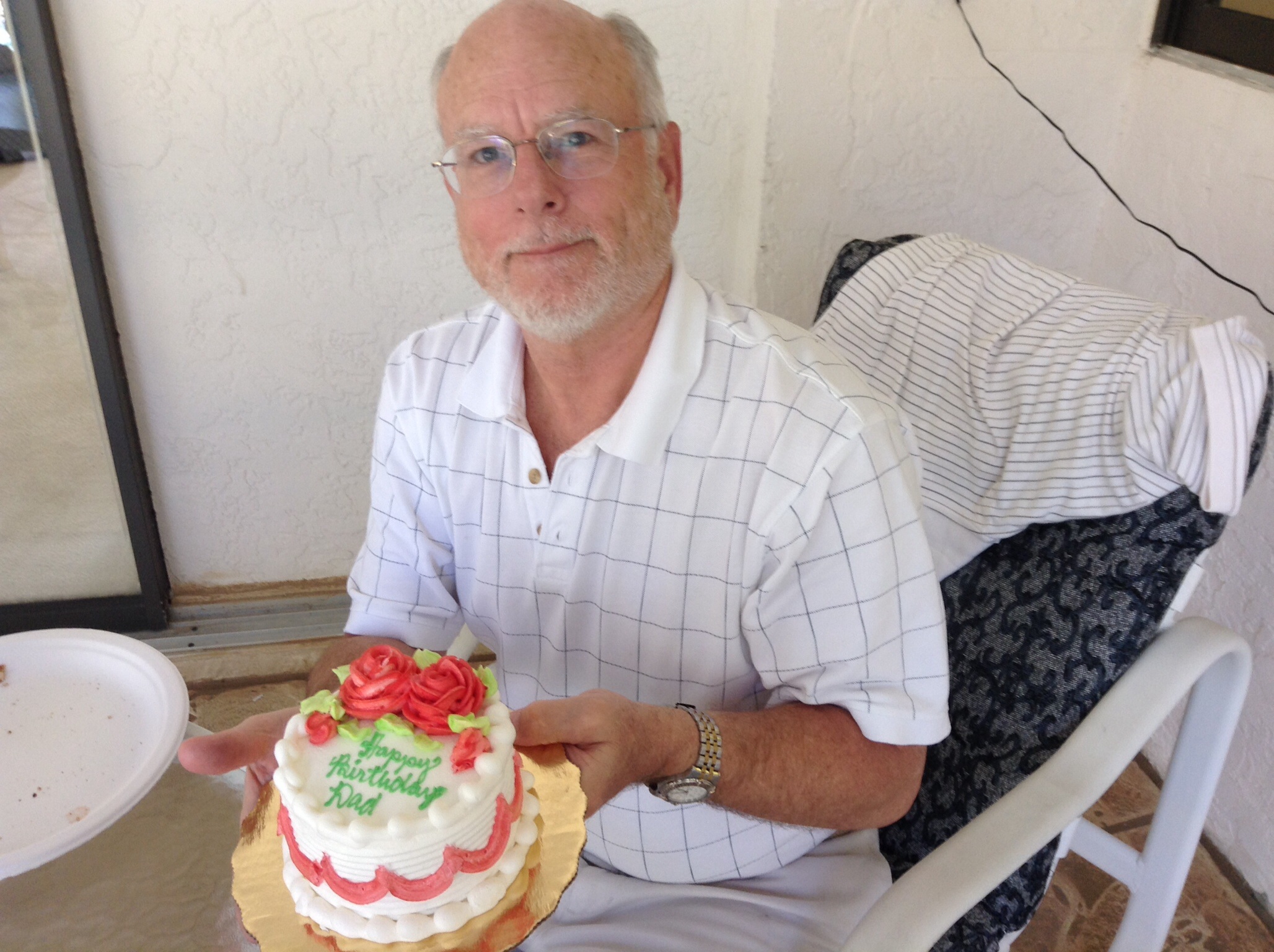
The man shown in this pic (from 2011) was active and working at age 106. He and hundreds like him have been the subject of scientific studies about human longevity. They are kind and gentle people who enjoy life by all accounts; they wish only to live as long as possible.

These are the folks who never suffer from depression; experience a major illness; spend time in hospital or prison; lose a child or spouse; worry about the sparkle of a crooked tooth or the part on their head of radiant hair. They don’t worry about any lack of symmetry that might render them unattractive — or about getting their way in life, because they always do.

I want to talk about the powerful, beautiful, effective people who everyone seems to want to be. I want to talk about the happy people like Steve McQueen who will always chase a fantasy, because they want to live in the worst, most desperate way.

I want to talk about the people who freeze themselves in the hope that in a benevolent future they will be thawed, and life will continue; I want to talk about the people who take 150 pills a day to prevent every ailment and strengthen every sinew.

I want to talk about the brilliant, optimistic people who expect that if they can just figure things out the right way, life awaits them for as long as they want it.  It’s all up to them. They will find a way to make life last; to achieve an eternal success, because they always have.

Is it time for a reality check?

Is this a good time to reveal some truths? — shocking truths, perhaps, for a few readers?  I want to predict our futures — all of our futures — as separate individuals with private lives; and as a species — a species anthropologists describe by the Latin words, homo sapiens, (smart people), which they use among themselves to differentiate you and me from all the other groups of living things we rarely notice or even think about.

Let’s smarten up for a few moments and defend our reputation among the kingdoms of the animals and the plants. Let’s think about best case scenarios for survival and whether we can make our dreams come true.

One statistic to keep in mind that is easily verified (and it might startle some readers): two-thirds of all deaths are not caused by aging.

So let’s move on.

Who wants to start with species survival? Who would rather address the riddle about how to lengthen an individual life?

Ok, the responses I think I hear in my head are nearly unanimous. People want to know how they themselves can live longer, correct?  People want to know how long they will live when everything is set right.

So, why not start with a best case scenario for individuals?  I promise to address the issues of survival for homo sapiens later, after a few paragraphs more.

Here are some simple, best-case-scenario assumptions:

Assume that disease is eradicated. We reach a state under the protections of ObamaCare (or maybe Trump-Care, who knows?) where no one dies in hospital anymore; all diseases have cures and can be prevented; in fact, disease is eliminated from the face of the earth — no bacterial or viral infections; no malevolent genes gone haywire; no Alzheimer’s or mental impairments; no more skin rashes or herpes or warts or annoying ear-wax that morphs into septic brain infections.

Disease is gone. Now take another step. Make a leap of faith. Assume that the genetics of aging is solved and that no one grows old. No one deteriorates. Skin does not wrinkle; no more age spots or rotting teeth; loss of hair and muscle-mass becomes a thing of the past. Aches and pains and constipation and diarrhea and acid reflux — what be them? They gone!

Our long medical nightmare is over, to paraphrase the words of President Gerald Ford on the night he pardoned Dick Nixon so that no prosecutor could ever charge and convict him for being a crook and throwing an election.

OK. What now become the odds for our survival?  How long can one person expect to live?  I think everyone can see, there’s something we didn’t consider; one thing no one thought of; a missing piece in the puzzle of living-large that is going to leap up and grab each of us sooner or later — unless we live bundled by bubble-wrap in a bunker, miles below the surface of the earth. We all know what it is, right?

It happens when we bike on a country road, and a candy-coking cell-talker in a Corvette runs us over. It happens when we climb Mount Everest (just to cross it off our bucket-list) and whoops! someone in the group forgot to tie their shoelaces. People see a video on the evening news — dead people buried in snow.

It happens when flying an airplane — a flock of geese smashes the windscreen. The pilot gets sucked out the opening — shredded by shards of glass.

We visit an amusement park to thrill ourselves on a ride that throws us upside down and — oops again! — an unscheduled stop; a mechanical malfunction. Two hours later, rescued, we’re vegetables. Homo sapiens don’t do well hanging upside down for long periods.

Yes, the one thing no one counted on is accidents.


Accidents kill a lot of people every single day. And nothing is going to change that fact unless people decide to live in virtual reality and never get off the couch to go outdoors or walk their dog.

What exactly are the statistics of accidents?

Well, every year one person in a thousand dies in a screw-up by somebody, usually themselves. It doesn’t sound like much, but for the person who dies it’s one death too many. Anyone who expects to live 25,000 years should perform a statistical analysis to see what the chances are they will live that long.

Why guess?

The way the math works is this: figure the chances of living deadly-accident-free for one year (it’s 999/1000), then multiply this number by itself for each year of life.

Save time by using the exponent key on a calculator to enter years, anyone who doesn’t want to spend a week multiplying the same number over and over 25,000 times. The result will give the chances for survival over a span of that many years. Try some other numbers to make comparisons.

The bottom line is this: no one has any realistic hope at all of living more than 10,000 years or so. Of the seven billion humans alive today, only one in 22,000 can expect to live to the age 10,000.

A mere 2,000 people out of 7,000,000,000 will survive to see year 15,000. There’s a small chance (one in ten) that a solitary person might make it to 25,000 years, but they will be an outlier; a statistical anomaly. Who wants to be an anomaly?  Not me.

In most cases; under the most realistic scenarios, the chances are that everyone alive today is going to be dead at age 25,000 because of accidents alone. They will die healthy though. It might be consolation for some.

No one will make it to year 25,000. That’s my bet. It’s not going to happen 90% of the time. 

Accidents happen.

OK. Now that everybody knows that our individual situation is hopeless, what about the survival of our species — the human race (for those who disdain the scientific term, homo sapiens)?


Not sure why this video, but it’s pretty good, so let’s go with it. 


I am sorry to report that the survival odds for our species are actually far worse than the odds for our survival as individuals. This depressing fact means that we can totally ignore the individual survival scenario we just took so much effort to describe. If our species dies-off early, individuals are going to die early too.

How can this terrible situation be possible? It seems so unfair.

I’ve been reading the book Global Catastrophic Risks — a collection of essays edited by Nick Bostrom and Milan M. Cirkovic — first published nine years ago (in 2008) when species survival was more certain than it is now. These brilliant men collected essays written by other forward-thinking geniuses who describe in delirious detail thirteen (or so) existential threats to the survival of humans. Some readers might want to review the list.

1 – Systems-based risks and failures

2 – Super-volcanism

3 – Comets and asteroids

4 – Supernovae, gamma-ray bursts, solar flares, and cosmic rays

5 – Climate change

6 – Plagues and pandemics

7 – Artificial intelligence

8 – Social collapse

9 – Nuclear War

10 – Nuclear Terrorism

11 – Biotechnology

12 – Nanotechnology

13 – Totalitarianism

The authors argue that certain scenarios involving these threats will create an inevitable cascade of events that lead to the melt-down of civilization and a kill-strike against the human-species. I decided to assign a 1 in 10,000 chance of occurrence to each of these 13 catastrophes and crunch the numbers to understand how much danger people on Earth might be facing.

What I discovered scared me.


A super-volcano eruption in Toba, Indonesia 70,000 years ago reduced the population of humans on Earth to less than 4,000. Volcanoes that we know about today, like the one under Yellowstone National Park, might be larger and more dangerous.  

For one thing, it’s not possible to know if 1 in 10,000 is an optimistic or pessimistic assessment of each of these risks. Nuclear war might be 1 in 100; climate change — 1 in 50; asteroids — 1 in 50,000; supernovae — 1 in 100,000,000; artificial intelligence — 1 in 10.

Who knows?

Can humans survive 10,000 years without a pandemic or nuclear war? No one knows.

Experts resort to heuristics, which erupt from biases even they don’t know they carry. I suppose a gut-check by an expert has more validity than a seat-of-the-pants guess by a pontificator. I will give you that. But the irony is that no matter who is right, no one will know because we are all going to die.

Evidence in the fossil and genetic record already shows that at least three human-like species are known to have come and gone during the past several 100,000 years or so, including Neanderthals and Denisovans. Extinction of intelligent, human-like species happens more often than not — 3 out of 4 times, maybe more if scientists continue to dig and look.

Number-crunching shows that if my 1 in 10,000 or so years risk assessments are anywhere close to being realistic, humans have no more than a 1 in 4 chance to avoid extinction during the next 1,000 years. Our chance to survive approaches zero as the number of years reaches into the realm of 5,000 years and beyond.

Humans have recorded their stories for 5,000 years. Some call these stories, history. Sometime during the next 5,000 years, history will end unless humans lower the odds of these catastrophes to much less than 1 in 10,000.


We are truly stupid — dumber than earthworms — to refuse to make the effort to increase our survival prospects by lowering these probabilities, these ratios, to one-in-one-hundred-thousand or better still, one-in-a-million or even better, one-in-one-hundred million. Why not one-in-a-gazillion?

How? It’s the big question.

Reducing odds of catastrophe is the most important thing. It’s urgent. Failure seals our fate.

We search the heavens. No one seems to be broadcasting from out there. Maybe it’s something simple like Miyake events, which some argue make communication infrastructure near stars impossible to sustain.  

What science hears is silence… and tiny chirps, yes, but not from crickets.

Doomsday clocks? 

They’re ticking.

Billy Lee

WHAT HILLARY DID

Hillary Clinton 6
Hillary Clinton sometimes shares stories with people about her late mother Dorothy Rodham who was born on 4 June 1919 — the same day that the women’s voting rights amendment cleared its final legislative hurdle in the US Congress.

People have a difficult time grasping a simple truth: every time the right of women to vote in national elections has come before the Supreme Court, the Court has voted against it. Despite a national movement that started in 1848 at Seneca Falls and continued with annual meetings of National Women’s Rights Conventions from 1850 onward, courts in America have rarely ruled in favor of women’s rights; the Supreme Court has never ruled in favor of a woman’s right to vote; never.

Even when women were arrested and imprisoned; when they went on hunger strikes and guards force-fed them like modern day prisoners at Guantanamo Bay, the courts remained harsh and unforgiving.

It took a constitutional amendment (the 19th) passed by the votes of loving brothers, fathers, grandfathers, husbands, sons, and boyfriends in state legislatures across the country for women to make their successful end-run around the opposition to female voting that infused the Supreme Court; it wasn’t until 1920 that every woman in America secured the right to walk into polling places to vote in national elections. They never looked back.

Voting rights for women became a settled legal matter in 1922 when the Supreme Court ruled unanimously that the procedures demanded by the Constitution were properly followed. The 19th amendment would never be reversed — short of another constitutional amendment. That amendment can never come now that women are voters.

It’s been ninety-six years. There are women walking around today who were alive when their right to vote was granted. It wasn’t that long ago. Hillary Clinton has sometimes reminded us that her late mother was born on June 4, 1919 — the same day the voting amendment passed its final legislative hurdle in the United States Congress.

Before I explain just what it was that Hillary did, here’s some background; a little history, Billy Lee-style:


Alfred_A._Stratton civil war amputee
Union soldier Alfred Stratton lost both arms to cannon fire at age 19. One of every thirteen soldiers lost limbs in the Civil War. After his discharge Sgt. Stratton sold pictures of his wounds to support his family. He died at age 29 leaving behind his wife and two children. For me his eyes convey the heartache of a soldier who won at war and lost everything.

After the end of the Civil War, which traumatized the nation with its toll of 750,000 deaths and millions maimed and wounded — 1 of every 13 soldiers who served became an amputee — something worse happened. The men in America who survived but lost their way of life to war, many of them, became demoralized and angry; they spiraled downward. Some who managed to keep their limbs continued to fight; they went to war against the ”redskins” in genocidal campaigns that decimated our native populations.

But other men — I would say most of the survivors — went on a drinking binge. The binge lasted decades. Some men drank themselves to death. The tranquilizers and antidepressants that might have saved many hadn’t yet been invented.

Opiates were available, yes, and many ex-soldiers purchased them in bottled elixirs sold by traveling salesmen. But alcohol was the remedy of choice for men whose minds and missing limbs exuded the chronic, excruciating pain of amputations and the memories of horrors. Alcoholic spirits were cheap and easy to buy. The excessive use of alcohol and the inevitable abuse of women that always seemed to follow became a national epidemic; a cultural disgrace. It lasted decades; some say it has never really ended.

The bullying of minorities, native people, and women — cruelty often directed against the weak and defenseless — became a way of life for many veterans who suffered post-traumatic-stress-disorder, which no one understood at the time. The vocabulary folks needed to even discuss the dynamics of this personal degradation by war was not available like it is today. For southern soldiers, the trauma of a lost way of life; the shock of watching former slaves ascend to leadership positions once reserved for whites-only became too much to bear.

Violence against women — their vulnerability in the face of drunk husbands and boyfriends — reached a level that women simply couldn’t take anymore. Many women believed that if they could just get their husbands to stop drinking, the abuse they experienced at home might come to an end.

No one understood at the time that the drinking and abuse were symptoms of an underlying psychological distress, not the cause. A hundred-and-fifty years of fear and paranoia was erupting out of the guilt and shame of seizing lands that belonged to others; of kidnapping, enslaving, and vilifying millions of Africans; murdering tens-of-thousands of women and children during wars with the Indians; and blood-letting in the war between north and south where brothers killed their own brothers.

Americans wasted the lives of other Americans in the Civil War at a rate that has never been equaled since by any external enemy or foe. Americans suffered more casualties during the Civil War than in all other wars combined.

All this evil bubbled up out of the badlands of America — America was arguably the world’s largest and most isolated island at the time. The men who witnessed war; who lived it; who perpetuated it and became its victims held onto their minds and emotions by clinging to desperately delicate threads. Many lost their grip — emotionally and physically — and died early; some took their own lives.  

By the beginning of the twentieth century, most women had had enough. By 1914 (the start of World War I) they were fed up, vulnerable, and powerless. Their men were going off to fight another senseless war where a third of the dead would expire by poison gas while hiding helpless in the muck of trenches. The government passed the Selective Service Act of 1917 (the draft) because in this war young men, many of them, lost their will to fight. 

Women had a big stake in the new war. Most women, despite the abuse, had male friends and relatives. They were mothers; sisters; daughters; grandmothers; even great-grandmothers. They nurtured the men in their lives who weren’t coping well with the nightmare-world into which the USA morphed after terrible decades of slavery, endless war, cruel repression that followed Reconstruction, and the extermination of the native peoples (who they called Indians).

Men, some of them, began to see that women might be right. As a country, what we were doing wasn’t working. People were going to have to change the way they lived and conducted the nation’s affairs.

Most folks know what happened. Women — who couldn’t vote — organized. Men joined them. Everyone seemed to agree on the underlying problem: it wasn’t so much the wars or racial violence or even the rise of robber barons and corrupt governance; what was wrong with America — it was so plain to see for anyone who made the effort to open their eyes — was the alcohol.

Get rid of alcohol, the Devil’s drink, and God would heal our land. God would make right the terrible things we had done. Citizens would all enjoy together at long last the peace of mind that comes with the forgiveness of sin and the love that only Jesus brings to every man who murders and rapes because he can’t stop drinking.

In January 1919 — led by women from the suffrage and temperance movements among others — the 18th amendment passed, which put commercial restrictions on the manufacture and sale of alcohol. The amendment took full effect in January 1920. The public consumption of alcohol — with all its problems — was now in the past.


Let women vote poster


Emboldened and buoyed by their power to pass almost simultaneously — and in the face of judicial opposition — two constitutional amendments: one that allowed women to participate in the nation’s democracy; the other that corralled the wicked impulses unleashed by alcohol in their war-weary men (World War I ended in November 1918), the women of 1920 felt the stirrings of a new optimism about life in the United States and their future.  

With the help of the men who leaned on them for comfort and emotional support, 75% of the states agreed to ratify the two amendments certain to set things right; amendments that would most assuredly lead the way forward to the salvation of America.

Thus began the walk on the pathway toward righteousness. Citizens basked in the light of greatness; they had won the war in Europe; men marched home in the glow of favor that comes to every repentant people by the forgiveness of Almighty God.

The nation was being transformed into a people; a united people, a nation of both men and women who turned their backs on the devil; who put behind them his corrupting spirits and ales.

Americans — all of us together — at last embraced liberty and freedom and voting-rights for women. After all was said and done — campaign posters explained it beautifully — it was women who brought every single voter into the world. 

And indeed alcohol related crimes fell fast after 1920.

There was a little problem, though.

Despite widespread support for the right of women to vote and for the prohibition of the public consumption of alcohol, it turned out that not everyone in America wanted to climb on board the choo-choo train of righteous-living.

Again, we know what happened. Men formed gangs from which they drew the power to circumvent Prohibition. They continued manufacturing and distributing alcohol, which they sold in clubs they called speakeasies and blind pigs.

Although the 18th amendment did not forbid drinking by private individuals in their own homes, the Constitution of the United States now forbade the commercial production and sale of spirits and ales in public spaces like clubs and liquor stores.

Like the forbidden fruit of a modern Garden of Edenblind pigs became the rage in every major city in America. By the 1930s, the revenues generated by illegal clubs were so enormous that the gangs who merchandized alcohol were able to wrest control over whatever businesses or local and state governments they chose.


Inequality is never good. Neither is packing a family into a car with no seat belts.


What happened? Crime cartels took over and basically ran our country into the ground. By 1930 our economy collapsed. The Great Depression began. By 1933 ordinary people had enough. Voters — women and men — repealed Prohibition. Voters hoped repeal would stimulate the economy, emasculate the crime-bosses, and reverse the rot that was infesting like a plague of sewer-rats every city and municipality.

It wasn’t to be. By 1933 the iron grip of organized crime was entrenched and intractable. It wasn’t going to let go. Despite massive government spending, new social programs, and numerous public-works projects, unemployment, poverty, and despair continued to demoralize society. The USA spiraled downward; it seemed to never end; maybe it would last forever. 

World War II changed everything. The cartels went into the munitions business. They took control of the factories that built bombers and guns. We’ve been at war ever since. We’ve waged war against one out of every four countries on Earth during the past 75 years. Business has been good.

In the 1980s the cartels decided to try their hand at pharmaceuticals; medical care would come later. It was challenging; pharma was technical; it was hard to understand. What they learned was this: Americans were open, even eager, to try new drugs; to adopt new treatments. The treatments and drugs offered hope. It didn’t seem to matter if they worked all that well.

The drug cartels lobbied Congress for regulatory relief so they could advertise their ”medicines” on television. The rest as they say is history. The people of the United States are now the most drug dependent civilization ever. We may not be that healthy compared to people in a lot of other countries but with the right medications we sort of feel like we might be.

We all know the results. Americans spend more on heath care and drugs than on their houses and food. USA health care is a mess — who will argue with me? But it’s lucrative.

Health care is today the biggest cash cow for the most heartless group of wise-guys ever to take control of American institutions; let’s give this group of con-artists some respect and refer to them as “the medical profession“.

Why not?

Even if folks were able find out the address of their local hospital administrator and a few of his surgeons, they would never be able to visit to drop-off their complaints because these high-rollers live in a hidden world behind gates, most of them. They live like the heads of caliphates, many of them. Yes, these individuals are clever. But Americans are paying too high a price for cleverness.

So… readers who’ve read this far might be asking,

Well… are you going to tell us what Hillary did?

Of course I am. Would I let readers down?

Never!

Hillary’s husband, Bill Clinton, became president of the United States in January 1993. One of the first things he did was appoint his wife to help create a healthcare plan to cover every American — detractors would come to call it HillaryCare.
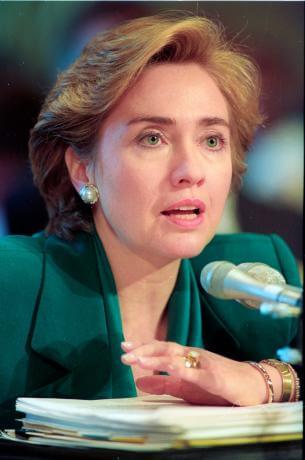

First Lady Hillary Clinton testifies for the final day before the Senate Finance Committee on Health Care September 30, 1993. REUTERS/Mike Theiler
First Lady Hillary Clinton testifies for the final day before the Senate Finance Committee on Health Care 30 September 1993.  REUTERS/Mike Theiler

The techniques used by the healthcare industry to crush universal health care are a case-study in Evil — for anyone who has the stomach to examine what its leaders did. Anyone can click on links in this essay to learn more if they want.

I don’t really care to get into it; the details, that is. The whole episode disgusts me as it should any fair-minded person who cares about ordinary people and their health.

The bottom-line is this: Hillary walked into a snake pit, then hit a brick wall. The healthcare industry chose to demolish the wife of a sitting president in the first year of his first term. They made an example of her.

People would think twice before pulling a stunt like healthcare reform again. It worked — for 15 years anyway — until the Kenyan usurper with no birth certificate, President Barack Hussein Obama, showed up.

The bad-actors who administer the health delivery system in America today consider Hillary Clinton a clear and present danger to their trillion-dollar cash cow. They intend to regain control of Health Care as soon as the GOP wins the presidency this fall. That’s their plan, anyway.

After defeating Hillary’s efforts in 1993, the industry and their buddies began a CIA-style disinformation campaign against her which has continued for the past 23 years — in case she might rise from the ashes of defeat to come after them one more time.

Guess what? She’s on her way. This time she is not one person — the eager-to-please wife of a new president. This time she is 120 million voters strong and counting. If current polling holds, she will be the next president. 

Look at what these yahoos said about President Obama after he tried to fix our casino-style healthcare system during his first term. Does anyone think these folks are not able to discredit others while maximizing their own considerable advantages?

They’ve thrown up roadblock after roadblock. They’ve arranged things so that the new healthcare options can’t be fully implemented until Obama has left the White House. With the election of a Republican president, they plan to dismember and discard ObamaCare  — quickly. Most Americans will never fully understand what they missed or what was taken from them.

Before ObamaCare, when people got sick, insurance administrators sometimes kicked them out of the healthcare casino, altogether. People were on their own. Good luck, and God bless. 

The people who enforced these heinous policies are the same people who call Obama incompetent and a failed president. These are the people who have inflicted the nightmare of the current Republican contender on America; who are willing to scare the whole world to prove they are serious.  

These insurance folks and their  allies aren’t the government; they are civilians with the money to hire experts; they believe themselves fully capable of discrediting even the Crucifixion of Jesus should it ever become necessary. 

During the next six months they are going to use every technique in the army psyche manual to convince voters that Hillary Clinton is a witch who deserves to be burned on a phallic stake.

Watch and learn. They don’t want ObamaCare fixed. They want it wrecked.

Read my essay, Why This Time Women Will Win, to learn more.

Character assassination is just another way to kill someone, to my way of thinking. It’s murder. The Bible says it is, anyway.  I’m intrigued by the possibility that when Jesus said anything at all — even in a Book as discredited by the wealthy and powerful as the Bible apparently is — it might actually be God who is doing the talking.

Our self-described healers of broken bodies (I’m not going to name them because I don’t want them showing up at my house) cooperated with insurance company executives and drug company titans to destroy Hillary Clinton’s reputation. Their lavish lifestyles give them away.

People believe crazy stuff because they’ve listened to these creeps — sometimes on Fox News, the GOP propaganda mill. One guy on my Twitter feed called Secretary Clinton, Killary. He wasn’t smart enough to make up this epithet on his own, believe me. If this guy is the Christian he claims to be, Jesus is going to ask him someday why he would say such a thing. It could get awkward.

People on the right seem to believe that if they hate somebody, they can make stuff up to tear them down. It’s the way the game is played. 

There is an irony of wickedness here that almost defies explanation. It’s all because when she was young and naive Hillary believed that even the bad guys would do the right things when given the right opportunities; she dared to challenge the way health care is delivered in America — to make it fair and accessible to the 80% of Americans who could not afford it.

She learned the hard lesson many Americans now know is true. It isn’t about health care. It’s about protecting the golden cash-cow.

Who wants to work for $25 per month? they are always telling us about Cuban doctors. People who feel called to help the suffering multitudes will be the only takers in a system like that. People who value money will find something else to occupy their time.

Anyway, with a Hillary Clinton win this fall — should the Democrats take majorities in the House and Senate — our citizens will finally have a government with the right people in place to better defend us against being used for prey by the predators who presently plunder us.


Sandy Hook parents grieve
Victims of Sandy Hook massacre Christmas Season 2012. CBS News reported that the shooter’s parents were NRA members because NRA certificates and pamphlets were found in their homes. The NRA forced CBS to retract the story.  (Photo by Reuters / Andrees Latif — 2012)

Hillary has also taken on the NRA, in case anyone forgot; it’s another (some would argue) bad-boy organization that scares the daylights out of its opposition because a lot of crazy people with guns seem to be among its members. They defend the Second Amendment, which they think permits them to scare the crap out of people by carrying their guns into churches, hospitals, libraries, and schools.

NRA family members are numbered among the crowd of people who have ”gone postal” during the past few years; people who massacred politicians, children, and theater-goers. Hillary challenged this monster-cult. Its a group of men mostly who intimidate congressional leaders to vote against their own common sense.

Children die every week because the gun-makers sell unsafe firearms to an irresponsible public. It’s not right. It’s not safe. It’s not freedom. It’s manufactured fear, plain and simple.

The right to bear arms described in our Second Amendment was included to keep Americans safe and free, not scared and intimidated. It was written to save time when raising an army should foreigners like France or England choose to invade. The NRA has turned the amendment on its head into a money-making scheme for gun panderers who play to people’s paranoia and hate. It’s that simple, at least to me.

So yes, Hillary is a threat to people who are used to getting their way while they live like the cold-hard oligarchs they have become. Do these bad people have nice smiles? Do they wear beautiful clothes? Of course they do. They are billionaires. Their smiles cost hundreds-of-thousands of dollars, some of them. Their clothes cost more.

Hillary is not a billionaire. She never will be. For those readers not good at numbers, let me remind everyone: a billion is 1,000 millions. The man who is running against her; who calls her crooked Hillary — claims to possess 14,000 piles of a million dollars each.

Is it possible to earn and keep billions while working honestly and playing fair? I might believe him if someone I trust analyzed his tax returns, his company balance sheets, and income statements. Until he agrees to release them like everyone else who runs for president, I’m more than skeptical; I’m incredulous. 

In any event, it is the policy of theBillyLeePontificator.com to advocate for income and estate maximums based on agreed-upon and reasonable ratios tied to the minimum wage. These maximums can be very high and do no harm. Please read my essay, Capitalism and Income Inequality, to learn more.

We at theBillyLeePontificator.com do not believe we need a revolution to achieve simple changes to our tax codes that will impact less than one-hundred thousand privileged people.

We are 324 million people living in a democratic republic. It can’t be that hard to raise taxes on the greedy who are distorting our democracy and driving our country off a cliff to protect their power and privilege. Please read my essay Is Something Wrong With America? to learn more.

Something else Hillary did this week while challenging some of the most powerful people on Earth: she clinched the Democratic nomination for president; she’s the first woman of a major political party to do it.

What Hillary achieved cannot be overstated. It’s pretty darn incredible given the negative attitudes toward women-in-leadership espoused by many church and corporate leaders — behind closed doors, of course.  

Here are the election results; they might amaze some readers. The numbers say that mama Clinton has a fighting chance to win this election. My wife prays for her safety and success every single day.

So do I.

Billy Lee


2016 06 07 primary results popular vote
These results are from the 35 states where both parties held a popular vote contest. DC Democrats vote on June 14. Bold black ink indicates the winner. Blue ink indicates a second place finish.


2016 06 07 primary results mixed and caucus
These results are from the 11 states and 4 territories where both parties held caucus contests; and the 5 mixed primaries where one party held a popular vote, the other a caucus.


Editors Note: In the November election of 2016, Hillary Clinton beat Donald Trump in popular votes by nearly 3 million. Third-party candidates polled 8 million more. Donald Trump lost the popular count by 11 million votes — one of the largest popular defeats in the nation’s history. Manipulation of vote counts in Michigan and a few other states secured his win in the Electoral College. All courts everywhere refused to hear a single challenge to the results, which were razor thin in three states

XANAX

During my teens I followed a TV series called Twilight Zone.  Rod Serling hosted and wrote most of the shows — but not all.

One episode has stayed with me: Number 12 Looks Just Like You. John Tomerlin adapted it from Charles Beaumont’s 1952 story, The Beautiful People.


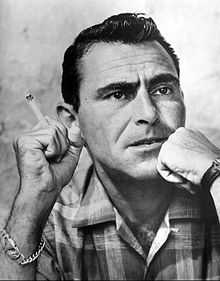
Rod Serling 1959. Heavily censored by sponsors before he got his own show — Twilight Zone — Rod wrote freely until death at age 50 following multiple heart attacks, the last during surgery.

As I remember the story, people in some imagined future-world valued harmony. They thought unattractive people divisive and a threat to world peace.

They demanded that government use its powers to enable folks to better love and accept one another, which required that every member of society agree to a surgical procedure, called the transformation.

Surgeons transformed each person into one of a dozen archetypes — each archetype identified by researchers as appealing to all other people.


Collin_Wilcox_1958 twilight zone number 12 looks just like you
Collin Wilcox played Marilyn Cubele. She died of brain cancer in 2009.

The heroine, 18-year-old Marilyn Cubele, decided against having the surgery because her father committed suicide after learning to regret his transformation — it cost him his identity, he said. Nevertheless, Marilyn’s friends and family pressured her to go along.

After all, everyone else was having the procedure, they argued. Did she really want to be less attractive around beautiful people?

Eventually Marilyn broke down and agreed.

The surgery went well. The doctors administered a drug to ease her mind; to help her accept what was done; to reduce chances of post-procedure depression like her father suffered.

In the last scene, Marilyn confides to her best friend. “Valerie, you know the nicest part…? I look just like you! 


ayn rand
Ayn Rand, author of Virtue of Selfishness and Atlas Shrugged. Ms. Rand died at 77 of heart failure.  Economist Alan Greenspan attended her funeral.

At about the same time another writer caught my attention, this time from print media. I began to collect and read everything available from the novelist Ayn Rand. I even subscribed to her newsletter, The Objectivist.

Ayn Rand marketed herself as a utopian idealist who believed capitalism and minimal government worked best for rational human beings. I attended a lecture by this unusual woman, and wanted to meet her, but that story is for another time.

Ayn Rand is relevant to this article on Xanax, because she wrote about an ideal world where reality forced a certain fairness on people and on society in general. If people did irrational things, their lives unraveled; they tended to fall into disarray. Rand believed happiness must be earned. It shouldn’t be acquired without intellectual effort. It wasn’t a birthright.

People were to strive for and achieve happiness through rational thought and action; by right-living.  Joy was not something just anyone could bestow on themselves with a drug, legal or illegal. Rand could not imagine a future where people would display bad or irrational behavior yet continue to experience a comforting happiness, all because they took tranquilizers and antidepressants.


Xanax, 0.25 mg. I took up to six a day to stop episodic ventricular tachycardia
Xanax, 0.25 mg. I took up to six a day to help prevent episodic supraventricular tachycardia, until surgery made them unnecessary.

But now, decades after Ayn Rand’s death, researchers have learned that people may suffer depressions for no easily discoverable reasons. Depression, it’s now known, may have nothing to do with behavior or right-living. In some people, it is a chemical imbalance in the brain and hormonal system that could have any number of causes not necessarily related to behavior.

Because depression is the main reason for suicides, doctors often prescribe antidepressants and other mood-elevating drugs — like Xanax — to suffering people. The clinical results are often amazing.

Psychiatrists today spend much less time administering expensive and time-consuming therapies, like psychoanalysis and out-patient counseling. The right drug, properly prescribed, is sometimes all it takes to rescue people from their emotions-gone-awry.

In the 1960s and 70s, before tranquilizers and antidepressants were widely accepted and prescribed, most public schools required students to take Health Class as part of Gym.  

Instructors taught that people suffering emotional distress had two options. They could change their environment — or change themselves.  The third option — drug-rescue — wasn’t on the table. Many drugs available today hadn’t yet been invented.


Supra ventricular tachycardia
Supraventricular tachycardia is a fast regular heartbeat. It feels like a little bird in your chest, flapping its wings.

I’ve never taken antidepressant drugs, so I don’t know how I might react to them. But I suffered for years from a heart arrhythmia called supraventricular tachycardia. Doctors prescribed a number of drugs to control it, including the mood elevating tranquilizer, Xanax.

Although it’s been a few years since my last exposure, I am familiar with Xanax, having used it daily for years during two separate periods. I quit the drug twice, once by tapering, and once suddenly — providing direct experience of its “dependency” properties, which for me at least were mild. Everyone is different and readers are advised to follow strictly only their doctor’s instructions. 

For those who have never used it, the main thing I can tell you about Xanax is that it works as advertised. If you suffer from panic attacks (the cause of some episodes of tachycardia), Xanax stops them cold.

If you suffer from anxiety, Xanax stops that kind of suffering as well. The first time I took this brand of benzodiazepine, I dropped to my knees and thanked God for the people who invented it. Just knowing the drug is out there, gives me confidence to live without it. It’s that good, at least for me.


social anxiety disorder-cognitive-therapy
Didn’t suffer social anxiety when taking Xanax. Didn’t grow hair, either.

One thing I didn’t suffer while on Xanax was irritable bowel syndrome — an anxiety driven disorder that bothered me a lot when younger. Weeping stress blisters on my feet cleared-up completely.

Though baldness continued to plague me, social anxiety disappeared. I became somewhat fearless. I took risks in social situations unthinkable in pre-Xanax years. Most times, benefits outweighed risks.

Occasionally, I crossed boundaries with bad results. I still do but not as often. For some reason I want to believe that feeling the pain of social anxiety is morally superior to being dependent on a drug that eliminates it.

And truthfully, Xanax taught me what it felt like to live free, without fear. Once I knew it was possible — that my body and mind were capable of it — I let the drug go.

I guess I felt like Marilyn Cubele, the Twilight Zone girl, who didn’t want to be surgically transformed.  It has something to do with the dignity of the human spirit, as writer John Tomerlin put it in Number 12.  

I want to believe I can be happy without drugs — to think I can face life without a pill or injection to get me through.

The nicest part? — I want to be just like you.

Billy Lee

Note from the Editors: Despite the heroics claimed in his essay, Billy Lee continues to use Xanax to control anxiety and relieve the strain on his heart from chronic coronary artery disease.  26 November 2019