Top people charged with responsibility to protect and defend the United States know with certainty two facts, which the American people can only guess.
Who knows what they might be?
Think long and hard.
Maybe destinies of powerful persons, their families and friends, collaborators and enablers, hang in the balance.
Does anyone know?
Lives and legacies might depend on what Team USA believes it knows for certain.
Are we in a bio-war or not? If so, with whom?
Did someone throw the 2016 election and install a Manchurian Imposter?
Well… ??
Who is destabilizing America? Are legions loyal to foreign oligarchs and who intend us harm infiltrating Parties, paramilitaries, social media, and talk radio?
What about television news shows?
Believe it or not, people exist who know with certainty the answers to these questions. They possess power to set things right. They work for Team USA.
America’s defenders know which answers are yes and which are no. They are able to distinguish between threats that are crazy-talk and those which are dead serious. They possess data bases filled with names, phone numbers, and addresses of people who plot mayhem.
If they choose, they can put stealth missiles through the bedroom windows of those who have the wherewithal and intent to start World War Three. No one believes it, but it’s true.
The United States rules Earth. It isn’t going to change—not ever.
Folks who aren’t American, some of them, don’t understand. The USA rules because it knows how to identify threats and neutralize them. A lot of wannabe dictators could testify in the affirmative but unfortunately for them they are dead.
Why does power concentrated for long in the hands of solitary sociopaths drive some insane? Power-trippers, most of them, learn too late that their inevitable screw-ups suck like quicksand to extinguish their ambitions. History is filled with such stories.
It might be better for some folks to have never been born. They suffer in this life and maybe the next. Their goal?—to make their subjects as miserable as they can. It’s not right.
My dad worked for the National Security Agency when he wasn’t flying jet-helicopters to defend our eastern borders from adversarial submarines. I met and knew his friends. In their world, right made might, not the other way around.
I can assure readers that those I knew who served to defend American freedom were the good-guys. The world has no hope of living free absent the United States.
Yes, some of our oligarchs are depraved and crazy. Americans will deal with them eventually, right? For now, we face another decision, which is whether to settle scores with oligarchs who live elsewhere who may have tried to hurt us.
No ordinary person who lacks security clearances can say which threats are real and which are conspiracy theories told to divert attention from terrors most folks are not well-trained to handle.
People today deny it, but truth is—80 years ago—the Japanese people, some of them, wanted to be conquered by America. They longed for freedom, prosperity, and most of all for our collective sense that right and wrong mattered.
It’s why they obeyed their emperor and attacked Hawaii. Some generals knew full-well defeat was sure to follow, because they were sophisticated and well-traveled. They understood America. Being undone by Americans meant those in their families who survived war would soon live free and proud. When annihilation finally came it would bring fresh wind; they and everyone left alive would be delivered from evil.
There was no other way.
I lived in Japan for two years following the Korean War. The Japanese people, many of them, worshipped the righteous ground we walked on. We were heroes.
Today, America is led by loving people (Joe Biden and Kamala Harris) who care about doing what is right and fair. Unfortunately for our adversaries, we might have scores to settle. I have no way to know for sure. What some adversaries don’t seem to understand is that whatever are the stakes, events which will shape the future are already well-planned and underway as I write.
Underestimating capabilities of the USA to protect its secrets and war-making technologies is a trap the foolhardy step into from time to time. Adversaries should know by now that the USA does not bluff. For the United States, freedom is not a chess match; it’s not a game of Pong or Checkers.
We don’t fuck around.
If it’s true that scores will soon be settled, then the lives of powerful people, their families and friends, their collaborators and enablers in lands faraway are at this moment in grave danger.
America goes for the jugular of those who fuck with us. We hit leaders first if we can, last if we must.
When conflict comes, the takedown of foreign oligarchs who have messed with our democracy will be ruthless and total.
Who disagrees?
When it’s over the world will be a better place.
Yes, a few bad people will end-up missing. The best part is no one will miss them because everyone they know will disappear. It’s how civilization advances against barbarism when options vanish.
My advice to people who have done wrong is to write notes of apology to America and its friends. Tell us what you did wrong and what you regret. It shouldn’t surprise anyone that Americans love apologies and are eager to forgive with open hearts any who are contrite and filled with remorse.
Leaders of the World:
Bring freedom to your peoples by dividing your governments into co-equal branches where no one person or like-minded group can seize power; where consent of the governed determines the course of history.
This essay is one of the shortest on the website, but it might be the most timely during this moment of impeachment inquiries. Questions like the following are being asked on forums around the internet and the world:
Would you rather have Joe Biden or Elizabeth Warren run against President Trump? September 2019 on Quora.com
The problems that President Trump creates are the most serious to face Americans in my lifetime. Three exceptions might be the Cuban Missile Crisis, the Vietnam War, and 911.
As a people, we are at this moment completely dependent on our elected representatives. Nothing any civilian does can make any difference; we are helpless in the face of an alleged sociopath who holds the most power of any human on Earth.
Tony Schwarz wrote Trump’s Art of the Deal and split the profits 50-50. He has said that Trump is a sociopath capable of initiating a nuclear conflagration.
The following is an answer to the Quora question, which I hope people who matter carefully consider. And yes, the answer is somewhat oblique. I don’t think whoever runs against Trump will make much difference in the events that will come after.
Does anyone believe that Trump is the kind of man who relinquishes power?
The surest way to remove Trump is through impeachment, but it’s not clear that he will step down if he is convicted by the Senate. Waiting for clarity is not a valid reason for caution. Inaction will bring catastrophe. Too much is at stake.
I know it’s difficult for many Americans to remember, but Trump insisted that the 2016 election was rigged by Hillary Clinton; many believed he planned not only to challenge the election in the courts but to lead an insurrection or even a revolution if the result turned against him.
Trump is allied with the NRA—an armed, insurrectionary group of lunatics dedicated to revolution should they fail to get their way. The NRA has been swarmed by Russian intelligence. The Russian objective is to destabilize the United States by fanning the flames of paranoia in a politically influential organization known to be susceptible to manipulation by conspiracy theorists.
Southern evangelical Christians are the backbone of the new Confederacy, which Trump leads; he is their modern day Jefferson Davis who plans first to reestablish legalized segregation under the guise of, I don’t know, “right to choose”, maybe.
Other atrocities will follow. The suppression of non-whites (like immigrants) is in full-swing, which white-supremacists, among others, support.
White evangelicals don’t preach against the ethnic-cleansing of America; they endorse it. Jerry Falwell Jr. of Liberty University has encouraged his students for years to train in the use of firearms so that they will be able to kill Muslims if given the opportunity. For years he has advocated for violence against those he hates by inciting unaccountable, non-state actors — like the students who attend his so-called “university”.
NOTE BY EDITORIAL BOARD: On August 25, 2020 Jerry Falwell accepted a $10.5 million severance package from Liberty University to step down. Like Adam in the Garden of Eden, he blamed his wife for the sex scandals that followed him pretty much everywhere during his tenure.
I think most reasonable folks are at a point where they can figure-out that the coming election might amount to no more than a simple diversion — a shiny object to pull people’s attention away from what might turn out to be the only course of action with any chance at all to remove the president — an impeachment in the House of Representatives followed by conviction in the Senate.
Many people are in denial; people withdraw their attention from events that disturb them. Seizure of American institutions has already taken place by people working for the other side. Some people seem to have unrealistic expectations that a media owned by oligarchs like Trump will warn them.
Very few are able to face head-on a reality that includes loss-of-country. People sleep better at night if they pull their heads inside their shells and pretend everything is OK when it isn’t.
Some resort to a version of the Stockholm Syndrome to help them cope with the sickness that tears at their stomachs when they remember that Trump grabbed them by their electoral colleges; they embrace the tormentor to maintain their sanity.
Stockholm Syndrome is at the core of Trump’s power. Trump is right that he can kill, and his supporters will stand with him. He has nothing to fear from so-called “church-goers” who love him because he is bad.
Trump has put into place policies that seem designed to terrorize sick children; ICE puts them in cages where they risk death from neglect and illness; the president’s policies strike fear in families who are running from gangs to search for safety north of the southern-border.
Everyone wants to believe that a shining-city-on-a-hill exists somewhere in the world that they can crawl to during hard times. It’s a myth, unfortunately. Trump has shredded people’s dreams for a better future. Impoverished freedom-seekers are neither welcome nor safe in Trump’s America.
A bad election result is the easiest thing for a thug who already holds power to cast aside. An election can be rigged; it can be ignored; it can be challenged in stacked courts; it can be won in the electoral college.
Trump ought to know; he lost the popular count in 2016 by a record 11 million votes; 3M from Hillary; 8M from third-parties. No president has lost the popular vote by a larger margin. The president knows he will lose the popular vote in 2020; it didn’t stop him in 2016; it won’t stop him next year, either.
Losing the popular vote by a wide margin is not going to be a problem for President Trump. Who doesn’t agree that it’s true?
If Americans wait for the 2020 election to make the change that everyone with sense knows we must make, then our country could be lost for a long time, perhaps forever, at least for us, the little people who depend on it to breathe free.
Billy Lee
Note from the Editorial Board: We recommend that readers view each video in Billy Lee’s essay. The short videos are historical in nature. Current confirming videos can be found on YouTube and other websites. Billy Lee included the older videos to remind people about where they’ve been. He wants to encourage folks to reflect about what they imagined was going on when first they saw them.
I dropped out in June—two courses short of a degree—to evade being shipped to southeast Asia to kill “gooks”. The university ROTC program trained future officers to lead Army combat platoons—destination Vietnam. After hearing horror stories from returning GIs during advanced infantry training at Fort Riley, Kansas, I was having none of it.
Who calls air-strikes on kids younger than themselves they don’t know, have never met, and who did nothing wrong—other than look different? Who deserves to be torched alive with fire jellies called napalm and chemically seared by burn agents like white phosphorus? Nothing any military professor taught at the university convinced me that waging war for no good reason was the way honorable people earned a living.
I wasn’t going to make a career out of killing people. I wasn’t going to spend five minutes destroying farms, livestock, and families to test the nation’s weapon-systems on human beings.
I made a decision certain to impact the future. Resigning my officer’s commission in the United States Army would shut doors; I had no idea at the time how many. Attending a music concert with new found friends who were unschooled in military discipline seemed like a good idea. My mother, working alongside the Navy pilot she married, bred and raised me for military life. It seemed that now might be the right time to learn another way.
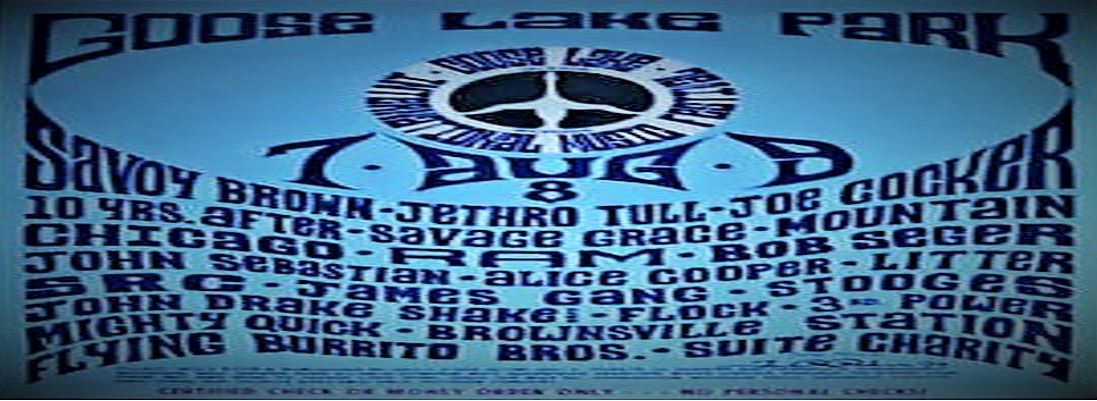
At Goose Lake almost no one brought cameras. None in my group knew anyone except possibly their parents who owned movie cameras. In 1970, only rich folks owned color movie cameras with sound; still-pics were what ordinary parents took of their kids, mostly in black and white. Color cameras and film were expensive back in the day. Most movie-camera brands lacked sound.
It was a different time.
The photo and video records of the Goose Lake International Music Festival are almost non-existent as far as any web search done by me can tell. What video and pics remain are grainy, faded, mostly black and white, and frankly depressing as hell, many of them—like two I found & put at beginning of this essay.
No one showed up to produce a serious movie like they had at Woodstock in August 1969, the previous year. Woodstock, the Movie (edited by Martin Scorsese and Thelma Schoonmaker) rolled into theaters across the USA in March 1970.
A whole lot of folks from Michigan decided to recreate the Woodstock Music Festival experience at Goose Lake. Within five months of Woodstock’s movie release, they managed to turn the fantasy viewed by most in theaters into a real-life, real-time spectacle for well over a quarter-million people.
Goose Lake was wild.
Note: (Click map to enlarge in new window) Billy Lee and friends camped in Sunmeadow, he thinks. It could have been Strawberry Meadow. It might have been somewhere close to Layalot. One thing Billy Lee remembers for sure… he couldn’t find the beach. Stoned Beach sounded great but he was wasted and couldn’t find it. He might have used a good map; he doesn’t remember seeing one until he searched the web for this essay—almost 50 years after. He says he thinks he remembers that promoters forced folks to buy entry tokens to get maps. Billy Lee claims he can’t remember buying tokens or even how he found the concert grounds or exactly how he managed to get in. He has no memory of the drive home. The Editorial Board
My new, radical friends brought to Goose Lake no change of clothes, no food, and no dope. They didn’t want to get busted by the pigs; everyone figured if we got hungry, food-stands would sell hot dogs to help get us through. We brought pocket change and pup-tents, nothing more. The way things went down, money (we called it “bread“) became the one thing we didn’t need.
We would require real bread—the kind people eat; readers will learn that some folks—like my group of friends—nearly starved at Goose Lake.
The concert turned out to be completely free once we worked our way inside. A fuzzy memory says we might have snuck in (like tens-of-thousands of others) through cuts in the barb-topped, chain-link fence erected to encircle the grounds and control the crowds.
I don’t remember anyone having money at the time to actually purchase $15 entry tokens, which have become collector items worth more now than then. ($15 in 1970 was equivalent to about $125 today.)
I remember the Goose Lake International Music Festival as a vivid technicolor freedom party.
Click pics, like this map, to enlarge for viewing.
In five days (we arrived early; stayed late), I learned more about anarchy—good and bad—than I learned during the following two years protesting the Vietnam war in the streets and the copy rooms of Joint Issue, the “underground” antiwar newspaper my closest friends published.
Goose Lake became for me the trip of a lifetime. This essay is an attempt to remember what I can before memories fade and go missing forever.
The first lesson learned was that people in America—white people who looked like me—used and were addicted, some of them, to heroin. I didn’t see anyone use heroin before Goose Lake.
Come to think of it, I don’t remember black people at Goose Lake, either. Through the lenses of today, the event might have seemed to the uninitiated like a gathering of white-supremacist men. Women attended, sure, but they made up not much more than a highly-desired minority—maybe 30%.
Heroin was what blacks ingested—that’s what white folks told themselves, anyway. It was the crack-cocaine of the 1960s and 70s. Whites didn’t do “hard” drugs—not according to news reports, which naive suburban kids who smoked weed suspected might mostly be sort of true but maybe not.
A black kid I worked with at Arlington National Cemetery trimming gravestones during summer confessed he tried it. He said heroin was so good he promised Jesus then and there he would never touch it again; he knew right away that if he shot it twice he would be toast—a lifelong addict with no hope of rescue this side of heaven.
What he shared was pretty much all I knew about a “hard” drug everybody heard of but no one used.
Admission tokens cost $15 and came in all colors, including red (not shown). Because fences topped with barbed-wire blocked entry, folks who didn’t buy tokens wire-cut their way in.
At Goose Lake we arrived early. My friends sat on a slope looking down onto a dirt parking lot. Cars, buses, and campers rolled-in like waves on a brown ocean. Dust hung in the air.
One car weaved; the driver seemed unable to negotiate a simple parking space. The car crawled almost to a stop when the driver-side door swung open; a guy in a white tee-shirt slow-motioned out the door—would he puke? As the car continued to inch forward, he plopped face down. Dust kicked up. His head hit hard.
The car rolled until it struck the back of a parked car. The door on the passenger-side jerked open. A girl leaned out; she fell like a sack of flour into the dirt.
The couple had finally made it to Goose Lake from wherever they came. Wrecked on heroin (or worse), they lay on the dusty lot for a while before dudes who wanted their blocked parking space got involved.
Maybe the couple ended up at the medical tent; maybe they recovered. I never learned what happened to them.
Things started moving faster; it was all anyone could do to keep up. As the festival revved—when security broke down, which as far as I could tell was before we got there, before the gates opened—pushers sold heroin in open markets to anyone who wanted to try; many did.
By the end of the festival, dealers were passing heroin free to anyone because they feared the gauntlet of police waiting outside the gates would arrest them on the way out. Festival goers heard that pigs were lined up at every exit and highway on-ramp to take revenge for being overwhelmed by the crowds.
When the time came for the festival to end, some people would be terrified to leave.
The folks who owned the food stands stupidly closed them the first night. Hungry people broke them down and took everything. By morning when my group went for breakfast, every concession stand was rubble. We wouldn’t eat again for three days.
As we stood around in shock wondering where to get food, semi-trucks rolled in loaded with tens-of-thousands of freezer-bags full of freshly harvested marijuana. Farmers from who knows where made Goose Lake a free pot zone. They tossed bags of grass from the back of their trailers for hours.
Someone brought papers. We rolled joints and stuffed them into empty cigarette packs—about 30 joints to a pack. For the rest of the festival we chain-smoked dope morning, noon, and nighty-nite-nite. Never before or since would I ingest as much THC.
Michigan grass is green and fresh; when lit, it smells like freedom. The farmers at Goose Lake brought their best weed and gave it away. I never understood why. Smoking weed was supposed to induce “the munchies.” I learned that you forget about hunger when you’re high enough.
At night I dreamed vivid dreams, not about sex, as was my habit during youth, but about baked potatoes piled high with butter and sour cream; steaks bleeding blood on the inside but burned black and crunchy on the outside coated with A1 sauce and spicy mustard; fresh cooked beans steamed in oil with lots of salt…
Dreaming about food made me feel joyful; glad to be alive. I knew I would eat these foods again and soon; I would ravage them with the appreciation deprivation provides. It is good to go without sometimes. It really is. Anyway, an unlimited stash of free dope lifted my spirits.
The music performed was uneven. Some groups came prepared to play; others, not so much. Music became a less interesting part of the festival, at least for me. A girlfriend who traveled with another group wandered around until she found me. She asked if I might try some mescaline someone gave her.
She said she wasn’t sure what it really was; it might be acid mixed with sedative; it might really be mescaline—an extract of peyote; all she knew for sure was that whoever gave her the pills promised it was mescaline.
I said, “Fine. Let’s drop some tabs an hour or so before the bandChicagoperforms. We’ll get off as the music starts.”
The night was going to be black and warm with a sky full of stars . My girlfriend promised to stop by my tent after the music started. She’d be high; we’d watch and listen together. I said, OK.
Night fell. I remember seeing light flash in streaks off gold trombones. Trumpets spit bursts of photons in all directions. The stage sat far away but was brightly lit. I saw sparkles of color flying off the edges of every item that shimmered.
I possessed the eye-sight of a predatory bird in flight. The music played crisp and clear. Percussive sounds splashed like warm rain across my face. I wanted to cry but amazement overwhelmed me.
My girlfriend showed up more or less on time and began to sway. I looked at her body, which I saw clearly through her dress with x-ray vision. My soul ached with desire. When I touched her she placed a hand on mine. Her dark eyes dilated—as I knew mine had. She leaned forward. “Want to?” she said. “I can’t believe how wet I am.”
We moved into the tent where she lifted her dress and wrapped her legs around me. I buried myself inside. We breathed heavy and made desperate sounds, which before mescaline we didn’t make.
Orgasm was intense. It took my entire existence. It lasted a lifetime inside a tent with its front flap open to the stars, music pouring in, and my newest friends nearby.
She, darling comrade whose name I’ve since forgot (God, forgive me), said something I won’t forget. “Billy!” she breathed. “I felt your orgasm—inside me. I felt it!”
Outside the tent, I stretched and yelled a grateful shout. One of the girls in my group poked her head out of the tent beside ours. “You shout after you ball? You are maximally stupid!”
The drug lasted. I wasn’t sure I would come down. Everything everyone said and did seemed to emerge somehow from an ocean of pearl-stones; miracles floated in the air like soap bubbles. I loved my mother—Gaia Earth—and everyone she carried with me, which included the girl in the next tent who called me stupid.
Without thinking or knowing what she had done, the other girl popped the biggest bubble of the most mystical moment of my life. It didn’t matter until decades later when memories were all I had left. Only then did my heart ache when I discovered I could no longer bring up the names of anyone I knew at Goose Lake. I forgot them all.
I saw bad things.
Iggy Pop of the Stooges performed after; he tried to bum the crowd by pivoting his play into a Pandora’s mess. While some started to flip-out and boo, I disassociated myself from the chaos. I witnessed bummer-terror sweep through the throng in the same way an entomologist might watch ants at war.
It was fascinating; entertaining, really. I floated like a prehistoric bird above the fray—superior to mortal sapiens who suffer in every way; I remained untouched by the vagaries of silly human cruelty.
A tall, thin kid got scared. He freaked-out. His acid trip went terribly wrong when he walked into a campfire where his ankles burned. I remember swarms of embers scattering like fireflies; he clawed the air howling like a wolf. A few folks managed to rescue and drag him flailing and kicking to the medics. He became a screaming madman. What happened later, I didn’t learn.
People built a mud pit, or something like it, near the stage. I heard folks say that a lot of people, mostly guys, were throwing themselves naked into the goo and wrestling in a huge pile. A girl in our group was there and ran back to tell us, “Guys are raping girls in that pit!”
No one believed her. No one went down to the stage area to check. The crowd was dense. You had to push and shove and step over people to get anywhere. Most folks weren’t up for it.
The next day around noon, the Chief of Police walked into the crowd. He chose to wear coat-and-tie to conceal his identity. In that mass of half-naked, un-washed hippie-freaks, he stood out like a bulldog in a china shop.
A line of kids formed behind him. It grew to be hundreds as he made his rounds to inspect festival conditions and assess the level of lawlessness. The kids behaved like happy third-graders as they started chanting and singing. Some offered the bulldog dope. They thought they might “turn him on” to “our side”.
I think the Chief was surprised to get out of the park validated and unharmed. Had there been an incident, it’s hard to know now what his back-up plan might be. He had an army of thousands outside the park. Maybe undercover cops dressed like hippies watched his back.
Who knows?
After a few days, we started to starve. Someone noticed field corn growing across a nearby road outside the fence. It’s fed mostly to pigs but we thought, hey, we’re starving. It’s corn. How bad can it be?
Someone said, “The corn isn’t ours. We can’t take it.”
“Bullshit,” someone said. He left to cut the wire barricade; in minutes he returned carrying a few dozen ears, which we threw—husks and all—on the coals of our campfire. With mouths watering like sprinklers, we were able to remember to retrieve the corn before it burned.
We shucked and ate. It’s true what people say. Anything edible tastes good when you’re starving. I thought at the time that it was the best tasting corn of my life. To think that farmers fed it to pigs! The world starves, but American pigs eat like royalty.
I haven’t eaten field corn since.
On the last day a farmer drove into the campgrounds with a semi-trailer stuffed with raw potatoes. Soon, our group had all the potatoes we could carry.
It was the first time I ate raw potatoes. We had run out of wood for the fire. The potatoes were free like everything else but unwashed. We brushed off the dirt. They tasted great.
When we decided to leave, the crowds had thinned. We fully expected to be arrested. We got rid of our dope, which was worth hundreds-of-dollars outside the festival. Today it would be thousands-of-dollars.
We left it behind for the cops. I wonder what they did with it. Concert goers left behind an enormous stash worth, I don’t know, maybe millions. No one will ever know. Anyone who knew told no one as far as I’m aware.
We left without incident. The cops disappeared; they let us leave. They arrested nearly 200 people we learned later. I didn’t see any of it.
When I got home and the drugs wore off, I got scared. My stomach caught fire; I thought I was losing my mind. I couldn’t shake the fear. It occurred to me that I was going to have to kill myself.
I went to an emergency room doctor I knew who gave me a week’s supply of valium. I took it for three days. When I stopped, I felt fine.
My biggest regret is that I didn’t visit the lake. It was there, somewhere, but I never saw it or swam in it. The crowds were huge. A trip to the Goose Lake beach wasn’t worth the hassle, my friends decided. If we went and left our stuff, someone might cop our dope. It was better to groove by our tents and dig the music whenever musicians decided to play.
Is there a better way to end an essay than to provide readers with a pleasant, commemorative link? Click below to view a Facebook video from another perspective.