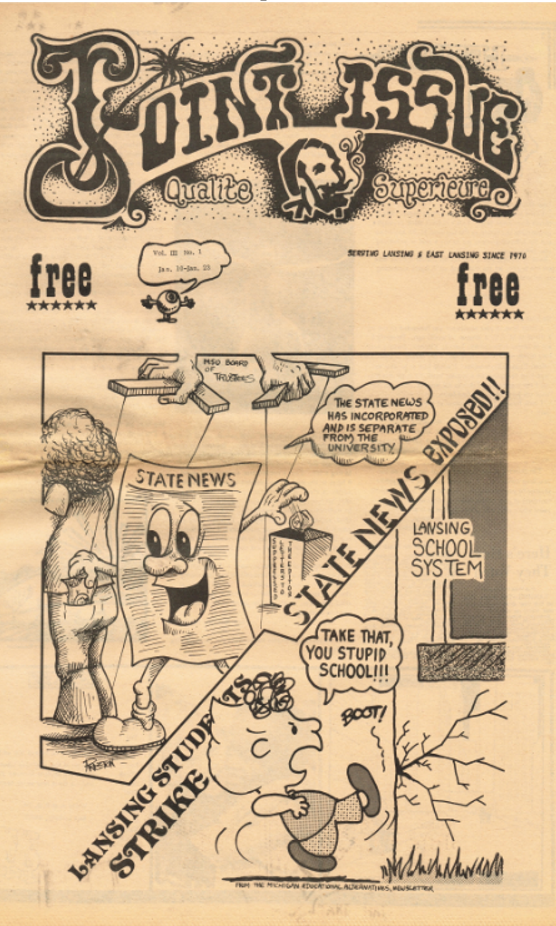
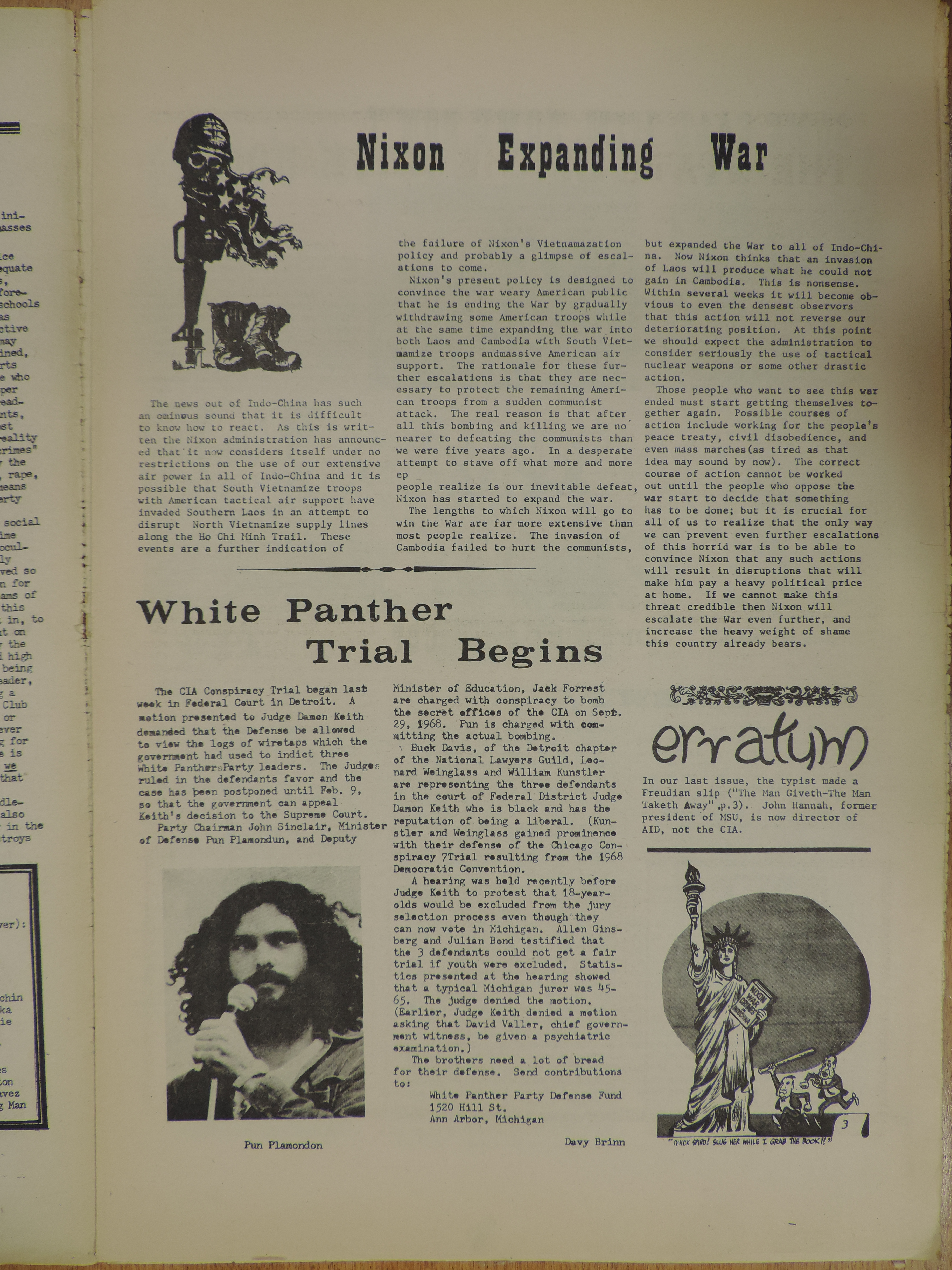
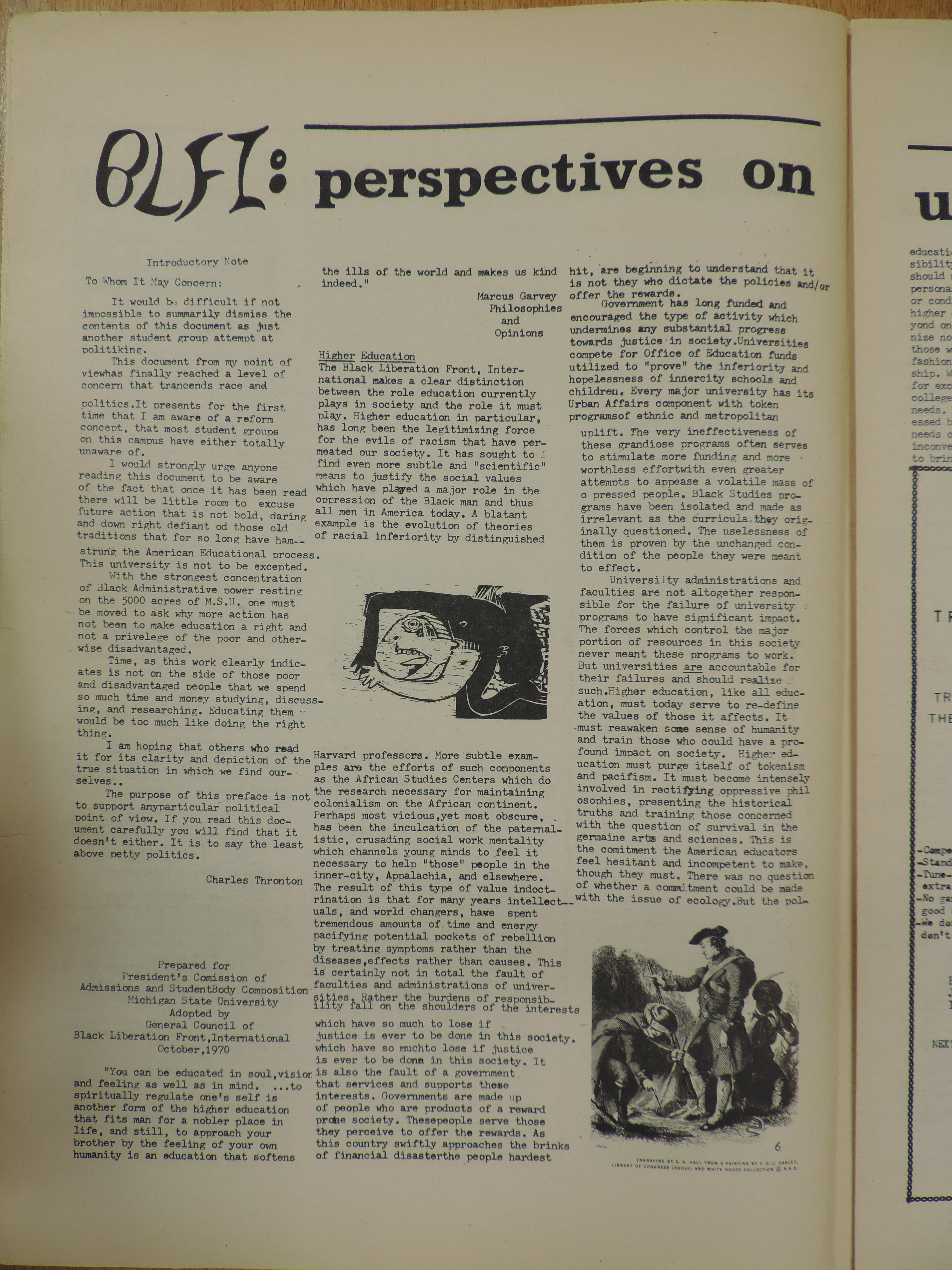
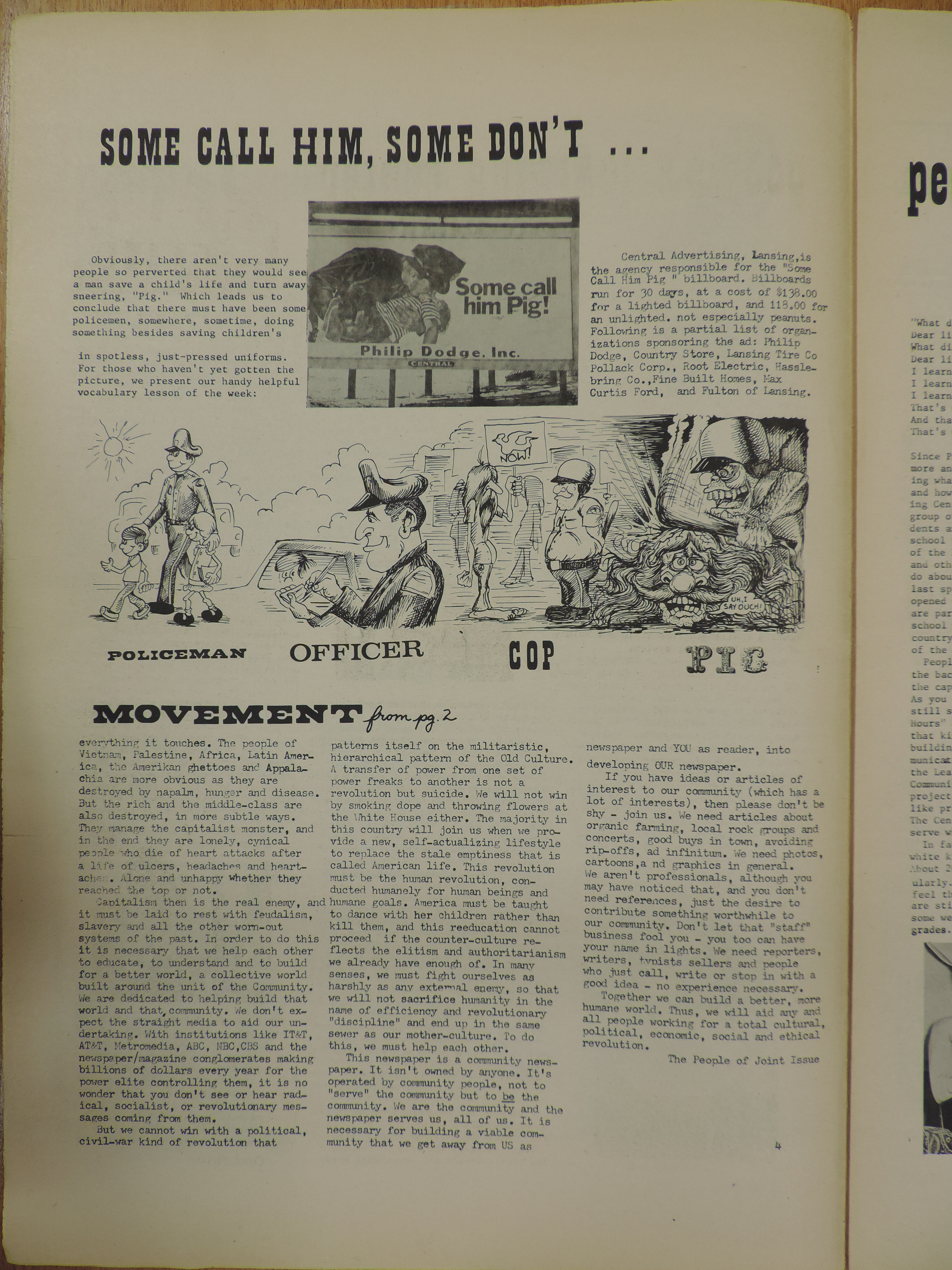
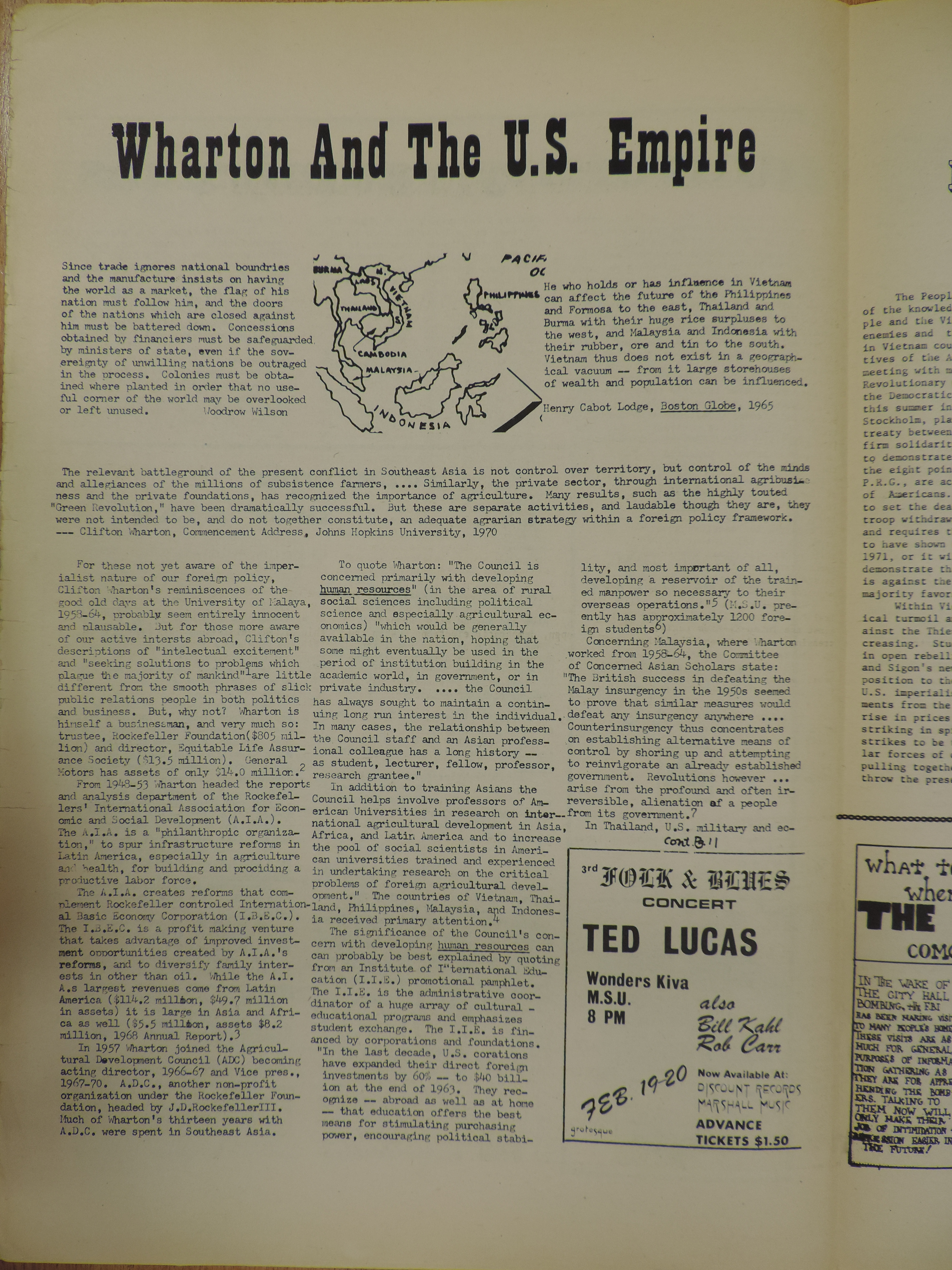
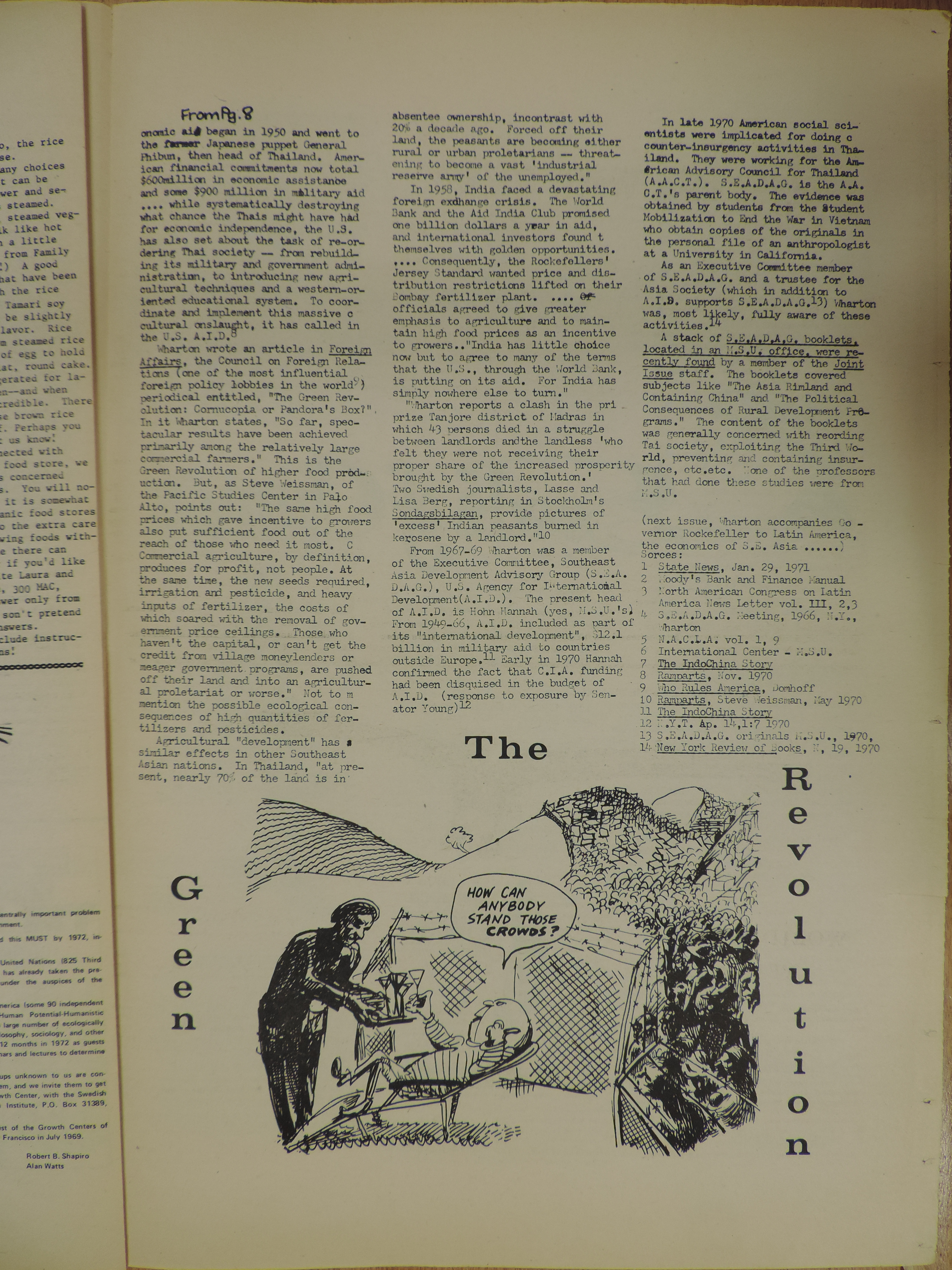
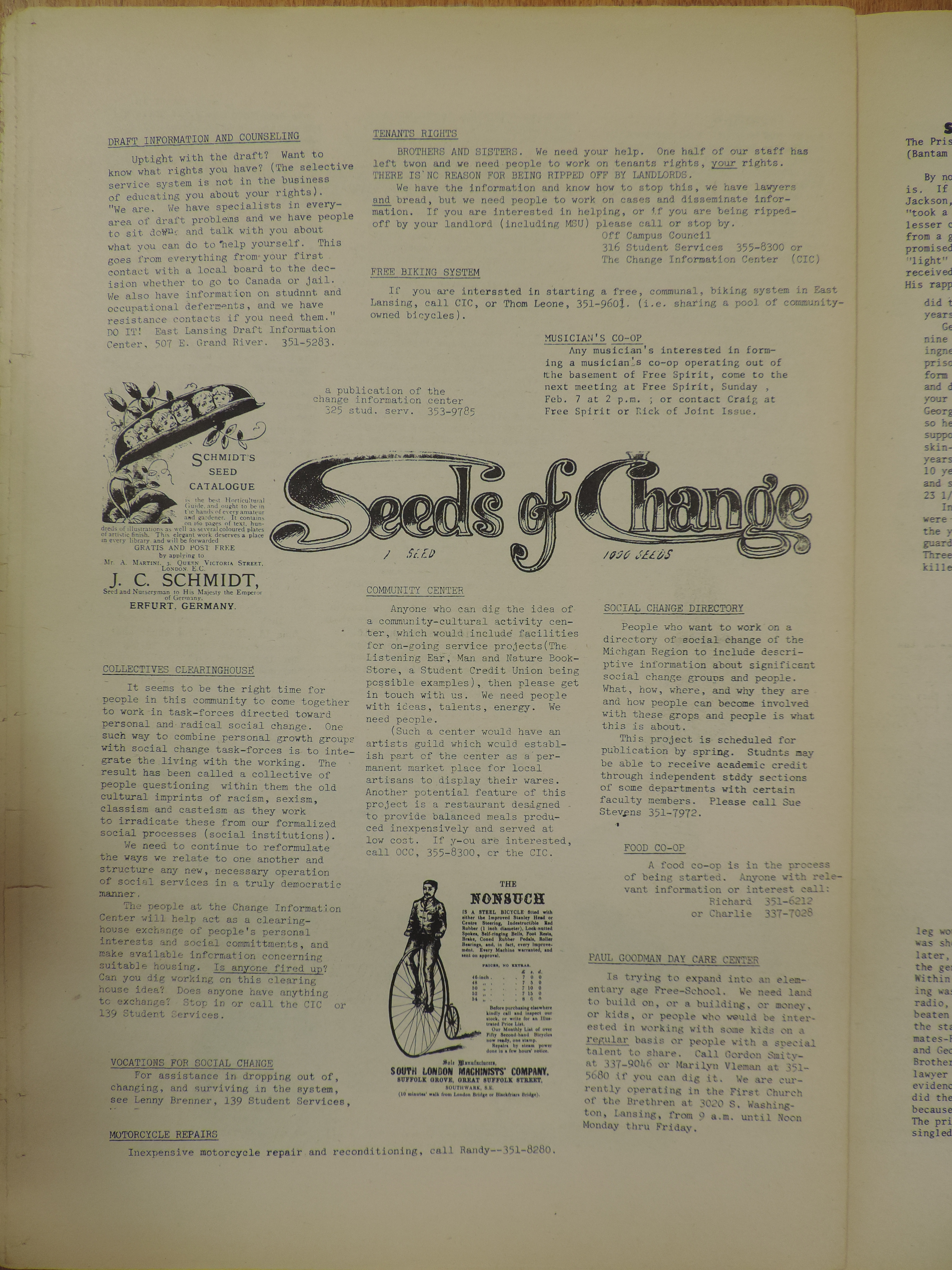
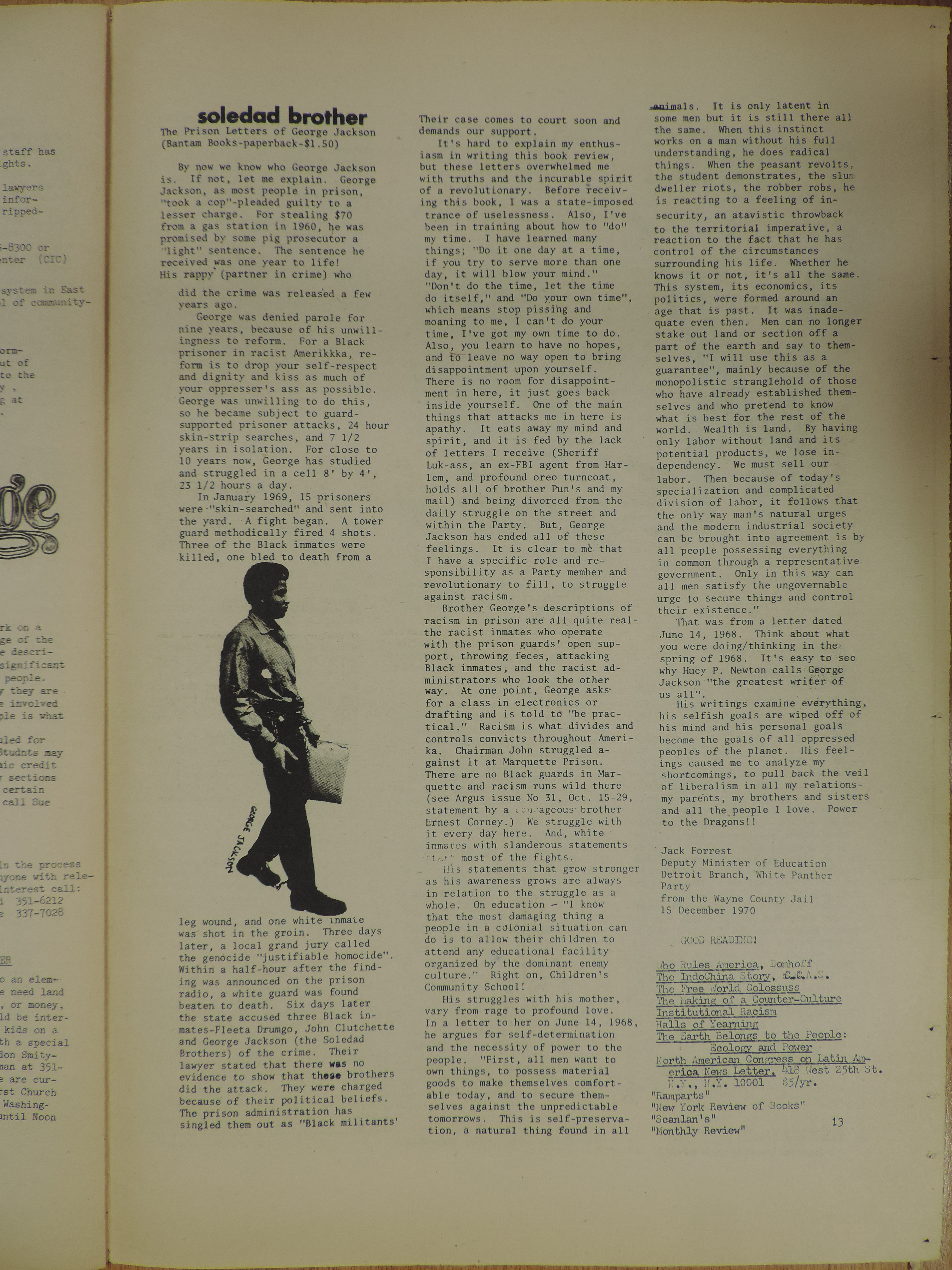
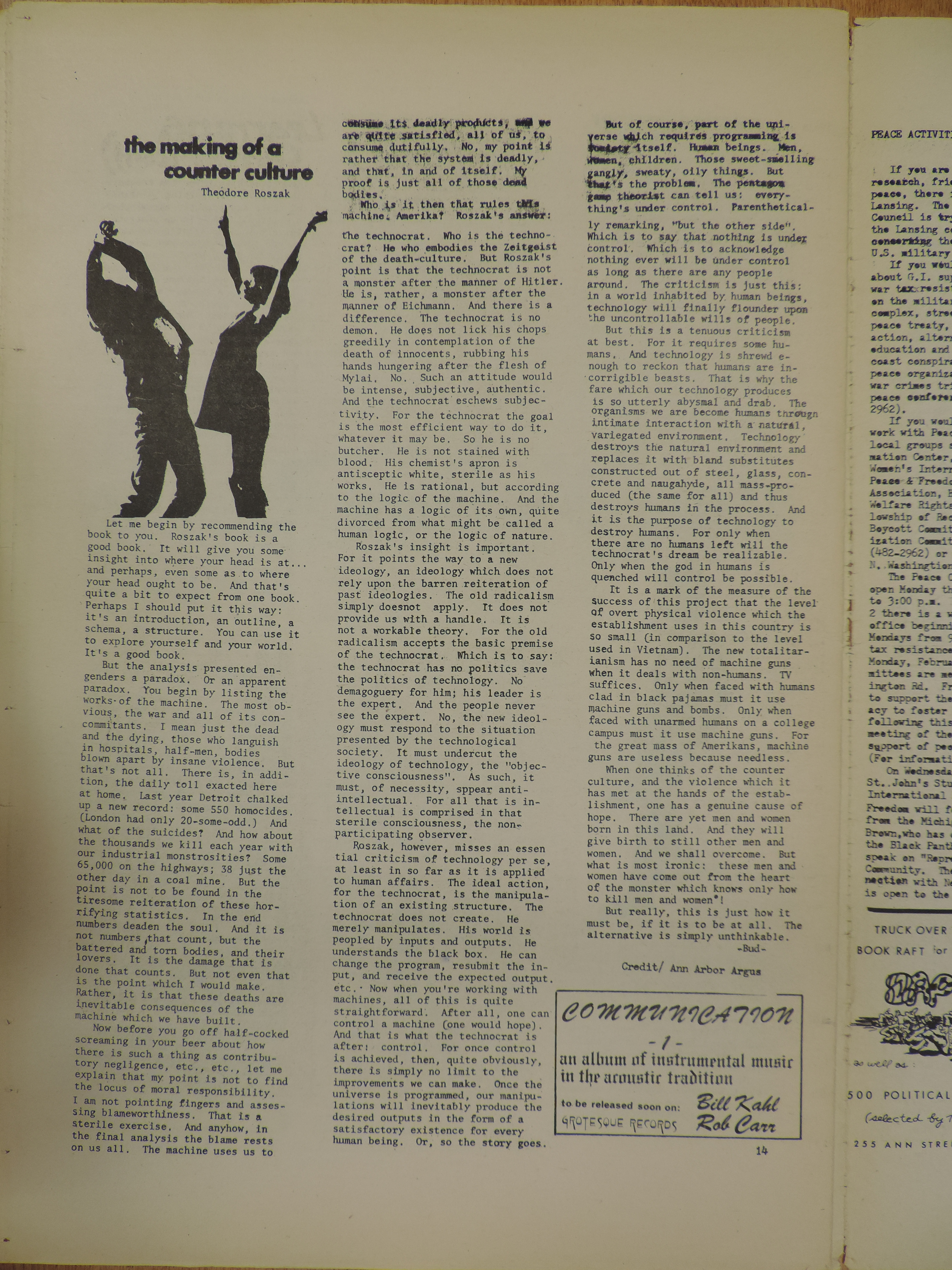
This month marks the 43rd anniversary of the birth of Joint Issue, a publication my friends and me produced, which became the Newspaper of Record for the anti-Vietnam War movement and counterculture “happenings” in East Lansing, Michigan during the years 1971-1973.
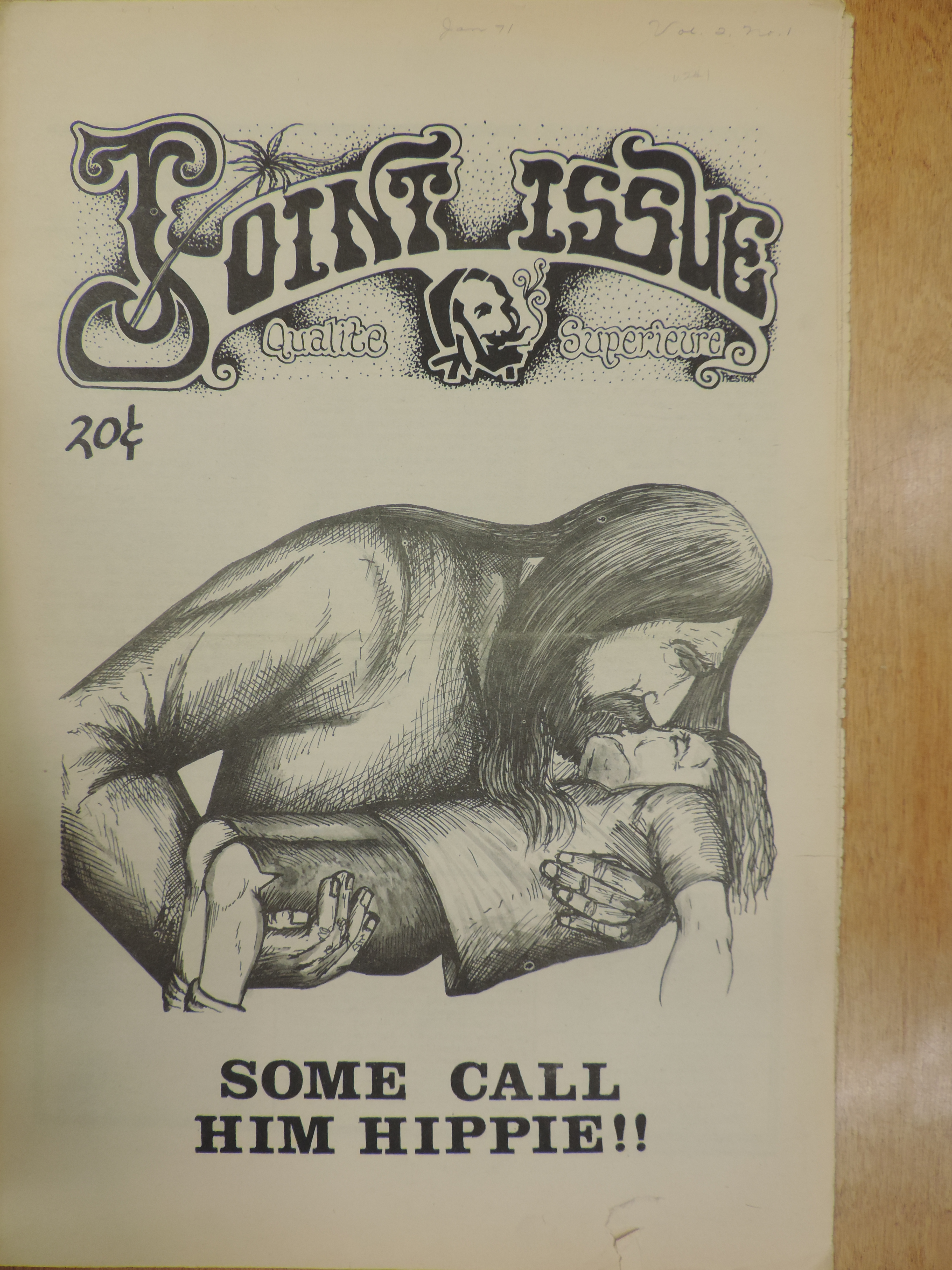
Hippie Rescues Drowning Child. Michigan legend, Denny Preston, illustrated this famous cover from the Underground Press.
Other papers like the Red Apple News, The Paper and the Bogue Street Bridge were around before and after Joint Issue. But none covered the anti-war movement and the counterculture like Joint Issue. None commanded the large readership, the community support, — including substantial advertising by local merchants — or the attention from police and other protectors of public morals.
Every local “radical” of consequence passed through our doors at one time or another. Every Lansing-area revolutionary and revolutionary wannabe read our paper and tried to know us.
Even the MSU police paid a visit from time to time. At 3AM one morning we found them in our Student Services office rummaging through our stuff. No warrants required, of course.
During the past months I have reread many of the old issues that me and my friends Ken, Davy, Patti and others once proudly worked to publish. It’s amazing how prescient we were, how many of our “wild” ideas caught hold and became mainstream. But there are disappointments too. Some causes, like gay rights, are still being fought. Editors Note:In June 2003, the Supreme Court legalized gay relationships; on 26 June 2015 all gay marriages became legal and constitutionally protected in the United States.
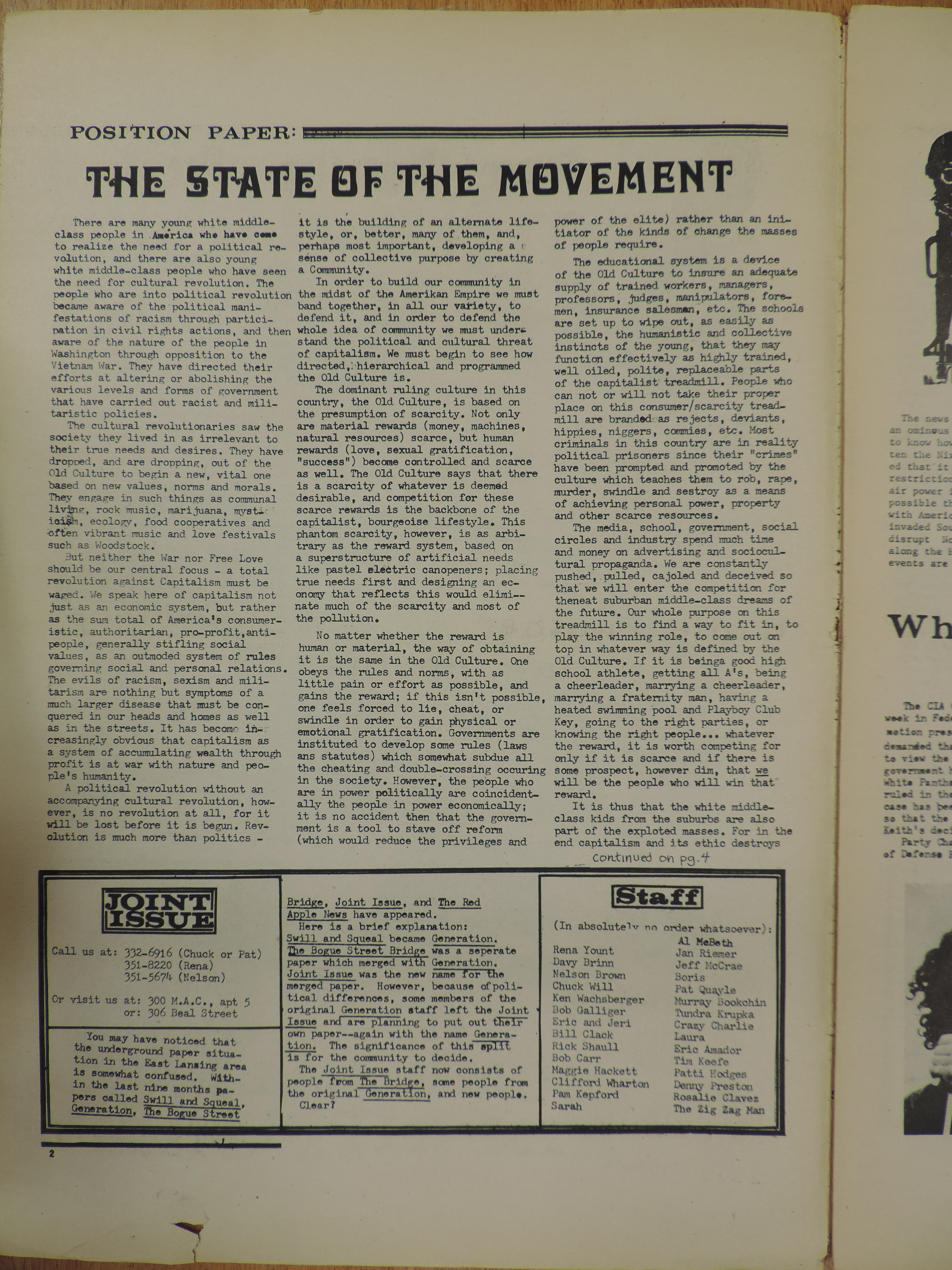
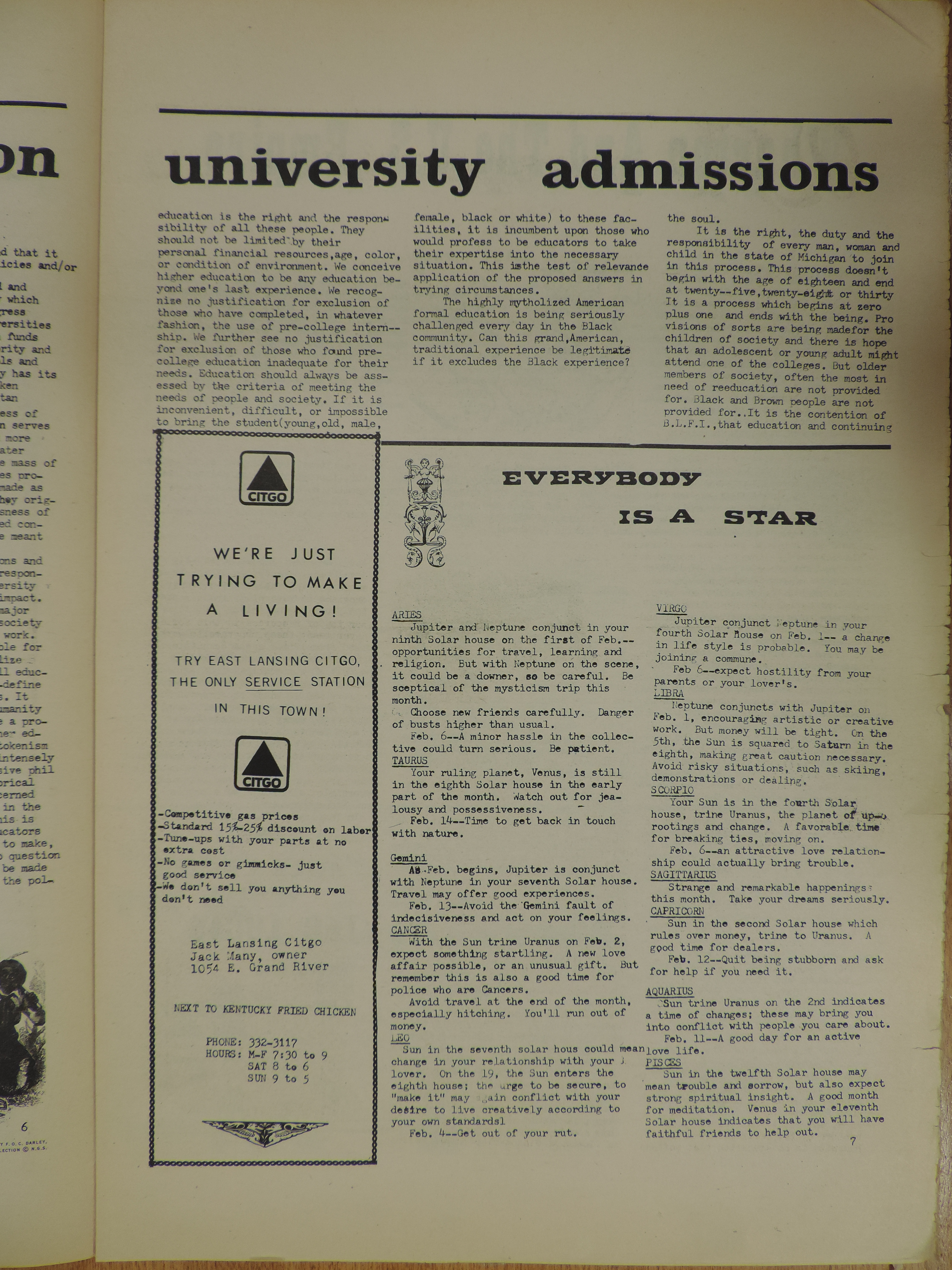
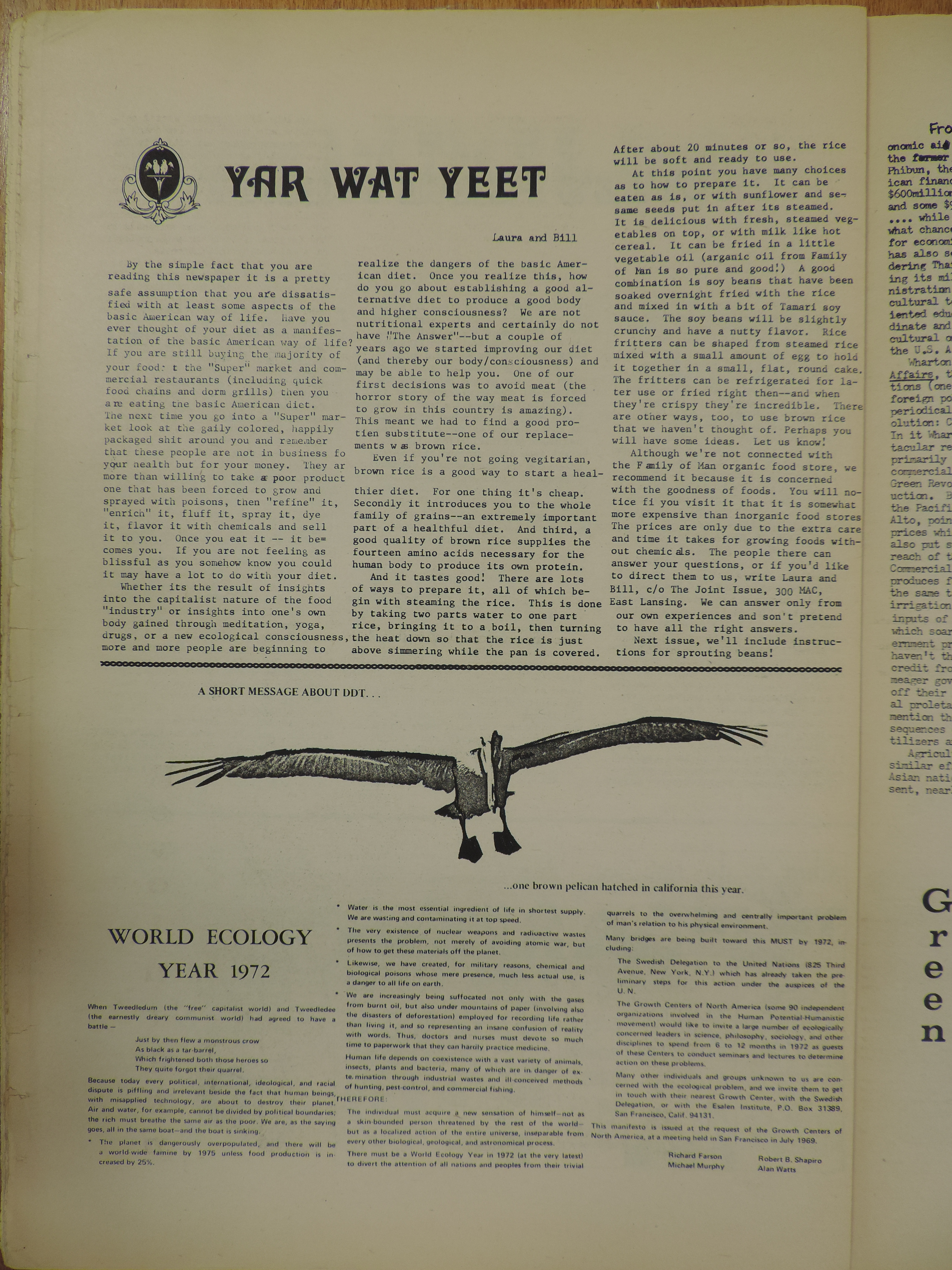
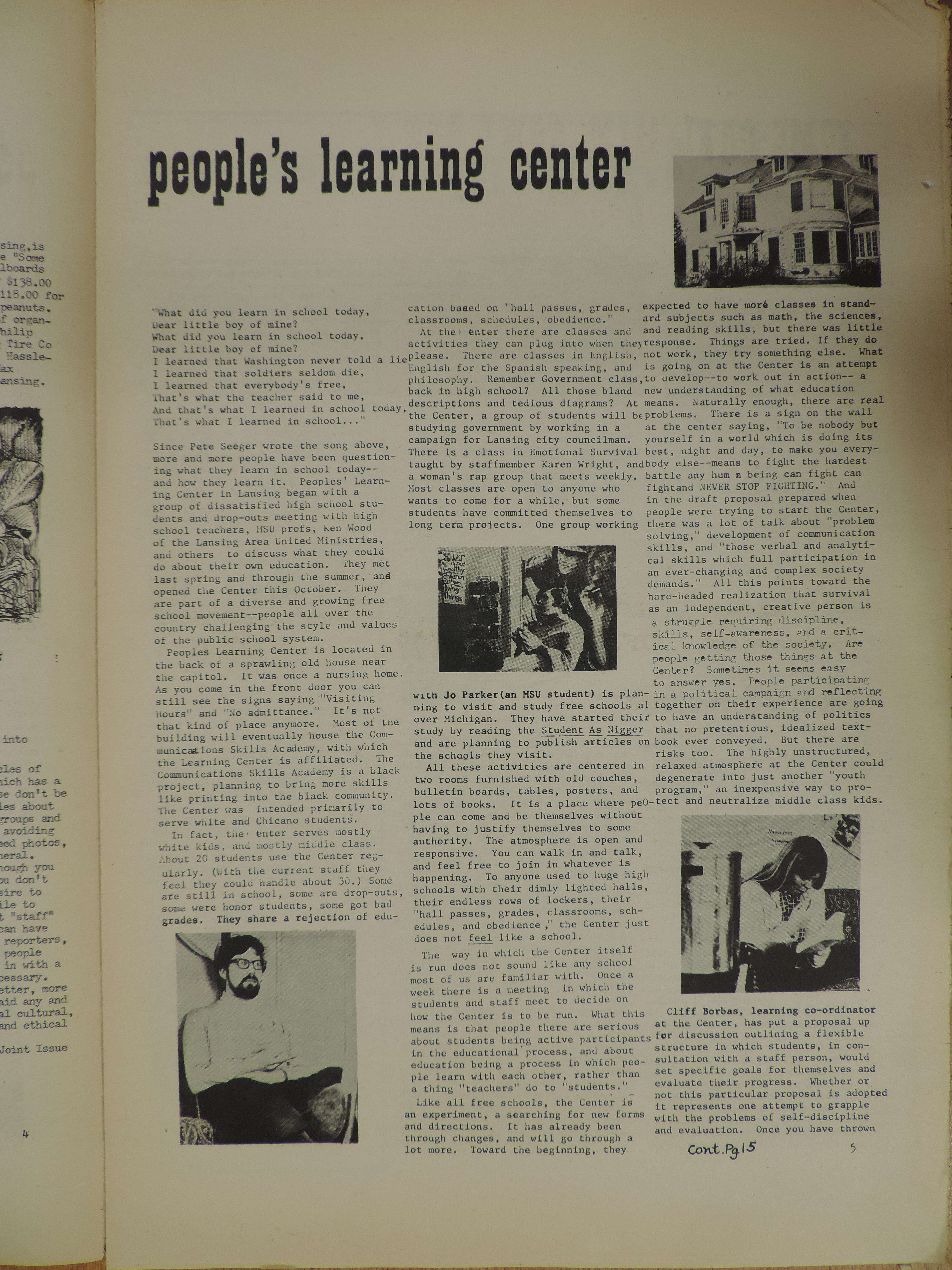
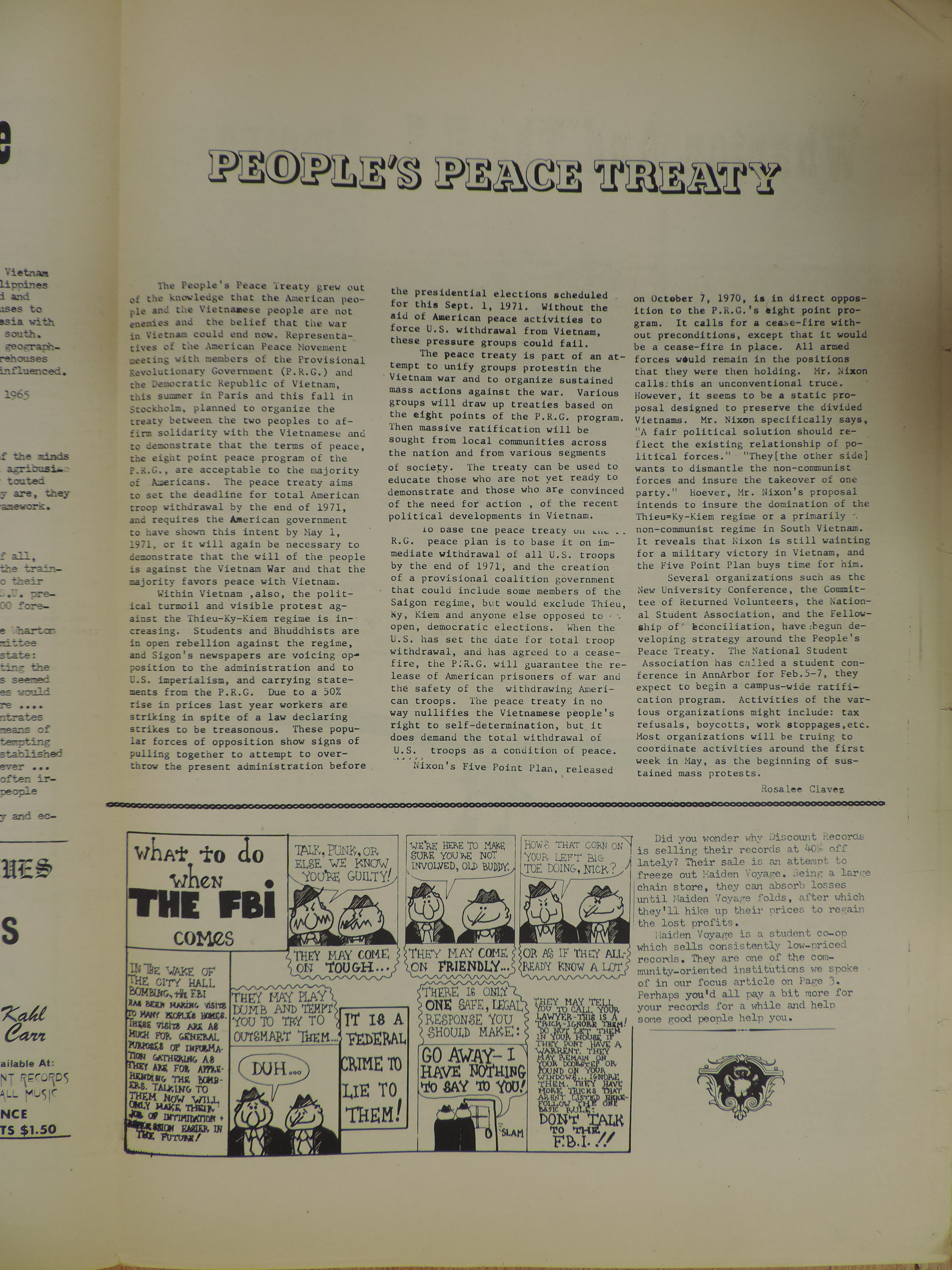
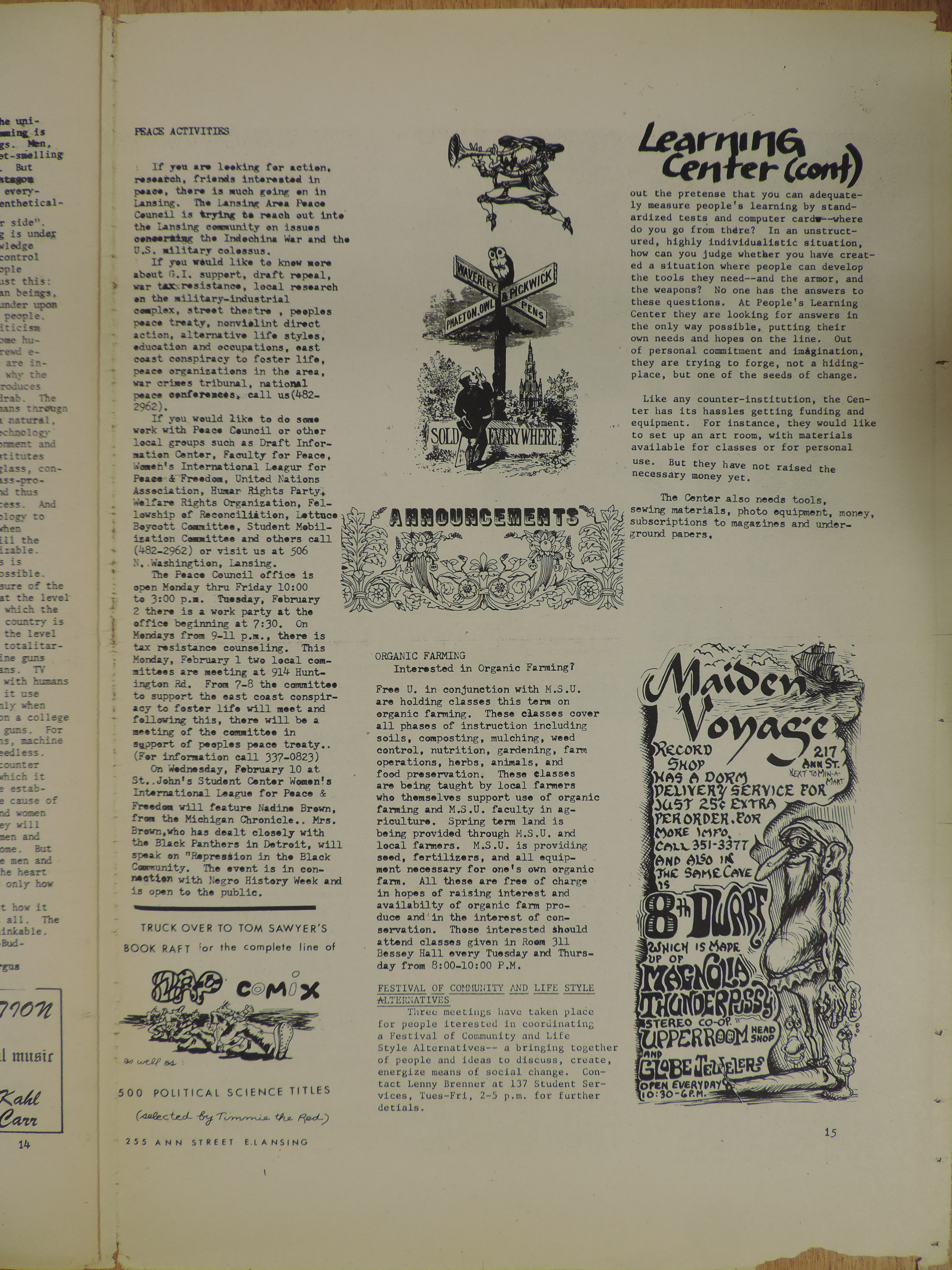
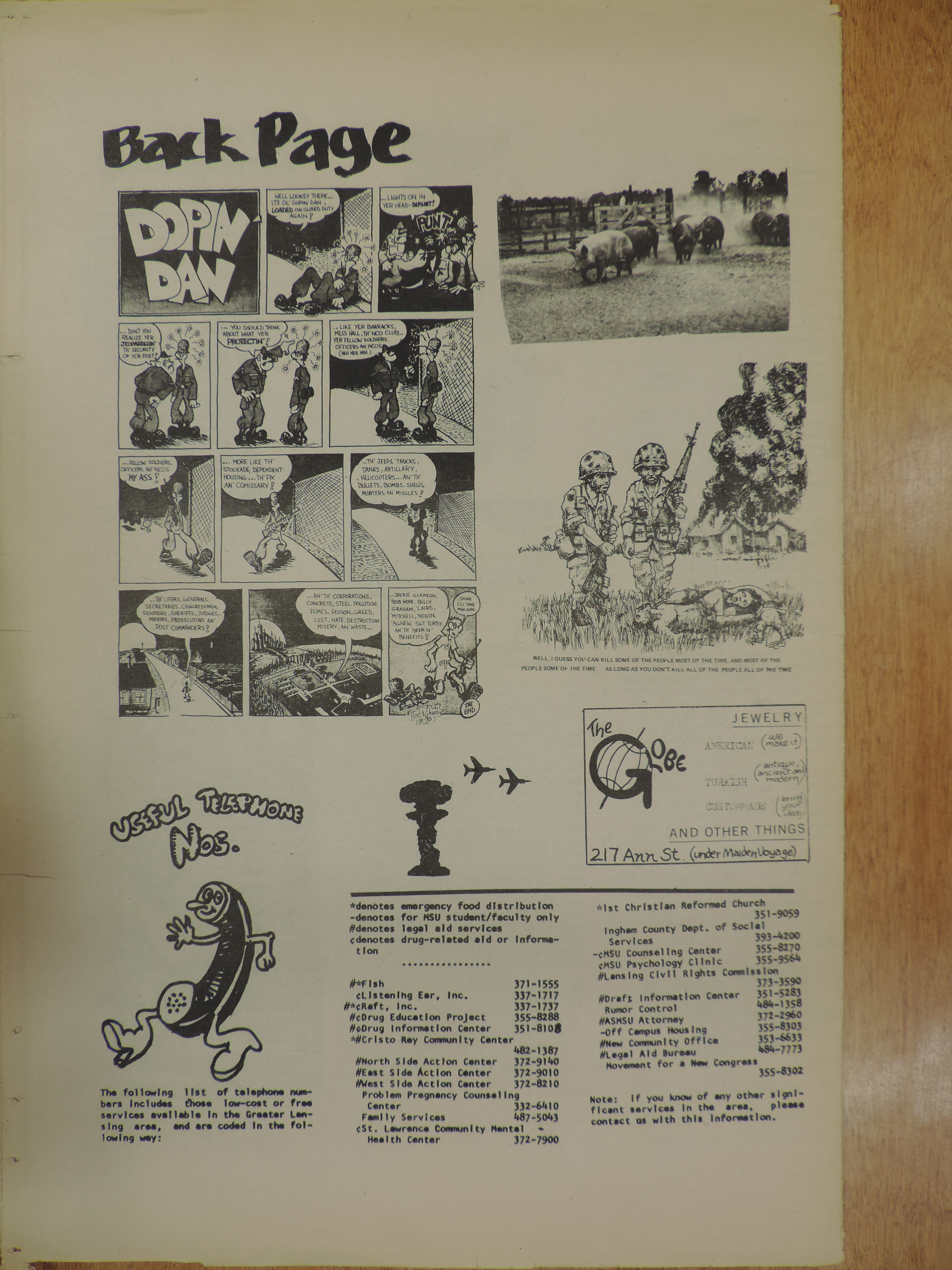
I included below a photo of each page of our first issue for folks to read. Some will be relieved to learn that many issues of the original Joint Issue are protected at libraries with a complete collection in very good condition in the archives of the MSU library.
Historian Ken Wachsberger covers some of the history of Joint Issue in his book Insider Histories, available on Amazon.com
The history of the underground press in general and of Joint Issue in particular remains largely untold by mainstream media. It is good that Kenny Wachsberger stepped up to preserve much of this history in his important and thorough Insider Histories — available through Amazon.com. The section on Joint Issue begins on page 195. It is a must read for anyone who wants to know what was really going on during this transformational era in US history.
Other important books by Ken Wachsberger can be found at this link.
The photos below are of a newspaper that is showing its age after forty-three years sitting in a library’s cardboard collection box or on the back shelf of a closet.
Back in the day, we published Joint Issue on clean white Demy-sized sheets folded in half to make the individual pages. We often used colored sheets — pink, blue, orange, green and yellow were our favorites — to give the Joint Issue a fresher look. Sometimes we used colored ink to highlight important stories.
Impco Graphics of Mason was our printer. Denny Preston, the local artist and musician who created the LugNuts logo, designed ours.
Joint Issue began publishing during the year Hewlett-Packard marketed the first hand-held calculators to the public. Like the HP calculator — able only to multiply and divide — Joint Issue faced technical hurdles of its own. Personal computers hadn’t yet been invented, so each page had to be painstakingly laid out by hand.
We typed up the copy on paper sheets with an actual Smith-Corona typewriter (remember those?), cut the typewritten sheets into usable bite-size pieces with scissors or exacto-knives, slopped on the glue with brushes or fingers, and carefully tweezered the pieces into location onto white cardboard layout sheets hanging on clotheslines in our basement office.
We pasted cool graphics (pictures) we scissored (if we had to) from books and magazines (expensive!) or we got them from our volunteers and donors. Sometimes a picture or piece of text would fall off the copy-sheet before it made it to Impco Graphics in Mason to be published. Someone might shove a piece of text into an inappropriate location. Shit happened.
But that was its charm and our purpose. We weren’t supposed to be a polished publication put out by an aristocracy trying to sell poisons to the public. Joint Issue was a people’s paper published by common people without an internet, Facebook, or Instagram.
Our first issues, like the one featured below, were crude. But over time the sophistication of Joint Issue grew and its reputation as a reliable chronicler of what was happening in the street became established.
Billy Lee
Note: tomagnify photos for reading, click on individual photo. Some pages are out of sequence.
After looking into the history that archaeologists think they know of the time around Horemheb, it seems to me that a compelling narrative of the Exodus and Horemheb can be constructed consistent with what is known from archaeology and written historical records including (and especially) the Bible, since it is the one and only account of the Exodus that exists today, I’m told.
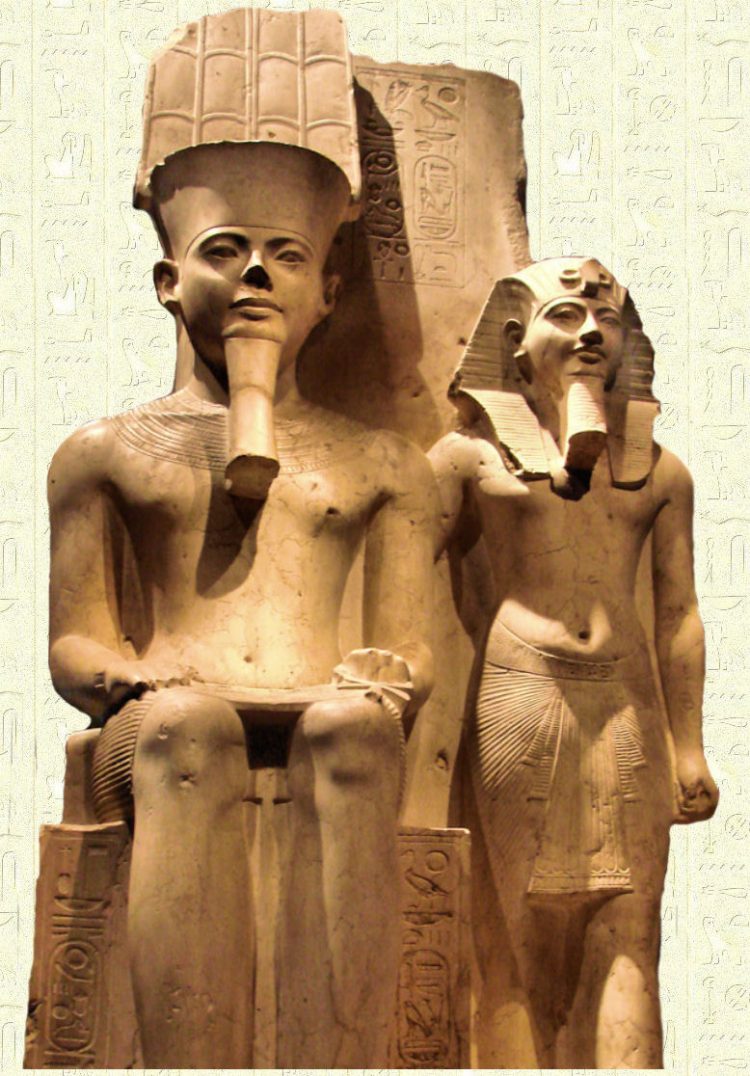
Pharaoh Horemheb with Amun-Ra, the king of the gods, standing beside him.
So here is my version of events.
The Son of Ra, Amun, Loves Horemheb
After comparing the dates Egyptologists have assigned to the reigns of the pharaohs with the date of Moses’s birth worked out by rabbinical scholars, it seems to me that Horemheb could have been the Exodus pharaoh.
But in a search of the Internet and other sources, I found that most historians don’t believe the Exodus occurred, and among other researchers, few say the Exodus pharaoh was Horemheb. Some claim he was Ramesses II; some, Thutmosis III; others speculate about other pharaohs; but very few have said, as far as I can tell, that he was Horemheb.
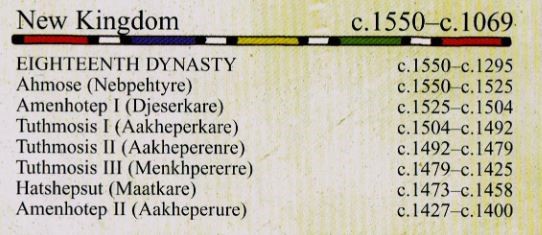
According to most Egyptologists, Horemheb ruled from 1319 to 1292 BCE. Some Rabbis claim that Moses was born in 1391 and, according to the Bible record, confronted Pharaoh eighty years later in 1311 — eight years after Horemheb took power.
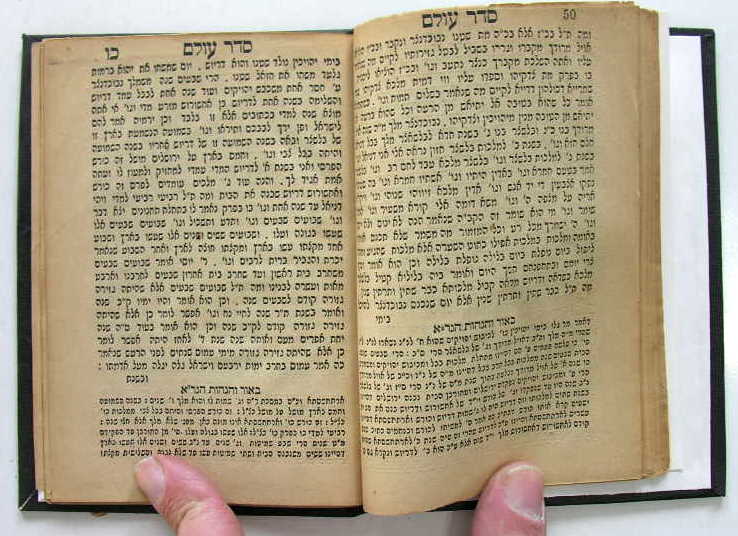
Seder Olam (sequence of world events -lit. World Order)
Rabbinic Judaism uses the Seder Olam (World Order) from the 2nd century CE to date Biblical events. According to the Seder Olam, 832 BCE is the date Solomon started construction of the first temple. 1311 BCE is the date of the Exodus.
The interval agrees closely with the 480-year period described in I Kings, 6:1. More importantly, the date 1311 BCE places Moses and the Exodus squarely in the reign of Horemheb if the chronology of modern Egyptologists is accepted.
To be fair, a few fundamentalist millennial Christian sources place the start of temple construction at 1000 BCE but this date strains credulity, because it was established to fit the theory of millennialism where history is divided into seven one-thousand year “days.” History is almost never as precise or the calendar that clean, even when written by God.
Historians have established that, before he was pharaoh, Horemheb commanded the Egyptian army under Pharaohs Tutankhamun and Ay. After he became pharaoh and lost the army (as described in the Exodus story of the Bible; see a summary below), an angry Horemheb enlisted his allies, the polytheistic priests and their cults, to erase the history of the “monotheist” former pharaoh, Akhenaten, his allies, and family members.
One of those family members was Akhenaten’s adopted cousin, Moses (see next section, The Exodus Story), who Horemheb blamed for bringing Egypt to ruin.
Historians agree that during his reign Horemheb intensified a damnatio memoriae (campaign to strike from memory) against the former pharaoh, Akhenaten. The campaign was initiated by Akhenaten’s son, Tutankhamun, and the pharaohs that followed — Smenkhkare, Neferneferuaten and Ay.
These pharaohs during the years 1334-1319 BCE reversed many — but not all — of Akhenaten’s reforms, because they thought the reforms created uncertainty and turmoil over the status of the priesthood and the gods, which to them seemed essential to the economy and stability of Egypt.
But Horemheb took the reversal to another level — restoring order by turning back all of Akhenaten’s reforms and re-establishing traditional polytheism throughout the whole of Egypt.
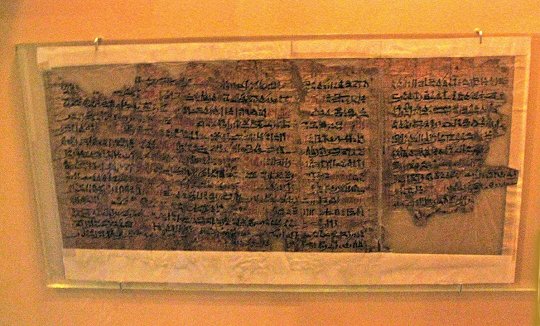
Ipuwer Papyrus
The surviving copy of the Ipuwer Papyrus — housed in the Netherlands at the Dutch National Museum of Antiquities and dating to the 19th dynasty (13th century BCE) — may actually describe the conditions in Egypt during the Amarna/post-Amarna period before and after Horemheb took power. It may have been during this period that the Hebrews, led by Moses, lobbied Horemheb to let them leave Egypt for their ancestral lands in Canaan.
The Exodus Story
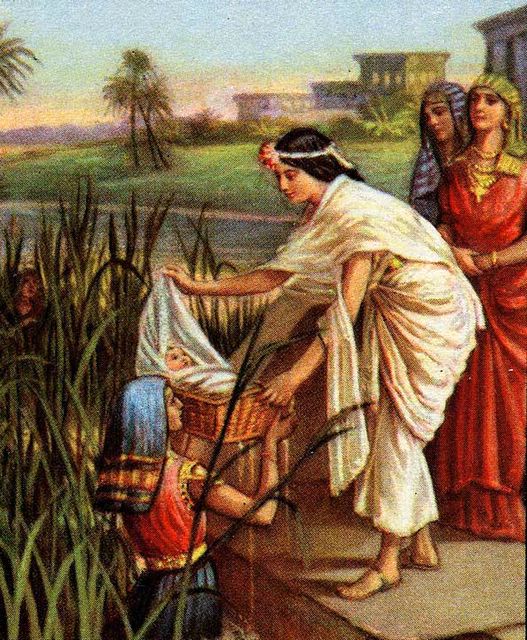
Pharaoh Thutmose IV died around 1390 BCE leaving a very young son, Amenhotep III, to become pharaoh. To fashion the story to fit the Bible narrative, that same year a teenage daughter of Thutmose IV, possibly Princess Tiaa, found Moses floating in a basket on the Nile River. She brought Moses into the palace to be a playmate for her brother, the new pharaoh.
The sister of the deceased Thutmose IV located Moses’s mother, Jochebed, and brought her into the palace to wet-nurse Moses. Soon after, Princess Tiaa adopted Moses and raised him as her son.
Through this arrangement Tiaa’s much younger brother, the new Pharaoh Amenhotep III, became Moses’s uncle, though they were about the same age. Perhaps the two grew up together and were close — more like brothers than uncle/nephew.
The influence of religion on the Thutmose family by Moses’s mother — a monotheistic Jewish woman — might have been considerable. No one can know for sure, but what followed — the eventual embrace of monotheism by Amenhotep III’s son, Amenhotep IV (who later changed his name to Akhenaten) — might be understood as having evolved under her influence.
Jochebed may have continued to live within the pharaoh’s household for many years assisting Princess Tiaa to raise her own son and through him influencing Tiaa’s grandson, Akhenaten, who would become the famous founder of Egyptian monotheism. Jochabed’s influence could make sense out of the history that followed.
According to this version of events, when Moses was forty years old, in 1351 BCE, Amenhotep III died. Amenhotep IV (his son and young cousin to Moses) became pharaoh.
Moses fled Egypt, according to the Bible to avoid trial for killing an overseer. But, because he was the adopted son of the prior pharaoh’s older sister, Moses may have worried that his cousin, Amenhotep IV, (or more likely, his aides) considered him a rival for power.
A few years later, Amenhotep IV changed his name to Akhenaten to reflect his revolutionary belief in a single creator god he called Aten, the Sun Orb. He then suppressed the existing polytheistic cults.
Akhenaten built a new city, Amarna, to honor Aten. This move toward a form of monotheism turned Egyptian society upside down and angered the priests who depended on polytheism for their economic well-being.
Pharaoh Akhenaten — formerly Amenhotep IV
In 1335 BCE Akhenaten died, and Moses at age 56 returned to Egypt. He found Egypt in chaos and rebellion due to outrage by the priests and their acolytes over the move away from polytheism.
During the next 15 years Moses lived among the Hebrews and by age 70 had become their de-facto leader. Horemheb meanwhile became pharaoh.
By age 80 Moses was challenging Horemheb to let the Hebrews leave Egypt. Eventually, Horemheb did — issuing a directive, according to the Bible, that the general population provide the Hebrews with gold and silver when they left.
Horemheb’s plan may have been to trap Moses and the Hebrews against the marshes in the Sea of Reeds and annihilate them to recover their newly acquired wealth to re-stock the depleted Egyptian treasury.
But during the Exodus of 1311 BCE an unexpected inundation (the famous Red Sea flood in the Bible account) cost Horemheb his army and his plans to destroy the fleeing Hebrews. The Hebrews escaped, so Horemheb, encouraged by the priests, turned his fury against the Amarna cults and ramped up the ongoing damnatio memoriae started by Tutankhamun against his father, the former Pharaoh Akhenaten, and his allies.
I should mention that although the Egyptians closely watched, recorded, and forecast the yearly inundations of the Nile, unexpected floods sometimes did occur in the Delta region through which the Exodus may have taken place.
Pharaoh Ramesses II
When Horemheb died leaving no heir, the Ramesses family seized power. Ramesses I, Seti I and Ramesses II spent the next forty years continuing the damnatio by finishing the demolition of the town of Amarna and its temples, destroying steles, and grinding down glyphs and cartouches that referred to anyone associated with the heretical Amarna one-god movement.
They also sent armies into Canaan to hunt down Moses and the Hebrews in the territory that both Moses and Joseph — who died 59 years before Moses’s birth — had claimed was the eternal homeland given to the Hebrews by God.
[Those readers unfamiliar with Joseph’s bio are advised to read his story in Genesis chapters 37-50. Billy Lee claims that it’s the most interesting passage from world literature he’s ever read. THE EDITORS]
Unknown to the pharaohs, Moses and the Hebrews decided to stay away from Canaan. Instead, according to the Bible, they found a source of water and hid themselves in the vast Sinai wasteland where they believed their pursuers were less likely to look.
The pharaohs sent at least three armies into Canaan to hunt them down. Unable to find Moses, they marched north to search in Syria where the Hittites ambushed them.
As a result, the Egyptians conducted a number of military campaigns against the Hittites. The most reliably verified and documented of the conflicts occurred in 1274 BCE, led by Pharaoh Ramesses II. This war financially exhausted and militarily weakened both sides.
Forty years after the Exodus (and just three years after the Ramesses II incursion into Syria) in 1271 BCE, Moses died. Egypt had by then already withdrawn from Syria and Canaan. The time would never be more right.
According to the Bible, Joshua (Moses’s successor) walked the Hebrews out of their Sinai desert hiding place and entered the land of Canaan.
Twelve years later in 1259 BCE — sixteen years after the end of hostilities between the Syrian Hittites and Egypt and fifty-two years after the Exodus — Egypt signed the famous peace treaty of Kadesh with the Hittites. The peace treaty — concluded between Egyptian Pharaoh Ramesses II and the Hittite King Hattusili III — is the oldest surviving treaty in existence.
It diminished the most dangerous existential threat to the new Israel by making less likely Egypt’s return to wage war either in Syria or Canaan. Egypt desired a lasting peace in order to rebuild its society and military and to restore its wealth.
The desire for peace didn’t last. By 1208 BCE (fifty years later), Egypt was aware that the hated Hebrews had returned to Canaan where they were building fortified towns and cities.
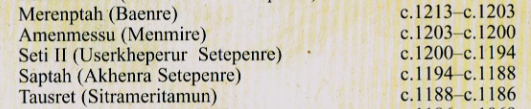
Ramesses’ son, the aging Merenptah, decided to finish his family’s vendetta and go into Canaan to do battle with the fledgling Israel. According to the “Merneptah Stele” (found by Flinders Petrie and housed in the Cairo Museum), he “destroyed Israel’s seed” such that “they were no more.”
History and the Bible agree that Merenptah exaggerated his assessment.
On this stele Merneptah claims that he destroyed Israel.
It is interesting to note that Merneptah’s inscriptions describing Israel’s destruction were carved on the back of a stelae that once belonged to Amenhotep III, Moses’ “uncle” and childhood companion. Merenptah simply turned it around and used it as his own.
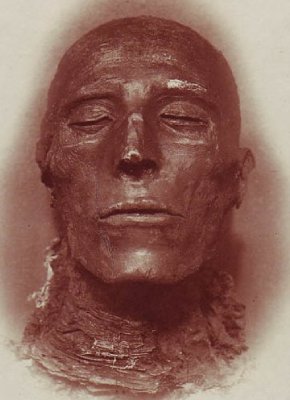
It is fascinating (perhaps macabre) to recall — in light of the Bible account of the Passover and the killing of the first-born by the Angel of Death — that tomb examiners found the fetus of Horemheb’s son and heir-apparent inside his wife’s mummified body. Horemheb had no heir, and the Ramesses’ family was able to take power.
No records of Moses or the Exodus itself, in hieroglyphs or Egyptian script, have been found.