RISK

Everyone wants to live as long as possible, right? Well, maybe not everyone.

Someone confided in me that their nightmare was they wouldn’t die; they would never get respite from an existence that terrified them, that depressed them, that hurt them, that disappointed and discouraged them; that humiliated them; that abused them; that made them wish they were never born.

Another friend confessed that she wished she had never been born because she was afraid to die. The certainty of death made living not worth the trouble. Anxiety about the end of life robbed her of joy. She found that she was unable to kick back and relax, because dark angels circled just outside her field of vision; one day, she was certain, the angels were going to pounce. The end would be brutal.

I remember hearing a story about a young mother who lay dying while her family knelt at her bedside. A scene of sweet-sorrow unfolded as the woman struggled to breathe in the presence of loved-ones. A worried husband, anxious toddlers, her parents, and a few close friends sang hymns to reassure and cast comfort. They clung to one another united by the belief that God would carry momma gently to heaven in his caring arms.

Momma didn’t experience death that way. She bolted up, away from her pillow. She stared wild-eyed at something behind her visitors; something no one saw.

She screamed. No! No! No! 

Momma dropped off the bed, slammed to the floor, and rolled onto her back making a loud crack — like a toppled refrigerator. She stared at the ceiling, face frozen, eyes open; crazed, except that now she was dead and too heavy for anyone to move.


Steve McQueen died at age 50 from cardiac arrest at a cancer treatment facility in Mexico in 1980. He made thirty movies; many were blockbusters.

Some people love life and don’t want to leave. I remember Steve McQueen, an actor from yesteryear who had everything to live for. He was a happy race-car enthusiast, a leading man in movies, incredibly handsome, kind, and grateful for every blessing his wonderful life showered on him.

He got cancer. Stateside doctors told him he had no chance. Death was certain. He traveled to Mexico to seek out a cancer recovery center he learned about from friends.

I remember hearing him weep during a radio interview because, he said, the medical director had saved his life. He thanked him again and again. He couldn’t say it enough. I felt touched. He loved life; his gratitude seemed to resonate with the voices of the angels. I would have gladly traded places with him.

Two days later, the newspapers and television news shows reported that he died. What went through his mind when he finally realized that his life wasn’t going to turn out the way he planned?

For people who seek death, death is easy to find — if they have the courage to face what comes after; if the pain of living exceeds the risks of non-existence or the risks of being reborn as someone new or the possibility of falling into the pits of Hell or wherever they imagine might lie the alternative to the pain of life on Earth. Relief is as close as the closeted gun, the nearest bridge, the bottle of medicine in the bathroom cabinet.

I feel bad for people who have been ruined, I do. Far more people kill themselves than are killed by others. No one believes it, but it’s true.

I don’t want to dwell on the ruined, because another class of people — a smaller group, I sometimes wonder — want to live.


The man shown in this pic (from 2011) was active and working at age 106. He and hundreds like him have been the subject of scientific studies about human longevity. They are kind and gentle people who enjoy life by all accounts; they wish only to live as long as possible.

These are the folks who never suffer from depression; experience a major illness; spend time in hospital or prison; lose a child or spouse; worry about the sparkle of a crooked tooth or the part on their head of radiant hair. They don’t worry about any lack of symmetry that might render them unattractive — or about getting their way in life, because they always do.

I want to talk about the powerful, beautiful, effective people who everyone seems to want to be. I want to talk about the happy people like Steve McQueen who will always chase a fantasy, because they want to live in the worst, most desperate way.

I want to talk about the people who freeze themselves in the hope that in a benevolent future they will be thawed, and life will continue; I want to talk about the people who take 150 pills a day to prevent every ailment and strengthen every sinew.

I want to talk about the brilliant, optimistic people who expect that if they can just figure things out the right way, life awaits them for as long as they want it.  It’s all up to them. They will find a way to make life last; to achieve an eternal success, because they always have.

Is it time for a reality check?

Is this a good time to reveal some truths? — shocking truths, perhaps, for a few readers?  I want to predict our futures — all of our futures — as separate individuals with private lives; and as a species — a species anthropologists describe by the Latin words, homo sapiens, (smart people), which they use among themselves to differentiate you and me from all the other groups of living things we rarely notice or even think about.

Let’s smarten up for a few moments and defend our reputation among the kingdoms of the animals and the plants. Let’s think about best case scenarios for survival and whether we can make our dreams come true.

One statistic to keep in mind that is easily verified (and it might startle some readers): two-thirds of all deaths are not caused by aging.

So let’s move on.

Who wants to start with species survival? Who would rather address the riddle about how to lengthen an individual life?

Ok, the responses I think I hear in my head are nearly unanimous. People want to know how they themselves can live longer, correct?  People want to know how long they will live when everything is set right.

So, why not start with a best case scenario for individuals?  I promise to address the issues of survival for homo sapiens later, after a few paragraphs more.

Here are some simple, best-case-scenario assumptions:

Assume that disease is eradicated. We reach a state under the protections of ObamaCare (or maybe Trump-Care, who knows?) where no one dies in hospital anymore; all diseases have cures and can be prevented; in fact, disease is eliminated from the face of the earth — no bacterial or viral infections; no malevolent genes gone haywire; no Alzheimer’s or mental impairments; no more skin rashes or herpes or warts or annoying ear-wax that morphs into septic brain infections.

Disease is gone. Now take another step. Make a leap of faith. Assume that the genetics of aging is solved and that no one grows old. No one deteriorates. Skin does not wrinkle; no more age spots or rotting teeth; loss of hair and muscle-mass becomes a thing of the past. Aches and pains and constipation and diarrhea and acid reflux — what be them? They gone!

Our long medical nightmare is over, to paraphrase the words of President Gerald Ford on the night he pardoned Dick Nixon so that no prosecutor could ever charge and convict him for being a crook and throwing an election.

OK. What now become the odds for our survival?  How long can one person expect to live?  I think everyone can see, there’s something we didn’t consider; one thing no one thought of; a missing piece in the puzzle of living-large that is going to leap up and grab each of us sooner or later — unless we live bundled by bubble-wrap in a bunker, miles below the surface of the earth. We all know what it is, right?

It happens when we bike on a country road, and a candy-coking cell-talker in a Corvette runs us over. It happens when we climb Mount Everest (just to cross it off our bucket-list) and whoops! someone in the group forgot to tie their shoelaces. People see a video on the evening news — dead people buried in snow.

It happens when flying an airplane — a flock of geese smashes the windscreen. The pilot gets sucked out the opening — shredded by shards of glass.

We visit an amusement park to thrill ourselves on a ride that throws us upside down and — oops again! — an unscheduled stop; a mechanical malfunction. Two hours later, rescued, we’re vegetables. Homo sapiens don’t do well hanging upside down for long periods.

Yes, the one thing no one counted on is accidents.


Accidents kill a lot of people every single day. And nothing is going to change that fact unless people decide to live in virtual reality and never get off the couch to go outdoors or walk their dog.

What exactly are the statistics of accidents?

Well, every year one person in a thousand dies in a screw-up by somebody, usually themselves. It doesn’t sound like much, but for the person who dies it’s one death too many. Anyone who expects to live 25,000 years should perform a statistical analysis to see what the chances are they will live that long.

Why guess?

The way the math works is this: figure the chances of living deadly-accident-free for one year (it’s 999/1000), then multiply this number by itself for each year of life.

Save time by using the exponent key on a calculator to enter years, anyone who doesn’t want to spend a week multiplying the same number over and over 25,000 times. The result will give the chances for survival over a span of that many years. Try some other numbers to make comparisons.

The bottom line is this: no one has any realistic hope at all of living more than 10,000 years or so. Of the seven billion humans alive today, only one in 22,000 can expect to live to the age 10,000.

A mere 2,000 people out of 7,000,000,000 will survive to see year 15,000. There’s a small chance (one in ten) that a solitary person might make it to 25,000 years, but they will be an outlier; a statistical anomaly. Who wants to be an anomaly?  Not me.

In most cases; under the most realistic scenarios, the chances are that everyone alive today is going to be dead at age 25,000 because of accidents alone. They will die healthy though. It might be consolation for some.

No one will make it to year 25,000. That’s my bet. It’s not going to happen 90% of the time. 

Accidents happen.

OK. Now that everybody knows that our individual situation is hopeless, what about the survival of our species — the human race (for those who disdain the scientific term, homo sapiens)?


Not sure why this video, but it’s pretty good, so let’s go with it. 


I am sorry to report that the survival odds for our species are actually far worse than the odds for our survival as individuals. This depressing fact means that we can totally ignore the individual survival scenario we just took so much effort to describe. If our species dies-off early, individuals are going to die early too.

How can this terrible situation be possible? It seems so unfair.

I’ve been reading the book Global Catastrophic Risks — a collection of essays edited by Nick Bostrom and Milan M. Cirkovic — first published nine years ago (in 2008) when species survival was more certain than it is now. These brilliant men collected essays written by other forward-thinking geniuses who describe in delirious detail thirteen (or so) existential threats to the survival of humans. Some readers might want to review the list.

1 – Systems-based risks and failures

2 – Super-volcanism

3 – Comets and asteroids

4 – Supernovae, gamma-ray bursts, solar flares, and cosmic rays

5 – Climate change

6 – Plagues and pandemics

7 – Artificial intelligence

8 – Social collapse

9 – Nuclear War

10 – Nuclear Terrorism

11 – Biotechnology

12 – Nanotechnology

13 – Totalitarianism

The authors argue that certain scenarios involving these threats will create an inevitable cascade of events that lead to the melt-down of civilization and a kill-strike against the human-species. I decided to assign a 1 in 10,000 chance of occurrence to each of these 13 catastrophes and crunch the numbers to understand how much danger people on Earth might be facing.

What I discovered scared me.


A super-volcano eruption in Toba, Indonesia 70,000 years ago reduced the population of humans on Earth to less than 4,000. Volcanoes that we know about today, like the one under Yellowstone National Park, might be larger and more dangerous.  

For one thing, it’s not possible to know if 1 in 10,000 is an optimistic or pessimistic assessment of each of these risks. Nuclear war might be 1 in 100; climate change — 1 in 50; asteroids — 1 in 50,000; supernovae — 1 in 100,000,000; artificial intelligence — 1 in 10.

Who knows?

Can humans survive 10,000 years without a pandemic or nuclear war? No one knows.

Experts resort to heuristics, which erupt from biases even they don’t know they carry. I suppose a gut-check by an expert has more validity than a seat-of-the-pants guess by a pontificator. I will give you that. But the irony is that no matter who is right, no one will know because we are all going to die.

Evidence in the fossil and genetic record already shows that at least three human-like species are known to have come and gone during the past several 100,000 years or so, including Neanderthals and Denisovans. Extinction of intelligent, human-like species happens more often than not — 3 out of 4 times, maybe more if scientists continue to dig and look.

Number-crunching shows that if my 1 in 10,000 or so years risk assessments are anywhere close to being realistic, humans have no more than a 1 in 4 chance to avoid extinction during the next 1,000 years. Our chance to survive approaches zero as the number of years reaches into the realm of 5,000 years and beyond.

Humans have recorded their stories for 5,000 years. Some call these stories, history. Sometime during the next 5,000 years, history will end unless humans lower the odds of these catastrophes to much less than 1 in 10,000.


We are truly stupid — dumber than earthworms — to refuse to make the effort to increase our survival prospects by lowering these probabilities, these ratios, to one-in-one-hundred-thousand or better still, one-in-a-million or even better, one-in-one-hundred million. Why not one-in-a-gazillion?

How? It’s the big question.

Reducing odds of catastrophe is the most important thing. It’s urgent. Failure seals our fate.

We search the heavens. No one seems to be broadcasting from out there. Maybe it’s something simple like Miyake events, which some argue make communication infrastructure near stars impossible to sustain.  

What science hears is silence… and tiny chirps, yes, but not from crickets.

Doomsday clocks? 

They’re ticking.

Billy Lee

RENORMALIZATION

I have a lot to say about renormalization; if I wait until I’ve read everything I need to know about it, my essay will never be written; I’ll die first; there isn’t enough time.

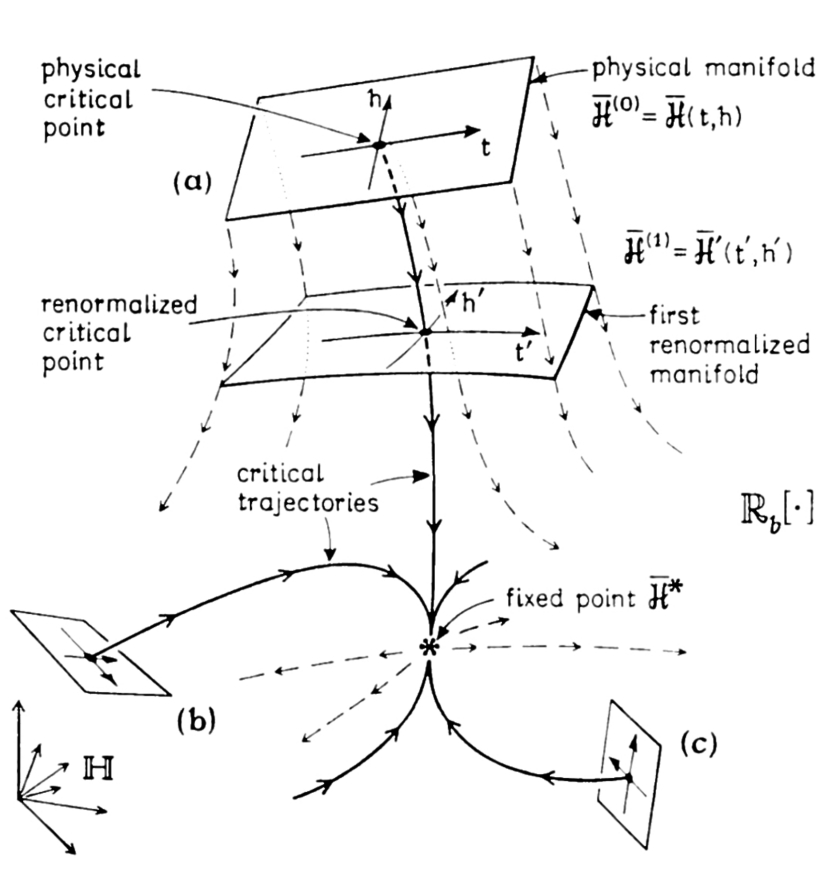
Click this link and the one above to read what some experts argue is the why and how of renormalization. Do it after reading my essay, though.


Our guess is that this graphic will be incomprehensible to the typical reader of Billy Lee’s blog. So, don’t worry about it. Billy Lee isn’t going to explain it, anyway. More important things need to be told that everyone can understand, and they will. The Editorial Board

There’s a problem inside the science of science; there always has been. Facts don’t match the mathematics of theories people invent to explain them. Math seems to remove important ambiguities that underlie all reality.

People noticed the problem as soon as they started doing science. The diameter of a circle and its circumference was never certain; not when Pythagoras studied it 2,500 years ago or now; the number π is the problem; it’s irrational, not a fraction; it’s a number with no end and no pattern — 3.14159…forever into infinity.

More confounding, π is a number which transcends all attempts by algebra to compute it. It is a transcendental number that lies on the crossroads of mathematics and physical reality — a mysterious number at the heart of creation because without it the diameters, surface areas, and volumes of spheres could not be calculated with arbitrary precision. 


For a circle, either the circumference or the diameter can be rational (written as a fraction) but not both. Perfect circles and spheres cannot exist in nature. Why?  ”π” is irrational. It can’t be written like a fraction —  a ratio — where one integer divides another.

The diameter of a circle must be multiplied by π to calculate its circumference; and vice-versa. No one can ever know everything about a circle because the number π is uncertain, undecidable, and in truth unknowable. 

Long ago people learned to use the fraction 22 / 7 or, for more accuracy, 355 / 113These fractions gave the wrong value for π but they were easy to work with and close enough to do engineering problems.

Fast forward to Isaac Newton, the English astronomer and mathematician, who studied the motion of the planets. Newton published Philosophiæ Naturalis Principia Mathematica in 1687. I have a modern copy in my library. It’s filled with formulas and derivations. Not one of them works to explain the real world — not one.

Newton’s equation for gravity describes the interaction between two objects — the strength of attraction between Sun and Earth, for example, and the resulting motion of Earth. The problem is the Moon and Mars and Venus, and many other bodies, warp the space-time waters in the pool where Earth and Sun swim. No way exists to write a formula to determine the future of such a system.


This simple three-body problem cannot be solved using a single equation. It’s not so simple. More than three bodies makes systems like these much harder to work with.

In 1887 Henri Poincare and Heinrich Bruns proved that such formulas cannot be written. The three-body problem (or any N-body problem, for that matter) cannot be solved by a single equation. Fudge-factors must be introduced by hand, Richard Feynman once complained. Powerful computers combined with numerical methods seem to work well enough for some problems. 

Perturbation theory was proposed and developed. It helped a lot. Space exploration depends on it. It’s not perfect, though. Sometimes another fudge factor called rectification is needed to update changes as a system evolves. When NASA lands probes on Mars, no one knows exactly where the crafts are located on its surface relative to any reference point on the Earth.

Science uses perturbation methods in quantum mechanics and astronomy to describe the motions of both the very small and the very large. A general method of perturbations can be described in mathematics. 

Even when using the signals from constellations of six or more Global Positioning Systems (GPS) deployed in high earth-orbit by various countries, it’s not possible to know exactly where anything is. Beet farmers out west combine the GPS systems of at least two countries to hone the courses of their tractors and plows.

On a good day farmers can locate a row of beets to within an eighth of an inch. That’s plenty good, but the several GPS systems they depend on are fragile and cost billions per year. In beet farming, an eighth inch isn’t perfect, but it’s close enough.

Quantum physics is another frontier of knowledge that presents roadblocks to precision. Physicists have invented more excuses for why they can’t get anything exactly right than probably any other group of scientists. Quantum physics is about a hundred years old, but today the problems seem more insurmountable than ever.


The sub-atomic world seems to be smeared and messy. Vast numbers of particles — virtual and actual — makes the use of mathematics problematic. This pic is an artist’s conception. Concepts such as ”looks like” have no meaning at sub-atomic scales, because small things can’t be resolved by any frequency of light that enables them to be visualized realistically by humans.

Insurmountable?

Why?

Well, the interaction of sub-atomic particles with themselves combined with, I don’t know, their interactions with swarms of virtual particles might disrupt the expected correlations between theories and experimental results. The mismatches can be spectacular. They sometimes dwarf the N-body problems of astronomy.

Worse — there is the problem of scales. For one thing, electrical forces are a billion times a billion times a billion times a billion times stronger than gravitational forces at sub-atomic scales. Forces appear to manifest themselves according to the distances across which they interact. It’s odd.

Measuring the charge on electrons produces different results depending on their energy. High energy electrons interact strongly; low energy electrons, not so much. So again, how can experimental results lead to theories that are both accurate and predictive? Divergent amplitudes that lead to infinities aren’t helpful.

An infinity of scales pile up to produce troublesome infinities in the math, which tend to erode the predictive usefulness of formulas and diagrams. Once again, researchers are forced to fabricate fudge-factors. Renormalization is the buzzword for several popular methods.

Probably the best-known renormalization technique was described by Shinichiro Tomonaga in his 1965 Nobel Prize speech. According to the view of retired Harvard physicist Rodney Brooks, Tomonaga implied that  …replacing the calculated values of mass and charge, infinite though they may be, with the experimental values… is the adjustment necessary to make things right, at least sometimes. 

Isn’t such an approach akin to cheating? — at least to working theorists worth their salt?  Well, maybe… but as far as I know results are all that matter. Truncation and faulty data mean that math can never match well with physical reality, anyway. 

Folks who developed the theory of quantum electrodynamics (QED) used perturbation methods to bootstrap their ideas to useful explanations. Their work produced annoying infinities until they introduced creative renormalization techniques to chase them away.

At first physicists felt uncomfortable discarding the infinities that showed up in their equations; they hated introducing fudge-factors. Maybe they felt they were smearing theories with experimental results that weren’t necessarily accurate. Some may have thought that a poor match between math, theory, and experimental results meant something bad; they didn’t understand the hidden truth they struggled to lay bare.

Philosopher Robert Pirsig believed the number of possible explanations scientists could invent for phenomena were in fact unlimited. Despite all the math and convolutions of math, Pirsig believed something mysterious and intangible like quality or morality guided human understanding of the Cosmos. An infinity of notions he saw floating inside his mind drove him insane, at least in the years before he wrote his classic Zen and the Art of Motorcycle Maintenance.

The newest generation of scientists aren’t embarrassed by anomalies. They “shut up and calculate.” Digital somersaults executed to validate their work are impossible for average people to understand, much less perform. Researchers determine scales, introduce “cut-offs“, and extract the appropriate physics to make suitable matches of their math with experimental results. They put the horse before the cart more times than not, some observers might say.


Apologists say, no. Renormalization is simply a reshuffling of parameters in a theory to prevent its failure. Renormalization doesn’t sweep infinities under the rug; it is a set of techniques scientists use to make useful predictions in the face of divergences, infinities, and blowup of scales which might otherwise wreck progress in quantum physics, condensed matter physics, and even statistics. From YouTube video above.

It’s not always wise to question smart folks, but renormalization seems a bit desperate, at least to my way of thinking. Is there a better way?

The complexity of the language scientists use to understand and explain the world of the very small is a convincing clue that they could be missing pieces of puzzles, which might not be solvable by humans regardless how much IQ any petri-dish of gametes might deliver to brains of future scientists.

It’s possible that humans, who use language and mathematics to ponder and explain, are not properly hardwired to model complexities of the universe. Folks lack brainpower enough to create algorithms for ultimate understanding.

People are like the first Commodore 64 computers (remember?) who need upgrades to become more like Sunway TaihuLight or Cray XK7 Titan super-computers to have any chance at all.

Perhaps Elon Musk’s Neuralink add-ons will help someday. 


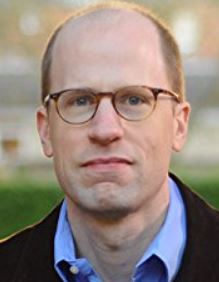
Nick Bostrom, author of SUPERINTELLIGENCE – Paths, Dangers, Strategies

The smartest thinkers — people like Nick Bostrom and Pedro Domingos (who wrote The Master Algorithm) — suggest artificial super-intelligence might be developed and hardwired with hundreds or thousands of levels — each  loaded with trillions of parallel links —  to digest all meta-data, books, videos, and internet information (a complete library of human knowledge) to train armies of computers to discover paths to knowledge unreachable by puny humanoid intelligence.

Super-intelligent computer systems might achieve understanding in days or weeks that all humans working together over millennia might never acquire. The risk of course is that such intelligence, when unleashed, might enslave us all.

Another downside might involve communication between humans and machines. Think of a father — a math professor — teaching calculus to the family cat. It’s hopeless, right? 

The founder of Google and Alphabet Inc., Larry Page, who graduated from the same school as one of my sons, is perfecting artificial super-intelligence. He owns a piece of Tesla Motors, started by Elon Musk of SpaceX.

Imagine an expert in AI & quantum computation joining forces with billionaire Musk who possesses the rocket launching power of a country. Right now, neither is getting along, Elon said. They don’t speak. It could be a good thing, right? 

What are the consequences?

Entrepreneurs don’t like to be regulated. Temptations unleashed by unregulated military power and AI attained science secrets falling into the hands of two men — nice men like Elon and Larry appear to be — might push humanity in time to unmitigated… what’s the word I’m looking for?

I heard Elon say he doesn’t like regulation, but he wants to be regulated. He believes super-intelligence will be civilization ending. He’s planning to put a colony on Mars to escape its power and ensure human survival.


Elon Musk

Is Elon saying he doesn’t trust himself, that he doesn’t trust people he knows like Larry? Are these guys demanding governments save Earth from themselves?

I haven’t heard Larry ask for anything like that. He keeps a low profile. God bless him as he collects everything everyone says and does in cyber-space. 

Think about it.

Think about what it means.

We have maybe ten years, tops; maybe less. Maybe it’s ten days. Maybe the worst has already happened, but no one said anything. Somebody, think of something — fast.

Who imagined that laissez-faire capitalism might someday spawn an airtight autocracy that enslaves the world?

Ayn Rand?

Humans are wise to renormalize their aspirations — their civilizations — before infinities of misery wreck Earth and freeless futures emerge that no one wants.

Billy Lee 

ESCAPE FROM FREEDOM

Today, as I write, the orange man (now blonde) who stole our election on behalf of the Russians held a meeting with Russian diplomats. He allowed only one press organization to cover and release photos. I asked some reasonably well-informed, smart people what press organization they thought it might be. They answered, Fox News.

Of course, their answer was nonsense. Fox News is clueless. It always has been. It’s run by a group of non-native Americans (their countries of origin are China and Australia) who have their own idiosyncratic ideas about what they want the USA to become. Their women parade around on camera half-dressed; recent lawsuits have disclosed that executives use many of them for sex.

They pretend to be patriots and Christians. Of course, anyone who isn’t deaf, dumb, and blind knows they are neither. They aren’t reporters either. Cheerleaders for GOP politicians is a better descriptor.


No, the correct answer is TASS, the Russian news agency, which is an arm of the Russian government. TASS made the press announcements. They released the photographs. And of course, life goes on. No one seems to care. On Tuesday, the FBI director — who led the investigation into ties between our leaders and Russian mafia-oligarchs — was fired.

On Wednesday (today), we learned that it was the president — he remains under investigation — who fired the FBI director; he celebrated by meeting with his Russian friends. They wore black suits, as if to highlight their bonds of power. The president lied, it turns out, about both the process and his reasons — according to members of his own staff, who leaked to major news outlets.


The president’s bodyguard, who delivered the FBI director’s pink slip. Note: on 20 Sept. 2017, the bodyguard left White House service. The Editors

The FBI director learned that he had been dismissed when he saw the announcement on television — the place where most folks get the news they trust most.

Director Comey thought it was a prank. He was preaching to a new class of recruits somewhere in southern California. He read the announcement on the scrolling news ribbon.

Later, the leader of the president’s civilian bodyguards hand-delivered the director’s pink slip. One report claimed that the FBI head hired a commercial aircraft to make his escape home. (ABC News reported that he was able to secure a government plane.)

Unless the Russians go door to door arresting people, no one will ever care — certainly no one in the GOP, it seems. The typical American lives inside a psychotic bubble of evil. Some act like they’ve lost the ability to assess realistic threats to their way of life; to the things they hold dear. They’ve watched too much television, too many movies, too much pornography; they’ve explored too many fake news sites — sites designed by experts to manipulate them into believing absurdities.

The typical American takes too many drugs — some wake up with caffeine and amphetamines; some struggle through stressful work days that last way too long; they sustain themselves by swallowing tranquilizers or derivatives of heroin like oxycodone; some put themselves to sleep with barbiturates or alcohol or both. Some drugs are prescribed; they’re necessary. Others are illegal.

It doesn’t seem to matter. The appetite for drugs is massive; Americans spend billions of dollars each year for drugs they might be better off not taking. They might more realistically assess threats to their freedoms with minds less anesthetized.  Feeling good while living in a high-tech prison bult by billionaires is unnatural and, if anyone thinks about it much, sad and more than a little pathetic.


Howard Hughes (1905-1976) inherited the Hughes Tool Company. It became the nexus of a defense contractor empire worth billions of dollars.

Many Americans would strap syringes to their arms if they believed that no one would notice — as did Howard Hughes, the billionaire industrialist from yesteryear. Some readers may recall that our government confiscated his many businesses to make it easier to build and secure our country’s infamous war machine; the process drove Howard insane; he became dependent on drugs only they could reliably supply to keep him docile and compliant. He lived his last days wearing Kleenex boxes on his feet, because the tissues cushioned his arches and comforted him.

Howard Hughes watched movies all day long — movies he once produced; they often featured his long-lost Hollywood friends. When he felt sad, which was often, he tapped the end of the plungers in the syringes strapped to his arms. Sometimes he cried.

The Mormon FBI agents who baby-sat him allowed him to wallow. They left him to himself for the most part. He never traveled unless they took him. He never fled his gilded prison. His addictions made flight impossible. He might as well have been left to die on a sandbar in the middle of the Pacific Ocean. He dropped off the face of the earth. Members of Congress, some of them, worried about him.

The public was asking, Did Howard Hughes die?  He had vanished from view like a ghost. No one ever saw him. He must be dead, some argued. Others knew better. They arranged a phone call with his handlers — to allay the fears of those few who believed that bad actors held him against his will. Powerful congress members wanted to know the truth and share it with the public.

During the call — which was broadcast to the world via speaker-phone before a full congressional gathering — Howard said that he was OK. He was alive. Someone asked, almost as an afterthought, if he was happy. His reply stunned Congress into silence. He answered, No… I’m not happy.

The phone called ended, and that was that. A few years later, Howard died. The coroner said that he found broken needles embedded in the bones of Howard’s arms and legs. He weighed less than ninety pounds.


Escape from Freedom; Amazon.com

Erich Fromm published the book Escape from Freedom in 1941. It was a required read in my high school during the 1960s, which was a long time ago — for some people. It seems like yesterday to me.

Fromm was a German psychoanalyst who argued that true freedom, if it ever came, would scare people so bad that they would embark on an unhealthy search for security; for certainty. The search would be a kind of escape; a frantic fleeing from the painful dissonance that the dissimilarity between people with disparate values can induce.

This discord intensified inside the USA during the past decade or so. Does anyone really want to go through the list of things that Americans hate about each other? Must I mention gay marriage, abortion, liberal politics, civilian access to weapons of war, religion, race, ethnicity, politics, viewing habits, Facebook rants, Twitter smears, and on and on?

People follow; they unfollow; they block; they unblock. They flip channels. They jump from Facebook to Instagram and back again. Nothing works; nothing helps.

Erectile dysfunction, for example, is a subject that has been thrust into everyone’s faces; into the deepest recesses of our subconscious minds. It’s relentless. It’s been discussed with commercial intensity on every media channel. People who watch sports programming can’t escape it.

No one can turn off the voices that are driving us mad, because the people who manipulate the public don’t agree with our points of view; with our sense of life. Do I suffer from erectile dysfunction?  No; Hell no!  I wish I never heard the term.

Do I yearn for a leader; a guide; someone to stand things up; to set things right?  Yes. Of course I do. But it seems like Christ Jesus is not going to visit anytime soon. Maybe a Second Coming is fantasy. Maybe we’ve been stood up. Maybe we need a Führer. Yeah, that’s it.

I said earlier that I borrowed this essay’s title from the book of the same name published in 1941 by the German-born psychoanalyst, Erich Fromm. I don’t know if the book is required reading today or not; perhaps it should be; better books might have replaced it.

I considered a different title; I did. Maybe the Stockholm Syndrome would have been better. It’s about the ten percent of hostages who take on the values of their tormentors. I thought and thought. No; Escape from Freedom was best.

At least for now.

Billy Lee

Note from the Editorial Board: The details of the life of Howard Hughes included in Billy Lee’s essay are based on his memories of events as recorded in press accounts written and televised in real time as they were unfolding. Billy Lee’s memories do not in every case align with current historical accounts, because the history of Howard’s life has been reconstructed and fictionalized by many sources — according to Billy Lee. Billy Lee believes current accounts are revisionist, and in some particulars may in fact be inaccurate. Billy Lee witnessed the congressional interview with Mr. Hughes as it occurred.

NIGHTMARE

I lived as a teenager and young adult during the 1960s in an America where abortion was illegal in every state. At least 10% of women and girls got abortions anyway, maybe more.

Who knows? The technology of abortion is not complicated; people performed them for pregnant girls and women, usually for small fees.
 
Birth control was something new. Girls and young women, most of them, did not yet understand how it all worked. They suffered shame and ignorance. Many got “into trouble” who never imagined it could happen to them — learning about their pregnancies, some of them, long after their boyfriends had moved on.

In junior high — it was 1961 — I was thirteen. In those days, Thursday was Queers Day. Anyone who wore green was considered queer and could be harassed — no mercy.

God help the wearer of green on Queers Day. I had no idea what being queer meant. I knew it was bad. Queer folk went to prison, some of them. They couldn’t get security clearances in the military, not in the Navy, anyway.

Dad told me, so I knew it was true. 

Blacks couldn’t vote until 1964. I was 16. Until the assassination of civil rights leader Martin Luther King Jr. in 1968, businesses like hotels, drugstores, theaters, and realtors could choose to not sell their products to anyone they hated — usually Negroes
 
Yes, a few companies sold to black people but not many. After Martin was murdered, 125 cities erupted into racial violence. Some say more. Congress, fearing the unraveling of America, passed the Fair Housing Act and other legislation to make racial discrimination by business owners illegal.
 
I never saw a black face on television until 1965. I was 17. Black musicians and singers entertained on the radio and in night clubs in most large cities. On the radio it was not possible to know always if the singer was black.


Otis Redding released a hit song during Christmas of 1964. I loved it. When Otis died in 1967, I did not know what he looked like. I’d never seen a picture of one of the most popular American singers of all time.
 
When I graduated from college, one thing I did know for sure was what all the many brands of cigarettes looked like. I knew Marlboro tastes good like a cigarette should. 

The jingle burned my brain. I will never be rid of it. TV forced hundreds-of-millions in the USA and around the world to watch countless thousands of cigarette commercials

Viewers back then couldn’t pause or mute programs. Remotes didn’t exist.

Of course, I smoked. Who can resist sophisticated advertising

I can’t.

Back in the day, the one and only control anyone had over what they watched was the on-off switch. The “off” switch meant choosing to be lonely, sometimes.  


On television news, I watched the USA fight genocidal war in Vietnam. I signed up to serve as an infantry officer, no less. I learned that war is bad — much worse than I imagined.

I protested, and the army stripped me of my pending commission. I was arrested at an antiwar demonstration and spent hours in jail before some good lawyers set me free.
 
Historians have argued that sometime during 1952 (I was four) the USA dropped anthrax munitions on Chinese troops stationed in northern Korea. The act of bioterrorism was justified by the idea that the alternative was nuclear weapons, which everyone believed involved more risk.

When doing research, I learned that everyone in the world seemed to know about the anthrax attack except Americans.

In 1976, a “rogue” CIA employee blew up a commercial airplane carrying, among other folks, the Cuban Olympic fencing team. The bombing was the world’s first act of aviation terrorism — a form of warfare our enemies would one day turn against us.

A “rogue” CIA asset named Oswald assassinated President Kennedy in 1963. I was in high school. Back in the day, rogue actors seemed to show up from time to time in places where unusually catastrophic events erupted. 

Wikipedia reports: According to a 1963 FBI memo that was released to the public in 2008, [former president] Ford was in contact with the FBI throughout his time on the Warren Commission and relayed information to the deputy director, Cartha DeLoach, about the panel’s activities.

I lived in America under President Nixon, the closest thing to a Nazi ever elected to the White House.  I was 26 when Congress started the impeachment process against him, but Nixon chose to resign in exchange for a pardon by his vice-president turned president, Gerald Ford.

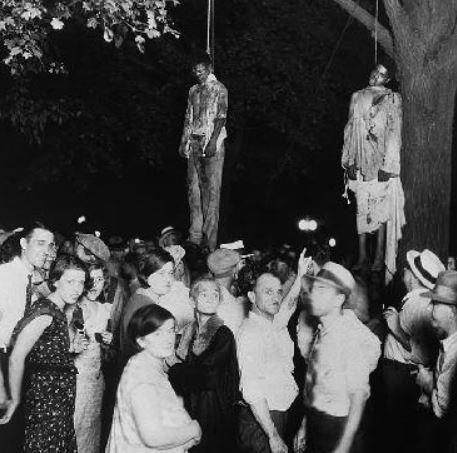
During high school, I lived in Virginia, where white people went “coon” hunting to find and execute random black people.

I lived a half mile from the headquarters of the American Nazi Party, which was led by a retired Navy Commander.

 Can things get worse?

Of course.

Government leaders lie. Many are hypocrites. It’s often not possible to know what’s true. A lot of people who wear suits and ties are haters and power-trippers.

It’s true.


We are a slave state.

Slavery was 100 years old in America when our nation established itself under a constitution in 1776 — it was 150 years old if indentured servants — who were white and European — are included. Two-thirds of whites came to America as slaves. True, they weren’t in chains, and their “contracts” expired after seven years.
 
Slavery is the fertile soil out of which the thorn bush of capitalism spread its vile branches of greed and exclusion. The institution of bondage makes getting rich a lot easier for those who own slaves.
 
Who doesn’t love the roses of capitalism? But its spines can grow long enough to wound and kill the unwary. Unlimited incomes and estate sizes turn capitalism into a predatory exercise; without limits people get hurt; democracy is devalued; economies stall; recession and depression follow.
 
The disadvantaged poor are as often as not sent to war by the rich and powerful to further maximize their enormous advantages. Threatening war to take the oil of Iraq is an example — an idea recently floated by President Trump.

Since the beginning of empires, every thinking person has known that greed, unchecked and unrestrained, destroys civilizations. The Bible says that the love of money is the root of every kind of evil.

It’s true.

Almost everyone in the world today lives under authoritarian governments run by men who don’t give a damn about freedom. It’s always been this way.

Even in an America with its Statue of Liberty, its Bill of Rights, its wide-open spaces and fast cars, most people find themselves trapped in jobs they hate working for rich folks who can disrupt and sometimes ruin their lives with two words: You’re fired.

To put things into perspective: unless our new president decides to arrest and execute dissenters, or drops nuclear bombs, we will get through what seems to some like a living nightmare. It is not, not really, not yet.
 
We’ve been down this nasty road before. It leads to upheaval, yes, but if my generation survived and prevailed, then our kids and grandkids have a chance to prevail as well.
 
My advice is to be smart; dignity and love demand that each person resist evil as best they can. Unfortunately, my experience is that the brave who resist lose every battle. 

Who can close their eyes? The USA targeted and killed resisters in both Asia and the United States during the Vietnam debacle, to cite one example out of many.   
 
War resisters lost every fight; every argument; every skirmish; every battle. 

People still ridicule baby boomers who said no to war. Ads on TV make claim that many boomers suffer from hepatitis C.  Imagine — the generation that said no to war is a leper colony according to pharma pigs, who always push imaginary cures. 
 
Like everything else billionaires tell us, it’s bullshit. I don’t know a single person from my generation who has hepatitis C. Yes, some boomers have hepatitis C; that much has to be true; it’s simple statistics; and, yes, some voters cheated during our recent presidential election. There are always some, always on both sides, it turns out. 

Anything is possible.

Everything is possible.


Powerful people can paint the people they despise in any colors they want.

Crooked Hillary.

Lying Ted.

Sleepy Joe. 
 
Slander is not new. The 9th Commandment forbids it. No one cares. People increase their power by violating it. It’s the way power rolls.

It always will be.
 
It’s why Jesus said that unless graced by a miracle by God, the wealthy have as much chance of getting into heaven as a camel squeezing through the eye of a needle.
 
Despite the harm that billionaires do, they can’t change the reality that Martin Luther King Jr. described during his short life of suffering for the cause of freedom and equality:

The moral arc of the universe is long, but it bends toward justice.

They murdered Dr. King when he was 39. He didn’t live long, but he changed the course of civilization on Earth for as long as civilization lasts. 

We, every one of us, can share Martin’s hope: non-violent resistance is not futile. Not yet. Not ever. It only seems futile when we are tired and discouraged.

Some have died to make folks free.

 It’s not fair, it’s not right, but it’s true.

We have heroes. 

Billy Lee

BAD THINGS

When a foreigner resides among you in your land, do not mistreat them. The foreigner residing among you must be treated as your native-born. Love them as yourself, for you were foreigners in Egypt. I am the Lord your God. Leviticus 19: 33-34

Follow the way of love and eagerly desire gifts of the Spirit, especially prophecy.
1 Corinthians 14: 1

Dad could tell the future. He was a Navy pilot who took off and landed on aircraft carriers, sometimes at night. His time to defend America was long ago. Aircraft carriers were then new to war, and pilots crashed their planes and helicopters a lot. Until the kinks got worked out over a period of many years, the Navy lost about one out of four pilots to mishaps at sea.

Dad predicted a number of crashes. Soon the pilots in his squadron wouldn’t fly if he got a “bad feeling.” His commanders respected him. Over time, good fitness reports and promotions led him to command an anti-submarine, jet-helicopter squadron during the Cuban Missile Crisis. Afterward, the Navy rated his squadron (HS-1) the safest combat aviation group on America’s east coast. Not one man was lost during his command.

Dad went with his feelings; when he got that “bad feeling”, he always flew the mission himself, or led it, rather than risk the lives of his men. Dad rose rapidly in the ranks, holding many important positions, not only in the Navy but also at the NSA (National Security Agency). Near the end of his career, a president appointed him to lead another intelligence agency not known to the public.

Navy fliers I talked with who knew dad said he was the best pilot in the United States Navy. He could fly anything under any conditions. Navy officers don’t lie. It’s against their Code of Conduct. Of course, I believed every word.

My dad was fearless to the very end of his ninety-one years of life. He once ate a half pound of spoiled cheese, because it was a gift, and he refused to embarrass the giver. The cheese smelled the way cheese smells when it has been ripened at the bottom of an army latrine; I almost threw up from the stench, but dad gulped it down like porterhouse steak. He grabbed the cheese with both hands, tore it in half, and inhaled a deep breath to savor the aroma. I was amazed that the rancid mess didn’t instantly kill him.

Today, many people seem to be having apocalyptic fears. People I don’t know well, who seem normal, have told me about vivid dreams they have had about good and bad things. Sometimes their visions trouble them. The thought has crossed my mind that a lot of folks are teetering on the edge of insanity. It’s sad and troubling.

The election added a lot of stress to people’s lives, did it not?  Election tampering by foreign intelligence agencies ran rampant and was obvious to anyone who was paying attention. The United States has an unfortunate reputation for election tampering in other countries, which goes back many decades; our recent election seemed to give other countries a golden opportunity for pay-back, which some inflicted brazenly — perhaps as a warning for us to back-off; to stand-down. Who knows?

Anyway, the election is done; Trump won; Hillary won the popular vote but lost the electoral college. In the countryside of Pennsylvania, Wisconsin, Ohio, and Michigan (among other states) Trump won by huge margins never before seen in the free world, ever. His biggest leads came in districts with electronic voting machines. These margins overwhelmed the leads racked up by Democrats in urban areas.

It was a strange election that lasted a very long time. Many “unprecedented” things happened during the contest that no one in America has ever experienced before. Is it any wonder that some people feel unhinged by an outcome that makes no statistical sense; by an outcome no one saw coming?

Republicans now control the entire federal government; they control enough state governments to enable easy passage of amendments to the Constitution, should the GOP decide to change America in that way.

Some people want to know: what’s coming next; what sudden shocks might rock their world?

How would I know?

Yes, I took the time to compile a list of bad things that could happen. Yes, it may have been a waste of time; maybe my effort might have been better spent helping the poor.


(FILES): These recent file photos show the ten Republican presidential candidates who will appear August 6, 2016 on Fox News for the first US presidential debate of the 2016 Republican primary cycle. Top row from left: Billionaire real-estate tycoon Donald Trump; former Florida governor Jeb Bush; Wisconsin Governor Scott Walker; Florida Senator Marco Rubio; former Arkansas governor Mike Huckabee. Bottom row from left: Retired neurosurgeon Ben Carson; Kentucky Senator Rand Paul; Texas Senator Ted Cruz; New Jersey Governor Chris Christie; and Ohio Governor John Kasich. AFP PHOTO / Files
With GOP leaders like these, what things could possibly go bad?

It’s possible that none of the bad things in the list below will happen. Maybe some will. My contribution to understanding the future is simply to point out things that have a chance of happening, which people may not have considered, or yet read about, or even shared (if they have thought about them).

My blog is read by not very many people; stilI, I felt compelled to write these “heads-up” warnings to help any curious humans (or bots) who might accidentally stumble onto my essay; to open the eyes of the few and the lucky, so that they might better understand what’s coming next; to inoculate some of them — especially the people I love — against the despair that can overwhelm any one of us when we find ourselves ambushed by the bad things in our future.

So here is my list of BAD THINGS. I might add to it from time to time if my imagination runs amok, or freaked-out people tell me scary stuff.

Here it is:

— The First Family refuses to live in the White House.

— Blacks and women start disappearing from news shows, replaced by white men.

— Athletes and entertainers step forward to confess: yes, they voted for Trump.

— Evidence emerges: The birth certificate was faked. Congress starts an investigation.

— The Civil Rights Act of 1964 is overturned.

— The military draft of young people is resurrected.

— The USA drops a neutron bomb on a city for the very first time.

— The United Nations disbands.

— Russia reestablishes its control over Eastern Europe.

— The Philippines makes a military alliance with China.

— Donald Trump resigns.

— Mike Pence becomes president.

— A hot year kills hundreds of millions.

— Many popular foods become unavailable.

— The president’s wife reveals that he is gay.

— The Mueller investigators reveal that the new president is an agent of the Russian government — hand-picked by Paul Manafort.

— A major volcanic eruption inside the USA kills hundreds of thousands.

— The Post Office is privatized.

— The Veterans Administration is privatized.

— Social Security is privatized.

— Medicare is privatized.

— Prisons are privatized.

— Public education is privatized.

— Tax deductions are eliminated, raising taxes on the poor and middle-class.

— Inheritance taxes are eliminated, locking-in a permanent aristocracy.

Unlawful assembly is redefined: three or more unrelated people who gather in a public space for any purpose other than private discourse shall be guilty of a misdemeanor, unless they have in their possession a permit signed by the president of the United States.

— A 1954 law denying tax exemptions to churches who endorse politicians is repealed.

— Church attendance plummets.

— Charitable giving plummets.

— Inflation rises to 22% per year.

— The banking system collapses.

— Stock markets close.

— Congress declares misdemeanor unlawful assembly a felony.

— The WALL is retooled to restrain fleeing Americans.

— The Constitution is amended to eliminate all forms of naturalization to block any pathway to citizenship for children bred by foreigners. 

— An insect species is destroyed by a gene-driver released from an unregulated lab.

— Chipmunks are rendered extinct by a second gene-driver accident.

— Internet access is placed under federal regulation.

SCOTUS hands over abortion policy to the states.

— SCOTUS rules that businesses have a constitutional right to choose who can buy their products and services, and who cannot.

— State governments add lithium to city water supplies to raise the spirits of unhappy citizens.

— Congress mandates that electronic nano-chips be injected into the buttocks of every person to help ICE track, identify, and differentiate people’s movements and immigration status.

— Congress declares that felony unlawful assembly is ”from this time forward” a capital offense.

— The 2020 election is postponed until ”we can figure out just what the hell is going on.”

— GOP controlled state legislators amend the constitution to fight terrorism; they rescind the Bill of Rights.

Cruel and unusual punishment replaces baseball as our country’s most popular spectator sport.

Selfies by folks jumping off bridges and skyscrapers go viral on social media.

 Billy Lee

NO GOOD DEED…

Disclaimer by the Editorial Board:  The following story, No Good Deed… is a work of fiction by Billy Lee.  Events and persons depicted in the story exist only in the imagination of the writer and have no connection to living persons or actual events.


Christmas bulbs in a row


The old woman ahead of me in the checkout lane at the grocery sat in a battery-operated three-wheeler and struggled to move her purse off her wrist into the front basket. She couldn’t do it and gave up. She was grossly overweight; she couldn’t maneuver — her fat arms were black and blue right down to her fingernails. Diabetes, I thought.

I wondered if I should help, but she soon stopped and let the purse dangle where it was, on her wrist. It was a bad angle. It would be awkward for me to reach for it; and besides, it was her purse, a personal item she might try to defend. It was a good bet she fought this fight every time she shopped. No big deal. Let it go.

It was her own cart that she sat in, from the looks of it. She probably had used it for years. Held together by duct tape and bubble gum, it was dirty; a yellowed eggnog color; depressing to look at.

The cashier at the register — a black college-aged girl — finished the tally; the old woman sitting in the beat-up cart fumbled unsuccessfully to open her purse; the line of shoppers behind us continued to grow. It was busy. It was Christmas. I was in a hurry. What the heck… I reached over to the card reader and inserted my card. I’ll get this, I said. Merry Christmas.

The old lady looked up at me and said, thank you.

You look like you have enough to worry about, I said, beaming. We’ll make it one less thing.

Yes, she said. I worry about so many things these days. She fell silent and looked down. Something drippy fell from her mottled face into her lap. The eyes of the young black woman working the cash-register grew large and began to sparkle from tears, which she tried to hold back.

She would tell me later she had just immigrated from Ghana, Africa. She has stories, that girl, I would think to myself. The African regained her composure and gathered the old lady’s items.

As the cashier and myself exchanged a sympathetic look, the old woman with the black and blue arms and drippy face reached for a button on her cart and sped away. She didn’t remember to collect her receipt. I don’t think she felt embarrassed. Maybe she thought I might change my mind; make her pay for her own groceries, or something.

The cashier rang up my stuff. It was all good. I started to get that warm glow one gets when they’ve done something for someone, especially a stranger.

A melodic accent from somewhere out of Africa interrupted my reverie, Oh, look! Here is a bag of things. Are they yours? I think I forgot to give them to that person.

We checked the contents against the old woman’s receipt. Yup, they weren’t mine.

The cashier grabbed the bag and ran down the long aisle of the store to search for an old woman driving a beat-up mobility scooter with a missing bag of groceries. The folks in line behind me started to stir. A few threw unfriendly looks in my direction. My warm feeling turned to heat, then dread.

The cashier returned; she hadn’t found the customer. Since I had the receipt, I decided to take the groceries. If the old lady returned, she would be unable to convince anyone the groceries were hers, I reasoned.

I began to worry. It was Christmas. Undercover cops — temporaries with little training or empathy — lurked pretty much everywhere. They loved to patrol the parking lots, someone once told me.

What if store security decided to stop the old lady in the busy lot? What if they intercepted her before she could rendezvous with whoever was driving her home? Maybe she lived alone nearby, and there was no one to escort her. Minus the receipt, they might arrest her for shoplifting.

They might already have her in a little room somewhere, hidden from the public, to interrogate her. That’s why we couldn’t find her. I loosened my collar as my mind began to race. I felt sweat bead on the top of my head.

She would notice — under the intense pressure of  questioning — one bag of groceries was missing. And she couldn’t produce the receipt. He took it, she’d realize. It was the old man!  I could hear her screaming. She was cursing me — the old codger who had stood behind her and had the audacity to jump into her business for no good reason.

Of course she had the money to pay for everything, she screamed at the SWAT team as they held her down; as they restrained her. Of course she did. She didn’t need that smelly stranger’s credit card. And he stole a bag of her groceries! Arrest him!  It was he, the grey-beard, who robbed her; it was he who took her receipt; it was he who confused her — and the cashier!  He got her arrested. It was he, he, he — an old FART! — not her!

I imagined her anguish. By now she must realize that she would spend Christmas in prison; behind bars; isolated; alone; cold; away from family and a warm fire in the hearth — for I just knew she had no money for lawyers or bail.

I thought I could hear her weeping. I could hear her, but I would never be able to find her. No one else could hear her cries for mercy, no one would ever step forward to defend her and confirm her story. Take her out of here, I heard the arresting officer boom. Thief! 

My parting words to the cashier were short enough. I hurried to my car and drove out of the busy parking lot, quickly, furtively. I cast a side-long glance into my rear-view mirror. No flashing lights. No siren. An old red van with a tree tied on top pulled up behind me.

It was Christmas; the most wonderful time of the year.

Billy Lee


Christmas bulbs in a row

KILLING FRENZY

You have heard that it was said to the men of old, ‘You shall not kill; and whoever kills shall be liable to judgment.’ 
Jesus

The wars of Israel were the only ‘holy wars’ in history… there can be no more wars of faith. The only way to overcome our enemy is by loving him.
Dietrich Bonhoeffer

Those who have waged war in obedience to the divine command (or in conformity with His laws) have represented…the wisdom of government and… put to death wicked men; such persons have by no means violated the commandment, ‘Thou shalt not kill.’
Saint Augustine


drone strike
The United States deploys drones like the Scan Eagle and the Predator (which can dispatch Hellfire missiles) to kill people by remote control anywhere in the world.

Readers might notice that the quotes by the three Christians cited above the picture don’t agree about murder. Killing is a moral controversy.

The subject is even more contentious between leaders of religions outside Christianity. It’s a strange thing. In the United States where Christianity is mainstream, pastors sometimes lead the charge toward war; some endorse capital punishment, so it’s confusing.

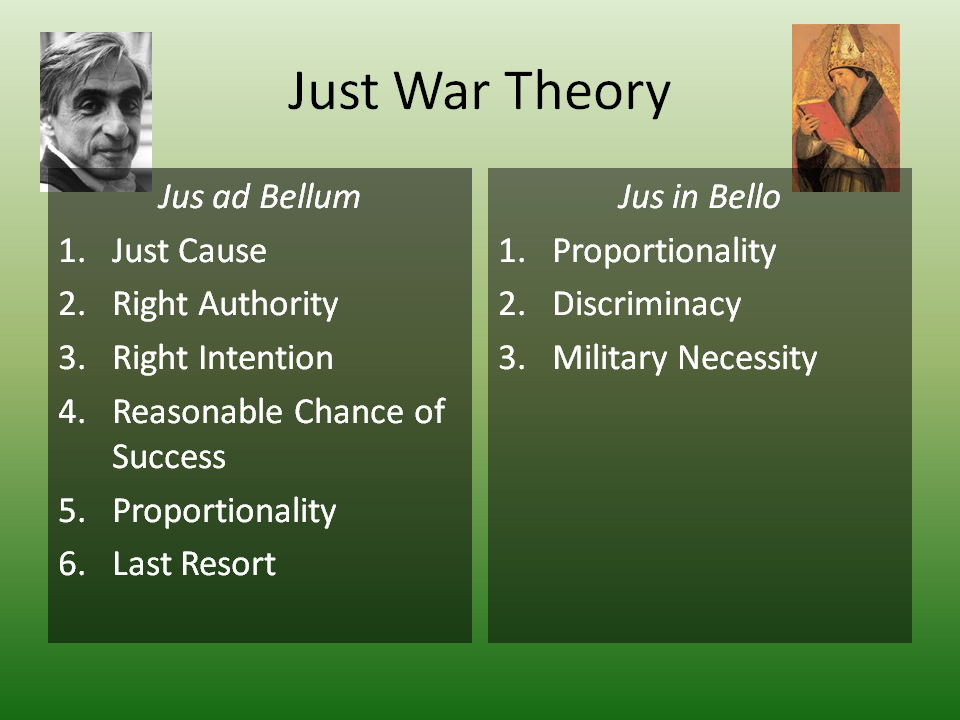
Can killing people be a good thing? The Catholic Church developed Just War doctrines to permit good people to kill the wicked under certain carefully crafted conditions such as proportionality, just cause, and last resort.


just war


From my point of view, ideas of Just War fall under the umbrellas of self-justification, rationalization, and delusion. Will anyone admit the obvious? All countries are ruled by elites, and the USA is no exception.

Elites get to be elite through in-fighting, war, intrigue, and politics. They are, for the most part, desensitized to violence. The morality of religion is of no use to them except when it helps to consolidate and enhance their prestige and power. If a philosophy like Just War helps to alleviate the guilt feelings of soldiers they order into combat, they are fine with it.

Elites are, by process and definition, really good at fighting to maximize their advantages. Over time elites become a law unto themselves and develop their world view and their reasons for doing things, which are usually not well-understood by the average people who serve them.


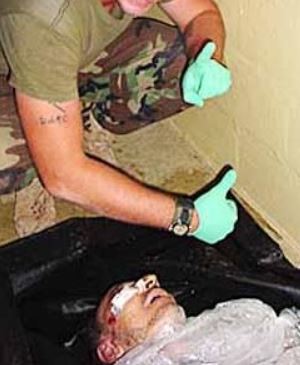
abu gharib
Who wants to take on people who can really hurt them?

In most places, people go-along with their elites to get along. It’s less stressful and much safer to pretend that average people’s best interests are at the heart of decisions made by the wealthy and the powerful — especially as they negotiate deals, wage wars, and craft treaties. 

Who wants to take-on people who can really hurt them should they ever choose to?

For their part, our elites tolerate religion, because in the United States at least Christianity seems to encourage citizens to be docile and compliant. Preachers and pastors encourage their flocks to turn the other cheek and obey authorities.

Christian evangelicals don’t challenge military power, and they generally oppose government policies designed to curb the power of individuals who accumulate vast wealth. Some encourage gun ownership and participation in wars — confusing non-Christians who might be under the impression that Jesus advocated pacifism and non-violence.

In the United States, the wealthy have built a powerful military and have used it to kill many millions of people during the past seventy-five years (the modern era).  Much of the killing has occurred during periods when the United States did not formally declare war.

A lot of the killing has taken place under continuing resolutions like the Gulf of Tonkin resolution, which helped to justify the long war in Vietnam.

Another is the AUMF (Authorization for Use of Military Force) — passed by Congress on September 14, 2001 — which provided the legal authority for the United States to use military power in perpetuity against any individual, group, or country who dared threaten it. 

Only Barbara Lee of California voted “no“.


Joint session of Congress 2
Only Barbara Lee (no relation to Billy Lee) of California voted against AUMF, the perpetual war resolution of 14 September 2001. President George W. Bush signed it into law on September 18.

Congressional consent is no longer required to wage war. Military force is now forever justified whenever and wherever the United States is threatened. The Congressional authorization of 2001 makes it easier for the USA to kill people, including American citizens living out of country.

One estimate by The Hill — a news organization whose on-line stories are widely read by members of Congress — places the number of killings by USA drones operating outside of war zones since 2001 at 2,400.

TheBillyLeePontificator.com could not independently confirm the estimate, which one of its editors characterized as “bordering on the ridiculous.”

It defies common sense that high numbers of assassinations of civilians could occur outside of warzones without arousing a profound backlash by people of goodwill, she insisted.

Is she right? Does anyone outside of government really know?

History seems to say it’s possible. Over the years the USA has invaded and tried to overthrow many countries, often under the pretext of retrieving businesses that were seized by their host countries.

In most places, the United States has succeeded — temporarily — like in Iran in 1953 where it secured natural gas and oil reserves; in Guatemala in 1954 when it took back the nationalized United Fruit Company; and in Chile in 1973 when it repossessed certain mines that were producing strategic metals.

The problem for most countries is that after the USA retrieves its property it moves in to take over the country, usually behind the scenes using native-born (and ruthless) dictators loyal to the United States.


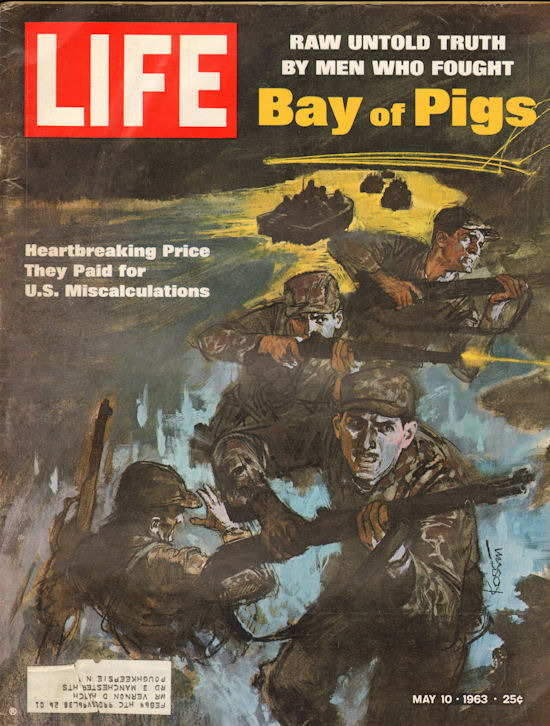
life magazine bay of pigs
USA backed fighters killed and wounded 5,000 Cubans during the failed Bay of Pigs Invasion in 1961. Cuba captured 1,200 who they added to several thousand political detainees in a trade for medicine.

Every once in a while, takeover fails, like in Cuba in 1961 and in Vietnam in 1972. In those countries, strategic resources were never at stake, so the losses didn’t seem to affect our safety or our economic security. Still, after the fights ended, the USA worked overtime to make sure it ruined their economies by deploying embargos and unleashing its leverage over international banking.

The USA ignited recent wars in the Middle EastKuwait, IraqSyria — for various reasons and continues them to this day. The United States fights terrorists in undeclared wars permitted by AUMF resolutions, which allow it to kill enemies anywhere in the world by remote control using un-humaned drones.

It’s pointless to argue whether the killings are justified or moral, smart or stupid. Many families have been ruined by drones and by war. They don’t care about smart or stupid. They just hurt; survivors wonder what might have been were their loved ones allowed to live.

So, how many people have we killed? How many hurt? How many wounded? How many amputees; how many blinded; how many deafened; how many disfigured?  How many orphans?  How many widows?  How many dreams crushed; how many aspirations demolished?


Hellfire missile explosion
The picture reveals the lethality of Hellfire missile-strikes. The heat cooks flesh off bones of bystanders who get too close. 

How many loves-of-a-lifetime have been dashed on America’s battlefields? 

Unless God Himself reveals it someday, we will never know, because during the era of Bush-senior and his general, Norman Schwarzkopf (of the renown German family) no one bothered to track body-counts; no one kept statistics on the maimed and crippled.

Our military says it doesn’t do counts. It’s in bad taste. A country like the USA doesn’t count pelts or put notches on rifles; besides, how does anyone collect the names of entire families destroyed in atomic blasts like Hiroshima and Nagasaki?

In those attacks, the genealogy archives of families were obliterated. The files of victims, the records of everyone who knew them, were vaporized.

The directories of the dead in Japan are missing, perhaps forever. Unless resurrected by God, the dead, many of them, are forgotten to the end of time.


Arlinton National Cemetary
The Arlington National Cemetery holds the remains of 400,000 veterans who have served the USA in defense of our way of life. It is a sacred place. A summer job during college privileged me to trim the gravestones of thousands who loved their country enough to serve. A cemetery for those the USA has killed in the modern era, should it ever be built, will be 25 to 150 times larger depending on who collects the dead.

Nevertheless, brave reporters and historians have tried to pull together records where they can find them. I can tell you that the numbers of deaths, executions, and imprisonments in America’s wars are in dispute — with some articles on Wikipedia, for example, frozen in place and fought over by review committees for historical accuracy. The reports are hard reading, disturbing really, because some folks seem to be trying for whatever reasons to understate and misrepresent the carnage.

Despite obvious inaccuracies which defy common sense, the numbers on the internet are the most reliable civilians have. They may perhaps be understated, but they are still large. I’ve included links for those who might want to verify the statistics.

Billy Lee

Notes from the Editorial Board: As everyone knows, the United States is a close ally of Israel. Many prominent Israelis are citizens of the United States, such as former Homeland Security Director, Michael Chertoff.  Some folks, like Billy Lee, consider Israel a de-facto fifty-first state of the Union, much like Hawaii, though he admits there are important differences, to be sure.

Billy Lee has pointed out that since 1948 Israel and the United States have cooperated in a dozen or so wars and flare-ups — among them, the War of Independence, the Suez Crisis, the Six Day War, the War of Attrition, the Yom Kippur War, the Lebanon War of 1982, the South Lebanon conflict, the first and second Intifadas, the 2006 Lebanon War, the Gaza War, and various operations like Protective Edge — which were fought to secure Israel’s safety and its autonomy.

The USA has spent trillions of dollars to stabilize the Middle East and prop up with money and weapons governments favorable to our side. It has pumped over two-hundred billion dollars into Israel’s economy alone. How many people have been killed in the wars which erupted?  Billy Lee doesn’t know.

He seems to think that an accurate figure for war-related killings by the USA should include in some way the deaths inflicted during the many conflicts in the Middle East where the United States was directly involved. He simply doesn’t have the numbers, so he can’t report them. The numbers may be available to others, but they are not included in his analysis.

A similar concern involves NATO, where the United States, again, is partnering with others in wars and conflicts, and is not the sole actor.

As for other conflicts: Billy Lee has added the following list with links to the statistics. The Editorial Board


Dear Readers,

Here is a list of wars the United States has fought since 1940: World War II, the Korean War, the Cold War (including attacks on Cuba, Guatemala, Chile, Peru, Argentina, Grenada, Panama, Haiti, and others), Bosnia-Herzegovina, Kosovo, Kuwait, Afghanistan, Iran, the Iraq War, the Vietnam War, Cambodia, Laos, Thailand, the Persian Gulf War, Syria, Yemen, Somalia, and the War on Terror.


Hiroshima and Nagasaki
The names and numbers of people killed in Japan will never be known. USA bombers obliterated their records in the fires they ignited in the Japanese made-from-wood-and-paper neighborhoods and cities. 

The War against Japan deserves special mention.

The names and quantities of people the USA killed in Japan will never be known. The Air Force obliterated their records in the fires they set in the Japanese made-from-wood-and-paper neighborhoods and cities.

Beginning in 1945 sixty-seven Japanese cities of consequence were burned to rubble by incendiary night-time attacks involving hundreds of B-29 Superfortress bombers under the command of USA General Curtis LeMay.

During the first attack against Tokyo in March 1945, Lemay deployed 325 bombers to drop a half-million slow-burning napalm cluster-bombs, which killed at least 150 thousand civilians. His bombing of the capital city continued unabated for three weeks; the fire-bombing of the other sixty-six Japanese cities continued for three more months.

Five cities were held back (protected from attack) until August 1945 to permit General LeMay to decisively demonstrate American atomic fire-power. He annihilated two of them — Hiroshima and Nagasaki — with the atomic bombs named Little Boy and Fat Man.

He spared the three remaining targets, Yokohama (Japan’s second largest city, where I lived from 1952-1954), Niigata, and Kokura — after the Japanese surrendered on August 15, 1945.

Some older readers might remember that Curtis LeMay ran for Vice-President in 1968 on a third-party ticket led by Alabama Governor George Wallace. The two men tried unsuccessfully to derail racial integration in the South, which our Congress had recently mandated.

One of General Douglas MacArthur’s closest aides, Bonner Fellers, described Curtis LeMay’s attacks on Japanese civilians as “the most ruthless and barbaric killings of non-combatants in all history.”

The most conservative estimate of the number of civilians burned alive that I’ve seen in print is 500,000. Some historians have estimated the number to be as high as two million. The Japanese effort to evacuate their cities saved countless lives, but left many millions of women and children homeless, until the cities could be rebuilt after the Japanese surrendered.

Official histories written by the US Air Force claim that ”five months of jellied fire attacks” were ”so destructive” that they ”cremated 65 Japanese cities.” The attacks left ”9.2 million homeless.”


Here are some numbers of interest: atomic bomb attacks in Japan — 225,000 killed; Vietnam War — 3.4 million killed; World War II — 55 million killed; Korean War — 2 million killed; Iraq War — 1 million killed.

This list of wars is necessarily incomplete, because the USA fights secret wars from time to time. In his 1990 book, Freedom in Exile, the Dalai Lama spoke of one such war against the Chinese and admitted taking millions from the USA to support the effort. He claimed that America’s policy was to destabilize and overthrow wherever possible each and every Communist country in the world. Inside the US intelligence establishment, the suppression is called Strategic Strangulation.

This policy was the reason many Communist societies sealed their borders during the Cold War. Some, like North Korea, still do. Military historians have claimed that the United States dropped anthrax bombs on North Korean troops and their Chinese allies in 1954. This biological terror was unleashed after what historian Richard Rhodes says was a program of US bombing against cities and dams in North Korea that killed two million civilians.

General Curtis LeMay agreed. He led the US Strategic Air Command during the bombing of Korea. In 1984 he bragged before the Office of Air Force History, ”Over a period of three years or so, we killed off — what — twenty percent of the population.”  It helps to explain why they hate us. 

The numbers killed in these secret and not-so-secret wars are argued over; they are not certain or even known — certainly not by civilians who lack security clearances. Mayhem from traumatic wounds is not known.

The consensus seems to be that the total number of human beings killed by the United States since 1940 exceeds ten million.  Depending on how it is counted, the number could be far higher. A case can be made that it’s as high as sixty-five million.

In the modern era, the United States has warred against one out of four countries on the earth. I didn’t believe it, until I did the count. Count the number any which way you choose. It’s a big number. And the numbers of wounded and traumatized human beings is certainly enormous, but unknown.

I’d like to think that in the future the United States will resolve its differences with other countries and organizations in a way that doesn’t involve killing people.

The United Nations was established to do just that — peacefully resolve disputes — but the United States runs the place, some say, and others have insisted that the USA is the biggest warmonger on the planet.

It has something to do with its defense industry and the efforts of tycoons to maximize profits for themselves and their shareholders.

I hope it’s not true.

How horrible it is to have so many people killed–And what a blessing that one cares for none of them!   Jane Austin, 1811, on the Battle of Albuera

Billy Lee

Postscript:  Here is a quotation from wisdom literature, which — who knows? — might help policymakers. I wonder if anyone believes it.

It is by the fear of the LORD that someone turns away from evil. When someone’s ways please the LORD, He makes even their enemies be at peace with them. 

I found the passage in the Proverbs of the Bible.  See chapter 16.