People assume they see nothing, but in every case, when they look closely — when they investigate — they find something… air, quantum fluctuations, vacuum energy, etc.
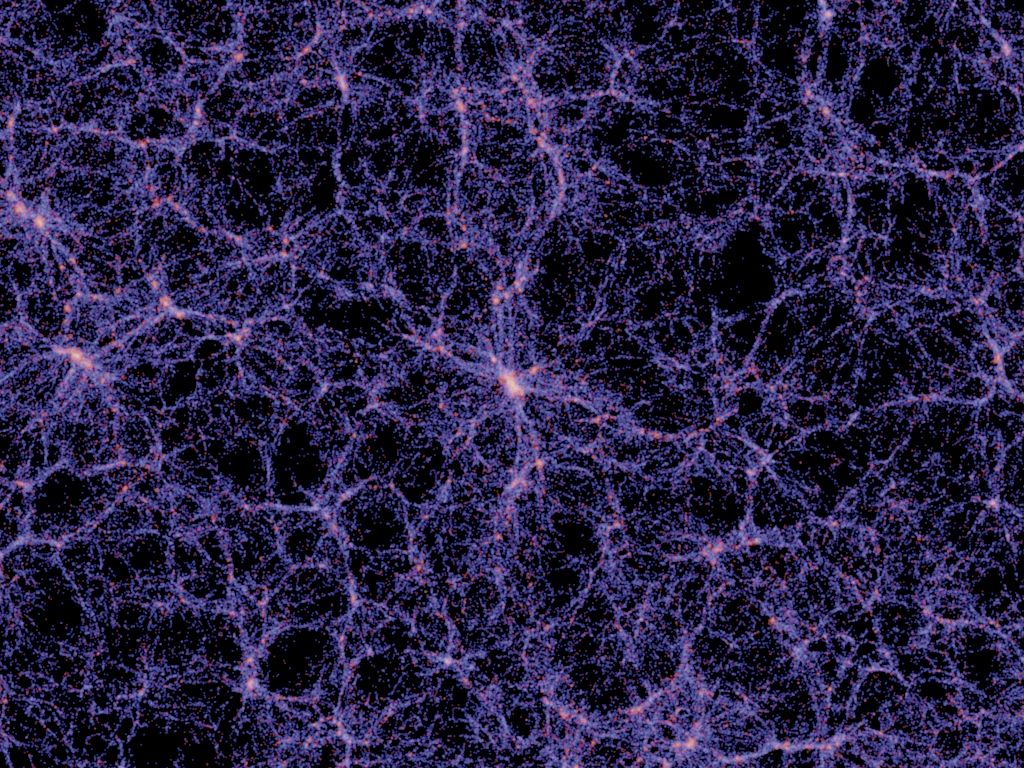
QUESTION: Is this a large-scale view of the universe or a sub-microscopic view of vacuum energy and quantum fluctuations? Can anyone tell? The universe is not empty. Everywhere anyone looks, at all scales, it seems like there is no such thing as nothing.
Everyone finds no evidence that a state of nothing exists in nature or is even possible.
Physicists know this for sure: there can be no state of absolute zero in nature — not for temperature; not for energy; not for matter. All three are equivalent in important ways and are never zero — at all scales and at all time intervals. Quantum theory — the most successful theory in science some will argue — claims that absolute zero is impossible; it can’t exist in nature.
There can be no time interval exactly equal to zero.
Time exists; as does space (which is never empty); both depend for their existence on matter and energy (which are equivalent).
Einstein said that without energy and matter, time and space have no meaning. They are relative; they vary and change according to the General Theory of Relativity, according to the distribution and density of energy and matter. As long as matter and energy exist, time can never be zero; space can never be empty.
People can search until their faces turn blue for a physical and temporal place where there is nothing at all, but they will never find it, because a geometric null-space (a physical place with nothing in it) does not exist. It never has and never will. Everywhere scientists look, at every scale, they find something.
We ask the question, Why is there something rather than nothing?
Physicists say that nothing is but one state of the universe out of a google-plex of other possibilities. The odds against a state of nothingness are infinite.
Another glib answer is that the state of nothing is unstable. The uncertainty principle says it must be so. Time and space do not exist in a place where nothing exists. Once the instability of nothing forces something, time and space start rolling. A universe cascades out of the abyss, which has always existed and always will. Right?
Think about it. It’s not complicated.
People seem to ignore the plain fact that no one has ever observed even a little piece of nothing in nature. There is no evidence for nothing.
Could it be that the oft-asked question — Why is there something rather than nothing? — is based on a false impression, which is not supported by any evidence?
Cosmic microwave background radiation is a good example. It’s a humming sound that fills all space. Eons ago CMB was visible light — photons packed like the molecules of a thick syrup — but space has expanded for billions of years; expansion stretched the ancient visible light into invisible wavelengths called microwaves. Engineers have built sensors to hear them. Everywhere and at every distance microwave light hums in their sensors like a cosmic tinnitus.
Until someone finds evidence for the existence of nothing in nature, shouldn’t people conclude that something exists everywhere they look and that the state of nothing does not exist? Could we not go further and say that, indeed, nothing cannot exist? If it could, it would, but it can’t, so it doesn’t.
Why do people find it difficult, even disturbing, to believe that no alternative to something is possible? Folks can, after all, imagine a place with nothing in it. Is that the reason?
Is it human imagination that explains why, in the complete absence of any evidence, people continue to believe in the possibility of null-spaces — and null-states — and empty voids?
Photons are mysterious quantities of light which have both wave and particle properties. The odd thing: physicists say they have zero rest mass. All their energy comes from their frequencies, which are invisible fields of electricity and magnetism that oscillate in a symbiotic dance of orthogonality.
A physical packet (quantum) of vibrating light (a photon) can be said to have zero mass (despite having momentum, which is usually described as a manifestation of mass), because it doesn’t interact with a field now known to fill the so-called vacuum of space — the Higgs Field.
Odder still: massive bodies distort the shape of space and the duration of time in their vicinities; packets of vibrating light (photons), which have no mass, actually change their direction of travel when passing through the distorted spacetime near massive bodies like planets and suns.
Maybe people cling to their belief in the concept of nothingness because of something related to their sense of vision — their sense of sight and the way their eyes and brains work to make sense of the world. Only a tiny interval of the electromagnetic spectrum, which is called visible light, is viewable. Most of the light-spectrum is invisible, so in the past no one thought it was there.
The photons people see have a peculiar way of interacting with each other and with sense organs, which has the effect of enabling folks to sort out from the vast mess of information streaming into their heads only just enough to allow them to make the decisions necessary for survival. They are able to see only those photons that enter their eyes. Were it otherwise humans and other life-forms might be overwhelmed by too much information and become confused.
Folks don’t see a lot of the extraneous stuff which, if they did observe it, would immediately disavow them of any fantasies they might have had about a state of nothingness in nature.
If we were not blind to 99.999% of what’s out there, we wouldn’t believe in the concept of nothing. Such a state, never observed, would seem inconceivable.
The reason there is something rather than nothing is because there is no such thing as nothing. Deluded by their own blindness, humans invented the concept of ZERO in mathematics. Its power as a place holder convinced them that it must possess other magical properties; that it could represent not just the absence of things that they could count, but also an absolute certainty in measurement that we now know is not possible.
ZERO, we have learned, can be an approximation when it’s used to describe quantum phenomenon.
When the number ZERO is taken too seriously, when folks refuse to acknowledge the quantum nature of some of the stuff it purports to measure, they run into that most vexing problem in mathematics (and physics), which deconstructs the best ideas: dividing by zero, which is said to be undefined and leads to infinities that blow-up the most promising formulas. Stymied by infinities, physicists have invented work-arounds like renormalization to make progress with their computations.
Because humans are evolved biological creatures who are mostly blind to the things that exist in the universe, they have become hard-wired over the ages to accept the concept of nothingness as a natural state when, it turns out, there is no evidence for it.
Anyone who has witnessed the birth of their own child understands that the child does not emerge from nothing, but is a continuation of life that goes back eons.
The phenomenon of life and death has added to the confusion. We are born and we die, it seems. We were once nothing, and we return to nothing when we die. The concept of non-existence seems so right; the state of non-being; the state of nothingness, so real, so compelling.
But we are fools to think this way — both about ourselves and about nature itself. Anyone who has witnessed the birth of their own child understands that the child does not emerge from nothing but is a continuation of life that goes back eons. And we have no compelling evidence that we die; that we cease to exist; that we return to a state of nothingness.
No one remembers not existing. None of us have ever died. People we know and love seem to have died, physically, for sure. But we, ourselves, never have.
Those who make the claim that we die can’t know for sure if they are right, because they have never experienced a state of non-existence; in fact, they never will. No human being who has ever lived has ever experienced a state of non-existence. One has to exist to experience anything.
Why is there something, not nothing? Because there is no such thing as nothing. There never will be.
A foundation of modern physics is the Heisenberg Uncertainty Principle, right? If this principle is truly fundamental, then logic seems to demand that nothing can be exactly zero.
Nothing is more certain than zero, right? The Uncertainty Principle says that nothing fundamental about our universe can have the quale of certainty. The concept of nothing is an illusion.
An alternative to nothing, is something. Something doesn’t require an explanation. It doesn’t require properties that are locked down by certainty. Doesn’t burden-of-proof lie with the naysayers?
Find a patch of nothing somewhere in the universe.
It can’t be done.
The properties of things may need to be explained — scientists are always working to figure them out. People want to know how things get their properties and behave the way they do. It’s what science is.
Slowly, surely, science makes progress.
Billy Lee
Afterthought: The number ZERO is a valid place holder for computation but can never be a quantity of any measured thing that isn’t rounded-off. When thought about in this way, ZERO, like Pi (π), can take on the characteristics of an irrational number, which, when used for measurement, is always terminated at some arbitrary decimal place depending on the accuracy desired and the nature of the underlying geometry.
Working with ZERO is tricky. Dividing by ZERO is never allowed, which is what was done in the second-to-last line to give the result: 2 = 1. Remember: (a – b) = 0, because a = b.
The universe might also be pixelated, according to theorists. Experiments are being done right now to help establish evidence for and against some specific proposals by a few of the current pixel-theory advocates. If a pixelated universe turns out to be fact, it will confound the foundations of mathematics and require changes in the way small things are measured.
For now, it seems that Pi and ZERO — indeed, all measurements involving irrational numbers — are probably best used when truncated to reflect the precision of Planck’s constant, which is the starting point for physicists who hope to define what some of the properties of pixels might be, assuming of course that they exist and make up the fabric of the cosmos.
In practice, pixelization would mean that no one needs numbers longer than forty-five or so decimal places to describe at least the one-dimensional properties of the subatomic world. According to theory, quantum stuff measured by a number like ZERO might oscillate around certain very small values at the fortieth decimal place or so in each of the three dimensions of physical space. A number ZERO which contained a digit in the 40th decimal place might even flip between negative and positive values in a random way.
The implications are profound, transcending even quantum physics. Read the Billy Lee Conjecture in the essay Conscious Life, anyone who doesn’t believe it.
One last point: quantum theory contains the concept of superposition, which suggests that an elementary particle is everywhere until after it is measured. This phenomenon — yes, it’s non-intuitive — adds weight to the point of view that space is not only not empty when we look; it’s also not empty when we don’t look.
Billy Lee
Comment by the Editorial Board:
Maybe a little story can help readers understand better what the heck Billy Lee is writing about. So here goes:
A child at night hears a noise in her toy-box and imagines a ghost. She cries out and her parents rush in. They assure her. There are no ghosts.
Later, alone in her room, the child hears another sound, this time in the closet. Her throbbing heart suggests that her parents must be lying.
Until she turns on the light and peeks into her closet, she can’t know for sure.
Then again, maybe ghosts fly away when the lights are on, she reasons.
In this essay, Billy Lee is trying to reassure his readers that there is no such thing as nothing. It’s not real.
Where is the evidence? Or does nothing disappear when we look at it?
Maybe ghosts really do fly away when we turn on the lights.
UPDATE: 18 December 2022: Royal Swedish Academy of Sciences on 4 October 2022 awarded the Nobel Prize in Physics to:
Alain Aspect Institut d’Optique Graduate School – Université Paris- Saclay and École Polytechnique, Palaiseau, France
Alain Aspect, winner of 2022 Nobel Prize in Physics
John F. Clauser
J.F. Clauser & Assoc., Walnut Creek, CA, USA
Anton Zeilinger University of Vienna, Austria
“for experiments with entangled photons, establishing the violation of Bell inequalities and pioneering quantum information science”
UPDATE: September 5, 2019: I stumbled across this research published in NATURE during December 2011, where scientists reported entanglement of vibrational patterns in separated diamond crystals large enough to be viewed without magnification. Nature doi:10.1038/nature.2011.9532
UPDATE: May 8, 2018: This video from PBS Digital Studios is the best yet. Click the PBS link to view the latest experimental results involving quantum mechanics, entanglement, and their non-intuitive mysteries. The video is a little advanced and fast paced; beginners might want to start with this link.
UPDATE: February 4, 2016: Here is a link to the August 2015 article in Nature, which makes the claim that the last testable loophole in Bell’s Theorem has been closed by experiments conducted by Dutch scientists. Conclusion: quantum entanglement is real.
UPDATE: Nov. 14, 2014: David Kaiser proposed an experiment to determine Is Quantum Entanglement Real? Click the link to redirect to the Sunday Review, New York Times article. It’s a non-technical explanation of some of the science related to Bell’s Theorem.
Someone nominated Irish physicist, John Stewart Bell, (1928-1990) for a Nobel Prize during the year he died from a sudden brain hemorrhage. Nobel rules prevent the awarding of prizes to people who have died. Bell never learned of his nomination.
John Stewart Bell‘s Theorem of 1964 followed naturally from the proof of an inequality he fashioned (now named after him), which showed that quantum particle behavior violated logic.
It is the most profound discovery in all science, ever, according to Henry Stapp—retired from Lawrence Berkeley National Laboratory and former associate of Wolfgang Pauli and Werner Heisenberg. Other physicists like Richard Feynman said Bell simply stated the obvious.
Here is an analogy I hope gives some idea of what is observed in quantum experiments that violate Bell’s Inequality: Imagine two black tennis balls—let them represent atomic particles like electrons or photons or molecules as big as buckyballs.
The tennis balls are created in such a way that they become entangled—they share properties and destinies. They share identical color and shape. [Entangled particles called fermions display opposite properties, as required by the Pauli exclusion principle.]
Imagine that whatever one tennis ball does, so does the other; whatever happens to one tennis ball happens to the other, instantly it turns out. The two tennis balls (the quantum particles) are entangled.
[For now, don’t worry about how particles get entangled in nature or how scientists produce them. Entanglement is pervasive in nature and easily performed in labs.]
According to optical and quantum experimentalist Mark John Fernee of Queensland, Australia, ”Entanglement is ubiquitous. In fact, it’s the primary problem with quantum computers. The natural tendency of a qubit in a quantum computer is to entangle with the environment. Unwanted entanglement represents information loss, or decoherence. Everything naturally becomes entangled. The goal of various quantum technologies is to isolate entangled states and control their evolution, rather than let them do their own thing.”
In nature, all atoms that have electron shells with more than one electron have entangled electrons. Entangled atomic particles are now thought to play important roles in many previously not understood biological processes like photosynthesis, cell enzyme metabolism, animal migration, metamorphosis, and olfactory sensing. There are several ways to entangle more than a half-dozen atomic particles in experiments.
Imagine particles shot like tennis balls from cannons in opposite directions. Any measurement (or disturbance) made on a ball going left will have the same effect on an entangled ball traveling to the right.
So, if a test on a left-side ball allows it to pass through a color-detector, then its entangled twin can be thought to have passed through a color-detector on the right with the same result. If a ball on the left goes through the color-detector, then so will the entangled ball on the right, whether or not the color test is performed on it. If the ball on the left doesn’t go through, then neither did the ball on the right. It’s what it means to be entangled.
Now imagine that cannons shoot thousands of pairs of entangled tennis balls in opposite directions, to the left and right. The black detector on the left is calibrated to pass half of the black balls. When looking for tennis balls coming through, observers always see black balls but only the half that get through.
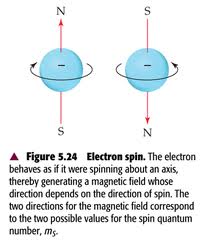
Spin describes a particle property of quantum objects like electrons — in the same waycolor or roundness describe tennis balls. The property is confusing, because no one believes electrons (or any other quantum objects) actually spin. The math of spin is underpinned by the complex-mathematics of spinors, which transform spin arrows into multi-dimensional objects not easy to visualize or illustrate. Look for an explanation of how spin is observed in the laboratory later in the essay. Click links for more insight.
Now, imagine performing a test for roundness on the balls shot to the right. The test is performed after the black test on the left, but before any signal or light has time to travel to the balls on the right. The balls going right don’t (and can’t) learn what the detector on the left observed. The roundness-detector is set to allow three-fourths of all round tennis balls through.
When round balls on the right are counted, three-eighths of them are passing through the roundness-detector, not three-fourths. Folks might speculate that the roundness-detector is acting on only the half of the balls that passed through the color-detector on the left. And they would be right.
These balls share the same destinies, right? Apparently, the balls on the right learned instantly which of their entangled twins the color-detector on the left allowed to pass through, despite all efforts to prevent it.
So now do the math. One-half (the fraction of the black balls that passed through the left-side color-detector) multiplied by three-fourths (the fraction calibrated to pass through the right-side roundness-detector) equals three-eighths. That’s what is seen on the right — three-eighths of the round, black tennis balls pass through the right-side roundness-detector during this fictionalized and simplified experiment.
Polarization is a term used to describe a wave property of quantum objects like photons. Polarizing filters are rotated in experiments to determine some of the properties of atomic particles, like spin.
According to Bell’s Inequality, twice as many balls should pass through the right-side detector (three-fourths instead of three-eighths). Under the rules of classical physics (which includes relativity), communication between particles cannot exceed the speed of light.
There is no way the balls on the right can know if their entangled twins made it through the color detector on the left. The experiment is set up so that the right-side balls do not have time to receive a signal from the left-side. The same limitation applies to the detectors.
The question scientists have asked is: how can these balls (quantum particles) — separated by large distances — know and react instantaneously to what is happening to their entangled twins? What about the speed limit of light? Instantaneous exchange of information is not possible, according to Einstein.
The French quantum physicist, Alain Aspect, suggested his way of thinking about it in the science journal, Nature (March 19, 1999).
He wrote: The experimental violation of Bell’s inequalities confirms that a pair of entangled photons separated by hundreds of meters must be considered a single non-separable object — it is impossible to assign local physical reality to each photon.
Of course, the single non-separable object can’t have a length of hundreds of meters, either. It must have zero length for instantaneous communication between its endpoints. But it is well established by the distant separation of detectors in experiments done in labs around the world that the length of this non-separable quantum object can be arbitrarily long; it can span the universe.
When calculating experimental results, it’s as if a dimension (in this case, distance or length) has gone missing. It’s eerily similar to the holographic effect of a black hole where the three-dimensional information that lives inside the event-horizon is carried on its two-dimensional surface. (See the technical comment included at the end of the essay.)
Here is a drawing of an apparatus the French physicist, Alain Aspect, designed to quickly change the angle of polarity-measurements for emitted photons. In experiments, he used the logic of Bell’s Inequalities and the speed of his switches to show that it was not possible for photons to carry specific (or unique) polarity-angles until after they were measured by the polarization detectors. Once measured, Alain showed that the new, narrowly defined polarity states of his photons always propagated to their distant entangled twins, instantly.
Another way physicists have wrestled with the violations of Bell’s Inequality is by postulating the concept of superposition. Superposition is a concept that flows naturally from the linear algebra used to do the calculations, which suggests that quantum particles exist in all their possible states and locations at the same time until they are measured.
Measurement forces wave-particles to “collapse” into one particular state, like a definite position. But some physicists, like Roger Penrose, have asked: how do all the super-positioned particles and states that weren’t measured know instantaneously to disappear?
Superposition, a fundamental principle of quantum mechanics, has become yet another topic physicists puzzle over. They agree on the math of superposition and the wave-particle collapse during measurement but don’t agree on what a measurement is or the nature of the underlying reality. Many, like Richard Feynman, believe the underlying reality is probably unknowable.
Quantum behavior is non-intuitive and mysterious. It violates the traditional ideas of what makes sense. As soon as certainty is established for one measurement, other measurements, made earlier, become uncertain.
It’s like a game of whack-a-mole. The location of the mole whacked with a mallet becomes certain as soon as it is struck, but the other moles scurry away only to pop up and down in random holes so fast that no one is sure where or when they really are.
Physicists have yet to explain the many quantum phenomena encountered in their labs except to throw-up their hands to say — paraphrasing Feynman — it is the way it is, and the way it is, well, the experiments make it obvious.
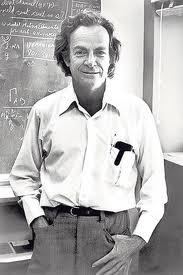
Richard Feynman (1918-1988) downplayed Bell’s Inequality because, he said, it simply pointed out what was already obvious from experiments.
But it’s not obvious, at least not to me and, apparently, many others more knowledgeable than myself. Violations of Bell’s Inequality confound people’s understanding of quantum mechanics and the world in which it lives. A consequence has been that at least a few scientists seem ready to believe that one, perhaps two, or maybe all four, of the following statements are false:
1) logic is reliable and enables clear thinking about all physical phenomenon;
4) a model can be imagined to explain quantum phenomenon.
I feel wonder whenever the idea sinks into my mind that at least one of these four seemingly self-evident and presumably true statements could be false — possibly all four — because repeated quantum experiments suggest they must be. Why isn’t more said about it on TV and radio?
Some scientists think non-physicists cannot grasp quantum mechanics. This little girl disagrees.
The reason could be that the terrain of quantum physics is unfamiliar territory for a lot of folks. Unless one is a graduate student in physics — well, many scientists don’t think non-physicists can even grasp the concepts. They might be right.
So, a lot is being said, all right, but it’s being said behind the closed doors of physics labs around the world. It is being written about in opaque professional journals with expensive subscription fees.
The subtleties of quantum theory don’t seem to suit the aesthetics of contemporary public media, so little information gets shared with ordinary people. Despite the efforts of enthusiastic scientists — like Brian Cox, Sean M. Carroll, Neil deGrasse Tyson and Brian Greene — to serve up tasty, digestible, bite-size chunks of quantum mechanics to the public, viewer ratings sometimes fall flat.
When physicists say something strange is happening in quantum experiments that can’t be explained by traditional methods, doesn’t it deserve people’s attention? Doesn’t everyone want to try to understand what is going on and strive for insights? I’m not a physicist and never will be, but I want to know.
Even me — a mere science-hobbyist who designed machinery back in the day — wants to know. I want to understand. What is it that will make sense of the universe and the quantum realm in which it rests? It seems, sometimes, that a satisfying answer is always just outside my grasp.
Here is a concise statement of Bell’s Theorem from the article in Wikipedia — modified to make it easier to understand: No physical theory about the nature of quantum particles which ignores instantaneous action-at-a-distance can ever reproduce all the predictions about quantum behavior discovered in experiments.
Familiarity with concepts like wave polarization and particle-spin can help demystify some aspects of quantum mechanics. One aspect that can’t be demystified: in experiments quantum objects display the properties of both waves and particles.
To understand the experiments that led to the unsettling knowledge that quantum mechanics — as useful and predictive as it is — does indeed violate Bell’s proven Inequality, it is helpful not only to have a solid background in mathematics but also to understand ideas involving the polarization of light and — when applied to quantum objects like electrons and other sub-atomic particles — the idea of spin. Taken together, these concepts are somewhat analogous to the properties of color and roundness in the imaginary experiment described above.
This essay is probably not the best place to explain wave polarization and particle spin, because the explanation takes up space, and I don’t understand the concepts all that well, anyway. (No one does.)
But, basically, it’s like this: if a beam of electrons, for example, is split into two and then recombined on a display screen, an interference pattern presents itself. If one of the beams was first passed through a polarizer, and if experimenters then rotate the polarizer a full turn (that is, 360°), the interference pattern on the screen will reverse itself. If the polarizer-filter is rotated another full turn, the interference pattern will reverse again to what it was at the start of the experiment.
So, it takes two spins of the polarizer-filter to get back the original interference pattern on the display screen — which means the electrons themselves must have an intrinsic “one-half” spin. All so-called matter particles like electrons, protons, and neutrons (called fermions)have one-half spin.
Yes, it’s weird. Anyway, people can read-up on the latest ideas by clicking this link. It’s fun. For people familiar with QM (quantum mechanics), a technical note is included in the comments section below.
Otherwise, my analogy is useful enough, probably. In actual experiments, physicists measure more than two properties, I’m told. Most common are angular momentum vectors, which are called spin orientations. Think of these properties as color, shape, and hardness to make them seem more familiar — as long as no one forgets that each quality is binary; color is white or black; shape is round or square; hardness is soft or hard.
Crystals can be used to “down-convert” photons into entangled pairs.
Spin orientations are binary too — the vectors point in one of two possible directions. It should be remembered that each entangled particle in a pair of fermions always has at least one property that measures opposite to that of its entangled partner.
The earlier analogy might be improved by imagining pairs of entangled tennis balls where one ball is black, the other white; one is round, the other square; add a third quality where one ball is hard, the other soft. Most important, the shape and color and hardness of the balls are imparted by the detectors themselves during measurement, not before.
Before measurement, concepts like color or shape (or spin or polarity) can have no meaning; the balls carry every possible color and shape (and hardness) but don’t take on and display any of these qualities until a measurement is made. Experimental verification of these realities keep some quantum physicists awake at night wondering, they say.
Anyway, my earlier, simpler analogy gets the main ideas across, hopefully. And a couple of the nuances of entanglement can be found within it. I’ve added an easy to understand description of Bell’s Inequality and what it means to the end of the essay.
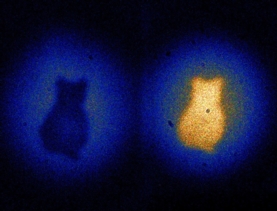
This cardboard cut-out of a cat was imaged by entangled photons. Lower energy photons interacted with the cut-out while their higher energy entangled twins interacted with the camera to create the picture. Credit: Gabriela Barreto Lemos
In the meantime, scientists at the Austrian Academy of Sciences in Vienna recently demonstrated that entanglement can be used as a tool to photograph delicate objects that would otherwise be disturbed or damaged by high energy photons (light). They entangled photons of different energies (different colors).
They took photographs of objects using low energy photons but sent their higher energy entangled twins to the camera where their higher energies enabled them to be recorded. New technologies involving the strange behavior of quantum particles are in development and promise to transform the world in coming decades.
Perhaps entanglement will provide a path to faster-than-light communication, which is necessary to signal distant space-craft in real time. Most scientists say, no, it can’t be done, but ways to engineer around the difficulties are likely to be developed; technology may soon become available to create an illusion of instantaneous communication that is actually useful. Click on the link in this paragraph to learn more.
Non-scientists don’t have to know everything about the individual trees to know they are walking in a quantum forest. One reason for writing this essay is to encourage people to think and wonder about the forest and what it means to live in and experience it.
The truth is, the trees (particles at atomic scales) in the quantum forest seem to violate some of the rules of the forest (classical physics). They have a spooky quality, as Einstein famously put it.
The quantum forest is a spooky place, Einstein said.
Trees that aren’t there when no one is looking suddenly appear when someone is looking. Trees growing in one place seem to be growing in other places no one expected. A tree blows one way in the wind, and someone notices a tree at the other end of the forest — where there is no wind — blowing in the opposite direction. As of right now, no one has offered an explanation that doesn’t seem to lead to paradoxes and contradictions when examined by specialists.
John Stewart Bell proved that trees in the quantum forest violate laws of nature and logic. It makes me wonder whether anyone will ever know anything at all they can fully trust about fundamental, underlying essence of reality.
Some scientists, like Henry Stapp (now retired), have proposed that brains enable processes like choice and experiences like consciousness through the mechanism of quantum interactions. Stuart Hameroff and Roger Penrose have proposed a quantum mechanism for consciousness they call Orch Or.
Others, like Wolfgang Pauli and C. G. Jung, have gone further — asking, when they were alive, if the non-causal coordination of some process resembling what is today called entanglement might provide an explanation for the seeming synchronicity of some psychic processes — an arena of inquiry a few governments are rumored to have incorporated (to great effect) into their intelligence gathering tool kits.
In a future essay I hope to speculate about how quantum processes like entanglement might or might not influence human thought, intuition, and consciousness.
Billy Lee
P.S. A simplified version of Bell’s Inequality might say that for things described by traits A, B, and C, it is always true that A, not B; plus B, not C; is greater than or equal to: A, not C.
When applied to a room full of people, the inequality might read as follows: tall, not male; plus male, not blonde; is greater than or equal to: tall, not blonde.
Said more simply: tall females and dark haired men will always number more than or equal to the number of tall people with dark hair.
People have tried every collection of traits and quantities imaginable. The inequality is always true, never false; except for quantum objects.
Schrödinger’s Wave Equation describes how the quantum state of a physical system changes with time. It can be used to calculate quantized properties and probability distributions of quantum objects.
One way to think about it: all the ”not” quantities are, in some sense, uncertain in quantum experiments, which wrecks the inequality. That is to say, as soon as ”A” is measured (for example) ,”not B” becomes uncertain. When ”not B” is measured, ”A” becomes uncertain.
The introduction of uncertainties into quantities that were — before measurement — seemingly fixed and certain doesn’t occur in non-quantum collections where individual objects are big enough to make uncertainties not noticeable. The inability to measure both the position and velocity of small things with high precision is called the uncertainty principle and is fundamental to physics. No advancement in the technology of measurement will ever overcome it.
Uncertainty is believed to be an underlying reality of nature. It runs counter to the desire humans have for complete and certain knowledge; it is a thirst that can never be quenched.
But what’s really strange: when working with entangled particles, certainty about one particle implies certainty about its entangled twin; predicted experimental results are precise and never fail.
Stranger still, once entangled quantum particles are measured, the results, though certain, change from those expected by classical theory to those predicted by quantum mechanics. They violate Bell’s Inequality and the common sense of humans about how things should work.
Worse: Bell’s Theorem seems to imply that no one will ever be able to construct a physical model of quantum mechanics to explain the results of quantum experiments. No ”hidden variables” exist which, if anyone knew them, would explain everything.
Another way to say it is this: the underlying reality of quantum mechanics is unknowable. [A technical comment about the mystery of QM is included in the comments section.]
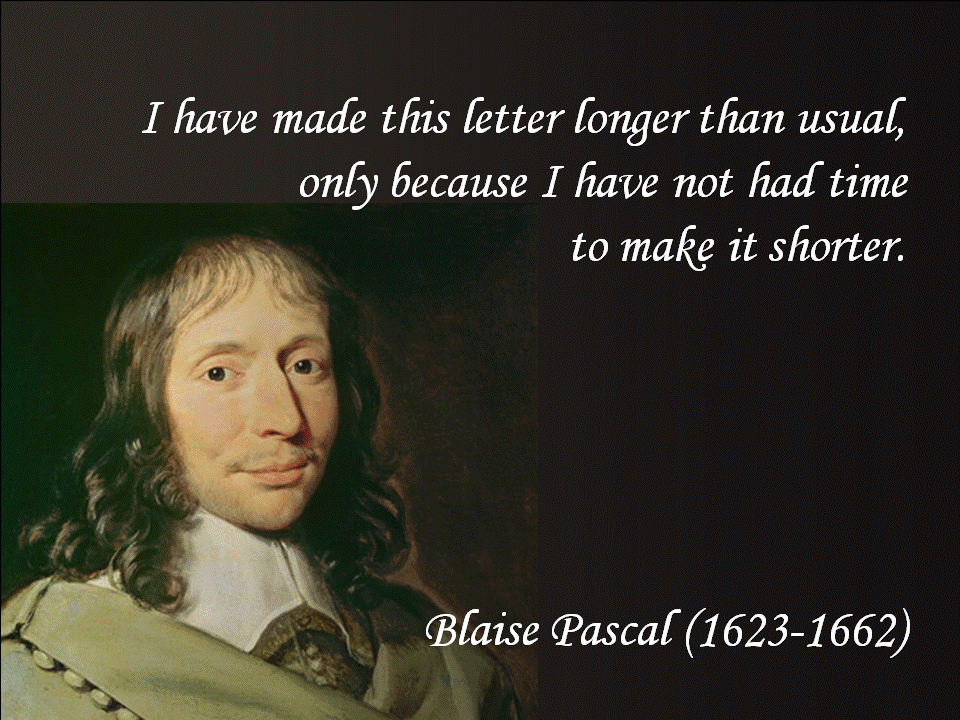
Blaise Pascal was a man who suffered terribly his entire life until he died at age 39 from a metastasized stomach cancer. His mother died when he was 3 years old; his father when he was 28.
For those who aren’t familiar with his life, let me point out that he was French, raised by his sisters, educated by his father, and very involved in the religious controversies of his time (1623-1662). He was an inventor and mathematician of the highest order. His sufferings — his physical ailments and psychological agonies — are legendary.
I won’t burden people with the details of his life — historians and biographers have written many books to help folks understand this tragic man, if anyone is interested. What I want to do is share, in English, some of the clever things he wrote during his short life and provide a link to his books, if anyone is interested in reading further.
Most of the quotations in this essay were first published some years after his death, gleaned from scraps of paper found among his personal belongings. Had they been published during his lifetime, he might have become even more controversial than he actually was. The added stress of additional criticism from contemporaries might have shortened his life even more.
Blaise Pascal had what modern people would call a negative attitude toward groups like the Jesuits and possibly the Catholic Church, which declared five tenets of his Calvinist-style religious order, the Jansenists, heresy when he was 30 years old and still grieving for his lost father. But mostly, he had a negative attitude toward other people and himself, all of whom he considered to be hopelessly wicked.
Sensitive individuals who suffer like Pascal did, it seems to me, find it more natural than others who live easier lives to think that the world is a hostile place populated by selfish and uncaring people in need of a savior.
Pascal is reported to have said, Sickness is the natural state of Christians. He spoke his dying words in a moment of sublime clarity amid a chaos of physical suffering. He whispered helplessly, May God never abandon me.
Pascal solved several previously intractable problems associated with cycloids.
Below are some samples of Pascal’s thoughts, which I found interesting and a little sad when first I read them many years ago. His ”pensees” seem to be his way of making sense of a world that held no comfortable place for him to lay his head; a world devoid of a mother’s touch to reassure him; a world lacking the medicines and psychological insights he needed to find the peace, freedom from pain, and the joy for living so many of us in the modern world freely pursue.
Blaise Pascal was oppressed by the heightened discernment of a brilliant mind smothered by relentless suffering. His intelligence (contemporaries called him a prodigy) enabled this sensitive man to articulate his suffering through the lens of Christian philosophy, which he adopted as his own.
Here are some of his thoughts:
Myself at twenty is no longer me.
Christian piety destroys the self. Human civility conceals and suppresses it.
It is a bad sign when someone is seen producing outward results as soon as he is converted.
Sleep, you say, is the image of death; for my part I say that it is rather the image of life.
We are standing on sand; the earth will be dissolved, and we will fall as we look up at the heavens.
Life is nothing but a perpetual illusion; there is nothing but mutual deception and flattery. No one talks about us in our presence as he would in our absence.
Man is nothing but disguise, falsehood and hypocrisy…. He does not want to be told the truth.
Each rung of fortune’s ladder which brings us up in the world takes us further from the truth, because people are more wary of offending those whose friendship is most useful and enmity most dangerous. A prince can be the laughing-stock of Europe and the only one to know nothing about it.
Is it not true that we hate the truth and those who tell it to us, and we want them to be deceived to our advantage, and want to be esteemed by them as other than we actually are?
It is no doubt an evil to be full of faults, but it is a still greater evil to be full of them and unwilling to recognize them, since this entails the further evil of deliberate self-delusion.
The most unreasonable things in the world become the most reasonable because men are so unbalanced. What could be less reasonable than to choose a ruler of a state the eldest son of a queen?
When we have heard only one side, we are always biased in its favor.
To the church: There is no need to be a theologian to see that their only heresy lies in the fact that they oppose you.
It is false zeal to preserve truth at the expense of charity.
Humiliations dispose us to be humble.
It is better not to fast and feel humiliated by it than to fast and be self-satisfied.
God can bring good out of evil, but without God we bring evil out of good.
God will create an inwardly pure Church, to confound…the inward impiety of the proud Pharisees. …. For, although they are not accepted by God, whom they cannot deceive, they are accepted by men, whom they do deceive.
We all act like God in passing judgments.
Do small things as if they were great, because of the majesty of Christ, who does them in us and lives our life; and great things as if they were small and easy, because of his almighty power.
They do both good works and bad to please the world and show that they are not wholly Christ’s, for they are ashamed to be.
Jesus was abandoned to face the wrath of God alone. Jesus is alone on earth, not merely with no one to feel and share his agony, but with no one even to know of it.
Silence is the worst form of persecution.
No one is allowed to write well anymore.
You brand my slightest deceptions as atrocious, while excusing them in yourselves as the [(way of your church)].
Would God have created the world in order to damn it? Would he ask so much of such feeble people?
Persecution is the clearest sign of piety.
Which is harder, to be born or to rise again? That what has never been should be, or that what has been should be once more?
All faith rests on miracles.
How happy I should be if…someone took pity on my foolishness, and was kind enough to save me from it in spite of myself.
We must make no mistake about ourselves: we are as much automaton as mind.
You would soon have faith if you gave up a life of pleasure.
We never do evil so fully and cheerfully as when we do it out of conscience.
The proper function of power is to protect.
If everyone knew what others said about him, there would not be four friends in the world.
Fear not, provided you are afraid, but if you are not afraid, be fearful.
God hides himself. He has left men to their blindness, from which they can escape only through Jesus Christ.
I marvel at the boldness with which these people presume to speak of God.
It is an appalling thing to feel all one possesses drain away.
Who has more cause to fear hell, someone who does not know whether there is a hell, but is certain to be damned if there is, or someone who is completely convinced that there is a hell, and hopes to be saved if there is?
Truth is so obscure nowadays and untruth so well established that unless we love the truth we shall never recognize it.
“Yet I have left me seven thousand.” I love these worshippers who are unknown to the world, and even to the prophets.
We never love anyone, only their qualities.
Must one kill to destroy evildoers? That is making two evildoers in place of one. Overcome evil with good.
We are nothing but lies, duplicity, contradiction, and we hide and disguise ourselves from ourselves.
As I write down my thought it sometimes escapes me, but that reminds me of my weakness, which I am always forgetting….
Man’s sensitivity to little things and insensitivity to the greatest things are marks of a strange disorder.
It is a fearful blindness to lead an evil life while believing in God.
Pascal’s death mask.
That’s enough for now.
Blaise, I pray you have found the happiness in Heaven that eluded you on Earth.
Bevy Mae and me are coffee drinkers. Bevy used to drink a dozen cups of fully caffeinated coffee everyday. By her third cup she could boogie with the best of them. But that was a long time ago, before we got old. Now she drinks about two cups, and it’s decaffeinated. Me, on the other hand, well, I still imbibe the high-octane stuff. I love it.
I drink the high-octane stuff.
If your marriage is anything like ours, you probably own one coffee-maker, but you and your spouse drink different brands, flavors or styles of coffee. For us it means we have to store the contents of at least one of our coffee-pots off-site away from the coffee-maker in containers and carafes; perhaps cups or bowls or glasses or whatever is handy. The coffee gets cold.
My wife and I have one coffee maker between us. It’s not enough.
Only one of us at a time can store coffee in the coffee-pot. But since we have two microwave-ovens, we don’t really need to keep our coffee hot. We can turn off the coffee-maker after we brew each pot to save energy. Everyday we reheat our coffees in the microwaves more than once; thanks to having two of them we don’t wait in line.
Two microwaves: they can sometimes save a marriage.
Bevy Mae and I have an eclectic collection of coffee mugs gathered together over decades of marriage. I’ve often wondered: how is it that no matter how big the coffee cup or how tiny; how robust the mug or how dainty; how full or empty we fill — or even which microwave we choose — my wife and I almost never set the timer to reheat our coffee more than once?
We always seem to set the microwave to exactly the right number of minutes and seconds to heat our coffee to exactly the right temperature.
She got the calculation right.
Think about it. Can there be any doubt that the mathematics required to accurately set the timer must be beyond the capabilities of 99% of the people who set these timers to reheat their coffee everyday?
The size of the cup, its thickness and material; the amount of coffee in the cup — these are important variables that are required to be taken into account when setting the timer. Not only these variables, but there is the subjective calculation: how hot do I want this coffee to be today? Real hot? Tepid? Mildly warm?
There are many tricky variables to track and put into an equation. And, if we are reheating coffee for our significant others, we have to anticipate their calculation of what the best temperature is for their mood and state of mind.
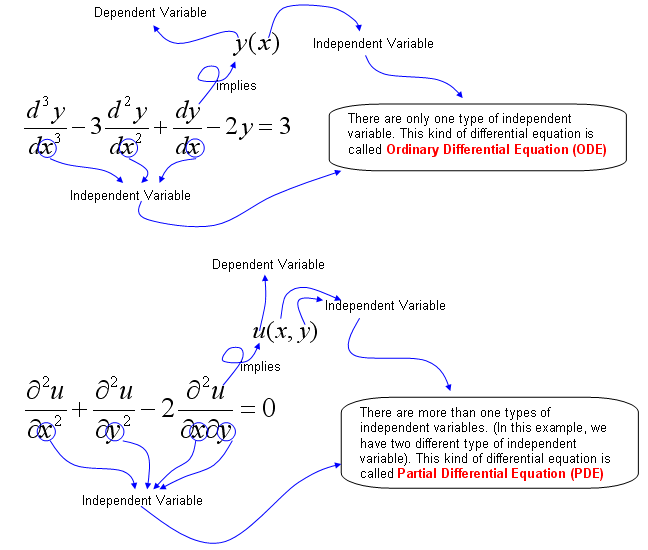
It takes a matrix of differential and difference equations plus a super computer to get microwave coffee right.
It really takes a sophisticated matrix populated with complex differential and difference equations to work out what the results might be under all the possible scenarios. And it might require a government super-computer to crunch the numbers.
Of course, I’ve never done the actual work of creating the matrix — or the equations. Even if I had, I would have faced the daunting task of isolating all the relevant variables, the tedium of tracking all the units to make sure I ended up with secondsonly in the answer, and the exhaustive testing of results to see if they match up with my expectations and experience.
Successful creation and application of a workable calculus might involve a lot of tweaking.
He didn’t bother with the calculation.
Come to think of it, why would I do that? Guessing seems to work better and it’s a lot faster. But I wonder. Am I really guessing? Or is my brain, somehow, doing the math in some far away place inside my brain, behind the scenes and beyond my conscious scrutiny?
It’s kind of mysterious, being right all the time, about something as complicated as getting the number of minutes and seconds correct when setting the timer to reheat coffee.
And my wife, who knows no math, is as good at the mental calculation as me. Go figure.
Billy Lee
P.S. Note to readers: On Valentines Day, 2015, Billy Lee bought a second coffee-maker for his wife, Bevy Mae. Why it took Billy Lee so long to solve his coffee-problem is a mystery even skilled mathematicians can’t solve. The Editorial Board.
Don’t try these calculations at home. Seriously. This man tried; his face froze — for. two. hours.
The visible universe is big. Most scientists believe the invisible universe — the universe no one can see — is really big.
If the Universe shrunk down to where Earth became the size of a period at the end of a sentence, how big would it be?
When I was a kid, questions like this one fascinated me; what harm is there to revisit a few?
About 100 dots the size of the period at the end of this sentence must be strung together to make an inch. We can imagine shrinking Earth to the size of one of these dots, then plugging-in the numbers to calculate the scale of everything else. It turns out that the observable universe shrinks to a diameter of about two light years.
Since a light year is nearly six-trillion miles, the universe is fantastically big. At this reduced scale, the size of the universe remains pretty much incomprehensible.
In this pic, the Sun sits directly behind Saturn, which is backlit by it. Earth is the tiny dot inside the illustrator’s circle to Saturn’s left. Earth is hundreds-of-millions of miles into the page—behind the gas-giant and its rings. Click pic to enlarge in new window.
When Earth becomes a period (or dot), the Sun shrinks to close to an inch in diameter — or 2/3 the diameter of a ping-pong ball. [regulation ping-pong balls are 1.575″ in diameter] The dot-sized Earth orbits 10 feet away. Neptune, the farthest planet, is smaller than a BB — a tiny ball of methane ice almost one football field distant (97 yards).
The distance light travels in a year shrinks to 120 miles — a speed approaching ¼ inch-per-second. The distance to Alpha Centauri, the nearest Sun-like star, shrinks to 500 miles. The star Alpha Centauri shrinks to a ball that is only slightly larger than our under-sized ping-pong ball-sized Sun.
Think about two 1″ diameter ping-pong balls separated by 500 miles. Imagine trying to commute between these balls when the top speed is less than ¼ inch-per-second. Of course, nothing travels at the speed of light. At speeds typical of spacecraft today, it takes 100,000 years to reach Alpha Centauri.
At the scale where Earth is a dot, one might wonder what is the size variation of stars. It turns out that most suns (stars) in the universe range in size from a grapefruit to a pea.
Of course, outliers exist like Deneb, the blue-white supergiant visible in the Summer Triangle. At 203 times the size of the Sun, it shrinks to 17 feet or so in diameter depending on how accurately anyone cares to scale things. Rare super-giants are larger; some are 75 feet or more in diameter at this scale. But in the Milky Way Galaxy, our undersized ping-pong Sun is one of the larger stars.
Is there another way to grasp how large the universe is?
The Milky Way Galaxy — the Sun orbits its center in the space between two of its outermost spiral-arms — is 100,000 light-years across. If the Milky Way was reduced to the dimensions of a coin the size of a quarter, the visible universe (the universe that can be seen with telescopes) would collapse into a sphere of space 15 miles in diameter.
In such a reduced sphere of space, large galaxies become the size of Frisbees but outliers like the mammoth IC1101 are the size of truck tires. The smallest galaxies shrivel into mere grains of sand. Distances between galaxies diminish to 100 feet or so but variations are huge because galaxies tend to cluster together to form groups, which are separated from one another by vast distances.
At this scale, astrophysicists say that the presence of galaxies that cannot be seen (because the distances between our Milky Way Galaxy and the farthest-away galaxies recede faster than the speed-of-light) makes the entire universe, visible and beyond, a minimum of 50 miles in diameter. Light, believe it or not, stands still at this scale. No human observer during their lifetime would notice any movement at all of light or any other phenomenon.
Even the faster-than-light expansion of the universe would be unobservable.
According to physicist, Stephen Hawking, it takes a billion years for the universe to expand by 10%. Five miles (10% of 50) during a period of one billion years is 7 billionths-of-an-inch per day. During a human lifetime the expansion adds to 2 thousandths-of-an-inch (.002″) — less than half the width of a strand of hair.
At the scale where the Milky Way Galaxy is the size of a quarter, the entire universe would appear to be frozen solid during the span of a human lifetime.
Artist’s view of water molecules. Molecules are the smallest structures that can be directly observed (with the help of special sensing instruments and computer generated enhancements). Molecules are the building blocks of all things.
What about tiny things?
To examine the scale of the very small we can imagine enlarging molecules, the building blocks of all things, to the size of the same period-sized dots.
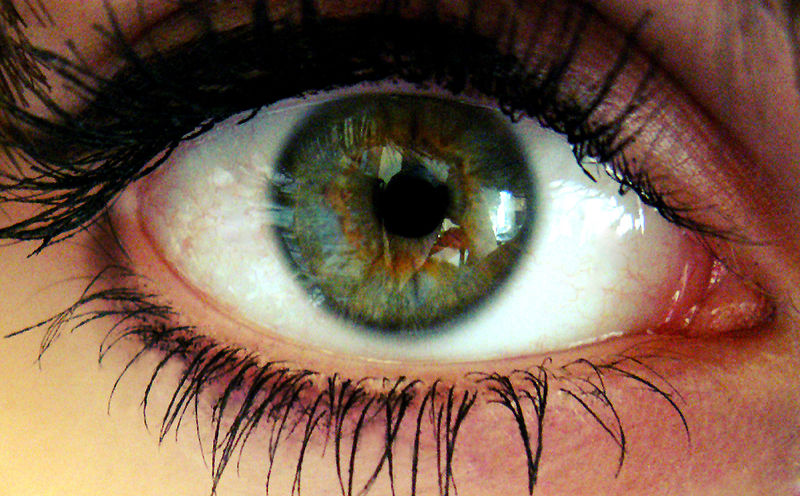
How tall might an average person be? After again plugging in the numbers and calculating, it turns out that a human stretches to a height of 1,000 miles. The eye expands to an orb 15 miles across.
Molecules are small. But at this imagined scale — a scale that requires sophisticated instruments to discern — individual molecules become visible. They grow to look like little dots separated by distances only a bit larger than the dots themselves. Sadly, no one can see the individual atoms that make up the molecules. Even at this enlarged scale, they are too small.
No instruments or microscopes can be constructed to enable anyone to “see” atoms. Physicists believe atoms are real because they see the evidence left behind as their debris moves through the detection mediums of cyclotrons, colliders, and other sensors.
Since 1981 physicists have used scanning tunneling microscopes (STMs) to “feel” the forces of atoms with “nano” probes. A computer algorithm plots the forces and creates pictures of atoms, which with this method look like stacked billiard balls.
Billiard balls is not what quantum objects “look” like because quantum objects can’t be seen using human vision but at least scientists can prove that lumps of energy exist and are arranged in patterns that can be analyzed. It’s a start. It’s something.
Models of atoms studied in science class at universities around the world are contrived to help make sense of the results of many experiments. They are somewhat fanciful.
As for living cells — the basic building blocks of all biology — people are able to observe them under magnification because every cell is built-up from many billions of molecules. Some human cells have trillions. The size of a typical cell at the scale where molecules are expanded to about the size of three-dimensional dots is about 60 feet across.
Artist’s large scale view of the universe.
The gulf between the very large and the very small strains credulity but science says it’s real. When thinking about it, I am overcome by wonder and despair of not knowing why or how.
Theoretical physicist Nima Arkani-Hamed has said that the gulf between the very large and the very small is required to balance the force of gravity against electrical forces in celestial objects like planets. He has pointed out that the ratio of the surface area of a typical atom and the surface area of a typical planet mirrors the difference between the two forces.
Nima Arkani-Hamed, one of the world’s top theoretical physicists, makes a point.
The huge difference between the force of gravity and the force of electricity makes the gap between the very large and the very small essential in a universe that works like ours; the difference in scale is necessary and inevitable, Nima has said.
If the ratio moves too far from this balance — if the surface area of an object gets too big — gravity will overwhelm the electrical forces that hold the atoms apart to cause the object to light up from a process called fusion, which can leave behind a shining star. A much larger object will collapse to become a black hole.
Why is the gap between the force of gravity and the electrical force as vast as the difference in surface area between a typical planet and a hydrogen atom? How did the ratio get that way?
No one knows. The values of the forces seem as finely tuned as they are arbitrary. Nima Arkani-Hamed and others are working to understand why.
Another mystery: Why is the universe so big?
Even Nima Arkani-Hamed admits he doesn’t have the answer — not yet, anyway. Perhaps the answer lies in the geometry of spheres, which is the basis of the Billy Lee Conjecture discussed in the essay Conscious Life.
Speaking of spheres, everyone knows that billiard balls are polished smooth, right? Earth, after being shrunk to the size of a pool ball, is smoother and less blemished; more perfectly round. Exhale on a pool-ball to create a mist that is 10 times deeper at scale than the deepest ocean on Earth.
Do the math.
It’s true.
As a child my nightmare was of an enormous whale crushing a tiny flower. A psychologist told me that the whale was a parent; I was the flower.
Maybe.
But the universe captures my nightmare. It’s really big, and I am so very small — helpless, lost, and crushed within its vast expanse.
Sensing involves seeing, hearing, feeling, smelling, and tasting, right? It’s the traditional five senses that most folks learned about in elementary school a long time ago.
Scientists added complexity to the number and capabilities of the senses in modern times to include “modalities” like sense of place, pain, balance, temperature, vibration, and awareness of chemical concentrations — like salt and carbon dioxide— inside the body.
All this complexity pushes readers into deep weeds, which I am going to avoid in this essay. It will work just as well not to needlessly bewilder people.
Never mind that certain life forms like birds can sense the earth’s magnetic field, or that sharks can sense the electrical activity in living prey. Many ways of sensing the universe are possible. This essay deals with those most familiar to humans.
Until humans developed the technologies of modern science, sensing (and making sense of what was sensed through the mental process of reasoning) was how people formed ideas about what the universe is. But there was a big problem.
Senses told us the sun looked yellow, thunder sounded loud, rocks felt hard, roses smelled sweet, and almonds tasted bitter.
The problem should now be obvious.
These qualities don’t exist in the universe. They are hallucinations of brains created when organs like the eye, ear, skin, nose, and tongue interact with elements of the universe which, in themselves, share none of these qualities.
Qualities like these don’t exist in the physical universe. They are hallucinations of living brains.
These hallucinations are inaccessible to all but the living organism who experiences them. They are unique and not detectable by others, in this sense: people can ask others if they see the same yellow color they see. When they say yes, they can decide to take them at their word, or not.
It is not possible to prove that they are telling the truth. In fact it’s not possible for anyone to answer truthfully, because no one can know how anyone but themself experiences the color yellow.
The interaction of sense organs, like eyes, with electromagnetic radiation is selective. Only a limited range of frequencies will stimulate the retina of the eye, for example, to emit the necessary electric and chemical messaging the brain uses to construct the hallucination called vision.
Some of the radiation falling into the eye does not interact with any sensing organ and remains undetected. In fact, the human eye can detect only wavelengths of light between 15 and 35 millionths of an inch long (400 to 900 nanometers).
Note to the non-technical :A nanometer is a billionth of a meter, which is written as a decimal point followed by eight zeroes and a one — i.e. .000000001. In engineering shorthand it’s written as 1E-9 meters. Humans see wavelengths of light that are 400 to 900 times longer. Scientists and engineers usually work in meters, not inches. The Editorial Board.
This narrow range is transformed by structures in the retina into messaging the brain can use. Wavelengths up to a thousand times longer (one thirty-second of an inch) are able to be felt as heat.
To the rest of the light spectrum, humans are completely blind. This spectrum includes light with wavelengths as long as sixty miles (called radio waves) down to wavelengths of light called gamma rays, which are many millions of times smaller than the wavelength of violet, the shortest wavelength human eyes can detect.
One reason people (and other life) see and feel a limited range of frequencies is because the energy of the sun that is able to penetrate Earth’s atmosphere to reach its surface lies in this limited band. The rest is blocked.
Of the sun’s energy that is able to reach Earth’s surface, 43% is in the narrow visible spectrum people can see. 49% is in the form of heat, which can be felt. Ultra-violet light — which some insects see — makes up 7%. Life on Earth evolved to sense light at wavelengths able to reach its surface.
The other parts of the light spectrum — like X-ray and gamma light — are deflected or absorbed by the nitrogen and oxygen in the atmosphere. Only 1% of the sun’s energy that manages to reach Earth’s surface lies in these high frequency bands.
A great deal of the light that reaches Earth from outside the solar system falls into the range of low-energy radio frequencies to which all Earth-life is completely blind. Radio-frequency light-waves are long and fuzzy. The sun produces mostly higher frequency light. Radio-waves seem to be unnecessary to the survival of life on Earth.
An ability to sense radio waves makes no impact on living things; it provides no survival advantages. Yes, on Earth intelligent life-forms (i.e. humans) have learned to amplify and convert radio light into sound to communicate and entertain themselves over large distances.
Scientists continue to search for evidence that far away life, should it exist, might share the same aptitude for communication. So far, the search has found nothing — no evidence for any kind of life whatever.
The image of light formed by the mind is fantastic — which means it is useful to the organism that sees the image, but the image doesn’t contain many (or any) clues about the external physical phenomenon that triggered its creation.
There is nothing even remotely similar between the color yellow (or any other color) and the electromagnetic radiation that oscillates trillions of times per second to ignite the mechanisms of vision.
There is nothing even remotely similar between the color yellow (or any other color) and electromagnetic radiation oscillating trillions of times per second.
The hard solid feeling of rock has nothing in common with the silicon atoms from which rock is made and whose nuclei are separated from one another by spaces many thousands of times their size. Nor does it have anything in common with the hundreds of different molecules which make up the nearby skin and nerve cells — themselves many millions of times larger than silicon atoms and separated from them by large distances.
The feeling of hard solid and the color yellow exist in my mind. I am sure of it. But can I find, for example, the color yellow in your mind?
The answer is no. A brain surgeon might probe a part of someone’s brain, and they report seeing yellow. But if she examines the area of the probe, she has no chance of discovering the color yellow. She will never find it.
My experience with the color yellow is subjective. If you tell me you also experience yellow, I believe you, because you are like me, and it seems reasonable that we will experience things in the same way.
But if you were asked to prove you see yellow the way I see it, you couldn’t do it.
Not only colors, but sounds, feelings, smells and tastes will vanish without a trace once life is gone. So again, the question: What, exactly, is the Universe?
If life disappears from the universe it will take the color yellow with it. Only the electromagnetic radiation that triggered the hallucination of the color yellow will remain.
Since the radiation can no longer be detected, seen, or experienced by any conscious observer, what is it exactly? Not only colors, but sounds, feelings, smells, and tastes will vanish without a trace once life is gone.
So again, I ask: What exactly is the universe?
Gas Sensor
Let’s “look” at scientific inquiry for the answer. What does science do? Science examines the universe quantitatively and avoids the qualitative and subjective attributes the senses provide. Or it at least tries to.
Science designs detectors to find as much discoverable phenomenon as it can — phenomenon human biological senses can’t discern or aren’t sensitive enough to experience.
But someone has to ask: Aren’t these detectors nothing more than enhanced sensors augmented by gauges and dials to increase the precision of measurement? And don’t living, conscious human-beings use their senses and their brains to make sense of the information the detectors provide? What has anyone gained by science?
The scientist’s tool of choice is mathematics, because it dramatically reduces the fuzziness — the subjectivity — of the senses, and replaces qualities like the color yellow and the feeling hard solid with measurables like oscillations per second and pounds per square inch; that is, with attributes that can be measured by all observers and which, presumably, exist independently of a conscious mind.
Mathematics uses logic and simplified representations of objects and forces to create symbolic models. Certain operations can be performed on these models to reveal non-intuitive relationships among the simplified variables.
Ok… again, have we gained anything? Or does mathematics force a sacrifice of information and detail to simplify understanding? Are we closer to knowing what the universe is, or farther away? Can the best sensors and the most sophisticated mathematics really get humans closer to understanding what the universe is?
One surprise that mathematics has revealed: telescopes and other sensors show that too much gravity is at work in the universe for the amount of matter and energy scientists see. 85% of the matter that must be out there can’t be seen.
More shocking: 95% of the energy and matter that the theory of gravity says must be out there, no one has ever observed. Physicists don’t know what this invisible matter and energy is, or even where it is — though some scientists believe it is evenly distributed throughout the cosmos. They call it dark matter and dark energy.
I don’t want to scare anyone, but the universe is mysterious, and no one understands it. Two questions I’m grappling with:
2 – Is Consciousness powerless to interact with the universe in ways that change it?
Consciousness may exist independently of any individual conscious-being.
These are serious questions.
If the answers to these questions are yes, then consciousness is not necessary for the universe to exist, and the understanding of what the universe really is will probably never be complete — certainly not for humans. Consciousness is something that evolved over billions of years and will someday be missing once again.
The universe won’t notice or care. Conscious life — like humans — can think about the universe all they want. They will never change it. This is the current popular view, is it not?
But the answers to these questions could be no. And it might be possible to prove it.
Consciousness might be something human beings plug into and even share.
If the answers turn out to be no, the implications are profound.
No means the physical universe may have evolved from consciousness, not the other way around.
No means conscious humans may have the ability to completely understand the universe and make sense of it someday.
No means that consciousness may exist independently of any individual conscious-being.
No might mean consciousness is something human beings plug into and even share.
No might mean God exists, and — though our bodies die — we never will.
People seem to think that mathematics is something special — a kind of magic language that when tinkered with properly makes it possible for mortals to unravel mysteries about the universe hitherto known only by God.
I see it differently. Mathematics isn’t a language per se. Although mathematics can be (and is) explained by language, math itself is a collection of rules and symbols that makes it possible to avoid the encumbrances, flourishes, and ambiguities of language. It accomplishes this feat by defining things and their relationships in strictly limited — but important — ways.
Math involves symbols and rules that aren’t explained inside the equations. It is the lackof words that gives math its mysterious and magical reputation. But once everything is defined and understood, applying the contrived but logical rules of mathematics enables folks to manipulate equations to uncover previously hidden and non-intuitive relationships among the things they have defined.
What am I saying exactly? I am saying that it is possible to use words alone to describe the process of solving and manipulating an equation, which can lead to insights into the relationship of the things in the equations. But these words will make the process of computation cumbersome, impractical, and confusing.
Spoken language contains noise and nuances that interfere with the manipulation of carefully defined relationships between narrowly defined variables. Yes, the no-nonsense logic and bare bones precision of mathematics as well as the reduction of things to a few carefully chosen attributes enables mathematicians to apply rules to discover consequences that might otherwise remain undiscovered.
But the tightness of mathematical construction makes it a tool which is almost useless for describing and analyzing many subtle yet vivid experiences of a conscious mind — like beauty, the feel of an orgasm, or the experience of grief. For these realities of conscious experience, mathematics has a reputation for being irrelevant.
Spoken language gives conscious humans the messy modeling mechanism they need to connect with each other to share and understand the more nuanced experiences of life. The messiness and ambiguity of spoken language makes the unique intimacies of human communication possible. Mathematics, despite its elegance, doesn’t do intimacy well.
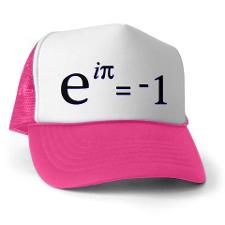
The Euler Identity, illustrated above, is sometimes presented as an example of the mysterious power of mathematics. But if anyone takes the time to think about it, what does the equation say? It says that minus one plus one equals zero.
The explanation is easy. -1can be rewritten as eraised to the power of i times π because of simple rules, which place on a circle of radius 1 all the values of eraised to the ith power times anything.
The number that sits next toi is the angle in radians where the result lies, right? In this case, an angle of π radians (180°) takes the value 1 (at 0°, or 0 radians)to half-way around the circle to the value -1.
Easy… , right?
Despite the reputation of equations for precision, it turns out that physicists and other scientists struggle to make mathematics match the results of real-world measurements. It has to do with the problem of scales, mostly.
The electrical force is a trillion times a trillion times a trillion times greater than the force of gravity at the scale of electrons and protons. At the scale of quarks, it’s one-hundred-thousand times greater still.
It’s one example.
The non-technical public is unaware for the most part that astronomical observations involving the movement of stars, planets, and other celestial bodies — or the results of observations made of the subatomic world (no matter how carefully contrived) — fail as often as not to provide results sufficiently in agreement with mathematics to be of any practical use until they are massaged a little.
Fudge-factors are a big component of doing real science. People have won Nobel prizes for inventing fudge-factor protocols to fix things.
They claim to have good reasons for all the tinkering; it’s complicated down there among the quarks or up there, among the quasars; there are nuances and messiness and ambiguity in the underlying reality of nature that no one can see or fully understand — not now; not anytime soon; perhaps not ever.
At subatomic scales, a tangled mess of virtual particles — which come into and out of existence more or less spontaneously — often gets the blame for the mismatch between mathematical elegance and the cold reality of experimental results.
On the scale of the universe, dark matter and energy (which have yet to be detected or observed) are sometimes blamed for anomalies. Click on the link in this paragraph to learn more.
It’s possible that no system involving mathematics can be contrived by humans to bring the satisfaction of knowing everything for certain; nothing we are able to invent will bring a tranquil end to the pain of cognitive dissonance that seems to drive our species to wonder and explore to find the satisfying answer.
On the other hand, perhaps mathematics is more complex and goes further than we know. Methods may yet be discovered to make mathematics and physics match-up with better accuracy and precision.
Recent work by Cohl Furey and others on numbers known as octonions is showing tantalizing hints that internal properties like the force and charge of particles and their external manifestations like mass and spin are connected in peculiar ways that might be described by a more fully developed mathematics.
Dixon algebra (a combination of four division algebras) is a tool that people are using to collaborate in the search for a path forward. So far, success eludes them. Some experts are hopeful, but many express skepticism.
The more deeply people travel into the complexities of mathematics and science the more elusive truth seems to become; perhaps God is not a mathematician; maybe Einstein was right when he said, God does not play at dice.
A die is cast into the lap, yes, but its decision is from the LORD, according to an old proverb of Solomon.
Can it really be true that understanding the world is beyond the limitations of all life on the earth — beyond the abilities of the most brilliant minds that have lived or ever will live?
Is it possible that the universe cannot be understood by any conscious life anywhere in the universe for all time?