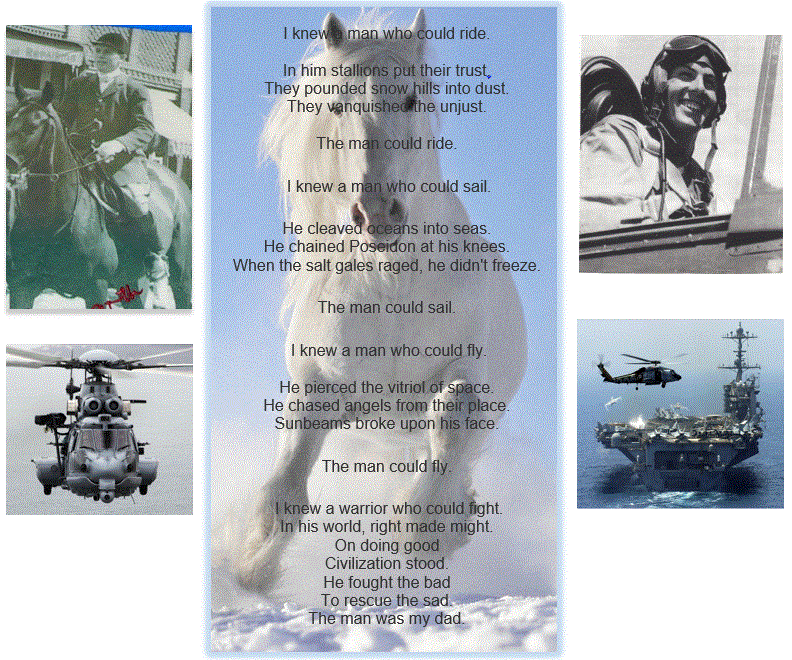
In his world, right made might. On doing good, Civilization stood.
. . . . .
Click pics to enhance text for reading.The Editors
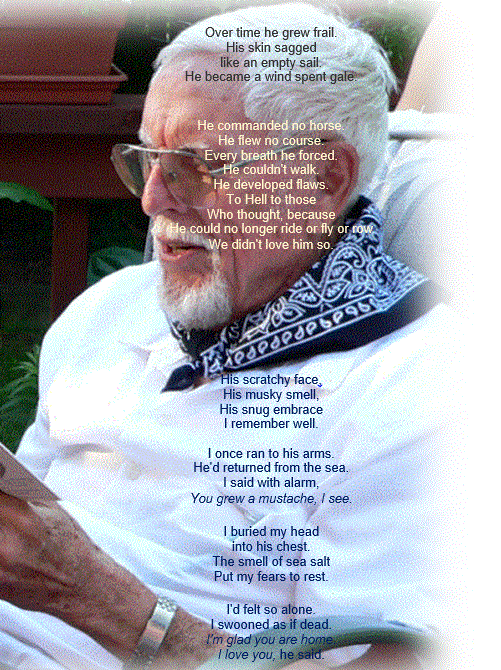
Captain Bryce Lee (USN) on his 85th birthday.Billy Lee read a version of his poem, Warrior, to his father at his party. Bryce never said he liked it. The Billy Lee Editorial Board
Bryce Lee helped stand-up the National Security Agency in the 1950s when the agency helped track atom bomb materials and components loaded aboard foreign ships.
He played a prominent role during the Cuban Missile Crisis when he led an anti-submarine jet-helicopter squadron based near the confrontation.
Because of their sensitive nature, some of the Captain’s accomplishments will never be known outside of government.
Bryce spoke Russian and French. In his mind, integrity was the most important quality a person could have. He did well for a farm boy from Michigan.
Bryce Lee passed peacefully at home with family present a few days before his 91st birthday in 2011.
The Billy Lee Editorial Board
In his world, right made might. On doing good, Civilization stood.
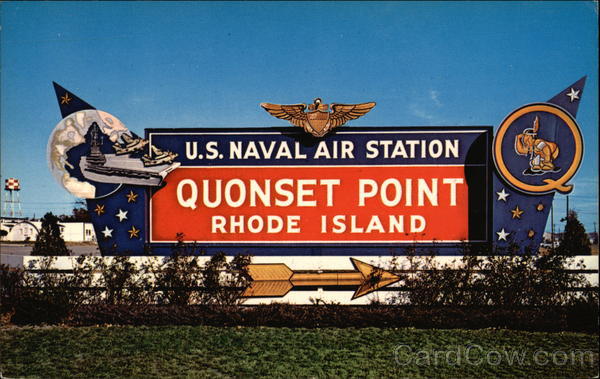
In 1958 when I was a fourth grader our family moved to Quonset Point, Rhode Island where my dad was soon promoted to lead HS-11, one of the Navy jet-helicopter squadrons defending the east coast from attack by Russian submarines.
We moved to Quonset Point with some trepidation because Hoskins Park — the housing project for military families in those days (now sold, redeveloped, and renamed Wickford Point) — had a long waiting list; we didn’t know where we would live or if we could afford off-base housing.
As it turned out, we got a lucky break. A Navy Lieutenant — who was a Negro — moved his family into Hoskins Park. Some white officers found out and decided their families weren’t going to live in non-segregated housing. As a result, vacancies popped-up, and we got in; we moved-in next door to the Negro officer and his family.
In 1958, my family moved to Quonset Point, Rhode Island. Inexpensive on-base housing was overcrowded. We didn’t know where we would live, or if we could afford to live anywhere.
Lieutenant Brown, his wife and two daughters, lived in the two-story, condo-style apartment on the other side of a thin concrete wall from us.
Despite the custom that white and black families didn’t fraternize in those days, eventually I had encounters, conversations, and interactions with all the members of the Brown family.
Over time, I came to understand how traumatized they were, each in their own way, living in a country that, basically, isolated and mistreated them.
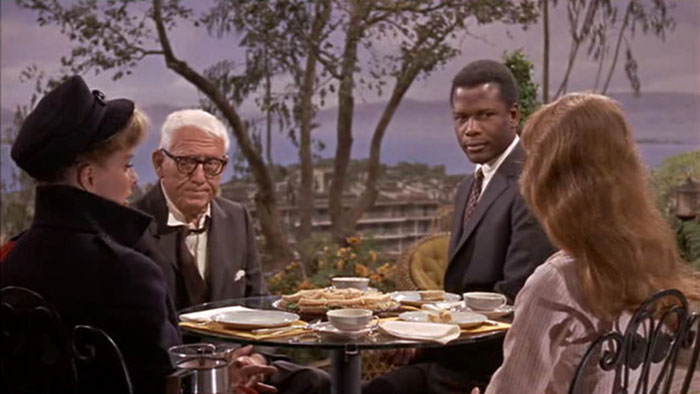
My parents accepted an invitation to the Brown’s for dinner — an event that had all the drama of the movie, Guess Who’s Coming to Dinner, released nine years later, in 1967.
One encounter involved my parents. The Browns invited them for dinner to get acquainted, and after agonizing about it, Mom and Dad accepted. I think Dad wanted to check them out; to make sure his kids would be “safe” living next door.
After the meal, Dad reported that the Lieutenant’s wife, Jean (Alston), was a good cook, but he couldn’t shake a queasy feeling in his stomach, which spoiled his appetite. He had never interacted with negroes, except servants(everyone called black people negroes in the 1950s); he certainly had not eaten food at the same table. And, unlike my dad, Mr. Brown was a graduate of the Naval Academy.
In that sense, the lieutenant kind of outranked him. According to dad, Academy graduates favored one another and worked hard to help each other achieve promotions. They put non-Academy graduates (like dad) to great disadvantage in the competition for rank, which was fierce inside the Navy.
A black Academy graduate presented a dilemma. Brown was a graduate of the elite Naval Academy with all its privileges and protections; at the same time, he belonged to a race that was, to put it politely, undervalued both by the Navy and the country at large. It was unfamiliar terrain for dad and made him uncomfortable. I remember my parents writing a thank-you note to the Brown’s for their hospitality but as far as I know, they didn’t return an invitation.
Another incident occurred a few weeks later that changed the way I thought about people and what they sometimes go through. It happened on a day when my fourth-grade teacher decided to punish me for violation of good-citizenship. I sassed her, she claimed, because I insisted — in a loud voice before classmates — she couldn’t tell me what to do!She wasn’t my parent!
In my mind, it made sense. To show how wrong I was, she kept me after school to clean the blackboard. She forced me to practice my reading. I left school an hour late.
When I arrived home, I saw Billie — Lieutenant Brown’s sixth-grade daughter — standing on her porch a few feet from ours, crying, and shifting back and forth on her feet in a puddle of — I took a second look to be sure — her own pee. I couldn’t believe it; I didn’t know what to say or do. I ran inside our condo to tell mom.
I wish I could say that Mom brought Billie into our place, helped her clean-up, and gave her a secure place to wait until her mom got home with a key. But mother did nothing like that. Instead, she became animated and began to marvel about how such an embarrassing calamity could befall a sweet girl like Billie. I became annoyed. Why didn’t she ask us? I interrupted. We would have let her use our bathroom!
Maybe she was afraid to ask, mom said. Maybe she was afraid we would say, no.
So afraid she let her stomach burst? I yelled.
1957. Daisy Bates tries to enter Central High in Little Rock, Arkansas. President Eisenhower sent the 101st Airborne Division to rescue her and eight other students from angry whites. It was the following year that our family moved to Quonset Point, Rhode Island.
Some weeks after, I stood alone in the playground behind our building when Billie walked up. We didn’t speak but sat down together on the ground to draw pictures in the gray clay beneath us — clay the housing complex we shared was built on.
It didn’t seem right to sit with someone and not talk but I couldn’t think of anything to say. Billie was a couple of years older. We had little in common, it seemed. We concentrated for a while, in silence, on our art.
Then, she looked up. She fixed her eyes on mine. I didn’t look away. I tried to hold her gaze. Finally, she whispered. She said simply, I hate being colored.
I felt the blood drain from my face. Hate was a bad word. We didn’t use the word hate in our family.
To hear Billie whisper, hate, about herself — hate about something she had no control over or responsibility for, which she couldn’t change, wish away, or escape — upended my internal world. In that moment, the ground shifted beneath my feet.
Somehow, hearing her speak those words — and the mental image I had created in my memory of the day she danced in a pool of her own urine — conflated in my mind. As Billie waded ankle-deep in her own bodily fluids, I heard her screaming. I hate being colored!!! I hate it!! I hate it!I hate it.
In my imagination, I took my place beside her. I raged against God and all the earth for making her colored; for allowing white people to be so insensitive, so mean, so un-caring, so ill-tempered, so prejudiced.
—————
Billie’s father supervised a motor-pool near, but outside, the Quonset Point military base. According to friends of my mom, he was some kind of gas-station attendant. One warm day, he saw me playing outside and asked if I wanted to take a ride with him in his new convertible. I said sure.
He said he wanted to show me something. He was in charge of something and wanted to show me what it was. He wanted to show me what he did.At his work.
I thought, this is a crazy request. After all, I didn’t know what my own dad did. He’d never taken me to work or showed me anything having to do with what he was about when he wasn’t home.
So, I climbed into Mr. Brown’s convertible, top down, and off we went. It turned out that he was good at small talk. I listened happily to his resonant voice and enjoyed the sun and warm breezes as we rambled along. We passed through some old guard shacks, a few barbed-wire-topped chain-link fences, and entered an area so remote and wild, it was hard to believe we were still in Rhode Island.
We drove through a dense grove of trees and up onto a hill. Mr. Brown slowed the car and stopped. The sun blazed into the open convertible. Look, he said. He frowned, then nudged my shoulder and pointed. Look down there.
There were more military vehicles under Navy Lieutenant Brown’s command than I imagined there were cars in the entire world. This photo of a military motor-pool in a western state reminds me of what I saw in Rhode Island.
Below us for as far as my eyes could see, in a valley that stretched to the very edge of Earth, sat thousands of green and gray trucks and jeeps; armored personnel carriers and tanks; military vehicles of every stripe and size, all neatly parked in long straight lines. As a naive fourth grader, I found the view hard to take in. There lay spread below us more vehicles than I imagined existed in the entire world.
It was the second time a member of the Brown family stunned me. I was speechless. Then I said, you’re in charge of all of those trucks? Navy Lieutenant Brown smiled, sadly, I thought, then looked at me like Billie had.
I am, he said.
Billy Lee
Editor’s Postscript: This story is grounded in the memories of a fourth grader of events that occurred almost sixty years ago. The make of Mr. Brown’s car and the nature of the installation visited may or may not be accurate.
After writing this article, Billy Lee learned that Mr. Brown, sadly, passed away on May 22, 2012, at age 85 from cancer. After reading old press releases, he discovered that historian Robert J. Schneller had published a book in 2005 about Mr. Brown’s experiences at the Naval Academy called Breaking the Color Barrier. In 1949, it turns out, Midshipman Brown became the school’s first black graduate.
Unknown to Billy Lee, Wesley Brown had become an historical figure. Billy Lee has asked the Editors to add biographical notes to his post.
In 1958, neither Billy Lee nor Mr. Brown’s neighbors knew that the young Naval officer owned the distinction of being the first black midshipman to graduate from the Naval Academy. In the racial climate of the 1950’s, an achievement like Mr. Brown’s would have been seen as the exception that proved the rule: Negroes were inferior. It would have been bad taste in polite society to call attention to Lieutenant Brown’s achievement.
None of Wesley’s neighbors, Billy Lee recalls, had any idea of the hell he went through to become a Naval officer. In any event, white people in 1958 were so blinded by racism that they would have thought, had they known: Wesley’s accomplishment was of no consequence; it was not worth mentioning or even thinking about.
It’s hard to believe now, but white Americans in 1958 didn’t know their country had a race problem.
Wesley Brown was the first black graduate of the Naval Academy. Because no white midshipmen would share a room with him, he lived alone during the four years it took to earn his engineering degree. When classmates blocked his admission to the academy choir, Wesley joined the cross-country track team where future President and upperclassman, Jimmy Carter, befriended him.
Wesley Brown became the first black American to survive the racial hazing at the Naval Academy and graduate. I knew him to be a happy person with a charitable attitude toward all people. He was a kind and gentle neighbor who, during the year of 1958, made me feel good each time I saw or spent time with him.
His wife, Jean (Alston), led our church choir and taught me to sing. We did a television show under her direction. His daughter, Willetta (Billie), transformed my view of the world with a single sentence. I read somewhere that Carol, the youngest daughter, did well in life.
After our families parted ways, Wesley’s family grew to include sons. Eventually, Wesley Brown and Jean divorced; Wesley married Crystal Malone in 1963. He rose to the rank of Lieutenant Commander before retiring in 1969 to pursue other interests.
As my story tells, it was racism in the Navy that made it possible for me to know the Browns. Midshipman Wesley Brown changed America for the better. He suffered to accomplish it, but he kept his pain to himself and his closest friends.
I am proud to say that once, I knew Wesley Brown and he knew me.
People hate me. People have hated on me my whole life, but never more than now, it seems, in my old age, when I need their love so bad. If they only knew how their hatred weakens me and any hope I have for happiness. Maybe they’d relent and welcome me into their friendly world.
But I don’t think so. If they knew how much I hurt, they’d hate me more, shun and isolate me even further, just to watch me suffer.
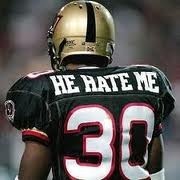
Rod Smart was the leading rusher for the Las Vegas Outlaws of the short-lived XFL. His career took him to both the CFL and NFL, where he played in Super Bowl 38 for the Carolina Panthers. On the last play of the game, with the Panthers trailing 32-29 and only 4 seconds left on the clock, Rod Smart received the New England Patriots kick-off. He was unable to score the game-winning touch-down.
As Torrold DeShaun “Rod” Smart, the would-be NFL star, once said: I feel as if everyone hates me, from my mom to my dad and even my brothers and sisters; everyone ”Hates Me.”
All hope abandon, ye who enter here…
The first time I learned people hate me was at the Army boot-camp for officer-candidates at Fort Benning, Georgia during the summer of 1968. I went there to train after becoming an officer candidate to avoid the military draft during the Vietnam War.
It was a period in our history when the government conscripted hundreds of thousands of young men to fight in Vietnam. Exemptions from the draft (called deferments) had been given to college students for years, but no longer.
Students across the country began competing to get into Army ROTC training programs, because they were the only sure way to stay in school and avoid military service, at least temporarily. At my school, I was one of only eighteen students (out of a pool of several thousand applicants) who qualified for officer training.
I felt lucky, because now I could finish my education. Maybe, by the time of my graduation, the war would be over.
Cadets who enjoyed push-ups (and were good at them) thrived in officer training camp.
At officer boot-camp that summer, in the humid choking heat of Georgia, the training began. The recruits were, like me, the cream of the crop, the best of the best, from some of the finest colleges and universities in the USA and around the world. I’ve not been with smarter, worthier people than those who shared my summer of ’68 at Fort Benning.
We found ourselves trapped in the grasp of some of the most ignorant, mean-spirited drill sergeants I’ve ever encountered. Their mission was to squeeze each recruit through a juice-grinder to see what we were made of and to prove to the military how strong (or how weak) were our minds and bodies.
They cursed us, abused us, deprived us of sleep and dignity, and told us we were over-privileged swamp scum, not worthy of the army. They convinced me they meant every word.
Drill-sergeants ask a young recruit whether he prefers caramel or strawberry syrup on his French soufflé.
In chow-lines, gnarly swamp-people with missing teeth menaced and taunted us by swearing, shoving and pointing fingers. One officer forced recruits to eat their own cigarettes.
During a month-and-a-half of hell, I watched people go beserk on the firing range, collapse with seizures due to excessive heat and lack of water, quit the program, and go mad.
All I thought about during those forty-two days in Hell was this: it can’t last forever. I can survive, I can hold on, I can sleep again with my sweet girl-friend, Mary-Ann, who loves me. All this pain, this agony, will fade to an unpleasant memory, nothing more, in good time.
Studies conducted on young men adept at crawling through mud beneath barbed-wire show that they enjoy the taste of dirt more than cadets who lack this skill.
But, of course, I was naïve. Every dinner has its dessert, its crème-de-la-crème, its grand-finale, its coup-de-grace. Boot-camp was no different.
Two days before the end of training, the Army announced that each cadet in every forty-three-man platoon would participate in mandatory peer-reviews of their fellows. Drill Instructors — armed with notepads and pencils — ordered every officer-candidate to rank every other officer-candidate, from top to bottom.
Worst of all, the DIs forced each cadet to write an explanatory paragraph about each soldier they placed in the bottom-five. I think I remember trying to say something nice about each one of the five I chose.
As it happened, the evening after the peer-review, one of the cadets broke into the administration building and stole the reviews. Word got around, and soon a few dozen cadets, including me, gathered outside the barracks to rummage through them, their summaries and explanatory comments.
I discovered that my fellow cadets ranked me third from the bottom. I couldn’t grasp it, it seemed so unreal, so I read the comments. Apparently, I lost equipment, stole things, went AWOL, and was generally unprepared and unkempt.
I lacked the intelligence required to lead, lacked problem solving skills, etc. etc., on and on. I kept checking the name to see if it was mine. Nothing written about me was true.
This photo, retrieved from the Army Archive, shows Billy Lee on his last day of boot camp. He is the cadet lying on the stretcher, apparently too drunk to walk the quarter-mile to a waiting bus.
It occurred to me that all of it — all the negativity and cruelty; every last hateful condemning word — was going to be part of my permanent record, my profile, which would follow me forever in the army and beyond.
Why, I asked myself over and over, would people who I thought were my friends write nasty, untrue, career-ending things about me? I couldn’t work out the answer.
Officer training camp broke me. I spent the next two days drunk, sobbing silently inside myself. On the last day, while the other cadets scurried to leave, I writhed on the floor by my bunk, unable to pack my things or police my area. Psychological trauma and grief immobilized me. The pain of being hated ruined me. I never recovered.
Billy Lee
Editor’s note:This article has been a fictionalized compilation of actual events, which occurred during two training camps — the first at Fort Benning, Georgia; the second at Fort Riley, Kansas the following summer. The stolen peer-reviews incident occurred at Fort Riley during the summer of 1969.
Incidents in the two camps have been conflated by Billy Lee to make a more comprehensible read. The incidents are true. The order is true. But events happened over consecutive camps — basic training and advanced infantry training the following summer.
P.S. Since writing this article, some people have asked me if, over the years, I might not have garnered some insight into why my ROTC compatriots at Fort Riley rejected me. (At Fort Benning, peer reviews weren’t conducted.)
The answer is yes, but these insights weren’t included in the article, so that readers (who might not know me well) could experience the wonder I felt. In truth, (allow me first to lie; the truth is too painful) I was well-connected and proud. People hate arrogance, and that is what I was. I received special treatment from higher-ups. That, and my attitude, didn’t go over well. (Will you permit me to do some preliminary blame-shifting?)
General Boatwright was two months older than my dad. Like my dad, he was a Warrior who dedicated his life to the defense of the United States of America.
General Boatwright, the base commander at Fort Riley — who knew my dad — gave me an escort on his private plane to camp. I boasted about it. Later, he flew to our bivouac-site with a half dozen helicopters and called me out of formation (as I remember it, with a bull-horn) to interview me in front of everyone about camp conditions. I remember he asked about the food and how we were treated. I told him everything was great.
The General invited me to what I think I remember was his daughter’s birthday celebration, which meant I had to abandon my buddies to harsh camp conditions, while I partied.
Later, I wrote a thank-you letter to the General, which a drill instructor somehow managed to intercept. He read it aloud at morning reveille to my gathered platoon. In front of everyone, the outraged DI tore up my letter, while he explained so that even a child could understand: cadets don’t write letters to Generals.
None of these incidents helped me get a good peer review. (Listen to me shuck and jive over these irrelevant incidents. Patience, please. I’m working my way to truth, but it’s hard)
The most damaging things that happened were self-inflicted. I remember bragging about myself to others. (Here comes partial self-serving approximations of truth.) I told wildly exaggerated stories to hide the truth about myself from others. The truth was, I hated the choices I made. I bragged about myself, but I bragged about things no one should be proud of — like the details of my sex-life.
I self-destructed. Yes, I hated the Army. Yes, I hated war. Yes, I trapped myself in a place I didn’t want to be. I made it embarrassingly obvious to everyone. I hated myself.
Yes, I hated the Army. Yes, I hated war.
I couldn’t believe the terrible decisions I’d made. I couldn’t believe what a coward I was; how I caved to the powerful idiots who took us into the genocidal killing-field that was Vietnam for no other purpose than to test our newest equipment and evaluate our effectiveness to wage war. (More tangential bullshit is on its way.)
I found myself in a space I didn’t want to be, doing things I didn’t believe, for reasons that made no sense. I was scared to pay the price that came with resisting the evil I saw so clearly once I immersed myself in it. I had abandoned my point of view, my sense of what was right and wrong; my identity; my sense of self; my integrity. (If only any of this were true!)
Why, under the stress of basic training, did I turn on myself? Why did I manipulate others to turn on me? Why did I work so hard to bring the Universe of judgment and condemnation down on my pathetic-loathing-self? I would have to wait until many years later in therapy to learn the answers. (And I can never share them. Why don’t you understand? It’s killing me. I’m so afraid.)
I became obnoxious and inauthentic. It must have been obvious to everyone but me. It’s a wonder one of the cadets didn’t shoot me. They turned on me, because to them I was a sick puppy and a phony to boot. I wouldn’t own up. I was a coward. I refused to embrace the truth about myself.
Today, it’s clear to me that way back then in the fevered heat of officer training camp my peers would have ranked me at the very bottom of the pile had it not been for a couple of loving, perceptive souls who shared my pain and placed me, mercifully, carefully, near the very top.
Their act of kindness meant that when the scores were averaged, two other cadets would suffer the excruciating shame of being hated even more than me. Imagine. Hated more than me! HaHa! HaHaHa! Burp.