12 ASSERTIONS

I have hope that someday readers will visit Quora.com to look up meBilly Lee — to read my answers to hundreds — perhaps one day thousands — of questions asked by every kind of curious person from every part of the world.

I love to read and think about questions from unmet others — to encounter oddities that have never occurred to me to ask or answer.

It’s humbling to be confronted by the knowledge that not only do I not know the answers to thousands of questions, but I lack the breadth of mind to even imagine such questions; I am convicted by my own lack of curiosity and inability to think deeply about an almost infinite number of mysteries that other people of all types and backgrounds wonder about and seek to understand.

Hundreds of years ago, polymaths — the smartest and most energetic of them, anyway — could know and understand all that humankind ever dreamed. Today, the world is too complex; the depth of knowledge required to understand a narrow subject — like juice-carton safety-caps (I hold a patent) — takes years, maybe decades, to acquire.

Is it any wonder that smart people give up and go stupid?

No matter how much a Doctor of Philosophy knows about the rules of logic, he’s a dummy to every certified automobile mechanic he will ever meet — and vice-versa, right?

A way out of the dilemma is to practice the art of pontification. I pontificate based on a lifetime of experience; and reading; and wandering the world; and poking around in my backyard — to ponder why things are the way they seem to be.

Je connais beaucoup de merde, and I know a lot of nothing. When I write it down, well, magic happens. Resonate rings of truth rise which when later read render me reeling.

I’m unsure where-from the magic comes. It seems to fall from heaven to light the world. I’m driven to share with souls known only to God, because I have no way to know who reads my blog. I know only that some folks make the time, because WordPress stats say it’s so.

One of the things on Quora.com that seems to confuse a lot of people is the difference between momentum — a measure of the mass of an object multiplied by its velocity in a particular direction — and kinetic energy, which is a measure of the energy of an object that has been accelerated for a period of time in a particular direction, which enables it to do work.

Momentum is an object’s mass times its velocity; it is a measure of its inertia along a defined direction. It is measured in newton-seconds.

Kinetic energy is released by an object in units of acceleration that were initially induced by newtons of force. It is equal to half the quantity that is calculated by multiplying an object’s mass by its velocity squared. It is measured in units called joules, which are newton-meters.

Of course, spinning objects that aren’t moving in any direction have momentum and kinetic energy, too. The two are wrapped together in a concept called, torque.

Dear God, help me.

Now, I’m confused. Somebody, please, explain to me. I thought I understood until I started writing.  I did.  Really.

Another source of confusion concerns the nature of photons, which are tiny packets of oscillating electric and magnetic energy — from which light is made, right?

Photons seem to have no mass in the vacuum of space. When they pass through a material like glass, they leave a wake of disrupted electrons in the glass which belch out polaritons. These particles add mass to the photons and slow them down by as much as forty percent.

Polaritons can be described as light-matter waves

Does anyone believe it?

It’s God’s honest truth.

When photons exit the glass and enter the vacuum of space they leave the polaritons behind, lose their acquired mass, and jump to light speed, instantaneously.

Who knows for sure that it’s true?

Who understands why?

Here is an interesting thought:  if humans — limited in understanding by language and mathematics  — are unable to ever know why photons exist and behave as they appear to do, then who can? Who does understand?

Is all the complexity of the universe understood by no one? Is it possible that an unlikely universe can exist forever whose fundamentals cannot be articulated and which lies outside the experience and ability to comprehend of any sentient life-form whatever, whenever, wherever?

What kind of place do we live in, anyway?

Calm down. Take a breath.

Reality may not be as hopelessly inaccessible as it seems. Can it?

Here are some questions, which I’ve answered as truthfully as I know how. The answers are assertions of truth.


1 – How did a single cell organism eventually lead to complex life on earth, and does that mean that all life has a common ancestor (the single cell)?

This one is the 64-million-dollar question that no one has ever answered convincingly. Prokaryotic cells were established 3.5 billion years ago on the early Earth. They evolved to become the bacteria and archaea branches in the tree of life that exist to this day.

Here is the amazing part, at least for me:  Eukaryotic cells, which are the much larger and more tightly organized cells of all animals and plants, did not emerge until two billion years after prokaryotes. It took a long time to evolve cells capable of conjugating into more complex life.

For the past 1.5 billion years eukaryotic cells have evolved into life forms capable of civilization and space exploration. The time frame is amazingly long.

The thought that a lunatic could in a moment of bad judgment start a cascade of events that extinguishes all life is troubling.

When astronomers look into space they see no signatures of life as advanced as ours. Again, this is troubling, because it might be an indicator that the knowledge possessed by advanced life-forms may approach some asymptotic limit where self-annihilation becomes inevitable.

NO CODE

RISK


2 -What evidence would falsify the theory of evolution?

No one knows all the myriad ways that life evolves, only that it does. That life evolved from cells that were fully functional 3.5 billion years ago is an established fact, because of evidence found in rocks.

Scientists know that it took two billion years for these ancient cells to evolve into the much larger and more tightly organized eukaryotic cells that today are the foundational structures of all animals and plants.

No one knows how life as complex as cells was established on a hostile planet like the early Earth, but everyone has an opinion; these opinions are called conjectures and theories.

One scientist might say that life started on Mars and was transferred to Earth on space debris uplifted by a cataclysm on Mars. Another says no; all the stuff necessary to make prokaryotic (primitive) cells existed in abundance on a young Earth — perhaps near hot vents in the ocean floor. Other geologists say the earth was bone dry at one billion years. Oceans came later, so just what the heck does anyone know for sure, anyway?

Many conjectures purport to explain how life changed from unicellular eukaryotic forms 1.5 billion years ago into the space-exploring civilizations of today. Every conjecture thus far has already been falsified either by evidence or by competing conjectures that make as much sense but are different.

For example: some say mutations in DNA drive evolution. The problem is that mutations are too rare. Some say an eco-sphere of processes driven by a halo of molecules that cling to DNA drives evolution. They call it epigenetics. Others say, no. RNA drives evolution like colonies of intelligent ants who build hives. There are other explanations.


None are verifiable or generally accepted due to an insufficient body of proof that is able to overcome alternative ideas that are equally compelling.

Another problem is that no one knows if DNA life is all there is. DNA is a molecule that cannot be seen or worked with until it is amplified into a viewable goo.

Are there other undiscovered molecules no one knows how to amplify?

Understanding of the parameters and limits of life is incomplete and may perhaps mislead researchers. Humans might not yet know enough to figure out the dynamics of genomes. More needs to be discovered and understood.

Is there a shadow biosphere that is in a symbiotic relationship with DNA? Where is the dark DNA that biologists can’t find that is necessary to code for many of the proteins they know exist?

How were cells themselves established so quickly on Earth? It’s a question whose answer is discussed by countless experts and non-experts; no answer fully satisfies.

Darwin’s ideas about natural selection and survival of the fittest have their place. But he was just getting started, and he died a long time ago. Scientists have a lot of work left to do.

NO CODE


3 – Which Bible story is most objectionable when looked at in the context of modern morality?

All Scripture is God-breathed. To love and be loved by both God and people is why we were born; it’s what makes life precious and worth living. No one wants to die; no one wants to be hated.

The sad part is that everyone suffers; everyone is hated by someone; everyone hates someone; everyone dies after a life of blunders and sin. Christ Jesus came to save the lost, which by the looks of this thread is pretty much everyone.

We have hope. It’s something to hold onto as we grow weak and find ourselves ruined at the end of our minutes in the sun on our beloved Earth.

Jesus made a path for us. It cost him everything a human can pay. He somehow survived the Roman crucifixion that killed him to show the poor and overly burdened that in his power is the way, the truth, and the life.

There is a path to paradise; we — everyone of us — can find it by surrendering to the God who loved us, gave us life, and suffered to set right what we put wrong.

JESUS, THE CHRIST


4 – People say Newton’s third law, “For every action, there is an equal and opposite reaction,” is not accurate. Is it true?

Einstein said that only mass and energy exist; they are in fact equivalent; they are the same thing; two sides of the same coin. Energy gives rise to all other phenomenon and forces that scientists observe.

Stephen Hawking said that when mass (or energy) comes into existence a negative energy must emerge to balance it so that when added up everything in the universe sums to zero. It appears that Newton’s third law, equal and opposite, is not only accurate — it is a fundamental balancing principle that undergirds existence.

Mass is matter, which can be positive or negative and is referred to as matter or anti-matter.

The Billy Lee Conjecture claims that mass is pixelated (quantized) such that in the contest of emergence within the smallest spherical volume, matter or anti-matter (one or the other) will prevail due to a natural truncation of π in the putative spherical volume of the creation space.

An evenly divided ratio of matter and anti-matter within a spherical creation-space is physically impossible if π is truncated by pixelization. Matter and anti-matter will annihilate until a single piece of either matter or anti-matter remains after the creation event.

To maintain a zero-sum, balancing counter-energy will emerge according to speculation by the late Stephen Hawking.

Over long periods it seems that an extraordinary amount of matter has accumulated inside our own universe by surviving the natural annihilation of matter by anti-matter. This matter seems to have generated an enormous amount of counter-balancing energy — some of which Newton called gravity. Most of the energy remains undiscovered and is referred to as “dark.”

In our own universe, π seems to “round-off” near the precision of the Planck constant.

In universes outside our own — some of which seem to be pulling our universe apart in an accelerating expansion caused, perhaps, by their own gravitational forces — π may truncate to different values to generate in some cases a prevailing anti-matter and opposing energies that manifest qualities different from the energies found in our own universe.

If parallel universes disrupt the zero-sum strategy of our own, it may still be true that the principle of zero-sum or equal but opposite is operational, but humans are too small and the distances are too far for anyone to ever know for sure that it is true.

CONSCIOUS LIFE


5 – What are the major foreign policy issues that the United States of America is working on in 2018?

I’m writing this answer just after the meeting in Singapore between North Korea and the United States involving the Korean nuclear arsenal.

The Secretary of State, Pompeo, said yesterday that NK has two years to de-nuke. This delay might tempt the Japanese to convert their stockpile of 47 tons of plutonium into bombs. Japan and North Korea have issues related to the Japanese occupation of Korea from 1910 to 1945.

It takes ten pounds to make one bomb. The Japanese can make as many bombs as they want in as little as 24 hours.

A Japan armed with 10,000 nuclear bombs (they already have the missiles to launch them) is a clear and present danger to China, Russia, and Korea — not to mention the United States with whom Japan has a beef that goes all the way back to World War Two when the USA destroyed 67 of their cities with napalm; two cities by atomic bombs.

The USA has occupied Japan ever since. Some of the Japanese probably hate us — who knows for sure?

47 TONS

MKWA


6 – Can a photon’s speed be slowed down? I have heard that it can be slowed by a medium, but I have also heard that it is just the velocity being slowed as it “bounces” from particle to particle? I am not talking about Bose-Einstein condensation.

The current thinking is this: when a photon leaves the vacuum to enter a material object, it leaves a wake in its path that vibrates electrons in the medium. These oscillating (or disturbed) electrons generate polaritons, which are photon-like objects that can catch and add mass to the photon. With mass added, the photon slows down — as much as 40% in glass, for example, which enables more polaritons to pile on.

When the photon exits into the vacuum of space, it disentangles from the polaritons, and instantly resumes light speed.

I didn’t make this up.

It’s what some physicists are saying, and it explains a lot and leaves a lot unexplained — like all things physics when folks go just a little deeper into the abyss of understanding.


7 – What is the relation between light and darkness? Can one exist without the other?

Light is the action of certain wavelengths of electromagnetic radiation on structures in the eye, which trigger hallucinations in the brain that humans report as “light.”

An infinite range of frequencies are “out there.” Humans are blind to almost all of them. People who are unable to trigger hallucinations induced by electromagnetic radiation say that they are experiencing “darkness.”

Some frequencies of light are experienced as “heat.” Because the sensation is not accompanied by visual cues, people in hot rooms with no windows believe they are experiencing “darkness.”

The experience of heat is caused by the same electromagnetic waves that induce visual experience, but they are a tiny bit longer in length than those which induce the experience of the color “red” in humans.

The longer waves carry less energy and are invisible to people unless they view the ”infra-red” light through high-tech sensors. Local fire-departments use these sensors to identify ”hotspots” where fires might reignite.

SENSING THE UNIVERSE

WHY SOMETHING, NOT NOTHING?


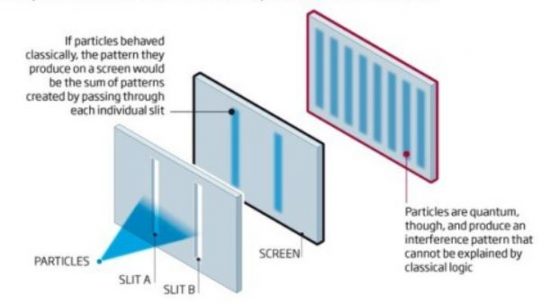
8 – Given an opportunity to pass through one or two slits with no detection, will a quantum object always pass through both?

If the slits are in the right position and are cut to the right size and are at the right distance from the source, a pattern on a detector screen will evolve over time to look as if waves are passing through the slits and interfering in a predictable way with each other.

Of course, it’s not true, because the particles are shot one at a time and the duration of the experiment can be hours to weeks long. The shots land one dot at a time. After thousands of shots, a pattern that resembles what one would expect of waves interfering is formed by the particles as they accumulate on the detector backstop.

No one knows why. The phenomenon is inexplicable.

BELL’S INEQUALITY


9 – Is Jesus a hoax? Jesus has not walked on Earth in 2,000 years. How can a man 2,000 years ago save anyone?

I was hungry and you gave me something to eat, I was thirsty and you gave me something to drink, I was a stranger and you invited me in,
I needed clothes and you clothed me, I was sick and you looked after me, I was in prison and you came to visit me.

The righteous will say, ‘Lord when did we do these things?’

My answer will be, ‘Everything you did to help suffering people, you did for me.’

The preceding is a paraphrase of part of Matthew 25, a book in the Bible.

Read it. Why not?

The answer is in the sense that it is not a hoax that the “least of these” walk the earth when we do. How we treat unfortunates is, in the view of Jesus, the way we treat him. He will return to us the same courtesies when finally we give GOD an account of our lives.

JESUS, THE CHRIST


10 – Can RNA or DNA think?

RNA, in its many forms, behaves like ant colonies which swarm over the DNA pile to do a number of tasks that seem to involve a lot of decision making.

RNA selects out of billions of bases a few thousand which it strings together to make “genes” that it transfers to ribosomes — which are made almost entirely of RNA and are among the oldest structures in cells.

At a ribosome, the genes are coupled to RNA that carries amino acids; the amino acids are then ejected from the ribosome to be strung together like necklace beads; they are transported to Golgi structures where they are folded into proteins.

A process this complex — and it’s actually far more complex than this summary implies — can be orchestrated without intelligence; it’s possible, but without intelligence of some form, the process seems, at least to me, to border on the miraculous.

After all, what is the result?

It is a conscious thinking life-form who can, in cooperation with others, figure out its own origins.

It’s amazing, right?

NO CODE


11 – How do Quantum spins get affected by Quantum entanglement?

All atoms with electron shells that are home to more than one electron have entangled electrons. The spins tend to oppose each other. With bosonic particles, down conversion techniques produce photons that have opposite polarization.


Most physicists think that spin is induced during measurement; the spin is transmitted oppositely to the entangled partner instantly — no matter how far separated.

For this reason, a pair of entangled particles can be envisioned as a single particle that behaves as if one of its dimensions (the distance between its endpoints) is missing.

The distance between the entangled pair behaves as if it is zero — when it is known to be non-zero.

BELL’S INEQUALITY

QUANTUM ENTANGLEMENT


12 – What is the viability of colonies on other planets?

The two planets closest to Earth are the most viable places for colonies simply because they are the easiest to resupply. They are Mars and Venus.

Neither can sustain colonies, because they lack magnetospheres, which are essential for deflecting high energy particles emitted by the Sun (called the solar wind). These particles are deadly to life. The molten iron-nickel cores of Mars and Venus froze millions of years ago on both planets, which collapsed their magnetospheres.

Venus has a highly toxic atmosphere, which is another reason to rule out colonization there.

Beyond Mars are gas giants. Only their rocky moons are candidates for human colonies. All the moons appear to be too cold to operate the machinery necessary to sustain human life. Most lack protection from the solar wind.

FINDING LIFE IN THE UNIVERSE


Bonus Assertion – Does a photon consist of (f) quantized energy packets each of (h) joules?

A photon seems to be a packet of vibrating electric and magnetic energy, each part of which exerts its energy at a right angle to the other. The energy in the packet is proportional to vibrational frequency alone. A photon has no mass or acceleration. It travels along at a constant speed in space-time. The electric portion of the energy is about seven times the energy of the magnetic portion.

Photons can become more intense (that is, brighter) when they pile up. Pile ups don’t happen to electrons, protons, and neutrons because they obey an exclusion principle that forbids them from occupying the same space at the same time.

Photons can pile up, but their intensity (or energy) can only be transferred into electrons that are in an energy state that resonates with the frequency of the incoming photons. Non-resonate electrons ignore un-matched photons, so photons pass through non-resonate electrons unimpeded.

The energy of an individual photon can be expressed as its kinetic energy and  shown to equal Planck’s constant times the photon’s frequency, which always results in a very small number.

When expressed in terms of its wavelength (λ), photon energy equals the Planck constant (h) times the speed of light (c) divided by the wavelength (λ) of the photon. Notice that the mass term is missing due to a simple manipulation of the relevant equations — which anyone who is interested can find in the following link.

PHOTON

Momentum might not be an appropriate metric for a force carrying boson like a photon, because momentum is based on mass, which many physicists say photons in a vacuum don’t possess.

Another reason momentum could be an inappropriate metric is that the velocity of photons in a vacuum is independent of any reference frame, right? Momentum is a vector quantity that is always measured in relationship to a particular reference frame or the momentum of another particle.

There is a theory that claims that photons pick up mass when they pass through materials like glass. They seem to leave a wake that shakes up electrons in the material. The vibrating electrons release polaritons, which by a mechanism analogous to superposition add mass to the photon and slow it down. When the photon exits and returns to vacuum, it sheds the polaritons, becomes massless, and returns to light speed instantly.

Perhaps photons in the vacuum of space acquire mass by interacting with virtual particles that emit virtual polaritons.  Notions about the nature of the universe would be changed radically if such a notion were confirmed by evidence.

Because h and c are constants, they can be multiplied together to give a constant that is very close to 2E-25. Dividing 2E-25 by the wavelength of a photon will give its energy in joules. Of course, all units are SI, which stands for standard international units, correct?

Since E = hf or (hc / λ) , the energy is always a multiple of h, which is the Planck constant. The word “multiple” is a simple way to say “quantized”.

So, the energy of a photon bunch or pile can be expressed as a multiple of the number of photons of a certain wavelength in that bunch. The energy in each individual photon is its wavelength (or frequency, if you like) multiplied by the Planck number — a constant equal to 6.626E-34.

It takes a pile-up — or bunch — of about 7 photons with wavelengths close to 2.5 one-hundred-thousandths of an inch long (635 nanometers) to carry enough energy to light up the sensors in a human eye.

How much energy is in those seven photons? It is seven times 2E-25 / 635E-9 —  in joules, right?

It’s 2.2E-18 joules. Converted to an easier metric befitting its scale, the energy is nearly 14 electron volts, which is equivalent to the energy held in 14 electrons.

People say that photons with wavelengths that measure 635 nanometers create the color yellow-orange in their minds.

SENSING THE UNIVERSE


Billy Lee

Q & A BY THE BOOK

All writers know the column, By the Book, published every Sunday in the New York Times Book Review section.  Each week the editors pick a popular writer and ask him or her a fairly standard set of questions that would be impossible for normal people to answer off the top of their heads.

The authors rattle off the names of all kinds of titles and writers and say smart things designed to dazzle the little people who are always starved for an entertaining read.

I’m a pontificator who has never sold a book and never will, most likely. Authors sell their souls to write for money; they do exhausting tours where they answer stupid questions asked by stupid people day after stupid day. From these gatherings of stupidity they hope to sell a few books. It’s stupid.

Through books and other media, the public is exposed to a version of truth filtered by the most powerful people on Earth — to paraphrase Pulitzer Prize winner, Ronan Farrow.

Yes, it’s sickening. People are reading crap; they are immersed literarily in fibs and fabrications, which are shaped to make the world seem less evil, more friendly.

The truth that no wants to hear — I’m screaming it from cell towers to swarming people who seem to lack ears — billionaires have enslaved us. We are living in a gilded prison.

Totalitarianism has already won — not through governments but by supremely advantaged individuals who have no limits on the money they can make and keep — no limits on their power or their reach.

It’s true.

The rest of this essay is a parody of By the Book. The imagined interviewee is Billy Lee, the Pontificator. That’s me.


Billy Lee, the Pontificator

What books are on your nightstand?

I honestly don’t know. Can you give me a minute to run upstairs and look on the floor and my wife’s dresser? I keep current reads close to bed where I do most of my reading. It won’t take long… …

Ok. Thanks for waiting.

“The Periodic Table in Minutes,” by Dan Green; “Genetics in Minutes,” by Tom Jackson; “The Making of the Atomic Bomb,” by Richard Rhodes.

What kind of reader were you as a child? Any favorites?

“The Poky Little Puppy,” by Janette Sebring Lowrey and Gustaf Tenggren was my all time favorite. Mother read it hundreds of times.

I remember being amazed to learn that anyone can dig a hole under a fence to open a world of naughty possibilities. It cost a serving of strawberry shortcake to get caught; it seemed worth it to my little mind.

Your nightstand doesn’t seem to include fiction.  What genres do you avoid and which are you drawn to?

I’ve read a lot of good fiction, but most are classics like “War and Peace” by Leo Tolstoy and “Crime and Punishment” by Fyodor Dostoevsky. I would say that Fyodor ruined my interest in fiction. His book was a nightmare that threw me into depression.

War and Peace was different; it taught me how the world works; Leo laid bare the fallacy of the great man theory of history.

But yes, I avoid fiction. As a teenager I read “Atlas Shrugged” by Ayn Rand a couple times. The book ruined my life more than any other work of fiction, because it claimed to be truth. Living life proved it wrong, but its view of the nature of humans derailed me for decades.

I am drawn to books about science and math. Enough said, I hope.

I enjoy history.

“Retribution” by Max Hastings is a block buster about World War II — as is “Devil’s Voyage” by Jack L. Chalker.  “This Kind of War” by T. R. Ferenbach is a history of the Korean War that knocked my socks off.

You like history. Is there any history you learned from reading that isn’t taught in school? Anything you learned that’s shocking?

During the 150 years before America became a constitutional republic, two-thirds of all white people immigrated as slaves, who in those former times were called indentured servants. Amazing, right?

They came unchained on boats voluntarily, because life was brutal in Europe for poor people. Their term of slavery lasted seven years and ended with emancipation.

Africans came in chains. They served until they became too frail to work; they were set free to die of starvation. The term used was manumission. Ten percent of African slaves were set free this way by the time America became a republic in the late 1700s.

From before the beginning, America was a slave state. The privileges of freedom were extended to white men who owned property. Only they could vote, but not for Senators. State legislators with approval from their Governors appointed Senators.

The founders enshrined slavery in the constitution. Eighty-five years after its signing, half of all Americans went to war against the other half to preserve slavery, but they lost.

After the Civil War, it took the Confederates twenty-five years to terrorize blacks back into submission. At the same time, northern whites committed a genocide against the native peoples they called redskins.

In the 1900s, slavery was renamed capitalism by industry titans to help them make a more appealing counter argument against a system that was catching fire in Europe called communism.

Communists believed wealth should be produced cooperatively and then shared. The idea of sharing was anathema to slave holders (business owners) who referred to their slaves as workers.

Owners abrogated their obligation to care for their slaves by forcing them to provide for their own food, housing, and medical care out of a tiny stipend they bestowed, which today people refer to as a minimum wage. The owners somewhat derisively called the new rules freedom.

After WWII, the wealthy created what they liked to call a middle class (which included about ten percent of the population) to reward the mostly poor farm boys who had risked their lives to protect them.

After 1980, the entitled kids and grandkids of the aristocracy began to disassemble the system their fathers and grandfathers had built, because they felt that the little people weren’t grateful enough. They called it the Reagan Revolution.

Today, leaders promise to make America great again. No more Negro presidents. No more subsidized health care. No more regulations to protect the disadvantaged. Everyone will stand on their own two feet or perish.

It’s the way it’s always been. The escape to America, it turned out, was an escape from freedom.

The USA is now the most merciless police state in world history. The country is demoralized by a military occupation punctuated by non-judicial executions and excessive displays of military force against civilians.

The occupation of America is undergirded by a nightmarish penal system that locks up millions in high-tech prisons where tens-of-thousands are tortured with solitary confinement.

What is the worst part? The USA is building a wall to lock people in. Soon everyone in the USA will be a prisoner unable to leave. That’s the future.

America is going to create a society that reflects the values of its billionaires and the cartel of foreign oligarchs they call friends.

Guess what? There’s nothing anyone can do about it. Take the pills they give you and pretend life is great.

Try hard to cope, and you just might.

Wow, Billy Lee. Glad you got that off your chest. If you could require the president to read one book, what would it be?

The Bible.

Does he have time? It’s close to 800,000 words —  twenty novels.  It’s a lot of reading for a man in his seventies who golfs and is known for not reading much.

Who knows how much time any of us have?  I don’t.

What book are you embarrassed not to have read yet?

Moby-Dick” by Herman Melville. I own the book and have read through the first half at least twice. It’s going to sound strange, but I honestly think the book is about homosexuality. There is a scene in one of the first chapters where two men sleep together in the bowels of a boat. They seem to have an affection for each other that, frankly, I find touching.

The title is a little suspicious. Try screaming it three times in a church without offending anyone.  Moby-Dick!  Moby-Dick!  Moby-Dick!  It’s hard. It’s a bit of a tongue-twister to boot.

You’re organizing a literary dinner party. Which of three writers, dead or alive, do you invite?

Well, first, I have to get a buy-in from my wife, Bevy Mae. Beverly isn’t going to throw a dinner party just because I say so. But assuming she agrees, I’d invite Michael Faraday, Albert Einstein, and Richard Rhodes.

All three lived on the edge of knowledge where uncertainty rages; where fear can overwhelm the unprepared. Faraday’s The Chemical History of a Candle is one of the best science books about candle flames that I’ve ever read. Einstein’s General Theory of Relativity is a joy that anyone can imbibe in a few short hours if they skip the math and physics. And Richard Rhodes proves in his tomes that any idiot can build and store thermonuclear bombs in their basement.

If you would be gracious enough to permit me a fourth invitee, it would be Che Guevara — probably the best read and most informed writer of all time according to declassified CIA assessments. John Kennedy organized the original Green Berets based on one of his books. 

Much of Che’s work is unpublished. His published work is under a suppression protocol inside the USA. Expect releases now that new leadership has risen in Cuba and the United States.

Who would you want to write your life story?

Jesus of Nazareth. People say that he never wrote anything, but he was literate and knew things most folks can only wonder about. Of all public figures past and present, Jesus seems to be the one who understood people best and loved enough to be tender. I don’t think he would humiliate me.

Paul Newman. (January 26, 1925 – September 26, 2008)

What do you plan to read next?

Something I’ve written, probably. I’m the greatest pontificator there’s ever been. Why go out for hamburger when there’s steak at home?

Paul Newman said the same when someone asked why he stayed faithful to his wife, Joanne Woodward. For those who understand what love is, no explanation is necessary.

Billy Lee

25 QUESTIONS

A few months ago, I published 25 Answers to questions readers of Quora.com took time to ask me, because they trusted I knew what I was writing about. Yes, the world is easily fooled by pontificators posing as experts. I confess, I am one of them.

I am a bona-fide pontificator and intend to continue pontificating until I can no longer remember my name. For me, it’s art. My promise is truth, accuracy, and to fix screw-ups when someone points them out. 

The response to my blog-bag of answers was underwhelming to the point where I wondered whether I should ever inflict another anthology of eclectic curiosities on any group of readers anywhere in the world.

Yes!  I decided. Of course, I will. I love to read what I write!

When I forget what I once knew, I read the posts and remember how smart I was when I could remember stuff. It’s a good feeling. Someday I hope my grandchildren will understand why I don’t remember their names or how old they are. Someday I hope they will get what I’m talking about.

Brain-dead and happy is a wonderful combination, and I have it. Yes, I do. It is wonderful. I feel happy and content most of the time.

My mother had Alzheimer’s for years. It was a peculiar variation where she could remember twenty-five quips and jokes, which she repeated to anyone who would listen. Sometimes she wondered what was wrong with her. She asked about it, sometimes.

She always forgot the answer, but to the end she never forgot her repertoire of sure-fire laugh lines. Mom delighted us to the very end of her life, God bless her.

Anyway, I know stuff, and I’m no longer afraid to share. I would say I am becoming fearless.

This essay is a collection of 25 more questions that people from around the world have asked, and I have dared answer. My last Quora compilation was mostly math and physics. Not this time. Here answers focus more on politics, philosophy, religion, and other esotery.

Oh, I might slip a science or math question in here or there for nerds I know are out there who read my stuff and cling to every word.

Here goes.

1 – How is it “just” for jails to be privately owned in the U.S.?

Allowing private citizens to own the means-of-incarceration is as insane as it is unjust and undemocratic.

Since 1984, America has allowed people to sequester as much wealth as they can manage. The looting, cheating, and chicanery that followed has turned America into one of the most corrupt, cruel, and unfair countries the world has ever known.

The result is that now we have an associate of a powerful Russian cartel serving as our president. Are we really going to allow his friends to own our prisons?

Are we out of our minds?

The situation is far worse than you can imagine.

Billionaires run the media. You aren’t going to hear about ways of organizing our country that are in opposition to their consensus about how things should be done. What passes as “dissent” on shows like Rachel Maddow, for example, has the backing of some billionaire somewhere.

We don’t know the names of the people who run our country. They don’t run for office. They do buy the services of office holders on both sides of the aisle — GOP and Democrat. It’s disturbing, especially when people finally realize that they are at bottom mere slaves with no real power. If voting made a difference, would billionaires allow it? Would you, if you were rich? I don’t think so.
 

Even now, confidence in our electoral system is being undermined. Reality Winner, the NSA contractor who exposed Russian tampering with our election results, rots in jail; she can’t obtain bail. The media doesn’t cover her. They want us to forget all about her.

Keeping Reality incarcerated undermines confidence, because it makes it seem like the government has something to hide about our election process.

Is Something Wrong With America?

Capitalism and Income Inequality

2 – What does Elon Musk think about religion?

RISK

Elon believes (correctly) that the risk of a future human extinction event approaches certainty over a very short period of time that can be estimated to be in the hundreds of years or less.

Elon believes we are in a race against catastrophe; humans are special and must be protected; one way to reduce extinction probabilities for humans is to establish populations on other planets and moons.

There are 165 or so rocky (solid) bodies in the solar system with enough gravity that humans can walk on them. Places where large populations can survive are fewer than five and could be as few as absolute zero.

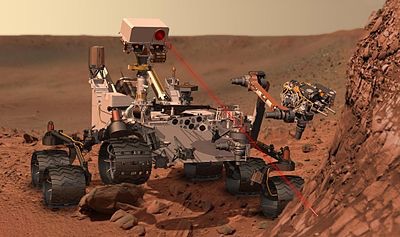
Mars has special problems for human survival which must be solved. It has no protection from high energy radiation and cosmic rays. It lacks a magnetosphere and the atmospheric gases like nitrogen and oxygen that are opaque to harmful rays and particles. Elon believes these problems will be solved and that risk of extinction can be reduced if we establish vigorous colonies there.

He has hope where most informed people do not. My hope is that we can avoid extinction on Earth, but volatile climate and frequent ice ages are difficult to overcome.

We also have new and unusual risks associated with our technologies —biological, nuclear, AI, totalitarianism, resource depletion, and runaway climate change.

Natural risks include asteroid strikes, super nova irradiation, and volcanism. These natural risks are likely to be the same (or larger) on other bodies in the solar system as they are on Earth.

Two human-like species are known to have gone extinct in the geological record. (Some anthropologists say it’s three.) Human populations experienced a near extinction event 70,000 years ago when the total population collapsed to less than 4,000.

I do not know what Elon Musk thinks about organized religion.

I see religion as a brake on the tendency of humans to kill each other, which history teaches has sometimes been effective and at other times not. Sometimes, strongly held religious beliefs lead to war.

On one thing humans agree: they love to fight.

3 – What is the greatest achievement in human history?

Blaise Pascal said that civilization advanced when people finally understood that being the son of a Queen did not qualify someone to be a King.

Nepotism kills civilizations and impedes human progress. An example is the president bringing in his family to manage the United States, presumably because loyalty trumps ability.

The cascading catastrophe that is enveloping us will soon teach anyone who is teachable that placing loyalty to a “king” above the ability to serve our country is one of the many roads that leads nations to ruin.

4 – Why is there a lot of woo-woo surrounding the double slit experiment?

If you shot a BB gun once every five minutes for two weeks at a steel plate that had cut into it two quarter-inch slits, you wouldn’t expect to find 25 or so tidy columns of holes in the wall behind when you were done. People who have done this experiment with atomic scale particles always say “woo” after, because the phenomenon makes no sense. 
 
The mathematics to describe the phenomenon is the same as that used to explain wave-behavior. The problem is this: even if you shoot one wave packet at a time (using photons) instead of solid BB-like particles (like Buckyballs), no one expects that over a few weeks tidy columns will form on the back wall that look like wave interference. The reason for the pattern is a total mystery.

5 – What is the origin of geometric shapes (triangle, circle, cube, etc.)?  If the universe was governed by different laws, would it be possible that these concepts would also be different?

People speculate about the origins of idealized shapes that don’t occur in nature (except approximately). People seem to crave symmetry. They don’t like cognitive dissonance, uncertainty, or ambiguity.

People who are dissonant-intolerant are easy to manipulate. Politicians prey on people’s discomfort by offering simple solutions in return for votes. The result is always disillusionment, because nothing involving people is simple.

Nothing in nature is simple, either.

Triangles, circles, and cubes seem simple because of their symmetries. They appeal to the simple-minded among us — which is 99% of the population, right? It might be 100% if mathematics and language are insufficient to understand ultimate reality.

Einstein had this theory that only mass and energy exist. They are equivalent; they are two sides of the same coin. Space and time are a consequence, not a cause.

Space-time was described by tensor-metrics, and the metrics show that space-time does not have to be flat.

Lines can be thought of as geodesics, which are “straight” only when the metrics of space-time are “flat”. When the metrics “curve” space-time (as they do near massive objects) parallel lines might be parallel in one place only, as lines of longitude on Earth are parallel in one place only — at the equator.

The laws of physics seem unlikely, because twenty or so constants in nature have been discovered that can’t be derived and seem to make no sense. All these constants have been revealed by experiments and seem to be irrational. One example is the constant “α” (alpha), which is discussed in the first link that follows this answer.

Stephen Hawking says that the odds of a universe configured like ours are 1E500 against, which is close to an infinity. But Stephen Wolfram says that at the heart of the universe is a simple algorithm. In his view the algorithm, should anyone ever discover it, will prove that our universe is the only configuration possible.

Who knows?

Fine Structure Constant

Conscious Life

6 – What salary in the United States puts you in the top 10%, top 5%, top 2%, and top 1% in terms of salary?

All anyone needs to know about train-wreck America is that half of all black families live on less than $40K per year; half of all non-black families live on less than $75K per year. It’s hard to imagine that families can survive, let alone prevail, on so little income.

The USA is segregated by income and race. Poor people have no idea how easy life is for the wealthy; the wealthy don’t believe America has poverty.

I have five sons and one daughter. Only two of the six are in the top 1%. The most talented one, an assistant professor of kinetic art at a major university, is in the bottom half. His brothers give him money so he can get by.

Gross inequality isn’t right.

Capitalism and Income Inequality

7 – Modern humans appeared 200,000; civilization 10,000; and advanced technology 500 years ago. Why no advancement for something like 190,000 years?

Technology advances when survival demands it. Wars involving large populations did not become possible until about 3,000 years ago, because human populations were small.

Technology (to wage war) began to advance when population size increased; war technology percolated into the general population during peacetime.

70,000 years ago the human population collapsed to what some anthropologists believe was fewer than 4,000 individuals. The climb back took a long time because the world was in an ice age until 15,000 years ago or so. It has taken time to reach seven billion individuals.

The good news is that advances in technology and science are no longer driven by war, but by the preparation for war. Entertainment, comfort, convenience, and other factors drive inventors to bring clever technologies to peacetime populations.

Avoidance of war should become the highest priority of humankind from here on out, or we might suffer a catastrophic population collapse that would most certainly set back human development for hundreds of thousands of years.

Extinction is another possibility. At least two intelligent hominid species are known to have gone extinct during the past 200,000 years. There may be others.

Sorry for the short answer. The list of technologies and natural catastrophes that can annihilate homo sapiens is long. Click the following link to read about most of them.

RISK

8 – Should the USA build a competing Status-6 Oceanic Multipurpose System (Doomsday) Nuclear warhead?

Enough Pu239 has already been produced in weapons and processed from nuclear fuel rods to sterilize planet Earth of all life.

One country, Japan, has isolated 47 tons of Pu239 from fuel rods, is adding 8 tons per year, and has complained on NHK television that they don’t know what to do with it. Ten pounds is enough to make one atomic bomb.

Plutonium 239 is bomb making material. Japan has 94,000 pounds. It is producing 16,000 pounds per year. Twelve pounds makes one high-yield bomb.

The level of toxicity of Pu239 dust has recently become controversial. My understanding is the traditional one: the speck of brown dust that kills you, you will never see.

The half-life of Pu239 is 24,000 years. Risk studies (which include about a dozen hazards not related to plutonium) have shown that the chance that homo sapiens will survive a catastrophic population collapse during the next 24,000 years is less than one-in-a-million.

Humans cannot baby-sit all the plutonium that exists in facilities on every continent and keep life on earth safe from annihilation by contamination. The warheads and storage facilities are going to rot over time, and the earth will soak up the poisons left behind like vinegar in a sponge.

Doomsday is not a question of whether-or-not but of fast-or-slow. There is no upper limit to the size of a hydrogen bomb, so fast is doable. A rogue group with enough resources could construct a bomb powerful enough to obliterate Earth.

No one can undo the poisons that now exist, so slow is inevitable.

47 TONS

RISK

9 – What is the evolutionary reason that human beings are superficial and attracted to external appearances more than towards intrinsic qualities such as intelligence, character, integrity, honesty and virtuosity?

My reading and life experience tell me that humans are attracted to symmetry.

There could be any number of reasons, but it is easy to argue that symmetry seems to create less stress in those who encounter it, which may make them more receptive (and less reluctant) to mate with those who have it.

Reduction of cognitive dissonance is a major driver of conscious-life; symmetry seems to reduce dissonance in sentient beings like humans.

Interest by humans in mathematics and art seems to confirm, at least to my mind, that folks are driven to imbibe “harmonies” and “patterns” in nature; these symmetries provide them with reassurance that the world is not hostile and that happiness and reduction of stress is possible in the face of accidents, disease, and predators.

Intelligence, character, integrity, honesty and virtuosity are qualities that are not easily perceived and can even be illusory. People are good at feigning all these qualities to manipulate others to satisfy their needs — especially their sexual appetites and their desire for power over others.

Symmetry is not easily disguised (or the lack of it, even with good grooming) and can be an indicator of good mental and physical health, because symmetrical (attractive) people tend to have higher status and are in general less traumatized by mistreatment (on average) than people who do not have this physical quality.

People may mate with high symmetry individuals and later discover than the intangible moral qualities that they value in a life-partner are missing. Such a discovery can lead to separation, but meanwhile offspring have been spawned who have high levels of symmetry, and the process of selection for this quality continues unabated into future generations.

Yes, I have no evidence that this conjecture is correct; it’s not my field, but it seems to be a factor in the world I find myself.

10 – How does Russia stay on par with the USA in many high-tech military systems when their GDP and military budget is so small by comparison? Shouldn’t we be light-years ahead of them by now?

USA military spending is deceptive and classified.

The United States has 800 bases inside 70 countries. It is at war with every country that doesn’t do what it’s told.

Since the end of WW2, the USA has attacked one-fourth of the 195 countries on the earth. Depending on who counts, the USA has killed between 10 and 65 million people, most of them civilians. Injured people are uncountable.

The high casualty rates are due to the way it fights. The USA bombs the enemy to rubble, then moves in a few troops supported by large numbers of indigenous mercenaries to deny the rubble to the enemy.

Take two countries the size of the USA and put them side by side. The land area is less than Russia. Russia is huge. Its entire population is technically literate.

In the USA, only elites are educated. The vast majority of Americans are poorly trained, because public education is underfunded and neglected. Under the American system, education doesn’t generate profits for the wealthy, so they won’t support it.

Because America is segregated by race and income, it is difficult for visitors to get a sense of how poor the general population is. Wealthy Americans are in complete denial of the simple truth that their country is a train wreck for 75% of the people who live in it.

People with the money to travel don’t explore urban ghettos or rural wastelands. They don’t know things, nor do they want to know.

The USA has the world’s biggest and cruelest prison system for a reason.

Think about it.

Every country in the world, including Russia, is trying to avoid the wrath of the United States. They say nice things to us, so we won’t hurt them. They build as much deterrence as they can to avoid being attacked or embargoed.

It’s simple, really.

KILLING FRENZY

11 – Has anyone considered leaving the USA because of the gun laws?

Anyone who has to carry a gun to feel safe is living in the wrong place. My recommendation is to move to safety ASAP.

The guns that many civilians own today inflict shattering injuries that no one who is shot can recover from. The slugs are high velocity and tumble. They are designed in non-conformance with the Geneva accords and are diabolical workarounds.

I would rather die myself than fire one of these weapons at another human being, no matter what they’ve done.

We have police and soldiers who are trained to inflict mayhem when necessary to protect civilians from human predation. Why not let them do their jobs while we civilians throw our war guns away?

Carrying a high-powered weapon into a wild area that is rife with people-eating predators might be a good idea under some circumstances. I don’t have a problem with defense-by-gun against wild animals who might be trying to kill for food or fun.

My recommendation is to travel in wild areas in a way that doesn’t unnecessarily encourage attack by dumb and innocent animals — because, can we face facts? — they don’t know any better.

Animals have a right to live in a natural way and not be provoked. People are smart enough to travel in the wild and avoid unnecessary contacts with carnivores.

ILLUSIONS

12- What would happen to Hitler if he was captured today?

Well, I believe he would be released and featured in the next GOP presidential debates, win the Republican nomination, lose the popular vote by millions in the general election but win the electoral college, and become president.

As a lunatic with delusions of grandeur, he might do very well indeed.

I don’t think he would kill nearly a hundred million people like he did the last time around. It is more likely closer to two billion. But hey, that leaves five billion humans to abase themselves before him, so it would be worth it, right?

Republicans, can I hear an Amen?

BILLIONAIRE CHRISTIANS

13 – Would you consider the USA a noble superpower when compared to other superpowers like Russia and China?

The billionaires who run the USA believe that private ownership is noble and that public ownership is ignoble. They are in a war against any form of socialism or collectivism.

Since the end of WW2, the wealthy have used the military power of the United States to attack one-fourth of the 195 countries on the earth to prevent a cascade of civilizations into communism. This war has, with a few exceptions, been enormously successful.

Today, they are fighting to consolidate their power. The billionaires of Russia, China, Israel, and the USA are dividing up the world like the New York City crime families of a few generations ago (watch the Godfather Trilogy or read the book by Mario Puzo).

Private ownership (called Capitalism) is a permutation of slavery that can be corrupting to democratic governance — as is obvious to any observer of U.S. history.

CAPITALISM AND INCOME INEQUALITY

CIVILIZATION AND INEQUALITY

KILLING FRENZY

14 – How do you interpret human consciousness? Are you the center of the universe?

Consciousness is the fundamental and foundational principle of the universe. Conscious life plugs into this foundational consciousness in a way analogous to televisions plugging into a cable outlet. A television can be unplugged and replaced. But the cable programming continues. It is eternal. Consciousness is at the center of the universe. Conscious life is at the periphery.

CONSCIOUS LIFE

15 – How would slavery have evolved in society if it was not seen as morally wrong?

“Capitalism” is the modern term for slavery. Owners of plantations, factories, and other businesses accrue the benefits of the plantation owners of former times.

Instead of providing slave quarters and food to their slaves, they pay a tiny stipend (called a minimum wage) to their laborers, which frees owners from the additional responsibility of caring for and protecting workers.

Putting the burden of housing, food, health care, and transportation on the backs of low-paid workers is called “freedom.”

The legal system disciplines unruly workers, while the state unemployment system helps dissatisfied owners replace those workers they believe are unfit.

For a small percentage of Americans, it’s a beautiful system.

Because the USA segregates workers both by race and income, most poor people don’t interact with the wealthy. This lack of contact between rich and poor reduces conflict and promotes peaceful living.

SEGREGATION AND THE GATED COMMUNITY

16 – Who was the most powerful human being that ever lived?

The most powerful person in human history was Jesus of Nazareth.

Modern calendars are organized based on the date of his birth. No one else holds that honor.

He taught the world that love — and suffering to love and save others — is what makes life worth living.

Billions have submitted their lives to the cause of Jesus, the Christ. No other human comes close.

JESUS, THE CHRIST

17 – Which among these countries is the best to live? Canada, USA or Australia? Why?

My question is, which country is the best place to live if you are poor? Most people are born poor.

If people go on living by being born again after they die, the odds that they will be born impoverished is high regardless of how well they lived in their prior life. That’s why its important to make the world a good place to live for impoverished people.

Does anyone seriously believe that they only live once? Consciousness continues somewhere, and it’s all there is, right? Absent conscious-life the universe can have no meaning.

I believe Cuba is the best place to live if you are poor, because it has a good climate and the government tries to provide services to ordinary people that are available only to the well-to-do in places like Canada, Australia, and the USA.

People might want to go to Cuba to find out how the poor live on that island. Then come back and observe how the poor live in their own countries.

The United States is segregated by income and wealth, so it’s hard to find poor people if you are rich, and if you are poor it is impossible to meet rich people.

CUBA HEY GUEVARA

CONSCIOUS LIFE

18 – Trump wants to develop a lot of smaller, “tactical” nukes. Should the US use these against North Korea?
 
The USA bombed North Korea back to the Stone Age during the Korean War.

It killed an estimated two million civilians. The bombing was led by General Curtis LeMay of the Strategic Air Command who later partnered with George Wallace when he ran for president back in the 1960s and carried several states including Michigan (if I remember it right).

Wallace was a white supremacist. The Air Force’s own official historians have called LeMay’s bombing of North Korea the cruelest use of military power in world history.

This is the same General who destroyed 67 Japanese cities and burned their populations alive with napalm (fire-jelly) during WW2.

North Korea has done nothing to justify a military strike against its territory.

Nuclear weapons of any size or type should never be used in war, especially when there is nothing to be gained but the reputation for being a monster.

What does Korea have that we could possibly want? The answer is, nothing.

We have a choice to make: are we good or evil? Our destiny depends on how we answer that question.

KILLING FRENZY

47 TONS

19 – I am terrified of single-payer systems as implemented in socialist countries. Can this happen in the US? Was Obama trying to give everyone healthcare all along?

The USA is based on a slave system (now referred to as capitalism or free-market) where the owners of the plantations have doctors, which they share with their favorite house slaves. The field hands get nothing. The plantation owners are terrified that they might have to share their doctors with “unworthy” people should a slave revolt occur, so they have built the world’s most massive prison system to isolate slaves who might dare challenge the status quo.

In other words, people have to work for the right company and have the right job to get access to free health care. Very few do.

The system is so simple, a child can understand it.

Obama threw a wrench into the system by making it possible for people who work for the wrong companies (or who don’t work at all, for whatever reason) to buy access to health care for a reduced fee. Care is still expensive, but it’s not totally out of reach anymore for about three-quarters of the population.

In Cuba (for example) every neighborhood and apartment complex has a doctor assigned to it. What could be more effective than walking down the hall or across the street to be evaluated? If necessary folks are referred for further treatment to a hospital. Otherwise they get the meds they need, and that’s as complicated and inconvenient as it gets.

I grew up in a Navy family. We had free health care. If you got sick, you just drove to the base hospital and the doctors evaluated you. No paper work, no fees. It was a “single-payer” socialized system of medicine. It was better than what we have today as civilians except that protocols, equipment, and medicines are more effective today than they were sixty years ago when I was in that Navy system.

It’s hard for me to believe that this is a serious question by a serious person, but clueless people in the USA are subject to sophisticated behavioral modification protocols due to the immense amount of money that is involved in medicine and drugs, as well as guns, entertainment, food, and transportation.

So it isn’t surprising that people fear a lot of things that aren’t dangerous and are oblivious to dangers that are serious. It’s all about helping a relatively few families and cartels sequester the lion’s share of our nation’s resources.

Someday, maybe things will become more fair than they are now. I hope so.

OBAMA CARE AND THE LAW OF UNINTENDED CONSEQUENCES

CAPITALISM AND INCOME INEQUALITY

20 – Why is it assumed that America invented slavery when slavery has been around for much of human history?

America practiced one of the cruelest forms of slavery. It is the only country in the western hemisphere where slave revolts were successfully suppressed.

Today, slavery has been renamed; it is called capitalism. In the USA, slaves are called workers and are free to live outside the gated communities of the wealthy. Workers are segregated by income to minimize the possibility of unrest.

The USA continues to prevent a successful slave revolt by maintaining the largest prison system by far that the world has ever known.

ARMAGEDDON

SEGREGATION AND THE GATED COMMUNITY

21 – What was the worst year of slavery?

Two-thirds of white people came to America as slaves, called indentured servants. This practice started 150 years before the country became a constitutional republic and continued for many decades after. Indentured servitude was a seven year term of slavery that ended in freedom.

For Africans slavery was permanent. 100% of Africans came to America as slaves for life. There were notable exceptions. Billy Lee, George Washington’s slave and best friend, was set free when George Washington died; Billy Lee continued to live on GW’s Mount Vernon estate as a free man until his death.

WHO IS BILLY LEE?

22 – Is it true that until humans become one nation, we will never go further than Mars?
 
Organizing a human mission to Mars is expensive and dangerous. A coalition of nations might be able to manage the expense and risk.

Elon Musk’s company, SpaceX, is planning a Mars mission. I haven’t heard how the company plans to finance it.

Mars has an iron-nickel core like the earth, but it froze solid many millions of years ago. The magnetic field collapsed, which permitted the solar wind to blow away most of the planet’s atmosphere.

Any biological life forms on or near its surface will have to withstand the stress of continuous, high-energy radiation and the bombardment by cosmic particles with the energy of baseballs.

Travel to planets or moons as far as Jupiter and beyond will take many years.

Unless humans are heavily sedated, it is doubtful that they will be able to endure a journey of several years in a cramped space vehicle. They will lose muscle mass and possibly their sanity — certainly their perspectives that help them maintain a sense of normalcy.

Successful functioning by humans on an alien moon or planet after a journey of several years might not be possible no matter who organizes the trip or what precautions are taken.

FINDING LIFE IN THE UNIVERSE

23 – To Christians: Which scientific claims are incompatible with your faith, and why?

Science confirms my faith, because it seems to be saying that reality is mind-boggling; the odds against a universe constructed like ours with its unusual forces and constants seems to be infinite.

Jesus came to save the ignorant and the despised of the world, which is pretty much everyone. He avoided the subject of science altogether, for good reason.

No reasonable person can believe that the universe started with the big bang of a singularity that then inflated rapidly to create the conditions for conscious life with enough intelligence to understand its origins. That’s cray-cray, but it’s how some astronomers explain the universe.

Even with all we know, the underlying reality of existence remains a complete mystery. If Jesus came to Earth today, would he talk science to humanity?

I seriously doubt it. I don’t believe humans are hard-wired to understand how the universe works or what reality is. We evolved in an unusually safe place and time in the universe and carry with us all the peculiarities and idiosyncrasies that accompany our unlikely presence.

The Bible says plainly that one day people who have ridiculed God will be asked why they didn’t look up at the night sky and wonder why it is that they are so small and dark while the night sky is so large and bright.

How could serious people have missed such an important clue? How could anyone misunderstand their predicament and not concede the possibility that one day they might realize their hopes and dreams through the love of God who created, cares for, and protects them?

SENSING THE UNIVERSE

RESURRECTION

24 – Keeping the knowledge you have today, would you rather travel a thousand years into the future, or a thousand years into the past?

The risks to survival that faced individuals a thousand years ago far exceed the risks that people will face a thousand years from now—if humans survive another thousand years.

The counter-intuitive statistical reality is that the odds against species survival are actually higher than odds against survival of any individual human, should individual humans achieve viability during the next thousand years.

Most analysts of risk are suggesting that homo sapiens do not have much time left before extinction overwhelms them.

The geological record shows that at least two human-like species have already gone extinct. The particular species that thrives today (us) faces risks brought on by its technological expertise, which is certain to destroy it eventually.

I would choose to go forward in time, but I would do so with a great deal of fear knowing the old adage that curiosity kills the cat.

If everything turns out all right, the big question would be, how do uneducated, stupid people do in this new world?

Because uneducated and stupid is exactly what anyone will become who dares travel into a future one-thousand years more advanced than today.

RISK

25 – What are ways one can approach a complex idea that we don’t understand?

Complex ideas are of two kinds: ideas that one or more people understand but others don’t; and ideas which no one understands.

In the case where certain humans exist who understand a complex idea, the objective should be to learn what they know either by talking to them or reading what they have published. By this process, maybe folks can gather enough clues to guide them to further inquiries, which will lead eventually to understanding.

Many complex ideas require skills in certain subsets of knowledge like mathematics, languages, logic, philosophy, and the technical arts (such as metallurgy or whatnot) to make progress.

In the case where a complex idea can be demonstrated and stated but no one understands it (an example is “entanglement” in quantum physics), the approach is different. In these cases, it may not be possible to create a model of any kind in anyone’s mind to reduce the annoying dissonance that comes from not understanding.

People waste a lot of time — some go mad — trying to understand ideas no one understands or will ever understand. Most people seem to believe (in error, it seems to me) that everything can be understood if smart people work hard and are clever.

The idea, which I believe, is that complete understanding is not possible; it is a complex idea that no one understands, including me.

TRUTH

BONUS QUESTION 1 – In history, humans have fought and killed each other for every piece of land on the Earth. Why has the massive continent of Antarctica always been out of that conflict?

This absence of conflict may be coming to an end. A National Geographic reporter has been reporting on alarming developments in Antarctica over the past several years that the fake news has all but ignored.

ANTARCTICA

BONUS QUESTION 2 – Why did mankind invent religion?

As far as I can tell, no records of an ancient civilization without religion have been discovered. I think that it is very scary to be suddenly aware that you exist and not know why — especially at night when wild animals roam freely, and the sky is full of lights that should not be there.

LOSING MY RELIGION

Billy Lee

Editorial Board Recommendation:  We are encouraging readers to visit Quora.com to read responses by Billy Lee (and others) to hundreds of questions asked by curious people from around the globe.