MANGANISM

A lot of people have been poisoned recently, mostly in Europe by Russians, if overseas media is believed.

Mark Rowley, Britain’s chief police official for counterterrorism and international security, told media that the former British agent and Russian citizen Sergei V. Skripal, 66, and his daughter Yulia Skripal, 33, “were targeted specifically,”  —  poisoned on 7 March 2018 by a nerve agent.

People familiar with nerve poisons have said that the poison used in this attack is impossible for a “non-state” actor to produce, let alone store and deploy to kill others. The statement by Britain’s top terrorism cop doesn’t leave room for many suspects.

Sergei and his daughter endured the mysterious deaths of several family members over the past many years. Now both lie in hospital in intensive care with Sergei remaining in critical condition as this essay is written. The killers seem to have targeted not only Sergei, but his entire family.

This essay isn’t about intentional assassinations by twisted power-trippers with appetites for terror.

The assassinations by poison in England and elsewhere set the context for something far more pervasive and debilitating — the unleashing of toxins on billions of humans and virtually every animal and plant on the earth and sea by uncaring people motivated not by revenge but by the desire to sequester money for themselves, their families, and their businesses.

A lot of money can be made by people who don’t care who or what they poison. There is no limit to how much money they can keep, either. Read Capitalism and Income Inequality.

In this essay I’m going to write about a dozen or so poisons that people are ingesting in ignorance which destroy their kidneys, their brains, their hearts, their nerves, their stomachs, their muscles, their finger and toenails, and their long beautiful hair. Who will warn people about the dangers if I don’t?

This chart is likely the best interactive periodic table on the web. The Royal Society of Chemistry (in London) provides it free to anyone who wants to use it. Click chart or this link to open it in a new window — and have fun!

Television tells us nothing except that the current president and his thugs are rolling back decades of protections against all kinds of dangerous products; nothing in popular media warns anyone that they are floating in a fog of toxins that is making them sick and killing them unawares. Without regulations, it’s going to get worse.

Dozens of people have dropped dead while using paint-strippers that contain the toxin methylene chloride, according to CBS News.  (Click link for video.) Manufacturers say that millions use their products safely. Why ban a substance that only kills a few people per year? Life is cheap in unregulated America. It seems like life is going to get a lot cheaper.

Methylene chloride is used to decaffeinate coffee and tea. No one in authority seems to care. A California judge is ruling whether a law that compels coffee retailers to warn customers about cancer risks can be enforced. The chemical in this case is acrylamide, a known carcinogen, which is produced when coffee is brewed.

Acrylamide contaminates French fries, potato chips, bread, and other foodstuffs. The current leadership at the EPA (Environmental Protection Agency) is laughing at California. EPA execs continue to push for deregulation while they strive to keep the population ignorant about the risks of the products they use and ingest.

What would people think if they learned that only one person in three dies of old age? The two other unfortunates are dying from preventable accidents and diseases caused primarily by the toxins they ingest daily. Think about it.

Does anyone believe it? The punks who seized power last year after a tampered election are planning to deconstruct the United States and its agencies, whose mission was once to make life safer and easier for ordinary people.

The danger is not only inside the USA. Anyone who disagrees that homo sapiens are in danger ought to look to the plant and animal kingdoms around the world. Diversity is collapsing; the health of adult animals is deteriorating; fish and other sea-life contain high levels of toxins that make them unsafe to eat.

Were it not for short life spans, the suffering of animals and plants would be obvious to all but the most willfully ignorant. Testing of animals shows that all adult animals are suffering from contamination by heavy metals and other toxins placed into the environment by guess who? — humans, mostly.

What is manganism, anyway?  Yes, it’s the title of my essay, but it’s also a matrix of symptoms induced by the deadly neurotoxin, manganese. Like most of the poisons in this article, it is a fundamental element of the periodic table. I am arguing that a position in the periodic table does not entitle entrepreneurs to extract and market elements in the table that are poisons.

Humans need 5 milligrams of manganese daily to power up the enzymes used in cell catalysis. Double the dose to 10, however, and they develop psychosis — manganese madness. The difference between survival and suffering is razor thin.

Symptoms start as irritability, mood swings, and compulsiveness, which progress to full-fledged Parkinson disease-like pathologies that are often misdiagnosed. Manganism lowers IQ and increases aggression — a dangerous juxtaposition.

With the advent of industrialization and the follow-on of high-technology, manganese has been poured into the environment like rain-water. It’s used everywhere in industry to prevent corrosion in metals.

Most steel contains manganese; some steels have as much as 15%. Construction helmets and military headgear are fabricated from them.

Manganese is a major component of alkaline batteries. It’s found in ground water, gasoline, and fertilizers —  it’s used on the plants people eat. It’s concentrated by water-heaters that feed hot water to showers, of all places. Never swish water in your mouth from a shower-head while bathing.

Chronic exposure to air contaminated by manganese dioxide particles can cause manganism.  MnO2 is classed as a cumulative neurotoxin according to the MSDS for manganese dioxide. The black powder is used in ”salt water” car batteries, now under development to replace lithium batteries. David Pogue ate the powder during a NOVΛ television broadcast to demonstrate its ”safety.” Don’t do it, Billy Lee advises. He recommends that scientists who plan to remain capable of adding together more than two numbers avoid inhaling manganese dioxide dust. The Editorial Board

The sodium-ion battery (some call it a salt-water battery) is, at this moment, coming on line. It uses manganese-dioxide electrodes. The plan is to use these batteries to power cars by 2020, mainly because the batteries don’t catch fire. The introduction of these batteries into electric cars will add another flood of manganese into the environment where it will — eventually — be ingested by plants, animals, and humans.

Brain damage by manganese is irreversible. 

People once wondered why the people of ancient Rome went crazy. Edward Gibbon and other historians attributed it to moral decay and corruption. But the people of ancient Rome added lead to their wine to kill pathogens (like mold and fungus) and to sweeten it. Even on a good day adding highly toxic lead to wine is a bad idea.

Americans — like the ancient Romans — are weird, too. Maybe someday historians and pathologists will note the high levels of manganese in our exhumed bodies and conclude that we also unwittingly destroyed ourselves from a single chemical no one really needed and that no one took the time to forbid.

Amethyst. Natural and manufactured contain manganese, which gives it a purple color.

It takes a lot of effort to isolate manganese. People take the time to produce it for one reason and one reason only — to make money. Manganese is an iron-like metal used to impart the color purple to the gemstone, amethyst.  Producers of manganese pay lobbyists to convince congress-people to go easy on them, so they can continue to enrich their families while the planet dies beneath their shuffling feet.

Breathing manganese vapors is the most direct path to poisoning, but manganese is also imbibed by eating too many of the wrong vegetables and not eating enough other vegetables that counter-act the toxin. The balance between enough and too much is that fragile.

Modern technology is tipping the balance into the way-too-much zone. Soon people will be too far gone to notice or care. They will be weak and shaky — unable to save themselves; unable to find refuge from poisons they can’t see, smell, or taste.

Steels rust and corrode. Manganese dust worms its way into soils and floats in the air, carried by the wind. Folks spread manganese-rich fertilizers on their lawns and crops. Inhaling small amounts of dust induces neurological injury.

Introducing tens-of-thousands of tons of manganese into the power plants of electric cars is only going to add to the problems of maintaining a healthy Earth.

There is a good reason why tycoons want to make manganese a staple of the world’s diet of toxins. The supply is inexhaustible. The floors of the Earth’s oceans are covered by 500 billion tons of baseball sized nodules of manganese. When the land-based stuff is gone, profiteers plan to scoop manganese nodules off the ocean floors.

At least 500 billion tons of baseball sized manganese nodules lay on the floor of the world’s oceans. Entrapped within are other elements like the neurotoxin, thallium.

Here’s the problem: these nodules contain an additional neurotoxin called thallium, which was used as a rodent poison in the United States until it was banned in 1972 — accidents killed too many pesticide technicians.

Enough said.

I don’t want to depress or scare anyone, so I’m only going to go into detail on a couple of other poisons that are ruining lives. Then I will list a number of toxins that everyone is ingesting everyday — with links added for anyone who wants to learn more.

To any reader who has read this far — congratulations. You have courage and a high bummer tolerance.

Wall-Mart sold to “juniors” hundreds-of-thousands of Miley Cyrus jewelry accessories coated with high levels of cadmium in 2010. According to press accounts, they refused to stop selling these poison trinkets for months, because they claimed they lacked the tools to test their products for safety. Cadmium is toxic, even in the smallest amounts. There is no safe level.

Artists discovered cadmium’s toxic effects, when first they mixed it into paints to make vibrant orange, yellow, and red colors during the early 1800s. It’s a heavy metal that when ingested instantly attacks the kidneys (which it eventually destroys), lungs, and bones. It causes cancer. Smoking, welding, painting, metals production, galvanizing, and fertilizers are common sources of human contamination.

Ni-Cad (nickel-cadmium) rechargeable batteries are one of the most pervasive consumer products — used in every kind of electronic gadget, including computers and even children’s toys until banned by many countries a few years ago.

Did anyone properly dispose these batteries when they came to the end of their useful lives? I don’t think so. Most folks tossed them in the trash where over the decades they have been corroding in land-fills to poison everything they touch. There is no safe-level for human exposure. 

Ni-Cad batteries are banned for general use by the EU (European Union), but are freely available in the United States and other countries. In the current climate of deregulation, toxins like cadmium are going to be unloaded on our unsuspecting populations for one reason and one reason only; we all know why: money.

Billionaires rule, and none live in the toxic wastelands of ordinary America. Greed thrives on greed while it drives out compassion, common sense, and consumer safety.

Cadmium is pervasive in zinc deposits and is embedded in every galvanized piece of metal you have ever handled. In Japan rice grown in cadmium contaminated irrigation water causes itai-itai disease. It makes bones so weak they fracture spontaneously. Click the link to learn more.

People who work to galvanize steel can develop metal fume fever, a flu-like disease that renders them unconscious should they breathe in the cadmium that always contaminates zinc, which is the galvanizing metal. When ingested in fumes, zinc will by itself make workers sick.

Gun enthusiasts sometimes fall victim to metal fume fever, because bullets can tear away microscopic layers of gun-barrel bores; metal-toxins become an invisible mist they inhale unaware.

Zinc-oxide is the major component of sunscreens. Do sunbathers trust the manufacturers of sunscreen around the world to decontaminate zinc from the cadmium in its ores? There is no safe dose for cadmium. Smearing cadmium into the pores of sweating skin is a bad idea.

Zinc is 97.5% of every U.S. penny minted since the 1980s. The copper cladding is less than three percent. It is impossible to remove all traces of cadmium from zinc. Pennies are poisonous. There is no safe level for cadmium. Handling old pennies with sweaty hands (or swallowing one accidentally) is another bad idea.

To say again: I have compiled a list of about a dozen or so poisons that people are ingesting in ignorance that destroy their kidneys, their brains, their hearts, their nerves, their stomachs, their muscles, their finger and toenails, and their long beautiful hair. Who is going to tell them about the dangers if I don’t?

I see nothing on television; I read nothing in print media that warns the public that they are living in a poison glen of toxins where billionaires make them sick and yes, murder them.

Do these greedy monsters care? If they did, they would provide health care to the miserable people they hurt. The truth is, they could care less. The consensus among billionaires is to ruin health care in the United States and let victims fend for themselves.

The wealthy intend to privatize every government program designed to defend the helpless. Their puppets advocate for privatization and an end to regulations on conservative talk shows all the time, and I for one believe they mean it.

It must be asked again: Does anyone know that only one person in three dies of old age? The two other unfortunates are dying from preventable accidents and diseases caused primarily by the toxins they ingest daily.

Anyone who disagrees that humans are at risk ought to look to the plant and animal kingdoms. As I wrote earlier, diversity is collapsing; the health of adult animals is in a terrible state; sea-creatures are irradiated by the run-off from ruined nuclear power generators like those at Fukushima in Japan and those on sea-going vessels that have sunk like the Thresher and Scorpion submarines; sea-life is radio-active and unsafe to eat. Were it not for short life spans, the suffering of animals and plants would be obvious to all but the most willfully ignorant.

Like manganese, selenium is another element in the periodic table that is required in trace amounts for cell catalysis but is toxic in slightly higher amounts. It is produced by burning coal, among other processes.

Selenium causes garlic breath, intestinal distress, hair loss, fingernail fall-out, and neurological damage. It smells like horse-radish. Who wouldn’t eat horse radish if they smelled it in their food? Cirrhosis of the liver, pulmonary edema, and death are not uncommon.

Selenium is a major component of lithium batteries, photo-copiers, and solar cells. Brazil nuts and peaches, especially those grown in certain soils, are sometimes loaded with selenium.

So far I have mentioned three toxic elements: manganese, cadmium, and selenium. It’s the tip of a ginormous iceberg of poisons.

Does anyone understand that catalytic converters — the five inch diameter by two foot long tubes in exhaust pipes under all cars —  have a useful life of only 100,000 miles? A lot of things can wreck converters before a hundred-thousand miles — unburned fuel and leaks of coolant and oil can clog and render useless the pollution reducing power of any converter.

Whether wrecked early or not, a large percentage of cars in cities rely on catalytic converters that are ineffective, because many are old, for one thing. They are supposed to prevent pollutants that induce ADHD, autism, and Alzheimer’s in old folks, babies, children, and the vulnerable — which is everyone who doesn’t wear a face mask.

People in China and Japan wear white face masks. When they blacken, they throw them out and put on new. Who wears face masks in the USA? No one.

Catalytic converters are not working!  Look along the curbs of city streets a few days after a heavy snow. It’s a grey-black mess of God knows what. When the snow melts where do the contaminants go that the innocents trusted catalytic converters to soak up?

Isn’t it obvious? The sludge dries to become dust; it blows in the wind; people and animals breathe it in. Animals eat it, because they don’t wash their food.

Environmental contaminants measure in the millions of tons. Workers produce them in factories where they spend their careers trying to avoid the accidents that will poison them and ruin perhaps the rest of their lives.

Few coal miners avoid the miseries of coal toxins — an example that should by now be obvious to anyone who is paying attention. All the old-timers are sick. Visit coal country. Meet these unfortunates.

Go to farms where the run-off from fertilizers contaminates the wells. Only farmers who drink bottled water avoid disease. Go to farm country and look for old men. Ask them about their health issues, if you can find them.

Undiagnosed (or misdiagnosed) people who are sick from toxins do not understand why they suffer from delusional thinking, mood swings, and PTSD-type symptoms. No general tells his battle-hardened soldiers that poison impregnates their ammunition;  it’s loaded with spent uranium to make it heavier and more lethal.

Few soldiers on today’s killing fields escape poisoning by the highly toxic materials in their ammunition and the weapons-exhaust that spreads a smoke of poisons on friendly positions during war.

Some soldiers come home terrorized by a fear whose source is unknown to them. Irrational behavior, aggression, spousal abuse, persistent nightmares, even mass shootings are all behaviors that can sometimes be traced back to battlefield poisons, should anyone be brave enough to do the studies that would confirm what anyone with common sense knows is true.

Now might be the time to admit that I’ve found it best to keep essays from becoming overly long; it would take many books to cover the subject of commercial toxins comprehensively.

What follows is a simple list of a few of the elements from the periodic table that are in common use today which are toxic and will kill or debilitate anyone who ingests them. Click on the links to learn more.

  • Heavy metals – coal is the biggest source, as well as waste from the mining of less-toxic metals. Toxic heavy metals include lead, arsenic, cadmium, mercury, and chromium. Heavy metals help to populate the list of elements below.
    .
  • Beryllium – no safe level. Used in all kinds of spark-proof tools and in the alloyed metals of outer-space and under-sea vehicles.
    .
  • Chlorine – once used in trench warfare, because it is heavy and clings to the ground. Highly poisonous.
    .
  • Bromine – until recently unregulated, it eats the ozone layer. It can cause psychosis in humans and has other toxic effects. People put it in their swimming pools — and in pesticides, which farmers spray on plants people eat.
    .
  • Cobalt – can be used to safely house “dirty” bombs. During an explosion cobalt debris converts into a deadly isotope that poisons land for decades.
    .
  • Arsenic – a poison unable to be detected until the mid eighteen-hundreds. Referred to in times past as “inheritance powder.”
    .
  • Thallium – another “inheritance powder” that is tasteless and odorless. Before government banned its use in 1972, folks used thallium to poison rats and ants. It contaminates many ores, including zinc. It is a pollutant of cement and coal processing. The skin sucks it into the body like a sponge. Low doses cause hair loss.
    .
  • Strontium – bones and teeth suck up radio-active strontium like vinegar to a sponge. It bursts into flame when exposed to air, which is one reason it’s used in fireworks and roadside flares.
    .
  • Antimony – used by the ancients to make them vomit. They believed purging was a pathway to better health.
    .
  • Tellurium – contact with even the smallest amounts will make a person smell bad for weeks. Miners try to avoid it, often without success.
    .
  • Barium – makes rat poison that is fatal in doses as small as one gram.
    .
  • Cerium – used in the walls of self-cleaning ovens, in cigarette lighters, and in camping lanterns. Commercial grade cerium always contains radioactive thorium. Civilians have been prosecuted for isolating thorium from cerium in vain attempts (thus far) to make atomic bombs.
    .
  • Osmium – an extremely toxic metal that is easily absorbed through the skin when touched. It shreds the lungs and ruins the eyes.

OK. I think this is a list that is sufficient to show that not every naturally occurring element is as safe as, say, nitrogen; probably no element is as safe as nitrogen, which is 78% of the air folks breathe. Of course, anyone who breathes nitrogen without oxygen dies of suffocation in minutes.

Are there other elements in the periodic table that are dangerous to human health? Unfortunately, yes. Most of them are refined in labs and used by the military.

This essay is about elements that the public might encounter at work or from products they buy or use to simply live their lives — like foods or building materials in homes, for example.

The problem is this: thousands of toxic materials are produced from combinations of elements that are sold everywhere to do almost everything. Unless these materials are ruthlessly regulated, pigs who produce and profit by them have proven time and again that they are willing to hurt people — sometime kill them — to get rich.

Whoever heard of a CEO going to prison for poisoning someone? It doesn’t happen.

Some people, after reading an essay like this one, might decide that living is fraught with too many dangers. Life is no longer worth living. Some might ask themselves: is it better to just die and get it over with?

Well, one way that works, I’m told, is to ingest 37 bananas. It’s important to eat the peels as well as the meat. Thirty-seven is apparently the right dose.

Bananas are naturally radioactive; they contain potassium; a lot of people don’t know. Who will tell them? Not only radioactivity, but pesticides like chlorpyrifos coat the peels so that people are less likely to get bit by venomous spiders, which most assuredly would otherwise be hiding in bunches of untreated fruit.

Bananas contain substantial amounts of hydroxytryptamine, a serotonin-like chemical that if improperly dosed or taken with other substances can induce either euphoria or adverse reactions up to and including death.

People hell-bent on successful self-immolation might try eating 38 bananas — one more than necessary — just to be on the safe side.

The practice of blowing oneself up by eating one more banana than necessary is called, bananism.  I almost used the term to title this essay.

Billy Lee

Warning by the Editorial Board:  Billy Lee recommends that anyone who eats more than twenty bananas a day seek medical attention and psychological counseling. Never eat the peels.

25 ANSWERS

Two months ago, I discovered QUORA. It’s been around since 2009.

Since 2010, Quora has enabled people to ask experts questions about topics they like; even to answer questions on subjects they claim to know something about.

Quora is a site for geeks and nerds, and so far I  like it. The people who hang out in the areas I hang out tend to be polite, kind, and smart. If they like someone, they follow them and are notified when they post. So far, ten people have signed on to follow me. It’s a start. I think most are from India.

During the first six weeks, 150 or so of my answers were viewed 35,000 times; I got nearly 175 “upvotes”, which enabled many of the answers to move to the head of the line. I wrote most answers in the wee hours between 2 AM and 7 AM when I couldn’t sleep. Insomnia inspired me.

What follows are 25 of the most popular answers I posted to the first 150 or so questions that caught my interest. They are sequenced by popularity — the most read first .

Why not read a few? How many questions can anyone answer? Not many, I’m thinking.

Who knows what you might learn?

What? 

Someone thinks they know better than a pontificator with no bonafides?

I don’t think so.

No way!   😉


1)   What are some of the most popular “mathematically impossible questions“?

Freeman Dyson — one of the longest-lived and most influential physicists and mathematicians of all time — argued that it is impossible to find a whole (or exact) number that is a power of two where someone can reverse its digits to create a whole number that becomes a power of 5.

In other words, 2^{11} = 2048 , right? Reversing the digits to make 8402 does not result in an exact number that is a power of 5.

In this case,  8402^{1/5} = 6.09363  plus a lot more decimals. It’s not a whole (or exact) number. Not only that, no matter how many decimal places anyone rounds-off 6.09363… , the rounded number raised to the power of 5 will never return 8402 exactly.

Dyson claimed that this conjecture must be true, but there is nothing in mathematics that enables anyone to write a proof. He claimed that there must be an infinite number of similar statements—-each one true, none provable.

Click the link below to learn more.

TRUTH

The Snowplow Problem is another “impossible” problem. My differential equations professor assigned it with the promise that anyone who solved it would receive a 4.0 grade, regardless of their performance on tests. I was the only student he ever taught who actually managed it.

The problem goes like this: It is snowing at a constant rate. A snowplow starts plowing snow at noon. By one o’clock the plow has traveled one mile. By two o’clock the plow travels an additional half mile. At what time did it start snowing?

It took me 3 days and two pages of calculations, but I got my 4.0.

Note from the Editorial Board: Over 50 people on Quora submitted answers to Billy Lee’s Snow Plow problem. One person had the right answer, but would not produce his proof. He did point out an unusual feature of the solution that Billy Lee had not noticed before. Billy Lee characterized the feature as ”very surprising.” When pressed Billy Lee refused to reveal the secret. 

2)   How much force is one Newton?

A newton is the force that an average sized apple makes on your hand when you hold it. No matter where in the universe you are; no matter on what planet you stand or how strong the gravitational field, a newton of force always feels the same.

A newton is one kilogram of mass that is accelerating at one meter per second per second. Gravity on Earth accelerates everything at nearly 10 meters per second per second. A kilogram of mass feels like 2.2 pounds on earth. One tenth of 2.2 pounds is 0.22 pounds or 3.5 ounces, which is the weight of a typical apple. The weight is the force that you feel against your hand. It is one newton.

On the moon, an object with the mass of a large brick would feel as light as an apple on earth due to the moon’s lower gravity. The force of the brick in your hand would feel like one newton.

3)   x + y = 4 .  and  . x^x + y^y = 64 .   What are x and y?

The simplest way to solve is to make y = (4-x) and create an equation in terms of x.

An easy version to create and solve is

{x^x + (4-x)^{4-x} = 64}

You can solve it by hand using iteration or throw it into an app like Wolfram Alpha and let them solve it in a few seconds.

Either way, one value for x is .606098…. The other is 3.393901… , which you can assign to y. The two numbers add to 4.000… and when substituted into both initial equations return the right results.

4)   If I had 1,000,000,000,000,000 times 1,000,000,000,000,000 hamsters floating in space in close proximity, would gravity turn them into a hamster planet?

Assuming the question is serious, it deserves a serious answer.

A typically fat hamster weighs around one ounce, which is about 0.03 kilograms of mass. The number of hamsters in your question is 10E30.

Multiplying the mass of a single hamster by this large number gives the result of 3E28 kilograms.

To compare, the mass of planet Earth is 6E24 kilograms. The mass of the proposed population of hamsters is 5,000 times the mass of the earth.

The sun contains 67 times more mass than the hamster population. If the hamsters are close enough together to hold paws, a hamster planet is almost certain. I haven’t worked out how long the process to congeal would take, but I can estimate that the hamsters would probably die of starvation before the inexorable forces of gravity completed their work.

The hamster planet would be formed mostly from three elements: hydrogen (64%), oxygen (33%), and carbon (10%). 3% would be trace elements like calcium and maybe lithium.

The most likely outcome, given enough time, is a planet-like object. The hamsters have only one-fifth of the mass to make the smallest of the smallest suns — red dwarfs, which populate 67 to 80 percent of the Milky Way Galaxy.

There are way too many hamsters to make a reasonably sized moon.

Their mass (3E28 kg) happens to fall on the border between the range of masses that are required to form celestial objects known as brown dwarfs and the less massive sub-brown dwarfs — sometimes referred to as free-floating planets.

Brown dwarfs don’t have enough mass to ignite like a star, but they do produce heat and can accept small orbiting planets. The chemistry of brown dwarfs is not well-understood and is a bit controversial.

It’s a toss-up, but my vote goes to the notion that the hamsters will eventually form a very large but ordinary planet — a free-floating planet — which I referred to earlier as a sub-brown dwarf. This hamster planet might wander through space for millions (or even billions) of years before being captured by a massive-enough star to begin to orbit.

Because the elements of hydrogen and oxygen are likely to become the constituents of frozen moisture (or water ice), there is the risk that the ice might melt into oceans and perhaps boil away if the hamster planet approaches too close to a star (or sun). In the case where the planet loses its water, a carbon planet with 50 times the mass of earth would form.

Otherwise, should the planet find itself in a far-distant future orbiting in the “goldilocks” zone around a sufficiently massive star, the water would not evaporate. Life could arise in the planet’s oceans. It’s possible.

Life-forms might very well crawl up out of the water and onto land someday where — over the eons and under  ideal conditions — they will evolve into hamsters.

5)   Why is evolution a valid scientific theory despite the fact that it can’t be conclusively proven due to the impossibility of simulating the millions-of-years processes that it entails?

Evolution is a fact that is thoroughly established by observations made in many disciplines of science. Changes in species happen fast or slow; in the lab and in the field.

The mystery is how one-celled life got established so quickly — it was solidly established within one billion years of earth’s formation. It’s taken 3.5 billion years to go from one-celled life to what we have now.

Why so fast to get life started; why so slow to get to human intelligence and civilization?

People have a lot of ideas, but no one is sure. Some life forms have orders of magnitude more DNA than humans. Only 2% of human DNA is used to make the proteins that shape us.

So, yes, there are lots of questions.

NO CODE

6)   Why do cosmologists think a multiverse might exist?

Many high-level, theoretical physicists have written about the obvious problem our universe seems to have, which is that it has too many arbitrary constants that are too tightly constrained to be explained by any theory so far. No natural cause has been found for so many constants, so it’s fertile ground for theorists.

Stephen Hawking, among others, has said that the odds of one universe having the physics that ours has is 1E500 against. He is joking in his English way, because such a large number is essentially an infinity. It’s not possible to constrain a universe like ours by chance unless there are an infinity of choices, and we happen to be in the one that supports intelligent, conscious life.

Two ways of getting to infinity are the concepts of multi-verse and the new one proposed by Paul J. Steinhardt of Princeton University in 2013, which is based on data supplied by the Planck Satellite launched in 2003. Paul is the Einstein Professor of Science at Princeton, so his opinion holds a lot of weight.

Steinhardt has proposed that the universe is ekpyrotic, or cyclic. He has asserted that the universe beats like a heart, expanding and contracting in cycles, with each cycle lasting perhaps a trillion years and repeating, on and on, forever. Each cycle produces conditions — some which are ideal for life. This heart has been beating forever and will continue to do so, forever.

Conscious Life

7)   How will we visit distant galaxies if we cannot travel faster than light? 

We will never visit distant galaxies, because they are too far away; most are moving away from us faster than our current technologies can overtake. At huge distances space itself is expanding, which adds to our problems.

The expansion of space is gradually accelerating. Any increase in performance by space vehicles over the next few thousand years is certain to be overwhelmed by the accelerating expansion of the universe.

As time goes on the amount of objects that are reachable (or even viewable) by earthlings will shrink.

On the happy side, our own solar system has at least 165 interesting places to visit that should keep folks fascinated for many thousands of years. A huge cavern has been discovered on Mars, for example, that might make a safe habitat against some forms of radiation dangers; it seems to be a place where a colony of humans might be able to live, work, and survive — perhaps even flourish.

Elon Musk is planning a mission to Mars soon.

8)   What is the mathematical proof for a+a = 2a ?

Some things that are true can’t be proved. All math systems are based on axioms, which are statements believed to be true but which, in themselves, are not provable.

This link provides a list of axioms for addition: https://sites.math.washington.edu/~hart/m524/realprop.pdf

A lot of interesting philosophical and mathematical work has been done on conjectures that are believed to be true, but can’t be proved.

TRUTH

9)   Can you explain renormalization in physics in simple words?

There is a problem in physics that has to do with the huge variation in scales between the very large and the very small. This problem of scales involves not only the size and mass of things, but also forces and interactions.

Philosopher Robert Pirsig believed that the number of possible explanations that scientists could invent for phenomenon were, in actual fact, unlimited.

Despite all the math and all the convolutions of math, Pirsig believed that something mysterious and intangible like quality or morality guided our explanations of the world. It drove him insane, at least in the years before he wrote his classic book, Zen and the Art of Motorcycle Maintenance.

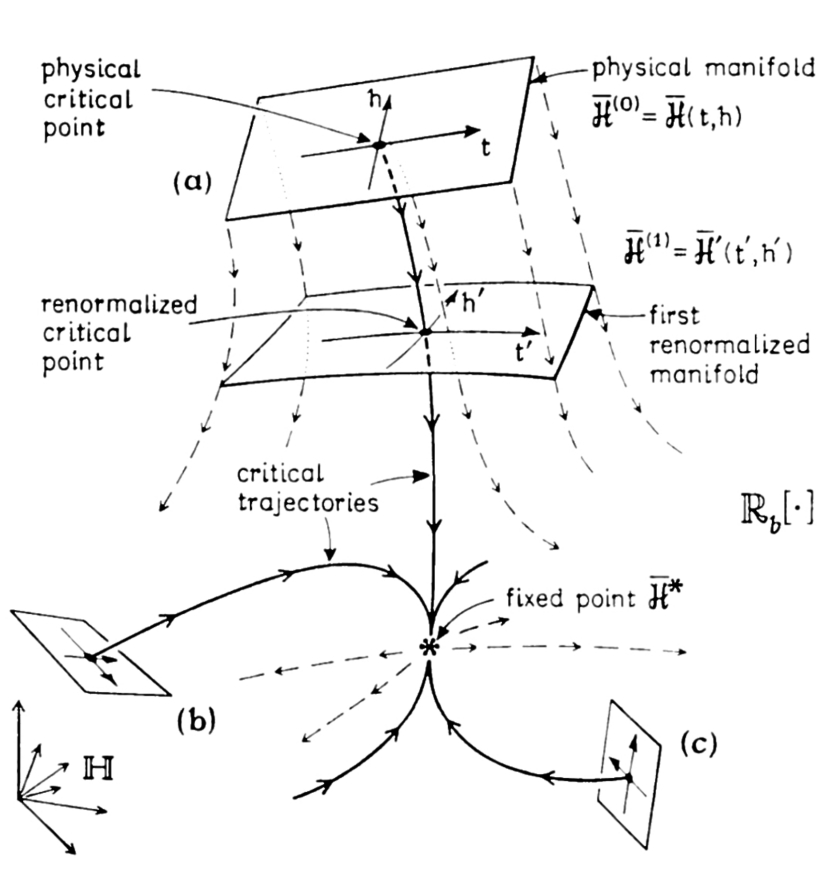
Anyway, the newest generation of scientists aren’t embarrassed by anomalies. They have taught themselves to “shut up and calculate.” The digital somersaults they must perform to validate their work are impossible for average people to understand, much less perform. Researchers determine scales, introduce “cut-offs“, and extract the appropriate physics to make suitable matches to their experimental results.

The tricks used by physicists to zero in on pieces of a problem where sensible answers can be found have many names, but renormalization is one of the best known.

When physicists renormalize an equation, they cut away infinities and other annoying problems (like dividing by zero). They focus the range of their attention to smaller spaces where the vast differences in scales and forces don’t blow up their formulas and disrupt putative pairings of their carefully crafted mathematics to the world of actual observations.

It’s possible that the brains of humans, which use language and mathematics to ponder and explain the world, are insufficiently structured to model the complexities of the universe. We aren’t hard wired with enough power to create the algorithms for ultimate understanding.

RENORMALIZATION

10)   If a propeller rotates at the speed of light at half of its length, what happens to the outer parts?

Only the ends of the propeller can rotate at near light speed (in theory). At half lengths the speed of the propellers will be half the speed of their ends, because the circumference of a circle is 2πr. (There is no squared term.)

So the question is: will the propellers deform according to the rules of the Lorentz transformation along their lengths due to the difference in velocity along their lengths?

The answer is, yes.

As you move outward along the propeller, it will become thinner in the direction of rotation, and it will get more massive. A watch will tick more slowly at the end than at the middle.

I am not sure how it would look to an outside observer. Maybe such a propeller would resemble in some ways the spiral galaxies, which don’t rotate the way we think they should. Dark matter and energy are the usual postulates for their anomalous rotations. Maybe their shape and motion is related to relativity in some way. I really don’t know.

In reality, no propeller can be constructed that would survive the experiment you describe. But in theory (and ignoring the physical limitations of materials) there would be consequences.

However, no part of the propeller will move at light speed or higher. Such speeds for objects with mass are impossible.

11)   What is the fundamental concept behind logarithms?

The first thing that anyone might try to understand is that the word logarithm means exponent.

Example 1:

log 100 = 2 . What does this expression say? It says that the exponent that makes 100 is 2. What confuses people is this: exponent acting on what number?

The exponent acts on a number called the base. Unfortunately, the base is not written down in the two most common logarithm systems, which are log and ln.

The base for the log system is 10. In the example above, the exponent 2 acts on the base 10, which is not shown. In other words,  10^2 = 100 , right? The exponent that makes 100 from the base 10 (not shown) is (equals) 2.

Example 2:

ln 10 = 2.302585… .  What does this expression say? It says that the exponent that makes 10 is 2.302585… . Again, exponent acting on what number?

The base used in the ln system is 2.7182818… ,which is an irrational number that has an infinite number of decimal places. It happens to be a useful number in all branches of science and math including statistics, so mathematicians have decided to represent this difficult-to-write-down number with the letter “e”, which is known as Euler’s number.

The base for the ln system is e . In the example above, the exponent 2.302585… acts on the base e , which is not shown.

In other words,  e^{2.302585...} = 10 , right?

The exponent on e ( which is 2.7182818… and not shown in the original equation above) that makes 10 is (equals) 2.302585… .

All other logarithmic systems express the base as a subscript to the right of the word log.

Example 3:

log_{7}49 = 2

This expression says: The exponent on seven that makes 49 equals 2.

12)   Why do so many spiritual types have mental blocks about science and mathematics?

Everyone has mental blocks about science and math including scientists and mathematicians. Like the lyrics to the old song — people hear what they want to hear and disregard the rest — Einstein, to cite just one example, never accepted most of quantum physics even after it was well established and no longer controversial.

People don’t like the feeling of “cognitive dissonance”. The tension between strongly held beliefs and objective facts can bring unbearable psychological pain to most people. Someone once said that genius is the ability to hold contradictory ideas inside the mind. Most people don’t do that well; they don’t like contradictions.

Here is a link to an essay called Truth that some will find interesting:

TRUTH

13)   Is time infinitely divisible?

Einstein said that time and space (i.e. space-time) depends on mass and energy, which are equivalent. In the absence of mass and energy, space and time are meaningless.

The most recent experiments by NASA have found no evidence that time is anything but continuous. However, the shortest time possible is the length of time it takes light to move the shortest distance possible, which is called Planck time. It is thought to be 5.39E-44 seconds.

Time can be divided into as many smaller increments as anyone wants, but nothing can happen in fewer than the number of intervals that add to 5.39E-44 seconds. Time is a variable that isn’t fundamental. It expands and shrinks in the presence of mass and energy.

Some physicists of the past suggested that the “chronon” might be the shortest interval of time. It is the time light travels past the radius of a classical (at rest) electron — an interval of 6.27E-24 seconds. Its calculation depends only on mass and charge, which can change if a particle other than an “at rest” electron is measured.

It seems to me that time is probably best thought of as being continuous. That said, it doesn’t mean that mass-energy interplay isn’t pixelated — much like a digital camera image. Pixelation is critical to a conjecture concerning the preponderance of matter over anti-matter — a conjecture described in the essay CONSCIOUS LIFE.

14)   Which is bigger:   \frac{3}{5}\;  or  \;\frac{1}{9} ?

Think of fractions as pies, which are all the same size. The bottom number is the total number of pieces into which each pie is cut. The first pie was cut into 5 pieces, which are all the same size. The second pie was cut into 9 pieces, which again are all the same size.

The second pie is cut into smaller pieces than the first pie, because there are more pieces. Right?

Mice come along and eat pieces from both pies. The top number is the number of pieces they left behind; the top number is the number of pieces the mice didn’t eat.

So which pie plate has more pie on it? Is it the 5 piece pie that has 3 pieces left or the 9 piece pie that has 1 piece left?

If you think hard you will figure out that it must be the first plate that has the most pie on it. Right?  

15)   Why is a third of 30 equal to 10 and not 9.999999999, as a third of 10 is 3.33333333? 

You can make three piles of ten objects in each pile. When you count the total, it adds to exactly 30 objects. So the answer of “10” is demonstrably true, right? Three piles of ten adds to thirty.

There is no way to make three piles of any identical objects that adds to 10. Three piles of three adds to nine. Four piles of three objects adds to twelve.

We are required to make three piles of three objects and then add a piece of a fourth object to each pile that is smaller than a whole piece.

It turns out that the fourth object is 1/3 of a whole object. When these three piles of three objects plus 1/3 of an object are added up they equal exactly ten.

The problem in understanding comes from trying to grasp that 1/3 — when written as a decimal — is what mathematicians call a repeating decimal. The rules of arithmetic say that the decimal form of 1/3 is calculated by dividing “1” by “3”.

Following the rules of arithmetic when doing the division forces an answer to the problem that results in a repeating decimal — in this case, 0.333333… .

There is no way around these rules that keeps math working right, consistent, and accurate.

Sorry.

16)   Will we be able to have life extension through cloning? 

Cloning not only doesn’t work, it can’t work.

That said, the idea of cloning is to make a genetic replicant of an existing life-form. Extending life-span would require changes to the genome through other means involving changes to structures called telomeres, probably, which straddle the ends of chromosomes in eukaryotic cells.

Here is a link:  Telomere

A short discussion of cloning is included in the essay at this link:  NO CODE

NO CODE is long (11,000 words), but explains in words, pics, graphics, videos, and links some of the complexities, misunderstandings, and dangers of current genetic-engineering at an undergraduate level. It explains basic cell biology, protein production, and much more.

17)   Why does time slow down when we are on a massive planet or star like Jupiter? 

Gravity is equivalent to acceleration. Accelerating clocks tick slower, according to General Relativity, which has been confirmed by experiments. It has to do with the concept of space-time and the fact that all objects travel through space-time at the same rate.

To understand, it helps to read up on space-time, special relativity, and general relativity. The concepts aren’t easy. The universe is an odd place, but it can be described to a somewhat fair degree by mathematics.

Some of the underlying reasons for why things are the way they are seem to be unknowable.

18)   If the ancients had focused on science instead of religion, could we have become immortal by now? 

Immortality is not possible due to the odds of accidental death, which at the current rate makes death by age 25,000 a virtual certainty for individuals.

Worse: the odds for extinction of the human species as a whole are much higher — it’s a near statistical certainty for annihilation within the next 10,000 years according to experts. It seems counterintuitive, but it’s true.

RISK

19)    How do I solve, if the temperature is given by f(x,y,z) =  3x^2 - 5y^2 + 2z^2  and you are located at  (\frac{1}{3}  ,  \frac{1}{5} ,  \frac{1}{2})  and want to get as cool as possible, in which direction should you set out? 

 You want to establish what the gradient is, establish its direction, then head in the opposite direction, right?

By partial differentiation the gradient is (6x – 10y + 4z), right? You don’t have to take another partial derivative and set it equal to zero to establish a maximum, because all the second derivatives of the variables are equal to one, right? You can drop the variables out and treat them as unit vectors like i, j, & k, correct?

The resulting vector points in the direction of increasing temperature, right?

Changing the signs makes a vector that points in the opposite direction toward cooler temperatures. That vector is (-6, 10, -4).

The polar angle (θ) is 71.068° and the azimuth angle (Φ) is 120.964°. The length (or magnitude) is 12.3288. Right? (We won’t use this information to solve the problem, but I wanted to write it down should I need to refer to it to respond to any comments or to help check my work graphically.)

These directions are from the origin, and you aren’t located at the origin. To determine the direction to travel to get to (-6, 10, -4), you need to subtract your current position. Again, for reference your location is .6333 from the origin at θ = 37.8636° and Φ = 30.9638°. Right?

After subtracting your position vector from the gradient vector, the resulting vector is (-6.333, 9.8, -4.5). Agree?

This vector tells you to travel 12.506 at a polar angle (θ) of 68.9105° and an azimuth angle (Φ) of 122.873° to intersect the gradient vector. At the intersection you must change direction to follow the gradient vector’s direction to move toward cooler temperatures at the fastest rate.

I haven’t graphed out the solution to double-check its accuracy. You might want to do this and let me know if you agree or not.

20)   What is  \sqrt[3]{i} - \sqrt[3]{i}  equal to?

The answer is zero, of course.

But not really. It only seems that way. Each number has three roots.

Depending on which roots are chosen the result can be one of six different sums (as well as zero if both roots are the same). We have to start somewhere so:

What is  i^\frac{1}{3} ?

i =  e^\frac{{i\pi}}{2} .  Right?

Therefore, a third root of i is  e^\frac{{i\pi}}{6} .  Right? It’s not the only root.

It’s the principal root. There are three third roots, which are equally spaced around the unit circle. Right?

It’s clear by inspection that to be equally distributed around the unit circle the other two roots must be  e^\frac{{i5\pi}}{6}  and -i.  Right?

Convert the three roots to rectangular coordinates and do the subtractions.

Here are the roots in rectangular form: (.86603 + .50000 i) , (-.86603 + .50000 i) , and (0.00000 -i).

Here are the six answers (in bold type) to the original question with the subtractions shown to the right:

1.7302 = (.86603 + .50000 i) – (-.86603 + .50000 i)

(.86603 +1.5 i) = (.86603 + .50000 i) – (0.00000 -i)

-1.7302 = (-.86603 + .50000 i) – (.86603 + .50000 i)

(-.86603 + 1.5 i) = (-.86603 + .50000 i) – (0.00000 -i)

(-.86603 – 1.5 i) = (0.00000 -i) – (.86603 + .50000 i)

(.86603 – 1.5 i) = (0.00000 -i) – (-.86603 + .50000 i)

These rectangular coordinates can be converted back to the Euler-form ( e^{i\theta} ).  It’s easy for anyone who knows how to work with complex variables. In Euler-form the angle in radians sits next to i.  The angle directs you to where the result lies on a unit circle. Right?

In fact, the six values lie 60 degrees apart on the circumference of a circle whose radius is the square root of 3. I don’t know what to make of it except to say that the result seems unusual and intriguing, at least to me.

As mentioned earlier, if both roots are chosen to be the same, then in that particular case the result is zero.

21)   What is tensor analysis and how is it used in physics?

Understanding tensors is crucial to understanding Einstein’s General Theory of Relativity.

This question seems to assume that everyone knows what tensors are and how they are represented symbolically. It’s a good bet that some folks reading this question might want some basics to better understand the explanations of how tensors are used for analysis in physics.

If so, here are links to two videos that together will help with the basics:

22)   What is the velocity of an electron?

Electrons can move at any speed less than light depending on the strength of the electro-magnetic field that is acting on them. Inside atoms electrons seem to move around at about one-tenth of the speed of light. You might want to check me on this number. The situation is as complicated as your mind is capable of grasping.

When interacting with photons of light electrons inside atoms seem to jump into higher or lower shells or orbits instantaneously. That said, it is impossible to directly observe electrons inside atoms.

On an electrical conductor like a wire, electrons move very slowly, but they bump into one another like billiard balls or dominoes. The speed of falling dominoes can be very high compared to the speed of an individual domino, right?

So, the answer is: it all depends…

23)   What exactly is space-time? Is it something we can touch? How does it bend and interact with mass? 

Spacetime, according to Einstein, depends on mass and energy for its existence. In the absence of mass and energy (which are equivalent), space-time disappears.

The energy of things like bosons of light — which seem to have no internal (or intrinsic) mass, right? — is proportional to their electric and magnetic fields. Smallest packets of electromagnetic oscillations are called photons.

Many kinds of oscillating fields, like electromagnetic light, permeate (or fill) the universe. In this sense, there is no such thing as nothing anywhere at any scale.

Instruments and tools of science (including mathematics) can give a misleading impression that at very small scales massive particles exist.

According to the late John Wheeler, mass at small scales is an illusion created by interactions with measuring devices and sensors.

Mass is a macroscopic statistical process created by accumulations of whatever it is that exists near the rock bottom of reality where humans have yet to gain access. These accumulations, some of them, are visible to humans; they seem to span 46 billion light years in all directions from the vantage-point of Earth and are displayed for the most part in as many as two-trillion galaxies according to recent satellite data by NASA.

Mass is thought to interact with everything that can be measured (including everything in the Standard Model) by changing its acceleration (that is, its velocity and/or direction), which is equivalent to changing its momentum.

It is in this sense that mass and energy are equivalent. Spacetime depends on mass and energy. Spacetime does not act on mass and energy; it is its result, its consequence. 

Spacetime is a concept (or model) that for Einstein helped to quantify how mass and energy behave on large scales. It helped explain why his idea that the universe looks and behaves differently to observers in different reference frames might be the way the universe on large scales works.

His mathematical description of spacetime helped him build a geometric explanation for gravity that can be described for any observer by using tensor style matrices; many find his approach compelling but difficult computationally.

WHY SOMETHING, NOT NOTHING?

24)   Hypothetically speaking, if one could travel faster than light, would that mean you would always live in the dark?

The space in which objects in the universe swim does expand faster than light when the expansion is measured over very large distances that are measured in light-years. A light year is six trillion miles.

At distances of billions of light years, the expansion of space between objects becomes dramatic enough that light begins to stretch itself out. This stretching lengthens the distance between the peaks and valleys of the electric and magnetic waves that light is made from, so its frequency appears to drop.

The wave lengths of white light can stretch so dramatically that the light begins to appear red. It’s called red shift.

Measuring the red shift of light is a way to tell how far away an object like a star is. As light stretches over farther distances the ability to see it is lost.

The wavelengths of light stretch toward the longer infra-red lengths (called heat waves) and then at even farther distances stretch to very long waves called radio-waves. Special telescopes must be placed into outer space to see these waves of light, because heat and radio waves radiating from the earth will interfere with instruments placed at the surface.

Eventually the distances across space become so great that the amplitudes (or heights) of the waves flat line. They flat-line because space is expanding faster than light can keep up. Light loses its structure. At this distance the galaxies and stars drop out of the sight of our eyes, sensors, and instruments. It’s a horizon beyond which the universe is not observable.

No one knows how big the universe is, because no one can see to its end. The expansion of space — tiny over short distances — starts to get huge at distances over 10 billion light years or so. The simple, uncomplicated answer is that the lights go out at about 14.3 billion light years.

Because there is no upper limit to how fast the universe can expand, and because the objects we see at 14.3 billion light-years have moved away during the time it has taken for their light to reach Earth, astronomers know that the edge of the universe is at least 46 billion light years away in all directions. Common sense suggests the universe might be much larger. No one has proved it, but it seems likely.

Over the next few billion years the universe that can be seen will get smaller, because the expansion of space is accelerating. The sphere of viewable objects is going to shrink. The expansion of space is speeding up.

The problem will be that the nearby stars that should always be viewable (because they are close) are going to burn out over time, so the night sky is going to get darker.

Most (4 out of 5) stars in the galaxy are red dwarfs that will live pretty much forever, but no one can see them now, so no one will see them billions of years from now, either. Red dwarfs radiate in the infra-red, which can only be seen with special instruments from a vantage point above the atmosphere.

Stars like our sun will live another 4 or 5 billion years and then die. The not-too-distant future of the ageless (it seems) universe is going to fall dark to any species that might survive long enough to witness it.

25)   What does “e” mean in a calculator? 

There are two “e”s on a calculator: little “e” and big “E”.

Little “e” is a number. The number has a lot of decimals places (it has an infinite number of them), so the number is called “e” to make it quick to write down.

The number is 2.71828… . The number is used a lot in mathematics and in every field of science and statistics. One reason it is useful is because derivatives and integrals of functions formed from its powers are easy to compute.

Big “E” is not a number. It stands for the word “exponent”, but it is used to specify how many places to the right to move the decimal point of the number that comes before it.

5E6 is the number 5,000,000, for example. The way to say the number is, “five times ten raised to the sixth power”. It’s basically a form of shorthand that means 5 multiplied by 10^6 .

Sometimes the number after E can be negative. 5E-6 would then specify how many places to the left to move the decimal point. In this case the number is 0.000005, which is 5 multiplied by 10^{-6}.

Bonus Question 1 – What difficulties lie in finding particles smaller than quarks, and in theory, what are possible solutions? 

The Standard Model is complete as far as it goes. Unfortunately, it covers only 5% of the matter and energy believed to exist in the universe.

And humans can only see 10% of the 5% that’s out there. We are blind to 99.5% of the universe. We can’t see energy, and we can’t see most stars, because they radiate in the infra-red, which is invisible to us.

The Standard Model doesn’t explain why anti-matter is missing. It doesn’t explain dark matter and energy, which make up the majority of the material and energy in the universe. It doesn’t explain the accelerating expansion of the universe.

Probing matter smaller than quarks may require CERN-like facilities the size of our solar system, or if we’re unlucky, larger still.

We are approaching the edge of what we can explore experimentally at the limits of the very small. Some theorists hope that mathematics will somehow lead to knowledge that can be confirmed by theory alone, without experimental confirmation.

I’m not so sure.

The link below will direct readers to an essay about the problem of the very small.

ON THE VERY SMALL

Bonus Question 2 – What if science and wisdom reached a point of absolute knowledge of everything in the universe, how would this affect humanity?   

Humanity has reached a tipping point where more knowledge increases dramatically the odds against species survival. Absolute knowledge will result in absolute assurance of self-destruction.

Astronomers have not yet detected advanced civilizations. The chances are excellent that they never will.

Humans are fast approaching an asymptotic limit to knowledge, which when reached will bring catastrophe — as it apparently has to all life that has gone before in other parts of the universe.

Everywhere we look in the universe the tell-tale signatures of advanced civilizations are missing.

RISK


We hope readers enjoyed the answers to these questions. Follow Billy Lee on Quora where you will find answers to thousands of unusual and interesting questions.  The Editorial Board  

Billy Lee

EYE TO EYE

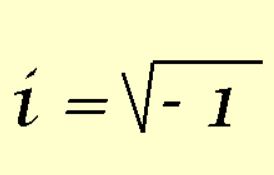
What are complex numbers? What does “i” mean, anyway?  How can a number be “imaginary“?   What does it mean to multiply “i” exactly “i” times?  Why is math hard?

For me, math is difficult because it’s interesting.  I learn things from equations that aren’t obvious when I think about the world using words and images. Some things can’t be put into words. Some things can’t be pictured.

It’s true.

What makes i^i interesting is the four real numbers it generates. (The numbers are +.2078… , -.2078… , +4.8104… , and -4.8104… .)

Can anyone give a geometric reason why an imaginary number raised to the power of an imaginary number generates four real numbers and no imaginary ones?

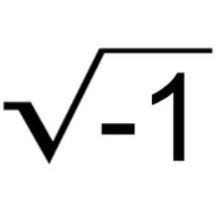
What does \sqrt{-1}^{\sqrt{-1}} even mean? Is there anyone who can visualize a reason why the answers make sense? Are all the answers even correct? Or is only one correct, as any calculator that can do the calculation will tell?


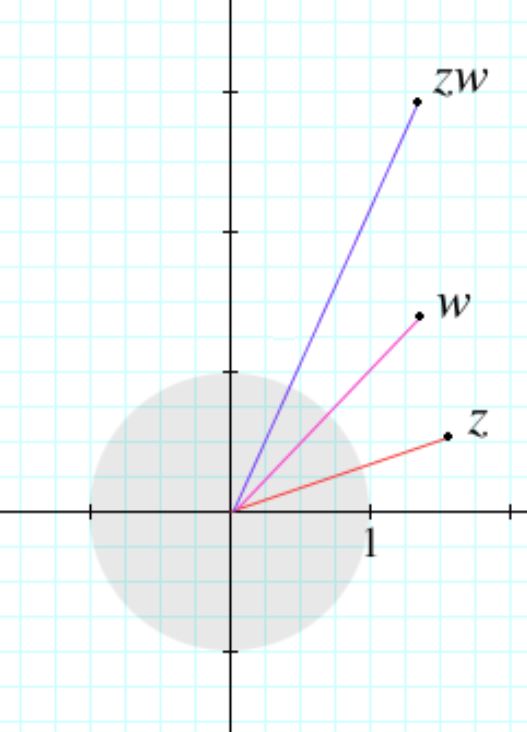
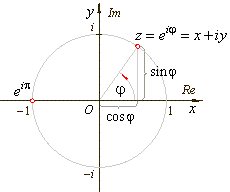
Complex numbers are two-dimensional numbers that are made by raising the number ”e” to the power of an imaginary number — called ”i” — times an angle in radians. Complex numbers lie on a circle in the complex number plane. Unless ”e” is preceded by a number that stretches or shrinks it, the numbers always lie on a unit circle like the one in the picture. Recall that ”i” is the square root of minus one. When ”i” is raised to the power of ”i”, the result collapses onto the real number line — in one of four possible places. Which one? The numbers don’t land on the unit circle. The process can be demonstrated mathematically, but any physical intuition about why imaginary numbers with imaginary exponents behave the way they do can be elusive.

Abstract math that hides no model that anyone can visualize makes results startling, even unnerving. It’s a lot like the quantum mechanics of entanglement or the physical meaning of gravity. They can be mathematically described and their effects accurately predicted, but no one can explain why.   

Mathematics alone can sometimes describe (or at least approximate) realities of the universe and how it seems to work, but as often as not when humans dive deep into the abyss of ultimate knowledge, math is unable to provide a picture that anyone can understand. 

How can that be? Things seem to happen that cannot be thought about except by playing around with numbers and being taken by surprise. Intuition is difficult, if not impossible.

Here is the solution of  i^i. Perhaps clues exist in the math that I’ve overlooked. If a model exists in the mind of a reader somewhere, I hope they will share it with me.


(1)       i^i = e^{\ln(i^i)} = e^{i\ln(i)} = cos (ln i) + i sin (ln i)

By definition:  e^{i\frac{\pi}{2}} = i

Also:  ln {(e^{i\frac{\pi}{2}})} = ln i

Therefore:     ln i =  i (\frac{\pi}{2})

It should now be obvious to anyone who has taken a basic course in complex variables that multiplying i (\frac{\pi}{2}) by i equals the exponent on e in line (1).

Right?

It’s a real number that returns a real result when used as the exponent of e and plugged into a calculator.  The answer is completely abstract, though. We might learn more if we take a different path to the result.   

By substitution into line (1):    i^i = cos (i\frac{\pi}{2}) + i sin (i\frac{\pi}{2})

By half angle formulas:             i^i  = (\sqrt\frac{1 + cos (i\pi)}{2}) + i (\sqrt\frac{1 - cos (i\pi)}{2})

Convert 2nd term i to  \sqrt -1 :

i^i  = (\sqrt\frac{1 + cos (i\pi)}{2}) + \sqrt -1 (\sqrt\frac{1 - cos (i\pi)}{2})

(2)     Simplify the 2nd term:     i^i  = (\sqrt\frac{1 + cos (i\pi)}{2}) + (\sqrt\frac{cos (i\pi)-1}{2})

Euler’s cosine identity is:   cos θ =  \frac{e^{i\theta} + e^{-i\theta}}{2}

Therefore:                          cos (iπ) =  \frac{e^{i(i\pi)} + e^{-i(i\pi)}}{2}

(3)     Simplifying:               cos (iπ) =  \frac{e^{-\pi} + e^{\pi}}{2}

Substitute line (3) into line (2) and simplify:

i^i  = \sqrt{{\frac{1}{2} + \frac{e^{-\pi} + e^{\pi}}{4}}} + \sqrt{{\frac{e^{-\pi} + e^{\pi}}{4}} - \frac{1}{2}}

Now it’s just a matter of pulling out an old calculator and punching the keys.

e^{-\pi} = .043214;  e^{\pi} = 23.140693. 

I rounded off both numbers, because they seem to go on forever like π and “e”; they prolly are irrational, because they don’t seem able to be formed from ratios of whole numbers. [In fact, they are transcendental numbers, because they transcend algebra. In addition to being irrational, they are not roots of any finite degree polynomial with rational coefficients. Take my word.] Using these numbers will enable anyone to compute {i^i} who has a simple calculator with a square root key.


When square roots are calculated the answers can be positive or negative. Two negatives make a positive, right? So do two positives. So doing the math gives four numbers. See if your numbers match mine: .2078… , -.2078… , 4.1084… , and -4.1084… .

I don’t know why. The answers aren’t intuitive. Who would guess that imaginary numbers raised to powers of imaginary numbers yield real numbers? — not a solitary number like anyone might expect, but four. Pick one. In nature a unique answer can be arbitrary — determined by chance, most likely.

In this case, no.


It feels to me like the imaginary fairies flying around in complex space are destined to collapse onto the real number line for no good reason, except that the math says they must collapse (maybe from exhaustion?) in at least one of four places. Can anyone make sense of it?

The ln i is well known. It is —   i\frac{\pi}{2}  — which equals (1.57078… i ). The ln of —   i^i   — can be rewritten by the rules of logarithms as i ln i, which is i times (1.57078…i ), which equals -1.57078… (a real number).  Right? The ln of the correct answer must equal this number. Only one of the four results listed above has the right ln value: .2078… .

It seems odd that a set of equations I know to be sound should return a set of results from which only one can be validated by back-checking. Maybe there is something esoteric and arcane in the mathematics of logarithms that I missed during my education along the way.

Then again square roots can be messy; there are two square roots in the final equation, each of which can be evaluated as positive or negative. Together they produce four possible answers, but just one result seems to be the right one.

Adding the four numbers is kind of interesting. They sum to zero. That is so like the way the universe seems to work, isn’t it? When everything is added up, physicists like Stephen Hawking claim, there’s really nothing here. Everything is imaginary. Some philosophers agree: everything that is real is at its core imaginary.

Are there clues in the pictures and models of complex number space that would ever make anyone think? Sure, I totally get it. Yeah, I’ve got this. Real numbers cascading out of imaginary powers of imaginary numbers make perfect sense — like snowflakes falling from a dark sky.

A mathematician told me, Rotating and scaling is all it is. The base must be the imaginary ”i” alone; ”i” is the key that unlocks everything. The power of the key can be any imaginary number at all; ”i” is why the result of every imaginary power of ”i” becomes real. 

The explanation calms me; but it seems somehow incomplete; it’s missing something; in my gut I feel like it can’t be entirely right, though it purports to persuade what the math insists is truth

Believe, for now at least, and move on.

Billy Lee

WHAT IS e exp (-i π) ?

What is e^{-i\pi} ?

I posted a long answer on Quora.com where it sort of didn’t do well.

Answers given by others were much shorter but they seemed, at least to me, to lack geometric insights. After two days my answer was ranked as the most read, but for some reason no one upvoted it. It did receive a few positive replies though.

I can’t help but believe that there must be nerds in cyberspace who might enjoy my answer. Why not post it on my blog? Maybe someday one of my grandkids will get interested in math and read it.

Who knows?

Anyway, below is a pic and a working GIF, which should help folks understand better. Anyone who doesn’t understand something can always click on a link for more information. 

Here is the drawing I added and the answer:


This diagram is excellent but contains a mystery point not on the unit circle — {i^i}. The point is shown at .2078… on the real number line.  An imaginary number raised to the power of an imaginary number yields a result that is a real number. How can that be? It’s something to ponder; something to think about. The Editorial Board 

What is e^{-i\pi} ?

The expression evaluates to minus one; the answer is (-1). Why?

Numbers like these are called complex numbers. They are two-dimensional numbers that can be drawn on graph-paper instead of on a one-dimensional number line, like the counting numbers. They are used to analyze wave functions — i.e. phenomenon that are repetitive — like alternating current in the field of electrical engineering, for example.


A simplified explanation of {i^i} starts at 02:30.


“e” is a number that cannot be written as a fraction (or a ratio of whole numbers). It is an irrational number (like π, for instance). It can be approximated by adding up an arbitrary number of terms in a certain infinite series to reach whatever level of precision one wants. To work with “e” in practical problems, it must be rounded off to some convenient number of decimal places.

Punch “e” into a calculator and it returns the value 2.7182…. The beauty of working with “e” is that derivatives and integrals of functions based on exponential powers of “e” are easy to calculate. Both the integral and the derivative of e is ex  — a happy circumstance that makes the number “e” unusually curious and extraordinarily useful in every discipline where calculus is necessary for analysis. 

What is “e” raised to the power of (-iπ) ?


A wonderful feature of the mathematics of complex numbers is that all the values of expressions that involve the number “e” raised to the power of “i” times anything lie on the edge (or perimeter) of a circle of radius 1. This feature makes understanding the expressions easy.

I should mention that any point in the complex plane can be reached by adding a number in front of e^{i\theta} to stretch or shrink the unit circle of values. We aren’t going to go there. In this essay “e” is always preceded by the number “one“, which by convention is never shown.

The number next to the letter “i” is simply the angle in radians where the answer lies on the circle. What is a radian?  It’s the radius of the circle, of course, which in a unit circle is always “one”, right? 

Wrap that distance around the circle starting at the right and working counter-clockwise to the left. Draw a line from the center of the circle at the angle (the number of radius pieces) specified in the exponent of “e” and it will intersect the circle at the value of the expression. What could be easier?

For the particular question we are struggling to answer, the number in the exponent next to “i” is (-π), correct?

“π radians” is 3.14159… radius pieces — or 180° — right? The minus sign is simply a direction indicator that in this case tells us to move clockwise around the unit circle — instead of counter-clockwise were the sign positive.

After drawing a unit circle on graph paper, place your pencil at (1 + 0i)—located at zero radians (or zero degrees) — and trace 180° clockwise around the circle. Remember that the circle’s radius is one and its center is located at zero, which in two dimensional, complex space is (0 + 0i). You will end up at the value (-1 + 0i) on the opposite side of the circle, which is the answer, by the way.

[Trace the diagram several paragraphs above with your finger if you don’t have graph paper and a pencil. No worries.]

Notice that +π radians takes you to the same place as -π radians, right?  Counter clockwise or clockwise, the value you will land on is (-1 + 0i), which is -1. The answer is minus one.

Imagine that the number next to “i” is (π/2) radians (1.57… radius pieces). That’s 90°, agreed? The sign is positive, so trace the circle 90° counter-clockwise. You end at (0 + i), which is straight up. “i” in this case is a distance of one unit upward from the horizontal number line, so write the number as (0 + i) — zero distance in the horizontal direction and “plus one” distance in the “i” (or vertical) direction.

So, the “i” in the exponent of “e” says to “look here” to find the angle where the value of the answer lies on the unit circle; on the other hand, the “i” in the rectangular coordinates of a two-dimensional number like (0 + i) says “look here” to find the vertical distance above or below the horizontal number line.

When evaluating “e” raised to the power of “i” times anything, the angle next to “i”—call it “θ”—can be transformed into rectangular coordinates by using this expression: [cos(θ) + i sin(θ)].

For example: say that the exponent of “e” is i(π/3).  (π/3) radians (1.047… radius pieces) wraps around the circumference to 60°, right? The cosine of 60° is 0.5 and the sine of 60° is .866….

So the value of “e” raised to the power of i(π/3) is by substitution (0.5 + .866… i ). It is a two-dimensional number. And it lies on the unit circle.

The bigger the exponent on “e” the more times someone will have to trace around the circle to land at the answer. But they never leave the circle. The result is always found on the circle between 0 and 2π radians (or 0° and 360°) no matter how large the exponent.

It’s why these expressions involving “e” and “i” are ideal for working with repetitive, sinusoidal (wave-like) phenomenon.


In this essay Billy Lee uses θ in place of the Greek letter φ shown in this GIF.  Remember that ”r” equals ”one” in a unit circle, so it’s typically not shown. The Editorial Board

In case some readers are still wondering about what radians are, let’s review:

A radian is the radius of a circle, which can be lifted and bent to fit perfectly on the edge of the circle. It takes a little more than three radius pieces (3.14159… to be more precise) to wrap from zero degrees to half-way around any circle of any size. This number — 3.14159… — is the number called “π”.   2π radians are a little bit more than six-and-a-quarter radians (radius pieces), which will completely span the perimeter (or circumference) of a circle.

A radian is about 57.3° of arc. Multiply 3.1416 by 57.3° to see how close to 180° it is. I get 180.01… . The result is really close to 180° considering that both numbers are irrational and rounded off to only a few decimal places.

One of the rules of working with complex numbers is this: multiplying any number by “i” rotates that number by 90°. The number “i” is always located at 90° on the unit circle by definition, right? By the rule, multiplying “i” by “i” rotates it another 90° counter-clockwise, which moves it to 180° on the circle.

180° on the unit circle is the point (-1 + 0i), which is minus one, right?

So yes, absolutely, “i” times “i” is equal to -1.  It follows that the square root of minus one must be “i”. Thought of in this way, the square root of a minus one isn’t mysterious.

It is helpful to think of complex numbers as two dimensional numbers with real and imaginary components. There is nothing imaginary, though, about the vertical component of a two-dimensional number.

The people who came up with these numbers thought they were imagining things. The idea that two-dimensional numbers can exist on a plane was too radical at the time for anyone to believe.  Numbers, they believed, only existed on a one-dimensional number line of one dimension and no place else.

Of course they were mistaken.  Numbers can live in two, three, or even more dimensions. They can be as multi-dimensional as needed to solve whatever the mysteries of mathematical analysis might require.

Click the link, “What is Math?” for another explanation.

Billy Lee

RISK

Everyone wants to live as long as possible, right? Well, maybe not everyone.

Someone confided in me that their nightmare was they wouldn’t die; they would never get respite from an existence that terrified them, that depressed them, that hurt them, that disappointed and discouraged them; that humiliated them; that abused them; that made them wish they were never born.

Another friend confessed that she wished she had never been born because she was afraid to die. The certainty of death made living not worth the trouble. Anxiety about the end of life robbed her of joy. She found that she was unable to kick back and relax, because dark angels circled just outside her field of vision; one day, she was certain, the angels were going to pounce. The end would be brutal.

I remember hearing a story about a young mother who lay dying while her family knelt at her bedside. A scene of sweet-sorrow unfolded as the woman struggled to breathe in the presence of loved-ones. A worried husband, anxious toddlers, her parents, and a few close friends sang hymns to reassure and cast comfort. They clung to one another united by the belief that God would carry momma gently to heaven in his caring arms.

Momma didn’t experience death that way. She bolted up, away from her pillow. She stared wild-eyed at something behind her visitors; something no one saw.

She screamed. No! No! No! 

Momma dropped off the bed, slammed to the floor, and rolled onto her back making a loud crack — like a toppled refrigerator. She stared at the ceiling, face frozen, eyes open; crazed, except that now she was dead and too heavy for anyone to move.


Steve McQueen died at age 50 from cardiac arrest at a cancer treatment facility in Mexico in 1980. He made thirty movies; many were blockbusters.

Some people love life and don’t want to leave. I remember Steve McQueen, an actor from yesteryear who had everything to live for. He was a happy race-car enthusiast, a leading man in movies, incredibly handsome, kind, and grateful for every blessing his wonderful life showered on him.

He got cancer. Stateside doctors told him he had no chance. Death was certain. He traveled to Mexico to seek out a cancer recovery center he learned about from friends.

I remember hearing him weep during a radio interview because, he said, the medical director had saved his life. He thanked him again and again. He couldn’t say it enough. I felt touched. He loved life; his gratitude seemed to resonate with the voices of the angels. I would have gladly traded places with him.

Two days later, the newspapers and television news shows reported that he died. What went through his mind when he finally realized that his life wasn’t going to turn out the way he planned?

For people who seek death, death is easy to find — if they have the courage to face what comes after; if the pain of living exceeds the risks of non-existence or the risks of being reborn as someone new or the possibility of falling into the pits of Hell or wherever they imagine might lie the alternative to the pain of life on Earth. Relief is as close as the closeted gun, the nearest bridge, the bottle of medicine in the bathroom cabinet.

I feel bad for people who have been ruined, I do. Far more people kill themselves than are killed by others. No one believes it, but it’s true.

I don’t want to dwell on the ruined, because another class of people — a smaller group, I sometimes wonder — want to live.


The man shown in this pic (from 2011) was active and working at age 106. He and hundreds like him have been the subject of scientific studies about human longevity. They are kind and gentle people who enjoy life by all accounts; they wish only to live as long as possible.

These are the folks who never suffer from depression; experience a major illness; spend time in hospital or prison; lose a child or spouse; worry about the sparkle of a crooked tooth or the part on their head of radiant hair. They don’t worry about any lack of symmetry that might render them unattractive — or about getting their way in life, because they always do.

I want to talk about the powerful, beautiful, effective people who everyone seems to want to be. I want to talk about the happy people like Steve McQueen who will always chase a fantasy, because they want to live in the worst, most desperate way.

I want to talk about the people who freeze themselves in the hope that in a benevolent future they will be thawed, and life will continue; I want to talk about the people who take 150 pills a day to prevent every ailment and strengthen every sinew.

I want to talk about the brilliant, optimistic people who expect that if they can just figure things out the right way, life awaits them for as long as they want it.  It’s all up to them. They will find a way to make life last; to achieve an eternal success, because they always have.

Is it time for a reality check?

Is this a good time to reveal some truths? — shocking truths, perhaps, for a few readers?  I want to predict our futures — all of our futures — as separate individuals with private lives; and as a species — a species anthropologists describe by the Latin words, homo sapiens, (smart people), which they use among themselves to differentiate you and me from all the other groups of living things we rarely notice or even think about.

Let’s smarten up for a few moments and defend our reputation among the kingdoms of the animals and the plants. Let’s think about best case scenarios for survival and whether we can make our dreams come true.

One statistic to keep in mind that is easily verified (and it might startle some readers): two-thirds of all deaths are not caused by aging.

So let’s move on.

Who wants to start with species survival? Who would rather address the riddle about how to lengthen an individual life?

Ok, the responses I think I hear in my head are nearly unanimous. People want to know how they themselves can live longer, correct?  People want to know how long they will live when everything is set right.

So, why not start with a best case scenario for individuals?  I promise to address the issues of survival for homo sapiens later, after a few paragraphs more.

Here are some simple, best-case-scenario assumptions:

Assume that disease is eradicated. We reach a state under the protections of ObamaCare (or maybe Trump-Care, who knows?) where no one dies in hospital anymore; all diseases have cures and can be prevented; in fact, disease is eliminated from the face of the earth — no bacterial or viral infections; no malevolent genes gone haywire; no Alzheimer’s or mental impairments; no more skin rashes or herpes or warts or annoying ear-wax that morphs into septic brain infections.

Disease is gone. Now take another step. Make a leap of faith. Assume that the genetics of aging is solved and that no one grows old. No one deteriorates. Skin does not wrinkle; no more age spots or rotting teeth; loss of hair and muscle-mass becomes a thing of the past. Aches and pains and constipation and diarrhea and acid reflux — what be them? They gone!

Our long medical nightmare is over, to paraphrase the words of President Gerald Ford on the night he pardoned Dick Nixon so that no prosecutor could ever charge and convict him for being a crook and throwing an election.

OK. What now become the odds for our survival?  How long can one person expect to live?  I think everyone can see, there’s something we didn’t consider; one thing no one thought of; a missing piece in the puzzle of living-large that is going to leap up and grab each of us sooner or later — unless we live bundled by bubble-wrap in a bunker, miles below the surface of the earth. We all know what it is, right?

It happens when we bike on a country road, and a candy-coking cell-talker in a Corvette runs us over. It happens when we climb Mount Everest (just to cross it off our bucket-list) and whoops! someone in the group forgot to tie their shoelaces. People see a video on the evening news — dead people buried in snow.

It happens when flying an airplane — a flock of geese smashes the windscreen. The pilot gets sucked out the opening — shredded by shards of glass.

We visit an amusement park to thrill ourselves on a ride that throws us upside down and — oops again! — an unscheduled stop; a mechanical malfunction. Two hours later, rescued, we’re vegetables. Homo sapiens don’t do well hanging upside down for long periods.

Yes, the one thing no one counted on is accidents.


Accidents kill a lot of people every single day. And nothing is going to change that fact unless people decide to live in virtual reality and never get off the couch to go outdoors or walk their dog.

What exactly are the statistics of accidents?

Well, every year one person in a thousand dies in a screw-up by somebody, usually themselves. It doesn’t sound like much, but for the person who dies it’s one death too many. Anyone who expects to live 25,000 years should perform a statistical analysis to see what the chances are they will live that long.

Why guess?

The way the math works is this: figure the chances of living deadly-accident-free for one year (it’s 999/1000), then multiply this number by itself for each year of life.

Save time by using the exponent key on a calculator to enter years, anyone who doesn’t want to spend a week multiplying the same number over and over 25,000 times. The result will give the chances for survival over a span of that many years. Try some other numbers to make comparisons.

The bottom line is this: no one has any realistic hope at all of living more than 10,000 years or so. Of the seven billion humans alive today, only one in 22,000 can expect to live to the age 10,000.

A mere 2,000 people out of 7,000,000,000 will survive to see year 15,000. There’s a small chance (one in ten) that a solitary person might make it to 25,000 years, but they will be an outlier; a statistical anomaly. Who wants to be an anomaly?  Not me.

In most cases; under the most realistic scenarios, the chances are that everyone alive today is going to be dead at age 25,000 because of accidents alone. They will die healthy though. It might be consolation for some.

No one will make it to year 25,000. That’s my bet. It’s not going to happen 90% of the time. 

Accidents happen.

OK. Now that everybody knows that our individual situation is hopeless, what about the survival of our species — the human race (for those who disdain the scientific term, homo sapiens)?


Not sure why this video, but it’s pretty good, so let’s go with it. 


I am sorry to report that the survival odds for our species are actually far worse than the odds for our survival as individuals. This depressing fact means that we can totally ignore the individual survival scenario we just took so much effort to describe. If our species dies-off early, individuals are going to die early too.

How can this terrible situation be possible? It seems so unfair.

I’ve been reading the book Global Catastrophic Risks — a collection of essays edited by Nick Bostrom and Milan M. Cirkovic — first published nine years ago (in 2008) when species survival was more certain than it is now. These brilliant men collected essays written by other forward-thinking geniuses who describe in delirious detail thirteen (or so) existential threats to the survival of humans. Some readers might want to review the list.

1 – Systems-based risks and failures

2 – Super-volcanism

3 – Comets and asteroids

4 – Supernovae, gamma-ray bursts, solar flares, and cosmic rays

5 – Climate change

6 – Plagues and pandemics

7 – Artificial intelligence

8 – Social collapse

9 – Nuclear War

10 – Nuclear Terrorism

11 – Biotechnology

12 – Nanotechnology

13 – Totalitarianism

The authors argue that certain scenarios involving these threats will create an inevitable cascade of events that lead to the melt-down of civilization and a kill-strike against the human-species. I decided to assign a 1 in 10,000 chance of occurrence to each of these 13 catastrophes and crunch the numbers to understand how much danger people on Earth might be facing.

What I discovered scared me.


A super-volcano eruption in Toba, Indonesia 70,000 years ago reduced the population of humans on Earth to less than 4,000. Volcanoes that we know about today, like the one under Yellowstone National Park, might be larger and more dangerous.  

For one thing, it’s not possible to know if 1 in 10,000 is an optimistic or pessimistic assessment of each of these risks. Nuclear war might be 1 in 100; climate change — 1 in 50; asteroids — 1 in 50,000; supernovae — 1 in 100,000,000; artificial intelligence — 1 in 10.

Who knows?

Can humans survive 10,000 years without a pandemic or nuclear war? No one knows.

Experts resort to heuristics, which erupt from biases even they don’t know they carry. I suppose a gut-check by an expert has more validity than a seat-of-the-pants guess by a pontificator. I will give you that. But the irony is that no matter who is right, no one will know because we are all going to die.

Evidence in the fossil and genetic record already shows that at least three human-like species are known to have come and gone during the past several 100,000 years or so, including Neanderthals and Denisovans. Extinction of intelligent, human-like species happens more often than not — 3 out of 4 times, maybe more if scientists continue to dig and look.

Number-crunching shows that if my 1 in 10,000 or so years risk assessments are anywhere close to being realistic, humans have no more than a 1 in 4 chance to avoid extinction during the next 1,000 years. Our chance to survive approaches zero as the number of years reaches into the realm of 5,000 years and beyond.

Humans have recorded their stories for 5,000 years. Some call these stories, history. Sometime during the next 5,000 years, history will end unless humans lower the odds of these catastrophes to much less than 1 in 10,000.


We are truly stupid — dumber than earthworms — to refuse to make the effort to increase our survival prospects by lowering these probabilities, these ratios, to one-in-one-hundred-thousand or better still, one-in-a-million or even better, one-in-one-hundred million. Why not one-in-a-gazillion?

How? It’s the big question.

Reducing odds of catastrophe is the most important thing. It’s urgent. Failure seals our fate.

We search the heavens. No one seems to be broadcasting from out there. Maybe it’s something simple like Miyake events, which some argue make communication infrastructure near stars impossible to sustain.  

What science hears is silence… and tiny chirps, yes, but not from crickets.

Doomsday clocks? 

They’re ticking.

Billy Lee

RENORMALIZATION

I have a lot to say about renormalization; if I wait until I’ve read everything I need to know about it, my essay will never be written; I’ll die first; there isn’t enough time.

Click this link and the one above to read what some experts argue is the why and how of renormalization. Do it after reading my essay, though.


Our guess is that this graphic will be incomprehensible to the typical reader of Billy Lee’s blog. So, don’t worry about it. Billy Lee isn’t going to explain it, anyway. More important things need to be told that everyone can understand, and they will. The Editorial Board

There’s a problem inside the science of science; there always has been. Facts don’t match the mathematics of theories people invent to explain them. Math seems to remove important ambiguities that underlie all reality.

People noticed the problem as soon as they started doing science. The diameter of a circle and its circumference was never certain; not when Pythagoras studied it 2,500 years ago or now; the number π is the problem; it’s irrational, not a fraction; it’s a number with no end and no pattern — 3.14159…forever into infinity.

More confounding, π is a number which transcends all attempts by algebra to compute it. It is a transcendental number that lies on the crossroads of mathematics and physical reality — a mysterious number at the heart of creation because without it the diameters, surface areas, and volumes of spheres could not be calculated with arbitrary precision. 


For a circle, either the circumference or the diameter can be rational (written as a fraction) but not both. Perfect circles and spheres cannot exist in nature. Why?  ”π” is irrational. It can’t be written like a fraction —  a ratio — where one integer divides another.

The diameter of a circle must be multiplied by π to calculate its circumference; and vice-versa. No one can ever know everything about a circle because the number π is uncertain, undecidable, and in truth unknowable. 

Long ago people learned to use the fraction 22 / 7 or, for more accuracy, 355 / 113These fractions gave the wrong value for π but they were easy to work with and close enough to do engineering problems.

Fast forward to Isaac Newton, the English astronomer and mathematician, who studied the motion of the planets. Newton published Philosophiæ Naturalis Principia Mathematica in 1687. I have a modern copy in my library. It’s filled with formulas and derivations. Not one of them works to explain the real world — not one.

Newton’s equation for gravity describes the interaction between two objects — the strength of attraction between Sun and Earth, for example, and the resulting motion of Earth. The problem is the Moon and Mars and Venus, and many other bodies, warp the space-time waters in the pool where Earth and Sun swim. No way exists to write a formula to determine the future of such a system.


This simple three-body problem cannot be solved using a single equation. It’s not so simple. More than three bodies makes systems like these much harder to work with.

In 1887 Henri Poincare and Heinrich Bruns proved that such formulas cannot be written. The three-body problem (or any N-body problem, for that matter) cannot be solved by a single equation. Fudge-factors must be introduced by hand, Richard Feynman once complained. Powerful computers combined with numerical methods seem to work well enough for some problems. 

Perturbation theory was proposed and developed. It helped a lot. Space exploration depends on it. It’s not perfect, though. Sometimes another fudge factor called rectification is needed to update changes as a system evolves. When NASA lands probes on Mars, no one knows exactly where the crafts are located on its surface relative to any reference point on the Earth.

Science uses perturbation methods in quantum mechanics and astronomy to describe the motions of both the very small and the very large. A general method of perturbations can be described in mathematics. 

Even when using the signals from constellations of six or more Global Positioning Systems (GPS) deployed in high earth-orbit by various countries, it’s not possible to know exactly where anything is. Beet farmers out west combine the GPS systems of at least two countries to hone the courses of their tractors and plows.

On a good day farmers can locate a row of beets to within an eighth of an inch. That’s plenty good, but the several GPS systems they depend on are fragile and cost billions per year. In beet farming, an eighth inch isn’t perfect, but it’s close enough.

Quantum physics is another frontier of knowledge that presents roadblocks to precision. Physicists have invented more excuses for why they can’t get anything exactly right than probably any other group of scientists. Quantum physics is about a hundred years old, but today the problems seem more insurmountable than ever.


The sub-atomic world seems to be smeared and messy. Vast numbers of particles — virtual and actual — makes the use of mathematics problematic. This pic is an artist’s conception. Concepts such as ”looks like” have no meaning at sub-atomic scales, because small things can’t be resolved by any frequency of light that enables them to be visualized realistically by humans.

Insurmountable?

Why?

Well, the interaction of sub-atomic particles with themselves combined with, I don’t know, their interactions with swarms of virtual particles might disrupt the expected correlations between theories and experimental results. The mismatches can be spectacular. They sometimes dwarf the N-body problems of astronomy.

Worse — there is the problem of scales. For one thing, electrical forces are a billion times a billion times a billion times a billion times stronger than gravitational forces at sub-atomic scales. Forces appear to manifest themselves according to the distances across which they interact. It’s odd.

Measuring the charge on electrons produces different results depending on their energy. High energy electrons interact strongly; low energy electrons, not so much. So again, how can experimental results lead to theories that are both accurate and predictive? Divergent amplitudes that lead to infinities aren’t helpful.

An infinity of scales pile up to produce troublesome infinities in the math, which tend to erode the predictive usefulness of formulas and diagrams. Once again, researchers are forced to fabricate fudge-factors. Renormalization is the buzzword for several popular methods.

Probably the best-known renormalization technique was described by Shinichiro Tomonaga in his 1965 Nobel Prize speech. According to the view of retired Harvard physicist Rodney Brooks, Tomonaga implied that  …replacing the calculated values of mass and charge, infinite though they may be, with the experimental values… is the adjustment necessary to make things right, at least sometimes. 

Isn’t such an approach akin to cheating? — at least to working theorists worth their salt?  Well, maybe… but as far as I know results are all that matter. Truncation and faulty data mean that math can never match well with physical reality, anyway. 

Folks who developed the theory of quantum electrodynamics (QED) used perturbation methods to bootstrap their ideas to useful explanations. Their work produced annoying infinities until they introduced creative renormalization techniques to chase them away.

At first physicists felt uncomfortable discarding the infinities that showed up in their equations; they hated introducing fudge-factors. Maybe they felt they were smearing theories with experimental results that weren’t necessarily accurate. Some may have thought that a poor match between math, theory, and experimental results meant something bad; they didn’t understand the hidden truth they struggled to lay bare.

Philosopher Robert Pirsig believed the number of possible explanations scientists could invent for phenomena were in fact unlimited. Despite all the math and convolutions of math, Pirsig believed something mysterious and intangible like quality or morality guided human understanding of the Cosmos. An infinity of notions he saw floating inside his mind drove him insane, at least in the years before he wrote his classic Zen and the Art of Motorcycle Maintenance.

The newest generation of scientists aren’t embarrassed by anomalies. They “shut up and calculate.” Digital somersaults executed to validate their work are impossible for average people to understand, much less perform. Researchers determine scales, introduce “cut-offs“, and extract the appropriate physics to make suitable matches of their math with experimental results. They put the horse before the cart more times than not, some observers might say.


Apologists say, no. Renormalization is simply a reshuffling of parameters in a theory to prevent its failure. Renormalization doesn’t sweep infinities under the rug; it is a set of techniques scientists use to make useful predictions in the face of divergences, infinities, and blowup of scales which might otherwise wreck progress in quantum physics, condensed matter physics, and even statistics. From YouTube video above.

It’s not always wise to question smart folks, but renormalization seems a bit desperate, at least to my way of thinking. Is there a better way?

The complexity of the language scientists use to understand and explain the world of the very small is a convincing clue that they could be missing pieces of puzzles, which might not be solvable by humans regardless how much IQ any petri-dish of gametes might deliver to brains of future scientists.

It’s possible that humans, who use language and mathematics to ponder and explain, are not properly hardwired to model complexities of the universe. Folks lack brainpower enough to create algorithms for ultimate understanding.

People are like the first Commodore 64 computers (remember?) who need upgrades to become more like Sunway TaihuLight or Cray XK7 Titan super-computers to have any chance at all.

Perhaps Elon Musk’s Neuralink add-ons will help someday. 


Nick Bostrom, author of SUPERINTELLIGENCE – Paths, Dangers, Strategies

The smartest thinkers — people like Nick Bostrom and Pedro Domingos (who wrote The Master Algorithm) — suggest artificial super-intelligence might be developed and hardwired with hundreds or thousands of levels — each  loaded with trillions of parallel links —  to digest all meta-data, books, videos, and internet information (a complete library of human knowledge) to train armies of computers to discover paths to knowledge unreachable by puny humanoid intelligence.

Super-intelligent computer systems might achieve understanding in days or weeks that all humans working together over millennia might never acquire. The risk of course is that such intelligence, when unleashed, might enslave us all.

Another downside might involve communication between humans and machines. Think of a father — a math professor — teaching calculus to the family cat. It’s hopeless, right? 

The founder of Google and Alphabet Inc., Larry Page, who graduated from the same school as one of my sons, is perfecting artificial super-intelligence. He owns a piece of Tesla Motors, started by Elon Musk of SpaceX.

Imagine an expert in AI & quantum computation joining forces with billionaire Musk who possesses the rocket launching power of a country. Right now, neither is getting along, Elon said. They don’t speak. It could be a good thing, right? 

What are the consequences?

Entrepreneurs don’t like to be regulated. Temptations unleashed by unregulated military power and AI attained science secrets falling into the hands of two men — nice men like Elon and Larry appear to be — might push humanity in time to unmitigated… what’s the word I’m looking for?

I heard Elon say he doesn’t like regulation, but he wants to be regulated. He believes super-intelligence will be civilization ending. He’s planning to put a colony on Mars to escape its power and ensure human survival.


Elon Musk

Is Elon saying he doesn’t trust himself, that he doesn’t trust people he knows like Larry? Are these guys demanding governments save Earth from themselves?

I haven’t heard Larry ask for anything like that. He keeps a low profile. God bless him as he collects everything everyone says and does in cyber-space. 

Think about it.

Think about what it means.

We have maybe ten years, tops; maybe less. Maybe it’s ten days. Maybe the worst has already happened, but no one said anything. Somebody, think of something — fast.

Who imagined that laissez-faire capitalism might someday spawn an airtight autocracy that enslaves the world?

Ayn Rand?

Humans are wise to renormalize their aspirations — their civilizations — before infinities of misery wreck Earth and freeless futures emerge that no one wants.

Billy Lee 

FINE-STRUCTURE CONSTANT

What is the fine-structure constant?


Many smart physicists wonder about it; some obsess over it; a few have gone mad. Physicists like the late Richard Feynman said that it’s not something any human can or will ever understand; it’s a rabbit-hole that quantum physicists must stand beside and peer into to do their work; but for heaven’s sake don’t rappel into its depths. No one who does has ever returned and talked sense about it.

I’m a Pontificator, not a scientist. I hope I don’t start to regret writing this essay. I hope I don’t make an ass of myself as I dare to go where angels fear to tread.

My plan is to explain a mystery of existence that can’t be explained — even to people who have math skills, which I am certain most of my readers don’t. Lack of skills should not trouble anyone, because if anyone has them, they won’t understand my explanation anyway.

My destiny is failure. I don’t care. My promise, as always, is accuracy. If people point out errors, I fix them. I write to understand; to discover and learn.

My recommendation to readers is to take a dose of whatever medicine calms their nerves; to swallow whatever stimulant might ignite electrical fires in their brains; to inhale, if necessary, doctor-prescribed drugs to amplify conscious experience and broaden their view of the cosmos. Take a trip with me; let me guide you. When we’re done, you will know nothing about the fine-structure constant except its value and a few ways curious people think about it.

Oh yes, we’re going to rappel into the depths of the rabbit-hole, I most certainly assure you, but we’ll descend into the abyss together. When we get lost (and we most certainly will) — should we fall into despair and abandon our will to fight our way back — we’ll have a good laugh; we’ll cry; we’ll fall to our knees; we’ll become hysterics; we’ll roll on the soft grass we can feel but not see; we will weep the loud belly-laugh sobs of the hopelessly confused and completely insane — always together, whenever necessary.


spelunkers-caving-rabbit-hole-fine-structure
We will get lost together. This rabbit-hole is the Krubera Cave of Abkhazia land. It is the deepest cave in the world. Notice the tiny humans, for scale.

Isn’t getting lost with a friend what makes life worth living? Everyone gets lost eventually; it’s better when we get lost together. Getting lost with someone who doesn’t give a care; who won’t even pretend to understand the simplest things about the deep, dark places that lie miles beyond our grasp; that lie beneath our feet; that lie, in some cases, just behind our eyeballs; it’s what living large is all about.

Isn’t it?


Well, for those who fear getting lost, what follows is a map to important rooms in the rather elaborate labyrinth of this essay. Click on subheadings to wander about in the caverns of knowledge wherever you will. Don’t blame me if you miss amazing stuff.  Amazing is what hides within and between the rooms for anyone to discover who has the serenity to take their time, follow the spelunking Sherpa (me), and trust that he (me) will extricate them eventually — sane and unharmed.  

1 — Complex Numbers, Probabilities, and Vectors
2 — Elementary particles
3 — Coupling constants
4 — Irrational numbers and music 
5 — Gravity and Relativity 
6 — Fine Structure: What is it, exactly?
7 — Mystic and numerology secrets of 137
8 — Why alpha (α)?
9 — Twelve whys for alpha (α) 
10 — Deepest mystery 
11 — Summary
12 — Avoiding the rabbit hole


Anyway, relax. Don’t be nervous. The fine-structure constant is simply a number — a pure number. It has no meaning. It stands for nothing — not inches or feet or speed or weight; not anything. What can be more harmless than a number that has no meaning?

Well, most physicists think it reveals, somehow, something fundamental and complicated going on in the inner workings of atoms — dynamics that will never be observed or confirmed, because they can’t be. The world inside an atom is impossibly small; no advance in technology will ever open that world to direct observation by humans.

What physicists can observe is the frequencies of light that enormous collections of atoms emit. They use prisms and spectrographs. What they see is structure in the light where none should be. They see gaps — very small gaps inside a single band of color, for example. They call it fine structure.

The Greek letter alpha (α) is the shortcut folks use for the fine-structure constant, so they don’t have to say a lot of words. The number is the square of another number that can have (and almost always does have) two or more parts — a complex number. Complex numbers have real and imaginary parts; math people say that complex numbers are usually two dimensional; they must be drawn on a sheet of two dimensional graph paper — not on a number line, like counting numbers always are.

Don’t let me turn this essay into a math lesson; please, …no. We can’t have readers projectile vomiting or rocking to the catatonic rhythms of a panic attack. We took our medicines, didn’t we? We’re going to be fine.

I beg readers to trust; to bear with me for a few sentences more. It will do no harm. It might do good. Besides, we can get through this, together.

Like me, you, dear reader, are going to experience power and euphoria, because when people summon courage; when they trust; when they lean on one another; when — like countless others — you put your full weight on me; I will carry you. You are about to experience truth, maybe for the first time in your life. Truth, the Ancient-of-Days once said, is that golden key that unlocks our prison of fears and sets us free.

Reality is going to change; minds will change; up is going to become down; first will become last and last first. Fear will turn into exhilaration; exhilaration into joy; joy into serenity; and serenity into power. But first, we must inner-tube our way down the foamy rapids of the next ten paragraphs. Thankfully, they are short paragraphs, yes….the journey is do-able, peeps. I will guide you.

The number (3 + 4i) is a complex number. It’s two dimensional. Pick a point in the middle of a piece of graph paper and call it zero (0 + 0i). Find a pencil — hopefully one with a sharp point. Move the point 3 spaces to the right of zero; then move it up 4 spaces. Make a mark. That mark is the number (3 + 4i). Mathematicians say that the “i” next to the “4” means “imaginary.” Don’t believe it.

They didn’t know what they were talking about, when first they worked out the protocols of two-dimensional numbers. The little “i” means “up and down.” That’s all. When the little “i” isn’t there, it means side to side. What could be more simple?

Draw a line from zero (0 + 0i) to the point (3 + 4i). The point is three squares to the right and 4 squares up. Put an arrow head on the point. The line is now an arrow, which is called a vector. This particular vector measures 5 squares long (get out a ruler and measure, anyone who doesn’t believe).

The vector (arrow) makes an angle of 53° from the horizontal. Find a protractor in your child’s pencil-box and measure it, anyone who doubts. So the number can be written as (5∠53), which simply means it is a vector that is five squares long and 53° counter-clockwise from horizontal. It is the same number as (3 + 4i), which is 3 squares over and 4 squares up.

The vectors used in quantum mechanics are smaller; they are less than one unit long, because physicists draw them to compute probabilities. A probability of one is 100%; it is certainty. Nothing is certain in quantum physics; the chances of anything at all are always less than certainty; always less than one; always less than 100%.


multiply-complex-numbers-fine-structure
To multiply the vectors Z and W, add their angles and multiply their lengths. The vector ZW is the result; its overall length is called its amplitude. When both vectors Z and W are shorter than the side of one square in length, the vector ZW will become the shortest vector, not the longest (as it is in this example), because multiplying fractions together always results in a fraction that is less than the fractions that were multiplied. Right? To calculate what is called the probability density, simply multiply the length of the amplitude vector by itself, which will shrink it further, because its length (called its magnitude) is always a fraction that is less than one in quantum probability problems. This operation is called ‘’the Born Rule” where the magnitude of an amplitude is squared; it reduces a two-dimensional complex number to a one-dimensional unit-less number, which is — as said before — a probability. Experiments with electrons and photons must be performed to reveal interaction amplitude values; when these numbers are squared, the fine structure constant is the result. The probability density is a constant. That by itself is amazing.

Using simple rules, a vector that is less than one unit long can be used in the mathematics of quantum probabilities to shrink and rotate a second vector, which can shrink and rotate a third, and a fourth, and so on until the process of steps that make up a quantum event are completed. Lengths are multiplied; angles are added. The rules are that simple. The overall length of the resulting vector is called its amplitude.

Yes, other operations can be performed with complex numbers; with vectors. They have interesting properties. Multiplying and dividing by the “imaginary” i rotates vectors by 90°, for example. Click on links to learn more. Or visit the Khan Academy web-site to watch short videos. It’s not necessary to know how everything works to stumble through this article.

The likelihood that an electron will emit or absorb a photon cannot be derived from the mathematics of quantum mechanics. Neither can the force of the interaction. Both must be determined by experiment, which has revealed that the magnitude of these amplitudes is close to ten percent (.085424543… to be more exact), which is about eight-and-a-half percent.

What is surprising about this result is that when physicists multiply the amplitudes with themselves (that is, when they “square the amplitudes“) they get a one-dimensional number (called a probability density), which, in the case of photons and electrons, is equal to alpha (α), the fine-structure constant, which is .007297352… or 1 divided by 137.036… .

Get out the calculator and multiply .08524542 by itself, anyone who doesn’t believe. Divide the number “1” by 137.036 to confirm.

From the knowledge of the value of alpha (α) and other constants, the probabilities of the quantum world can be calculated; when combined with the knowledge of the vector angles, the position and momentum of electrons and photons, for example, can be described with magical accuracy — consistent with the well-known principle of uncertainty, of course, which readers can look up on Wikipedia, should they choose to get sidetracked, distracted, and hopelessly lost.

Magical” is a good word, because these vectors aren’t real. They are made up — invented, really — designed to mimic mathematically the behavior of elementary particles studied by physicists in quantum experiments. No one knows why complex vector-math matches the experimental results so well, or even what the physical relationship of the vector-math might be (if any), which enables scientists to track and measure tiny bits of energy.

To be brutally honest, no one knows what the “tiny bits of energy” are, either. Tiny things like photons and electrons interact with measuring devices in the same ways the vector-math says they should. No one knows much more than that.

And no one knows the reasons why. Not even the late Richard Feynman knew why the methods of quantum chromodynamics (QCD) and the methods of quantum electrodynamics (QED) — which he invented and for which he won a Nobel Prize in 1965 — worked.

What is known is that the strong force of QCD is 137 times stronger than the electromagnetic force of QED — inside the center of atoms. Multiply the strong force by (α) to get the EM force.  No one knows why.

There used to be hundreds of tiny little things that behaved inexplicably during experiments. It wasn’t only tiny pieces of electricity and light. Physicists started running out of names to call them all. They decided that the mess was too complicated; they discovered that they could simplify the chaos by inventing some new rules; by imagining new particles that, according to the new rules, might never be observed; they named them quarks.

By assigning crazy attributes (like color-coded strong forces) to these quarks, they found a way to reduce the number of elementary particles to seventeen; these are the stuff that makes up the so-called Standard Model. The model contains a collection of neutrons and muons; and quarks and gluons; and thirteen other things — researchers made the list of subatomic particles shorter and a lot easier to organize and think about.

Some particles are heavy, some are not; some are force carriers; one — the Higgs — imparts mass to the rest. The irony is this: none are particles; they only seem to be because of the way we look at and measure whatever they really are. And the math is simpler when we treat the ethereal mist like a collection of particles instead of tiny bundles of vibrating momentum within an infinite continuum of no one knows what.


feynman-diagram
Feynman diagrams help physicists think about what’s going on without getting bogged down in the mathematical details of subatomic particle interactions. View video below for more details. Diagram protocols start at 12:36 into the video. 

Physicists have developed protocols to describe them all; to predict their behavior. One thing they want to know is how forcefully and in which direction these fundamental particles move when they interact, because collisions between subatomic particles can reveal clues about their nature; about their personalities, if anyone wants to think about them that way.

The force and direction of these collisions can be quantified by using complex (often three-dimensional) numbers to work out between particles a measure during experiments of their interaction probabilities and forces, which help theorists to derive numbers to balance their equations. These balancing numbers are called coupling constants.


The fine-structure constant is one of a few such coupling constants. It is used to make predictions about what will happen when electrons and photons interact, among other things. Other coupling constants are associated with other unique particles, which have their own array of energies and interaction peculiarities; their own amplitudes and probability densities; their own values. One other example I will mention is the gravitational coupling constant.

To remove anthropological bias, physicists often set certain constants such as the speed of light (c), the reduced Planck constant () , the fundamental force constant (e), and the Coulomb force constant (4πε) equal to “one”. Sometimes the removal of human bias in the values of the constants can help to reveal relationships that might otherwise go unnoticed.

The coupling constants for gravity and fine-structure are two examples.

{\alpha}_g = m_e^2  for gravity;

\alpha = e^2  for fine-structure.

These relationships pop-out of the math when extraneous constants are simplified to unity.

Despite their differences, one thing turns out to be true for all coupling constants — and it’s kind of surprising. None can be derived or worked out using either the theory or the mathematics of quantum mechanics. All of them, including the fine-structure constant, must be discovered by painstaking experiments. Experiments are the only way to discover their values.

Here’s the mind-blowing part: once a coupling constant — like the fine-structure alpha (α) — is determined, everything else starts falling into place like the pieces of a puzzle.

The fine-structure constant, like most other coupling constants, is a number that makes no sense. It can’t be derived — not from theory, at least. It appears to be the magnitude of the square of an amplitude (which is a complex, multi-dimensional number), but the fine-structure constant is itself one-dimensional; it’s a unit-less number that seems to be irrational, like the number π.

For readers who don’t quite understand, let’s just say that irrational numbers are untidy; they are unwieldy; they don’t round-off; they seem to lack the precision we’ve come to expect from numbers like the gravity constant — which astronomers round off to four or five decimal places and apply to massive objects like planets with no discernible loss in accuracy. It’s amazing to grasp that no constant in nature, not even the gravity constant, seems to be a whole number or a fraction.

Based on what scientists think they know right now, every constant in nature is irrational. It has to be this way.

Musicians know that it is impossible to accurately tune a piano using whole numbers and fractions to set the frequencies of their strings. Setting minor thirds, major thirds, fourths, fifths, and octaves based on idealized, whole-number ratios like 3:2 (musicians call this interval a fifth) makes scales sound terrible the farther one goes from middle C up or down the keyboard.


Jimi Hendrix, a veteran of the US Army’s 101st Airborne Division, rose to mega-stardom in Europe several years before 1968 when it became the American public’s turn to embrace him after he released his landmark album, Electric Ladyland. Some critics today say that Jimi remains the best instrumentalist who has ever lived. Mr. Hendrix achieved his unique sound by using non-intuitive techniques to tune and manipulate string frequencies. Some of these methods are described in the previous link. It is well worth the read.

No, in a properly tuned instrument the frequencies between adjacent notes differ by the twelfth root of 2, which is 1.059463094…. . It’s an irrational number like “π” — it never ends; it can’t be written like a fraction; it isn’t a ratio of two whole numbers.

In an interval of a major fifth, for example, the G note vibrates 1.5 times faster than the C note that lies 7 half-steps (called semitones) below it. To calculate its value, take the 12th root of two and raise it to the seventh power. It’s not exactly 1.5. It just isn’t.

Get out the calculator and try it, anyone who doesn’t believe.


[Note from the Editorial Board: a musical fifth is often written as 3:2, which implies the fraction 3/2, which equals 1.5. Twelve half-notes make an octave; the starting note plus 7 half-steps make 8. Dividing these numbers by four makes 12:8 the same proportion as 3:2, right? The fraction 3/2 is a comparison of the vibrational frequencies (also of the nodes) of the strings themselves, not the number of half-tones in the interval.

However, when the first note is counted as one and flats and sharps are ignored, the five notes that remain starting with C and ending with G, for example, become the interval known as a perfect fifth. It kind of makes sense, until musicians go deeper; it gets a lot more complicated. It’s best to never let musicians do math or mathematicians do music. Anyone who does will create a mess of confusion, eight times out of twelve, if not more.]


An octave of 12 notes exactly doubles the vibrational frequency of a note like middle C, but every note in between middle C and the next higher octave is either a little flat or a little sharp. It doesn’t seem to bother anyone, and it makes playing in large groups with different instruments possible; it makes changing keys without everybody having to re-tune their instruments seem natural — it wasn’t as easy centuries ago when Mozart got his start.

The point is this:

Music sounds better when everyone plays every note a little out of tune. It’s how the universe seems to work too.

Irrationality is reality. It works just fine.

As for gravity, it works in part because space-time seems to curve and weave in the presence of super-heavy objects. No particle has ever been found that doesn’t follow the curved space-time paths that surround massive objects like our Sun.


Notice the speed of the hands of the clocks and how they vary in space-time. Clocks slow down when they are accelerated or when they are immersed in the gravity of a massive object, like the star at the center of this GIF. Click on it for a better view.

Even particles like photons of light, which in the vacuum of space have no mass (or electric charge, for that matter) follow these curves; they bend their trajectories as they pass by heavy objects, even though they lack the mass and charge that some folks might assume they should to conduct an interaction.

Massless, charge-less photons do two things: first, they stay in their lanes — that is they follow the curved currents of space-time that exist near massive objects like a star; they fall across the gravity gradient toward these massive objects at exactly the same rate as every other particle or object in the universe would if they found themselves in the same gravitational field.

Second, light refracts in the dielectric of a field of gravity in the same way it refracts in any dielectric—like glass, for example. The deeper light falls into a gravity field, the stronger is the field’s refractive index, and the more light bends. 

Measurements of star-position shifts near the edge of our own sun helped prove that space and time are curved like Einstein said and that Isaac Newton‘s gravity equation gives accurate results only for slow moving, massive objects.

Massless photons traveling from distant stars at the speed of light deflect near our sun at twice the angle of slow-moving massive objects. The deflection of light can be accounted for by calculating the curvature of space-time near our sun and adding to it the deflection forced by the refractive index of the gravity field where the passing starlight is observed. 


In the exhilaration of observations by Eddington during the eclipse of 1919 which confirmed Einstein’s general theory, Einstein told a science reporter that space and time cannot exist in a universe devoid of matter and its flip-side equivalent, energy. People were stunned, some of them, into disbelief. Today, all physicists agree.

The coupling constants of subatomic particles don’t work the same way as gravity. No one knows why they work or where the constants come from. One thing scientists like Freeman Dyson have said: these constants don’t seem to be changing over time.

Evidence shows that these unusual constants are solid and foundational bedrocks that undergird our reality. The numbers don’t evolve. They don’t change.

Confidence comes not only from data carefully collected from ancient rocks and meteorites and analyzed by folks like Denys Wilkinson, but also from evidence uncovered by French scientists who examined the fossil-fission-reactors located at the Oklo uranium mine in Gabon in equatorial Africa. The by-products of these natural nuclear reactors of yesteryear have provided incontrovertible evidence that the value of the fine-structure constant has not changed in the last two-billion years. Click on the links to learn more.

Since this essay is supposed to describe the fine-structure constant named alpha (α), now might be a good time to ask: What is it, exactly? Does it have other unusual properties beside the coupling forces it helps define during interactions between electrons and photons? Why do smart people obsess over it?

I am going to answer these questions, and after I’ve answered them we will wrap our arms around each other and tip forward, until we lose our balance and fall into the rabbit hole. Is it possible that someone might not make it back? I suppose it is. Who is ready?

Alpha (α) (the fine-structure constant) is simply a number that is derived from a rotating vector (arrow) called an amplitude that can be thought of as having begun its rotation pointing in a negative (minus or leftward direction) from zero and having a length of .08524542…. . When the length of this vector is squared, the fine-structure constant emerges.

It’s a simple number — .007297352… or 1 / 137.036…. It has no physical significance. The number has no units (like mass, velocity, or charge) associated with it. It’s a unit-less number of one dimension derived from an experimentally discovered, multi-dimensional (complex) number called an amplitude.

We could imagine the amplitude having a third dimension that drops through the surface of the graph paper. No matter how the amplitude is oriented in space; regardless of how space itself is constructed mathematically, only the absolute length of the amplitude squared determines the value of alpha (α).

Amplitudesand probability densities calculated from them, like alpha (α) — are abstract. The fine-structure constant alpha (α) has no physical or spatial reality whatsoever. It’s a number that makes interaction equations balance no matter what systems of units are used.

Imagine that the amplitude of an electron or photon rotates like the hand of a clock at the frequency of the photon or electron associated with it. Amplitude is a rotating, multi-dimensional number. It can’t be derived. To derive the fine structure constant alpha (α), amplitudes are measured during experiments that involve interactions between subatomic particles; always between light and electricity; that is, between photons and electrons.

I said earlier that alpha (α) can be written as the fraction “1 / 137.036…”. Once upon a time, when measurements were less precise, some thought the number was exactly 1 / 137.

The number 137 is the 33rd prime number after zero; the ancients believed that both numbers, 33 and 137, played important roles in magic and in deciphering secret messages in the Bible. The number 33 was Christ’s age at his crucifixion. It was proof, to ancient numerologists, of his divinity.

The number 137 is the value of the Hebrew word, קַבָּלָה (Kabbala), which means to receive wisdom.

In the centuries before quantum physics — during the Middle Ages  — non-scientists published a lot of speculative nonsense about these numbers. When the numbers showed up in quantum mechanics during the twentieth century, mystics raised their eyebrows. Some convinced themselves that they saw a scientific signature, a kind of proof of authenticity, written by the hand of God.

That 137 is the 33rd prime number may seem mysterious by itself. But it doesn’t begin to explain the mysterious properties of the number 33 to the mathematicians who study the theory of numbers. The following video is included for those readers who want to travel a little deeper into the abyss.


Numerology is a rabbit-hole in and of itself, at least for me. It’s a good thing that no one seems to be looking at the numbers on the right side of the decimal point of alpha (α) — .036 might unglue the too curious by half.

Read right to left (as Hebrew is), the number becomes 63 — the number of the abyss

I’m going to leave it there. Far be it for me to reveal more, which might drive innocents and the uninitiated into forests filled with feral lunatics.

Folks are always trying to find relationships between α and other constants like π and e. One that I find interesting is the following:

\frac{1}{\alpha}  =  {4{\pi^3} + \pi^2 + \pi}

Do the math. It’s mysterious, no?

Well, it might be until someone subtracts

\frac{9}{\pi^9}

which brings the result even closer to the experimentally determined value of α. Somehow, mystery diminishes with added complexity, correct? Numerology can lead to peculiar thinking e times out of π.  Right?


fine-structure-constant-triangle
People’s fascination with the fine-structure constant has led to many unusual insights, such as this one, found during an image search on the web. The hypotenuse is 137.036015… .

The view today is that, yes, alpha (α) is annoyingly irrational; yet many other quantum numbers and equations depend upon it. The best known is:

e=\sqrt{2hc\epsilon\alpha} .

What does it mean?

It means that the electric charge of an electron is equal to the square root of a number.

What number?

Well… it is a number that is two times the Planck constant (h); times the speed of light constant (c); times the electric constant (ε); times the fine-structure constant (α).

Why?

No one knows.

These constants (and others) show up everywhere in quantum physics. They can’t be derived from first principles or pure thought. They must be measured.

As technology improves, scientists make better measurements; the values of the constants become more precise. These constants appear in equations that are so beautiful and mysterious that they sometimes raise the hair on the back of a physicist’s head.

The equations of quantum physics tell the story about how small things that can’t be seen relate to one another; how they interact to make the world we live in possible. The values of these constants are not arbitrary. Change their values even a little, and the universe itself will pop like a bubble; it will vanish in a cosmic blip.

How can a chaotic, quantum house-of-cards depend on numbers that can’t be derived; numbers that appear to be arbitrary and divorced from any clever mathematical precision or derivation?

What is going on?

How can it be?

The inability to solve the riddles of these constants while thinking deeply about them has driven some of the most clever people on Earth to near madness — the fine-structure constant (α) is the most famous nut-cracker, because its reciprocal (137.036…) is so very close to the numerology of ancient alchemy and the kabbalistic mysteries of the Bible.

What is the number alpha (α) for? Why is it necessary? What is the big deal that has garnered the attention of the world’s smartest thinkers? Why is the number 1 / 137 so dang important during the modern age, when the mysticism of the ancient bards has been largely put aside?

Well, two reasons come immediately to mind. Physicists are adamant; if α was less than 1 / 143 or more than 1 / 131, the production of carbon inside stars would be impossible. All life we know is carbon-based. The life we know could not arise.

The second reason? If alpha (α) was less than 1 / 151 or more than 1 / 124, stars could not form. With no stars, the universe becomes a dark empty place.

Conscious life got lucky. The fine-structure constant (α) sits smack-dab in the middle of a sweet spot that makes a cosmos full of stars and life possible; perhaps inevitable.


fundamental-constants
These are the values of some of the fundamental constants mentioned in this essay. Plug them into formulas to confirm they work, any reader who enjoys playing with their calculator. It’s clear that these numbers make no precisional sense; their values don’t correspond to anything one might find on any list of rational numbers. It’s possible that they make no geometric sense, either. If so, then God is not a mathematician. 

Without mathematics, humans have no hope of understanding the universe.

Yet, here we are wrestling against all the evidence; against all the odds that the mysteries of existence will forever elude us. We cling to hope like a drowning sailor at sea, praying that the hour of rescue will soon come; we will blow our last breath in triumph; humans can understand. Everything is going to fall into place just as we always knew it would.

It might surprise some readers to learn that the number alpha (α) has a dozen explanations; a dozen interpretations; a dozen main-stream applications in quantum mechanics.

The simplest hand-wave of an explanation I’ve seen in print is that depending on ones point of view,  “α” quantifies either the coupling strength of electromagnetism or the magnitude of the electron charge. I can say that it’s more than these, much more. 

One explanation that seems reasonable on its face is that the magnetic-dipole spin of an electron must be interacting with the magnetic field that it generates as it rushes about its atom’s nucleus. This interaction produces energies which — when added to the photon energies emitted by the electrons as they hop between energy states — disrupt the electron-emitted photon frequencies slightly.

This jiggling (or hopping) of frequencies causes the fine structure in the colors seen on the screens and readouts of spectrographs — and in the bands of light which flow through the prisms that make some species of spectrographs work.

OK… it might be true. It’s possible. Nearly all physicists accept some version of this explanation.

Beyond this idea and others, there are many unexplained oddities — peculiar equations that can be written, which seem to have no relation to physics, but are mathematically beautiful.

For example: Euler’s number, “e” (not the electron charge we referred to earlier), when multiplied by the cosine of (1/α), equals 1 — or very nearly. (Make sure your calculator is set to radians, not degrees.) Why? What does it mean? No one knows.

What we do know is that Euler’s number shows up everywhere in statistics, physics, finance, and pure mathematics. For those who know math, no explanation is necessary; for those who don’t, consider clicking this link to Khan Academy, which will take you to videos that explain Euler’s number.


What about other strange appearances of alpha (α) in physics? Take a look at the following list of truths that physicists have noticed and written about; they don’t explain why, of course; indeed, they can’t; many folks wonder and yearn for deeper understanding:

1 — One amazing property about alpha (α) is this: every electron generates a magnetic field that seems to suggest that it is rotating about its own axis like a little star. If its rotational speed is limited to the speed of light (which Einstein said was the cosmic speed limit), then the electron, if it is to generate the charge we know it has, must spin with a diameter that is 137 times larger than what we know is the diameter of a stationary electron — an electron that is at rest and not spinning like a top. Digest that. It should give pause to anyone who has ever wondered about the uncertainty principle. Physicists don’t believe that electrons spin. They don’t know where their electric charge comes from.

2 — The energy of an electron that moves through one radian of its wave process is equivalent to its mass. Multiplying this number (called the reduced Compton wavelength of the electron) by alpha (α) gives the classical (non-quantum) electron radius, which, by the way, is about 3.2 times that of a proton. The current consensus among quantum physicists is that electrons are point particles — they have no spatial dimensions that can be measured. Click on the links to learn more.

3 — The physics that lies behind the value of alpha (α) requires that the maximum number of protons that can coexist inside an atom’s nucleus must be less than 137.

Think about why. 

Protons have the same (but opposite) charge as electrons. Protons attract electrons, but repel each other. The quarks, from which protons are made, hold themselves together in protons by means of the strong force, which seems to leak out of the protons over tiny distances to pull the protons together to make the atom’s nucleus. 

The strong force is more powerful than the electromagnetic force of protons; the strong force enables protons to stick together to make an atom’s nucleus despite their electromagnetic repulsive force, which tries to push them apart.

An EM force from 137 protons inside a nucleus is enough to overwhelm the strong forces that bind the protons to blow them apart. 

Another reason for the instability of large nuclei in atoms might be — in the Bohr model of the atom, anyway — the speed that an electron hops about is approximately equal to the atomic number of the element times the fine-structure constant (alpha) times the speed of light. 

When an electron approaches velocities near the speed of light, the Lorentz transformations of Special Relativity kick in. The atom becomes less stable while the electrons take on more mass; more momentum. It makes the largest numbered elements in the periodic table unstable; they are all radioactive.

The velocity equation is V = n * α * c .  Element 118 — oganesson — presumably has some electrons that move along at 86% of the speed of light.  [ 118 * (1/137) * (3E8) ]   86% of light-speed means that relativistic properties of electrons transform to twice their rest states.

Uranium is the largest naturally occurring element; it has 92 protons. Physicists have created another 26 elements in the lab, which takes them to 118, which is oganesson.

When 137 is reached (most likely before), it will be impossible to create larger atoms. My gut says that physicists will never get to element 124 — let alone to 137 — because the Lorentz transform of the faster moving electrons grows by then to a factor of 2.3. Intuition says, it is too large. Intuition, of course, is not always the best guide to knowledge in quantum mechanics.

Plutonium, by the way — the most poisonous element known — has 94 protons; it is man-made; one isotope (the one used in bombs) has a half-life of 24,000 years. Percolating plutonium from rotting nuclear missiles will destroy all life on Earth someday; it is only a matter of time. It is impossible to stop the process, which has already started with bombs lost at sea and damage to power plants like the ones at Chernobyl and at Fukushima, Japan. (Just thought I’d mention it since we’re on the subject of electron emissions, i.e beta-radiation.)

4 — When sodium light (from certain kinds of streetlamps, for example) passes through a prism, its pure yellow-light seems to split. The dark band is difficult to see with the unaided eye; it is best observed under magnification.


sodium-lamp-spectrum


The split can be measured to confirm the value of the fine-structure constant. The measurement is exact. It is this “fine-structure” that Arnold Sommerfeld noticed in 1916, which led to his nomination for the Nobel Prize; in fact Sommerfeld received eighty-four nominations for various discoveries. For some reason, he never won.


graphene-matrix


5 — The optical properties of graphene — a form of carbon used in solid-state electrical engineering — can be explained in terms of the fine-structure constant alone. No other variables or constants are needed.

6 — The gravitational force (the force of attraction) that exists between two electrons that are imagined to have masses equal to the Planck-mass is 137.036 times greater than the electrical force that tries to push the electrons apart at every distance. I thought the relationship should be the opposite until I did the math.

It turns out that the Planck-mass is huge — 2.176646 E-8 kilograms (the mass of the egg of a flea, according to a source on Wikipedia). Compared to neutrons, atoms, and molecules, flea eggs are heavy. The ratio of 137 to 1 (G force vs. e force) is hard to explain, but it seems to suggest a way to form micro-sized black holes at subatomic scales. Once black holes get started their appetites can become voracious.

The good thing is that no machine so far has the muscle to make Planck-mass morsels. Alpha (α) has slipped into the mathematics in a non-intuitive way, perhaps to warn folks that, should anyone develop and build an accelerator with the power to produce Planck-mass particles, they will have — perhaps inadvertently — designed a doomsday seed that could very well grow-up to devour Earth, if not the solar system and beyond.

7 — Alpha (α) is hidden inside the coupling constants of the electroweak theory, which unified the theories of the weak interaction and electromagnetism.

8 — The Standard Model of particle physics contains 20 or so parameters that cannot be derived; they must be experimentally discovered. One is the fine-structure constant (α), which is one of four constants that help to quantify interactions between electrons and photons.

9 — The speed of light is 137 times greater than the speed of “orbiting” electrons in hydrogen atoms. The electrons don’t actually “orbit.” They do move around in the sense of a probability distribution, though, and alpha (α) describes the ratio of their velocities to the cosmic speed limit of light. (See number 3 in this list for a description of element 118 — oganesson — and the velocity of some of its electrons.)

10 — The energy of a single photon is precisely related to the energy of repulsion between two electrons by the fine-structure constant alpha (α). Yes, it’s weird. How weird? Set the distance between two electrons equal to the wavelength of any photon. The energy of the photon will measure 137.036 times more than the repulsive force between the electrons. Here’s the problem. Everyone thinks they know that electron repulsion falls off exponentially with distance, while photon energy falls off linearly with wavelength. In these experimental snapshots, photon energy and electron repulsive energy are locked. Photons misbehave depending on how they are measured, right? The anomaly seems to have everything to do with the geometric shape of the two energy fields and how they are measured. Regardless, why “α”?


11 — The charge of an electron divided by the Planck charge — the electron charge defined by natural units, where constants like the speed of light and the gravitational constant are set equal to one — is equal to \sqrt{\alpha} . This strange relationship is another indicator that something fundamental is going on at a very deep level, which no one has yet grasped.


(\frac{q_e}{q_p})^2 = \alpha

The Planck relation and Planck’s law might provide additional insights for readers who want to know more.

12 — Some readers who haven’t toked too hard on their hash-pipes might remember from earlier paragraphs that the “strong force” is what holds quarks together to make protons and neutrons. It is also the force that drives protons to compactify into a solid atomic nucleus.

The strong force acts over short distances not much greater than the diameter of the atom’s nucleus itself, which is measured in femtometers. At this scale the strong force is 137 times stronger than the electromagnetic force, which is why protons are unable to push themselves apart; it is one reason why quarks are almost impossible to isolate.  Why 137?  No one has a clue.


Now, dear reader, I’m thinking that right now might be a good time to share some special knowledge — a reward for your courage and curiosity. We’ve spelunked together for quite a while, it seems. Some might think we are lost, but no one has yet complained.

Here is a warning and a promise. We are about to descend into the deepest, darkest part of the quantum cave. Will you stay with me for the final leg of the journey?  I  know the way.  Do you believe it?  Do you trust me to bring you back alive and sane?

In the Wikipedia article about α, the author writes, In natural units, commonly used in high energy physics, where ε0 = c = h/2π = 1, the value of the fine-structure constant is:

\alpha=\frac{e^2}{4\pi}

Every quantum physicist knows the formula. In natural units e = .302822…. 

Remember that the units collapse to make “α” a dimensionless number. Dimensional units don’t go away just because the values used to calculate the final result are set equal to “1”, right? Note that the value above is calculated a little differently than that of the Planck system — where 4πε is set equal to “1”.  

As I mentioned, the value for “α” doesn’t change. It remains equal to .0073…, which is 1 / 137.036…. What puzzles physicists is, why?

What is the number 4π about? Why, when 4π is stripped away, does there remain only “α” — the mysterious number that seems to quantify a relationship of some kind between two electrons?

Well… electrons are fermions. Like protons and neutrons they have increments of 1/2 spin. What does 1/2 spin even mean?

It means that under certain experimental conditions when electrons are fired through a polarized disc they project a visible interference pattern on a viewing screen. When the polarizing disc is rotated, the interference pattern on the screen changes. The pattern doesn’t return to its original configuration until the disc is rotated twice — that is, through an angle of 720°, which is 4π radians.

Since the polarizer must be spun twice, physicists reason that the electron must have 1/2 spin (intrinsically) to spin once for every two spins of the polarizer. Yes, it makes no sense. It’s crazy — until it isn’t.

What is more insane is that an irrational, dimensionless number that cannot be derived by logic or math is all that is left. We enter the abyss when we realize that this number describes the interaction of one electron and one photon of light, which is an oscillating bundle of no one knows what (electricity and magnetism, ostensibly) that has no mass and no charge.

All photons have a spin of one, which reassures folks (because it seems to make sense) until they realize that all of a photon’s energy comes from its so-called frequency, not its mass, because light has no mass in the vacuum of space. Of course, photons on Earth don’t live in the vacuum of space. When photons pass through materials like glass or the atmosphere, they disturb electrons in their wake. The electrons emit polaritons, which physicists believe add mass to photons and slow them down.

Polaritons can be thought of as light-matter waves

The number of electrons in materials and their oscillatory behavior in the presence of photons of many different frequencies determine the production intensity of polaritons. It seems to me that the relationship cannot be linear, which simply means that intuition cannot guide predictions about photon behavior and their accumulation of mass in materials like glass and the earth’s atmosphere. Everything must be determined by experiment.

Theories that enable verifiable predictions about photon mass and behavior might exist or be on the horizon, but I am not connected enough to know. So check it out.

Anyway… frequency is the part of Einstein’s energy equation that is always left out because, presumably, teachers feel that if they unveil the whole equation they won’t be believed — if they are believed, their students’ heads might explode. Click the link and read down a few paragraphs to explore the equation.

In the meantime, here’s the equation:

E=\sqrt{m^2c^4+(hf)^2}

When mass is zero, energy equals the Planck constant times the frequency. It’s the energy of photons. It’s the energy of light.

Photons can and do have any frequency at all. A narrow band of their frequencies is capable of lighting up our brains, which have a strange ability to make sense of the hallucinations that flow through them.

Click on the links to get a more detailed description of these mysteries.

What do physicists think they know for sure?

When an electron hops between its quantum energy states it can emit and absorb photons of light. When a photon is detected, the measured probability amplitude associated with its emission, its direction of travel, its energy, and its position are related to the magnitude of the square of a multi-dimensional number. The scalar (α) is the probability density of a measured vector quantity called an amplitude.

When multi-dimensional amplitudes are manipulated by mathematics, terms emerge from these complex numbers, which can’t be ignored. They can be used to calculate the interference patterns in double-slit experiments, for one thing, performed by every student in freshman physics.

The square root of the fine-structure constant matches the experimentally measured magnitude of the amplitude of electron/photon interactions — a number close to .085. It means that the vector that represents the dynamic of the interaction between an electron and a photon gets “shrunk” during an interaction by almost ten percent, as Feynman liked to describe it.

Because amplitude is a complex (multi-dimensional) number with an associated phase angle or direction, it can be used to help describe the bounce of particles in directions that can be predicted within the limitations of the theory of quantum probabilities.

Square the amplitude, and a number (α) emerges — the one-dimensional, unit-less number that appears in so many important quantum equations: the fine-structure constant.

Why? It’s a mystery. It seems that few physical models that go beyond a seemingly nonsensical vision of rotating hands on a traveling clock can be conjured forth by the brightest imaginations in science to explain the why or how.

The fine-structure constant, alpha (α) — like so many other phenomenon on quantum scales — describes interactions between subatomic particles — interactions that seem to make no intuitive sense. It’s a number that is required to make the equations balance. It just does what it does. The way it is — for now, at least — is the way it is. All else is imagination and guesswork backed by some very odd math and unusual constants.

By the way (I almost forgot to mention it): α is very close to 30 times the ratio of the square of the charge of an at-rest electron divided by Planck’s reduced constant.

Anyone is welcome to confirm the calculation of what seems to be a fairly precise ratio of electron charge to Planck’s constant if they want. But what does it mean?

What does it mean?

Looking for an answer will bury the unwary forever in the rabbit hole.


I’m thinking that right now might be a good time to leave the abyss and get on with our lives. Anyone bring a flashlight?

Follow me. And please — hurry.

Billy Lee

10001001.0000100100110111001111000011111000000111111

0.00000001110111100011111