FLASH CARD ANSWERS

Wisdom can be condensed and gurgitated easily by anyone who has experienced a lifetime of learning, experimentation, and the testing of limits. No one understands America who has not spent time in its ghettos and prisons; in its jails and colleges; in its military and its resorts; in its paradises and hells. 

No one who’s never been both rich and poor knows what either is like; rich and poor is what the majority of Americans are. The ten percent who consider themselves middle-class know almost nothing about either — rich and poor is how ninety percent of the population lives –with ninety percent of the ninety percent living poor. 

I know things — amazing things that most people believe are not true. I’ve lived all over the world; worked for over a dozen companies; attended a dozen schools; trimmed gravestones in Arlington National Cemetery and invented products everyone uses — like milk carton safety caps and tear-spout coffee lids. I developed products of war — like the run-flat wheel that enables military vehicles with shot-out tires to keep rolling. 

My truth is not reflected in media or in the faces of my family and friends. I have secrets, which many want kept until I sleep in the grave. When speaking truth, they tell me to stop; when I continue, some walk away. 

So be it. 

People on Quora.com ask me (and others) for answers to questions. What follows is a small sample of questions I’ve answered.  Readers can scan to find something they like. Find something interesting and read a flash card answer, which is my version of what might be true. Copy answers onto index cards. Who will stop you?

I admit: some answers are not true.

Who will find what’s fake?


If objects in the universe are moving away from us in all directions, are we the center according to the Big Bang theory?   
It’s not true that all objects are moving away from us. The Andromeda Galaxy is heading toward us (the Milky Way); the collision is due in a few billion years; it’s likely that the black holes at the center of both galaxies will interact with unpredictable results.

The material in the universe can be compared to the dust in a household vacuum cleaner that is shaken loose into a large room. Over time the individual particles will separate to fill the space, but what an individual particle will do is not knowable, at least not right away.

That said, we know for certain that the metrics of space are changing; it is an expansion that is increasing with time.

Currently the rate of expansion is 14 miles per second for every million light years (a distance of nearly six-million-trillion miles). It seems like a small number until you do the calculation for the size of the universe. Past the “event horizon” of 14 billion light years the expansion exceeds the speed-of-light.

Do the math.

What is the future of a universe that is undergoing a runaway expansion?

A conjecture has been proposed by mathematician Sir Roger Penrose called Conformal Cyclic Cosmology (CCC). Data gathered by recent satellites seems likely to strengthen his view.


What is wrong with the question “What existed before the Big Bang?” I have been told that this question doesn’t make sense, but I have never heard a decent layman’s explanation as to why. 
The question is sensibly answered by the theory proposed by Roger Penrose: Conformal Cyclic Cosmology or CCC, sometimes referred to as Eon Theory.

The conjecture was proposed around 2004, I think, but collaborating evidence is only now becoming available through data collected by the WMAP and Planck satellites, and by LIGO.

The premise is that in both the singularity and a maximally expanded universe the degrees of freedom of gravity, which is associated with “mass”, drop out of the metrics. Without mass it is not possible to differentiate the initial and terminal states of the universe by scaling; the two states are in fact conformally equivalent.

The Big Bang emerges from a maximally expanded universe; the cycle repeats endlessly like a chugging choo-choo train whose next puff seems to emerge from the dispersion of the last puff; time has no beginning and no end.


If or when the universe ends someday and ceases to exist, could it be created again as it was in the beginning? 
The idea by Roger Penrose, retired mathematician and cosmologist, that the universe is conformally equivalent at its beginning and end is gathering evidence from the WMAP and Planck satellites that acolytes who do the math claim might be confirmational.

Evidence may also be buried in the data collected by LIGO, according to Penrose. He’s urging folks to dig through the data to find it.

Conformal Cyclic Cosmology (CCC) — some call it Eon Theory — has been exciting for the past 15 years, but only in the past few years has data been available to help validate what at first seemed to some like a crackpot idea.


Is it safe to have a nuclear reactor in a submarine?

Of course not.

Of the 82 nuclear submarines deployed or under construction by the US Navy, two have sunk (the Scorpion and Thresher).

It’s 2.5%, which for me is too high.

In war, all USA subs will be destroyed at sea by enemy fire during a first strike surprise attack.

The USA will destroy all adversary nuclear subs with a coordinated and long-planned after-strike.

Large numbers of nuclear reactors and their poisons boiling at the bottom of oceans are a threat to every living creature on Earth.

The nuclear genie needs to be put back in its bottle. It should be the highest priority of the international community if humans are to have any chance at all to continue as a species for more than a few hundred years.

All personnel engaged in warfare preparation involving nuclear weapons are subject to sophisticated arguments in training fashioned by psychologists to ensure their enthusiastic support of nuclear weapons and a solid belief in their own personal safety.

I beg these trained individuals to use their common sense.

      Don’t we live under a nuclear reactor called the Sun? It does no harm. 
We would die, everyone of us, if Earth didn’t have a magnetosphere to deflect the solar wind; the field works with nitrogen and oxygen to make Earth’s atmosphere opaque to high energy radiation from the Sun. It doesn’t work the same way for Earth-generated radiation.

Nuclear power is not safe; on so many levels, it never will be. A world with 10,000 nuclear reactors and 50,000 nuclear warheads is a planet doomed to extinction, if not in the near future, then in the long, for sure.

     Scrap nuclear deterrence? What?
We need to learn to work with people who have different ideas about what life is and how it should be lived. We don’t have much time to learn. The danger is imminent; the need is urgent.

Even without war, the poisons of rotting reactors and weapons will percolate into the environment over time. We’ve already destroyed the planet.

If humans survive, people will someday forget about the weapons; they will rot unattended and unremembered. A few thousand years from now people might wonder why everyone they know is sick and dying.


In hindsight, was going to Iraq justifiable?
Was killing a million human beings and destabilizing the Middle East justifiable?

What does an enemy of the United States have to do to suffer such consequences? Almost all the “facts” the Bush family “shared” with Americans and the rest of the watching world about Saddam and the Iraqis were bald-face lies.

The damage is that people believe these lies to this day. Their misunderstanding of what happened distorts everything they believe and do.

We will never get it right when Americans’ views are twisted out of all proportion to realities.

Is the situation dangerous in the Middle East?

After all the blood-letting, are things better or worse?


How was the first cell created? Can we replicate those circumstances?
No one knows how the first cells were created. It is a mystery of science likely never to be solved.

What is known is that cellular life began on Earth almost immediately after it cooled sufficiently to be safe for life, which unravels at temperatures above 300 degrees or so Fahrenheit.

The first cells were thousands of times smaller than the cells that make the plants and animals of today. These tiny prokaryotes persisted for a few billion years until the larger eukaryotes evolved.

Once eukaryotes developed the ability to convert sunlight into energy through photosynthesis, they produced huge volumes of a byproduct called oxygen, which poisoned most prokaryotic life on Earth during that time.

Prokaryotes able to adjust to the presence of oxygen survive today, mostly as bacteria and archaea.


Does socialism only work in small countries?
Any system that is supported by the people who live under it works well — especially socialism.

The problem for socialism is interference by the United States. It is the policy of the USA to disrupt and prevent — to the point of war if need be — the success of socialism anywhere.

The reasoning is simple. When socialism succeeds, billionaires are at risk. They don’t share well, and some are willing to kill anyone who tries to undercut their power.

Read the news: what wealthy people do is disgusting. Don’t make me explain. Get your head out of the sand, anyone who doesn’t believe it.

The pharaohs made the Egyptian system work. They built pyramids. The Russians were first into space and first to the moon. The Germans produced the scientists who propelled civilization into the future after WWII.

Slavery inside the USA clothed the world in cotton.

Pick a system, any system, and it can be made to work as well as any other.

If billionaires can convince cotton-pickers that life is good, who will challenge them?


What was the real reason why the USA lost the war against Vietnam?
The USA killed two-million Vietnamese. The Vietnamese killed fifty-eight thousand Americans. The USA thoroughly trashed Vietnam and poisoned the country-side with Agent Orange defoliants. The Vietnamese didn’t knock down a single structure inside the United States.

The USA deployed a program to assassinate over one-hundred-thousand South Vietnamese men and women it suspected of siding with the North. No such program of civilian murders was carried out by the North.

The Americans and their allies napalmed entire villages and executed both civilian and animal survivors. Not a single village was ever cremated by the North.

The USA carpet-bombed huge swaths of Vietnam daily for twelve years. The North didn’t have an effective air force.

It was a one-sided fight from the beginning. The USA killed and murdered until its leaders’ lust for blood was satiated. When nothing was left to prove and the thrill of the kill faded, the United States pulled out its troops and went home.

The whole world knows what we did. The reason the international community of nations doesn’t confront us for doing bad things is because we scare them.

The families of tens-of-millions of the dead cry out to God to settle scores; they pray for justice.

Americans trust — as the Germans, the Japanese, and the Romans before them trusted — that justice never comes.


Who is Donald Trump’s base? Why is he popular? Why are people voting for him? Why do people like and support him?
Trump lost the popular vote in 2016 by nearly eleven million votes. Three million went to Hillary; eight million to third party candidates. It was the biggest loss by popular vote in the history of USA elections.

Losing the popular vote by 8% yet securing the electoral college is a result that will live in infamy.

The first election after his “victory” was in 2018 when the largest swing of Republican districts to Democrats occurred in the history of the contests between Republicans and Democrats.

Trump is the most unpopular man to hold the presidency in my lifetime.

Why do his supporters love him?

My view is that in every country people exist who are attracted to bad things like moths are to flames. History shows that in Germany, people loved Hitler. The allies forced the German population to tour the concentration camps, because otherwise no one in Germany would believe their government committed genocide.

Trump is doing bad things to powerless people — not only to mothers and children at our southern border but in the middle east, far east, and around the world.  His decisions are making a more dangerous world; it’s possible that tens-of-millions of innocents will die should he continue to trash the edifice that has enabled Earth to avoid nuclear war during the past 75 years.

We must avoid nuclear catastrophe for thousands of years more if we are to become the great space-faring civilization many people seek. We can’t go to the stars if Earth is poisoned by plutonium.

People have a dark side. Philosophers, psychologists, and priests have argued this point for millennia. Evidence is solidly on their side. Political campaigns are waged using “hidden persuaders” that appeal to the reptilian nature of human conscious thought. These persuaders are built from the bricks of fear, sexuality, aggression, and cruelty. They work.

Until people learn to turn away from the dark side, survival of civilization is at risk.

Leaders like Hitler and Trump are inevitable and unavoidable. It will be interesting to learn whether America’s great experiment in divided government will survive Trump’s attempt to undermine it so that he can become a king of sorts whose family members will succeed him in their quest for ultimate power.


What do you find interesting about physics?
The science of physics is all about explaining what is happening but not why. It’s interesting to me that the smartest scientists in the world can’t tell anyone why anything works the way it does.

The universe is governed so far as anyone knows by forces and constants that are unknowable, underivable, and unexplainable. All anyone can know is what happens; no one understands why.

Billions of dollars are spent to determine that gravity behaves according to certain rules. Experiments to discover the measure of forces and constants are always being done and refined. But where do the rules come from that make the forces and constants? What principles underlie the formation of the Universe?

Good luck to anyone who finds someone who knows why. Scientists laugh at the philosophers who try to provide clues to the why of things; it’s because some scientists are arrogant and ignorant. They don’t believe that what little they know is almost nothing at all.

Even animals as dumb as cats, goats, and birds calculate distances in their heads to make survival decisions based on their answers. Like humans they have no clue about the why of things, either.


What must happen for all Americans to accept the same truths?
Reduce the number of television and radio channels to one. Restrict diversity of content on the internet. Reduce the number of people who think “outside the box.” Put them into prisons or execute them, whichever is cheaper.

Torture people who refuse to think like everyone else. Others will “get the message” and adjust their thinking to conform to the American Way.

Eliminate elections — they stir-up people unnecessarily.

Reduce the wages of the 99% to subsistence; pay the 1% as much as possible to encourage them to embrace conformity.

Build impenetrable walls on all borders. Malcontents must not be allowed to leave; they might spread anti-American ideas abroad.

Do these things and Americans will accept the same truths. They will present a united front against anyone who might dare to challenge them.


What shocked you the most from the Mueller report?
The most shocking aspect of the report is the absence of any mention of or investigation into the president’s wife who is the daughter of a former member of the communist party of Yugoslavia back in the day.

She was born when DT was 24 years old. Was she groomed for the job she currently holds? Can America rule out with confidence that she is not a sleeper agent? She immigrated to the USA not too many years ago. It would be nice to hear that she is trustworthy.

It is clear from the report that DT is working for the other side. No one will say that the emperor has no clothes. Is it fear of the Russian-Israeli mob bosses, or is it something else?

Why is everyone in denial when the truth is obvious? How can Mueller say there was no conspiracy when the report screams that there was?

As for obstruction of the investigation, no sensible person needs a report to understand the extraordinary lengths that the president and his team traveled to discredit the people who defend Americans against despots and liars like the ones we currently endure.

The president has the power to hurt a lot of people should he go postal, which he seems in his tweets to threaten from time to time.


What are volcano eruptions good for?
Volcanism permits the release of heat generated by the radioactive decay of uranium, thorium, and potassium in Earth’s interior. The release of heat permits convection currents in the liquid part of Earth’s core — without these currents the magnetosphere collapses, which puts the survival of all life at risk due to dramatically increased exposure to charged particles from solar and cosmic radiation.


When will the earth’s core cool down enough to make the magnetic field too weak to counter the suns solar storms?
Earth’s magnetic field depends more on convection currents in its molten metallic core than on its temperature. If the core gets too hot, it cannot sustain a magnetic field.

For convection currents to circulate, heat must be generated, but it must be able to escape so that it doesn’t build up.

Earth’s crust or mantle is cracked like the shell of a hard-boiled egg.

Crustal pieces called tectonic plates move about to permit volcanism and venting faults, which release the heat that is generated by the radioactive decay of uranium, thorium, and potassium in Earth’s interior.

Earth’s core is the size of the planet Mars. It is solid at the center with a liquid (but highly viscous) outer layer. The solid center stays solid because of the pressure it is under; it is too hot to be magnetic. The outer liquid center is also under pressure; it must circulate to generate Earth’s magnetic field; otherwise the field will collapse; the protection it offers Earth against the solar wind will die.

Venus has a solid-liquid core like Earth’s but no tectonic plate activity to release heat and permit convection currents. As a result, Venus lacks a magnetosphere to shield it from cosmic radiation and solar flares.

The core of Mars froze solid millions of years ago. With no magnetosphere and little gravity, over time the solar wind has been able strip away a sizable portion of the Martian atmosphere. Only the heaviest gas is left in more than trace amounts: carbon dioxide.

I’ve read that geologists believe that the dynamics which generate the magnetosphere of Earth are robust and will last as long as the planet. Let’s hope they are right. 


I have heard from Conservatives that Communism killed millions of people. Leftists claim that Capitalism killed the same. Which economic system has killed more people, and how are these numbers figured?
Since the start of the first World War until today two countries have killed the majority of people who have died in fights between nations: Germany and the United States.

During their killing sprees, oligarchs in both countries built and nurtured vast military-industrial alliances that automated mayhem and suffering. The rapid killing of humans began with chemicals, advanced to automated machine gunnery, and culminated in the deployment of atomic bombs and massive aerial bombardment of cities with fire-jellies known today as napalm.

During WWII, Germany attempted a partially successful ethnic-cleansing of Jewish populations in Europe and the Middle East. After the war against Germany was won, the United States and Russia worked together to orchestrate the execution of 100,000 German citizens for war-crimes. It was a small fraction of the numbers killed during that war, which some analysts believe approached 100 million souls.

It occurred to me that your question might be asking about which system, Capitalism or Communism, killed the largest number of its own subjects as it struggled to stand itself up and establish itself.

My view is that Capitalism is a euphemism for slavery. The word was invented to put a positive spin on the system in the USA where everyone works to enrich a privileged few. USA oligarchs needed an attractive term for their system when it came under popular challenge around the world by Communists during the twentieth century.

Communists believed that people should cooperate to create wealth, which they then shared. This kind of thinking was anathema to those who believed that only the people who risked their fortunes were entitled to the wealth created by their subjects (workers or slaves).

Through this lens, it is clear that Capitalism (or slavery) in the USA — the one country in the modern world able to preserve its slave system — decimated its indigenous populations and oppressed the Negro population under the cruelest form of slavery that has yet existed on Earth.

Oligarchs known as robber barons permitted the killing of thousands of ordinary workers during the building of the nation’s infrastructure, not only in mines, on road and railway systems, and on dams but also in unregulated sweat shops hidden behind the invisible walls of poverty in overcrowded cities.

The United States has a media system owned by a handful of families that sustains itself on advertising revenue. The practice of advertising in the USA is sophisticated. Psychologists help oligarchs maximize their advantages by crafting messages to modify the attitudes and behaviors of ordinary people.

Billionaires (most of whom are well-dressed thieves) hold themselves up as pillars of virtue and civic service in the media they control. They fight wars to secure the resources of countries like Venezuela, Brazil, Vietnam, Japan, etc. etc. They explain these wars to the public as righteous acts against evil powers.

It’s sickening.


If something is 40 million light years away, how long will it take for the light to reach us?
A light-year is a distance, which is 5.8786 trillion miles. 40 million light-years is a distance of 235 trillion miles.

Space expands at 14 miles-per-second per million light-years. For objects separated by a distance of 40 million light years, space expands at 560 miles per second.

Every million years, as the light from an object approaches Earth, the expansion of space will decrease by 14 miles per second, because the distance between the incoming light and Earth will be decreasing.

Therefore, it is certain that the time it takes light that started its journey 40 million light-years distant from Earth will take more than 40 million years to reach us. Right?

The first million light-years will take close to an additional 3,006 years due to the expansion of space. Each million light years of reduced distance will add less travel time until the added time becomes insignificant, because as the distance between the incoming light and Earth falls to zero so does the expansion of space.

If we take half of 3,006 years to be the average added time per million light-years, a simple calculation that doesn’t involve calculus will be a close approximation of the additional time traveled.

Do the math to learn that the added time of travel is 60,120 years due to the expansion of space alone.

Light 40 million light-years away takes 40,060,120 years to reach Earth.


The answer to whether or not our own consciousness has anything to do with how a wave or a particle manifests in physics seems to change completely with whoever answers it. Is there any real way to prove this?
Richard Feynman said once that he believed the underlying nature of reality is unknowable. Violations of Bell’s inequality in quantum entanglement cannot be visualized by models or any sort of mental imagery.

Something that can be described by mathematics but not explained by words or imagery is probably 95% of reality for the species-human. We are tadpoles in a muddy pond who struggle in vain to understand a world we will never see.

It has been known for a hundred years that when humans conduct an experiment on nanoscale particles they affect the results during their observation of both the process and the outcomes. Every kid who does the several variations of the double-slit experiment learns that it is true.

Engineers take what works and turn it into miracles that no one understands — the digital device folks use to view my answer is incomprehensible to most. Some understand parts, but it takes a team to understand the whole.

People crave certainty. Quantum observations prove that certainty is a quixotic quest doomed from the start. People want to believe that what they think “must be true” is provable by both logic and experimental verification.

Unfortunately for those who don’t tolerate cognitive dissonance well, everything and nothing is both provable and falsifiable depending on which axioms are chosen as starting points.


What elements do scientists use to estimate the age of the Earth?
They use isotope ratios. Although 118 elements make up the periodic table, the elements have thousands of isotopes, right?

For example, lead can be separated into eleven groups — each group has a different weight. The weight differences are the result of the number of neutrons in the nucleus. The more neutrons, the heavier the isotope. Four of the isotopes of lead are stable — they don’t decay into other isotopes or other elements.

All chemical properties of the 118 elements in the periodic table are determined by their electrical structure, which is the number of electrons they carry. Neutrons add weight carried in the nucleus but otherwise are irrelevant to the simple chemical behaviors of the elements.

To estimate the age of Earth, scientists study the composition of zircon, a common silicate element in Earth’s crust. Zircon is lead averse. Any lead found in zircon must be the result of radioactive decay of either uranium or thorium, which are common impurities. These impurities are radioactive and can over time change the color of zircon as they break down its crystal structure.

One of the isotopes of uranium has a half-life of 4.47 billion years; another isotope has a half-life of 710 million years. Both isotopes decay to stable isotopes of lead.

So the process is to measure how much of each isotope of uranium is contaminating the zircon sample and how much of that uranium has decayed into the two isotopes of lead that are stable; that don’t decay any further. This method can measure the age of the earth to a precision of 50 million years.

Earth’s age is believed to be 4.543 billion years.


Does it seem odd that such a useful trait like high level cognitive function is not more common in Earth’s life-forms? 
Once a species (humans) reaches a certain level of intelligence, other intelligent creatures become a source of fear and loathing.

Imagine raccoons or squirrels equipped with human intelligence. They are able to out-game us, work their way into living spaces, even sneak up in the night to kill us with their imaginative weapons.

After the kill, they sneak into refrigerators by deploying ingenious levers and pulleys to take and eat cold pizza and left-over wiener-schnitzel.

How long will people put up with such behavior before they go on an extermination campaign?

In New York City extermination campaigns against intelligent rats have already begun. It might take a hundred years, but eventually rats with sense will refuse to live in NYC.

Over hundreds-of-thousands of years collections of intelligent creatures have devolved to fear and mistrust other collections of intelligent creatures. The lust for war has entered human DNA to the point that people search for differences among themselves to justify mass-slaughter and genocides.

What is less subtle than skin color or religion or immigration-status? All these “superficialities” have been used as an excuse to attack and kill “others” no matter how similar or different — some of whom, as I write, are watching from their burrows in horror as they plan their assaults on the species human.

The Kingdom of Animals does not distinguish between our physical and moral differences. Humans deserve to die for their cruelties. With every squashed bug, fear and loathing intensifies. Even now legions of mosquitoes and Japanese beetles plan their revenge.

This summer they will extract it — even as most humans occupy themselves with arguments pro-and-con about what a hair-ball the president has turned out to be.

Only when humans destroy themselves and go extinct will intelligence get its chance to bloom within the diversity of species that occupy the planet. By then extra-terrestrials will have found Earth and enslaved it.

It is in this sense that the species-human will achieve its revenge against the intelligent squirrel and raccoon; against the mosquito and beetle who so often drove people to distraction when they dominated Earth.


Billy Lee

CONFORMAL EQUIVALENCE

Infinities and singularities are equivalent when mass is absent and entropy (that is, randomness) is maximum, because in both states the ability of the universe to scale itself is lost.

It is called conformal equivalence. It means that the shape of everything in two systems is the same; the scale is indeterminate or irrelevant. Size can’t be measured. 

Warning to the faint of heart: this essay will reveal ideas that might change the way some readers think about the universe. Keep an open mind.  

What is the fate of the cosmos?  Almost everyone agrees that it will expand exponentially, possibly forever. As it does, all matter will be sucked into black holes like water into bathtub drains where — perhaps over trillions of years — it will evaporate by a mechanism believed to produce Hawking radiation; mass converts into massless photons and radiates outward until every black hole evaporates and disappears. 

Sir Roger Penrose, the brilliant mathematical physicist, has said that new satellite data might support his theory of Eons, which asserts among other things that the universe expands while black holes collect and evaporate away all matter; entropy (or randomness) increases to maximum.

At the termination of the Eon the universe cannot tell whether it is at its beginning or its end because it doesn’t know what size it is; all its metrics become equivalent to those found in the singularity that many speculate preceded the emergence of the Universe humans find themselves in today. 

In the unimaginable heat of a singularity, the concept of mass also disappears; it becomes irrelevant. Energy dwarfs mass to overwhelm it; runaway entropy (randomness) goes to maximum. 

With no mass the concept of scale disappears.  Without mass all the gravitational degrees of freedom vanish. The universe doesn’t know what size it is or if it is any size at all.

Entropy (or randomness) of “the singularity” initiates the Big Bang in the same way as a maximally expanded and evaporated universe; the two states — infinity and singularity — are equivalent.  They are not distinguishable; one is like the other and emerges from the other. 

Both the singularity and the infinitely expanded universe are unable to determine how big they are because both lose the ability to scale themselves when matter is no longer present; both states have maximum entropy; the distribution of energy becomes infinitely random

The result is that the expansion of a maximally expanded universe starts anew as if it were a singularity. A new “eon” begins at the end of each expansion; the universe expands in stages with the beginning of each stage indistinguishable from a singularity. 

The universe seems to chug along like a smoking choo-choo train — almost like a perpetual motion machine that generates a brand new universe on the fading gasp of its last puff.

A contraction of mass into a singularity is a popular idea, but it never happens — not in this theory — except in black holes where all matter evaporates over time into the pure energy of Hawking radiation.  In Penrose’s theory, only an infinite series of expansions following one upon the other from singularities indistinguishable by their metrics from maximally-expanded-universes will emerge. 

It’s like a woman who gives birth to a daughter.  The process repeats forever in the history of humans. Daughter buds from mother. Mother doesn’t contract to the size of a baby who then grows to become a new mother.

No, the process is continuous — one mother gives birth to a baby who grows to become a mother who births a new baby and on and on into an infinity of mothers that progress in a line of succession to the end of a time that has no end. 

The universe expands until it becomes a singularity that expands into a new universe. The process never ends. There is no beginning and no end.

Roger Penrose at a conference. Photo by Biswarup Ganguly.

Does this idea by Roger Penrose resonate with the ring of truth to anyone?  Roger has said that his idea is having some trouble catching on with bona-fide cosmologists.

For me, Roger Penrose’s idea feels like truth.  His truth sets me free; everything falls into place; a weight is lifted from my shoulders when I think about what it means and why things might be the way they are.  

Roger says that he is retired; the mathematics of his theory are worked out by his acolytes; they make predictions that are testable. One thing they predict are “Hawking points” or spots.

Hawking points are places where massive black holes have evaporated away every bit of the matter of the galaxies that fell into them. This radiation is concentrated; it will emerge to imprint the cosmic background of the universe that follows. The points or regions will spread to cover a circle in the sky that is four degrees across — close to eight times that of the Moon.  Hawking points, if verified, will emit an energy that is ten to fifteen times more intense than the cosmic background radiation.    

Hawking “spots” should  be findable by humans. The radiation they represent bled into our universe from the universe that preceded and spawned them. Identifying Hawking spots will lend credence to the idea that a universe preceded ours and that another will follow in the far distant future — perhaps trillions of years from now. 

Perhaps thirty candidates have been identified by recent satellite observations. The WMAP (Wilkinson Microwave Anisotropy Probe) satellite — illustrated above — and the newer Planck satellite have identified in the microwave background radiation (CMB) areas in space where the predictions of the Eon theory seem likely to be confirmed.

Roger claims that — absent mass —  big and cold is equivalent to small and hot. The laws of thermodynamics hold in both worlds and are conformally equivalent. The mathematics are the same. 

Roger Penrose has won 17 major awards in science; he has made major contributions in at least 30 areas of science and mathematics. The implications of his theory of conformal cyclic cosmology (CCC), if accepted by mainstream science, are worthy of a Nobel Prize.

I hope he lives long enough to receive it. 

The video above, at 23:23, explains a consequence of the theory that dark matter (called erebons by Penrose) is required to make it work. Erebons are hugely massive compared to other atomic particles; they possess the mass equivalent of the eyeball of a flea. Sir Roger predicts that they decay and leave behind signals that will be confirmed by a focused analysis of data collected by the Laser Interferometer Gravitational-Wave Observatory LIGO

Another interesting and rather strange consequence of the theory addresses the Fermi Paradox.  From Wikipedia is the following reference:

”In 2015 Gurzadyan and Penrose discussed the Fermi paradox, the apparent contradiction between the lack of evidence but high probability estimates for the existence of extraterrestrial civilizations. Within conformal cyclic cosmology, the cosmic microwave background provides the possibility of information transfer from one Eon to another, including of intelligent signals within the information panspermia concept.”

Billy Lee

“C”

NOTE:  The members of the EDITORIAL BOARD are aware that many readers may not have studied physics or astronomy. They might be under the false impression that an article like the one that follows is going to be incomprehensible. 

Nothing could be farther from the truth. Yes, those who have studied Maxwell’s Equations and Einstein’s theories will find his essay a kind of cakewalk. No doubt, eggheads will have issues with some assertions. Submit objections in comments — your head does not have to look like an egg.

WE, THE EDITORS wish to reassure readers — especially those who have yet to study math and science — that they have intelligence and imagination enuf to understand Billy Lee’s basic arguments.

We know Billy Lee. We work with him every day. He talks and tweets a lot but what does he really know? 

Billy Lee likes to share notions with folks who can read. He claims it does no harm. For those who get “high” on science, Billy Lee included videos to make rabbit-hole hopping fun. Don’t be afraid to watch some.

THE EDITORIAL BOARD


UPDATE BY THE EDITORIAL BOARD:  May 15, 2019; Victor T. Toth, the Hungarian software developer, author, and Quora guru of quantum physics wrote, “a photon has no rest mass, but it carries plenty of energy, and it has momentum.  Its stress-energy-momentum tensor is certainly not zero.  So it can be a source of gravity, it has inertia, and it responds to gravity.  […] relativity theory predicts … twice the deflection angle for a photon in a gravitational field than the deflection of a Newtonian particle.”

Almost a century of experiments plus hundreds of upvotes on Quora by physicists seem to validate Victor’s argument. 


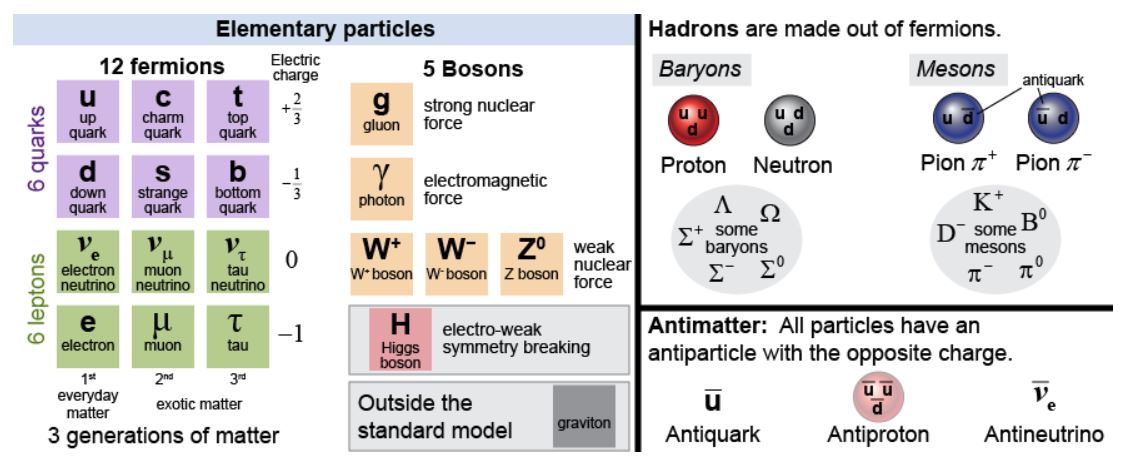
The photon is known to be the only massless, free-moving particle in the Standard Model of physics. Other massless particles are the gluon, the graviton, and of course the Higgs, discovered in 2012 at CERN. Europeans plan to build a Higgs factory to learn more about them. Gluons mediate the strong force. They don’t propagate through empty space.  No one has yet observed even a single graviton. Higgs give fermions like quarks their mass. 

Photons have an electric and magnetic structure. They are electromagnetic pulses of energy that emerge from atoms when electrons drop from a higher energy state to a lower one. When electrons shed energy, a pulse of electromagnetic radiation is emitted — a photon of light.


Click pic for better view in new tab.

Photons of light can be emitted from atoms at different frequencies — colors when wavelengths fall within the narrow range that humans see. These frequencies depend on the energy of electrons, which exist in many differently configured shells (or orbitals) within both atoms and molecules.

Wavelengths of light felt but not seen are called infrared; other invisible frequencies fall into broad categories such as radio waves, microwaves, x-rays, gamma rays and so on — all require instruments to detect.


Electromagnetic radiation is the medium through which humans observe and interact with everything knowable in the universe. Humans live inside an electromagnetic bubble that they are struggling to understand.

One thing most physicists understand is that a disturbing 95% of the energy and mass of the universe comes from a source no one can see. Physicists observe the effects of invisible (dark) matter and invisible (dark) energy by measuring the unusual dynamics of galaxies and by cataloging the physical organization and expansion of the universe itself.


These measurements make no sense unless folks assume that a lot of gravitationally interacting stuff is out there which no one has yet observationally confirmed. The missing mass is not debris or dark stars. The most exaggerated conjectures about how much mass and energy is scattered among the stars won’t come anywhere near enough to explain forces that make galaxies behave strangely.

Dark matter and energy don’t seem to be electromagnetic. Dark matter, if it exists, interacts with the mass of two-trillion galaxies and seems to refract their emitted light. Humans are blind to all of it.

Scientists postulate matter they call WIMPS, MACHOS, axions, and erebons.  Each has a few properties necessary to make the universe work as observed, but none have all the required properties except perhaps erebons, if Roger Penrose’s Conformal Cyclic Cosmology (CCC) is someday verified.

Other candidates for dark matter? — why not sterile neutrinos, GIMPs, and SIMPs

Space-saturating foam of micro-sized black holes is another idea some have proposed. The problem is that theorists believe tiny black holes might be too stable to radiate electromagnetic waves or gravity waves.

Micro-holes lie in a sort of crevice of invisibility — unobservable by LIGO and LISA style gravity-wave sensors, yet too massive for current and future particle-colliders like CERN to create. 

Because micro-holes don’t radiate light at any frequency, light telescopes will never find them. No imagined interaction of micro-holes is able to generate gravity-waves with enough disruptive power in spacetime to be detected. The nature of physics seems to suggest that no technology can be developed to confirm or deny the black-hole foam idea. 

Perhaps the same dilemma faces dark matter detection. We know it exists, but physics says we can never find it. It will always lie just outside our reach doing its work in an invisible universe no one will ever see. 

Worse, not one of the proposed forms of “dark” matter has ever been observed or identified. It is likely that no experiment currently scheduled will detect dark matter, which many physicists believe is “out there” and makes maybe four parts out of five of all the matter in the universe.

It’s an incredible paradox for conscious humans to live in a universe where they are blind to almost every important thing that is happening within and around them.

Humanoids are like fish which spend their lives swimming in streams buried deep inside caves. Spelunkers like me know that certain species of cave fish have no eyes. They lack all ability to see their world — as do we, it seems. As intelligent as people are, they don’t yet build sensors capable of confirming their notions about what the universe might actually be at large scales or small.  

Oh well…  someday maybe new discoveries will make our predicament evaporate away.  The universe will reveal itself to humans, as we knew it would. Our dream to fully understand reality will come true.

Some day.

Scientists have sensible mathematics to show that if electromagnetic particles are massless, they must travel at an upper limit, called c.  Over decades, folks decided that this constant is the speed of a photon in a vacuum; they decided that photons have no internal rest mass and travel in vacuum at a speed limit — the speed of light.

The truth might be more mysterious. No one knows what the upper limit of “c” is, because no one knows with certainty that space is truly empty or that massless particles exist.

When physicists say that certain particles are massless, they sometimes mean that they don’t interact with the Higgs Field, which is known to give mass to fermions, like quarks. They don’t mean they don’t have energy, specifically kinetic energy, which is a form of inertial mass, right? They also aren’t saying photons don’t interact gravitationally. They do, in a special way described by the geodesics of spacetime in Einstein’s General Relativity. 

More on this idea later. 


British physicist Brian Cox wrote in his book  Why Does E = mc2 ?  that the question about whether photons have rest mass is not yet settled.

It’s true that more than a few reasonable people seem to believe that photons traveling freely in the vacuum of space are massless. If they truly are then the permittivity constant “ε” in Maxwell’s equation can be established for electro-magnetic particles (like photons).


The formula below is used to calculate the speed of a massless electromagnetic particle; it is thought to be a maximum speed.


For now, ignore the μ term. It is the permeability (resistance) of vacuum to infusion by a magnetic field, which is determined by experiment. It is sometimes called the magnetic constant.

Epsilon (ε} is the permittivity (resistance) of vacuum to an electric field. It is sometimes called the electric constant.

c” is the so-called ”universal speed limit.” It is called the lightspeed constant

These three numbers — μ, ε, and — help to define the maximum velocity of an electromagnetic wave, which most people believe is the archetypal photon (of light). They assume that the photon packet travels at the maximum allowable speed in a vacuum.

A problem with this view is that no one has proved that space is free; or that space has no weight; or that photons have no rest mass; or that undiscovered particles formed from forces other than electricity and magnetism don’t exist. A few scientists have said that there might be no such things as free space or massless photons. It is also possible that space presents less resistance to other phenomenon yet to be discovered.

The idea that ”dark” matter and energy must exist to make the universe behave the way it does is compelling to many physicists. If true, it is possible — though light travels nearly 300 million meters-per-second — it is not traveling at the maximum speed of a generic, massless particle. The electric constant (ε) might need to be adjusted.

A decrease in the permittivity (resistance) of space (ε) — made obvious by inclusion of vast number of photons in the cosmic microwave background  — drives ”ε” to be smaller and ”c” to be larger, right? 

New particles, dark and as yet undiscovered, might do the same. The consequences could be significant.

Determining the upper speed of a massless particle requires a form of circular reasoning that is currently based on the measurement of the velocity of photons in a vacuum, which is called the speed of light.

The measured velocity of light in a vacuum is now an established constant of nature with a fixed value that doesn’t change regardless of the frame of reference. Modern labs have measured both the frequencies and wavelengths of various colors of light; multiplying the two numbers together always yields the same result — the speed of light.

Knowing the speed of light permits physicists to establish a value for ε by working backwards in the wave equation to solve for the electric permittivity of space. The value of “ε” falls easily from Maxwell’s Equations to a precision of 12 places.

It can’t be any other way. But is it the right way?

Here’s the problem: Physicists have measured mass in photons during experiments at the linear accelerator lab at Stanford University, SLAC.

In superconductors, photon mass has been measured to be as high as 1.2 eV.

Photon mass has been observed in wave guides and in plasmas.

Fact is, photons have inertial mass, which is a measure of their energy as calculated from their wavelengths or frequencies. In relativity theory, energy and mass are measured in the same units, electron-volts, because in the theory, mass and energy are equivalent. 


Click this link to view CLOSER TO TRUTH interview with Raphael Bousso.

Cosmologist, Raphael Bousso, believes that empty space has weight, which is a measure of the cosmological constant, which is a measure of dark energy.

Space seems to be saturated like a sponge with something that gives it energy or force or weight if you will. The weight of empty space determines the size of the universe and some of its fundamental laws. Universes beyond our own with different weights of space can be larger or smaller and obey different rules.

Most physicists agree that photons become massive when they travel through transparent materials like glass, where they slow down by as much as 40%.

The problem is that these observations conflict with both the Heisenberg and the Schrodinger view of quantum mechanics, which is the most tested and confirmed model physicists have. Modern ideas seem to work best when photon mass is placed on the energy side of the mass-energy column. Otherwise, the presence of internal mass suggests that photons can be restrained to a defined size, which drives their momentums to infinity.

The truth is that it is not possible to prove that photons are massless. The stress-energy-momentum tensor in Einstein’s equation of General Relativity implies that photons can be both the source and the object of gravity.  I’m referring to this tensor as “mass” and leaving it there for others to dispute. A rabbit hole for courageous readers to explore is the concept of pseudotensor, which this essay will avoid. 

It is also not true that a photon can never be at rest either.  Lab techs do unusual things with photons during experiments with lasers and superconductors — including slowing photons down and even stopping some (with supercooled helium-4).  Right?

Another problem is the electromagnetic nature of light. The electric part of a light-wave carries enough energy to move an electron up and down. The magnetic part carries the same energy but its motion creates a force that pushes electrons outward in the same direction as the light. It’s why light-sails work in space. Oscillating magnetic fields push light forward. Otherwise, light might stand in one place and simply jiggle. But is light-speed the best magnetic fields can do? 

Electromagnetism could be irrelevant in the search for an upper speed limit “c“, because “c” might prove to be the result of an unknown set of particles with properties outside the current boundaries of the Standard Model. 

Massless particles, — undiscovered ones anyway — might not be electromagnetic. Humans might be biologically unfit to detect them; unable to measure their properties. 

For those who might be rolling their eyes, remember that physicists claim that 95% of the mass and energy required to make the universe behave the way it does is missing. They call the missing stuff “dark” because they can’t find it. Excuse me should anyone catch me rolling my eyes. 

Some theorists have speculated that “dark photons” might exist to help fill in the gaps. The popular TV show How the Universe Works actually repeated the idea in an episode of its latest series. The writers were probably referring to axions, which some physicists propose are similar to photons except that they have mass and are slower moving.

Photons are bosons. They are force carriers for electrons, correct?

Maybe folks should try to accept the notion that nothing in physics prevents bosons like photons from having mass or from taking on mass when they whiz over and through atoms and molecules (in glass and water, for example) where some physicists conjecture, they stimulate the release of polaritons in their wake. Jiggling electrons that lack the energy to jump states emit polaritons, which seem to add enough equivalent mass to photons to slow them down. Think of polaritons as light-matter wavelets

Massive, gravitationally interacting photons are not required to be “dark.”  If photons are the dark matter, axions are unnecessary to solve certain problems both in cosmology and the Standard Model.  No experiment will find them.

I mentioned that three other particles are presumed to be massless: the gluon, the graviton, and the Higgs boson. 

To review, the gluon is not easily observed except in particle colliders where it lives briefly before decaying into other particles; it is confined among the protons and neutrons in the nuclei of atoms. The graviton, on the other hand, has never been observed. The Higgs boson was discovered in 2012. CERN plans to build a Higgs factory someday to explore its properties.

The only particle available to physicists right now that enables them to establish the permittivity of space and compute the velocity of massless particles is the photon.

That’s it.

If the photon has internal mass, i.e., rest mass, everything changes.


Let’s hop into a rabbit hole for a moment and go back a step: What if massless, non-electromagnetic particles mediate entanglement, for example? Wherever paired electrons are found, entanglement rules, right?

Everyone knows that entanglement violates laws of logic and physics. No one can make sense of it.

What if massless non-electromagnetic particles entangle the electromagnetic particles of the subatomic world? If they travel a thousand or ten-thousand times the speed of light, they will present an illusion over short planetary scales that entanglement is instantaneous. No instrument or lab will detect the difference.

What are the consequences if massless non-electromagnetic particles travel at a billion times the speed of light? Maxwell’s equations won’t apply to particles like these. 

Because it seems that speeds of subatomic particles like photons are able to increase as their masses approach zero, it is possible that “c” could be orders of magnitude faster than the speed of a photon — that is, the speed of light — if it turns out that photons harbor tiny but significant rest masses.

I’m not advocating this notion. Let’s crawl out of the rabbit hole. I’m suggesting only that such a state of affairs is possible, because the assumption that photons at rest are massless — that internal mass of photons is always zero — though reasonable and desirable to justify models, is not yet settled according to some physicists.

And there is, of course, the phenomenon of entanglement which no one can explain.

Here’s speculation that should blow the mind of any thinking person: Could photons, if shown to have internal mass, be the stuff that make the galaxies move in the non-intuitive ways they do?

Yes, some physicists argue that the upper limit on the internal (rest mass) of a photon must be less than 10-52 kilograms, which is about 5.6E-17 eV for folks who think that way. (Multiply mass by the speed of light twice to make the conversion and divide by 1.60218E-19 Joules per eV.)

5.6E-17 eV doesn’t seem like much mass at all until folks realize that the minimum number of photons in the universe might be as high as 1090.   This number is ten billion times the number of atoms in the universe. It means that the internal mass contribution from photons alone could easily exceed 1038 kilograms if the upper limit proposed by some is used to perform the calculation.

Do the math, anyone who doesn’t believe it.

Guess what?

Prepare for a letdown.

Based on the conjectured eVs, the mass of all material in the visible universe is in the neighborhood of 1053  kilograms. The video below will help the reader understand how this value and others are calculated. The mass of the visible universe turns out to be 1,000 trillion times more than the conjectured internal mass of all photons.


Think about it.

Is it enough mass to account for the galaxy anomalies seen by astrophysicists?  To any reasonable mind the answer is obviously, no. But this conclusion is not the end of the story. 


Those who study astronomy know that the outer stars in galaxies seem to move at roughly the same speed as the inner. Yet the galaxies aren’t flying apart.

By way of contrast, the planets in solar systems like ours travel slower the farther away they orbit from their sun.  If Neptune orbited as fast as Earth, it would fly away into deep space.

A recalibration to account for the internal mass of photons of light (which seems to always be discounted) does not at first blush offer the gravitational heft that astrophysicists require to make everything on galactic scales fall into place.

The cosmic background radiation — which is nothing more than photons that decoupled close to the beginning of time — saturates the universe like vinegar in a sponge, right?  It is distributed evenly across all space for as far as human-built instruments can see.

The CMB makes an annoying hum in radio telescopes no matter their focus or where they point. Photons with tiny internal masses or no mass at all will have no influence on the understanding by astrophysicists of how the universe behaves.

Neutrinos, which seem to oscillate between three (or perhaps four) as yet undetermined massive states, might at times take on values below the actual mass-value of photons — if photons turn out to be more massive than most believe. The laws of physics require that neutrinos less massive than massive photons, should they exist, must travel superluminally (faster than light).  Agreed?

Several “discredited” observations have reported faster-than-light neutrinos, including the unexpected outcome of the infamous OPERA experiment, which inspectors eventually blamed on a loose fiber-optic cable that was ever-so-slightly longer than it should have been.  

OK.  It seems reasonable.  Who can argue?

Scientists who believe that superluminal neutrinos actually exist don’t speak up, perhaps out of fear for their careers. They probably couldn’t get their opinions published anyway, right?


Click pic for better view in new tab.

Crackpot ideas that later prove valid is how science sometimes works. It’s how science has become the mess that it is — a chaos of observations that can’t make sense out of 95% of what is going on all around; a plethora of experimental results that don’t quite match the work of theorists.

The super-brilliant people who paint the mathematical structures of ultimate reality rely on physicists to smear their masterworks with the muds of perturbation, renormalization, and a half dozen other incomprehensible substrates to get the few phenomenon folks think they understand to look right and make sense. Theory and experiment don’t seem to match-up as well as some folks think they should more times than not.

A minor recalibration based on the acceptance of photons as quantum objects with tiny, almost unmeasurable masses will not change ideas about the nature of the universe and what is possible, because the upper-bound on photon masses might be undervalued — perhaps by a factor of billions.


Theorists like Nima Arkani-Hamed work on abstract geometries called amplituhedrons to salvage notions of massless particles while simplifying calculations of scattering probabilities in quantum mechanics. It seems to me like hopeless adventures doomed to fail. But in fairness so did Columbus’s exploration for new worlds.

To be a serious candidate for dark matter, a typical microwave photon should have an average mass of nearly .05 eV (electron volts), which is about 9 x 10-38 kilograms. If multiplied by the number of photons ( 1090 ), the photon masses add almost miraculously to become 85% of the theoretical mass of the universe.

(1E90)*(9E-38) = 9E52.  (9E52) / .85 = 1E53 kg. 

It’s the same number conjectured by dark-matter advocates. 

To qualify for dark matter means that a typical or average photon must have close to one ten-millionth of the mass of an electron.

Only then does everything fall into place like it should.

Pull out the calculator, anyone who doesn’t believe it.


Einstein, in his famous 1905 paper on special relativity, showed that mass is equivalent to the energy of an object divided twice by a constant, which is “c” squared, right?

Later, he added a second term to the internal energy of a particle which is its inertial energy, pc2 . Simplified, this term equals hf for a massless photon. The total energy of any object is the square root of the sum of its internal energy and its inertial energy. 

E = \sqrt {(mc^2)^2 + (pc)^2}

If Einstein is taken at his word, then the inertial mass of a photon is a function of its characteristic frequency — i.e. the inertial mass of a photon is equal to 

\frac{hf}{c^2}

where “h” is the Planck constant and “c” is the speed of light. The internal mass, should any exist, can be discounted. 

An argument can be made from Einstein’s equations that the mass of a photon might be \sqrt {2} times larger. A factor of 1.414… won’t change the argument. It strengthens the point but is, in the end, not important enough to include in an article that is already overly long. Curious readers can review the reasoning in my essay General & Special Relativity

If the average photon has an inertial mass of .05 eV, it requires that — all else being equal — the combined photon energy in a non-expanding universe would lie in the range of infrared light, a frequency in this case of 12E12 Hz, which is sometimes referred to as far-infrared.

(Set equivalent-mass equal to .05 eV (8.9E-38 kilograms) and solve for frequency.) The frequency approaches the lower energy microwave part of the light spectrum. 

Note:  For perspective, one eV is the energy (or mass equivalent) of a near-infrared photon of frequency 242E12 Hz, which approaches from below the higher-energy visible-light part of the light spectrum. 

The mass equivalence of the inertial energy of 1E90 infrared photons is sufficient to hold the universe together to prevent runaway expansion caused by repulsion due to the gravity constant Λ in Einstein’s equation for General Relativity. 

Do the math.

I know what some people might be thinking: Didn’t the 29 May 1919 solar eclipse, which enabled observers to confirm Einstein’s theory of General Relativity, demonstrate that photons lack internal mass?  Didn’t Eddington’s experiment prove wrong Newton’s idea that photons, which he called corpuscles, were massive objects? 

Maybe. Maybe not.  Maybe internal mass isn’t necessary. There is enough energy in the inertial term of Einstein’s equation to yield the required mass.

Unlike massive particles where internal energy far outweighs inertial energy, for photons, inertial energy is dominant. Even if science admits to a small amount of internal mass in photons, it is their inertial energy that dominates.

I found a good mathematical argument for light mass on Quora by Kyle Lochlann, an academic in relativity theory. Here is the link:

PHOTON MASS

Be sure to read comments to his answer — especially those who find math incomprehensible, which might be nearly everyone who reads my blog. 

After all, Newton’s theory of gravity predicted that the light from stars would deflect near the Sun at only half what Eddington’s experiment clearly showed. Eddington’s eclipse proved Einstein’s theory — the geodesics of spacetime bend in the presence of massive objects like stars.

Many concluded that photons followed the geodesics of spacetime, because photons lacked mass equivalence of any kind. Newton erred about pretty much everything involving gravity and light, some said.  

But their conclusion can’t be right, can it? Doesn’t their conclusion ignore what the math of Einstein’s formulas actually says?


Won’t it make more sense to say that the geodesics of spacetime constrain and overwhelm whatever internal and inertial mass photons might possess?  Doesn’t it make more sense to convert the frequency-related inertial energy of photons to mass to better explain their behavior near objects like the Sun? 

Evidence exists that light-mass is a thing and that it matters. Einstein included a mass-equivalence term for light in his tensors for general relativity. Frank Wilczek, MIT Nobel laureate, is famous for insisting that the mass of anything at all is its energy content. The energy of light is in its frequency, its momentum, which is a measure of its mass. 

It’s true that light does not seem to interact with the Higgs field. Nevertheless, the energy of light seems to interact gravitationally with ordinary matter. The interaction is not measurable when photon numbers are small. When photon numbers are huge, perhaps it is.  

A single photon in the presence of the Sun has no chance. When 10E90 photons saturate a space that is almost entirely devoid of matter, photons can shape a universe — especially when their number is 10 billion times the number of atoms. 

It seems possible, at least to me.

According to data gathered by the NASA WMAP satellite, ordinary matter in the observable universe amounts to a little more than 1/4 of a neutron per cubic meter of space. It amounts to 253.33E6 electron-volts of mass. Everything else WMAP observed was “cold dark matter” and “dark energy”.

How many .05 eV photons does it take to flood a cubic meter of space with enough mass-equivalence to reduce the mass-energy of 1/4 of a neutron to 15% of the total? How many photons are required to sum to 85% of the energy WMAP attributed to “cold dark matter”? It turns out that the number is 34 billion photons per cubic meter. 

The question is: how many photons are there? 

The observable universe has an estimated volume in the neighborhood of 1E80 cubic meters, right? Yes, it might be as much as 4 times that number. 

The lower-bound number of photons in the observable universe is 1E90. It might be ten times more.

It turns out that the number photons per cubic meter in the universe must be somewhere close to 25 billion.  25 is pretty darn close to 34. Since all the numbers are estimates with large margins of error, it’s possible that everything will fall into place as it should if and when the statistics of the universe are ever known with precision.

Could photons of light might be the “cold” dark matter everyone is searching for?

A single neutron has no chance when it is bathed in 136 billion .05 eV photons, which surround and envelop it on all sides from every direction. It makes a kind of quantum scale Custer’s Last Stand for random neutrons, right? 

When scientists look at the universe today, they see an accelerating expansion. They see in the cosmic background radiation photons that have slipped from infrared into longer, less energetic microwave wavelengths which no longer have enough mass-equivalence to hold the universe together.

As light stretches into longer and longer wavelengths through interaction mechanisms such as Compton scattering and other processes (like the push of “dark energy” or the less popular gravitational tug of parallel universes), light frequencies and energies diminish.

Eventually, when the total of all light falls below an average frequency of 12E12, the equivalent mass of the 1E90 primordial photons loses its grip; it becomes unable to hold the universe together.

Near the beginning of time when photons were orders-of-magnitude higher in frequency than now, their stronger gravitationally-equivalent-masses pulled together the structures astronomers study today, like stars and galaxies.


But now scientists seem to be witnessing a runaway expansion of the universe. Light has stretched and dimmed into the microwave and radio-wave frequencies where its mass-equivalence is unable to hold together the universe as it once was.

Because we can’t detect it, isn’t it possible that dark energy and dark matter don’t exist? That is to say, the idea that dark matter and energy are necessary to account for observations is no more than a conjecture made necessary by a misbehaving universe of unusual galaxies. But direct observational evidence for dark matter and energy is the part of the conjecture that is missing. No one has ever seen any.

What astronomers are observing instead is faraway galaxies that existed billions of years ago when the mass-equivalent energy of photons was greater than it is now.

The intact universe of galaxies seen in the night sky today, which is photographed with high-resolution space-borne telescopes, is not up to date in any sense at all, except that it is the view of an ancient past that goes back almost to the beginning of time depending on how deep into space anyone looks.

Everyone who cares about astronomy knows it’s true.

To qualify as a candidate for dark matter means that a photon must have close to one ten-millionth of the mass of an electron. It seems like a reasonable ratio, right?

In the Standard Model, only neutrinos are less massive than electrons. No one knows what the mass of each of the three “flavors” of neutrinos is, but when added they are less than 0.12 eV — about 2.4 times the equivalent-mass of infrared photons and about one four-millionth of the mass of electrons. It seems possible to me that the mass of at least one of the flavors of neutrinos will be less than the conjectured equivalent-mass of an infrared photon packet.

Neutrons and protons are, by contrast, 2,000 times “heavier” than electrons.

I am asking working physicists to reexamine estimates that claim the mass of a photon can be no more than trillions of times less than the mass of an electron.

The claim can be found at the back of articles in science journals as well as in blogs across the internet. For me, the idea seems ridiculous on its face. The energy-equivalent mass of photons varies with frequency, but only the lowest energy radio wave photons can hope to approach the low equivalent-mass estimated in the latest publications.

Scientists might want to revisit the mass of a photon and the methodology of its measurement. The stakes are high, and science doesn’t have many options. Hope — like the energy of ancient photons — is fading.


Science would be served best if scientists started from scratch to reexamine every assumption and lab procedure. The search for dark matter has become an expensive and compulsive quest that seems futile, at least to me. Several costly experiments have reached disappointing dead ends, which are reviewed in the “VICE on HBO” video located near the start of this essay.

What if photons of light really are the dark matter, which is hiding in plain sight waiting to be discovered by anyone who dares to look at the problem with fresh eyes?

What if the delay between the observations of the CMB (cosmic microwave background) and the structure of the universe is a natural disconnect in time and space that misleads folks to believe that mass must be “out there”, when it has in fact long since dissipated?

From another perhaps opposite perspective, what if photons are instead stimulating emissions from virtual particles as they travel at fantastic speeds through the vastness of space? What if these emissions add mass to photons sufficient to bring them to the “dark matter” threshold, as they do in materials like glass?

Such a state of affairs would imply that not all photons travel the same speed in the so-called vacuum of “empty” space. It is a heretical idea, for sure — a can of worms, perhaps to some, but hey! — you can catch a lot of fish with a can of worms.

A photon is a packet of electromagnetic oscillations built-up from many frequencies. Superposition of these frequencies adds to give a photon its characteristic frequency from which its equivalent mass can be calculated. Right?

Use imagination to think of the many ways a higher “speed limit” that is mandated by the existence of massive photons might work to stimulate the interest of a space-traveling civilization to explore the universe, which ordinary folks begin to understand is more accessible, more reachable than anyone thought possible.

Consider the number of inexplicable phenomena that would make sense if particles thought to have zero internal mass don’t really exist, and photons, gluons, gravitons, and Higgs bosons aren’t the only ones.

Recalibration might save a lot of time and effort in the search for the putative missing energy and mass of the universe.

Should “dark” particles exist whose internal mass is less than that of photons, they will likely move at superluminal speeds that make them difficult to track. To influence stars, their number would have to dwarf photons. Such an idea strains credulity.

A counterproposal by Roger Penrose speculates that dark matter particles might have the mass of the eye of a flea; he calls them “erebons.” These particles are electromagnetically invisible, but their huge masses relative to other particles in the Standard Model make them gravitationally compelling.

Erebons decay; evidence for their decay should be showing up in data collected by LIGO detectors.

So far persuasive evidence for erebons has not been found.


For scientists and explorers, the access-barrier to a universe shaped and configured by massive photons will most certainly shrink — perhaps thousands to millions of times.

The stars and galaxies that people believed were unreachable might finally fall within our grasp.

Or — perhaps less optimistically and more cynically — the mass-equivalent energy of 1E90 photons might by now be so severely degraded that nothing can save a universe that has already come undone and flown away into an abyss that humans will never see.

The radiation-evidence from a catastrophe of disintegrating galaxies that has already occurred won’t reach Earth-bound viewers for perhaps billions of years.

Should humans survive, our progeny — many millions or billions of years from now — may “see” in the vastness of space a cold and diminished radio-wave radiation that hums in a soul-less vacuum devoid of galaxies and visible light.  Microwave light will by then be nothing more than a higher-pitched, prehistoric memory.

Roger Penrose says that the fluid dynamics of an exhausted universe devoid of matter will become indistinguishable from the singularity that gave its start. A new universe will ignite from the massless, radiation-ashes of the old.

The idea is called Conformal Cyclic Cosmology — or CCC

Human-nature forces us to want to know more; most folks want to search for and find the answers to the questions that will determine the fate of all life on Earth and in the vast stretches of spacetime that remain beyond our reach.

Is the universe within our grasp, or has it already disintegrated?

We search for truth to set ourselves free.

Billy Lee

25 ANSWERS

Two months ago, I discovered QUORA. It’s been around since 2009.

Since 2010, Quora has enabled people to ask experts questions about topics they like; even to answer questions on subjects they claim to know something about.

Quora is a site for geeks and nerds, and so far I  like it. The people who hang out in the areas I hang out tend to be polite, kind, and smart. If they like someone, they follow them and are notified when they post. So far, ten people have signed on to follow me. It’s a start. I think most are from India.

During the first six weeks, 150 or so of my answers were viewed 35,000 times; I got nearly 175 “upvotes”, which enabled many of the answers to move to the head of the line. I wrote most answers in the wee hours between 2 AM and 7 AM when I couldn’t sleep. Insomnia inspired me.

What follows are 25 of the most popular answers I posted to the first 150 or so questions that caught my interest. They are sequenced by popularity — the most read first .

Why not read a few? How many questions can anyone answer? Not many, I’m thinking.

Who knows what you might learn?

What? 

Someone thinks they know better than a pontificator with no bonafides?

I don’t think so.

No way!   😉


1)   What are some of the most popular “mathematically impossible questions“?

Freeman Dyson — one of the longest-lived and most influential physicists and mathematicians of all time — argued that it is impossible to find a whole (or exact) number that is a power of two where someone can reverse its digits to create a whole number that becomes a power of 5.

In other words, 2^{11} = 2048 , right? Reversing the digits to make 8402 does not result in an exact number that is a power of 5.

In this case,  8402^{1/5} = 6.09363  plus a lot more decimals. It’s not a whole (or exact) number. Not only that, no matter how many decimal places anyone rounds-off 6.09363… , the rounded number raised to the power of 5 will never return 8402 exactly.

Dyson claimed that this conjecture must be true, but there is nothing in mathematics that enables anyone to write a proof. He claimed that there must be an infinite number of similar statements—-each one true, none provable.

Click the link below to learn more.

TRUTH

The Snowplow Problem is another “impossible” problem. My differential equations professor assigned it with the promise that anyone who solved it would receive a 4.0 grade, regardless of their performance on tests. I was the only student he ever taught who actually managed it.

The problem goes like this: It is snowing at a constant rate. A snowplow starts plowing snow at noon. By one o’clock the plow has traveled one mile. By two o’clock the plow travels an additional half mile. At what time did it start snowing?

It took me 3 days and two pages of calculations, but I got my 4.0.

Note from the Editorial Board: Over 50 people on Quora submitted answers to Billy Lee’s Snow Plow problem. One person had the right answer, but would not produce his proof. He did point out an unusual feature of the solution that Billy Lee had not noticed before. Billy Lee characterized the feature as ”very surprising.” When pressed Billy Lee refused to reveal the secret. 

2)   How much force is one Newton?

A newton is the force that an average sized apple makes on your hand when you hold it. No matter where in the universe you are; no matter on what planet you stand or how strong the gravitational field, a newton of force always feels the same.

A newton is one kilogram of mass that is accelerating at one meter per second per second. Gravity on Earth accelerates everything at nearly 10 meters per second per second. A kilogram of mass feels like 2.2 pounds on earth. One tenth of 2.2 pounds is 0.22 pounds or 3.5 ounces, which is the weight of a typical apple. The weight is the force that you feel against your hand. It is one newton.

On the moon, an object with the mass of a large brick would feel as light as an apple on earth due to the moon’s lower gravity. The force of the brick in your hand would feel like one newton.

3)   x + y = 4 .  and  . x^x + y^y = 64 .   What are x and y?

The simplest way to solve is to make y = (4-x) and create an equation in terms of x.

An easy version to create and solve is

{x^x + (4-x)^{4-x} = 64}

You can solve it by hand using iteration or throw it into an app like Wolfram Alpha and let them solve it in a few seconds.

Either way, one value for x is .606098…. The other is 3.393901… , which you can assign to y. The two numbers add to 4.000… and when substituted into both initial equations return the right results.

4)   If I had 1,000,000,000,000,000 times 1,000,000,000,000,000 hamsters floating in space in close proximity, would gravity turn them into a hamster planet?

Assuming the question is serious, it deserves a serious answer.

A typically fat hamster weighs around one ounce, which is about 0.03 kilograms of mass. The number of hamsters in your question is 10E30.

Multiplying the mass of a single hamster by this large number gives the result of 3E28 kilograms.

To compare, the mass of planet Earth is 6E24 kilograms. The mass of the proposed population of hamsters is 5,000 times the mass of the earth.

The sun contains 67 times more mass than the hamster population. If the hamsters are close enough together to hold paws, a hamster planet is almost certain. I haven’t worked out how long the process to congeal would take, but I can estimate that the hamsters would probably die of starvation before the inexorable forces of gravity completed their work.

The hamster planet would be formed mostly from three elements: hydrogen (64%), oxygen (33%), and carbon (10%). 3% would be trace elements like calcium and maybe lithium.

The most likely outcome, given enough time, is a planet-like object. The hamsters have only one-fifth of the mass to make the smallest of the smallest suns — red dwarfs, which populate 67 to 80 percent of the Milky Way Galaxy.

There are way too many hamsters to make a reasonably sized moon.

Their mass (3E28 kg) happens to fall on the border between the range of masses that are required to form celestial objects known as brown dwarfs and the less massive sub-brown dwarfs — sometimes referred to as free-floating planets.

Brown dwarfs don’t have enough mass to ignite like a star, but they do produce heat and can accept small orbiting planets. The chemistry of brown dwarfs is not well-understood and is a bit controversial.

It’s a toss-up, but my vote goes to the notion that the hamsters will eventually form a very large but ordinary planet — a free-floating planet — which I referred to earlier as a sub-brown dwarf. This hamster planet might wander through space for millions (or even billions) of years before being captured by a massive-enough star to begin to orbit.

Because the elements of hydrogen and oxygen are likely to become the constituents of frozen moisture (or water ice), there is the risk that the ice might melt into oceans and perhaps boil away if the hamster planet approaches too close to a star (or sun). In the case where the planet loses its water, a carbon planet with 50 times the mass of earth would form.

Otherwise, should the planet find itself in a far-distant future orbiting in the “goldilocks” zone around a sufficiently massive star, the water would not evaporate. Life could arise in the planet’s oceans. It’s possible.

Life-forms might very well crawl up out of the water and onto land someday where — over the eons and under  ideal conditions — they will evolve into hamsters.

5)   Why is evolution a valid scientific theory despite the fact that it can’t be conclusively proven due to the impossibility of simulating the millions-of-years processes that it entails?

Evolution is a fact that is thoroughly established by observations made in many disciplines of science. Changes in species happen fast or slow; in the lab and in the field.

The mystery is how one-celled life got established so quickly — it was solidly established within one billion years of earth’s formation. It’s taken 3.5 billion years to go from one-celled life to what we have now.

Why so fast to get life started; why so slow to get to human intelligence and civilization?

People have a lot of ideas, but no one is sure. Some life forms have orders of magnitude more DNA than humans. Only 2% of human DNA is used to make the proteins that shape us.

So, yes, there are lots of questions.

NO CODE

6)   Why do cosmologists think a multiverse might exist?

Many high-level, theoretical physicists have written about the obvious problem our universe seems to have, which is that it has too many arbitrary constants that are too tightly constrained to be explained by any theory so far. No natural cause has been found for so many constants, so it’s fertile ground for theorists.

Stephen Hawking, among others, has said that the odds of one universe having the physics that ours has is 1E500 against. He is joking in his English way, because such a large number is essentially an infinity. It’s not possible to constrain a universe like ours by chance unless there are an infinity of choices, and we happen to be in the one that supports intelligent, conscious life.

Two ways of getting to infinity are the concepts of multi-verse and the new one proposed by Paul J. Steinhardt of Princeton University in 2013, which is based on data supplied by the Planck Satellite launched in 2003. Paul is the Einstein Professor of Science at Princeton, so his opinion holds a lot of weight.

Steinhardt has proposed that the universe is ekpyrotic, or cyclic. He has asserted that the universe beats like a heart, expanding and contracting in cycles, with each cycle lasting perhaps a trillion years and repeating, on and on, forever. Each cycle produces conditions — some which are ideal for life. This heart has been beating forever and will continue to do so, forever.

Conscious Life

7)   How will we visit distant galaxies if we cannot travel faster than light? 

We will never visit distant galaxies, because they are too far away; most are moving away from us faster than our current technologies can overtake. At huge distances space itself is expanding, which adds to our problems.

The expansion of space is gradually accelerating. Any increase in performance by space vehicles over the next few thousand years is certain to be overwhelmed by the accelerating expansion of the universe.

As time goes on the amount of objects that are reachable (or even viewable) by earthlings will shrink.

On the happy side, our own solar system has at least 165 interesting places to visit that should keep folks fascinated for many thousands of years. A huge cavern has been discovered on Mars, for example, that might make a safe habitat against some forms of radiation dangers; it seems to be a place where a colony of humans might be able to live, work, and survive — perhaps even flourish.

Elon Musk is planning a mission to Mars soon.

8)   What is the mathematical proof for a+a = 2a ?

Some things that are true can’t be proved. All math systems are based on axioms, which are statements believed to be true but which, in themselves, are not provable.

This link provides a list of axioms for addition: https://sites.math.washington.edu/~hart/m524/realprop.pdf

A lot of interesting philosophical and mathematical work has been done on conjectures that are believed to be true, but can’t be proved.

TRUTH

9)   Can you explain renormalization in physics in simple words?

There is a problem in physics that has to do with the huge variation in scales between the very large and the very small. This problem of scales involves not only the size and mass of things, but also forces and interactions.

Philosopher Robert Pirsig believed that the number of possible explanations that scientists could invent for phenomenon were, in actual fact, unlimited.

Despite all the math and all the convolutions of math, Pirsig believed that something mysterious and intangible like quality or morality guided our explanations of the world. It drove him insane, at least in the years before he wrote his classic book, Zen and the Art of Motorcycle Maintenance.

Anyway, the newest generation of scientists aren’t embarrassed by anomalies. They have taught themselves to “shut up and calculate.” The digital somersaults they must perform to validate their work are impossible for average people to understand, much less perform. Researchers determine scales, introduce “cut-offs“, and extract the appropriate physics to make suitable matches to their experimental results.

The tricks used by physicists to zero in on pieces of a problem where sensible answers can be found have many names, but renormalization is one of the best known.

When physicists renormalize an equation, they cut away infinities and other annoying problems (like dividing by zero). They focus the range of their attention to smaller spaces where the vast differences in scales and forces don’t blow up their formulas and disrupt putative pairings of their carefully crafted mathematics to the world of actual observations.

It’s possible that the brains of humans, which use language and mathematics to ponder and explain the world, are insufficiently structured to model the complexities of the universe. We aren’t hard wired with enough power to create the algorithms for ultimate understanding.

RENORMALIZATION

10)   If a propeller rotates at the speed of light at half of its length, what happens to the outer parts?

Only the ends of the propeller can rotate at near light speed (in theory). At half lengths the speed of the propellers will be half the speed of their ends, because the circumference of a circle is 2πr. (There is no squared term.)

So the question is: will the propellers deform according to the rules of the Lorentz transformation along their lengths due to the difference in velocity along their lengths?

The answer is, yes.

As you move outward along the propeller, it will become thinner in the direction of rotation, and it will get more massive. A watch will tick more slowly at the end than at the middle.

I am not sure how it would look to an outside observer. Maybe such a propeller would resemble in some ways the spiral galaxies, which don’t rotate the way we think they should. Dark matter and energy are the usual postulates for their anomalous rotations. Maybe their shape and motion is related to relativity in some way. I really don’t know.

In reality, no propeller can be constructed that would survive the experiment you describe. But in theory (and ignoring the physical limitations of materials) there would be consequences.

However, no part of the propeller will move at light speed or higher. Such speeds for objects with mass are impossible.

11)   What is the fundamental concept behind logarithms?

The first thing that anyone might try to understand is that the word logarithm means exponent.

Example 1:

log 100 = 2 . What does this expression say? It says that the exponent that makes 100 is 2. What confuses people is this: exponent acting on what number?

The exponent acts on a number called the base. Unfortunately, the base is not written down in the two most common logarithm systems, which are log and ln.

The base for the log system is 10. In the example above, the exponent 2 acts on the base 10, which is not shown. In other words,  10^2 = 100 , right? The exponent that makes 100 from the base 10 (not shown) is (equals) 2.

Example 2:

ln 10 = 2.302585… .  What does this expression say? It says that the exponent that makes 10 is 2.302585… . Again, exponent acting on what number?

The base used in the ln system is 2.7182818… ,which is an irrational number that has an infinite number of decimal places. It happens to be a useful number in all branches of science and math including statistics, so mathematicians have decided to represent this difficult-to-write-down number with the letter “e”, which is known as Euler’s number.

The base for the ln system is e . In the example above, the exponent 2.302585… acts on the base e , which is not shown.

In other words,  e^{2.302585...} = 10 , right?

The exponent on e ( which is 2.7182818… and not shown in the original equation above) that makes 10 is (equals) 2.302585… .

All other logarithmic systems express the base as a subscript to the right of the word log.

Example 3:

log_{7}49 = 2

This expression says: The exponent on seven that makes 49 equals 2.

12)   Why do so many spiritual types have mental blocks about science and mathematics?

Everyone has mental blocks about science and math including scientists and mathematicians. Like the lyrics to the old song — people hear what they want to hear and disregard the rest — Einstein, to cite just one example, never accepted most of quantum physics even after it was well established and no longer controversial.

People don’t like the feeling of “cognitive dissonance”. The tension between strongly held beliefs and objective facts can bring unbearable psychological pain to most people. Someone once said that genius is the ability to hold contradictory ideas inside the mind. Most people don’t do that well; they don’t like contradictions.

Here is a link to an essay called Truth that some will find interesting:

TRUTH

13)   Is time infinitely divisible?

Einstein said that time and space (i.e. space-time) depends on mass and energy, which are equivalent. In the absence of mass and energy, space and time are meaningless.

The most recent experiments by NASA have found no evidence that time is anything but continuous. However, the shortest time possible is the length of time it takes light to move the shortest distance possible, which is called Planck time. It is thought to be 5.39E-44 seconds.

Time can be divided into as many smaller increments as anyone wants, but nothing can happen in fewer than the number of intervals that add to 5.39E-44 seconds. Time is a variable that isn’t fundamental. It expands and shrinks in the presence of mass and energy.

Some physicists of the past suggested that the “chronon” might be the shortest interval of time. It is the time light travels past the radius of a classical (at rest) electron — an interval of 6.27E-24 seconds. Its calculation depends only on mass and charge, which can change if a particle other than an “at rest” electron is measured.

It seems to me that time is probably best thought of as being continuous. That said, it doesn’t mean that mass-energy interplay isn’t pixelated — much like a digital camera image. Pixelation is critical to a conjecture concerning the preponderance of matter over anti-matter — a conjecture described in the essay CONSCIOUS LIFE.

14)   Which is bigger:   \frac{3}{5}\;  or  \;\frac{1}{9} ?

Think of fractions as pies, which are all the same size. The bottom number is the total number of pieces into which each pie is cut. The first pie was cut into 5 pieces, which are all the same size. The second pie was cut into 9 pieces, which again are all the same size.

The second pie is cut into smaller pieces than the first pie, because there are more pieces. Right?

Mice come along and eat pieces from both pies. The top number is the number of pieces they left behind; the top number is the number of pieces the mice didn’t eat.

So which pie plate has more pie on it? Is it the 5 piece pie that has 3 pieces left or the 9 piece pie that has 1 piece left?

If you think hard you will figure out that it must be the first plate that has the most pie on it. Right?  

15)   Why is a third of 30 equal to 10 and not 9.999999999, as a third of 10 is 3.33333333? 

You can make three piles of ten objects in each pile. When you count the total, it adds to exactly 30 objects. So the answer of “10” is demonstrably true, right? Three piles of ten adds to thirty.

There is no way to make three piles of any identical objects that adds to 10. Three piles of three adds to nine. Four piles of three objects adds to twelve.

We are required to make three piles of three objects and then add a piece of a fourth object to each pile that is smaller than a whole piece.

It turns out that the fourth object is 1/3 of a whole object. When these three piles of three objects plus 1/3 of an object are added up they equal exactly ten.

The problem in understanding comes from trying to grasp that 1/3 — when written as a decimal — is what mathematicians call a repeating decimal. The rules of arithmetic say that the decimal form of 1/3 is calculated by dividing “1” by “3”.

Following the rules of arithmetic when doing the division forces an answer to the problem that results in a repeating decimal — in this case, 0.333333… .

There is no way around these rules that keeps math working right, consistent, and accurate.

Sorry.

16)   Will we be able to have life extension through cloning? 

Cloning not only doesn’t work, it can’t work.

That said, the idea of cloning is to make a genetic replicant of an existing life-form. Extending life-span would require changes to the genome through other means involving changes to structures called telomeres, probably, which straddle the ends of chromosomes in eukaryotic cells.

Here is a link:  Telomere

A short discussion of cloning is included in the essay at this link:  NO CODE

NO CODE is long (11,000 words), but explains in words, pics, graphics, videos, and links some of the complexities, misunderstandings, and dangers of current genetic-engineering at an undergraduate level. It explains basic cell biology, protein production, and much more.

17)   Why does time slow down when we are on a massive planet or star like Jupiter? 

Gravity is equivalent to acceleration. Accelerating clocks tick slower, according to General Relativity, which has been confirmed by experiments. It has to do with the concept of space-time and the fact that all objects travel through space-time at the same rate.

To understand, it helps to read up on space-time, special relativity, and general relativity. The concepts aren’t easy. The universe is an odd place, but it can be described to a somewhat fair degree by mathematics.

Some of the underlying reasons for why things are the way they are seem to be unknowable.

18)   If the ancients had focused on science instead of religion, could we have become immortal by now? 

Immortality is not possible due to the odds of accidental death, which at the current rate makes death by age 25,000 a virtual certainty for individuals.

Worse: the odds for extinction of the human species as a whole are much higher — it’s a near statistical certainty for annihilation within the next 10,000 years according to experts. It seems counterintuitive, but it’s true.

RISK

19)    How do I solve, if the temperature is given by f(x,y,z) =  3x^2 - 5y^2 + 2z^2  and you are located at  (\frac{1}{3}  ,  \frac{1}{5} ,  \frac{1}{2})  and want to get as cool as possible, in which direction should you set out? 

 You want to establish what the gradient is, establish its direction, then head in the opposite direction, right?

By partial differentiation the gradient is (6x – 10y + 4z), right? You don’t have to take another partial derivative and set it equal to zero to establish a maximum, because all the second derivatives of the variables are equal to one, right? You can drop the variables out and treat them as unit vectors like i, j, & k, correct?

The resulting vector points in the direction of increasing temperature, right?

Changing the signs makes a vector that points in the opposite direction toward cooler temperatures. That vector is (-6, 10, -4).

The polar angle (θ) is 71.068° and the azimuth angle (Φ) is 120.964°. The length (or magnitude) is 12.3288. Right? (We won’t use this information to solve the problem, but I wanted to write it down should I need to refer to it to respond to any comments or to help check my work graphically.)

These directions are from the origin, and you aren’t located at the origin. To determine the direction to travel to get to (-6, 10, -4), you need to subtract your current position. Again, for reference your location is .6333 from the origin at θ = 37.8636° and Φ = 30.9638°. Right?

After subtracting your position vector from the gradient vector, the resulting vector is (-6.333, 9.8, -4.5). Agree?

This vector tells you to travel 12.506 at a polar angle (θ) of 68.9105° and an azimuth angle (Φ) of 122.873° to intersect the gradient vector. At the intersection you must change direction to follow the gradient vector’s direction to move toward cooler temperatures at the fastest rate.

I haven’t graphed out the solution to double-check its accuracy. You might want to do this and let me know if you agree or not.

20)   What is  \sqrt[3]{i} - \sqrt[3]{i}  equal to?

The answer is zero, of course.

But not really. It only seems that way. Each number has three roots.

Depending on which roots are chosen the result can be one of six different sums (as well as zero if both roots are the same). We have to start somewhere so:

What is  i^\frac{1}{3} ?

i =  e^\frac{{i\pi}}{2} .  Right?

Therefore, a third root of i is  e^\frac{{i\pi}}{6} .  Right? It’s not the only root.

It’s the principal root. There are three third roots, which are equally spaced around the unit circle. Right?

It’s clear by inspection that to be equally distributed around the unit circle the other two roots must be  e^\frac{{i5\pi}}{6}  and -i.  Right?

Convert the three roots to rectangular coordinates and do the subtractions.

Here are the roots in rectangular form: (.86603 + .50000 i) , (-.86603 + .50000 i) , and (0.00000 -i).

Here are the six answers (in bold type) to the original question with the subtractions shown to the right:

1.7302 = (.86603 + .50000 i) – (-.86603 + .50000 i)

(.86603 +1.5 i) = (.86603 + .50000 i) – (0.00000 -i)

-1.7302 = (-.86603 + .50000 i) – (.86603 + .50000 i)

(-.86603 + 1.5 i) = (-.86603 + .50000 i) – (0.00000 -i)

(-.86603 – 1.5 i) = (0.00000 -i) – (.86603 + .50000 i)

(.86603 – 1.5 i) = (0.00000 -i) – (-.86603 + .50000 i)

These rectangular coordinates can be converted back to the Euler-form ( e^{i\theta} ).  It’s easy for anyone who knows how to work with complex variables. In Euler-form the angle in radians sits next to i.  The angle directs you to where the result lies on a unit circle. Right?

In fact, the six values lie 60 degrees apart on the circumference of a circle whose radius is the square root of 3. I don’t know what to make of it except to say that the result seems unusual and intriguing, at least to me.

As mentioned earlier, if both roots are chosen to be the same, then in that particular case the result is zero.

21)   What is tensor analysis and how is it used in physics?

Understanding tensors is crucial to understanding Einstein’s General Theory of Relativity.

This question seems to assume that everyone knows what tensors are and how they are represented symbolically. It’s a good bet that some folks reading this question might want some basics to better understand the explanations of how tensors are used for analysis in physics.

If so, here are links to two videos that together will help with the basics:

22)   What is the velocity of an electron?

Electrons can move at any speed less than light depending on the strength of the electro-magnetic field that is acting on them. Inside atoms electrons seem to move around at about one-tenth of the speed of light. You might want to check me on this number. The situation is as complicated as your mind is capable of grasping.

When interacting with photons of light electrons inside atoms seem to jump into higher or lower shells or orbits instantaneously. That said, it is impossible to directly observe electrons inside atoms.

On an electrical conductor like a wire, electrons move very slowly, but they bump into one another like billiard balls or dominoes. The speed of falling dominoes can be very high compared to the speed of an individual domino, right?

So, the answer is: it all depends…

23)   What exactly is space-time? Is it something we can touch? How does it bend and interact with mass? 

Spacetime, according to Einstein, depends on mass and energy for its existence. In the absence of mass and energy (which are equivalent), space-time disappears.

The energy of things like bosons of light — which seem to have no internal (or intrinsic) mass, right? — is proportional to their electric and magnetic fields. Smallest packets of electromagnetic oscillations are called photons.

Many kinds of oscillating fields, like electromagnetic light, permeate (or fill) the universe. In this sense, there is no such thing as nothing anywhere at any scale.

Instruments and tools of science (including mathematics) can give a misleading impression that at very small scales massive particles exist.

According to the late John Wheeler, mass at small scales is an illusion created by interactions with measuring devices and sensors.

Mass is a macroscopic statistical process created by accumulations of whatever it is that exists near the rock bottom of reality where humans have yet to gain access. These accumulations, some of them, are visible to humans; they seem to span 46 billion light years in all directions from the vantage-point of Earth and are displayed for the most part in as many as two-trillion galaxies according to recent satellite data by NASA.

Mass is thought to interact with everything that can be measured (including everything in the Standard Model) by changing its acceleration (that is, its velocity and/or direction), which is equivalent to changing its momentum.

It is in this sense that mass and energy are equivalent. Spacetime depends on mass and energy. Spacetime does not act on mass and energy; it is its result, its consequence. 

Spacetime is a concept (or model) that for Einstein helped to quantify how mass and energy behave on large scales. It helped explain why his idea that the universe looks and behaves differently to observers in different reference frames might be the way the universe on large scales works.

His mathematical description of spacetime helped him build a geometric explanation for gravity that can be described for any observer by using tensor style matrices; many find his approach compelling but difficult computationally.

WHY SOMETHING, NOT NOTHING?

24)   Hypothetically speaking, if one could travel faster than light, would that mean you would always live in the dark?

The space in which objects in the universe swim does expand faster than light when the expansion is measured over very large distances that are measured in light-years. A light year is six trillion miles.

At distances of billions of light years, the expansion of space between objects becomes dramatic enough that light begins to stretch itself out. This stretching lengthens the distance between the peaks and valleys of the electric and magnetic waves that light is made from, so its frequency appears to drop.

The wave lengths of white light can stretch so dramatically that the light begins to appear red. It’s called red shift.

Measuring the red shift of light is a way to tell how far away an object like a star is. As light stretches over farther distances the ability to see it is lost.

The wavelengths of light stretch toward the longer infra-red lengths (called heat waves) and then at even farther distances stretch to very long waves called radio-waves. Special telescopes must be placed into outer space to see these waves of light, because heat and radio waves radiating from the earth will interfere with instruments placed at the surface.

Eventually the distances across space become so great that the amplitudes (or heights) of the waves flat line. They flat-line because space is expanding faster than light can keep up. Light loses its structure. At this distance the galaxies and stars drop out of the sight of our eyes, sensors, and instruments. It’s a horizon beyond which the universe is not observable.

No one knows how big the universe is, because no one can see to its end. The expansion of space — tiny over short distances — starts to get huge at distances over 10 billion light years or so. The simple, uncomplicated answer is that the lights go out at about 14.3 billion light years.

Because there is no upper limit to how fast the universe can expand, and because the objects we see at 14.3 billion light-years have moved away during the time it has taken for their light to reach Earth, astronomers know that the edge of the universe is at least 46 billion light years away in all directions. Common sense suggests the universe might be much larger. No one has proved it, but it seems likely.

Over the next few billion years the universe that can be seen will get smaller, because the expansion of space is accelerating. The sphere of viewable objects is going to shrink. The expansion of space is speeding up.

The problem will be that the nearby stars that should always be viewable (because they are close) are going to burn out over time, so the night sky is going to get darker.

Most (4 out of 5) stars in the galaxy are red dwarfs that will live pretty much forever, but no one can see them now, so no one will see them billions of years from now, either. Red dwarfs radiate in the infra-red, which can only be seen with special instruments from a vantage point above the atmosphere.

Stars like our sun will live another 4 or 5 billion years and then die. The not-too-distant future of the ageless (it seems) universe is going to fall dark to any species that might survive long enough to witness it.

25)   What does “e” mean in a calculator? 

There are two “e”s on a calculator: little “e” and big “E”.

Little “e” is a number. The number has a lot of decimals places (it has an infinite number of them), so the number is called “e” to make it quick to write down.

The number is 2.71828… . The number is used a lot in mathematics and in every field of science and statistics. One reason it is useful is because derivatives and integrals of functions formed from its powers are easy to compute.

Big “E” is not a number. It stands for the word “exponent”, but it is used to specify how many places to the right to move the decimal point of the number that comes before it.

5E6 is the number 5,000,000, for example. The way to say the number is, “five times ten raised to the sixth power”. It’s basically a form of shorthand that means 5 multiplied by 10^6 .

Sometimes the number after E can be negative. 5E-6 would then specify how many places to the left to move the decimal point. In this case the number is 0.000005, which is 5 multiplied by 10^{-6}.

Bonus Question 1 – What difficulties lie in finding particles smaller than quarks, and in theory, what are possible solutions? 

The Standard Model is complete as far as it goes. Unfortunately, it covers only 5% of the matter and energy believed to exist in the universe.

And humans can only see 10% of the 5% that’s out there. We are blind to 99.5% of the universe. We can’t see energy, and we can’t see most stars, because they radiate in the infra-red, which is invisible to us.

The Standard Model doesn’t explain why anti-matter is missing. It doesn’t explain dark matter and energy, which make up the majority of the material and energy in the universe. It doesn’t explain the accelerating expansion of the universe.

Probing matter smaller than quarks may require CERN-like facilities the size of our solar system, or if we’re unlucky, larger still.

We are approaching the edge of what we can explore experimentally at the limits of the very small. Some theorists hope that mathematics will somehow lead to knowledge that can be confirmed by theory alone, without experimental confirmation.

I’m not so sure.

The link below will direct readers to an essay about the problem of the very small.

ON THE VERY SMALL

Bonus Question 2 – What if science and wisdom reached a point of absolute knowledge of everything in the universe, how would this affect humanity?   

Humanity has reached a tipping point where more knowledge increases dramatically the odds against species survival. Absolute knowledge will result in absolute assurance of self-destruction.

Astronomers have not yet detected advanced civilizations. The chances are excellent that they never will.

Humans are fast approaching an asymptotic limit to knowledge, which when reached will bring catastrophe — as it apparently has to all life that has gone before in other parts of the universe.

Everywhere we look in the universe the tell-tale signatures of advanced civilizations are missing.

RISK


We hope readers enjoyed the answers to these questions. Follow Billy Lee on Quora where you will find answers to thousands of unusual and interesting questions.  The Editorial Board  

Billy Lee

WHY SOMETHING, NOT NOTHING?

People assume they see nothing, but in every case, when they look closely — when they investigate — they find something… air, quantum fluctuations, vacuum energy, etc.


QUESTION: Is this a large-scale view of the universe or a sub-microscopic view of vacuum energy and quantum fluctuations? Can anyone tell? The universe is not empty. Everywhere anyone looks, at all scales, it seems like there is no such thing as nothing.

Everyone finds no evidence that a state of nothing exists in nature or is even possible.

Physicists know this for sure: there can be no state of absolute zero in nature — not for temperature; not for energy; not for matter. All three are equivalent in important ways and are never zero — at all scales and at all time intervals. Quantum theory  — the most successful theory in science some will argue — claims that absolute zero is impossible; it can’t exist in nature.

There can be no time interval exactly equal to zero.

Time exists; as does space (which is never empty); both depend for their existence on matter and energy (which are equivalent).

Einstein said that without energy and matter, time and space have no meaning. They are relative; they vary and change according to the General Theory of Relativity, according to the distribution and density of energy and matter. As long as matter and energy exist, time can never be zero; space can never be empty.

People can search until their faces turn blue for a physical and temporal place where there is nothing at all, but they will never find it, because a geometric null-space (a physical place with nothing in it) does not exist. It never has and never will. Everywhere scientists look, at every scale, they find something.

We ask the question, Why is there something rather than nothing?  

Physicists say that nothing is but one state of the universe out of a google-plex of other possibilities. The odds against a state of nothingness are infinite.

Another glib answer is that the state of nothing is unstable. The uncertainty principle says it must be so. Time and space do not exist in a place where nothing exists. Once the instability of nothing forces something, time and space start rolling. A universe cascades out of the abyss, which has always existed and always will.  Right?

Think about it. It’s not complicated.

People seem to ignore the plain fact that no one has ever observed even a little piece of nothing in nature. There is no evidence for nothing.

Could it be that the oft-asked question — Why is there something rather than nothing? — is based on a false impression, which is not supported by any evidence?

Cosmic microwave background radiation is a good example. It’s a humming sound that fills all space. Eons ago CMB was visible light — photons packed like the molecules of a thick syrup — but space has expanded for billions of years; expansion stretched the ancient visible light into invisible wavelengths called microwaves. Engineers have built sensors to hear them. Everywhere and at every distance microwave light hums in their sensors like a cosmic tinnitus.

Until someone finds evidence for the existence of nothing in nature, shouldn’t people conclude that something exists everywhere they look and that the state of nothing does not exist? Could we not go further and say that, indeed, nothing cannot exist?  If it could, it would, but it can’t, so it doesn’t.

Why do people find it difficult, even disturbing, to believe that no alternative to something is possible? Folks can, after all, imagine a place with nothing in it. Is that the reason?

Is it human imagination that explains why, in the complete absence of any evidence, people continue to believe in the possibility of null-spaces — and null-states — and empty voids?


photon pic
Photons are mysterious quantities of light which have both wave and particle properties. The odd thing: physicists say they have zero rest mass. All their energy comes from their frequencies, which are invisible fields of electricity and magnetism that oscillate in a symbiotic dance of orthogonality. 

A physical packet (quantum) of vibrating light (a photon) can be said to have zero mass (despite having momentum, which is usually described as a manifestation of mass), because it doesn’t interact with a field now known to fill the so-called vacuum of space — the Higgs Field.  

Odder still: massive bodies distort the shape of space and the duration of time in their vicinities; packets of vibrating light (photons), which have no mass, actually change their direction of travel when passing through the distorted spacetime near massive bodies like planets and suns.

Maybe people cling to their belief in the concept of nothingness because of something related to their sense of vision — their sense of sight and the way their eyes and brains work to make sense of the world. Only a tiny interval of the electromagnetic spectrum, which is called visible light, is viewable. Most of the light-spectrum is invisible, so in the past no one thought it was there.

The photons people see have a peculiar way of interacting with each other and with sense organs, which has the effect of enabling folks to sort out from the vast mess of information streaming into their heads only just enough to allow them to make the decisions necessary for survival. They are able to see only those photons that enter their eyes. Were it otherwise humans and other life-forms might be overwhelmed by too much information and become confused.

Folks don’t see a lot of the extraneous stuff which, if they did observe it, would immediately disavow them of any fantasies they might have had about a state of nothingness in nature.

If we were not blind to 99.999% of what’s out there, we wouldn’t believe in the concept of nothing. Such a state, never observed, would seem inconceivable.

The reason there is something rather than nothing is because there is no such thing as nothing. Deluded by their own blindness, humans invented the concept of ZERO in mathematics. Its power as a place holder convinced them that it must possess other magical properties; that it could represent not just the absence of things that they could count, but also an absolute certainty in measurement that we now know is not possible.  

ZERO, we have learned, can be an approximation when it’s used to describe quantum phenomenon.

When the number ZERO is taken too seriously, when folks refuse to acknowledge the quantum nature of some of the stuff it purports to measure, they run into that most vexing problem in mathematics (and physics), which deconstructs the best ideas: dividing by zero, which is said to be undefined and leads to infinities that blow-up the most promising formulas. Stymied by infinities, physicists have invented work-arounds like renormalization to make progress with their computations.

Because humans are evolved biological creatures who are mostly blind to the things that exist in the universe, they have become hard-wired over the ages to accept the concept of nothingness as a natural state when, it turns out, there is no evidence for it.


baby in bubble
Anyone who has witnessed the birth of their own child understands that the child does not emerge from nothing, but is a continuation of life that goes back eons.

The phenomenon of life and death has added to the confusion. We are born and we die, it seems. We were once nothing, and we return to nothing when we die. The concept of non-existence seems so right; the state of non-being; the state of nothingness, so real, so compelling.

But we are fools to think this way — both about ourselves and about nature itself. Anyone who has witnessed the birth of their own child understands that the child does not emerge from nothing but is a continuation of life that goes back eons. And we have no compelling evidence that we die; that we cease to exist; that we return to a state of nothingness.

No one remembers not existing. None of us have ever died. People we know and love seem to have died, physically, for sure. But we, ourselves, never have.

Those who make the claim that we die can’t know for sure if they are right, because they have never experienced a state of non-existence; in fact, they never will. No human being who has ever lived has ever experienced a state of non-existence. One has to exist to experience anything.

Non-existence cannot be experienced. [for deeper insight, click Conscious Life and Conscious Quantum.]

Why is there something, not nothing?  Because there is no such thing as nothing. There never will be.

A foundation of modern physics is the Heisenberg Uncertainty Principle, right? If this principle is truly fundamental, then logic seems to demand that nothing can be exactly zero.

Nothing is more certain than zero, right? The Uncertainty Principle says that nothing fundamental about our universe can have the quale of certainty. The concept of nothing is an illusion. 

An alternative to nothing, is somethingSomething doesn’t require an explanation. It doesn’t require properties that are locked down by certainty. Doesn’t burden-of-proof lie with the naysayers?

Find a patch of nothing somewhere in the universe. 

It can’t be done.

The properties of things may need to be explained — scientists are always working to figure them out. People want to know how things get their properties and behave the way they do. It’s what science is.

Slowly, surely, science makes progress.

Billy Lee


Afterthought: The number ZERO is a valid place holder for computation but can never be a quantity of any measured thing that isn’t rounded-off. When thought about in this way, ZERO, like Pi (π), can take on the characteristics of an irrational number, which, when used for measurement, is always terminated at some arbitrary decimal place depending on the accuracy desired and the nature of the underlying geometry.


two equals one
Working with ZERO is tricky. Dividing by ZERO is never allowed, which is what was done in the second-to-last line to give the result:  2 = 1.  Remember: (a – b) = 0, because a = b.

The universe might also be pixelated, according to theorists. Experiments are being done right now to help establish evidence for and against some specific proposals by a few of the current pixel-theory advocates. If a pixelated universe turns out to be fact, it will confound the foundations of mathematics and require changes in the way small things are measured.

For now, it seems that Pi and ZERO — indeed, all measurements involving irrational numbers — are probably best used when truncated to reflect the precision of Planck’s constant, which is the starting point for physicists who hope to define what some of the properties of pixels might be, assuming of course that they exist and make up the fabric of the cosmos.

In practice, pixelization would mean that no one needs numbers longer than forty-five or so decimal places to describe at least the one-dimensional properties of the subatomic world.  According to theory, quantum stuff measured by a number like ZERO might oscillate around certain very small values at the fortieth decimal place or so in each of the three dimensions of physical space. A number ZERO which contained a digit in the 40th decimal place might even flip between negative and positive values in a random way.

The implications are profound, transcending even quantum physics.  Read the Billy Lee Conjecture in the essay Conscious Life, anyone who doesn’t believe it.

One last point: quantum theory contains the concept of superposition, which suggests that an elementary particle is everywhere until after it is measured. This phenomenon — yes, it’s non-intuitive — adds weight to the point of view that space is not only not empty when we look; it’s also not empty when we don’t look.

Billy Lee


Comment by the Editorial Board: 

Maybe a little story can help readers understand better what the heck Billy Lee is writing about. So here goes:

A child at night hears a noise in her toy-box and imagines a ghost. She cries out and her parents rush in. They assure her. There are no ghosts.

Later, alone in her room, the child hears another sound, this time in the closet. Her throbbing heart suggests that her parents must be lying.

Until she turns on the light and peeks into her closet, she can’t know for sure.

Then again, maybe ghosts fly away when the lights are on, she reasons.

In this essay, Billy Lee is trying to reassure his readers that there is no such thing as nothing. It’s not real.

Where is the evidence? Or does nothing disappear when we look at it?

Maybe ghosts really do fly away when we turn on the lights.