People assume they see nothing, but in every case, when they look closely — when they investigate — they find something… air, quantum fluctuations, vacuum energy, etc.
QUESTION: Is this a large-scale view of the universe or a sub-microscopic view of vacuum energy and quantum fluctuations? Can anyone tell? The universe is not empty. Everywhere anyone looks, at all scales, it seems like there is no such thing as nothing.
Everyone finds no evidence that a state of nothing exists in nature or is even possible.
Physicists know this for sure: there can be no state of absolute zero in nature — not for temperature; not for energy; not for matter. All three are equivalent in important ways and are never zero — at all scales and at all time intervals. Quantum theory — the most successful theory in science some will argue — claims that absolute zero is impossible; it can’t exist in nature.
There can be no time interval exactly equal to zero.
Time exists; as does space (which is never empty); both depend for their existence on matter and energy (which are equivalent).
Einstein said that without energy and matter, time and space have no meaning. They are relative; they vary and change according to the General Theory of Relativity, according to the distribution and density of energy and matter. As long as matter and energy exist, time can never be zero; space can never be empty.
People can search until their faces turn blue for a physical and temporal place where there is nothing at all, but they will never find it, because a geometric null-space (a physical place with nothing in it) does not exist. It never has and never will. Everywhere scientists look, at every scale, they find something.
We ask the question, Why is there something rather than nothing?
Physicists say that nothing is but one state of the universe out of a google-plex of other possibilities. The odds against a state of nothingness are infinite.
Another glib answer is that the state of nothing is unstable. The uncertainty principle says it must be so. Time and space do not exist in a place where nothing exists. Once the instability of nothing forces something, time and space start rolling. A universe cascades out of the abyss, which has always existed and always will. Right?
Think about it. It’s not complicated.
People seem to ignore the plain fact that no one has ever observed even a little piece of nothing in nature. There is no evidence for nothing.
Could it be that the oft-asked question — Why is there something rather than nothing? — is based on a false impression, which is not supported by any evidence?
Cosmic microwave background radiation is a good example. It’s a humming sound that fills all space. Eons ago CMB was visible light — photons packed like the molecules of a thick syrup — but space has expanded for billions of years; expansion stretched the ancient visible light into invisible wavelengths called microwaves. Engineers have built sensors to hear them. Everywhere and at every distance microwave light hums in their sensors like a cosmic tinnitus.
Until someone finds evidence for the existence of nothing in nature, shouldn’t people conclude that something exists everywhere they look and that the state of nothing does not exist? Could we not go further and say that, indeed, nothing cannot exist? If it could, it would, but it can’t, so it doesn’t.
Why do people find it difficult, even disturbing, to believe that no alternative to something is possible? Folks can, after all, imagine a place with nothing in it. Is that the reason?
Is it human imagination that explains why, in the complete absence of any evidence, people continue to believe in the possibility of null-spaces — and null-states — and empty voids?
Photons are mysterious quantities of light which have both wave and particle properties. The odd thing: physicists say they have zero rest mass. All their energy comes from their frequencies, which are invisible fields of electricity and magnetism that oscillate in a symbiotic dance of orthogonality.
A physical packet (quantum) of vibrating light (a photon) can be said to have zero mass (despite having momentum, which is usually described as a manifestation of mass), because it doesn’t interact with a field now known to fill the so-called vacuum of space — the Higgs Field.
Odder still: massive bodies distort the shape of space and the duration of time in their vicinities; packets of vibrating light (photons), which have no mass, actually change their direction of travel when passing through the distorted spacetime near massive bodies like planets and suns.
Maybe people cling to their belief in the concept of nothingness because of something related to their sense of vision — their sense of sight and the way their eyes and brains work to make sense of the world. Only a tiny interval of the electromagnetic spectrum, which is called visible light, is viewable. Most of the light-spectrum is invisible, so in the past no one thought it was there.
The photons people see have a peculiar way of interacting with each other and with sense organs, which has the effect of enabling folks to sort out from the vast mess of information streaming into their heads only just enough to allow them to make the decisions necessary for survival. They are able to see only those photons that enter their eyes. Were it otherwise humans and other life-forms might be overwhelmed by too much information and become confused.
Folks don’t see a lot of the extraneous stuff which, if they did observe it, would immediately disavow them of any fantasies they might have had about a state of nothingness in nature.
If we were not blind to 99.999% of what’s out there, we wouldn’t believe in the concept of nothing. Such a state, never observed, would seem inconceivable.
The reason there is something rather than nothing is because there is no such thing as nothing. Deluded by their own blindness, humans invented the concept of ZERO in mathematics. Its power as a place holder convinced them that it must possess other magical properties; that it could represent not just the absence of things that they could count, but also an absolute certainty in measurement that we now know is not possible.
ZERO, we have learned, can be an approximation when it’s used to describe quantum phenomenon.
When the number ZERO is taken too seriously, when folks refuse to acknowledge the quantum nature of some of the stuff it purports to measure, they run into that most vexing problem in mathematics (and physics), which deconstructs the best ideas: dividing by zero, which is said to be undefined and leads to infinities that blow-up the most promising formulas. Stymied by infinities, physicists have invented work-arounds like renormalization to make progress with their computations.
Because humans are evolved biological creatures who are mostly blind to the things that exist in the universe, they have become hard-wired over the ages to accept the concept of nothingness as a natural state when, it turns out, there is no evidence for it.
Anyone who has witnessed the birth of their own child understands that the child does not emerge from nothing, but is a continuation of life that goes back eons.
The phenomenon of life and death has added to the confusion. We are born and we die, it seems. We were once nothing, and we return to nothing when we die. The concept of non-existence seems so right; the state of non-being; the state of nothingness, so real, so compelling.
But we are fools to think this way — both about ourselves and about nature itself. Anyone who has witnessed the birth of their own child understands that the child does not emerge from nothing but is a continuation of life that goes back eons. And we have no compelling evidence that we die; that we cease to exist; that we return to a state of nothingness.
No one remembers not existing. None of us have ever died. People we know and love seem to have died, physically, for sure. But we, ourselves, never have.
Those who make the claim that we die can’t know for sure if they are right, because they have never experienced a state of non-existence; in fact, they never will. No human being who has ever lived has ever experienced a state of non-existence. One has to exist to experience anything.
Why is there something, not nothing? Because there is no such thing as nothing. There never will be.
A foundation of modern physics is the Heisenberg Uncertainty Principle, right? If this principle is truly fundamental, then logic seems to demand that nothing can be exactly zero.
Nothing is more certain than zero, right? The Uncertainty Principle says that nothing fundamental about our universe can have the quale of certainty. The concept of nothing is an illusion.
An alternative to nothing, is something. Something doesn’t require an explanation. It doesn’t require properties that are locked down by certainty. Doesn’t burden-of-proof lie with the naysayers?
Find a patch of nothing somewhere in the universe.
It can’t be done.
The properties of things may need to be explained — scientists are always working to figure them out. People want to know how things get their properties and behave the way they do. It’s what science is.
Slowly, surely, science makes progress.
Billy Lee
Afterthought: The number ZERO is a valid place holder for computation but can never be a quantity of any measured thing that isn’t rounded-off. When thought about in this way, ZERO, like Pi (π), can take on the characteristics of an irrational number, which, when used for measurement, is always terminated at some arbitrary decimal place depending on the accuracy desired and the nature of the underlying geometry.
Working with ZERO is tricky. Dividing by ZERO is never allowed, which is what was done in the second-to-last line to give the result: 2 = 1. Remember: (a – b) = 0, because a = b.
The universe might also be pixelated, according to theorists. Experiments are being done right now to help establish evidence for and against some specific proposals by a few of the current pixel-theory advocates. If a pixelated universe turns out to be fact, it will confound the foundations of mathematics and require changes in the way small things are measured.
For now, it seems that Pi and ZERO — indeed, all measurements involving irrational numbers — are probably best used when truncated to reflect the precision of Planck’s constant, which is the starting point for physicists who hope to define what some of the properties of pixels might be, assuming of course that they exist and make up the fabric of the cosmos.
In practice, pixelization would mean that no one needs numbers longer than forty-five or so decimal places to describe at least the one-dimensional properties of the subatomic world. According to theory, quantum stuff measured by a number like ZERO might oscillate around certain very small values at the fortieth decimal place or so in each of the three dimensions of physical space. A number ZERO which contained a digit in the 40th decimal place might even flip between negative and positive values in a random way.
The implications are profound, transcending even quantum physics. Read the Billy Lee Conjecture in the essay Conscious Life, anyone who doesn’t believe it.
One last point: quantum theory contains the concept of superposition, which suggests that an elementary particle is everywhere until after it is measured. This phenomenon — yes, it’s non-intuitive — adds weight to the point of view that space is not only not empty when we look; it’s also not empty when we don’t look.
Billy Lee
Comment by the Editorial Board:
Maybe a little story can help readers understand better what the heck Billy Lee is writing about. So here goes:
A child at night hears a noise in her toy-box and imagines a ghost. She cries out and her parents rush in. They assure her. There are no ghosts.
Later, alone in her room, the child hears another sound, this time in the closet. Her throbbing heart suggests that her parents must be lying.
Until she turns on the light and peeks into her closet, she can’t know for sure.
Then again, maybe ghosts fly away when the lights are on, she reasons.
In this essay, Billy Lee is trying to reassure his readers that there is no such thing as nothing. It’s not real.
Where is the evidence? Or does nothing disappear when we look at it?
Maybe ghosts really do fly away when we turn on the lights.
Communicating with distant spacecraft in the solar system is cumbersome and time consuming because the distances are huge and no one can send signals faster than the speed-of-light. A signal from Earth can take from three to twenty-two minutes to reach Mars depending on the position of the two planets in their orbits. Worse, the Sun blocks signals when it lies in their path.
As countries explore farther from Earth to Mars and beyond, these delays and blockages will become annoying. The need to develop a technology for instantaneous communication that can penetrate or bypass the Sun will become compelling.
Quantum particles are known for their ability to “tunnel” through or ignore barriers — as they clearly do in double-slit experiments where electrons are fired one at a time to strike impossible locations. So, looking to quantum processes for signaling might be good places to start to find solutions to long-range communication problems.
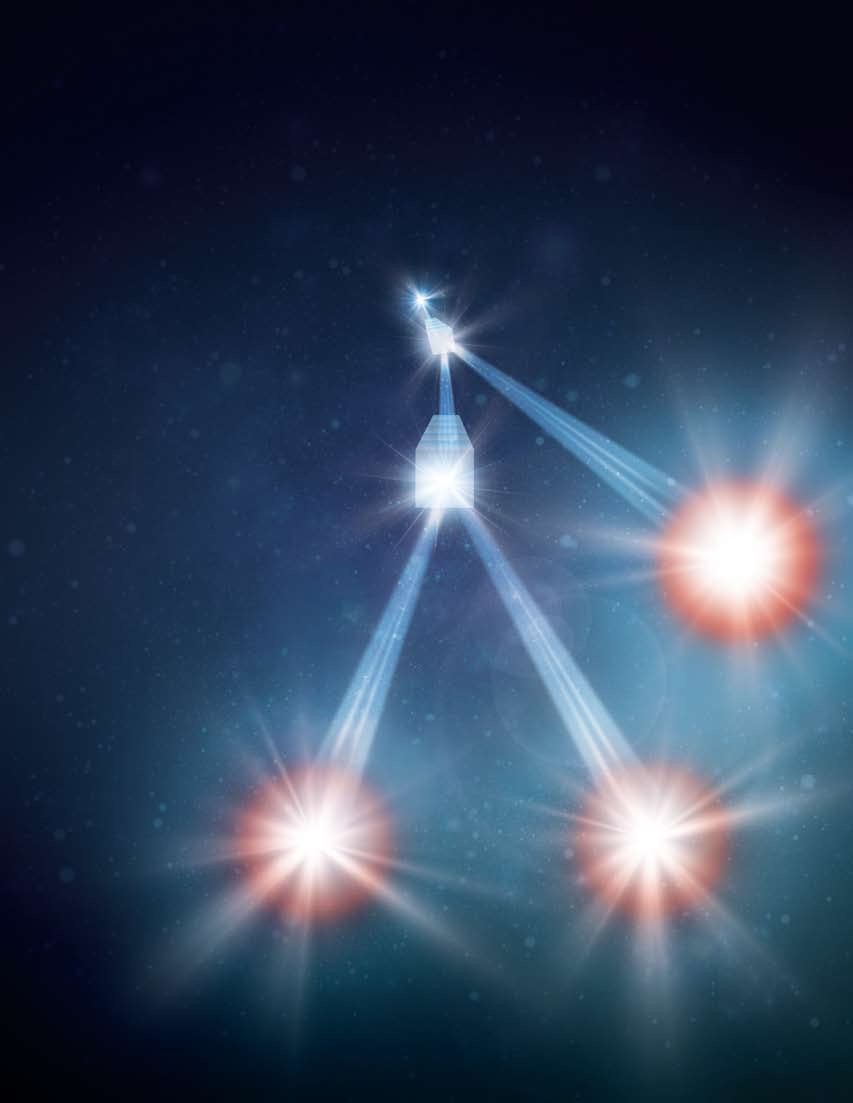
NOTE FROM THE EDITORIAL BOARD, May 8, 2019: Sixteen months after Billy Lee published this post, the Chinese launched the Mozi satellite. It successfully carried out the first in a series of experiments with entangled quantum particles over space-scale distances. This technology promises a quantum encrypted network by the end of 2020 and a global web built on quantum encryption by 2030. The Chinese seem to be on the cusp of both FTL communication (through teleportation of information) and quantum encryption.
If scientists and engineers are able to develop quantum signaling over solar-system-scale distances, they might discover later that adding certain tweaks and modifications will render the Sun transparent to our evolving planet-to-planet communications network.
Indeed, the Sun is transparent to neutrinos — the lightest (least massive) particles known. In 2012, scientists showed they could use neutrinos to send a meaningful signal through materials that block or attenuate most other kinds of subatomic particles.
But this article is about faster than light (FTL) communication. Making the Sun transparent to inter-planetary signaling is best left for another article.
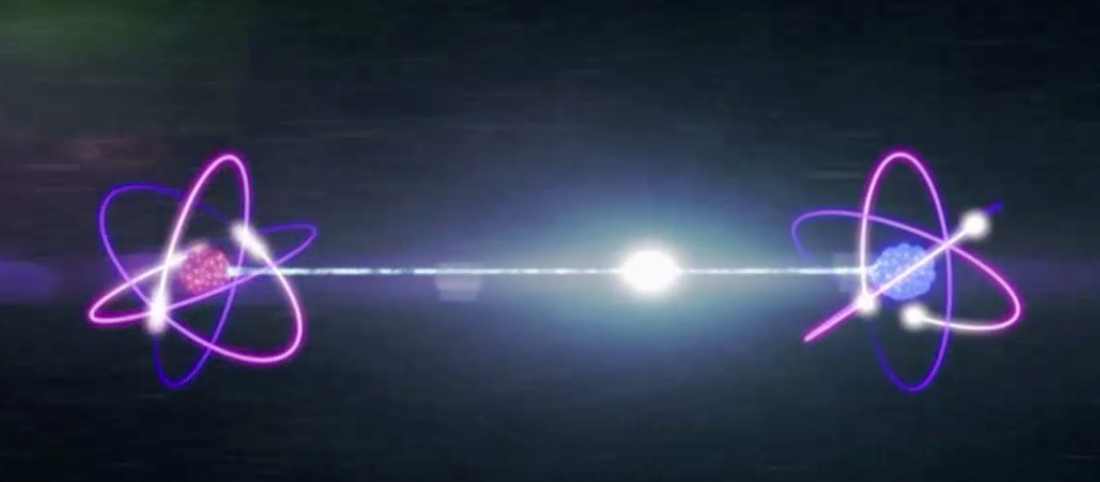
Quantum entanglement is the only phenomenon known where information seems to pass instantly between widely placed objects. But because the information is generated randomly, and because it is transferred between objects that are traveling at speeds at or below the speed-of-light, it seems clear to most physicists that faster-than-light (FTL) messaging can’t come from entanglement, certainly, or any other process — especially in light of Einstein’s assertion of a cosmic speed-limit.
Proposals for FTL communications based on technologies rooted in the quantum process of entanglement are usually dismissed as crack-pot engineering because they seem to be built on fundamental misunderstandings of the phenomenon.
Difficulties with the technology are often overlooked — such as spontaneous breaking and emergence of entanglement; progress seems impossible to skeptics. Nevertheless, there may be ways to make FTL happen, possibly. The country that develops the technology first will accrue advantages for their space exploration programs.
In this essay I hope to explain how FTL messaging might work, put my ideas into a blog-bottle and throw it into the vast cyber-ocean. Yes, the chances are almost zero that the right people will find the bottle, but I don’t care. For me, it’s about the fun of sharing something interesting and trying to explain it to whoever will listen.
Maybe a wandering NSA bot will detect my post and shuffle it up the chain-of-command for a human to review. What are the odds? Not good, probably.
Anyway, two serious obstacles must be overcome to communicate instantly over astronomical distances using quantum entanglement. The first is the problem of creating a purposeful signal. (To learn more about entanglement click the link in this sentence to go to Billy Lee’s essay, Bell’s Inequality. The Editors)
The second problem is how to create the architectural space to send signals instantly to a distant observer. Knowledgeable people who have written about the subject seem to agree that both obstacles are insurmountable.
Most scientists say FTL communication is impossible. This post suggests a way to engineer around the impossibility.
Why? It’s because the states of an entangled pair of subatomic particles are not determined until one of the particles is measured. The states can’t be forced; they can only be discovered — and only after they are created by a measurement.
Once one particle’s state is created (randomly) through the mechanism of a measurement, the information is transferred to the entangled partner-particle instantly, yes, but the particles themselves are traveling at the speed-of-light or less. The randomly generated states carried by these entangled particles aren’t going anywhere for very long faster than the speed-limit of light.
How can these difficulties be overcome?
Although the architectural problem is the most interesting, I want to address the purposeful-signal problem first. A good analogy to aid understanding might be that of an old-fashioned typewriter. Each key on a typewriter when pressed delivers a unique piece of information (a letter of the alphabet) onto a piece of paper. A person standing nearby can read the message instantly. Fair enough.
Imagine setting up a device which emits entangled pairs of photons; rig the emissions so that half the photons when measured later will be polarized one way, half the other. No one can know which photons will display which state, but they can predict the overall ratio of the two polarities from a “weighted” emitter.
Call the 50/50 ratio, letter “A”. Now imagine configuring another emitter-system to project 3 of 4 photons polarized one way; 1 of 4 another — after measurement. Call the 3 to 1 ratio “B”. If engineers are able to construct and rig weighted emitters like these, they will have solved half of the FTL communication problem.
Although no one can know the state of any single particle until after a measurement, engineers could identify the ratio of polarization states in a large number sent from any of the unique emitter-configurations they design.
This capability would permit them to build a kind of typewriter keyboard by setting up photon emitters with enough statistical variation in their emission patterns to differentiate them into as many identifiable signatures as needed — perhaps an entire alphabet or — better yet — some other symbolic coding array like a binary on-off signaling system perhaps. In that case, one configuration of emitter would suffice, but designers would need to solve other technical problems involving rapid signal-sequencing.
To send a purposeful-signal, engineers might select an array of emitters and rapid-fire photons from them. If they selected an “A” (or perhaps an “on”) emitter, 50% of the photons would register as being in a particular polarization state after they were measured. If they chose “B”, 75% would register, and so on. After measurements on Earth, the entangled bursts of particles on their way to Mars would take on these ratios instantly.
I believe it might be possible to build emitter-systems someday — emitter systems with non-random polarization ratios. If not, then as is sometimes said at NASA, Houston, we have a problem. FTL communication may not be designable.
On the other hand, if engineers build these emitters, then we can know for sure that when measured on Earth, the entangled photon-twins in the Mars-bound emitter-bursts will display the same statistical patterns; the same polarization ratios. Anyone receiving bundles of entangled-photons from these encoded-emitters will be able to determine what they encode-for by the statistical distribution of their polarities.
Ok. Assume engineers build these emitter-systems and set up a keyboard. How might they ensure that when someone presses a key the letter sent is seen immediately by a distant observer?
How might the architectural geometry of the communication space be configured?
This part is the most interesting, at least to me, because its success doesn’t depend on whether anyone sends a single binary-signal or a zoo of symbols — and it’s the most critical.
It does no one any good to instantly communicate polarization states to bunches of photons traveling at the speed of light to Mars. The signals take three to twenty-two minutes to get there, whoever tells them instantly what state to be in or not. We want the machines on Mars to receive messages at the same time we send them.
How can we do that?
Maybe the method is becoming obvious to some readers. The answer is: photons in Earth-bound labs aren’t measured until their entangled twins have had time enough to travel to Mars (or wherever else they might be going). Engineers will entrap on Earth the photons from each “lettered” emitter and send their entangled twins to Mars. The photons from each “lettered” emitter on Earth will circulate in a holding bin (a kind of information-capacitor), until needed to construct a message.
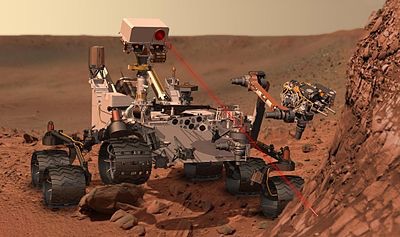
As entangled twins reach the Mars Rover (for example), anyone can “type-out” a message by measuring the Earth-bound photons in the particular holding bins that encode the “letters” — that is, they can start the process that takes measurements that will induce the polarization-ratios of the “lettered” emissions used to “type” messages. Instantly, the entangled particle-bursts reaching Mars will take on these same polarization-ratios.
I hear folks saying, Wait a minute! Stop right there, Billy Lee! No one can hold onto photons. You can’t store them. You can’t trap or retain them, because they are impervious to magnets and electrical fields. No one can delay measurements for five milliseconds, let alone five minutes or five days.
Well, to my mind that’s just a technical hurdle that clever people can jump over, if they set their minds to it. After all, it is possible to confine light for for short periods with simple barriers, like walls.
Then again, electrons or muons might make better candidates for communication. Unlike photons, they are easily retained and manipulated by electromagnetic fields.
Muons are short-lived and would have to be accelerated to nearly light-speed to gain enough lifespan to be useful. They are 207 times heavier than electrons, but they travel well and penetrate obstacles easily. (Protons, by comparison, are nine times heavier than muons.)
The National Security Agency (NSA) photographs every ship at sea with muon penetrating technology to make sure none harbor nuclear weapons. Muons are particles some engineers are already comfortable manipulating in designs to give the USA an edge over other countries.
We also have a lot of experience with electrons. Electrons are long-lived — they don’t have to be accelerated to near light-speeds to be useful. Speed doesn’t matter, anyway.
Entangled particles don’t have to travel at light-speed to communicate well, nor do they have to live forever. Particles only need enough time to get to Mars (or wherever they’re going) before designers piggyback onto their Earth-bound entangled partners to transmit instant-messages.
Inability to communicate instantly with distant probes like the Mars Rover is degrading our ability to conduct successful missions inside the solar system.
Even if it takes days or weeks for bursts of entangled-particles to travel to Mars (or wherever else), it makes no difference. Engineers can run and accumulate a sufficiently robust loop of streaming emissions on Earth to enable folks, soon enough, to “type” out FTL messages in real time whenever necessary.
As long as control of and access to the emitted particle-twins on Earth is maintained, people can “type out” messages (by measuring the captive Earth-bound twins at the appropriate time) to impose and transfer the statistical configuration of their rigged polarization ratios (or spins in the case of electrons or muons) to the Mars-arriving particle-bursts, creating messages that a detector at that far-away location can decode and deliver, instantly.
The challenge of instant-return messaging could be met by employing the same technologies on Mars (or wherever else) as on Earth. The trick at both ends of the communication pipe-line is to store (and if necessary replenish) a sufficient quantity of the elements of any possible communication in streaming particle-emission capacitors.
Tracking and timing issues don’t require the development of new technologies; the engineering challenges are trivial by comparison and can be managed by dedicated computers.
Discharging streaming information capacitors to send ordered instant messages in real-time is new — perhaps a path forward exists that engineers can follow to achieve instant, long-range messaging through the magic of quantum entanglement.
The technical challenges of designing stable entanglement protocols that will enable an illusion of instant messaging that is both useful and practical are formidable, but everything worth doing is hard — until it isn’t.
Twelve launch-capable space agencies (having as members about thirty countries) are, among other tasks, looking for alien life inside the solar system. They are exploring the four planets closest to the Sun: Mercury, Venus, Earth and Mars, which have three moons among them, and the five outer planets: Jupiter, Saturn, Uranus, Neptune and Pluto, which have one-hundred-and-sixty-three.
With so many moons and planets, the hope is that one of them will harbor life.
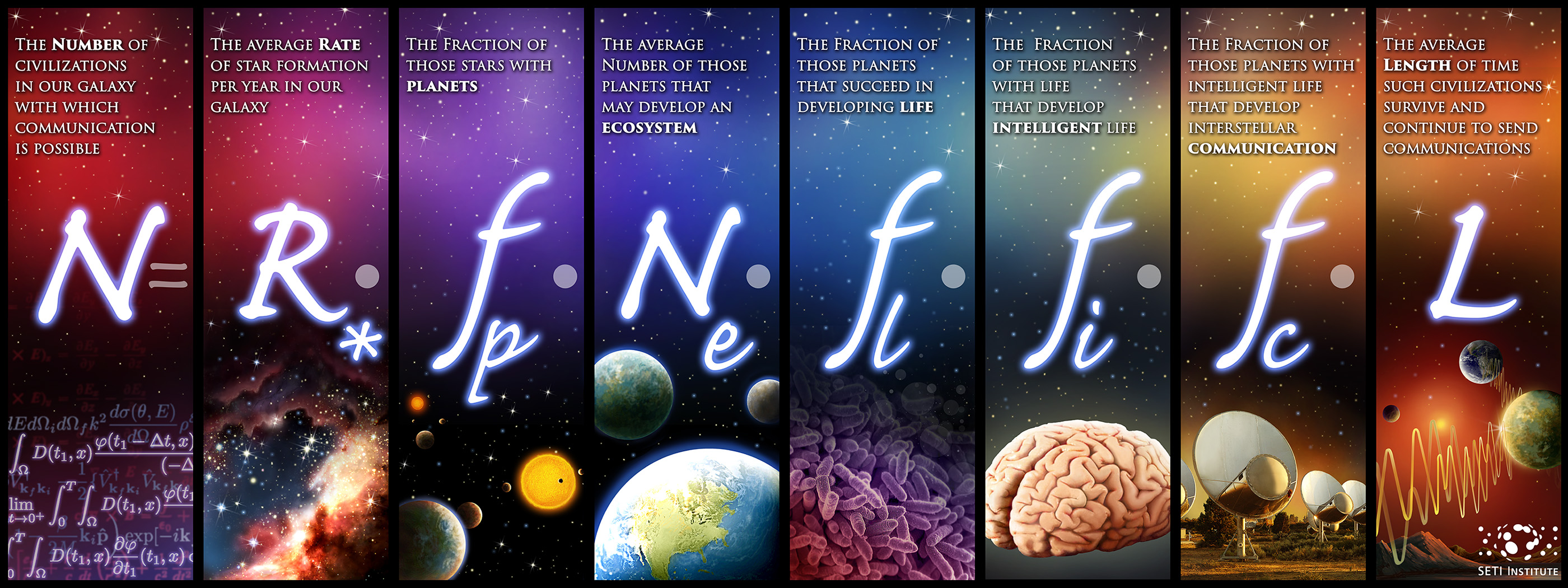
(Click pic to enlarge in new window.) Some recommend the Drake Equation to calculate odds that intelligent life which can communicate across space might exist elsewhere in the Milky Way Galaxy where our solar system is located.
Of the 166 moons and nine planets in the solar system, probes have managed to land on only five: Venus, Mars, Jupiter, Earth’s moon, and Titan (a moon of Saturn).
Just three moons are located in the Goldilocks zone where most scientists believe life has the best chance to take hold. Two orbit Mars at the outer edge of the habitable zone and are probably too cold and irradiated for life. The third moon orbits Earth.
(Click pic to enlarge.) Each column contains the orbiting moons of each planet (and a few other objects) inside the solar system.
Six moons in the solar system are comparable in size to the moon of Earth: Ganymede, Titan, Callisto, Io, Europa and Triton. All the rest are tiny with very little gravity — the force that can hold an atmosphere.
The twelfth largest rocky object in the solar system after Earth is Titania of Uranus, named for the Queen of the Fairies in Shakespeare’s Midsummer Night’s Dream. The moon is nearly a thousand miles in diameter. A 175 pound person on Titania takes on the weight of a newborn baby — a mere six pounds twelve ounces.
Few places in the solar system have enough gravity to hold a human securely, let alone an atmosphere.
No life has been found on any moon — or on any planet (except Earth) thus far. During the next several hundred years, humans will continue to look for life in the solar system should technology and civilization survive and advance.
The Kuiper Belt — which starts at Neptune and extends past Pluto — is a region that is home to an estimated 100,000 bodies of frozen methane, ammonia, and water.
Editors’ Note:(August 2016) The explorer spacecraft,New Horizons, flew by Pluto on July 14, 2016; it will fly by a Kuiper Belt object in January 2019.
Freeman Dyson — physicist, mathematician, and astronomer — has suggested that life might be pervasive in the Kuiper Belt and be easily detected once spacecraft get there. People wait and wonder.
Editors’ Note: (December 2018) Current analyses of data from the Pluto flyby describe a living, dynamic planet with a nitrogen atmosphere and a subsurface ocean. Portions of the surface are smooth with no signs of meteor impacts. Water-gushing volcanoes are common.
The solar system lies within a large disc-shaped galaxy called the Milky Way, which folks can see edge-on in the night sky should they travel out into the countryside away from well-lit cities, which tend to wash out vision.
It might surprise some readers to learn that no one really knows how many stars are in our galaxy. Credible astronomers believe the number to be somewhere between one-hundred and four-hundred billion — a huge range of uncertainty.
No one knows how many stars are similar to the sun. No one knows how many planets there are, or how many moons. Despite a lot of reporting and speculation, humans know almost nothing about the Milky Way.
Space is vast, and astronomers have few telescopes and satellites to accomplish the enormous job of taking it all in and cataloguing what they discover.
3.75 billion years from now, the Andromeda galaxy will collide with our own Milky Way. In this artist’s conception, Andromeda Galaxy is on the left; the Milky Way Galaxy is to the right.
Lack of knowledge about the details of our own galaxy helps to explain why it is difficult to understand the universe as a whole. When I first published this essay in late summer 2014, astronomers estimated that between a hundred and two-hundred billion galaxies populated the visible universe (the estimate is now known to be wrong).
Editor’s Note:On October 1, 2017 CBS News was among the first to report to the public that the Hubble space telescope had detected as many as two trillion galaxies — ten times more than previous estimates.
Two-trillion galaxies — and all the other objects in the universe that lie outside the local area of our own galaxy —are far away and too fuzzy for astronomers to know almost anything about them. The galaxies are out there, true, but the numbers are staggering. The small amount of data astronomers have already gathered is overwhelming scientists’ abilities to process and make sense of it all. And they are just getting started.
The Webb Telescope is scheduled for launch on 30 March 2021. Image is an artist’s rendition featured on Wikipedia.
Civilization is in the very first stages of placing sensors into space which eventually will help astronomers to learn more. One — the James Webb space telescope — is scheduled to launch sometime during the 2020s. Its purpose? — to tear down the 400-million-light-years-after-the-Big-Bang limit of the Hubble telescope.
Humans are going to be able to look back to the beginning of time, at long last. Understanding the process that brought us here is going to expand dramatically. Until then, the Drake equation (see illustration at beginning of the essay) and other speculative tools remain not much more than intriguing diversions.
New sensors like the Webb telescope will upgrade human understanding and bring a new realism that promises to sweep away much of the science-fiction people drink to satiate their thirst for ultimate knowledge.
Most articles, television shows, and movies that purport to portray the universe are (to risk overstating it) kind-of scammy. They seduce a gullible and curious public, which is hungry for answers about the universe that no one yet has.
The science community has a vested interest in public funding; they tend to go-along with dubious depictions to pander popular support. Claims that astronomers today understand fully the nature of the universe are ludicrous. The universe is vast. Much of its matter and energy that scientists believe is “out there” can’t be found — not yet anyway.
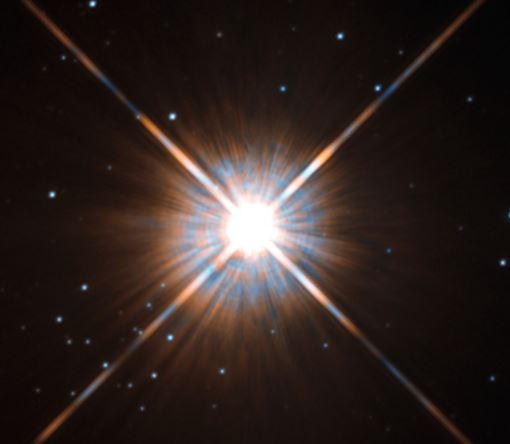
Most stars are too faint to see with unaided eyes. The closest star system to our Sun, Proxima Centauri, is too faint to see without a telescope.
Three out of four stars in the galaxy are probably red dwarfs. Red dwarfs burn essentially forever but are smaller and much cooler than the Sun, which makes them impossible to observe without special infrared detectors.
These infrared detectors are launched into outer space beyond Earth’s atmosphere to avoid being blinded by the infrared heat radiating off Earth’s surface.
Proxima Centauri main star. Image by Hubble Telescope.
Red dwarfs seem to be emitting solar flares that are a thousand times more energetic and frequent than those generated by stars like the Sun. They emit light in frequencies not useful for plant photosynthesis — the basic life-support process on Earth.
Worse, red dwarfs are often found in pairs gravitationally bound and rotating around each other. They make stable orbits for third body objects like planets nearly impossible. Without stable orbits lasting billions of years, odds that life evolves to civilization on planets in two-star solar systems is probably zero, some argue.
It’s difficult to see how Earth-style life could get started and survive to civilization inside red dwarf planetary systems. No one knows what percentage, if any, of red dwarf stars have planets suitable for life.
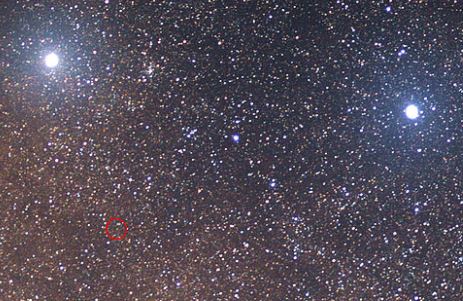
Canon 85mm photo of Proxima Centauri three-star system by Skatebiker on English Wikipedia.
Red dwarfs live for thousands-of-billions of years. The Sun’s lifespan is eight to ten billion years — a tiny fraction of a red dwarf’s.
The Sun is similar to — who knows? — maybe one in five stars in the galaxy. It’s an optimistic guess, based on sampling and wishful hoping. Astronomers seem to agree that the Sun ranks as one of the largest stars in the Milky Way.
Statistical sampling of two-trillion galaxies argues that the Milky Way galaxy is also among the largest. A full 90% of all galaxies are smaller.
Calculations involving galaxy-motion and gravity suggest that when astronomers look at the cosmos, they aren’t seeing ninety-five percent of what’s out there. Physicists call the missing stuff dark energy and dark matter. Something that no one has yet been able to detect seems to be distorting the rotation of galaxies and disrupting the metrics of space-time.
The universe seems to be expanding, and the expansion is accelerating. Where is the missing mass and energy that drives the expansion? No one knows.
Perhaps parallel universes are stacked on every side against our own. They might swarm like bees around a hive. The gravitational pull of their enormous masses might be pulling our own universe apart. Galaxies inside our universe might be falling toward massive structures that lie outside our field of vision beyond a kind of event horizon.
Again, no one knows. It’s speculation. Today the expansion is described by a simple constant added into Einstein’s equation for General Relativity. A constant seems too simple, at least for me. It describes but doesn’t explain.
Einstein’s equation accounts for the accelerating expansion of the universe by including a term called the ”cosmological constant”. It is the Greek letter lambda ( Λ), which is multiplied against every member of the metric tensor, ”g” and then added to the left side of the equals sign, which is the side of the equation that describes the shape (curvature) of spacetime. The right side describes the distribution of mass / energy in spacetime.
Many of the galaxies that are visible from Earth are tens-of-thousands of times farther away than the farthest stars in our own galaxy, the Milky Way, which astronomers say is at least 100,000 light years across — a distance of six-hundred-thousand trillion miles. The galaxy is perhaps 200 light years thick, but its center is thicker still — about 10,000 light years.
If the Milky Way was shrunk to the diameter of a ten-inch plate, the plate would assume a thickness of a few human hairs but at the center it would thicken to the size of an egg-yolk.
To put these distances into perspective, the latest space probes, which travel at roughly twelve miles-per-second, are not capable of escaping the gravity of our solar system until they are mechanically slung by multiple encounters with planets to a velocity greater than 27 miles per second. At that speed, crossing the Milky Way takes nearly 700 million years.
What the Milky Way might look like if photographed by an extremely powerful telescope from the galaxy Andromeda, which is two-and-a-half million light-years from Earth.
The Milky Way is one galaxy in what astronomers have learned is a universe of two trillion.
Until scientists know more — and it could be decades or even centuries from now — prudence and the scientific method advise odds-makers to use the most conservative estimates, not the most optimistic, to speculate about intelligent life in the cosmos.
Until evidence accumulates that is more compelling than what is available today, plugging conservative numbers into the Drake equation, or any other speculative tool, always seems to give the same discouraging result — a number so small it might as well be zero.
No intelligent life that can communicate across space should exist in our galaxy or anywhere else in the universe. None. Yet, here we all are. It’s kind of mysterious, at least to me.
Substituting less conservative numbers yields a different result. Intelligent civilizations could number in the thousands or even millions. No empirical evidence supports such optimism, at least not yet.
Planets and Sun are shown to scale in this model. Distances are not. From left to right, largest to smallest: Jupiter, Saturn, Neptune, Uranus, Earth, Venus, Mars, Mercury, and Pluto. Pluto — recently demoted to the status of a ‘’dwarf planet” — has been re-argued for planet-hood by some cosmologists because the recent NASA fly-by showed Pluto slightly larger and more planet-like than previously thought.
Looking closer to home within our own galaxy, astronomers in 2003 discovered Sedna, which some think is another dwarf-sized planet orbiting far beyond Pluto.
Astronomers seem to discover new planet candidates every other month — Eris and Makemake are two more Pluto-sized objects out of hundreds that come to mind.
In 2014 Caltech astronomers presented evidence for another planet they called the ninth planet, which might be an object ten times the mass of Earth orbiting in a highly elliptical orbit at the farthest reaches of the solar system.
Regardless of what astronomers continue to discover, it seems likely that the Sun will always contain at least 99% of the mass in the solar system.
Earth is fortunate to orbit a star that is located in a less active region of space than many other stars in the Milky Way. The Sun lies safely between two spiral arms that are bright because of ongoing birthing of new stars. The location lies halfway from the center of the galaxy to its outer edge.
Click pic for better view of Earth’s position inside Milky Way galaxy.
Although stars are spread more or less evenly throughout the Milky Way, life-destroying cosmic events are less likely in regions where stars aren’t being born. Earth lives between bright spirals in a zone of relative inactivity, which has enabled the evolution of eukaryotic one-celled life to progress to intelligence, then civilization, and finally to space exploration over the past billion-and-a-half years.
Earth has a number of unusual features that make it a good candidate for highly evolved life. One important feature is its nearly circular orbit around the Sun, which helps Earth avoid the catastrophic temperature variations characteristic of the more egg-shaped (elliptical) paths of some of the other planets, like Mars.
Only the orbits of Venus and Neptune are more round than Earth’s. Mar’s orbit is five times less round. Of all the solar objects, only Neptune’s moon Triton is known to have for all practical purposes a perfectly circular orbit.
Another advantage for Earth is its 300-mile thick atmosphere of nitrogen and oxygen, 80% of which lies within 10 miles of its surface. Nitrogen and oxygen make up 99% of Earth’s atmosphere. These gases are opaque to non-electrically-charged, high-frequency light.
Nitrogen molecules block high-frequency, ultra-violet light while oxygen molecules, slightly smaller, block higher-frequency (shorter wave-length) x-rays and gamma-rays, which can be lethal to living organisms.
A three-atom form of oxygen molecule known as ozone helps to absorb in the upper atmosphere a dangerous-to-life, lower-frequency-band of ultra-violet light that nitrogen can’t block.
In the distant past — during the Carboniferous Period 300 to 360 million years ago — Earth’s atmosphere held 60% more oxygen than it does now, which provided more shade against damaging high-energy light. Dinosaurs and large insects — like dragonflies with three-foot wing-spans — thrived in the highly-oxygenated air they breathed.
It is one of the wonderful ironies of our planet that the oxygen which empowers the biology of life also defends it against the physics of life-destroying high-energy light and cosmic rays that are always raining down from outer space.
Without atmospheric moisture and greenhouse gases, Earth’s average temperature would fall to 100°F below zero.
In contrast to nitrogen and oxygen, which block high-frequency light from reaching Earth’s surface, carbon-dioxide, methane, and water vapor trap low-frequency light (infra-red light, or heat) and prevent it from radiating (or escaping) into space.
These green-house gases work like a blanket to help keep Earth at a constant temperature. Carbon dioxide, though rare, is heavy compared to oxygen and nitrogen. It tends to cling close to Earth’s surface where it is respirated by plants. Without atmospheric moisture, methane, and carbon dioxide the temperature of Earth would average 100°F below zero and vary widely between day and night as it does on the Moon.
Although water vapor and carbon dioxide make but a tiny fraction of the atmosphere, they have a significant impact on the planet’s ability to retain heat when their concentrations increase in the atmosphere. Exhaust from commercial jet aircraft, believe it or not, contributes greatly to the concentration of carbon dioxide and water vapor in the eight-mile highs of the atmosphere where these jets fly.
After the terrorist attack on 911, the government suspended all flights over the United States — including those by commercial aircraft — for four days. The skies over America cleared themselves of clouds and turned deep blue. Temperatures dropped.
I was amazed to observe these changes develop so quickly after all flying was suspended. It took about two weeks for aviation to return to pre-attack intensity. With the return of aviation, familiar weather patterns followed.
Unlike Earth, the planet Venus has so much carbon dioxide that its surface broils with heat. An explorer would have to hover thirty-seven miles above its surface to experience atmospheric pressures and temperatures similar to those on Earth.
By contrast, the atmosphere of Mars, though almost entirely carbon dioxide, is thin — only 1% as thick as Earth’s. Even so, near their surfaces the density of carbon dioxide is 15 times higher on Mars than on Earth — enough to grow plants and — if poisons in the soil can be avoided — terraform the surface should humans decide.
Although Mars is cold, especially at night, its carbon dioxide atmosphere enables daytime temperatures to sometimes reach 85° F during summer in its southern latitudes. The problem is that any plants that might grow in Martian soil must endure bombardment by dangerous-to-life high-frequency light and cosmic particles. Also, Martian soils are poisoned by perchlorates. The soil is useless for agriculture though perchlorates could be broken down to provide a source of oxygen.
I should mention argon, which is 1% of Earth’s atmosphere. It is formed by the radioactive decay of a rare isotope of potassium in Earth’s crust. It is transparent to infra-red heat, so it has no effect on global warming. It is heavy — like carbon dioxide — so it clings to the surface, but its small atoms, widely spaced, do little to prevent the escape of infra-red radiation.
Another asset that gives Earth an advantage for life is its large moon whose gravitational field acts like a vacuum cleaner to suck up cosmic-debris like asteroids and comets that might threaten to strike. Only Jupiter, Saturn and Neptune are similarly equipped.
Image courtesy of NASA
The moon stabilizes Earth’s tilt as it orbits the sun. The tilt is about 23.4°, which is why Earth has seasons. The tilt swings back and forth a few degrees over periods of 41,000 years. This variation is stable enough to permit life to survive and evolve despite the periodic generation of ice-ages.
Computer simulations of a moonless Earth show that with no moon to stabilize it, tilt variations could approach 90°. Dramatic destabilization has emerged in some simulations that make it difficult to imagine how advanced life could evolve and survive the climate extremes that might result from chaotic wobbling.
The Moon is receding away from Earth at a rate of almost two inches per year. It will take at least a billion years for the motion of Earth to destabilize. It seems that humans have time to figure something out.
Sadly, the sun gets brighter and less massive with each passing day. Over the course of a billion years, Earth will move farther from the sun to conserve its angular momentum. Meanwhile, the warming sun will overtake Earth’s great escape to evaporate its oceans and make the planet uninhabitable.
Looking at coming events from a more optimistic perspective, people can probably agree that a billion years is a long time. The species-human is likely to be extinct by then anyhow. So why worry?!
Another life-enhancing feature of Earth is its large, open, ice-free, salt-water oceans. Most scientists believe salt-water oceans provide safe habitat for evolving life.
Earth’s oceans make up three-fourths of the planet’s surface. In addition to providing a vast incubator for life, oceans reduce the probability that space-debris will fall onto land.
Odds are that debris will fall into the oceans where it is rapidly cooled and rendered harmless. Should debris strike land and throw up clouds of dust and ash to block the sun, the oceans provide a safety-blanket of thermal protection.
This photo of Titan’s surface is the only picture taken at the surface of a moon or planet that is farther away than Mars.
Besides Earth, only Titan — one of Saturn’s many moons — has open oceans (of liquid methane and ethane) on its surface. These oceans are more like shallow seas or lakes, estimated to be about five-hundred feet deep. Scientists think Titan has a salty sub-surface water ocean, as well.
NASA reported this year that another moon of Saturn, tiny Enceladus (310 miles in diameter), holds a six mile deep subsurface ocean — confirmed from Cassini fly-bys. Its over one-hundred geysers are what is populating Saturn’s E-ring. Data from the geysers indicate that the ocean is warm and salty and saturated with organic molecules. Analysis by Cassini instruments is on-going.
Of the moons of Jupiter, only Europa, Ganymede, and Calisto are thought to harbor salt-water oceans.
Europa is known to have a salt-water ocean, but it is covered by miles-thick ice.
Ganymede, the largest moon in the solar system, is believed to have a 500 mile deep salt-water ocean that lies beneath a crust 125 miles thick. The crust is thought to be a rock and ice mixture.
Scientists suspect that Callisto has a salt-water ocean, but it might be sandwiched between ice layers sixty or more miles beneath its surface.
Only the oceans of Earth are open, un-frozen, and deep enough (averaging three miles) to protect Earth against most encounters with meteors and other space-debris.
Fortunately for Earth, the solar system itself contains a massive structure that helps to protect and shield it from danger. It is Jupiter, the large and strongly gravitational planet, which like the moon pulls away space-debris that might otherwise zoom toward Earth to imperil all life. Observations suggest that comets strike Jupiter every couple of years. Comets that don’t strike are gravitationally deflected out of the solar system more often than not.
Another fortunate feature: Earth has, geologists say, a molten iron-core that emits a strong magnetic field to deflect life-destroying, electrically-charged cosmic particles, that have energies, some of them, approaching those of baseballs traveling sixty miles-per-hour. Cosmic particles accelerated the process of ripping away Mar’s atmosphere. Without a magnetic field the Mars atmosphere is defenseless against cosmic erosion.
As for Earth, high energy particles that do manage to blast through it’s magnetic shield (magnetosphere) are often scattered and rendered harmless — fortunately — by collisions with the oxygen molecules in Earth’s dense atmosphere.
One exception is muons, which are byproducts of particle collisions high in Earth’s atmosphere that are energetic enough to burrow down to hundreds of yards beneath Earth’s land surfaces and oceans. In rare heavy bombardments at high altitudes, muons can increase risks of cancer and cataracts to pilots and their passengers. Muons are like electrons except that they are 207 times heavier and much shorter-lived.
Sun’s solar wind deflected by Earth’s magnetosphere. NASA art.
The magnetosphere is strong enough to deflect the solar wind, which can strip away all or part of the atmosphere of any planet that lacks one (like Mars).
The magnetosphere is effective and strong, because it is huge and surrounds Earth out to five Earth-diameters on the side facing the sun; one-hundred Earth-diameters on the side opposite. In any small area of space, though, a simple bar-magnet is fifty times stronger.
The solar wind isn’t all bad. As it radiates outward from our Sun, it forms a huge magnetic bubble called the heliosphere that extends 3.5 billion miles past the Kuiper Belt.
Inside this Sun Bubble the rest of the solar system is protected from massive cosmic particles that pour in from the two trillion galaxies of stars that make the universe. The Sun bubble deflects to shade our solar system in relative safety.
The heliosphere of the Sun works together with the magnetosphere of Earth and its oxygenated atmosphere to break up and knock away the vast majority of cosmic particles (high-speed protons and atomic nuclei) that would otherwise rip Earth-life to shreds.
Absent the magnetosphere, life could evolve safely only in the deep oceans or far below the surface of Earth. Stated differently: a strong, protective magnetic field is essential for the survival of surface life on any planet.
Large solar flares are known to have enough energy to kill exposed astronauts. It’s one of many reasons NASA doesn’t send people to Mars, which lacks a magnetosphere. Mars is under relentless bombardment of atomic particles that can damage the atoms and molecules in the cells of a human body.
All planets have magnetic fields of various strengths except Venus and Mars. The iron in the core of Mars is believed to have frozen solid, or nearly so, hundreds of millions of years ago, which helped force its protective magnetic field to collapse.
Venus retains its molten iron-nickel core, but the planet lacks tectonic action in its crust. The heat of its core can’t escape through its surface, which prevents in its molten center the emergence of the turbulence essential to make a planetary dynamo of sufficient power to rev-up a magnetosphere.
It’s a shame that both Mars and Venus lack magnetospheres, because both planets have attributes that might otherwise make them good candidates for life.
Earth’s core is huge — it rivals the entire planet of Mars in size. The inner third of the core — the center — is already frozen solid. It is believed to be pure iron. The core is freezing itself solid from the inside out.
The rest of the core is hot liquid iron and nickle, mostly, with some sulfur and other impurities mixed in. It circulates in complex eddies, which generate the magnetic fields that protect Earth by deflecting the solar wind.
The flow of currents in the molten metal is made stable and more reliable by the unusual plate tectonics peculiar to Earth. Gaps in Earth’s crustal plates allow heat to escape from volcanic valves, which help to maintain a controlled roil in the eddy currents to produce the dynamo that drives its magnetosphere.
The only moon known to have a magnetic field is Jupiter’s Ganymede. Jupiter itself harbors a field fourteen times more powerful than Earth’s. The giant planet’s four largest moons orbit inside it, where they are protected from the solar-wind and low frequency (low-energy) cosmic particles. By contrast, Mercury’s magnetic field is one-hundred times less powerful than Earth’s.
Despite these several advantages for sustained evolution of life, Earth has the apparent disadvantage of a volatile climate which, scientists believe, has turned cold and icy during several extended periods. I mention this volatility to remind people that the circumstances that have enabled life to advance to the technological civilization of today are complex and not obvious.
Until scientists are able to tease out of history what is actually important and significant for the development of advanced life, no one can know what the rest of the universe may have in store — unless we travel out into space and explore it.
I want to believe: we will find the way.
Here’s the problem. The closest stars to the Sun are twenty-five trillion miles away. To escape the solar system, engineers must build spacecraft that can accelerate to 27 miles per second. At that speed the nearest stars, Proxima Centauri, and the binary star system, Alpha Centauri, are 30,000 years distant.
How are humans going to explore the universe? How are we going to answer the questions about our place in the cosmos, when we can’t travel to the nearest stars?
There are trillions of stars, most of them many millions of times farther away than these, our closest neighbors. It seems hopeless that anyone will ever know the answers to the basic questions about the universe that so many are asking.
Still, in my heart of hearts, I want to believe we will find a way.
Billy Lee
Editors Note:November 2017; NASA announced that the latest count of galaxies might be as high as two trillion. The velocity required by spacecraft to escape the Milky Way galaxy from Earth (our planet is 25,000 light years from the galaxy center) is 342 miles-per-second. At this velocity the nearest galaxy — Andromeda — is a flight of 2.28 billion years. There are two-trillion galaxies more!
It doesn’t really matter. Here’s why:
The Parker Solar Probe scheduled for launch in 2018 will require seven gravity-assists from Venus over a period of six years to reach a velocity of 120 miles-per-second before it embarks on a 2024 suicide mission into the outer atmosphere of the Sun.
Venus and the Sun combined can’t accelerate the Parker Solar Probe to the galaxy-escape velocity of 342 miles-per-second.
Minus gravity-assists, the fastest vehicles in development today by space-flight engineers will accelerate to speeds less than 27 miles-per-second — the escape velocity required to exit the solar-system. Without gravity assists that take years to rev-up, we humans can’t leave our own solar system, which is arguably the tiniest imaginable fraction of the Milky Way galaxy.
The good news is that life-forms in far-away solar systems face the same obstacles. If they are hostile, humans can be assured that they will have a difficult time getting here.
The bad news is that humans are trapped. The Milky Way Galaxy is a prison. We can’t escape, at least not yet; most likely, not ever. The escape velocity of the Milky Way Galaxy from Earth exceeds 340 miles-per-second — nearly three times the velocity that the Parker Solar Probe will be traveling when it is finally able to bury itself inside the Sun.