RENORMALIZATION

I have a lot to say about renormalization; if I wait until I’ve read everything to know about it, my essay will never be written; I’ll die first; there isn’t enuf time.

Click this link and the one above to read what some experts argue is the why and how of renormalization. Do it after reading my essay, though.

Here is a snippet rewritten from a Quora post: Renormalization is a set of techniques used to resolve infinities that pop up when calculating. It is based on the idea that system behavior depends on scale. Cut away problematic pieces that scale badly to extract finite, testable portions where infinities don’t appear. 

Let’s move on. 
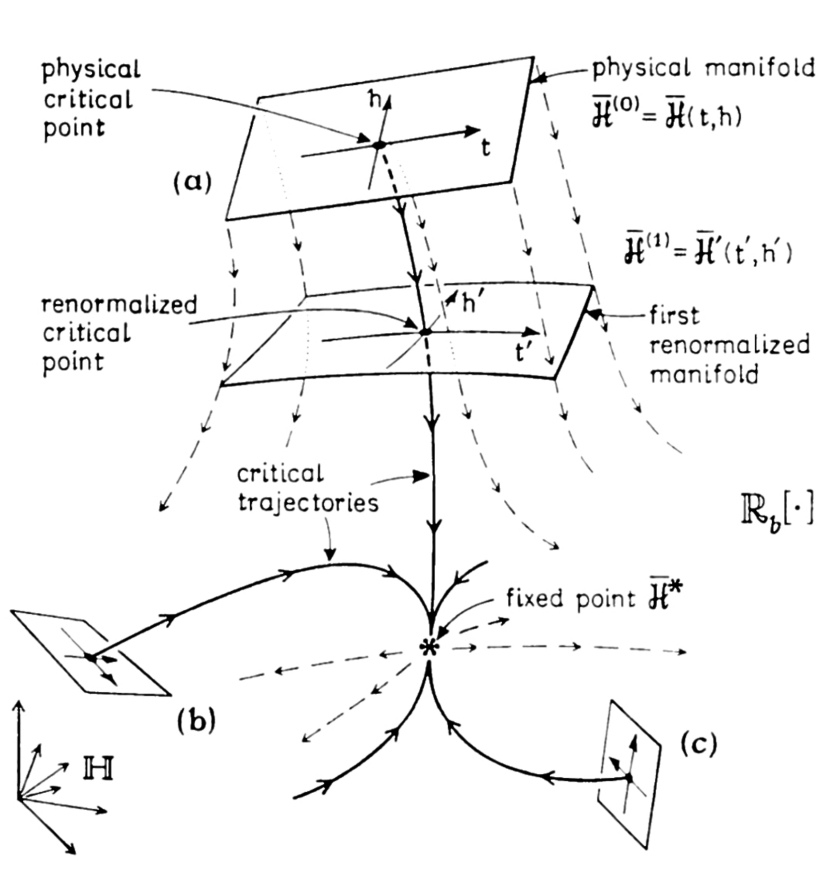

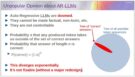
Our guess is that this graphic will be incomprehensible to the typical reader of Billy Lee’s blog. So, don’t worry about it. Billy Lee isn’t going to explain it, anyway. More important things need to be told that everyone can understand, and they will. The Editorial Board

There’s a problem inside the science of science; there always has been. Facts don’t match the mathematics of theories people invent to explain them. Math seems to remove important ambiguities that underlie all reality.

People noticed the problem as soon as they started doing science. The diameter of a circle and its circumference was never certain; not when Pythagoras studied it 2,500 years ago or now. Number π is the problem. It’s irrational, not a fraction; it’s a number with no end and no pattern — 3.14159…forever into infinity.

More confounding, π is a number which transcends all attempts by algebra to compute it. It is a transcendental number that lies on the crossroads of mathematics and physical reality, a curious number at the heart of creation because using it means that diameters, surface areas, and volumes of spheres cannot be calculated precisely. 


For a circle, either the circumference or the diameter can be rational (written as a fraction) but not both. Perfect circles and spheres cannot exist in nature. Why?  ”π” is irrational. It can’t be written like a fraction —  a ratio — where one integer divides another.

The diameter of a circle is multiplied by π to calculate its circumference, and vice-versa. No one can know exactly everything about a circle, because π is uncertain, undecidable, and in truth unknowable. 

Back in the day, people learned to use the fraction 22 / 7 or, for more accuracy, 355 / 113. These fractions gave the wrong value for π but they were easy to work with and close enough to do engineering problems.

Fast forward to Isaac Newton, English astronomer and mathematician, who studied the motion of planets. Newton published Philosophiæ Naturalis Principia Mathematica in 1687. I have a modern copy in my library. It’s filled with formulas and derivations. Not one works to explain the real world — not one.

Newton’s equation for gravity describes the interaction between two objects — the strength of attraction between Sun & Earth, for example, and the resulting motion of Earth.

Moon, Mars, Venus, and other bodies warp space-time waters in the pool where Earth & Sun swim. No formula predicts the future of multi-bodied systems. Numerical methods, 2-body approximations among others are used.  


This simple 3-body problem cannot be solved using a single equation. System is chaotic. 

In 1887 Henri Poincare and Heinrich Bruns proved that such formulas cannot be written. The three-body problem (or any N-body problem, for that matter) cannot be solved by a single equation. Fudge-factors must be introduced by hand, Richard Feynman once complained. Powerful computers combined with numerical methods seem to work well enough for some problems. 

Perturbation theory was first proposed in the 17th century. By 1960, physicists used it to solve problems in quantum physics. It helped. Space exploration depends on perturbation techniques. It’s not perfect. A fudge factor called rectification is sometimes used to update changes as systems evolve. When NASA lands probes on Mars, no one can know exactly where they are relative to reference points on the Earth.

Even when using the signals from constellations of six or more Global Positioning Systems (GPS) in high earth-orbit, it’s not possible to know exactly where anything is. Beet farmers out west combine the GPS systems of at least two countries to hone the courses of their tractors and plows. On a good day farmers can locate a row of beets to within an eighth of an inch. That’s plenty good, but the several GPS systems they depend on are fragile and cost billions per year. In beet farming, an eighth inch isn’t perfect, but it’s close enough.

Although a general method of perturbations can be described in mathematics, problems emerge when quantum and astral scales overlap. Relativity & quantum mechanics do not work well together, at least mathematically. Infinities appear that seem unresolvable. 

Quantum physics is a frontier of knowledge that presents unique roadblocks to precision. Physicists have invented more excuses for why they can’t get anything exactly right than probably any other group of scientists. Quantum physics is maybe 100-years old, but problems today seem more difficult than ever.


The sub-atomic world seems to be smeared and messy. Vast numbers of particles — virtual and actual — makes the use of mathematics problematic. This pic is an artist’s conception. Concepts such as ”looks like” have no meaning at sub-atomic scales, because small things can’t be resolved by any frequency of light that enables them to be visualized realistically by humans.

Insurmountable?

Well, interaction of sub-atomic particles with themselves combined with, I don’t know, interactions with swarms of virtual particles might disrupt the expected correlations between theories and experimental results. The mismatches can be spectacular. They dwarf N-body problems of astronomy.

Worse — the problem of scales. For one thing, electrical forces are a billion times a billion times a billion times a billion times stronger than gravitational forces at sub-atomic scales. Forces appear to manifest themselves according to the distances across which they interact. It’s odd.

Measuring the charge on electrons produces different results depending on their energy. High energy electrons interact strongly; low energy electrons, not so much. So again, how can experimental results lead to theories that are both accurate and predictive? Divergent amplitudes that lead to infinities aren’t helpful.

An infinity of scales piles up to produce troublesome infinities in the math which tend to erode predictive usefulness of formulas and diagrams. Once again, researchers are compelled to fabricate fudge-factors. Renormalization is the buzzword for several popular methods.

Probably the best-known renormalization technique was described by Shinichiro Tomonaga in his 1965 Nobel Prize speech. According to the view of retired Harvard physicist Rodney Brooks, Tomonaga implied that  …replacing the calculated values of mass and charge, infinite though they may be, with the experimental values… is the adjustment necessary to make things right, at least sometimes. 

Isn’t such an approach akin to cheating? — at least to working theorists worth their salt?  Well, maybe… but as far as I know results are all that matter. Truncation and faulty data mean that math can never match well with physical reality, anyway. 

Folks who developed the theory of quantum electrodynamics (QED) used perturbation methods to bootstrap their ideas to useful explanations. Their work produced annoying infinities until they introduced creative renormalization techniques to chase them away.

At first physicists felt uncomfortable discarding the infinities that showed up in their equations; they hated introducing fudge-factors. Maybe they felt they were smearing theories with experimental results that weren’t necessarily accurate. Some may have thought that a poor match between math, theory, and experimental results meant something bad; they didn’t understand the hidden truth they struggled to lay bare.

Philosopher Robert Pirsig believed the number of possible explanations scientists could invent for phenomena were in fact unlimited. Despite all the math and convolutions of math, Pirsig believed something mysterious & intangible like quality or morality guided human understanding of the Cosmos. He saw an infinity of notions floating inside his mind. It drove him insane, at least in the years before he wrote his iconic Zen and the Art of Motorcycle Maintenance.

The newest generation of scientists aren’t embarrassed by anomalies. N. David Mermin said, “shut up and calculate.” Digital somersaults are executed to validate work difficult for most to understand, much less perform. Researchers determine scales, focus on relevant portions, cut-away irrelevant parts, and extract appropriate physics to make suitable matches of math to experiment. They put horse before the cart more times than not, some critics have said.


Apologists say, no. Renormalization is simply a reshuffling of parameters in a theory to prevent its failure. Renormalization doesn’t sweep infinities under the rug; it is a set of techniques scientists use to make useful predictions in the face of divergences, infinities, and blowup of scales which might otherwise wreck progress in quantum physics, condensed matter physics, and even statistics. From YouTube video above.

It’s not always wise to question smart folks, but renormalization seems a bit desperate, at least to my way of thinking. Is there a better way?

The complexity of the language scientists use to understand and explain the world of the very small is a convincing clue that they could be missing pieces of puzzles, which might not be solvable by humans regardless how much IQ any petri-dish of gametes might deliver to brains of future scientists.

It’s possible that humans, who use language and mathematics to ponder and explain, are not properly hardwired to model complexities of the universe. Folks lack brainpower sufficient to create algorithms for ultimate understanding.

People are like the first Commodore 64 computers (remember?) who needed massive upgrades to become Sunway TaihuLight or Cray XK7 Titan super-computers, right? 

Perhaps Elon Musk’s Neuralink add-ons will help someday. 

Nick Bostrom, author of SUPERINTELLIGENCE – Paths, Dangers, Strategies

The smartest thinkers — people like Nick Bostrom and Pedro Domingos (who wrote The Master Algorithm) — predict artificial super-intelligence will be developed & hardwired with hundreds or thousands of levels — each loaded with trillions of parallel links —  to digest all meta-data, books, videos, and internet information (a complete library of human knowledge). Armies of trained computers will discover paths to knowledge unreachable by puny humanoid intelligence.

Super-intelligent computer systems might achieve understanding in days or weeks that all humans working together over millennia might never acquire. The risk of course is that such intelligence, when unleashed, might enslave us.

Another downside might involve communication between human and machine. Think of a father — a math professor — teaching calculus to the family cat. It’s hopeless, right? 

Founder of Google and Alphabet Inc., Larry Page (graduated from same school as one of my sons) is working on artificial super-intelligence. He owns piece of Tesla Motors, started by Elon Musk of SpaceX.

Imagine an expert in AI & quantum computation joining forces with billionaire Musk who possesses the rocket launching power of a country. Right now, neither is getting along, Elon said. They don’t speak. It could be a good thing, right? 

What are the consequences?

Entrepreneurs don’t like to be regulated. Temptations of military power added to science-knowledge provided by super-intelligence might corrupt these men and push them & humanity toward unmitigated… what’s the word I’m looking for?

I heard Elon say he doesn’t like regulation, but he wants to be regulated. He believes super-intelligence will be civilization ending. He’s planning to put a colony on Mars to escape its power and ensure human survival.


Elon Musk

Is Elon saying he doesn’t trust himself, that he doesn’t trust people he knows like Larry? Are these guys demanding governments save Earth from themselves?

I haven’t heard Larry ask for anything like that. He keeps a low profile. God bless him as he gathers to himself in cyberspace everything anyone says & does. 

Think about it.

Think about what it means.

We have maybe 10 years, tops, maybe less. Maybe it’s ten days. Maybe the worst has already happened, but no one told us. Somebody, think of something — quick.

Who thought laissez-faire capitalism might someday spawn an airtight autocracy that enslaves the world?

Ayn Rand?

Humans might want to renormalize their aspirations — their civilizations — before infinities of misery wreck Earth and unfree futures emerge that no one wants.

Billy Lee 

AFTERLIFE

To readers who cling to religious beliefs and ancient scriptures to keep themselves sane and inoculated against despair, I caution — please avoid this essay, if anyone can; if faith is fragile and belief not deeply rooted, why not watch a YouTube video or play a computer game?

What sense is there in exploring ways of thinking (and being) that might push the personality to unravel; that might introduce dissonance into the deepest recesses of the mind; that might, for example, induce lunatics — like  suicidal lemmings — to throw themselves off cliffs of certainty into the swarming froth of oceans that want only to swallow them whole, to drown them in unfamiliar worlds of sea monsters and dark, incomprehensible dangers; to flood their lungs with the knowledge that every true thing they’ve ever learned is a lie?

Some of the smartest folks who have ever lived believe that we cannot die. No one dies; everyone lives — forever.

Some of these people would say that every person reading this essay right now is living in an afterlife; it’s an afterlife that began a very long time ago and will continue, in one form or another, forever.

OK. I warned you. Let’s get on with it.

First, some caveats. Paragraphs of caveats. The evidence seems overwhelming: all scripture in all religions was written long ago by savants who lacked — by today’s standards — education.

Scripture writers knew almost nothing about almost everything, except for those experiences unique to their personal histories, which they sometimes wrote about. Old texts written by ignorant (but smart) men are the parchment scrolls that religions always use as the foundational pillars of their creeds, doctrines, and world views.

It turns out that almost all religions promote the belief in an afterlife; the problem is that their ideas about afterlife make no sense; they don’t stand up under the scrutiny of a dispassionate examination by scholars using the methodology of science.

The Jesus of Christianity said He was God — imagine that. He was born to save the world, not judge it (as so many haters hoped he would), and to demonstrate to all the earth the sacred truth of the Bible, which says plainly that God is love.

The problem is, Jesus didn’t write anything down. A few of his male friends quoted what he said in short tracts they wrote, which were gathered together decades later into a collection that is now referred to as the Four Gospels of the New Testament.

We have to take their word. They were ordinary people; working people. They lacked credentials. Their little books, from a scholar’s perspective, are primitive and clumsily written. Their stylistic errors give their writing authenticity to a modern eye, but their understanding of theology seems confused, child-like, and kind of messy.

The value of the Gospels comes from the effort of the authors to quote from memory the amazing things Jesus said. Given the ignorance of the writers, their quotations have a miraculous lucidity, which adds weight to what they left to history.

The person who saved the New Testament for the scholar’s ear is the apostle Paul, a contemporary of Jesus whose letters make up the largest part of the volume of the New Testament; they delivered the credibility demanded by the cynical eyes of intellectuals and sceptics of all eras.

Paul was a bonafide biblical scholar — he trained under Gamaliel — and was arguably the greatest theologian who ever lived. He met Christ only once — on the road to Damascus. It was a few years after the resurrection.  Paul was — along with many others at the time — on a mission from Rome to identify Christians; to arrest and turn them over to authorities for execution.

Paul’s encounter with Jesus left him blind. When his eyesight returned, he spent several years preparing. He then turned his learning and skills to the spread and growth of the new religion, which  at the time was called THE WAY. Under Paul’s guidance, Christianity became a spectacular success during his lifetime. Today it is the world’s largest religion.

Since for me, Jesus is God, I don’t take any other religions seriously, though the non-Christian scriptures I’ve read are interesting — much of the writing is admittedly intelligent and enlightened.

Paul wrote many of the foundational documents of the new religion — considered by scholars today to be the most sophisticated Scriptural literature ever written. According to Paul (and other writers), what was unique about Jesus was that he claimed to have a personal knowledge of the afterlife, which he backed up by demonstrating an ability to heal people of intractable ailments and by bringing folks presumed to be dead back to life. The afterlife was real, at least for Him.

What is also puzzling — Jesus’s friends and family didn’t seem to grasp fully what He was talking about, most of the time. His closest friends (the Bible calls them disciples) followed their shepherd around like a flock of sheep, by most accounts, because feats of magic mesmerized them. His explanations were incomprehensible — right through to his crucifixion and resurrection.

Even after His resurrection, friends remained mystified. During meetings they expressed a joyful disbelief. After all, no one could survive crucifixion. Once the process started, it was a one way journey into Hell.

Survival was something that didn’t happen. Jesus’s friends couldn’t understand. Modern folks can’t help but garble what they think they know about what His friends thought they heard and saw.

If those closest to Jesus couldn’t grasp His Truth, why should modern people expect to do any better? Isn’t it a bit unrealistic to expect a modern person to have more insight than Jesus’s closest confidantes — his family and friends — who lived with him for many years and knew Him best?

Anyway, this essay is about the afterlife; it’s about what some discerning people think about it, how it might work, how people may want to plan for it, and how to protect ourselves from any consequences of not understanding it properly; of not taking it seriously.

This essay is going to unnerve some readers; especially Christians who are under the mistaken impression that they have everything figured out, because they once read and memorized John 3:16, for example, and they pray everyday.

I am probably going to take a few readers into an unfamiliar landscape — one that Jesus could not have described to primitive people. I don’t want to alarm anybody. Some readers might experience fear; a few may wobble off-balance as they feel the ground shake beneath their feet.

My intent is to strengthen the resolve of believers to make whatever changes are necessary to secure the future of humanity. Jesus said that he came to save the world, not judge it. He suffered on the cross so that those who belong to Him won’t burn in Hell, which is our destiny apart from the love of a friend who has the desire and courage to rescue us.

Jesus said that God is love, and that all people are evil. Humans — everyone of us — are haters, whether we are able to admit it or not. Wherever it is that God lives, it is no place for ordinary people; it’s off-limits to haters. People can’t live where God lives, unless they are born again into a new life that reshapes who they are at their core.

People, many of them, hate the very idea of God. They have no fear of the consequences of God’s love for the orphan and widow, the oppressed and downtrodden, the crippled and the malformed, the prisoner and the tortured, the blind and the deaf, the possessed and the mentally tormented. 

They have no fear of hell — though the reality of hell lies on every side, they don’t see it. It doesn’t exist. It’s not something they feel compelled to fix. In modern minds —  most minds, probably — the idea of hell is an absurdity; it can’t exist.

To be literally true, what Jesus is quoted by his friends to have said must make sense and be aligned with the reality we observe when people look up into a night sky full of stars or gaze into a drop of pond water teaming with microscopic life.

It can’t be any other way.

His words will always align with the facts we know to be true, which we discover sometimes by doing science; by living life; by suffering; by knowing people. If they don’t, then we’re missing something — I would argue that it’s always something important.

Jesus spoke truth to people who thought stars were the light of Heaven shining through pin holes in a tarp that covered the night sky; to them, mental illness was demon possession; ailments were caused by sin. Jesus cured the anguished; healed the broken; he spoke gently, with compassion and loving sorrow in his heart; but it was frustrating, possibly exasperating; it wore him down sometimes.

In AD 30, truth sounded like lunacy to most people because everyone was ignorant and worse; people were evil — every single one. No one knew what was real and what was pretend. Everyone was crazy, by modern standards. Rulers executed people for speaking truth, and today some still do. Every thinking person knows it’s true.

OK. Enough caveats, already. I want now to move away from the religion of two-thousand years ago and move boldly toward the understanding of reality that the disciplines of the sciences provide. I want to explain what very smart people (some of whom do not think of themselves as religious) imagine is the afterlife, how it might work, why it’s important, and how culture and society might be better fashioned to give every person the best chance to live  free of despair and suffering.

Although this part of the essay will abandon religion and embrace science, the intent is not to cause believers to stumble; it is to wake believers from a slumber that threatens to make them impotent before the challenges to faith that are devouring America and many other parts of the modern world.

I want readers to think about how these ideas resonate with the words of Jesus — with His Truth — which is at odds as often as not with the religions of today, which by their works alone war with God’s love for human beings; war with Earth where all people live; war with the plants and animals that God gave people to comfort and protect with enlightened stewardship.

This essay offers a speculative view of science that aligns with the words of Jesus as quoted by the people who knew him best. It is very possibly dead wrong.

How could it not be? The smartest people not only don’t know what exactly is true, but truth itself, some humans have argued, might be unknowable. To his friends Jesus said, no, that’s not quite right — you will know the truth; and the truth will set you free.

Set us free from what?  Well, maybe religion, for one thing — and, hopefully, the fear of death, for another.

Speculation about truth by a pontificator? Well, readers can believe it or not. If faith is fragile, my advice is to stop right here. Hasn’t everyone read enough? Does anyone really want to learn anything new?

Who would ever endeavor to move out of their comfort zone? Does anyone believe that fate is certain; that the future of humankind might depend on how people behave, how they organize themselves, how they treat the most miserable among them, how they lift up the lowest rung of people, who Christ loves?

Some of the smartest psychologists, philosophers, and scientists — Nobel Prize winner Erwin Schrödinger who discovered the quantum wave equation was among the first — agree that it’s possible that consciousness might be a fundamental and foundational property of the universe. The smartest human ever, John von Neumann, wrote technical papers about it. Taking this view helped him to resolve many of the most aggravating paradoxes of quantum theory. Follow-on research by other brilliant scientists revealed that the problems of understanding consciousness seemed to become less daunting, as well.

I have written several essays about conscious-life and the sciences, which take readers on wild rides into the weeds of contemporary knowledge. These essays, some of them, are mind-blowing masterpieces that rummage through the garbage bins of modern science.

Click links at the end of this essay to take in more background and deeper understanding. Trust me. It will be fun.

This essay will gloss past the technical details of the science of life (because they can be found in related essays on this site). But I can begin by reminding readers that Schrödinger (and now others) believed conscious-life was something people plugged into, much like folks today plug their televisions into a cable box or connect their computers into a wireless modem for internet access.

People who think like Schrödinger are convinced that consciousness is imbibed by life forms; it’s something life-forms drink like living water; it isn’t located inside brains, although it is most likely processed there, possibly by dedicated but as yet not understood structures like the claustrum — or in tiny, sub-cellular structures called microtubules. No one knows.

When a computer breaks down and is dumped in the recycle bin, the internet doesn’t stop broadcasting. Cable news doesn’t stop when a television breaks down either. People buy a new computer, a new television; they keep watching; they keep playing.

Consciousness doesn’t stop when a human body dies. It keeps broadcasting — from its source. When a baby is born, it is thought by some to be hooked into this foundational consciousness that the universe itself depends on to exist and continue; like a child connected to her mother by placenta and umbilical cord, life continues uninterrupted; conscious life continues; life goes on.

Another way to think about it: imagine that people are swimmers in an ocean of consciousness — the ocean doesn’t depend on them. Swimmers who submit to the waves and the undertow and the currents — which together are too overwhelming to be controlled by anyone — find themselves floating along; sometimes they are tossed by the waves; sometimes the current pulls them in a direction they don’t want to go; sometimes the undertow sucks them under. Those who don’t fight the ocean do its will — automatically.

Whether they are living or dying, joy-riding or hanging-on terrified, the drowning swimmer rides the ocean and does its bidding. Those who fight — who depend on their own strength and will — exhaust themselves against the surf and drown in a frantic fit of futility, washed up on a random sandbar like rotting seaweed, separated from the sea and baking into dust under a blazing sun.

What happens when we die?  Jesus said that our bodies count for nothing. If I’m understanding Him and properly applying the views of Schrödinger (and others), then our bodies have no value except as temporary storage devices for a piece of consciousness that is not, it turns out, entangled at birth with the foundational consciousness of the universe.

When the umbilical cord is cut, the newborn gets disconnected somehow. The mother expels the placenta, and the baby cries. Getting re-entangled might be a physical process that can preserve our lives and tie our destiny to that part of reality that is eternal and foundational. The Apostle Paul called entanglement reconciliation in his second letter to the Corinthians.

People who aren’t accustomed to thinking this way, might find it unnatural and unusual. Take a few on-line courses in quantum mechanics to absolve these notions, anyone who is experiencing them. Read some of the related essays in the list at the end of this post.

When Jesus said to people more primitive than us that he was the way, the truth, and the life — that no one can come to God except through Him — maybe he might better have described a concept like entanglement to a modern audience. Who really knows?  Even modern people don’t understand physics; not most of them anyway.

Jesus did say: Because I live, you also will live. Someday you will realize that I am in my Father, and you are in me, and I am in you.

I know this: If consciousness is foundational to the physical reality of our universe; if — as Neumann argued in a technical paper — process operators he named I, II, & III are required to bring forth the universe we observe, then the consciousness that makes us feel alive must be entangled (or reconciled, as Paul put it) with one of these operators to enable anyone to survive and persist past the death of their body.

Can anyone imagine a scenario where tiny bubbles of conscious-life that were never able to successfully entangle themselves to God might be regurgitated at death into new persons, as some eastern religions profess?  It would be a better fate than going to Hell, right? Maybe not.

In a world where most people live in deprivation and physical suffering, it is almost certain that a bubble of conscious-life that once occupied the body of a billionaire, for example, would by chance alone come to rest more often than not in a body debilitated by malnutrition, parasites, and disease.

If people thought that they were going to be born again physically into circumstances dictated by the statistics of a random distribution, they might not be so enamored by the privilege and prerogatives of power and wealth. Laissez-faire systems, capitalism and oligarchy, might be feared like the ancients feared Hell.

Maybe people — if they knew that they were going to be regurgitated into the world they expended their lives to build — would take more time to think seriously about what to do with orphans and widows, the oppressed and downtrodden, the crippled and the malformed, the prisoner and the tortured, the blind and the deaf, the possessed and the mentally tormented, because after all, in that universe — in that place where there is no Christ — it’s who they will be someday, chances are, in the afterlife.

Billy Lee

RESURRECTION

So much to say; so little time. And dangerous. Imagine. When my essay is done, God will know for sure, should I get it wrong. What are the chances my essay will get it exactly right? Not good.

Jesus, before he died, said he had much more to share, but the ancient people he messaged couldn’t handle it. We know it’s true. Two thousand years ago people were more ignorant and intolerant than even today. The Holy Spirit, Jesus said, would lead modern people into all truth, but it would be done gently, gracefully, and in God’s good time. 

Jesus said that he came to save the world, not judge it; the last thing he said before crucifixion took him was this: It is accomplished. 

Greek: τετελεστα  (te-TEL-es-ta)


What was accomplished?

I’m not a theologian; I’m a pontificator. It means I have no credentials. Readers will not find a single group of humans anywhere on Earth who will vouch for me.

I know this: people are scared to die. Most feel like Otis Redding, who released his version of the soul classic A Change is Gonna Come during Christmas season 1964:

It’s been too hard living, oh my
And I’m afraid to die.
I don’t know what’s up there
Beyond the clouds.

Jesus sweat blood; he begged God to find another way. It wasn’t to be.

My dear wife, a geriatric nurse, gave care to hundreds of people who died as she comforted them. I’ve watched three people die — my mom and dad and my wife’s dad. Bevy Mae will disagree, but the word that describes death for me is horror.

Death has a finality to it that seems to rob life of all meaning. My dad was a heroic figure. His life as a Navy pilot was an adventure. People loved him. In death, it counted for nothing. Death robbed his life of context. That’s how I experienced it. Total loss. No redeeming virtues; no comfort.

My mother’s death was worse. Her mouth dropped open. When I leaned over to kiss her goodbye, I smelled death. It ruined memory. For a few moments I hated God.

Beverly’s dad collapsed in his downstairs bathroom. We slept upstairs during a visit. He fell on the medical-alert pendant he wore around his neck. It pierced his chest; he bled out before we reached him. My wife spent hours cleaning up her father’s blood. Some of it seeped into the floor boards beyond her reach.

When I looked into the faces of the dead, one thing was sure. People, once they’re gone, don’t come back. Death is final.

Jesus died in a storm during an earthquake. The violence and damage done terrified people. 

One of the military commanders on scene insisted that Jesus must be the “Son of God”, because the geologic violence that occurred during the execution proved it. 

To tamp down hysteria, Pontius Pilate, the governor, blocked access to the grave with a huge rock — which he ordered sealed — and he posted a guard to protect against gawkers and grave robbers. During an inspection a few days later, the tomb was found empty. Linen burial-strips lay in a pile.

Jesus eluded capture but was able to speak to hundreds of people, including members of his family. His brother, James, wrote a short, adulatory book about him, which was included in the canon of the New Testament many years later. In it he cautioned people to not doubt — something he did during his brother’s life. Until the resurrection, he didn’t know what to think about his controversial sibling.

Pastors sometimes say that people who don’t believe in the resurrection are not really Christians. The Bible says that all who call on the name of the LORD will be saved, so what difference does it make?

Jesus said it is accomplished before his resurrection took place — days before. It seems  impossible for a modern person to believe that a dead person is able to be brought back to life by any process anyone can imagine.

What amazes me is that folks don’t believe the simple things Jesus said, which are counter-intuitive, perhaps, but easily confirmed by anyone who chooses to live life outside their comfort zone.

Jesus said that rich people don’t go to heaven, for example, unless God arranges a miraculous intervention. One might think Christians would be shedding their money like dead skin. Yet some pastors preach that prosperity and wealth are an indicator of God’s favor for anyone who makes a confession of faith.  

A pastor’s wife once told me she had never visited anyone in prison. Jesus advised people to visit not only prisoners, but the sick and the shunned, the poor and disabled — even the lowest rung of people in society — to show God’s love by sharing their lives; by being with those who are beat down by times of trouble. Who does this?

I’ve met Christians who home-school their kids and live in gated, sometimes all-white neighborhoods where they wall themselves off like nuns in a convent; they do mission trips, yes — highly organized and scheduled; usually once each year for a week to ten days. It doesn’t seem to be either right or enough, at least to me.

Christ said that men who look at women with lust are adulterers; the punishment for some forms of adultery during Bible times was death.

It’s not unusual to hear Christian men complain that they are trapped in a web of pornography, which some feel helpless to resist. How can anyone obey Jesus and honor his suffering, they reason, while they themselves spend hours each day committing adultery online, or however they manage it?

I can go on. The list is endless. Christians want to be good, but they can’t.

No one avoids guilt; no one sidesteps shame. People seem to contort their minds to think pretty much whatever they want. The easy stuff they ignore, when it’s inconvenient. The difficult stuff — like grounding their faith in the resurrection of Christ Jesus — they take on without effort, because it doesn’t involve suffering to tell other “believers” that they believe it too. Suffering is what everyone is trying to avoid.

Jesus bled-out on a cross; I won’t have to, they imagine. But Jesus said that unless we eat his flesh and drink his blood, we have no life in us. What did he mean by it?

The Bible says most of his followers deserted him after he said it. But Matthew — maybe the most prominent disciple; the New Testament begins with his tract — quoted Jesus to say that followers would find in Him rest for their souls.

My yoke is easy and my burden is light, Jesus said.  

Folks whose heads are above water — who once suffocated in the quicksand of sin and were rescued — know exactly what Jesus meant. To live, they sometimes find themselves suffering to do what’s right. It’s inconvenient, but it leads to a better way of being. Poverty, not wealth, is a sign of the cross. It is a seal that binds us to Christ and his destiny.

Suffering along side of Christ, even in the midst of our own self-inflicted carnage, is a path that can lead to resurrection; to a life that lasts; to a life that has meaning. Suffering to help set the world right — to set ourselves right — can be a reminder of God’s promise to rescue us; to place us into a life that will last; into a place Jesus called Paradise. 

Folks who hold fast to the cross of Jesus; who drink His blood; who share His agony are never alone. Jesus said he came to save his own from the ruin that comes from dying evil. It’s a promise He doesn’t break. All other paths lead not only to suffering, but separation from God.

Loving people; aligning our aspirations with Christ’s destiny — which is to love and rescue others; to stand ready to die to ourselves, should it ever become necessary — are among the things Jesus might have meant when he said: 

I am the way, the truth, and the life. No one can come to God except through me.

Billy Lee

There’s a time I would go to my brother, oh my.
I asked my brother, ”Will you help me please?”, oh my oh my.
He turned me down and then I ask my dear mother, oh.
I said ”Mother!”
I said ”Mother! I’m down on my knees.”
            ————————
So tired, so tired of standing by myself
And standing up alone.
A change has gotta come.
 
(excerpts by Otis Redding)
 
 .

BAD THINGS

When a foreigner resides among you in your land, do not mistreat them. The foreigner residing among you must be treated as your native-born. Love them as yourself, for you were foreigners in Egypt. I am the Lord your God. Leviticus 19: 33-34

Follow the way of love and eagerly desire gifts of the Spirit, especially prophecy.
1 Corinthians 14: 1

Dad could tell the future. He was a Navy pilot who took off and landed on aircraft carriers, sometimes at night. His time to defend America was long ago. Aircraft carriers were then new to war, and pilots crashed their planes and helicopters a lot. Until the kinks got worked out over a period of many years, the Navy lost about one out of four pilots to mishaps at sea.

Dad predicted a number of crashes. Soon the pilots in his squadron wouldn’t fly if he got a “bad feeling.” His commanders respected him. Over time, good fitness reports and promotions led him to command an anti-submarine, jet-helicopter squadron during the Cuban Missile Crisis. Afterward, the Navy rated his squadron (HS-1) the safest combat aviation group on America’s east coast. Not one man was lost during his command.

Dad went with his feelings; when he got that “bad feeling”, he always flew the mission himself, or led it, rather than risk the lives of his men. Dad rose rapidly in the ranks, holding many important positions, not only in the Navy but also at the NSA (National Security Agency). Near the end of his career, a president appointed him to lead another intelligence agency not known to the public.

Navy fliers I talked with who knew dad said he was the best pilot in the United States Navy. He could fly anything under any conditions. Navy officers don’t lie. It’s against their Code of Conduct. Of course, I believed every word.

My dad was fearless to the very end of his ninety-one years of life. He once ate a half pound of spoiled cheese, because it was a gift, and he refused to embarrass the giver. The cheese smelled the way cheese smells when it has been ripened at the bottom of an army latrine; I almost threw up from the stench, but dad gulped it down like porterhouse steak. He grabbed the cheese with both hands, tore it in half, and inhaled a deep breath to savor the aroma. I was amazed that the rancid mess didn’t instantly kill him.

Today, many people seem to be having apocalyptic fears. People I don’t know well, who seem normal, have told me about vivid dreams they have had about good and bad things. Sometimes their visions trouble them. The thought has crossed my mind that a lot of folks are teetering on the edge of insanity. It’s sad and troubling.

The election added a lot of stress to people’s lives, did it not?  Election tampering by foreign intelligence agencies ran rampant and was obvious to anyone who was paying attention. The United States has an unfortunate reputation for election tampering in other countries, which goes back many decades; our recent election seemed to give other countries a golden opportunity for pay-back, which some inflicted brazenly — perhaps as a warning for us to back-off; to stand-down. Who knows?

Anyway, the election is done; Trump won; Hillary won the popular vote but lost the electoral college. In the countryside of Pennsylvania, Wisconsin, Ohio, and Michigan (among other states) Trump won by huge margins never before seen in the free world, ever. His biggest leads came in districts with electronic voting machines. These margins overwhelmed the leads racked up by Democrats in urban areas.

It was a strange election that lasted a very long time. Many “unprecedented” things happened during the contest that no one in America has ever experienced before. Is it any wonder that some people feel unhinged by an outcome that makes no statistical sense; by an outcome no one saw coming?

Republicans now control the entire federal government; they control enough state governments to enable easy passage of amendments to the Constitution, should the GOP decide to change America in that way.

Some people want to know: what’s coming next; what sudden shocks might rock their world?

How would I know?

Yes, I took the time to compile a list of bad things that could happen. Yes, it may have been a waste of time; maybe my effort might have been better spent helping the poor.


(FILES): These recent file photos show the ten Republican presidential candidates who will appear August 6, 2016 on Fox News for the first US presidential debate of the 2016 Republican primary cycle. Top row from left: Billionaire real-estate tycoon Donald Trump; former Florida governor Jeb Bush; Wisconsin Governor Scott Walker; Florida Senator Marco Rubio; former Arkansas governor Mike Huckabee. Bottom row from left: Retired neurosurgeon Ben Carson; Kentucky Senator Rand Paul; Texas Senator Ted Cruz; New Jersey Governor Chris Christie; and Ohio Governor John Kasich. AFP PHOTO / Files
With GOP leaders like these, what things could possibly go bad?

It’s possible that none of the bad things in the list below will happen. Maybe some will. My contribution to understanding the future is simply to point out things that have a chance of happening, which people may not have considered, or yet read about, or even shared (if they have thought about them).

My blog is read by not very many people; stilI, I felt compelled to write these “heads-up” warnings to help any curious humans (or bots) who might accidentally stumble onto my essay; to open the eyes of the few and the lucky, so that they might better understand what’s coming next; to inoculate some of them — especially the people I love — against the despair that can overwhelm any one of us when we find ourselves ambushed by the bad things in our future.

So here is my list of BAD THINGS. I might add to it from time to time if my imagination runs amok, or freaked-out people tell me scary stuff.

Here it is:

— The First Family refuses to live in the White House.

— Blacks and women start disappearing from news shows, replaced by white men.

— Athletes and entertainers step forward to confess: yes, they voted for Trump.

— Evidence emerges: The birth certificate was faked. Congress starts an investigation.

— The Civil Rights Act of 1964 is overturned.

— The military draft of young people is resurrected.

— The USA drops a neutron bomb on a city for the very first time.

— The United Nations disbands.

— Russia reestablishes its control over Eastern Europe.

— The Philippines makes a military alliance with China.

— Donald Trump resigns.

— Mike Pence becomes president.

— A hot year kills hundreds of millions.

— Many popular foods become unavailable.

— The president’s wife reveals that he is gay.

— The Mueller investigators reveal that the new president is an agent of the Russian government — hand-picked by Paul Manafort.

— A major volcanic eruption inside the USA kills hundreds of thousands.

— The Post Office is privatized.

— The Veterans Administration is privatized.

— Social Security is privatized.

— Medicare is privatized.

— Prisons are privatized.

— Public education is privatized.

— Tax deductions are eliminated, raising taxes on the poor and middle-class.

— Inheritance taxes are eliminated, locking-in a permanent aristocracy.

— Unlawful assembly is redefined: three or more unrelated people who gather in a public space for any purpose other than private discourse shall be guilty of a misdemeanor, unless they have in their possession a permit signed by the president of the United States.

— A 1954 law denying tax exemptions to churches who endorse politicians is repealed.

— Church attendance plummets.

— Charitable giving plummets.

— Inflation rises to 22% per year.

— The banking system collapses.

— Stock markets close.

— Congress declares misdemeanor unlawful assembly a felony.

— The WALL is retooled to restrain fleeing Americans.

— The Constitution is amended to eliminate all forms of naturalization to block any pathway to citizenship for children bred by foreigners. 

— An insect species is destroyed by a gene-driver released from an unregulated lab.

— Chipmunks are rendered extinct by a second gene-driver accident.

— Internet access is placed under federal regulation.

— SCOTUS hands over abortion policy to the states.

— SCOTUS rules that businesses have a constitutional right to choose who can buy their products and services, and who cannot.

— State governments add lithium to city water supplies to raise the spirits of unhappy citizens.

— Congress mandates that electronic nano-chips be injected into the buttocks of every person to help ICE track, identify, and differentiate people’s movements and immigration status.

— Congress declares that felony unlawful assembly is ”from this time forward” a capital offense.

— The 2020 election is postponed until ”we can figure out just what the hell is going on.”

— GOP controlled state legislators amend the constitution to fight terrorism; they rescind the Bill of Rights.

— Cruel and unusual punishment replaces baseball as our country’s most popular spectator sport.

— Selfies by folks jumping off bridges and skyscrapers go viral on social media.

 Billy Lee