FINDING LIFE IN THE UNIVERSE

Twelve launch-capable space agencies  (having as members about thirty countries) are, among other tasks, looking for alien life inside the solar system. They are exploring the four planets closest to the Sun: Mercury, Venus, Earth and Mars, which have three moons among them, and the five outer planets: Jupiter, Saturn, Uranus, Neptune and Pluto, which have one-hundred-and-sixty-three

With so many moons and planets, the hope is that one of them will harbor life. 
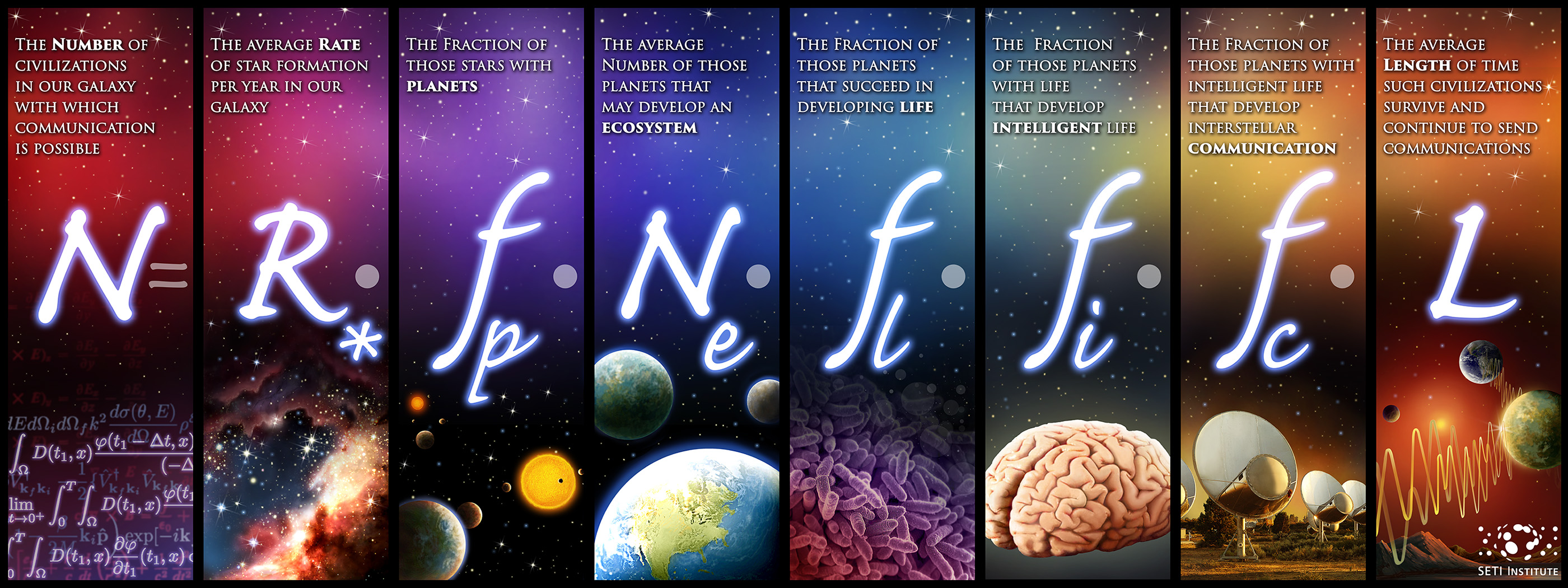

(Click pic to enlarge in new window.) Some recommend the Drake Equation to calculate odds that intelligent life which can communicate across space might exist elsewhere in the Milky Way Galaxy where our solar system is located.

Of the 166 moons and nine planets in the solar system, probes have managed to land on only five: Venus, Mars, Jupiter, Earth’s moon, and Titan (a moon of Saturn).

Just three moons are located in the Goldilocks zone where most scientists believe life has the best chance to take hold. Two orbit Mars at the outer edge of the habitable zone and are probably too cold and irradiated for life. The third moon orbits Earth.


solar system moons 1
(Click pic to enlarge.) Each column contains the orbiting moons of each planet (and a few other objects) inside the solar system.

Six moons in the solar system are comparable in size to the moon of Earth: Ganymede, Titan, Callisto, Io, Europa and Triton.  All the rest are tiny with very little gravity — the force that can hold an atmosphere. 

The twelfth largest rocky object in the solar system after Earth is Titania of Uranus, named for the Queen of the Fairies in Shakespeare’s Midsummer Night’s Dream. The moon is nearly a thousand miles in diameter. A 175 pound person on Titania takes on the weight of a newborn baby — a mere six pounds twelve ounces. 

Few places in the solar system have enough gravity to hold a human securely, let alone an atmosphere. 

No life has been found on any moon — or on any planet (except Earth) thus far. During the next several hundred years, humans will continue to look for life in the solar system should technology and civilization survive and  advance.

The Kuiper Belt — which starts at Neptune and extends past Pluto — is a region that is home to an estimated 100,000 bodies of frozen methane, ammonia, and water.

Editors’ Note: (August 2016) The explorer spacecraft, New Horizonsflew by Pluto on July 14, 2016; it will fly by a Kuiper Belt object in January 2019.  

Freeman Dyson — physicist, mathematician, and astronomer — has suggested that life might be pervasive in the Kuiper Belt and be easily detected once spacecraft get there. People wait and wonder.

Editors’ Note: (December 2018) Current analyses of data from the Pluto flyby describe a living, dynamic planet with a nitrogen atmosphere and a subsurface ocean. Portions of the surface are smooth with no signs of meteor impacts. Water-gushing volcanoes are  common. 

The solar system lies within a large disc-shaped galaxy called the Milky Way, which folks can see edge-on in the night sky should they travel out into the countryside away from well-lit cities, which tend to wash out vision.

It might surprise some readers to learn that no one really knows how many stars are in our galaxy. Credible astronomers believe the number to be somewhere between one-hundred and four-hundred billion — a huge range of uncertainty.

No one knows how many stars are similar to the sun. No one knows how many planets there are, or how many moons. Despite a lot of reporting and speculation, humans know almost nothing about the Milky Way.  

Space is vast, and astronomers have few telescopes and satellites to accomplish the enormous job of taking it all in and cataloguing what they discover.


galaxy 4 Earth's night sky 3.75 billion years from now
3.75 billion years from now, the Andromeda galaxy will collide with our own Milky Way. In this artist’s conception, Andromeda Galaxy is on the left; the Milky Way Galaxy is to the right.

Lack of knowledge about the details of our own galaxy helps to explain why it is difficult to understand the universe as a whole. When I first published this essay in late summer 2014, astronomers estimated that between a hundred and two-hundred billion galaxies populated the visible universe (the estimate is now known to be wrong).

Editor’s Note: On October 1, 2017 CBS News was among the first to report to the public that the Hubble space telescope had detected as many as two trillion galaxies — ten times more than previous estimates.

Two-trillion galaxies — and all the other objects in the universe that lie outside the local area of our own galaxy —are far away and too fuzzy for astronomers to know almost anything about them. The galaxies are out there, true, but the numbers are staggering. The small amount of data astronomers have already gathered is overwhelming scientists’ abilities to process and make sense of it all. And they are just getting started.


The Webb Telescope is scheduled for launch on 30 March 2021. Image is an artist’s rendition featured on Wikipedia. 

Civilization is in the very first stages of placing sensors into space which eventually will help astronomers to learn more. One — the James Webb space telescope — is scheduled to launch sometime during the 2020s. Its purpose? — to tear down the 400-million-light-years-after-the-Big-Bang limit of the Hubble telescope.

Humans are going to be able to look back to the beginning of time, at long last. Understanding the process that brought us here is going to expand dramatically. Until then, the Drake equation (see illustration at beginning of the essay) and other speculative tools remain not much more than intriguing diversions.

New sensors like the Webb telescope will upgrade human understanding and bring a new realism that promises to sweep away much of the science-fiction people drink to satiate their thirst for ultimate knowledge.

Most articles, television shows, and movies that purport to portray the universe are (to risk overstating it) kind-of scammy. They seduce a gullible and curious public, which is hungry for answers about the universe that no one yet has.  

The science community has a vested interest in public funding; they tend to go-along with dubious depictions to pander popular support. Claims that astronomers today understand fully the nature of the universe are ludicrous. The universe is vast.  Much of its matter and energy that  scientists believe is “out there” can’t be found — not yet anyway.

Most stars are too faint to see with unaided eyes. The closest star system to our Sun, Proxima Centauri, is too faint to see without a telescope.

Three out of four stars in the galaxy are probably red dwarfs.  Red dwarfs burn essentially forever but are smaller and much cooler than the Sun, which makes them impossible to observe without special infrared detectors.

These infrared detectors are launched into outer-space beyond  Earth’s atmosphere to avoid being blinded by the infrared heat radiating off Earth’s surface.
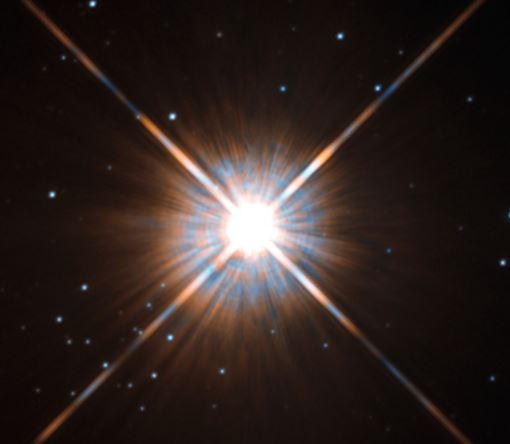

Proxima Centauri main star.  Image by Hubble Telescope.


Red dwarfs seem to be emitting solar flares that are a thousand times more energetic and frequent than those generated by stars like the Sun. They emit light in frequencies not useful for plant photosynthesis — the basic life-support process on Earth.

It’s difficult to see how Earth-style life could get started and survive inside a red dwarf planetary system. No one knows what percentage, if any, of red dwarf stars have planets suitable for life.
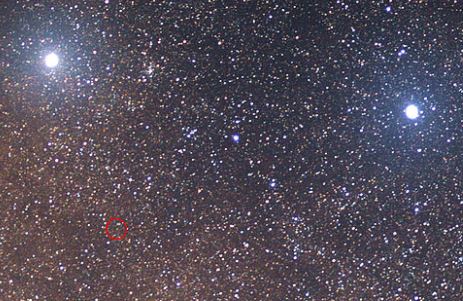

Canon 85mm photo of Proxima Centauri three-star system by Skatebiker on English Wikipedia.

Red dwarfs live for thousands-of-billions of years. The Sun’s lifespan is eight to ten billion years — a tiny fraction of a red dwarf’s.  

The Sun is similar to — who knows? — maybe one in five stars in the galaxy. It’s an optimistic guess, based on sampling and wishful hoping. Astronomers seem to agree that the Sun ranks as one of the largest stars in the Milky Way.

Statistical sampling of two-trillion galaxies argues that the Milky Way galaxy is also among the largest. A full 90% of all galaxies are smaller.

Calculations involving galaxy-motion and gravity suggest that when astronomers look at the cosmos, they aren’t seeing ninety-five percent of what’s out there. Physicists call the missing stuff dark energy and dark matter. Something that no one has yet been able to detect seems to be distorting the rotation of galaxies and disrupting the metrics of space-time.

The universe seems to be expanding, and the expansion is accelerating. Where is the missing mass and energy that drives the expansion? No one knows.

Perhaps parallel universes are stacked on every side against our own. They might swarm like bees around a hive. The gravitational pull of their enormous masses might be pulling our own universe apart. Galaxies inside our universe might be falling toward massive structures that lie outside our field of vision beyond a kind of event horizon. 

Again, no one knows. It’s speculation. Today the expansion is described by a simple constant added into Einstein’s equation for General Relativity. A constant seems too simple, at least for me. It describes but doesn’t explain.


Einstein’s equation accounts for the accelerating expansion of the universe by including a term called the ”cosmological constant”. It is the Greek letter lambda ( Λ), which is multiplied against every member of the metric tensor, ”g” and then added to the left side of the equals sign, which is the side of the equation that describes the shape (curvature) of spacetime. The right side describes the distribution of mass / energy in spacetime.

Many of the galaxies that are visible from Earth are tens-of-thousands of times farther away than the farthest stars in our own galaxy, the Milky Way, which astronomers say is at least 100,000 light years across — a distance of six-hundred-thousand trillion miles. The galaxy is perhaps 200 light years thick, but its center is thicker still — about 10,000 light years.

If the Milky Way was shrunk to the diameter of a ten-inch plate, the plate would assume a thickness of a few human hairs but at the center it would thicken to the size of an egg-yolk.

To put these distances into perspective, the latest space probes, which travel at roughly twelve miles-per-second, are not capable of escaping the gravity of our solar system until they are mechanically slung by multiple encounters with planets to a velocity greater than 27 miles per second.  At that speed, crossing the Milky Way takes nearly 700 million years.


What the Milky Way might look like if photographed by an extremely powerful telescope from the galaxy Andromeda, which is two-and-a-half million light-years from Earth.

The Milky Way is one galaxy in what astronomers have learned is a universe of two trillion.

Until scientists know more — and it could be decades or even centuries from now — prudence and the scientific method advise odds-makers to use the most conservative estimates, not the most optimistic, to speculate about intelligent life in the cosmos.

Until evidence accumulates that is more compelling than what is available today, plugging conservative numbers into the Drake equation, or any other speculative tool, always seems to give the same discouraging result — a number so small it might as well be zero.

No intelligent life that can communicate across space should exist in our galaxy or anywhere else in the universe. None. Yet, here we all are. It’s kind of mysterious, at least to me.

Substituting less conservative numbers yields a different result. Intelligent civilizations could number in the thousands or even millions. No empirical evidence supports such optimism, at least not yet.


Solar System with Sun to scale
Planets and Sun are shown to scale in this model. Distances are not. From left to right, largest to smallest: Jupiter, Saturn, Neptune, Uranus, Earth, Venus, Mars, Mercury, and Pluto.  Pluto — recently demoted to the status of a ‘’dwarf planet” —  has been re-argued for planet-hood by some cosmologists because the recent NASA fly-by showed Pluto slightly larger and more planet-like than previously thought. 

Looking closer to home within our own galaxy, astronomers in 2003 discovered Sedna, which some think is another dwarf-sized planet orbiting far beyond Pluto.

Astronomers seem to discover new planet candidates every other month — Eris and Makemake are two more Pluto-sized objects out of hundreds that come to mind.  

In 2014 Caltech astronomers presented evidence for another planet they called the ninth planet, which might be an object ten times the mass of Earth orbiting in a highly elliptical orbit at the farthest reaches of the solar system.

Regardless of what astronomers continue to discover, it seems likely that the Sun will always contain at least 99% of the mass in the solar system.

Earth is fortunate to orbit a star that is located in a less active region of space than many other stars in the Milky Way. The Sun lies safely between two spiral arms that are bright because of ongoing birthing of new stars. The location lies halfway from the center of the galaxy to its outer edge.


Click pic for better view of Earth’s position inside Milky Way galaxy.

Although stars are spread more or less evenly throughout the Milky Way, life-destroying cosmic events are less likely in regions where stars aren’t being born. Earth lives between bright spirals in a zone of relative inactivity, which has enabled the evolution of eukaryotic one-celled life to progress to intelligence, then civilization, and finally to space exploration over the past billion-and-a-half years.

Earth has a number of unusual features that make it a good candidate for highly evolved life. One important feature is its nearly circular orbit around the Sun, which helps Earth avoid the catastrophic temperature variations characteristic of the more egg-shaped (elliptical) paths of some of the other planets, like Mars.

Only the orbits of Venus and Neptune are more round than Earth’s. Mar’s orbit is five times less round. Of all the solar objects, only Neptune’s moon Triton is known to have for all practical purposes a perfectly circular orbit.

Another advantage for Earth is its 300-mile thick atmosphere of nitrogen and oxygen, 80% of which lies within 10 miles of its surface. Nitrogen and oxygen make up 99% of Earth’s atmosphere. These gases are opaque to non-electrically-charged, high-frequency light.

Nitrogen molecules block high-frequency, ultra-violet light while oxygen molecules, slightly smaller, block higher-frequency (shorter wave-length) x-rays and gamma-rays, which can be lethal to living organisms.

A three-atom form of oxygen molecule known as ozone helps to absorb in the upper atmosphere a dangerous-to-life, lower-frequency-band of ultra-violet light that nitrogen can’t block.

In the distant past — during the Carboniferous Period 300 to 360 million years ago — Earth’s atmosphere held 60% more oxygen than it does now, which provided more shade against damaging high-energy light. Dinosaurs and large insects — like dragonflies with three-foot wing-spans — thrived in the highly-oxygenated air they breathed.

It is one of the wonderful ironies of our planet that the oxygen which empowers the biology of life also defends it against the physics of life-destroying high-energy light and cosmic rays that are always raining down from outer space.


atmosphere
Without atmospheric moisture and greenhouse gases, Earth’s average temperature would fall to 100°F below zero.

In contrast to nitrogen and oxygen, which block high-frequency light from reaching Earth’s surface, carbon-dioxide, methane, and water vapor trap low-frequency light (infra-red light, or heat) and prevent it from radiating (or escaping) into space.

These green-house gases work like a blanket to help keep Earth at a constant temperature. Carbon dioxide, though rare, is heavy compared to oxygen and nitrogen. It tends to cling close to Earth’s surface where it is respirated by plants. Without atmospheric moisture, methane, and carbon dioxide the temperature of Earth would average 100°F below zero and vary widely between day and night as it does on the Moon.

Although water vapor and carbon dioxide make but a tiny fraction of the atmosphere, they have a significant impact on the planet’s ability to retain heat when their concentrations increase in the atmosphere. Exhaust from commercial jet aircraft, believe it or not, contributes greatly to the concentration of carbon dioxide and water vapor in the eight-mile highs of the atmosphere where these jets fly.

After the terrorist attack on 911, the government suspended all flights over the United States — including those by commercial aircraft — for four days. The skies over America cleared themselves of clouds and turned deep blue. Temperatures dropped.

I was amazed to observe these changes develop so quickly after all flying was suspended. It took about two weeks for aviation to return to pre-attack intensity. With the return of aviation, familiar weather patterns followed.

Unlike Earth, the planet Venus has so much carbon dioxide that its surface broils with heat. An explorer would have to hover thirty-seven miles above its surface to experience atmospheric pressures and temperatures similar to those on Earth.

By contrast, the atmosphere of Mars, though almost entirely carbon dioxide, is thin — only 1% as thick as Earth’s. Even so, near their surfaces the density of carbon dioxide is 15 times higher on Mars than on Earth — enough to grow plants and — if poisons in the soil can be avoided — terraform the surface should humans decide.

Although Mars is cold, especially at night, its carbon dioxide atmosphere enables daytime temperatures to sometimes reach 85° F during summer in its southern latitudes. The problem is that any plants that might grow in Martian soil must endure bombardment by dangerous-to-life high-frequency light and cosmic particles.  Also, Martian soils are poisoned by perchlorates. The soil is useless for agriculture though perchlorates could be broken down to provide a source of oxygen. 

I should mention argon, which is 1% of Earth’s atmosphere. It is formed by the radioactive decay of a rare isotope of potassium in Earth’s crust. It is transparent to infra-red heat, so it has no effect on global warming. It is heavy — like carbon dioxide — so it clings to the surface, but its small atoms, widely spaced, do little to prevent the escape of infra-red radiation.

Another asset that gives Earth an advantage for life is its large moon whose gravitational field acts like a vacuum cleaner to suck up cosmic-debris like asteroids and comets that might threaten to strike. Only Jupiter, Saturn and Neptune are similarly equipped.


Image courtesy of NASA

The moon stabilizes Earth’s tilt as it orbits the sun.  The tilt is about 23.4°, which is why Earth has seasons. The tilt swings back and forth a few degrees over periods of 41,000 years. This variation is stable enough to permit life to survive and evolve despite the periodic generation of ice-ages.

Computer simulations of a moonless Earth show that with no moon to stabilize it, tilt variations could approach 90°. Dramatic destabilization has emerged in some simulations that make it difficult to imagine how advanced life could evolve and survive the climate extremes that might result from chaotic wobbling.

The Moon is receding away from Earth at a rate of almost two inches per year. It will take at least a billion years for the motion of Earth to destabilize. It seems that humans have time to figure something out.

Sadly, the sun gets brighter and less massive with each passing day. Over the course of a billion years, Earth will move farther from the sun to conserve its angular momentum. Meanwhile, the warming sun will overtake Earth’s great escape to evaporate its oceans and make the planet uninhabitable. 

Looking at coming events from a more optimistic perspective, people can probably agree that a billion years is a long time. The species-human is likely to be extinct by then anyhow. So why worry?! 

Another life-enhancing feature of Earth is its large, open, ice-free, salt-water oceans. Most scientists believe salt-water oceans provide safe habitat for evolving life.

Earth’s oceans make up three-fourths of the planet’s surface. In addition to providing a vast incubator for life, oceans reduce the probability that space-debris will fall onto land.

Odds are that debris will fall into the oceans where it is rapidly cooled and rendered harmless. Should debris strike land and throw up clouds of dust and ash to block the sun, the oceans provide a safety-blanket of thermal protection.


Titan surface photo Huygens_surface_color_sr
This photo of Titan’s surface is the only picture taken at the surface of a moon or planet that is farther away than Mars.

Besides Earth, only Titan — one of Saturn’s many moons — has open oceans (of liquid methane and ethane) on its surface. These oceans are more like shallow seas or lakes, estimated to be about five-hundred feet deep. Scientists think Titan has a salty sub-surface water ocean, as well.

NASA reported this year that another moon of Saturn, tiny Enceladus (310 miles in diameter), holds a six mile deep subsurface ocean — confirmed from Cassini fly-bys. Its over one-hundred geysers are what is populating Saturn’s E-ring. Data from the geysers indicate that the ocean is warm and salty and saturated with organic molecules. Analysis by Cassini instruments is on-going.

Of the moons of Jupiter, only Europa, Ganymede, and Calisto are thought to harbor salt-water oceans.

Europa is known to have a salt-water ocean, but it is covered by miles-thick ice.

Ganymede, the largest moon in the solar system, is believed to have a 500 mile deep salt-water ocean that lies beneath a crust 125 miles thick. The crust is thought to be a rock and ice mixture.

Scientists suspect that Callisto has a salt-water ocean, but it might be sandwiched between ice layers sixty or more miles beneath its surface.

Only the oceans of Earth are open, un-frozen, and deep enough (averaging three miles) to protect Earth against most encounters with meteors and other space-debris.

Fortunately for Earth, the solar system itself contains a massive structure that helps to protect and shield it from danger. It is Jupiter, the large and strongly gravitational planet, which like the moon pulls away space-debris that might otherwise zoom toward Earth to imperil all life. Observations suggest that comets strike Jupiter every couple of years. Comets that don’t strike are gravitationally deflected out of the solar system more often than not.

Another fortunate feature: Earth has, geologists say, a molten iron-core that emits a strong magnetic field to deflect life-destroying, electrically-charged cosmic particles, that have energies, some of them, approaching those of baseballs traveling sixty miles-per-hour.  Cosmic particles accelerated  the process of ripping away Mar’s atmosphere. Without a magnetic field the Mars atmosphere is defenseless against cosmic erosion. 

As for Earth, high energy particles that do manage to blast through it’s magnetic shield (magnetosphere) are often scattered and rendered harmless — fortunately — by collisions with the oxygen molecules in Earth’s dense atmosphere.

One exception is muons, which are byproducts of particle collisions high in Earth’s atmosphere that are energetic enough to burrow down to hundreds of yards beneath Earth’s land surfaces and oceans. In rare heavy bombardments at high altitudes, muons can increase risks of cancer and cataracts to pilots and their passengers. Muons are like electrons except that they are 207 times heavier and much shorter-lived.


Sun’s solar wind deflected by Earth’s magnetosphere. NASA art. 

The magnetosphere is strong enough to deflect the solar wind, which can strip away all or part of the atmosphere of any planet that lacks one (like Mars).

The magnetosphere is effective and strong, because it is huge and surrounds Earth out to five Earth-diameters on the side facing the sun; one-hundred Earth-diameters on the side opposite. In any small area of space, though, a simple bar-magnet is fifty times stronger.

The solar wind isn’t all bad. As it radiates outward from our Sun, it forms a huge magnetic bubble called the heliosphere that extends 3.5 billion miles past the Kuiper Belt

Inside this Sun Bubble the rest of the solar system is protected from massive cosmic particles that pour in from the two trillion galaxies of stars that make the universe. The Sun bubble deflects to shade our solar system in relative safety.

The heliosphere of the Sun works together with the magnetosphere of Earth and its oxygenated atmosphere to break up and knock away the vast majority of cosmic particles (high-speed protons and atomic nuclei) that would otherwise rip Earth-life to shreds.

Absent the magnetosphere, life could evolve safely only in the deep oceans or far below the surface of Earth. Stated differently: a strong, protective magnetic field is essential for the survival of surface life on any planet.

Large solar flares are known to have enough energy to kill exposed astronauts. It’s one of many reasons NASA doesn’t send people to Mars, which lacks a magnetosphere. Mars is under relentless bombardment of atomic particles that can damage the atoms and molecules in the cells of a human body.

All planets have magnetic fields of various strengths except Venus and Mars. The iron in the core of Mars is believed to have frozen solid, or nearly so, hundreds of millions of years ago, which helped force its protective magnetic field to collapse.

Venus retains its molten iron-nickel core, but the planet lacks tectonic action in its crust. The heat of its core can’t escape through its surface, which prevents in its molten center the emergence of the turbulence essential to make a planetary dynamo of sufficient power to rev-up a magnetosphere.  

It’s a shame that both Mars and Venus lack magnetospheres, because both planets have attributes that might otherwise make them good candidates for life.

Earth’s core is huge — it rivals the entire planet of Mars in size. The inner third of the core — the center — is already frozen solid. It is believed to be pure iron. The core is freezing itself solid from the inside out.

The rest of the core is hot liquid iron and nickle, mostly, with some sulfur and other impurities mixed in. It circulates in complex eddies, which generate the magnetic fields that protect Earth by deflecting the solar wind.

The flow of currents in the molten metal is made stable and more reliable by the unusual plate tectonics peculiar to Earth. Gaps in Earth’s crustal plates allow heat to escape from volcanic valves, which help to maintain a controlled  roil in the eddy currents to produce the dynamo that drives its magnetosphere. 

The only moon known to have a magnetic field is Jupiter’s Ganymede. Jupiter itself harbors a field fourteen times more powerful than Earth’s. The giant planet’s four largest moons orbit inside it, where they are protected from the solar-wind and low frequency (low-energy) cosmic particles. By contrast, Mercury’s magnetic field is one-hundred times less powerful than Earth’s.


ice age earth
 Artist’s rendering of an ice age.

Despite these several advantages for sustained evolution of life, Earth has the apparent disadvantage of a volatile climate which, scientists believe, has turned cold and icy during several extended periods. I mention this volatility to remind people that the circumstances that have enabled life to advance to the technological civilization of today are complex and not obvious.

Until scientists are able to tease out of history what is actually important and significant for the development of advanced life, no one can know what the rest of the universe may have in store — unless we travel out into space and explore it.


I want to believe: we will find the way.

Here’s the problem. The closest stars to the Sun are twenty-five trillion miles away. To escape the solar system, engineers must build spacecraft that can accelerate to 27 miles per second. At that speed the nearest stars, Proxima Centauri, and the binary star system, Alpha Centauri, are 30,000 years distant.

How are humans going to explore the universe? How are we going to answer the questions about our place in the cosmos, when we can’t travel to the nearest stars?

There are trillions of stars, most of them many millions of times farther away than these, our closest neighbors. It seems hopeless that anyone will ever know the answers to the basic questions about the universe that so many are asking.

Still, in my heart of hearts, I want to believe we will find a way.

Billy Lee


Editors Note: November 2017; NASA announced that the latest count of galaxies might be as high as two trillion. The velocity required by spacecraft to escape the Milky Way galaxy from Earth (our planet is 25,000 light years from the galaxy center) is 342 miles-per-second. At this velocity the nearest galaxy — Andromeda — is a flight of 2.28 billion years. There are two-trillion galaxies more!

It doesn’t really matter. Here’s why:


The Parker Solar Probe scheduled for launch in 2018 will require seven gravity-assists from Venus over a period of six years to reach a velocity of 120 miles-per-second before it embarks on a 2024 suicide mission into the outer atmosphere of the Sun.

Venus and the Sun combined can’t accelerate the Parker Solar Probe to the galaxy-escape velocity of 342 miles-per-second. 

Minus gravity-assists, the fastest vehicles in development today by space-flight engineers will accelerate to speeds less than 27 miles-per-second — the escape velocity required to exit the solar-system. Without gravity assists that take years to rev-up, we humans can’t leave our own solar system, which is arguably the tiniest imaginable fraction of the Milky Way galaxy.

The good news is that life-forms in far-away solar systems face the same obstacles. If they are hostile, humans can be assured that they will have a difficult time getting here.  

The bad news is that humans are trapped. The Milky Way Galaxy is a prison. We can’t escape, at least not yet; most likely, not ever.  The escape velocity of the Milky Way Galaxy from Earth exceeds 340 miles-per-second — nearly three times the velocity that the Parker Solar Probe will be traveling when it is finally able to bury itself inside the Sun. 



PLANES, TRAINS, & AUTOMOBILES; AND OUR FREEDOM

The question is simple: If circumstances conspired to take away cars and licenses so no one could drive again, would anyone feel free?


no cars img_3425
Can folks feel free, or happy, in a land without cars?

Maybe I would. I couldn’t bum rides or hitchhike, true. But if no one could drive; if everyone’s cars were taken, public transportation might improve, right?  You  know — planes, trains, and buses — how would anyone feel?

Speaking for myself, I think I might get sad and depressed. Thinking about not being able to come and go when I want, of having to depend on public transportation to venture anywhere more than a few miles from home makes me sick to my stomach. Freedom to travel on my own terms is a big part of what it takes for me to feel free and, yes, happy.


public transportation metrorail012109.21382537_std
If the only way to travel to another town was by train, how would people feel?

So why torment myself with thoughts about something that’s never going to happen? What’s the point?

In truth, many people don’t drive, especially in large metro areas like New York City, for example. Not driving is a choice. In theory at least, New Yorkers can buy cars and move to the suburbs. Knowing they can drive if they choose makes not driving not so bad, at least for most.


In New York City, most people don't drive.
In New York City, most people don’t drive.

Here’s my point. Someone is always telling us we are free, because we can vote for our leaders and start businesses; even keep the profits. No one can be arrested without cause. If arrested, all have the guarantee of due process and the presumption of innocence under the Constitution. Everyone can own guns and fire them in their backyards.
Is it possible that whoever they are might be right?


constitution 1
What good is declaring independence, if no one can drive?

Think about it. 

80% of citizens don’t vote regularly. 98% don’t own businesses unless franchises and pyramid-schemes like Amway count; then it’s 10%.

Few citizens are ever arrested, much less charged with a crime. And most folks — those who aren’t psychopaths — take no pleasure disturbing neighbors by firing rifle rounds in their backyards. In general most don’t participate in the privileges that define freedom.  People don’t feel their freedoms most of the time.

But here’s something else to think about: 95% drive cars.

Isn’t it cars that give the feeling of being free? Take away cars and no one has the same carefree feeling– no matter what the Constitution guarantees or profs teach in school or university.

People can go into the back yard and fire a hundred rounds from an assault rifle. All that will happen is their ears start to ring and their neighbors hate them. 


automobiles Latest-Fast-Cars
It’s cars that give us the feeling we’re free.

The thrill of freedom comes from stepping on the accelerator of a favorite car and feeling Earth slide away below us. Freedom is the feeling that anyone can come-and-go on their own terms whenever they want.


Traffic slowdowns and standstills are an assault on our freedom.
Traffic slowdowns and stand-stills are an assault on freedom.

Many Americans seem not to grasp that the right to drive is being methodically and relentlessly stripped away. In cities and towns across America, congestion on streets is presenting a clear and present danger to our way of life; it’s diminishing the freedom to travel under our own power; under our own direction, which is what everyone wants to enjoy.

Lousy roads, poorly planned road construction, neglected road repair, deteriorated bridges and tunnels — all assault freedom and degrade our quality of life. 


Bad streets are an affront to our freedom and should be thought of as such.
Bad streets are an affront to freedom. Right?

It seems obvious that four-hour waits in line to vote wrecks freedom, because waits discourage voting, the foundational process of any democracy.  But four-hour commutes, traffic slowdowns and standstills are just as disruptive. They break the efficiency of our lives and muffle the nation’s economy.

The folks who run America seem to care little about voting or roads. Americans might want to step up to put pressure on politicians to make driving free and unencumbered — make freedom on the road the number-one national priority.

Driving free must be first-in-line; it is our most heartfelt and defining freedom.


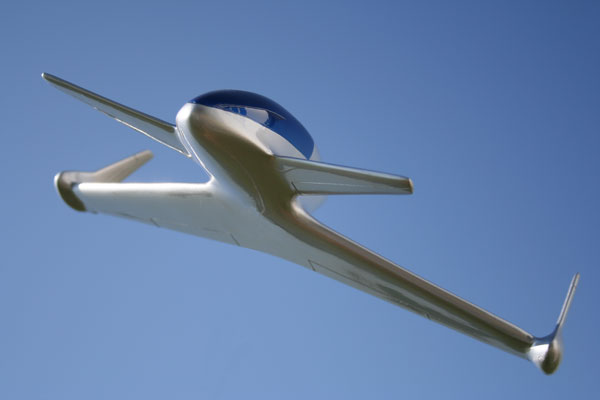
In a computer-controlled aircraft, passengers are only along for the ride.
In computer-controlled aircraft, passengers are only along for the ride.

I learned that a few companies have already designed aircraft to take the place of cars. In the years prior to 911, I toured a number of these firms to learn firsthand how they implemented computer software to organize their engineering drawings, bills-of-materials, and tech-specs for vendors.

The plan, then, was to unleash at the right time a new era of transportation options for the general public that included light aircraft.

These companies were designing planes to fly on autopilot along pre-established routes in the sky. They took advantage of the three dimensions of space the same way city planners use tall buildings to create more working space.

The idea was to eliminate congestion and speed traffic by stacking routes and putting computers in charge of flying instead of pilots.


Sure the view is nice--when there's no clouds and you don't have to stop to stretch your legs.
The view is great — when the sky is clear, and no one has to get out to stretch their legs.

It all seemed like a good idea at the time. But the events of 911 changed planners’ views of what it might mean to put hundreds-of-thousands — maybe millions — of flying vehicles in the airspace above America — even if the craft were flying on autopilot under the guidance of computers.

Had 911 not happened, the plans were that by now on any given day at any given time people who looked up to the sky would see and hear hundreds, maybe thousands, of high-flying aircraft buzzing to and fro 24/7.


Computer-controlled aircraft flying on 3D highways are a transportation option available for implementation when the time is right.
Computer-controlled aircraft flying on 3D highways are a transportation-option, which is available for implementation when the time is right.

This high-flying, high-tech solution to highway congestion though shelved for now sits yellowing in the dark closet of national transportation options. It can be implemented when the time is right in the same way as the internet and personal-computer. But when it’s implemented, it will pose big problems.

3D highways in the sky populated by hundreds-of-thousands of computer-guided light-aircraft will have the same effect on travelers as if they were set on automated conveyor belts and whisked hither and yon.

The thrill that comes from commanding a piece of machinery and directing it to go where we decide will be gone. The feeling of empowerment and freedom experienced in cars will evaporate. 

Because — you know what’s coming, right?  If computers can direct the flights of millions of aircraft in three-dimensional space, they can do the same to cars on two-dimensional roads. And soon, very soon, they will.


Yeah it's pretty. But if we're not flying it, do we really care?
Yes, it’s pretty. But if no one is flying it, does anyone care?

Because of over-population and the inevitable congestion it brings, the time may come when people will no longer be permitted to experience the freedom of a fast car on an empty road.

Our ancestors rode horses, after all. Most people have long-since adapted to the disappearance of the horse. Perhaps people will adapt. Circumstances will force grandchildren of today’s parents to go to private tracks to experience the lost joy of driving a car.

Riding in a computer-controlled helicopter, airplane, or other flying craft might become the norm for future travelers. People will be passengers — not drivers or pilots or navigators — for the duration of their trips. People will become dependent on another technology they don’t understand and can’t control.

We are likely to become a nation of flying and driving sheep who graze in a huge three-dimensional sheep-pen.

Will freedom ring?  Will people feel the thrill that comes from directing the path of complex machines that run like wild horses?  Will they feel the power that comes from being free?

Will children of the future experience the exhilarating freedom enjoyed by their parents during their season of control when no one felt threatened by a vice-grip embrace of an artificial-intelligence that is hovering ominously on the horizon? 

I don’t know.

Billy Lee

WHY DO HUMANS LIKE MUSIC?

No one knows why humans like music. Dopamine floods our brains when we hear patterns of sound, that’s all. Scientists are conducting research.


April 1, 2014:  Scientists in Jefferson City, Missouri discovered lab mice could play saxophones sold on Amazon. 

One surprise for me at least was to learn some animals enjoy music. It should resonate with their heartbeats and play at natural, species-specific pitches and timbres.

It takes effort to create music animals like. They won’t pay for it. Even pets—most anyway—don’t self-identify as music lovers.


The Prairie Dog Three are currently on tour in Utah and New Mexico.
The Prairie Dog Three, currently on tour in Utah & New Mexico.

As far as I know, only one species takes time to create tools to play music: homo sapiens. Yes, animals like gibbons, birds, whales, insects—even dogs next door—make noises that sound suspiciously like music to most humans. Research is ongoing.

Some philosophers say music is not something that can exist in the universe apart from conscious life. Music seems to require minds to produce and at least one semi-conscious mind to like.

Sensations of pleasure initiated by vibrations of air entering ears is the result of auditory hallucinations created by brains. Air molecules bounce off structures, which stimulate brains to manufacture mysterious qualia called sound, which in turn unleashes avalanches of chemical (emotional) reactions within the body.

Many parts of the brain are involved in music appreciation. Researchers report visual, tactile, olfactory, and gustatory areas of the brain are woke by music. Research continues—sometimes with focus on definitions of peculiar words like olfactory and gustatory.


music what sound looks like
3D image of musical sound. Sound doesn’t look like what sound sounds like.  …mmm…ahhh…

There seems to be no similarity between simple vibrations entering ears and complex, textured mental experience conjured by music. It might be sad for some readers to learn when Universe ends, it takes music with it.


Thomas Edison wore the phonograph he invented on his head as a hearing aid late in life.
Thomas Edison placed phonograph he patented on his head.  He thus invented world’s first hearing-aid.

Most people did not hear much music before the invention of the phonograph in 1877. What music they heard was played mostly by itinerant flute musicians and occasional wood-nymphs on tambourine.

It took decades for the phonograph to become enough widespread to impact the listening habits of average people. As music technology evolved to become pervasive, its mystery inspired some scientists to try to figure out just what the hell was going on.


music 1
Simon Cowell stops cotton-candy from dribbling out his ears. Simon’s television career revealed he is unable to evaluate musical talent.

Current research suggests that as many as 4% of humans do not enjoy music. Whatever process is not going on in their heads, it seems inherited. Some simply lack genetic coding required to process musical pleasures. If all life mimicked these unfortunates, music would cease to exist.

Some make claim folks would not miss it. Music is not necessary for survival, they insist. Humans have lived on Earth for maybe millions of years without any but the most primitive forms.


Grandma, when she was younger.
Young Grandma. Note bulky headphones popular 50 years ago.

That might be. But irrepressible popularity during past 50 years in all parts of the world is proof. People like music. It’s going nowhere.

Here’s some music to help persuade skeptics:


Billy Lee

Update:  5 July 2016: When Billy Lee wrote this essay two years ago, he was naive; he didn’t know about the dark side of music. Recently he learned that music has been used by intelligence agencies since the 1980s to torture people.

Imagine being forced to listen to old sound tracks from the Lawrence Welk Show over and over. It’s a sordid, terrifying prospect.  Billy Lee didn’t want to soil his essay by discussing it.

Alex Ross’s article in the 4 July 2016 issue of the New Yorker Magazine ripped open the underbelly of this stinking carcass of evil. Ross titled his essay, The Sounds of Hate.

Since then, links to the essay have been retitled to When Music is Violence. No one at The Pontificator knows why print version and Internet version titled differently.

The Editorial Board

SENSING THE UNIVERSE

Everything people know about the Universe comes from sensing it or from scientific inquiry. The two methods seem to be different.


What exactly is the universe?

Sensing involves seeing, hearing, feeling, smelling, and tasting, right? It’s the traditional five senses that most folks learned about in elementary school a long time ago.

Scientists added complexity to the number and capabilities of the senses in modern times to include “modalities” like sense of place, pain, balance, temperature, vibration, and awareness of chemical concentrations — like salt and carbon dioxide— inside the body.

All this complexity pushes readers into deep weeds, which I am going to avoid in this essay. It will work just as well not to needlessly bewilder people.

Never mind that certain life forms like birds can sense the earth’s magnetic field, or that sharks can sense the electrical activity in living prey. Many ways of sensing the universe are possible. This essay deals with those most familiar to humans.

Until humans developed the technologies of modern science,  sensing (and making sense of what was sensed through the mental process of reasoning) was how people formed ideas about what the universe is. But there was a big problem.

Senses told us the sun looked yellow, thunder sounded loud, rocks felt hard, roses smelled sweet, and almonds tasted bitter.

The problem should now be obvious.

These qualities don’t exist in the universe. They are hallucinations of brains created when organs like the eye, ear, skin, nose, and tongue interact with elements of the universe which, in themselves, share none of these qualities.


sensing the universe 8
Qualities like these don’t exist in the physical universe. They are hallucinations of living brains.

These hallucinations are inaccessible to all but the living organism who experiences them. They are unique and not detectable by others, in this sense: people can ask others if they see the same yellow color they see. When they say yes, they can decide to take them at their word, or not.

It is not possible to prove that they are telling the truth. In fact it’s not possible for anyone to answer truthfully, because no one can know how anyone but themself experiences the color yellow.

The interaction of sense organs, like eyes, with electromagnetic radiation is selective. Only a limited range of frequencies will stimulate the retina of the eye, for example, to emit the necessary electric and chemical messaging the brain uses to construct the hallucination called vision.

Some of the radiation falling into the eye does not interact with any sensing organ and remains undetected. In fact, the human eye can detect only wavelengths of light between 15 and 35 millionths of an inch long (400 to 900 nanometers).

Note to the non-technical : A nanometer is a billionth of a meter, which is written as a decimal point followed by eight zeroes and a one — i.e. .000000001.  In engineering shorthand it’s written as 1E-9 meters. Humans see wavelengths of light that are 400 to 900 times longer. Scientists and engineers usually work in meters, not inches.  The Editorial Board. 

This narrow range is transformed by structures in the retina into messaging the brain can use. Wavelengths up to a thousand times longer (one thirty-second of an inch) are able to be felt as heat.

To the rest of the light spectrum, humans are completely blind. This spectrum includes light with wavelengths as long as sixty miles (called radio waves) down to wavelengths of light called gamma rays, which are many millions of times smaller than the wavelength of violet, the shortest wavelength human eyes can detect.

One reason people (and other life) see and feel a limited range of frequencies is because the energy of the sun that is able to penetrate Earth’s atmosphere to reach its surface lies in this limited band. The rest is blocked.

Of the sun’s energy that is able to reach Earth’s surface, 43% is in the narrow visible spectrum people can see. 49% is in the form of heat, which can be felt. Ultra-violet light — which some insects see — makes up 7%. Life on Earth evolved to sense light at wavelengths able to reach its surface.

The other parts of the light spectrum — like X-ray and gamma light — are deflected or absorbed by the nitrogen and oxygen in the atmosphere. Only 1% of the sun’s energy that manages to reach Earth’s surface lies in these high frequency bands.

A great deal of the light that reaches Earth from outside the solar system falls into the range of low-energy radio frequencies to which all Earth-life is completely blind. Radio-frequency light-waves are long and fuzzy. The sun produces mostly higher frequency light. Radio-waves seem to be unnecessary to the survival of life on Earth.

An ability to sense radio waves makes no impact on living things; it provides no survival advantages. Yes, on Earth intelligent life-forms (i.e. humans) have learned to amplify and convert radio light into sound to communicate and entertain themselves over large distances.

Scientists continue to search for evidence that far away life, should it exist, might share the same aptitude for communication. So far, the search has found nothing — no evidence for any kind of life whatever.

The image of light formed by the mind is fantastic — which means it is useful to the organism that sees the image, but the image doesn’t contain many (or any) clues about the external physical phenomenon that triggered its creation.


sensing the universe 7
There is nothing even remotely similar between the color yellow (or any other color) and the electromagnetic radiation that oscillates trillions of times per second to ignite the mechanisms of vision.

There is nothing even remotely similar between the color yellow (or any other color) and electromagnetic radiation oscillating trillions of times per second.

The hard solid feeling of rock has nothing in common with the silicon atoms from which rock is made and whose nuclei are separated from one another by spaces many thousands of times their size. Nor does it have anything in common with the hundreds of different molecules which make up the nearby skin and nerve cells — themselves many millions of times larger than silicon atoms and separated from them by large distances.

The feeling of hard solid and the color yellow exist in my mind. I am sure of it. But can I find, for example, the color yellow in your mind?

The answer is no. A brain surgeon might probe a part of someone’s brain, and they report seeing yellow. But if she examines the area of the probe, she has no chance of discovering the color yellow. She will never find it.


Professor Daniel Robinson (1938-2018) University of Oxford.
Watch from 11:04 to 13:20.


My experience with the color yellow is subjective. If you tell me you also experience yellow, I believe you, because you are like me, and it seems reasonable that we will experience things in the same way.

But if you were asked to prove you see yellow the way I see it, you couldn’t do it.


sensing the universe 9
Not only colors, but sounds, feelings, smells and tastes will vanish without a trace once life is gone. So again, the question: What, exactly, is the Universe?

If life disappears from the universe it will take the color yellow with it. Only the electromagnetic radiation that triggered the hallucination of the color yellow will remain.

Since the radiation can no longer be detected, seen, or experienced by any conscious observer, what is it exactly? Not only colors, but sounds, feelings, smells, and tastes will vanish without a trace once life is gone.

So again, I ask: What exactly is the universe?


gas sensor
                      Gas Sensor

Let’s “look” at scientific inquiry for the answer. What does science do? Science examines the universe quantitatively and avoids the qualitative and subjective attributes the senses provide. Or it at least tries to.

Science designs detectors to find as much discoverable phenomenon as it can — phenomenon human biological senses can’t discern or aren’t sensitive enough to experience.

But someone has to ask: Aren’t these detectors nothing more than enhanced sensors augmented by gauges and dials to increase the precision of measurement? And don’t living, conscious human-beings use their senses and their brains to make sense of the information the detectors provide? What has anyone gained by science?

The scientist’s tool of choice is mathematics, because it dramatically reduces the fuzziness — the subjectivity — of the senses, and replaces qualities like the color yellow and the feeling hard solid with measurables like oscillations per second and pounds per square inch; that is, with attributes that can be measured by all observers and which, presumably, exist independently of a conscious mind.

Can mathematics really do that?


Special relativity Einstein
The Special Relativity of time.

Mathematics uses logic and simplified representations of objects and forces to create symbolic models. Certain operations can be performed on these models to reveal non-intuitive relationships among the simplified variables.

Ok… again, have we gained anything? Or does mathematics force a sacrifice of information and detail to simplify understanding? Are we closer to knowing what the universe is, or farther away? Can the best sensors and the most sophisticated mathematics really get humans closer to understanding what the universe is?

One surprise that mathematics has revealed: telescopes and other sensors show that too much gravity is at work in the universe for the amount of matter and energy scientists see. 85% of the matter that must be out there can’t be seen.

More shocking: 95% of the energy and matter that the theory of gravity says must be out there, no one has ever observed. Physicists don’t know what this invisible matter and energy is, or even where it is — though some scientists believe it is evenly distributed throughout the cosmos. They call it dark matter and dark energy.

I don’t want to scare anyone, but the universe is mysterious, and no one understands it. Two questions I’m grappling with:

1 – Can the Universe exist apart from Consciousness?

2 – Is Consciousness powerless to interact with the universe in ways that change it?


sensing the universe 4
Consciousness may exist independently of any individual conscious-being.

These are serious questions.

If the answers to these questions are yes, then consciousness is not necessary for the universe to exist, and the understanding of what the universe really is will probably never be complete — certainly not for humans. Consciousness is something that evolved over billions of years and will someday be missing once again.

The universe won’t notice or care. Conscious life — like humans — can think about the universe all they want. They will never change it. This is the current popular view, is it not?

But the answers to these questions could be no. And it might be possible to prove it. 


universe outer space
Consciousness might be something human beings plug into and even share.

If the answers turn out to be no, the implications are profound.

No means the physical universe may have evolved from consciousness, not the other way around.

No means conscious humans may have the ability to completely understand the universe and make sense of it someday.

No means that consciousness may exist independently of any individual conscious-being.

No might mean consciousness is something human beings plug into and even share.

No might mean God exists, and — though our bodies die — we never will.

Billy Lee 


Sensing the universe 3


Thanks to Erwin Schrödinger for his Mind and Matter lectures at Trinity College, Cambridge, Oct. 1956 for inspiring Billy Lee to write this essay; see  Schrödinger, What is Life?  available at Amazon.com

The Editorial Board 

WHAT IS LIFE?

This February marks the 71st anniversary of the lecture series What is Life? presented at Trinity College in Dublin, Ireland by quantum physicist Erwin Schrödinger — best known today for his Schrödinger’s Cat thought experiment.


baby in bubble


In these lectures Schrödinger correctly described — ten years before James Watson and Francis Crick published their work on the structure of DNA (for which they won the Nobel prize in 1962) — many of the important and essential markers of the yet undescribed and undiscovered molecule that we now know determines everything about us and all other living things.

The lectures are remarkable for their prescience and clarity — they have an almost prophetic quality about them — but what I found most interesting (and it’s all interesting to me) are Schrödinger’s observations in the Epilogue, which he labeled On Determinism and Free Will.


fish escapes fish bowl


After some warm-up remarks he says:

But immediate experiences in themselves, however various and disparate they be, are logically incapable of contradicting each other.

So let us see whether we cannot draw the correct, non-contradictory conclusion from the following two premises: (i) My body functions as a pure mechanism according to the Laws of Nature. (ii) Yet I know, by incontrovertible direct experience, that I am directing its motions, of which I foresee the effects that may be fateful and all-important, in which case I feel and take full responsibility for them.

What follows might blow your mind.  

What is Life?

Billy Lee

HOREMHEB, EXODUS PHARAOH?

After looking into the history that archaeologists think they know of the time around Horemheb, it seems to me that a compelling narrative of the Exodus and Horemheb can be constructed consistent with what is known from archaeology and written historical records including (and especially) the Bible, since it is the one and only account of the Exodus that exists today, I’m told.


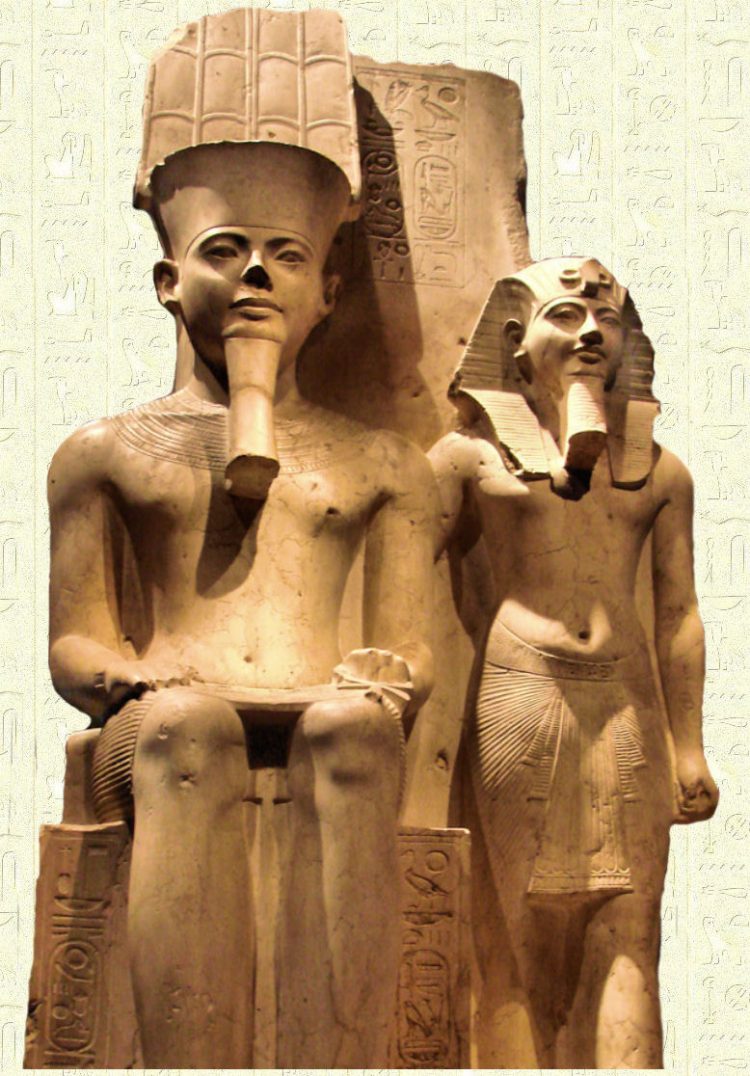
Pharaoh Horemheb with Amun-Ra, the king of the gods, standing beside him.

So here is my version of events.

Horemheb in hieroglyphs

 The Son of Ra, Amun, Loves Horemheb

After comparing the dates Egyptologists have assigned to the reigns of the pharaohs with the date of Moses’s birth worked out by rabbinical scholars, it seems to me that Horemheb could have been the Exodus pharaoh.

But in a search of the Internet and other sources, I found that most historians don’t believe the Exodus occurred, and among other researchers, few say the Exodus pharaoh was Horemheb. Some claim he was Ramesses II; some, Thutmosis III; others speculate about other pharaohs; but very few have said, as far as I can tell, that he was Horemheb.

According to most Egyptologists, Horemheb ruled from 1319 to 1292 BCE. Some Rabbis claim that Moses was born in 1391 and, according to the Bible record, confronted Pharaoh eighty years later in 1311 — eight years after Horemheb took power.


Seder Olam 2
Seder Olam (sequence of world events -lit. World Order

Rabbinic Judaism uses the Seder Olam (World Order) from the 2nd century CE to date Biblical events. According to the Seder Olam, 832 BCE is the date Solomon started construction of the first temple.  1311 BCE is the date of the Exodus.

The interval agrees closely with the 480-year period described in   I Kings, 6:1.  More importantly, the date 1311 BCE places Moses and the Exodus squarely in the reign of Horemheb if the chronology of modern Egyptologists is accepted.

To be fair, a few fundamentalist millennial Christian sources place the start of temple construction at 1000 BCE but this date strains credulity, because it was established to fit the theory of millennialism where history is divided into seven one-thousand year “days.”  History is almost never as precise or the calendar that clean, even when written by God.

Historians have established that, before he was pharaoh, Horemheb commanded the Egyptian army under Pharaohs Tutankhamun and Ay.  After he became pharaoh and lost the army (as described in the Exodus story of the Bible; see a summary below), an angry Horemheb enlisted his allies, the polytheistic priests and their cults, to erase the history of the “monotheist” former pharaoh, Akhenaten, his allies, and family members.

One of those family members was Akhenaten’s adopted cousin, Moses (see next section, The Exodus Story), who Horemheb blamed for bringing Egypt to ruin.

Historians agree that during his reign Horemheb intensified a damnatio memoriae (campaign to strike from memory) against the former pharaoh, Akhenaten. The campaign was initiated by Akhenaten’s son, Tutankhamun, and the pharaohs that followed — Smenkhkare, Neferneferuaten and Ay.

These pharaohs during the years 1334-1319 BCE reversed many — but not all — of Akhenaten’s reforms, because they thought the reforms created uncertainty and turmoil over the status of the priesthood and the gods, which to them seemed essential to the economy and stability of Egypt.

But Horemheb took the reversal to another level — restoring order by turning back all of Akhenaten’s reforms and re-establishing traditional polytheism throughout the whole of Egypt.


ipuwer papyrus
Ipuwer Papyrus

The surviving copy of the Ipuwer Papyrus — housed in the Netherlands at the Dutch National Museum of Antiquities and dating to the 19th dynasty (13th century BCE) — may actually describe the conditions in Egypt during the Amarna/post-Amarna period before and after Horemheb took power. It may have been during this period that the Hebrews, led by Moses, lobbied Horemheb to let them leave Egypt for their ancestral lands in Canaan.

The Exodus Story

Pharaoh Thutmose IV died around 1390 BCE leaving a very young son, Amenhotep III, to become pharaoh. To fashion the story to fit the Bible narrative, that same year a teenage daughter of Thutmose IV, possibly Princess Tiaa, found Moses floating in a basket on the Nile River. She brought Moses into the palace to be a playmate for her brother, the new pharaoh.


Pharaoh's Daughter Finds Moses Exodus 2:3-6
Pharaoh’s daughter, Princess Tiaa, discovers Moses

The sister of the deceased Thutmose IV located Moses’s mother, Jochebed, and brought her into the palace to wet-nurse Moses. Soon after, Princess Tiaa adopted Moses and raised him as her son.

Through this arrangement Tiaa’s much younger brother, the new Pharaoh Amenhotep III, became Moses’s uncle, though they were about the same age. Perhaps the two grew up together and were close — more like brothers than uncle/nephew.

The influence of religion on the Thutmose family by Moses’s mother — a monotheistic Jewish woman — might have been considerable. No one can know for sure, but what followed — the eventual embrace of monotheism by Amenhotep III’s son, Amenhotep IV (who later changed his name to Akhenaten) — might be understood as having evolved under her influence.

Jochebed may have continued to live within the pharaoh’s household for many years assisting Princess Tiaa to raise her own son and through him influencing Tiaa’s grandson, Akhenaten, who would become the famous founder of Egyptian monotheism. Jochabed’s influence could make sense out of the history that followed.

According to this version of events, when Moses was forty years old, in 1351 BCE, Amenhotep III died. Amenhotep IV (his son and young cousin to Moses) became pharaoh. 

Moses fled Egypt, according to the Bible to avoid trial for killing an overseer. But, because he was the adopted son of the prior pharaoh’s older sister, Moses may have worried that his cousin, Amenhotep IV, (or more likely, his aides) considered him a rival for power.

A few years later, Amenhotep IV changed his name to Akhenaten to reflect his revolutionary belief in a single creator god he called Aten, the Sun Orb. He then suppressed the existing polytheistic cults.

Akhenaten built a new city, Amarna, to honor Aten. This move toward a form of monotheism turned Egyptian society upside down and angered the priests who depended on polytheism for their economic well-being.


akhenaten profile
Pharaoh Akhenaten — formerly Amenhotep IV

In 1335 BCE Akhenaten died, and Moses at age 56 returned to Egypt. He found Egypt in chaos and rebellion due to outrage by the priests and their acolytes over the move away from polytheism.

During the next 15 years Moses lived among the Hebrews and by age 70 had become their de-facto leader. Horemheb meanwhile became pharaoh.

By age 80 Moses was challenging Horemheb to let the Hebrews leave Egypt.  Eventually, Horemheb did — issuing a directive, according to the Bible, that the general population provide the Hebrews with gold and silver when they left.

Horemheb’s plan may have been to trap Moses and the Hebrews against the marshes in the Sea of Reeds and annihilate them to recover their newly acquired wealth to re-stock the depleted Egyptian treasury.

But during the Exodus of 1311 BCE an unexpected inundation (the famous Red Sea flood in the Bible account) cost Horemheb his army and his plans to destroy the fleeing Hebrews. The Hebrews escaped, so Horemheb, encouraged by the priests, turned his fury against the Amarna cults and ramped up the ongoing damnatio memoriae started by Tutankhamun against his father, the former Pharaoh Akhenaten, and his allies.

I should mention that although the Egyptians closely watched, recorded, and forecast the yearly inundations of the Nile, unexpected floods sometimes did occur in the Delta region through which the Exodus may have taken place.


Ramesses II
Pharaoh Ramesses II

When Horemheb died leaving no heir, the Ramesses family seized power. Ramesses I, Seti I and Ramesses II spent the next forty years continuing the damnatio by finishing the demolition of the town of Amarna and its temples, destroying steles, and grinding down glyphs and cartouches that referred to anyone associated with the heretical Amarna one-god movement.

They also sent armies into Canaan to hunt down Moses and the Hebrews in the territory that both Moses and Joseph — who died 59 years before Moses’s birth — had claimed was the eternal homeland given to the Hebrews by God.


[Those readers unfamiliar with Joseph’s bio are advised to read his story in Genesis chapters 37-50. Billy Lee claims that it’s the most interesting passage from world literature he’s ever read. THE EDITORS]


Unknown to the pharaohs, Moses and the Hebrews decided to stay away from  Canaan. Instead, according to the Bible, they found a source of water and hid themselves in the vast Sinai wasteland where they believed their pursuers were less likely to look.

The pharaohs sent at least three armies into Canaan to hunt them down. Unable to find Moses, they marched north to search in Syria where the Hittites ambushed them.

As a result, the Egyptians conducted a number of military campaigns against the Hittites. The most reliably verified and documented of the conflicts occurred in 1274 BCE, led by Pharaoh Ramesses II. This war financially exhausted and militarily weakened both sides.

Forty years after the Exodus (and just three years after the Ramesses II incursion into Syria) in 1271 BCE, Moses died. Egypt had by then already withdrawn from Syria and Canaan. The time would never be more right.

According to the Bible, Joshua (Moses’s successor) walked the Hebrews out of their Sinai desert hiding place and entered the land of Canaan.


Ramesses Battle of Kadesh
Battle of Kadesh

Twelve years later in 1259 BCE — sixteen years after the end of hostilities between the Syrian Hittites and Egypt and fifty-two years after the Exodus — Egypt signed the famous peace treaty of Kadesh with the Hittites. The peace treaty — concluded between Egyptian Pharaoh Ramesses II and the Hittite King Hattusili III — is the oldest surviving treaty in existence.

It diminished the most dangerous existential threat to the new Israel by making less likely Egypt’s return to wage war either in Syria or Canaan. Egypt desired a lasting peace in order to rebuild its society and military and to restore its wealth.

The desire for peace didn’t last. By 1208 BCE (fifty years later), Egypt was aware that the hated Hebrews had returned to Canaan where they were building fortified towns and cities.

Ramesses’ son, the aging Merenptah, decided to finish his family’s vendetta and go into Canaan to do battle with the fledgling Israel. According to the “Merneptah Stele” (found by Flinders Petrie and housed in the Cairo Museum), he “destroyed Israel’s seed” such that “they were no more.”

History and the Bible agree that Merenptah exaggerated his assessment.


Merneptah Stele
On this stele Merneptah claims that he destroyed Israel. 

It is interesting to note that Merneptah’s inscriptions describing Israel’s destruction were carved on the back of a stelae that once belonged to Amenhotep III, Moses’ “uncle” and childhood companion. Merenptah simply turned it around and used it as his own.

It is fascinating (perhaps macabre) to recall — in light of the Bible account of the Passover and the killing of the first-born by the Angel of Death — that tomb examiners found the fetus of Horemheb’s son and heir-apparent inside his wife’s mummified body. Horemheb had no heir, and the Ramesses’ family was able to take power.

No records of Moses or the Exodus itself, in hieroglyphs or Egyptian script, have been found.

Billy Lee


Egypt King's List 1

Egypt King's List 2

Egypt King's List 3