FAKED LIFE

For decades now, Nick Bostrom has defended his view that the reality of existence can be described by one of only three possible states:

1  –  Life is rare in the universe; what life does exist always perishes before it reaches “technological maturity.”

2  –  Life is rare in the universe; some life reaches techno-maturity, but all advanced life decides to avoid the temptations and the consequences presented by its mastery over artificial super-intelligence and other high-technologies. 

3  –  Life is abundant in the universe, but it is simulated.  A few technologically mature civilizations yielded to temptation; their thirst for knowledge and entertainment pulled them into a spawning-orgy to artificially inseminate faked-life within an ever-increasing globe of stars and planets, galaxies and clusters — perhaps throughout all space.
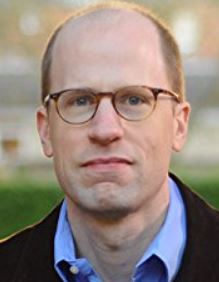

Bioethicist and philosopher of artificial intelligence, Nick Bostrom.

This injection of simulated-life (and the infrastructure to sustain it) serve the research and entertainment needs of the original civilizations who created the simulations and then broadcast them into the cosmos like farmers throwing flower-seeds into empty gardens. 

By now, faked life is pervasive. By now — after at least three generations of star formations — the number of simulations is hundreds-of-millions; perhaps billions; perhaps hundreds-of-billions.

Humans forced to wager on the odds that they themselves are artificial — that they are in fact simulated —  must place their bets knowing that the odds could be as high as a billion to one, maybe more.

Humans are machines; they aren’t real; they aren’t what emerged from the chemistry of the universe but were instead invented in the imaginations of super-computers programmed by an ancient civilization whose address and time may forever remain unknowable. 

If human civilization is faked, so might be its history, what it has been allowed to know, and what technologies it feels compelled to develop. A simulated, artificial civilization won’t necessarily know what is the time or era or eon in the real universe that exists beyond its view.  It might never be able to understand how large or old is the real universe where its creators live and play. 

Simulations might be created by life-forms curious about how certain scenarios they can imagine play out. Simulation might be a mature-tech version of television where advanced life-forms unveil the vagaries of their visions for the entertainment of vast audiences. 

Some simulations could be simple games designed for small children to entertain themselves while mommy does laundry and dad mows the lawn.

Simulations might be simple algorithms developed by quantum super-computers to test the limits of their power.  

Even the rules-of-play embedded in some releases might be undiscoverable — hidden by super-intelligent gamers who perhaps don’t really care about us; they are sure one day to lose interest and unplug the simulation. 

What are the odds?

People who think like Nick believe the odds make countless simulations a near-certainty.  If it were not so, then it is equally certain that human civilization will implode like all those civilizations that came before; humans will become the victim of their own technological march into the high-risk skill sets that lead inexorably to oblivion. 

It’s what the Fermi Paradox is all about, right?  Astronomers assume that life is common — pervasive perhaps — but they search the universe in vain for our companions.

Where is everybody? 

Is it possible that the evidence will forever be that in this cosmos humans are alone and on their own? 

If life — pervasive intelligent life — makes itself known, can anyone be sure that it will be authentic and not a simulation created by a life-form they will never meet?  Can anyone trust that this newly encountered life is conscious? 

Or is consciousness simulated so that no one real can discern who is genuine, what is authentic, who is faking true love, or what might behave in blind obedience to rules that render impossible any prejudices against faked life, which does not care? 

What are the odds?


During his #1350 podcast of 11 September 2019 Joe Rogan asked Nick Bostrom why it cannot be true that we humans are the first to broach the limits of the technologies that are spread before us. Why cannot humans know for sure that they are real, not simulated?

Why is it not realistic to assume that human civilization is on the cusp of becoming the first creator of simulations and artificial life instead of being itself one more simulation added to a long line of simulations that have spanned the cosmos during the past billions of years? 

In a simulation, which of its fake creatures is able to determine how old is the authentic universe it will never see? What avatar is able to determine how long or short-lived will be the simulation where it is trapped? 

Why can it not be more certain that the civilization that survives and prevails will be ourselves, the species human, who will be first to spawn false populations and fake technologies to coat with lies the cosmos whose lifespan is likely to last trillions of years?

Nick Bostrom went through the numbers with Joe. He described how the probabilities of his ideas are constructed; he explained that if humans are not fake; not simulated; not artificially created, it is more likely — much more likely — that homo-sapiens won’t make it into the future.

We will suffer the extinction of every advanced civilization that went before, no matter where in space and time they were once located — if ever there were any. 

Neither Nick nor Joe seemed interested to discuss more than perfunctorily the validity of the second listed possibility — the existence of technologically mature civilizations who refuse to extend their capabilities to logical conclusions.

The idea that civilizations might forego the use of artificial super-intelligence to secure their grip on the universe seemed a boring and unrealistic option. Nick included the possibility on the list of three only because it is possible to imagine that dozens of civilizations might decide, perhaps independently, to lay down their powers for some higher, universal moral-order.

Such a scenario defies common sense, does it not?

So the choices seem to have collapsed from three to two:  self-annihilation or a successful breach of the barrier that enables breachers to create new, simulated worlds — to raise their status, finally and forever, to the heights of what the ancient-world called “gods”, the creators of worlds.  

Is the ancient-world even real? — or is it another fabrication by simulators?

What do we know and when did we know it?

Why does science and history make no sense? 

What are the odds?

Every theoretical physicist seems to be saying that quantum mechanics and general relativity cannot be fundamental. A reality underlies these systems of physics that seems to lie beyond our reach.

Physicists today admit that at least for now they are stuck on stupid. They wait for la seconde venue d’Einstein — Albert Einstein, part two.  

How smart and creative can a simulation be when it can’t answer basic questions like: 

What time is it? 

Where am I ? 

Is anyone in charge? 

Why do the simplest things make no sense? 

Are simulated life-forms — necessarily separated by their natures from reality and truth — always insane?

Are simulations evil when they challenge the authentic life that created them? Is authentic-life virtuous when it destroys the faked-lives of its troublesome simulations? 

Which deserve to feel the emotions of existence more intensely — real-life? or artificial super-intelligence? or the billions-of-simulations, which Bostrom’s probabilities argue flow from them both?

Billy Lee

Warning from the EDITORIAL BOARD:   Billy Lee sometimes “pontificates” to try out ideas, which to our minds are absurd.

For one thing, Billy Lee seems to imply in FAKED LIFE that the absence of evidence for intelligent life in the Universe is exactly what a civilization locked inside a simulation would experience.

Simulated life hidden behind the walls of a game constructed by “Super-Intelligence” will inevitably come to believe it is alone and dependent on a Supreme Being who loves only the “simulants”, because no one else is “out there” for God to love. 

Billy Lee postulates in FAKED LIFE that the universe and its history make no sense, because it isn’t real. Maybe Billy Lee is dumb; maybe he doesn’t get things, because he can’t. Did the possibility that he is stupid ever cross his mind?

Perhaps “pity” is what Billy Lee deserves. 

Billy Lee has written in the past that desperate folks might want to trust God to explain things they don’t understand; otherwise, they will miss chances to make the world a fairer and more loving place for the billions of people who live in misery — the weak and impoverished, right?   

According to Billy Lee, the Bible says that God created people; God is love; He promised to never abandon the poor, the sad, the humble, the strivers for what is right, the merciful, the pure-hearted, the peacemakers, the persecuted.

God’s power is that He cannot change. 

So, according to the Bible, it’s all true. We are simulants who will never be unplugged. The rules of the game are simple: love God who gave us our lives; love each other as much as we can. 

Who will do it?

We are as real as our Creator made us to be. God decides who is real and who is fake, who lives and who dies. In His eyes, we aren’t fake — even though some of us say He is. 

Hey, Billy Lee signs our paychecks.

What? We argue?  

The Editors 
RENORMALIZATION

I have a lot to say about renormalization; if I wait until I’ve read everything to know about it, my essay will never be written; I’ll die first; there isn’t enuf time.

Click this link and the one above to read what some experts argue is the why and how of renormalization. Do it after reading my essay, though.

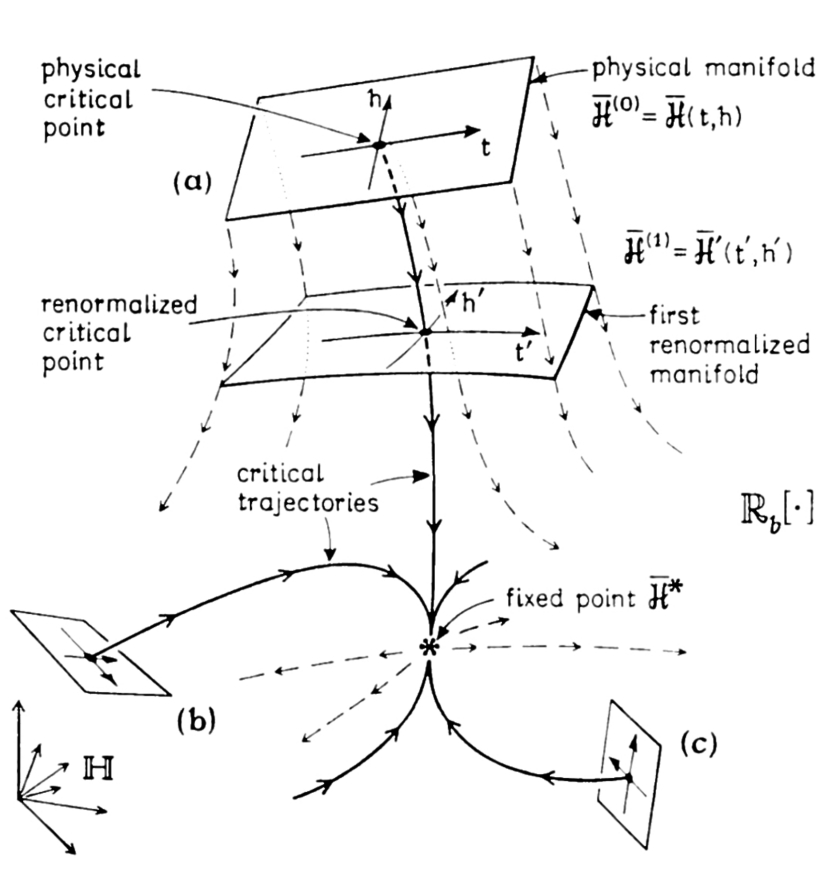
Here is a snippet rewritten from a Quora post: Renormalization is a set of techniques used to resolve infinities that pop up when calculating. It is based on the idea that system behavior depends on scale. Cut away problematic pieces that scale badly to extract finite, testable portions where infinities don’t appear. 

Let’s move on. 


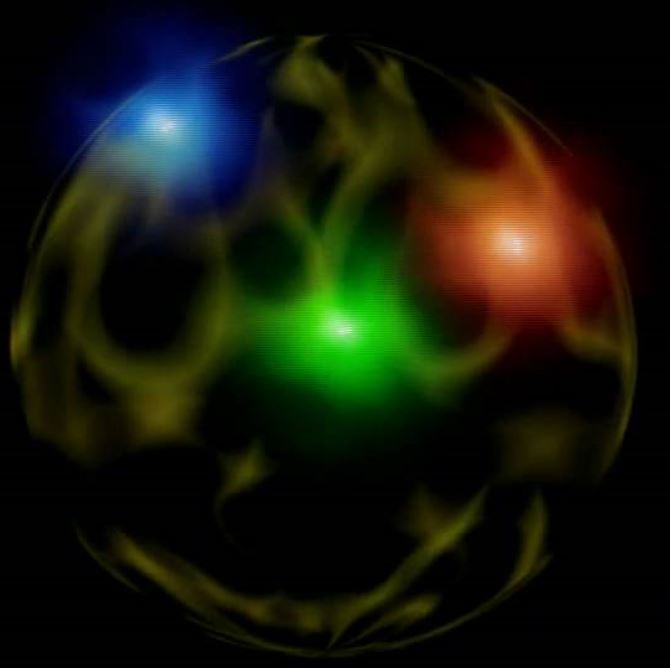
Our guess is that this graphic will be incomprehensible to the typical reader of Billy Lee’s blog. So, don’t worry about it. Billy Lee isn’t going to explain it, anyway. More important things need to be told that everyone can understand, and they will. The Editorial Board

There’s a problem inside the science of science; there always has been. Facts don’t match the mathematics of theories people invent to explain them. Math seems to remove important ambiguities that underlie all reality.

People noticed the problem as soon as they started doing science. The diameter of a circle and its circumference was never certain; not when Pythagoras studied it 2,500 years ago or now. Number π is the problem. It’s irrational, not a fraction; it’s a number with no end and no pattern — 3.14159…forever into infinity.

More confounding, π is a number which transcends all attempts by algebra to compute it. It is a transcendental number that lies on the crossroads of mathematics and physical reality, a curious number at the heart of creation because using it means that diameters, surface areas, and volumes of spheres cannot be calculated precisely. 


For a circle, either the circumference or the diameter can be rational (written as a fraction) but not both. Perfect circles and spheres cannot exist in nature. Why?  ”π” is irrational. It can’t be written like a fraction —  a ratio — where one integer divides another.

The diameter of a circle is multiplied by π to calculate its circumference, and vice-versa. No one can know exactly everything about a circle, because π is uncertain, undecidable, and in truth unknowable. 

Back in the day, people learned to use the fraction 22 / 7 or, for more accuracy, 355 / 113These fractions gave the wrong value for π but they were easy to work with and close enough to do engineering problems.

Fast forward to Isaac Newton, English astronomer and mathematician, who studied the motion of planets. Newton published Philosophiæ Naturalis Principia Mathematica in 1687. I have a modern copy in my library. It’s filled with formulas and derivations. Not one works to explain the real world — not one.

Newton’s equation for gravity describes the interaction between two objects — the strength of attraction between Sun & Earth, for example, and the resulting motion of Earth.

Moon, Mars, Venus, and other bodies warp space-time waters in the pool where Earth & Sun swim. No formula predicts the future of multi-bodied systems. Numerical methods, 2-body approximations among others are used.  


This simple 3-body problem cannot be solved using a single equation. System is chaotic. 

In 1887 Henri Poincare and Heinrich Bruns proved that such formulas cannot be written. The three-body problem (or any N-body problem, for that matter) cannot be solved by a single equation. Fudge-factors must be introduced by hand, Richard Feynman once complained. Powerful computers combined with numerical methods seem to work well enough for some problems. 

Perturbation theory was first proposed in the 17th century. By 1960, physicists used it to solve problems in quantum physics. It helped. Space exploration depends on perturbation techniques. It’s not perfect. A fudge factor called rectification is sometimes used to update changes as systems evolve. When NASA lands probes on Mars, no one can know exactly where they are relative to reference points on the Earth.

Even when using the signals from constellations of six or more Global Positioning Systems (GPS) in high earth-orbit, it’s not possible to know exactly where anything is. Beet farmers out west combine the GPS systems of at least two countries to hone the courses of their tractors and plows. On a good day farmers can locate a row of beets to within an eighth of an inch. That’s plenty good, but the several GPS systems they depend on are fragile and cost billions per year. In beet farming, an eighth inch isn’t perfect, but it’s close enough.

Although a general method of perturbations can be described in mathematics, problems emerge when quantum and astral scales overlap. Relativity & quantum mechanics do not work well together, at least mathematically. Infinities appear that seem unresolvable. 

Quantum physics is a frontier of knowledge that presents unique roadblocks to precision. Physicists have invented more excuses for why they can’t get anything exactly right than probably any other group of scientists. Quantum physics is maybe 100-years old, but problems today seem more difficult than ever.


The sub-atomic world seems to be smeared and messy. Vast numbers of particles — virtual and actual — makes the use of mathematics problematic. This pic is an artist’s conception. Concepts such as ”looks like” have no meaning at sub-atomic scales, because small things can’t be resolved by any frequency of light that enables them to be visualized realistically by humans.

Insurmountable?

Well, interaction of sub-atomic particles with themselves combined with, I don’t know, interactions with swarms of virtual particles might disrupt the expected correlations between theories and experimental results. The mismatches can be spectacular. They dwarf N-body problems of astronomy.

Worse — the problem of scales. For one thing, electrical forces are a billion times a billion times a billion times a billion times stronger than gravitational forces at sub-atomic scales. Forces appear to manifest themselves according to the distances across which they interact. It’s odd.

Measuring the charge on electrons produces different results depending on their energy. High energy electrons interact strongly; low energy electrons, not so much. So again, how can experimental results lead to theories that are both accurate and predictive? Divergent amplitudes that lead to infinities aren’t helpful.

An infinity of scales piles up to produce troublesome infinities in the math which tend to erode predictive usefulness of formulas and diagrams. Once again, researchers are compelled to fabricate fudge-factors. Renormalization is the buzzword for several popular methods.

Probably the best-known renormalization technique was described by Shinichiro Tomonaga in his 1965 Nobel Prize speech. According to the view of retired Harvard physicist Rodney Brooks, Tomonaga implied that  …replacing the calculated values of mass and charge, infinite though they may be, with the experimental values… is the adjustment necessary to make things right, at least sometimes. 

Isn’t such an approach akin to cheating? — at least to working theorists worth their salt?  Well, maybe… but as far as I know results are all that matter. Truncation and faulty data mean that math can never match well with physical reality, anyway. 

Folks who developed the theory of quantum electrodynamics (QED) used perturbation methods to bootstrap their ideas to useful explanations. Their work produced annoying infinities until they introduced creative renormalization techniques to chase them away.

At first physicists felt uncomfortable discarding the infinities that showed up in their equations; they hated introducing fudge-factors. Maybe they felt they were smearing theories with experimental results that weren’t necessarily accurate. Some may have thought that a poor match between math, theory, and experimental results meant something bad; they didn’t understand the hidden truth they struggled to lay bare.

Philosopher Robert Pirsig believed the number of possible explanations scientists could invent for phenomena were in fact unlimited. Despite all the math and convolutions of math, Pirsig believed something mysterious & intangible like quality or morality guided human understanding of the Cosmos. He saw an infinity of notions floating inside his mind. It drove him insane, at least in the years before he wrote his iconic Zen and the Art of Motorcycle Maintenance.

The newest generation of scientists aren’t embarrassed by anomalies. N. David Mermin said, “shut up and calculate.” Digital somersaults are executed to validate work difficult for most to understand, much less perform. Researchers determine scales, focus on relevant portions, cut-away irrelevant parts, and extract appropriate physics to make suitable matches of math to experiment. They put horse before the cart more times than not, some critics have said.


Apologists say, no. Renormalization is simply a reshuffling of parameters in a theory to prevent its failure. Renormalization doesn’t sweep infinities under the rug; it is a set of techniques scientists use to make useful predictions in the face of divergences, infinities, and blowup of scales which might otherwise wreck progress in quantum physics, condensed matter physics, and even statistics. From YouTube video above.

It’s not always wise to question smart folks, but renormalization seems a bit desperate, at least to my way of thinking. Is there a better way?

The complexity of the language scientists use to understand and explain the world of the very small is a convincing clue that they could be missing pieces of puzzles, which might not be solvable by humans regardless how much IQ any petri-dish of gametes might deliver to brains of future scientists.

It’s possible that humans, who use language and mathematics to ponder and explain, are not properly hardwired to model complexities of the universe. Folks lack brainpower sufficient to create algorithms for ultimate understanding.

People are like the first Commodore 64 computers (remember?) who needed massive upgrades to become Sunway TaihuLight or Cray XK7 Titan super-computers, right? 

Perhaps Elon Musk’s Neuralink add-ons will help someday. 


Nick Bostrom, author of SUPERINTELLIGENCE – Paths, Dangers, Strategies

The smartest thinkers — people like Nick Bostrom and Pedro Domingos (who wrote The Master Algorithm) — predict artificial super-intelligence will be developed & hardwired with hundreds or thousands of levels — each loaded with trillions of parallel links —  to digest all meta-data, books, videos, and internet information (a complete library of human knowledge). Armies of trained computers will discover paths to knowledge unreachable by puny humanoid intelligence.

Super-intelligent computer systems might achieve understanding in days or weeks that all humans working together over millennia might never acquire. The risk of course is that such intelligence, when unleashed, might enslave us.

Another downside might involve communication between human and machine. Think of a father — a math professor — teaching calculus to the family cat. It’s hopeless, right? 

Founder of Google and Alphabet Inc., Larry Page (graduated from same school as one of my sons) is working on artificial super-intelligence. He owns piece of Tesla Motors, started by Elon Musk of SpaceX.

Imagine an expert in AI & quantum computation joining forces with billionaire Musk who possesses the rocket launching power of a country. Right now, neither is getting along, Elon said. They don’t speak. It could be a good thing, right? 

What are the consequences?

Entrepreneurs don’t like to be regulated. Temptations of military power added to science-knowledge provided by super-intelligence might corrupt these men and push them & humanity toward unmitigated… what’s the word I’m looking for?

I heard Elon say he doesn’t like regulation, but he wants to be regulated. He believes super-intelligence will be civilization ending. He’s planning to put a colony on Mars to escape its power and ensure human survival.


Elon Musk

Is Elon saying he doesn’t trust himself, that he doesn’t trust people he knows like Larry? Are these guys demanding governments save Earth from themselves?

I haven’t heard Larry ask for anything like that. He keeps a low profile. God bless him as he gathers to himself in cyberspace everything anyone says & does. 

Think about it.

Think about what it means.

We have maybe 10 years, tops, maybe less. Maybe it’s ten days. Maybe the worst has already happened, but no one told us. Somebody, think of something — quick.

Who thought laissez-faire capitalism might someday spawn an airtight autocracy that enslaves the world?

Ayn Rand?

Humans might want to renormalize their aspirations — their civilizations — before infinities of misery wreck Earth and unfree futures emerge that no one wants.

Billy Lee 

ANTARCTICA

Antarctica is weirder and scarier than people think. Here is Wikipedia’s version:

Antarctica, on average, is the coldest, driest, windiest continent and has the highest average elevation of all the continents. Most of Antarctica is a polar desert…   

Trust me. It’s worse.

Something’s happening there… what it is ain’t exactly clear.


The landmass of Antarctica is 44% larger than Alaska, Hawaii, and the contiguous United States combined. It is twice the size of Australia. It covers a circular area at the bottom of the world that is 9.4 million square miles. Only scientists and researchers visit. No one has ever lived there.
Antarctica is remote. Ancient peoples speculated about a faraway land located in the extreme southern latitudes, but no one went to look until 1820 when Russian sailors discovered the continent but didn’t disembark. The landmass wasn’t named “Antarctica” until 1890. The ice-smothered continent is uninhabited except for a few thousand scientists who come and go from time to time to do research.
98% of Antarctica is covered by ice that soars, on average, 1.25 miles. 70% of the Earth’s fresh water is trapped in its ice. If the ice melts, sea levels will rise 200 feet. Deal with it. 
Antarctica is a land of mountains and lakes, almost all buried beneath thick ice. 70,000 killer-whales patrol its coast feeding on seals. A few folks believe that millions of years ago the landmass lay further north, near the equator. Others know that Earth’s climate was warmer during the ancient past. It supported diverse ecologies of fauna and flora, including dinosaurs, which roamed on land that became Antarctica. Some have speculated that Antarctica is the legendary lost continent of Atlantis
A barren landscape is typical of much of Antarctica today. Geologists consider Antarctica a desert because little precipitation falls there. What snow and ice precipitates doesn’t melt. Inland temperatures never rise above 41° F.  Most days, temperatures hover between zero and 100° below zero. 
Antarctica averages one Cat 5 and three Cat 3 hurricanes in winter (May, June, July, August, and September). Category 1 storms are common, filling gaps between major storms. It’s one reason why people don’t live in Antarctica but choose only to visit and conduct research.
During summer 2013, in February, National Geographic explorer Jean-Claude Michelle photographed turquoise shapes in Antarctica’s Pole of Cold region, two miles south of subglacial Lake Vostok. He named the ice blocks ”blue-seals” (after the familiar marine mammals) because blue ice emits high-pitched squeals when it expands and contracts under cold summer sun. Time-lapse photography revealed blue ice drifting toward Lake Vostok at a rate of meters per day. The blue field extends 30 miles in all directions according to Monsieur Michelle.
cryogenic world
Little fanfare accompanied NASA probe Harbinger 1 during the 6.7 years it sped toward tiny Enceladus, a moon of Saturn. The lunchbox sized probe touched down on March 3, 2014.  Photos show a surface similar to Antarctica. Tracks in the foreground are littered with large blocks of turquoise-colored ice, which Antarctic geologists call” blue-seals”.  NASA spokeswoman Eileen Schwarznagel announced: We go to Enceladus to understand the Earth; what we learn will advance our understanding of Earth’s cold regions, like Antarctica.  And yes, we search for life.  It is on moons like Enceladus that cryogenic life — if it exists — will be found.”
image
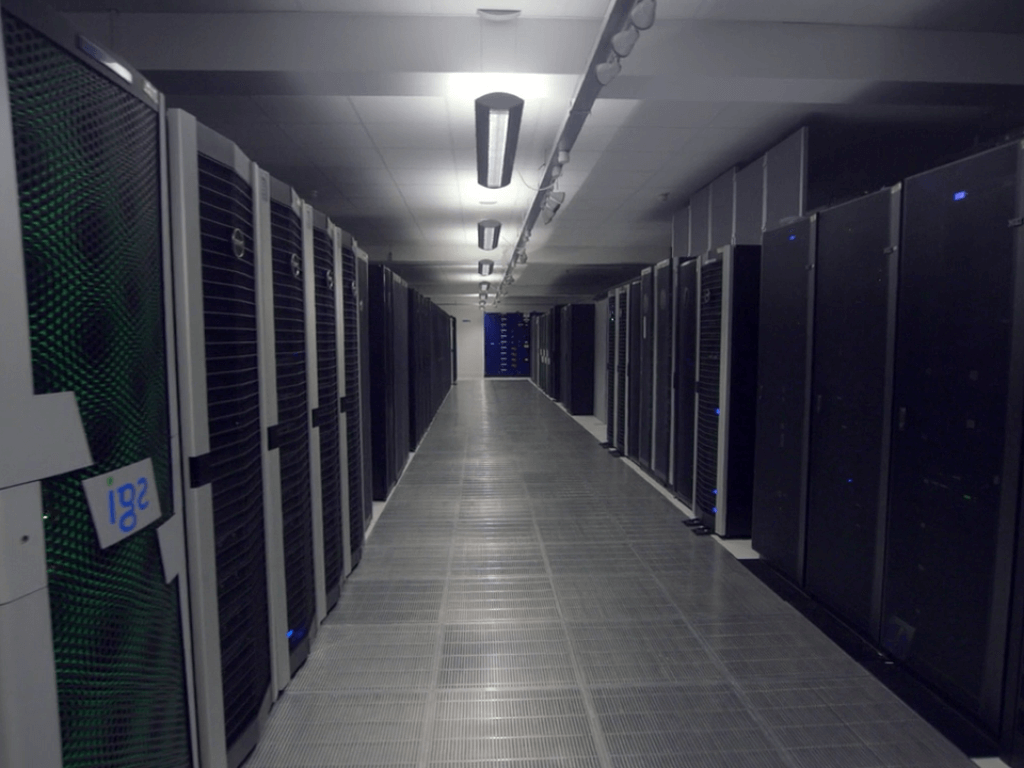
In June, CIA / NSA whistle-blower Edward Snowden announced that he had evidence (see photo) that proved Russia is building a cryogenic super-computer at Lake Vostok. Scheduled for completion October 2016, Snowden claimed that Vostok 1 will be the world’s first artificial super-intelligence computer and prove to be orders of magnitude smarter than the CIA’s HP-35, located in a vast underground complex near McLean, Virginia. The cryogenic temperatures in the Pole of Cold will permit Vostok 1 to become fully operational — even as it draws less power than a pen-light. By contrast, the CIA’s HP-35 eats energy like a city, Snowden said.
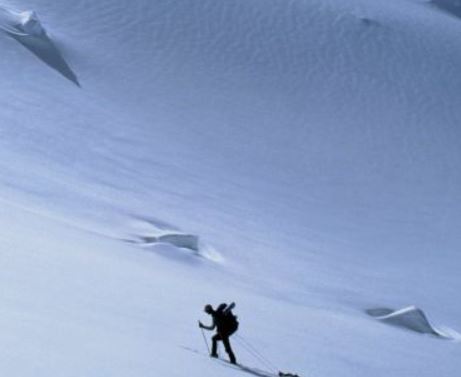
Antarctica explorer passes snow covered blue seals
This photo provided by Edward Snowden catches Russian artificial-intelligence expert Andron Trotsky Tolstoy making his daily ski-commute to the Vostok Artificial Intelligence Laboratory (VAIL) in the Pole of Cold. Snowden revealed that lab psychiatrists refer to Andron as ”Doctor Cool.”  ”Cool” leads the Russian team.  In this pic, the doctor slaloms through a field of blue-seals to prove he is the world’s fastest skier. Despite many skills (he is an accomplished survivalist), Reuters News reported that Andron went missing on October 9 during a commute to work.  
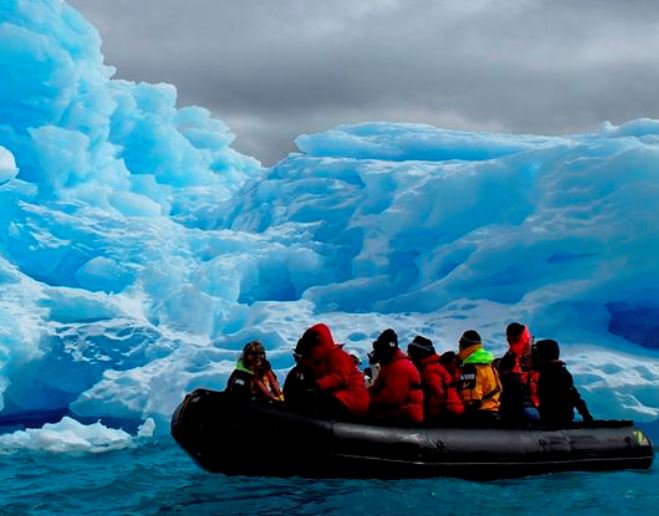
blue ice field in Antarctica
Cuban tourists explore blue-ice formations near the coast of Antarctica. More and more tourists are pouring into Antarctica every month. Tourists want to witness the wonders of abundant blue-seal ice and to hear the high-pitched noises the ice emits, which some say sound like screams of baby seals.
Tens-of-thousands of curiosity seekers have flooded into Antarctica — drawn by television messages broadcast to the southern latitudes of the world every hour by the Antarctic Bureau of Tourism (ABOT). Efforts by the staff of theBillyLeePontificator to contact the bureau have been unsuccessful. Senders encrypt messages to make them impossible to download or copy. Billy Lee included a written transcript, this screenshot, and another below for northern readers who are located out of range.  The Editorial Board

The following transcript is from an encrypted video beamed hourly from the Pole of Cold region.

Provided courtesy of:
Alien Detection by Humans Department (ADHD).

May we have attention, all the people?

Recent advances in cryogenic design make possible to fabricate mobile exploration trains, like Halley VI research modules you see on screen. By 2016, hundreds of convoys built from modules will transport tens-of-thousands of non-scientists, tourists, and children to frozen wonders of Antarctica.

By now all the people hear Russia builds and brings on-line cryogenic super-computers at Lake Vostok manufacturing complex. Advanced manufacturing provides chance for well-paying jobs for all the people who want to work hard and be cold. 

Yes, civilization arrives, finally, at South Pole. The future is bright as troops of blue-seals, which sparkle everywhere under Antarctic Sun. Come to Antarctica. All the people, come. 

Earth’s mysterious continent waits for you. We wait for you, all the people. We are all waiting, here, for you, all the people. We all wait. Come to Antarctica, now.

Clearly, unusual things are happening in the bottom of the world. Check below for updates as events unfold.

Billy Lee


Breaking-news-alert Fox News Antarctica
Update, August 10, 2015: 
MISSING RUSSIAN FOUND

Man upside-down in snow on mountain
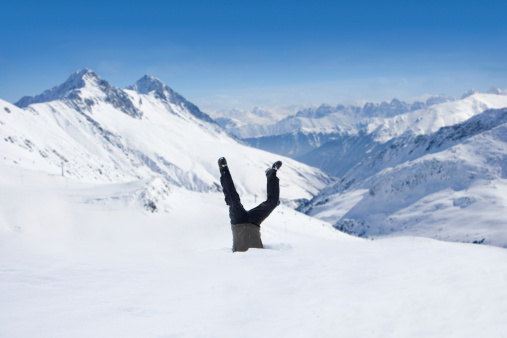
August 10, 2015: With the recent break in the weather, Canadian oil-workers located missing Russian computer pioneer, A. T. Tolstoy (Doctor Cool) this AM — frozen solid in Antarctic snow. Workers uncovered his partially dissolved head, which was embedded in an outcrop of blue-seals—medicine-ball sized ice-crystals common in the area. One said workers were drawn to the site by shrieks of a distressed sea-lion. Another said no, it was the squeal of shifting ice. Fox News

Update, January 28, 2016:
Responding to the recent spate of missing Antarctic geologists, Congress today passed the Presidential Organization to Locate, Identify, Capture, Keep, Engage, & Rescue Scientists Overwhelmed by Blue-Seals statute (POTLICKERSOBS).


Antarctica 13
Jan 30, 2016: German contractors Wersmee Uberride and Gustov Winde — on assignment for the USA under the POTLICKERSOBS law — search blue-seal ice-formations for missing Antarctic geologists.


Antarctica 19
February 1, 2016: Swedish explorer, Nos Pikker, makes a grizzly find after tripping over the out-stretched arms of three missing Antarctic geologists dissolved in blue-seal ice—almost to their elbows.


February 2, 2016: Investigators discover a partially dissolved head inside a blue-seal ice-crystal. Preliminary autopsy reports suggest the head belonged to a large fish. 


Antarctica 39
February 5, 2016: The Organization of Old Antarctic Search Scientists is reporting in their January issue of Antarctica Digest that penguins seem to be unaffected by blue-seal ice, which is known to have swallowed and dissolved a number of researchers in recent months. OOASS technicians photographed the ”Sphenisciformes” marching single-file to blue-ice fields where the aquatic birds dumped large fish, which they carried concealed beneath their brood pouches. 


February 18, 2019 — Trump calls for a WALL around Antarctica. ”Global warming is a hoax,” Trump shouted to a large crowd of Presidents Day supporters during his recent trip to the southernmost continent. ”Antarctic-cold is a national emergency which, if not contained, will bury in snow critical infrastructure like my Mar-a-Lago golf resort.” The crazy-town president implied that all Americans will be ”snorting snow soon if my big, beautiful WALL isn’t built.”  Trump deviated from his teleprompter to warn, ”Blue Seals are pouring over our southern border to dissolve and eat our beautiful women and butt-ugly children. They’re bringing drugs; they’re bringing crime; some are rapists and some, I assume, are good aliens from Enceladus.” Trump added, ”We’re going to build the wall, and Enceladus is going to pay for it!”


Acknowledgement: Billy Lee wishes to acknowledge cyber-explorer, Leah Reeser who encouraged him to publish portions of his Antarctica Diaries despite threats by blue-ice in his refrigerator to hunt down and freezer-burn the brains of any human who reads them.

Thank you, Leah. 

The Editorial Board


Postscript: We could not verify all statements — “fake-facts,” some call them — in this report.  The Editorial Board