DEGENERACY

In 1949, almost a year after I was born, the latest edition of the 30 volume Encyclopedia Americana hit the streets of America. The collection of big books was the first multi-volume encyclopedia sold in the United States, starting way back in 1829.  Each year it grew in size, sometimes adding new volumes to cover more subjects. By 1949, it was truly comprehensive.

I own a complete set of the 1949 edition, which my wife’s dad passed on to me after his death a few years ago. By all accounts, the volumes were a sensation when first published. Not only were they successfully sold door to door throughout the United States, but libraries everywhere stocked them on their shelves for scholars and the public alike to explore and absorb.

1949 was a few short years after the end of World War II.  Colleges overflowed with legions of returning GIs who studied for free courtesy of the recently passed GI BillThe Encyclopedia Americana became a beacon of knowledge and enlightenment for hundreds of thousands of optimistic Americans who were ramping up their skills to conquer the ignorance and backwardness of a world they knew all too well from their recent exposure to the wars overseas.

After perusing these volumes during the past few years, I have been struck by how much we knew in 1949, and by how much we thought we knew but didn’t.  I was dumbfounded by racist patterns of thinking, which seemed to permeate the collection. It came as a complete surprise. Modern people could be excused for thinking that Hitler himself wrote some of the articles, I thought to myself.

People have said that racism is the original sin of America; that we have never come to terms with the bad things we did (and continue to do), because some of our European forefathers — scientists even — believed that Africans were medically degenerate. 

Our country enslaved blacks because ostensibly responsible people told our ancestors that Negroes were animals, like lions or tigers. Of course it was OK to work them like pack-animals, some thought. Nothing wrong with that. Nothing at all.  Besides, slavery was in the Bible.

After slavery ended, whites continued to segregate the races. And they  still do.

Look at Florida if you don’t believe it. In the State of Florida, segregation is a way of life. Americans, some among us, seem to be oblivious to the evil of our actions and unaware of the demonic origin of many of our ideas about what is true and what is right.

We tend to repeat lies that hurt whole classes of people; lies that help no one but drive to despair and even suicide folks like South American immigrants, gays and, yes, Middle Eastern refugees who struggle to get by in a society that seems to value only excellence and perfection, money and power, symmetry and form, orthodoxy and moral rectitude.

We look down on, shun, and isolate authentic human beings who typically possess attributes we don’t admire like humility, lowliness, incompetence, average intelligence, awkward manners, social inadequacy, clumsiness, unreliable physical ability, psychological disabilities, ugliness, poor hygiene, ravaged skin, lack of hair, too much hair, unpleasant smells, thinness, fatness, and on and on.

We condemn millions to long prison terms who have done nothing more than act like fools; who have made mistakes, which with a little maturity and wisdom gained in the fresh air of freedom they might not ever make again.

Many readers can probably think of many undesirable attributes of human beings they find repulsive and would repress with long prison terms if only they could. It’s a desire best left unfulfilled.

Gated Arizona Community
Most are not permitted beyond these gates. They aren’t worthy.

Our inability to accept and live next to people who have less money, less education, different physical traits; who might be less attractive and less polished; who may not understand the world as we do; who are different in some way we find compelling is destroying our humanity; our ability to love and accept others.

Think about it.

We wreck any chance for happiness; any sense of well-being for tens of millions of ordinary people — probably hundreds of millions — who, it turns out, have very few advantages in this life of dog-eat-dog competition; it’s a fight that some lack the temperament to endure. Bigotry is demoralizing for those bullied by it; it is diminishing our country and our world.

We seem unable to even look at people with physical disabilities and handicaps; the blind; the deaf; the burned; the paraplegic; the paralyzed, the mentally incapacitated, the depressed, the hyperactive and the socially fearful.

Many Americans are hiding themselves behind gates, guard shacks, and walls to avoid facing the simple truth that people are diverse; God demands that we accept and respect everyone, because each person — even those who are unattractive and ungrateful in our own morally-damaged sight — are made from the stuff of God Himself and are in the reality we shun truly beautiful and deserving of respect and deference.

Jesus said that God loves the wicked. He loves people who are weak and powerless and undesirable. How can we do less?

Well… one reason is that we are degenerate, everyone of us, whether we are able to see the ugly truth or not. The most admirable person falls short of God’s glory.

Who believes it’s true?

Anyway, I thought that these two entries from the 1949 Encyclopedia Americana, reprinted below in their brutal original version, might help open the eyes of folks who are blind to the cesspool of ideas which have corrupted the spirits of our country; which have driven some people to avoid, ostracize, exclude, and kill people they think are unworthy to enjoy the advantages and privileges they demand for themselves.

These tombs of hate from our past sat on bookshelves and in libraries where they were read for many decades after their publication. Hatred poured forth not only from encyclopedias like the Americana, but from all forms of media and public discourse, it turns out.

The nasty rhetoric of race, exclusion, and the exaggerated elevation of our elites into a pantheon of god-like celebrities has poisoned our minds and our souls; it continues to poison our churches and schools; the military and our public institutions. It’s painfully evident in the rabid venom-spewing aspirants we find in our politics today who I won’t name.

Why demean a good essay by recognizing deplorable people? The president is a public celebrity who rose to power on an ocean tide of hatred. I guess it does no harm to call him out. 

People claim they mean well and are doing God’s will, but golly-gee, someone has to say it (it might as well be me): the movement to transfer children from public schools into homeschooling; the stampede to place civilians armed with concealed weapons into churches and schools; the attempts to scare women out of exercising their constitutionally protected freedom to make healthcare choices involving their bodies; fire bombing healthcare clinics that help the poor; intimidating writers like myself who publish views unpopular with morons — all are symptomatic of a country that has become less free, more fascist, less brave — certainly less accepting, less tolerant, less nurturing, and less forgiving.

America is a mean-spirited place for many people. Even upscale people in high places are afraid to speak their minds plainly out of fear for the faceless billionaires who pull their strings and determine their futures. Look at all the safe-talk on television. Some people call it political correctness.  What does that term mean?

It means people’s careers get ruined if they speak about certain subjects in a frank and unconventional way. When was the last time you heard a celebrity advocate for something as innocuous as a progressive income tax?  Shorter prison sentences?  Maximum incomes?  Estate size limits?  Limits on inherited wealth? 

What accelerates and widens inequality can’t be right.

Our celebrities are held in-check by tight leashes. And it isn’t the public holding the leashes. To remain in the spotlight, celebrities must wear muzzles. Does anyone think they are going to complain? 

Try to remember the names of celebrities who said something controversial and were never heard from again. You might remember their faces, maybe even some of the shows they were on. Few remember their names, more likely than not. They dropped off the face of the earth. They disappeared. The list is long, it really is.

I write about forbidden subjects all the time, but I’m not a celebrity. No one controls me, not since I resigned my memberships in certain organizations and work for free. But the public doesn’t read my blog. And, yes, some subjects are off-limits even for writers like me who want to believe they are free. 

I don’t write about Israel or North Korea or drug cartels; I don’t bad-mouth artists; I don’t condemn creative people, because people with unusual points of view who have talent are fragile and easily frightened to silence; money and fame drive people into isolation bubbles. I don’t publish articles about my sexuality. I tried once; it didn’t turn out well.

Sometimes I break my own rules, it’s true. But let’s get back on message.

I don’t feel like I’m overstating. Below are two examples of a vicious way of thinking, which was mainstream in the decades following 1949. Today in 2015 some folks continue to embrace crazy reasoning.  Who will exorcise the evil winds that freeze-dry hearts to raging cold?

Tolerance isn’t enough. It’s uncommitted and indifferent. 

Embracing outcasts in love is the way. 

It’s not possible to embrace the marginalized in love when advantaged people segregate themselves by income, class, and race.  No one can help when they push aside those who don’t think like them or look like them or act like them. No one who believes that diversity is a plague to be avoided can help desperados who need a hand up. 

Think about it.  

Who can save their children and grand-children when they lack the courage to confront the billionaires who built the gilded cell-block we call America? Billionaires built prison-America to protect themselves from us.

Here’s the problem. Most folks don’t know the names of the billionaires who rule them. Who can reason with the wealthy? Who can find them?

The truth is, they find us, usually when they need someone like a soldier to fight to protect their property or a worker who will add value to their estates by performing tasks for low wages.

The problem is: they don’t love us. Otherwise they would live in the world where we live, but they don’t. Then again, they might allow us to live in their world, where the water in their pools is blue and clean and the sun is warm. But they won’t do that either.

Maybe someday. Someday maybe if they change, they will. They will unlock the gates. They will throw away the keys. They will let us in.

On that day we will become one people, one nation, indivisible, under God.

While we wait, we change ourselves. We learn to live unafraid. We learn to share our advantages. We teach ourselves to love the unloved. 

What else is there? 

Billy Lee


[The following are excerpts from the 1949 edition of The Encyclopedia AmericanaBilly Lee does not endorse any of it. The Editorial Board.]

Degeneracy, pic of Encyclopedia Americana


DEGENERACY.  Unfavorable environment is now generally recognized as the chief cause of the failure of individuals to attain the physical, mental, and moral norm of the race. In certain individuals, however, a defective constitution may predispose them toward an inadequate development of mental, and especially moral, qualities. Such individuals are known as degenerates. 

In many such cases the basis of degeneracy is a lesion of the nervous system or of the sense organs. Congenital blindness and deafness can result in idiocy unless early measures are taken. However, the fundamental defects may be obscure and inaccessible to the pathological anatomist of the present day.  The neuro-sensory defects are often, but not always, accompanied by malformations of a more conspicuous character, known as stigmata. 

These include various distortions of the external ear, facial asymmetry, very early or very late closure of the cranial sutures, polydactylism and other digital anomalies and various signs of imperfect or abnormal development.  Individual stigmata may be present in a person of normal mental and moral make-up, but the concurrence of a considerable number of stigmata is a fairly good sign of degeneracy.

The forms assumed by degeneracy are very various. The mental defect varies from utter idiocy, where the patient is unable to protect himself from immediate physical danger, through imbecility, where he is still incapable of carrying out the daily processes of dressing and undressing, washing, etc., to the various grades of feeble-mindedness, in which he is able to satisfy all his immediate personal needs, but cannot earn an independent livelihood nor associate with his fellows on equal terms.

The causes of degeneracy are manifold.  The racial poisons of alcohol, drugs and venereal diseases are responsible for a large proportion of the cases, though in many cases alcoholism and drug habits may be symptoms rather than causes of degeneracy. Any factor which enfeebles the mother — poverty, illness or the like — may injure the mental and moral constitution of the child as well as its physical constitution.  However, the most important cause of degeneracy is in all probability the inherent inferiority of the stock.

That certain forms of degeneracy exhibit a pedigree conforming to the Mendelian law is now an established fact.  This hereditary quality of degeneracy, together with the fact that degenerates are often likely to have many children, owing to their immorality, makes the problem of degeneracy a most serious one. 

The so-called Jukes family cost the taxpayers of New York State millions of dollars in the course of the 19th century.  For this reason many States have enacted laws making it legal in certain cases to perform on degenerates operations designed to prevent their propagating their kind. 

See ALCOHOLISM; CRIMINOLOGY; DEGENERATION; EUGENICS; FEEBLE-MINDEDNESS; IDIOCY; INSANITY; PAUPERISM.

Bibliography. — Gillin, J.L., Poverty and Delinquency (New York 1926) ; Slawson, J., Delinquent Boy (Boston 1926) ; Glueck, S. S. and E., Five Hundred Delinquent Women (New York 1934) ; Chassell, C. R., Relation Between Morality and Intellect (New York 1935) ; Lunden, W. A., Juvenile Delinquency (Pittsburg 1936) ; Burt, C. L., Subnormal Mind (New York 1937) ; Karpman, B., Case Studies in the Psychopathology of Crime (Washington 1944).


DEGENERATION a work of Max Nordau (1895), which aimed at a scientific criticism of those degenerates not upon the acknowledged lists of the criminal classes.  Degenerates, asserted Nordau, are not always criminals, prostitutes, anarchists, and pronounced lunatics; they are often authors and artists. 

These, however, manifest the same mental characteristics, and for the most part the same somatic features, as the members of the above-mentioned anthropological family, who satisfy their unhealthy impulses with the knife of the assassin or the bomb of the dynamiter, instead of with pen and pencil…. 

Now I have undertaken the work of investigating the tendencies of the fashions in art and literature; of proving that they have their source in the degeneracy of their authors, and that the enthusiasm of their admirers is for manifestations of more or less pronounced moral insanity and dementia.


One word best describes my reaction to the above entries from the 1949 Encyclopedia Americana: Yikes! 

Billy Lee

RACISM

In 1958 when I was a fourth grader our family moved to Quonset Point, Rhode Island where my dad was soon promoted to lead HS-11, one of the Navy jet-helicopter squadrons defending the east coast from attack by Russian submarines.

We moved to Quonset Point with some trepidation because Hoskins Park — the housing project for military families in those days (now sold, redeveloped, and renamed Wickford Point) — had a long waiting list; we didn’t know where we would live or if we could afford off-base housing.

As it turned out, we got a lucky break. A Navy Lieutenant — who was a Negro — moved his family into Hoskins Park. Some white officers found out and decided their families weren’t going to live in non-segregated housing. As a result, vacancies popped-up, and we got in; we moved-in next door to the Negro officer and his family.
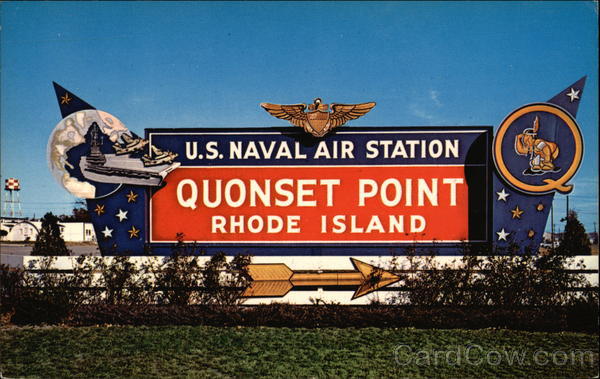

In 1958, my family moved to Quonset Point, Rhode Island. Inexpensive on-base housing was overcrowded. We didn’t know where we would live, or if we could afford to live anywhere.

Lieutenant Brown, his wife and two daughters, lived in the two-story, condo-style apartment on the other side of a thin concrete wall from us.

Despite the custom that white and black families didn’t fraternize in those days, eventually I had encounters, conversations, and interactions with all the members of the Brown family.

Over time, I came to understand how traumatized they were, each in their own way, living in a country that, basically, isolated and mistreated them.

Guess-Whos-Coming-to-Dinner
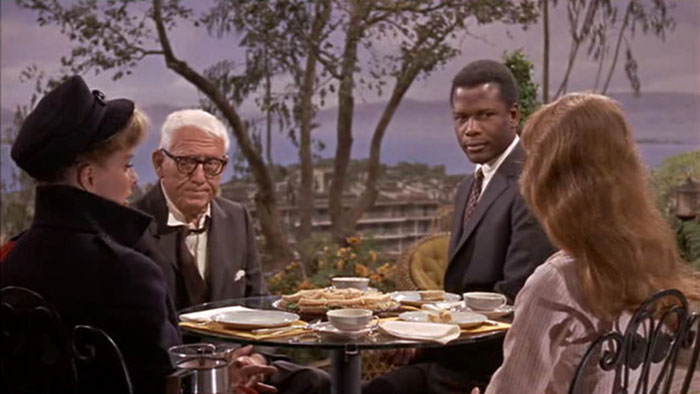
My parents accepted an invitation to the Brown’s for dinner — an event that had all the drama of the movie, Guess Who’s Coming to Dinner, released nine years later, in 1967.

One encounter involved my parents. The Browns invited them for dinner to get acquainted, and after agonizing about it, Mom and Dad accepted.  I think Dad wanted to check them out; to make sure his kids would be “safe” living next door.

After the meal, Dad reported that the Lieutenant’s wife, Jean (Alston), was a good cook, but he couldn’t shake a queasy feeling in his stomach, which spoiled his appetite. He had never interacted with negroes, except servants (everyone called black people negroes in the 1950s); he certainly had not eaten food at the same table. And, unlike my dad, Mr. Brown was a graduate of the Naval Academy.

In that sense, the lieutenant kind of outranked him. According to dad, Academy graduates favored one another and worked hard to help each other achieve promotions. They put non-Academy graduates (like dad) to great disadvantage in the competition for rank, which was fierce inside the Navy.

A black Academy graduate presented a dilemma. Brown was a graduate of the elite Naval Academy with all its privileges and protections; at the same time, he belonged to a race that was, to put it politely, undervalued both by the Navy and the country at large. It was unfamiliar terrain for dad and made him uncomfortable. I remember my parents writing a thank-you note to the Brown’s for their hospitality but as far as I know, they didn’t return an invitation.

Another incident occurred a few weeks later that changed the way I thought about people and what they sometimes go through. It happened on a day when my fourth-grade teacher decided to punish me for violation of good-citizenship. I sassed her, she claimed, because I insisted — in a loud voice before classmates — she couldn’t tell me what to do! She wasn’t my parent!

In my mind, it made sense. To show how wrong I was, she kept me after school to clean the blackboard. She forced me to practice my reading. I left school an hour late.

When I arrived home, I saw Billie — Lieutenant Brown’s sixth-grade daughter — standing on her porch a few feet from ours, crying, and shifting back and forth on her feet in a puddle of — I took a second look to be sure — her own pee. I couldn’t believe it; I didn’t know what to say or do. I ran inside our condo to tell mom.

I wish I could say that Mom brought Billie into our place, helped her clean-up, and gave her a secure place to wait until her mom got home with a key. But mother did nothing like that. Instead, she became animated and began to marvel about how such an embarrassing calamity could befall a sweet girl like Billie. I became annoyed. Why didn’t she ask us?  I interrupted. We would have let her use our bathroom!

Maybe she was afraid to ask, mom said. Maybe she was afraid we would say, no.

So afraid she let her stomach burst? I yelled.


Little Rock 9 segregation racism black suffering
1957. Daisy Bates tries to enter Central High in Little Rock, Arkansas. President Eisenhower sent the 101st Airborne Division to rescue her and eight other students from angry whites. It was the following year that our family moved to Quonset Point, Rhode Island.

Some weeks after, I stood alone in the playground behind our building when Billie walked up. We didn’t speak but sat down together on the ground to draw pictures in the gray clay beneath us — clay the housing complex we shared was built on.

It didn’t seem right to sit with someone and not talk but I couldn’t think of anything to say. Billie was a couple of years older. We had little in common, it seemed. We concentrated for a while, in silence, on our art.

Then, she looked up. She fixed her eyes on mine. I didn’t look away. I tried to hold her gaze. Finally, she whispered. She said simply, I hate being colored.

I felt the blood drain from my face. Hate was a bad word. We didn’t use the word hate in our family.

To hear Billie whisper, hate, about herself — hate about something she had no control over or responsibility for, which she couldn’t change, wish away, or escape — upended my internal world. In that moment, the ground shifted beneath my feet.

Somehow, hearing her speak those words — and the mental image I had created in my memory of the day she danced in a pool of her own urine — conflated in my mind. As Billie waded ankle-deep in her own bodily fluids, I heard her screaming.  I hate being colored!!!  I hate it!!  I hate it!  I hate it. 

In my imagination, I took my place beside her. I raged against God and all the earth for making her colored; for allowing white people to be so insensitive, so mean, so un-caring, so ill-tempered, so prejudiced. 

—————

Billie’s father supervised a motor-pool near, but outside, the Quonset Point military base. According to friends of my mom, he was some kind of gas-station attendant. One warm day, he saw me playing outside and asked if I wanted to take a ride with him in his new convertible. I said sure.

He said he wanted to show me something. He was in charge of something and wanted to show me what it was. He wanted to show me what he did. At his work. 

I thought, this is a crazy request. After all, I didn’t know what my own dad did. He’d never taken me to work or showed me anything having to do with what he was about when he wasn’t home.

So, I climbed into Mr. Brown’s convertible, top down, and off we went. It turned out that he was good at small talk. I listened happily to his resonant voice and enjoyed the sun and warm breezes as we rambled along. We passed through some old guard shacks, a few barbed-wire-topped chain-link fences, and entered an area so remote and wild, it was hard to believe we were still in Rhode Island.

We drove through a dense grove of trees and up onto a hill. Mr. Brown slowed the car and stopped. The sun blazed into the open convertible. Look, he said. He frowned, then nudged my shoulder and pointed. Look down there. 


M113a
There were more military vehicles under Navy Lieutenant Brown’s command than I imagined there were cars in the entire world.  This photo of a military motor-pool in a western state reminds me of what I saw in Rhode Island.

Below us for as far as my eyes could see, in a valley that stretched to the very edge of Earth, sat thousands of green and gray trucks and jeeps; armored personnel carriers and tanks; military vehicles of every stripe and size, all neatly parked in long straight lines. As a naive fourth grader, I found the view hard to take in. There lay spread below us more vehicles than I imagined existed in the entire world. 

It was the second time a member of the Brown family stunned me. I was speechless. Then I said, you’re in charge of all of those trucks?  Navy Lieutenant Brown smiled, sadly, I thought, then looked at me like Billie had.

I am, he said.

Billy Lee

Editor’s Postscript:  This story is grounded in the memories of a fourth grader of events that occurred almost sixty years ago. The make of Mr. Brown’s car and the nature of the installation visited may or may not be accurate. 

After writing this article, Billy Lee learned that Mr. Brown, sadly, passed away on May 22, 2012, at age 85 from cancer. After reading old press releases, he discovered that historian Robert J. Schneller had published a book in 2005 about Mr. Brown’s experiences at the Naval Academy called Breaking the Color Barrier. In 1949, it turns out, Midshipman Brown became the school’s first black graduate. 

Unknown to Billy Lee, Wesley Brown had become an historical figure. Billy Lee has asked the Editors to add biographical notes to his post.

In 1958, neither Billy Lee nor Mr. Brown’s neighbors knew that the young Naval officer owned the distinction of being the first black midshipman to graduate from the Naval Academy. In the racial climate of the 1950’s, an achievement like Mr. Brown’s would have been seen as the exception that proved the rule: Negroes were inferior. It would have been bad taste in polite society to call attention to Lieutenant Brown’s achievement. 

None of Wesley’s neighbors, Billy Lee recalls, had any idea of the hell he went through to become a Naval officer. In any event, white people in 1958 were so blinded by racism that they would have thought, had they known: Wesley’s accomplishment was of no consequence; it was not worth mentioning or even thinking about. 

It’s hard to believe now, but white Americans in 1958 didn’t know their country had a race problem.


esley Brown was the first black graduate of the Naval Academy. During his four years at the Academy, where he studied engineering, he lived alone. He said he didn't want a roommate. I believe he yearned for one, but no one would share a room with him. Wesley was gracious and had too much class to call attention to the racism of his mates who were the best and brightest young men in the USA at that time. Prevented by racists from joining the Academy choir, he joined the track team where an upperclassman, the future President Jimmy Carter, befriended him.
Wesley Brown was the first black graduate of the Naval Academy.  Because no white midshipmen would share a room with him, he lived alone during the four years it took to earn his engineering degree. When classmates blocked his admission to the academy choir, Wesley joined the cross-country track team where future President and upperclassman, Jimmy Carter, befriended him.

wesley brown


Wesley Brown became the first black American to survive the racial hazing at the Naval Academy and graduate. I knew him to be a happy person with a charitable attitude toward all people. He was a kind and gentle neighbor who, during the year of 1958, made me feel good each time I saw or spent time with him.

His wife, Jean (Alston), led our church choir and taught me to sing. We did a television show under her direction. His daughter, Willetta (Billie), transformed my view of the world with a single sentence. I read somewhere that Carol, the youngest daughter, did well in life.

After our families parted ways, Wesley’s family grew to include sons. Eventually, Wesley Brown and Jean divorced; Wesley married Crystal Malone in 1963. He rose to the rank of Lieutenant Commander before retiring in 1969 to pursue other interests.

As my story tells, it was racism in the Navy that made it possible for me to know the Browns. Midshipman Wesley Brown changed America for the better. He suffered to accomplish it, but he kept his pain to himself and his closest friends.

I am proud to say that once, I knew Wesley Brown and he knew me.

Billy Lee

OBAMACARE AND THE LAW OF UNINTENDED CONSEQUENCES

Opposition to Barack Obama’s health care law began six years ago, before he was even elected President. Opposition has continued through his presidency — Intense, persistent, unabated. As I write this article, advertising against “ObamaCare” is running around the clock in every state.


In June 2013 the Supreme Court overturned part of the new law to allow states to opt out of Medicaid expansion. All the Confederate states except Kentucky opted out, as did Maine and Wisconsin in the north, and the eight central states that divide the country down its middle, north to south.

One-half of the Medicaid-eligible uninsured live in these twenty-one states — five million people. Because their states opted out, these five million folks will continue to lack health insurance long after the rest of us are fully enrolled.

In addition, twenty-eight states refused to set up health care exchanges. This lack of cooperation continues to complicate the roll-out process and adds an unplanned-for burden to the new health plan.


racism makes me sick girl


What’s going on here? Anyone with common sense and a knowledge of history knows exactly why the opposition is relentless. Racism is at the heart of our politics, and we have a black president who proposed a universal health care law that enables Negroes in America to finally get health insurance like the rest of us. It’s that simple.

I am sure that only a very few of those who oppose “ObamaCare” would agree that their opposition is racially motivated. People don’t generally examine themselves or their motives. Nor do most people want to change. It’s the part of being human to which the writer of Genesis alluded when he wrote, The Lord saw that the inclination of the thoughts of the human heart was only evil all the time.  

Few people believe they are evil or even capable of it. No one believes they’re racist, even when it’s obvious to everyone else. Just because messing with the Affordable Care Act has wrecked havoc on minorities and the poor in the states that opted out doesn’t mean we’re mean-spirited, opponents say. We have our reasons.

Are there other reasons people despise “ObamaCare” that aren’t racist? Of course. Some have to do with greed. The USA has the most expensive health care in the world. People who care have to ask: why?

One possibility is that the USA — unlike most countries — no longer limits incomes.

In the 1980s Congress removed caps on incomes by lowering top-bracket federal tax rates from 92% to 28% (later adjusted to 35%). For the first time since before the Great Depression people could make and keep as much money as they could get their hands on. Owners and executives began to pay themselves as much cash as they could squeeze out of their companies.


bankers looting
Artist’s conception of greed gone wild. Some Americans consider selfish greed a virtue.

Driving down wages, overcharging customers, and misrepresenting company assets & income to accrue additional tax advantages can and does result in huge windfalls, which leaders are now able to keep — under the new tax codes — for their personal enrichment.

Business owners who once spent money to strengthen their company’s infrastructure — or to bolster wages and benefits for employees — now divert it into ridiculous pay packages for themselves and their executives.

In 1990 the USA spent five hundred billion dollars on health-care. Today it’s two-and-a-half trillion — five times as much. Most of the money has gone into increased compensation for “top” doctors and health care company owners and executives.

Excessive compensation of “specialists”, owners, and high-level executives is an embarrassment to our country and a disgrace. It is the reason USA health-care is notoriously expensive and has, during the past few years, soared beyond the grasp of most median-income families.

The wealthy custodians of America’s most lucrative cash cow — the vast health care industry — are in the fight of their lives to keep government as far away as possible from their private treasure trove.


jimmy fallon obamacare
People laughed at this joke. Is it funny?

Under Obama’s presidency racism and greed have joined forces to deny tens of millions of Americans affordable health care. The national campaign to smear the ACA and degrade support by labeling it “ObamaCare” (after the hated Negro president) has been successful enough that people actually laughed at the joke illustrated above when it played on late night television. The put-down went viral on the Internet.

Let’s be clear. Buying health insurance is not mandatory. People who choose not to buy health insurance forfeit a tax deduction — same as when they choose not to buy a house. Why is this hard to understand?

And by the way, deadlines and cut-off dates don’t increase enrollments. They decrease them. They were a concession to opponents in exchange for votes of support.

What have been the unintended consequences of the campaign to destroy the Affordable Care Act? This is where Jimmy Fallon got it right. It has been a Cinderella story.


opposition debate
When this debate is over the blue shirt will know more than the green shirt. Why?

Opposition has worked the way competition between companies sometimes does. It forced advocates to confront errors and mistakes. It compelled the builders of the ACA to address problems sometimes overlooked during roll-outs of big national programs like Social Security and NASA.

Opposition sharpened wits and forced clear thinking from people who might have been tempted to overlook issues until after the roll-out. It mandated an all-hands-on-deck approach to solving the problems of the Health Exchanges after opponents pointed them out.


kiss opposition
Love overcomes hate. Believe it.

When people write the history of the Affordable Care Act a hundred years from now, I believe they will say the ACA had a smoother roll-out than many of the successful government projects introduced during the twentieth century.

They will point out that the ACA became the model for the programs of the twenty-first century. They will remember Barack Obama as one of our best and most beloved Presidents.

And once again history will teach people the age-old lesson.  Love is more powerful than hate.

And what is love if it’s not helping suffering people who stand helpless before diseases they don’t understand, which will kill them if those who are healthy turn their backs?

May those Americans given much always be a grateful people who offer hope and comfort to the sick and disadvantaged who live all around.

God is counting on us.

Billy Lee