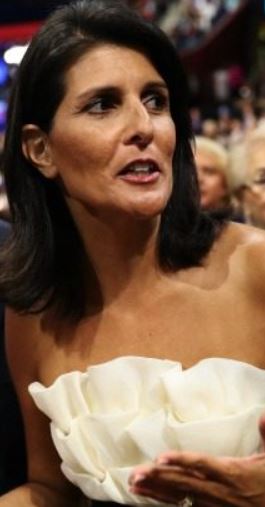
Nikki Haley, UN Ambassador, told the world that North Korea is begging for war. Her statement reminds me of the rape defense that bad men used in decades past at trial before court—she was begging for it, they would always insist.
The victim—always a woman—exercised her constitutional right to dress any way she chose. A prowling lunatic observed her and believed instead that she was advertising a willingness to copulate with a grease-ball, so he attacked.
In today’s United States the grease-ball defense no longer works. Women (and countries) have rights. The courts protect them, most of the time. When they don’t, women have recourse to civil suits.
Nikki Haley is the daughter of Sikh immigrants from Punjab, India. Her mother once owned a clothing company, Exotica International, where Nikki worked as a bookkeeper starting at age 12. She served as governor of South Carolina until she became UN Ambassador in the Trump Administration. Note from the Editorial Board:Haley resigned her UN post on December 31, 2018.
All countries (and women) have the right to defend themselves. No one should have to say it. But the United States has mucked-up the waters of international affairs by waging preemptive wars against communist and socialist countries for the past seventy-five years. It seems like these wars will never end.
The policy of the United States is to undermine any country that espouses communism; it attacks using whatever methods are devised and recommended by the brilliant, depraved minds of our intelligence community. Despite all the evidence, despite all the complaints lodged against the United States before international courts and the United Nations, most Americans refuse to believe it.
The USA birthed its war-policy against collectivism in the early 1900s when the first communist revolutions undermined the noble classes of eastern Europe. The well-connected saw what happened in Russia and Hungary and decided to do something about it. Writers like Aldous Huxley (Brave New World), George Orwell (1984), and Ayn Rand (We the Living) wrote short, easy to read tracts that portrayed life under communism as a personality-destroying nightmare. The public ate it up.
After World War II, the job of suppression was handed over to our newly formed intelligence agencies who gave the fight its name: the Cold War. With the recent CIA assisted transformations of the Soviet Union and Red China into oligarchies (marking a putative end to the biggest conflicts) other terms have emerged from inside the intelligence community to describe how the USA is continuing to war against what few holdouts remain. The current buzz phrase is strategic strangulation.
Billionaires don’t look at the world in the same way as the disenfranchised and exploited. In the neglected and overlooked far reaches of the world where billionaires don’t live, common people sometimes try to organize themselves by producing wealth cooperatively and sharing it as best they can. Once they attract the attention of the powerful, the powerful send in missionaries and agricultural-aid workers to undermine and disenfranchise their leaders.
If God and food don’t work, they send in assassins. It’s true. Since WWII, the United States has gone to war with one out of four countries. It has overthrown (or co-opted) many states including Iran, Guatemala, Chile, Poland, Iraq, Afghanistan and dozens more.
Eventually, the USA sends in Coca-Cola and other first-line-of-attack companies to overwhelm the nascent economies of the sharers and cooperators. The wealthy move in to buy the arable land and lock up the country; billionaire power-brokers make it their business to bury every way of governance that might threaten their right to administer an economic empire built for one purpose only: to empower their own families and the families of their friends to rule unimpeded into perpetuity.
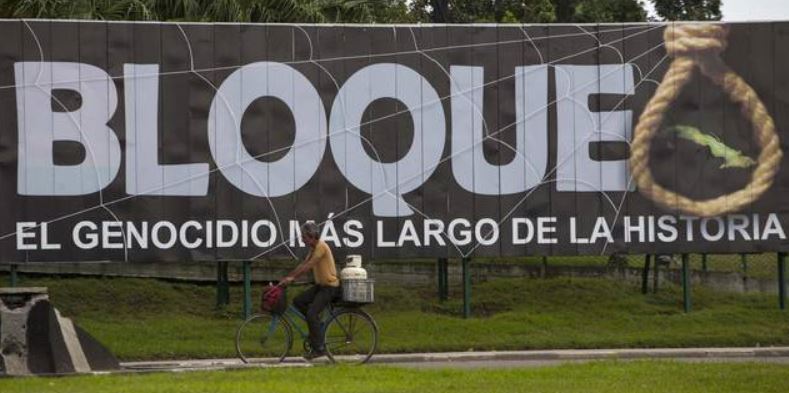
This billboard appears all over the island of Cuba. It says: BLOCKADE: THE LONGEST GENOCIDE IN HISTORY. It shows a Klansman’s noose strangling the island. Inside the USA intelligence community, it’s called strategic strangulation. Our leaders have enforced the embargo of Cuba for 55 years. Odds are it will never end.
The USA is good at undermining socialist countries. It’s why socialism doesn’t do well. When a communist country like Cuba manages to hold on somehow, they are tormented by embargos, infiltration by agents, sabotage, disinformation, slander, assassinations and so on. Radio Free Whatever is beamed into the targeted country to undermine morale and brainwash listeners with the most seductive psychological warfare techniques in our arsenal. It’s why communist countries seal their borders and jam our broadcasters.
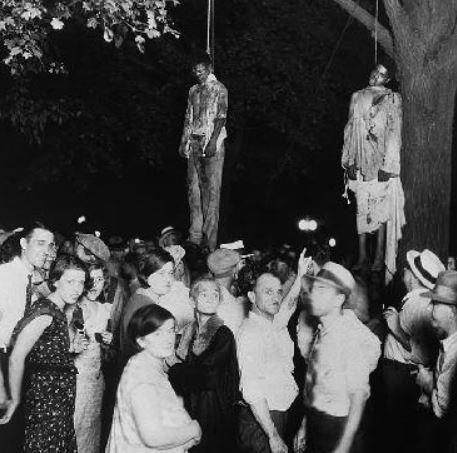
The United States makes sure that no administrator can relax; none can kick back without constantly looking over their shoulder and keeping guard. As long as the privately-owned United States exists, countries of the opposite sex — that is, socialist countries — are going to get blamed for however the rich and powerful choose to hurt them. The better these socialist countries do for their people the bigger the target they become. Their success is their mini-skirt; their low-cut blouse. Obviously, they are begging for war as Madame Haley so eloquently put it.
Blaming the victim is as old as Cain and Abel. It’s as old as history. The bullies win. They put on coats and tails, send their kids to exclusive schools, learn to speak with a different accent, and set themselves apart. They tell wonderful stories about themselves on TV, movies, radio, books, magazines, and the internet until people start to actually believe deep in their hearts that wealthy people are more wonderfully made than themselves or their kids.
The poor and disadvantaged admire their employers, because no one is left to help them understand that they are slaves — fools before a noble class that thinks of them as having no more value than farm animals. They live in the cow-pastures outside the gates of the wealthy. A few unlucky cows get a glimpse from time to time of what has been stolen from them; most of the time they are too incredulous before the view to believe their own eyes.
Today, billionaires are planning as they have for the past seventy years to obliterate the North Koreans. Tens of millions of Koreans will die in the first hours. The North Koreans and their Chinese allies were the first countries to challenge America after WWII. Apparently, our arsenal of atomic weapons didn’t intimidate them. The USA has a long memory.
If we use nuclear weapons in a first strike, no one will live on the peninsula again. That this threat has been floated by our new president (fire and fury like the world has never known) makes it easy to understand what the USA is all about.
Despite denials in the press, America may in fact have neutron bombs in its arsenal which kill people but leave infrastructure intact outside the immediate impact zone. Only bunkers constructed from heavy concrete impregnated with barium sulfate can shield against both neutrons and the gamma ray by-products of collisions between neutrons and the proton-rich substrate of heavy concrete.
High level command bunkers are likely to be built with these materials. Otherwise elements like lead and heavy metals are the barriers of choice against most frequencies of nuclear radiation. But heavy metals tend to be transparent and ineffective against neutron bombardment.
Neutron bombs emit little residual radiation so they don’t contaminate the attack zone. An occupying force can be inserted with little risk of radiation poisoning. It’s possible the USA will use neutron bombs against civilians for the first time if the Koreans continue begging our country to kill them. A follow-on insertion of Marine and Airborne divisions would locate and destroy any surviving command bunkers.
The United States always seems to be first to try diabolical things. We used anthrax against Chinese troops during the Korean war back in the 1950s. Everyone knows about it but us of course. We have short memories when it comes to remembering our own sins like the genocidal Vietnam War and other cruelties such as the war against Iraq and the destabilization of the Middle East.
And no one seems to remember that it was a CIA agent (yes, he was disgruntled and no longer employed, the agency insists) who blew up the first commercial airliner and wiped out the Cuban Olympic fencing team. It was an act of terrorism that didn’t happen when you ask most Americans. Lee Harvey Oswald was also disgruntled and no longer employed, come to think of it.
Speaking of begging for war, is anyone out there begging for peace? The USA killed two million North Koreans during aerial bombardments approved by President Truman. What’s stopping us from doing it again?
During the first days of the Korean War, the South rounded up 100,000 of its own citizens and summarily executed them, believing that each of their victims might be a leftist sympathizer of the North. The Korean War was an atrocity — which I won’t devote blog space to explain or explore. Click on links, those who want to know more.
South Korea from North Korea’s point of view. A massive China has their back. South Korea’s capital is close to their border — a tempting target. (Click on map to produce full-size view in a new window.)
The point is, we aren’t listening to the North or South Koreans. Most want the peninsula unified. We don’t. Most folks want to live in a safe and fair place where billionaires don’t reduce the average person to poverty. South Korea doesn’t want us to sacrifice millions of its own citizens in a military strike against the North — possibly triggering a nuclear conflagration — to make a point. It’s simple, really.
The only sensible solution is to leave Korea and to assist reunification as best as we can if the sides invite us. We aren’t leaving obviously, because our policy is to topple socialism wherever it takes root.
In the past the USA demonized so many of its enemies that it has become more confusing for most folks to know who the bad guys are this time around. Immigrants to the Americas once labeled native Americans with the pejorative, savages. We exterminated their food supply (buffalos), then their men, women and children.
Right now, no one knows who to trust. With our new president we will never know what the facts are. We will never know for sure who is begging for war, us or them.
Billy Lee
From the EDITORIAL BOARD:
Billy Lee supports private and public ownership of property (a mixed economy) but advocates for internationally enforced limits on personal incomes and estate sizes to reduce the temptations that drive the wealthy to burn down democracy on altars of greed. Read Billy Lee’s essay Capitalism and Income Inequality.
Billy Lee opposes war on humanitarian grounds. During war people get killed and are maimed in huge numbers. It sometimes takes generations for both winners and losers to emerge from the trauma and horrors.
Billy Lee supports the United States during war but in peacetime reserves his constitutional right to pontificate freely.
Russian hypersonic ship killing missiles fired from submarines and jets pose an existential threat to the US Navy Fleet. From AP Photo.
UPDATE BY THE EDITORS: 5 AUGUST 2021; The Associated Press reported yesterday the following: A prospective Russian hypersonic missile has been successfully test-fired from a nuclear submarine for the first time, the military said Monday. The Russian Defense Ministry said that the Severodvinsk submarine performed two launches of the Zircon cruise missile at mock targets in the Barents Sea.
Editors Note: The January 16, 2018 edition of the New York Times reports that five Naval officers are being charged with negligent homicide related to the incidents described in this essay where seventeen sailors lost their lives, others were injured, and ships were damaged. The decision to take these officers to trial or court-martial is imminent.
The United States Navy insists that it has 277 ships on active-duty. About 132 are combat surface vessels; 75 or so are submarines. About 70 are logistical craft designed to supply the fleet.
Do the math. 132 surface ships patrol the oceans. Yes, the Navy says they have a fleet of 160 or so non-commissioned ships held in reserve, but they are unavailable and ineffective during first strike scenarios.
The New York Times agrees with the Navy. Everyone agrees — we have 277 ships. I hope the Navy and the New York Times are lying, because if they aren’t, we are in big trouble. We don’t have enough boats.
132 surface ships can’t control the Great Lakes, let alone the world’s seven oceans. Submarines, everyone knows, are almost useless except when used for nuclear deterrence.
The Navy’s Seventh Fleet is headquartered in Yokosuka, Japan. The fleet is responsible to cover 48 million square miles — from Japan to South Korea to Singapore, unless the faraway reaches of the South China Sea are included; then the square miles are too confusing for anyone to compute.
China claims the whole of the South China Sea as its sovereign territory, including all reefs, atolls, and islands.
How many ships bear the awesome duty to keep the sea-lanes open and safe from pirates and hostile powers like North Korea? The Navy says, 70. The USA deploys one aircraft carrier and 69 ships.
Some news outlets have reported that an additional carrier group has been sent into the Sea of Japan to augment the current force configuration. A typical carrier strike group consists of eleven vessels, two of which are submarines. So, the total on the date of this essay might be as high as 81.
Sorry, but someone is ordering our sailors to do an impossible job. The job is too big, the resources are too thin, and guess what?
A flotilla of 81 vessels scurrying about the South China Sea to keep a lid on China, which is seizing islands that belong to Vietnam, Taiwan, and the Philippines as they build and fortify new ones wherever they want is more than enough problems to exhaust any navy. People get tired. Accidents happen.
We have 70 ships in theater, the Navy says. We probably have 81. What does the other side have?
Well, we don’t really know. They lie. So do we. But we and they both watch; and we and they both spy and calculate.
Hillary Clinton — once upon a time (anyone remember?) she had the security-clearance to know — during a 2016 presidential debate let slip that Russian drone submarines are patrolling our coasts. These are cheap subs that sail apparently with no crews on board.
She said it once. Her assertion was never repeated in the press or public media. Everyone pretended they didn’t hear, for good reason. The number and types of ships in the Russian and Chinese fleets that are arrayed against our tiny arsenal of boats are state secrets. It’s all classified — out of reach of everyone except those with a clearance and a need to know.
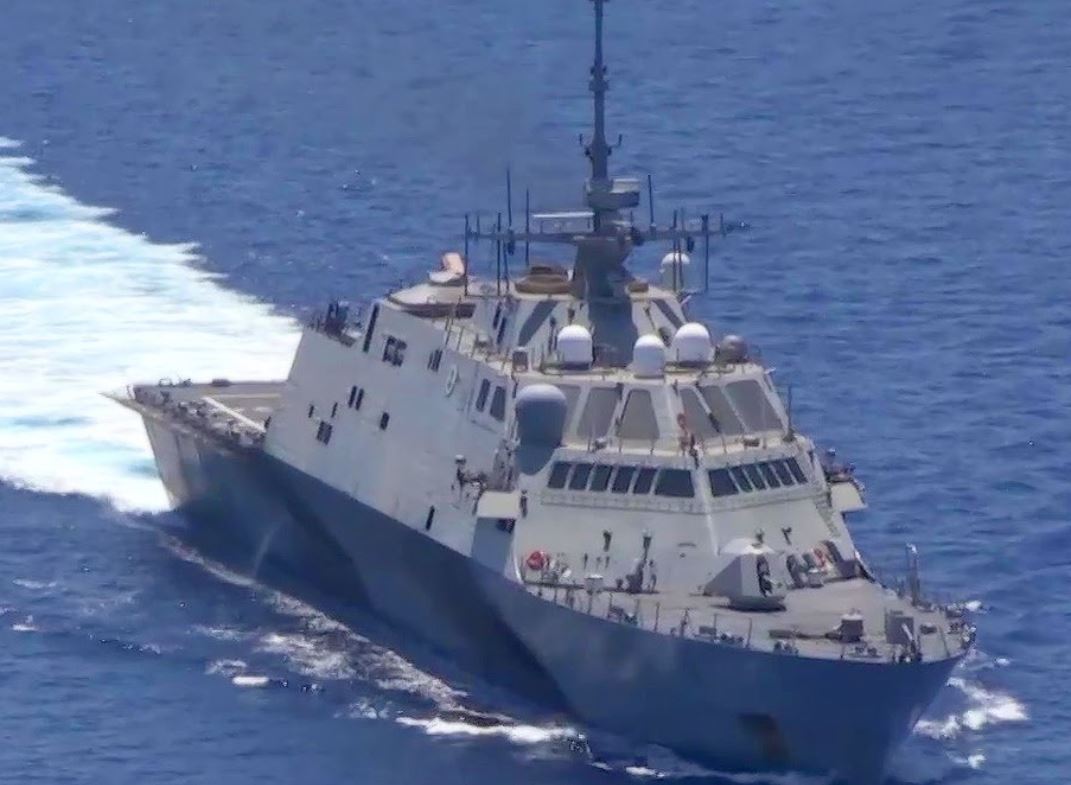
Chinese frigates like this one often stalk US ships in the South China Sea.
It seems clear to more than a few casual observers of Chinese shipping that the Chinese are building the most high-tech navy the world has ever seen. They have been building it for a few decades now.
The Chinese have practiced their sea-going skills in coordination with the Russian navy since 2012. Last year the Russians and Chinese held joint naval exercises in the South China Sea, of all places. Joint land-based military exercises started in 2007.
China is selling its naval technologies and hardware to smaller countries that don’t normally threaten us. Thailand is buying Chinese subs. With military hi-tech weapons spread among a dozen or more countries in secret alliances with China… well… if it’s happening more than we know, does anyone think it’s good for our side?
But really, what would any reasonable person suspect are the forces arrayed against us? Look around. Hundreds-of-thousands of Russians live on the island of Cuba ninety miles from the United States.
Upscale area southwest of the airport in Havana, Cuba. (From Google Earth. Street View not available.)
Go on Google Earth and look at the Cuban neighborhoods. Some nice ones have Russian street names. It’s true. The Russians have a number of wonderfully designed, modern military bases for both subs and ships; and — oh yeah — they have fighter jets and missiles, as well.
Does anyone disagree? Go look.
Am I trying to scare people?
Doesn’t the public have enough to fear? Isn’t terrorism, immigration, climate change, distant war, disease, and precarious health care that could collapse now that the GOP is in charge enough to worry about? Of course it is.
Secretary of State Rex Tillerson helped Boris Yeltsin and Vladimir Putin build Russia’s oil and gas infrastructure. It is the world’s best. Note from the Editors:Tillerson resigned his post on March 31, 2018.
Besides, our country has thousands of nuclear weapons buried hundreds of feet below the cornfields and deserts of the heartland to extinguish any threats, should we lose our Navy. Until the missiles rot and their plutonium payloads leech into our soils, why worry?
Everyone should sleep well at night, right? Who wants to alarm anyone? I don’t.
Secretary of State Tillerson said we should sleep well, so why not? He knows all about the Russians, having helped them build their oil industry over many decades.
Depending on when anyone takes its measure, Russia’s energy industry is the world’s largest and most productive — bigger than Saudi Arabia’s. People don’t believe it, but it’s true.
Russia is the world’s biggest oil and natural gas producer and exporter. Secretary Tillerson must know what he’s talking about, right?
Well, here is some stuff that is not so comforting. It might scare some people. Between 1975 and 2016 (41 years) our Navy experienced nine accidents, mostly between our own ships. Only two accidents involved the boats of foreign countries. That’s not bad. That’s not the scary part. But hear me out.
The Ehime Maru was on a 74-day voyage to train high school students to become commercial fishermen when it was struck on 9 February 2001 by a US submarine. It sank. Of the 35 on board, nine died, including four teenagers.
In 2001 a Japanese fishing-training boat, the Ehime Maru, with thirty-five Japanese citizens aboard, was obliterated near the Hawaiian island of Oahu when the commanding officer of one of our attack submarines allegedly hot-dogged the craft for civilian joy-riders.
Our new president, George W. Bush, went on national TV to apologize to the Japanese, and the United States paid huge fines and compensation to the Japanese government and the grieving families of the nine who died, which included four high school students.
In 2004, the aircraft carrier U.S.S. John F. Kennedy ran over an Arab sailboat in the Persian Gulf. 15 people died, but the Navy didn’t identify who they were it seems, and no one was compensated, as far as I know. Two jet fighters parked on deck were damaged. The Navy relieved the commanding officer.
USS Belknap, guided-missile cruiser, destroyed in 1975 near Sicily.
The most serious accident was in 1975 when the same U.S.S. John F. Kennedy hit one of our own guided-missile cruisers, the USSBelknap, off the island of Sicily. The Belknap was completely destroyed; seven sailors died.
A fire burned on the Belknap for twenty hours just a few yards from the magazine where Terrier surface-to-air missiles were stored. The ship was constructed with aluminum, which caught fire. The entire above deck structure melted. It took nearly five years to reconstruct the ruined cruiser. In 1995, the Navy struck it from the Naval Registry and began using it for target practice. They sunk it during a live-fire exercise in 1998.
A year after the Belknap accident, the USS John F. Kennedy collided with another ship, this time the aging USS Bordelon destroyer during a refueling. The Navy struck the ship from its registry and sold it to Iran for parts in 1977. No one died.
So, during the forty-one years between 1975 and 2016, the US Navy had nine peacetime accidents, seven of which were friendly-fire and self-inflicted. 24 foreign nationals died; 7 U.S. sailors; 1 U.S. civilian. Ship losses: one cruiser and one obsolete destroyer. Maybe other losses occurred. I haven’t heard about them, if there were any.
The USS John S. McCain collided with a Liberian oil tanker, the Alnic MC, on August 20, 2017 in an early morning incident that killed ten sailors. The crash took the destroyer out of action for at least one year.
And now comes the scary part; hold onto your pants: In the seven months since the inauguration of our comb-over commander-in-chief (and keeper of nuclear codes), the U.S. Navy has suffered four major accidents, which killed 17 sailors and injured scores more.
It’s lost two of its most powerful missile-guided destroyers — the U.S.S. Fitzgerald and the U.S.S. John S. McCain. It might be years before they are back in service. Readers can read about the fates of the USS Antietam and the USS Lake Chaplain in the links below.
At least two dozen sailors and officers have been disciplined, including a Vice-Admiral, a Commander, and a Lieutenant Commander. Admiral John Richardson, chief of Naval operations, has ordered an “operational pause” to all fleet commanders. He’s ordered a months-long review of protocols, because, he says, “there’s something out there that we’re not getting at.”
All this commotion is happening during a time when we’re planning to conduct war games against North Korea and are daily challenging the Chinese in the South China Sea.
Can I put things into perspective? If the accident rate of the past seven months was applied to the past forty-one years, the U.S. Navy would be short another 85 ships and 800 sailors. Thousands more young men and women would be maimed and wounded, and 250 promising Naval careers would be wrecked.
In peacetime, essentially, the U.S. Navy might have lost one-third of its fleet and some of its best sailors and officers at a cost of hundreds of billions of dollars.
The USS Antietam, a guided missile cruiser, grounded itself in Tokyo Bay January 31, 2017. It released over one thousand gallons of toxic hydraulic oil into the bay and damaged both of its propellers and propeller hubs. Repair costs will exceed $4 million.
Here are a few of the headlines from our country’s newspaper of record, the New York Times. All headlines are from articles written in 2017. I’ve read every single one of them. Readers can access their content by clicking on the links. The remainder of my essay is written below these headlines:
*Some readers may have noticed that the last headline seems to have no connection whatsoever to this essay. But they would be wrong.
Recall that the battleship USSIndianapolis was the fiercest war machine we had during World War II in the Pacific. We used that ship to deliver the atomic bomb Little Boy (dropped on Hiroshima) to Tinian Island in the western Pacific Ocean sometime during July, 1945. It would be assembled and delivered to the Japanese people with terrifying effect on August 15.
From Tinian the Navy ordered the Indianapolis to advance to Leyte Island in the Philippines to prepare for an all-out assault and invasion of Japan scheduled to follow the atomic blasts that were soon to occur.
On July 30 the lumbering battleship encountered a Japanese submarine which delivered six torpedoes in the wee hours of the night. The sub commander later said that the clouds parted, which permitted the Indianapolis to be silhouetted by moon-light. It made targeting easy. Two torpedo struck the Indianapolis.
The ammunition on board caught fire and blew-off the front quarter. It took twelve minutes for the battleship to sink below the surface. The ship sucked four hundred men to the bottom and left behind an oil slick that would sicken and blind many of the nearly one-thousand sailors and marines who survived to face death by dehydration, drowning, and sharks.
The USS Indianapolis delivered the atomic bomb to the Air Force in the Pacific before being sunk by a Japanese submarine. The ordeal took the lives of nearly a thousand men during five days in the open sea. Read Devil’s Voyage by Jack L Chalker.
The Navy didn’t notice that their prized battleship was missing. After five days of vomiting, diarrhea, hallucinations, and shark attacks, three hundred men were still alive (some in lifeboats, including the Commanding Officer) when an aircraft on an unrelated mission saw something suspicious and flew down to take a closer look.
Twenty-two men who were pulled from the water remain alive today. The Navy court-martialed the commander, Captain McVay, and convicted him for not zig-zagging as he sailed. The Japanese sub-commander testified that zig-zagging would not have mattered. The Indianapolis was going to the floor of the ocean, in any event, he insisted. Nothing could have stopped what happened.
Losing a ship, even in war, is a big deal in the Navy. It’s not something that anyone takes lightly, even when there are extenuating circumstances and good reasons for failure. Captain McVay committed suicide in 1968—clutching a toy sailor in one hand and his service revolver in the other.
The Navy has a history of not being able to keep track of its ships. The earth’s oceans are vast, and we don’t have that many boats on them. Hiding ships from our enemies means we sometimes hide them from ourselves.
Civilian boats are another matter. Merchant fleets deploy 51,405 ships on our oceans. Most of them are bigger and longer and heavier than our 277 Navy ships. Almost all run on auto-pilot most of the time, especially at night when the crews sleep. If the computer directs the tanker to ram a boat like the Fitzgerald, that’s what is going to happen. In collisions, chances are Navy ships will lose.
Collision avoidance should be easy. Crews need only have situational awareness and the ability to steer the boat. The problem is that to perform these tasks crews rely on a complicated matrix of technologies that always seem to fail in critical situations like combat or rule violations by other boats.
These technologies should be used to confirm human observation and decisions; instead sailors confirm what the technology tells them, but only when something goes wrong, which is almost always too late. An alarm sounds and a glance at a computer screen shows that a tanker is 500 meters to starboard, so a crew member looks out a window to see if it’s there. No! That’s bassackwards and will get someone killed.
Officers might better demonstrate proficiency in the absence of high-tech aids for situational awareness and steering, then add high-tech proficiencies one skill-set at a time. Maybe they wear merit badges to enable COs to tell at a glance who can handle hydraulic controls and who is good at computer-aided navigation, for example.
Every officer doesn’t have to master every skill-set, and the least skilled officer should be able to turn off the high-tech systems they haven’t mastered in order to steer the boat and stop it using the skills they do have, when necessary.
Laser distance finders (like those used by golfers) and wide-field-of-view night vision binoculars should be standard issue. A half dozen or more sailors should be stationed around the perimeter of every boat and be required to report what they see or don’t see every five minutes or so. No snoozing!
Mischief Reef is the site of a Chinese airstrip and military installation built on a contested atoll in the Philippines.
Anyway, one thing about the four accidents this year (January 31, the USS Antietam; May 9, the USS Lake Champlain; June 17, the USS Fitzgerald; August 20, the USS John S. McCain) bothers me: the destroyer McCain was nearly sunk just two weeks after it challenged the Chinese at a contested atoll named Mischief Reef, which the Chinese have in recent years built-up into a military base.
I have a problem with coincidences that turn out bad for our side. Malevolent intent by an adversary is always possible. Every bridge officer should understand the protocols to avoid intentional (or unintentional) collisions initiated by rogue (or wayward) boats.
A Philippine-manned cargo ship, the ACX Crystal, rammed the USS Fitzgerald, a guided-missile destroyer, on June 17, 2017. Seven US sailors died. The night was clear; the seas calm. The commanding officer and another crew member were severely injured. Repairs will cost hundreds of millions and take years to complete.
Our Navy is a mess. Everyone knows it. The optics of powerful warships limping into port under the power of a dozen or so tugboats emboldens our enemies and demoralizes our patriotic fighting men and women.
We have the wrong ships, designed the wrong way, for the wrong wars, for the wrong reasons. And our Navy is overworked to the max. We all know it’s true. It doesn’t have to be. It’s good to have high-tech systems, but they are useless during a crisis. Everyone must be proficient at low-tech and know how to enable it. Seriously.
Politics and corruption, profiteering and greed, laziness and lack of zeal are going to kill us all if we don’t wake up. It’s time for civilians to step up and defend our way of life. It’s time for corporations and billionaires to do what’s right — not what makes them wealthy at the expense of our country’s defense and the prosperity of our citizens and the people of the world who are looking to us for leadership.
We are going to regret privatizing our military and using contractors instead of citizens to fight our battles. We are going to lose our freedoms and our country if we don’t fight for both. Everyone must do their part. Corruption can have no role in the process.
We must use our power to make the world safer, freer, and better for everyone, not just ourselves. People are sick and tired of “America first.” We have so much, already.
It’s time to share our advantages, with love. If we do what’s right, if we embrace public service and reach out to the disadvantaged in the world (the military, after all, doesn’t have the room or the money for every citizen), we won’t need to kill everyone who hates us like we’ve been doing for hundreds of years.
A year or two of public service by every American in impoverished neighborhoods and blighted communities might make a big difference in the why, how, and who we fight.
I lived as a teenager and young adult during the 1960s in an America where abortion was illegal in every state. At least 10% of women and girls got abortions anyway, maybe more.
Who knows? The technology of abortion is not complicated; people performed them for pregnant girls and women, usually for small fees. Birth control was something new. Girls and young women, most of them, did not yet understand how it all worked. They suffered shame and ignorance. Many got “into trouble” who never imagined it could happen to them — learning about their pregnancies, some of them, long after their boyfriends had moved on.
In junior high — it was 1961 — I was thirteen. In those days, Thursday was Queers Day. Anyone who wore green was considered queer and could be harassed — no mercy.
God help the wearer of green on QueersDay. I had no idea what being queer meant. I knew it was bad. Queer folk went to prison, some of them. They couldn’t get security clearances in the military, not in the Navy, anyway.
Dad told me, so I knew it was true.
Blacks couldn’t vote until 1964. I was 16. Until the assassination of civil rights leader Martin Luther King Jr. in 1968, businesses like hotels, drugstores, theaters, and realtors could choose to not sell their products to anyone they hated — usually Negroes. Yes, a few companies sold to black people but not many. After Martin was murdered, 125 cities erupted into racial violence. Some say more. Congress, fearing the unraveling of America, passed the Fair Housing Act and other legislation to make racial discrimination by business owners illegal. I never saw a black face on television until 1965. I was 17. Black musicians and singers entertained on the radio and in night clubs in most large cities. On the radio it was not possible to know always if the singer was black.
Otis Redding released a hit song during Christmas of 1964. I loved it. When Otis died in 1967, I did not know what he looked like. I’d never seen a picture of one of the most popular American singers of all time. When I graduated from college, one thing I did know for sure was what all the many brands of cigarettes looked like. I knew Marlboro tastes good like a cigarette should.
The jingle burned my brain. I will never be rid of it. TV forced hundreds-of-millions in the USA and around the world to watch countless thousands of cigarette commercials.
Viewers back then couldn’t pause or mute programs. Remotes didn’t exist.
Of course, I smoked. Who can resist sophisticated advertising?
I can’t.
Back in the day, the one and only control anyone had over what they watched was the on-off switch. The “off” switch meant choosing to be lonely, sometimes.
On television news, I watched the USA fight genocidal war in Vietnam. I signed up to serve as an infantry officer, no less. I learned that war is bad — much worse than I imagined.
I protested, and the army stripped me of my pending commission. I was arrested at an antiwar demonstration and spent hours in jail before some good lawyers set me free. Historians have argued that sometime during 1952 (I was four) the USA dropped anthrax munitions on Chinese troops stationed in northern Korea. The act of bioterrorism was justified by the idea that the alternative was nuclear weapons, which everyone believed involved more risk.
When doing research, I learned that everyone in the world seemed to know about the anthrax attack except Americans.
In 1976, a “rogue” CIA employee blew up a commercial airplane carrying, among other folks, the Cuban Olympic fencing team. The bombing was the world’s first act of aviation terrorism — a form of warfare our enemies would one day turn against us.
A “rogue” CIA asset named Oswald assassinated President Kennedy in 1963. I was in high school. Back in the day, rogue actors seemed to show up from time to time in places where unusually catastrophic events erupted.
Wikipedia reports: According to a 1963 FBI memo that was released to the public in 2008, [former president] Ford was in contact with the FBI throughout his time on the Warren Commission and relayed information to the deputy director, Cartha DeLoach, about the panel’s activities.
I lived in America under President Nixon, the closest thing to a Nazi ever elected to the White House. I was 26 when Congress started the impeachment process against him, but Nixon chose to resign in exchange for a pardon by his vice-president turned president, Gerald Ford.
During high school, I lived in Virginia, where white people went “coon” hunting to find and execute random black people.
Government leaders lie. Many are hypocrites. It’s often not possible to know what’s true. A lot of people who wear suits and ties are haters and power-trippers.
Slavery was 100 years old in America when our nation established itself under a constitution in 1776 — it was 150 years old if indentured servants — who were white and European — are included. Two-thirds of whites came to America as slaves. True, they weren’t in chains, and their “contracts” expired after seven years. Slavery is the fertile soil out of which the thorn bush of capitalism spread its vile branches of greed and exclusion. The institution of bondage makes getting rich a lot easier for those who own slaves. Who doesn’t love the roses of capitalism? But its spines can grow long enough to wound and kill the unwary. Unlimited incomes and estate sizes turn capitalism into a predatory exercise; without limits people get hurt; democracy is devalued; economies stall; recession and depression follow. The disadvantaged poor are as often as not sent to war by the rich and powerful to further maximize their enormous advantages. Threatening war to take the oil of Iraq is an example — an idea recently floated by President Trump.
Since the beginning of empires, every thinking person has known that greed, unchecked and unrestrained, destroys civilizations. The Bible says that the love of money is the root of every kind of evil.
It’s true.
Almost everyone in the world today lives under authoritarian governments run by men who don’t give a damn about freedom. It’s always been this way.
Even in an America with its Statue of Liberty, its Bill of Rights, its wide-open spaces and fast cars, most people find themselves trapped in jobs they hate working for rich folks who can disrupt and sometimes ruin their lives with two words: You’re fired.
To put things into perspective: unless our new president decides to arrest and execute dissenters, or drops nuclear bombs, we will get through what seems to some like a living nightmare. It is not, not really, not yet. We’ve been down this nasty road before. It leads to upheaval, yes, but if my generation survived and prevailed, then our kids and grandkids have a chance to prevail as well. My advice is to be smart; dignity and love demand that each person resist evil as best they can. Unfortunately, my experience is that the brave who resist lose every battle.
Who can close their eyes? The USA targeted and killed resisters in both Asia and the United States during the Vietnam debacle, to cite one example out of many. War resisters lost every fight; every argument; every skirmish; every battle.
People still ridicule baby boomers who said no to war. Ads on TV make claim that many boomers suffer from hepatitis C. Imagine — the generation that said no to war is a leper colony according to pharma pigs, who always push imaginary cures. Like everything else billionaires tell us, it’s bullshit. I don’t know a single person from my generation who has hepatitis C. Yes, some boomers have hepatitis C; that much has to be true; it’s simple statistics; and, yes, some voters cheated during our recent presidential election. There are always some, always on both sides, it turns out.
Anything is possible.
Everything is possible.
Powerful people can paint the people they despise in any colors they want.
Crooked Hillary.
Lying Ted.
Sleepy Joe. Slander is not new. The 9th Commandment forbids it. No one cares. People increase their power by violating it. It’s the way power rolls.
It always will be. It’s why Jesus said that unless graced by a miracle by God, the wealthy have as much chance of getting into heaven as a camel squeezing through the eye of a needle. Despite the harm that billionaires do, they can’t change the reality that Martin Luther King Jr. described during his short life of suffering for the cause of freedom and equality:
The moral arc of the universe is long, but it bends toward justice.
They murdered Dr. King when he was 39. He didn’t live long, but he changed the course of civilization on Earth for as long as civilization lasts.
We, every one of us, can share Martin’s hope: non-violent resistance is not futile. Not yet. Not ever. It only seems futile when we are tired and discouraged.
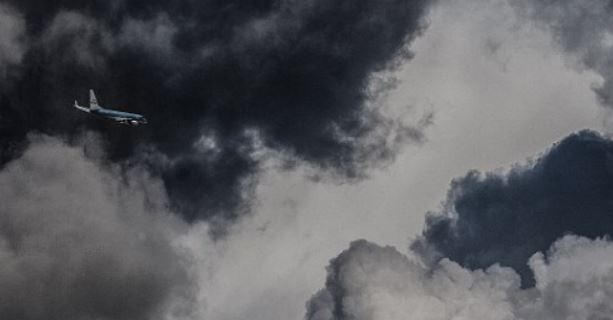
It’s possible to fly blind and survive. It’s possible to fly a twin-engine Beechcraft through a wicked storm without instruments; without communication; find the airfield, locate an empty runway, and land safely.
It’s possible to feel the air disappear beneath your wings and freefall — even tumble — thousands of feet, time after time, dozens of times, recover the aircraft, and keep on flying.
It’s possible for clouds to be impenetrable, lightning to be relentless and unceasing, rain to be thick as waterfalls — with a vomiting passenger in the seat next to you — and keep your wits, keep your senses, keep your fear in check, keep your focus, and keep flying.
Anything is possible during a storm when all is lost except training and skills and the belief that you really are the best pilot in the Navy — when you know deep in your gut that this storm, which forecasters managed to miss, is not how it’s going to end for you or the high-ranking government official sitting in the seat next who hates to fly; who hitched a ride, who chose you, because he trusted you to get him to his meeting with the president, or whoever it was, in one piece.
It’s not possible to stay dry however. During this flight my dad, the pilot, sweat through his clothes. When I met him after his ten minute drive home from the airfield, I asked him, how did you get so wet? His hair and face looked like he just stepped out of the shower. His flight-suit was dark with sweat; water dripped from his cuffs; even his shoes squeaked from pooling sweat around his feet.
I had a rough flight, he said. The worst flight of my life. I got overheated. Never sweat like this, ever. I’m ok. We made it. No problems.
Dad left it at that. But a week later, his passenger came to our house for dinner. He told the whole story. He said Dad saved his life during that flight. No one in the Navy was a better pilot, he insisted, and I believed him.
It was 1964; I was a high school sophomore living at home in Arlington, Virginia near the nation’s capitol. It was the year when Barry Goldwater, the darling of the lunatic fringe of the Republican Party, ran for president. He lost everywhere except Alabama, Georgia, Louisiana, Mississippi, South Carolina and Arizona — his home state. (Today — a lifetime later — lunatics are mainstream; go figure.)
In 1964, the American Nazi Party — led by retired Navy Commander Lincoln Rockwell — owned a field next to our neighborhood where it maintained a barracks and its national headquarters.
Rockwell’s few dozen men were heavily armed; we heard they used German Shepherds to keep gawkers away, but we never saw any when me and my friends snuck onto the property to fire bottle rockets at the barracks. One time a trooper in black boots and tee-shirt walked up on us and clicked the bolt on his rifle. We ran like hell to get away. He didn’t squeeze the trigger. We didn’t trespass again, either.
One time, we visited the Nazi offices and barracks on a dare. A guard let us into the headquarters. I was amazed at how much red color there was. The carpeting on the floors, the walls — even the carpeting on the ceilings — all was red.
It was quiet inside, like a church; even tranquil. One of the men invited us to take some pamphlets from a table in the foyer. We took some, but I don’t remember reading anything but a few of the headings. The content — what little I scanned — seemed ignorant. The Nazis despised Jews and Negroes. What else was new?
A few years later someone on a roof at a strip mall near our house fired a shot at Rockwell. He was leaving the laundromat where he washed his clothes, of all things.
I always bought pop-sickles and candy a few doors down at the Seven-Eleven. It didn’t seem particularly remarkable to learn in 1967 as I started my sophomore year at college that someone assassinated the Nazi commander a mere half-mile from my house.
But to get back to my essay…
Dad crashed a couple of planes during his time in the Navy; it seemed like every pilot screwed up sometime in those early days during World War II and a little after.
During one accident Dad and another pilot collided over a town in Florida. Dad had to bail; he was flying low; his parachute opened immediately; he swung three times as he hung suspended beneath; he hit the ground hard. Except for bruises, he was fine. The other pilot tumbled into the ground and was killed.
The Navy court-martialed my dad, which came as a shock; an official inquiry followed; it lasted a few months, and, in the end, Dad had to take the stand and testify; he was terrified the whole time, my grandfather told me.
Dad confirmed it; he was never more scared before or after, he confessed many years later. The Navy cleared Dad of wrong-doing; he lived to fly another day — with a clean record — which is all he wanted to do anyway since as a boy he first saw an airplane fly over his farm.
Flying was freedom. It was so clear. He hated working in the mud and manure of a farm; if he could fly, he could escape — like the pilots who flew over his farm, he would be free. He would find a way.
It took planning and luck, but he made it. He took a train from Detroit to Chicago; he managed to sign up for the Navy flight program five minutes before the deadline. The rest is history.
Dad rose rapidly in the ranks of both Naval Aviation and Navy intelligence; more specifically the National Security Agency (NSA), which in those days tracked ships, mostly. Early on, the Navy taught him to speak Russian; much later, they taught him French, but it was too late. He never became fluent.
People who know how I write, must by now realize that this essay is going somewhere amazing; somewhere they don’t expect. Have patience. Keep reading.
Dad was a leader with strong views about what made for good leadership. He believed in taking care of his men; he believed in meting out justice to misbehaving officers and enlisted men in the same way — no favoritism to officers.
Military justice doesn’t work the same way as civilian justice. People who have served in the Navy know that commanders can throw their people in the “brig” for any reason — or no reason.
Commanders have absolute power, which they must have if they are to lead an effective fighting force that obeys orders under combat duress and the threat of death. Dad punished officers in the same way he disciplined the men.
But Dad had another belief about power that people who have never wielded it don’t understand. To lead disparate and rebellious people — which large groups of humans tend to be — it is essential to keep them guessing; to keep them off guard; to keep them off-balance; and most important, to keep them uninformed. Never tell subordinates anything they don’t have an absolute need to know. Make everyone unsure of what they think they know and what they think they don’t know.
How does this work in practice? Why is it effective?
My uncle Dean told me a story about a time when Dad took him to visit the anti-submarine, jet-helicopter squadron he commanded in Key West, Florida. It was dark — about nine o’clock at night (2100 hours they say in the Navy).
Dad parked his car outside the guard shack; he and Dean got out and walked past the guard. The guard motioned them through with a salute and a smile.
According to my uncle, Dad whirled around and stormed the guard. He stood toe to toe, in his face, and dressed him down. You will demand identification from anyone who passes this point, sailor! He pointed at my uncle. This man, here, he might be a spy. You put the security of the most important squadron of fighters on this island at risk. Report to my office tomorrow morning — 1000 hours.
Yes sir! the guard said.
Dad took Uncle Dean into the hangar and showed him anti-submarine jet-helicopters. He took him aboard his favorite and showed him the complicated arrays of instruments and armaments then available to the armed forces.
Gages and dials, buttons and levers, advanced screens and switches covered the cockpit ceiling, its floor and doors and front panels. Belts and canisters and other incomprehensible items filled every available nook and cranny. There was no empty space, anywhere.
Dean got quite a show, I can tell you, because Dad took me on the same tour. My thought after seeing how the Navy fights was, how does anyone learn all this complicated stuff, let alone fly these monstrous beasts, which slay the Russian sub-dragons?
Anyway, the tour ended after ten or fifteen minutes, and the two men left the hangar to return to the car and begin the drive home. We lived on the base less than two miles from the squadron. Dad and Dean walked along laughing about something, when the guard stopped them. May I see your identification, gentlemen? he said calmly.
Once again, Dad spun on his heels. What? Are you blind? Am I not the commander of this squadron? Do you not see me every day? You checked Dean, here, ten minutes ago. He is a guest. Leave us alone and show respect. Return to post.
Sir… yes sir! the guard shouted.
Later, Dean asked dad. You ordered this sailor to always ask for ID. Later, when he did exactly as you asked, you humiliated him. Why?
When you’re in charge, Dad said, the men have to know. You keep them guessing. You keep them off-balance. You force them to determine in their own minds what they believe you expect from them.Everything works better that way.
Yeah, it’s weird. But I think he might have understood something important. I’ve known other powerful men who operate the same way. I’ve worked for some.
Another sacrosanct principle of leadership is not sharing information with “the help.” No one will ever see the tax returns, balance sheets, income statements, or health records of the newly elected president.
It’s called flying blind. Everyone flies blind except the pilot. He’s trained. He knows what to do. The world might seem to be falling apart all around. But with any luck at all, the pilot will land the plane — safely.
There is one thing that my dad once did that has been erased from history by disinformation. In the must-read book by Oliver Stone, The Untold History of the United States, Mr. Stone tells a story about an incident during the Cuban missile crisis that almost led to nuclear war. Here is an excerpt:
On October 27 [1962] an incident occurred that Schlesinger accurately described as ”not only the most dangerous moment of the Cold War. It was the most dangerous moment in human history.” A navy group led by the carrier USS Randolph began dropping depth charges near a Soviet B-59 submarine sent to protect the other Soviet ships approaching Cuba. Those inside the U.S. destroyers were unaware that the Soviet sub was carrying nuclear weapons. Soviet signals officer Vadim Orlov described the scene: ”The depth charges [sic] exploded right next to the hull.”
Get the book to read a harrowing account of the hours of hell Russian men inside the sub endured. Some officers passed out. The bottom line is this: the submarine’s commanding officer gave an order to launch a nuclear missile, but the communist political officer on board, Vasili Arkhipov, overruled him. According to Oliver Stone, Arkhipov refused to launch, single handedly preventing nuclear war.
I can tell readers that the only weapons of war we had in Key West capable of chasing nuclear subs and dropping depth charges with the accuracy described in the book was Sikorsky anti-submarine jet-helicopters, which were under the command of my dad. They used new communication technologies called spread spectrum communications. The Russians were unable to jam USA crosstalk or track the trajectories of our most lethal weapons.
The Russians were flying blind, and it hurt them, big-time. These secret technologies have since become the foundation of modern communications used by satellites, cell phones, and GPS.
One pilot in the Navy had both the nerve and skill to deploy depth charges onto a nuclear submarine without risk of a direct hit, which would have released poisons. Only one had access to intelligence about Russian subs in the area — intelligence no one but a few senior officers shared.
He was the one pilot in theater who was not flying blind. He happened to be an NSA officer, yes. He knew the rules of engagement on both sides. He spoke Russian. He trusted his training and skills. He could chase a Russian nuclear sub out of Cuban waters and turn the confrontation in our favor.
It’s what he did.
Enough said.
Researchers told Oliver Stone that we were flying blind; it was only luck and a Russian political operative who prevented a nuclear war during the Cuban missile crisis of 1962. So, he wrote it down.
What else could he do? He wasn’t there. I was. I lived with one of the key players. We ate breakfast and dinner together almost every single day.
Maybe most on the aircraft carrier USS Randolph and its escort ships were sailing blind, like Stone suggested; maybe most of the pilots were flying blind; but not everyone. Maybe, sometimes, people get lucky.
That’s what Dad believed. He always said, people make their own luck.
Practice, preparation, persistence, plus perception based on the best intelligence; the best equipment; the best technology — there is nothing lucky or blind about any of it.
When President Barack Obama visited Cuba in March 2016, the USA-imposed blockade or embargo or quarantine or whatever-else one wants to call it was the elephant on the island. It was the elephant in the room at every meeting between our officials (who numbered close to twelve-hundred) and theirs. We owe Cuba a huge apology. Of course, we didn’t offer one.
This billboard can be found in various places on the island of Cuba. In English it might be interpreted this way: The USA-organized embargo is the longest-lived genocide in world history. They intended to lynch us, but look; the noose is empty; Cuba swims free, beyond the yank of their rope.
Yes, Cubans once-upon-a-time tried to protect themselves from our overwhelming military power; our subversion; our unrelenting sabotage; our many plots to undermine and demoralize the Cuban revolutionary movement, which had overturned the Batista cartel and drove its Mafia friends off the island way back in 1959, a long time ago. We didn’t like it when the Cubans turned to the Soviet Union for help to defend themselves.
Let’s face some facts: It was 6 million of them against 220 million of us. It wasn’t going to be a fair fight. The Cubans were going to lose, and they knew it.
Terrorists fire-bombed El Encanto (a Havana department store) in 1961, just four days before the CIA-organized (and financed) Bay of Pigs invasion. This pic is from 1955.
Fifteen months after the revolution, in March 1960, someone blew-up a French ship in the Havana Harbor, which killed and wounded hundreds of civilians. Cuban police arrested a suspect who, it turned out, was an American with ties to organized-crime and CIA operatives; his team managed to infiltrate harbor-security, police said.
Strange people started flying airplanes over the island on a daily basis to bomb sugar refineries and drop napalm on sugar cane fields. The Cubans managed to shoot down one aircraft and rescue the pilot. He turned out to be an American. Authorities blamed the CIA.
Then, just a few days before the Bay of Pigs invasion, terrorists bombed and burnt to the ground El Encanto, one of Havana’s upscale department stores.
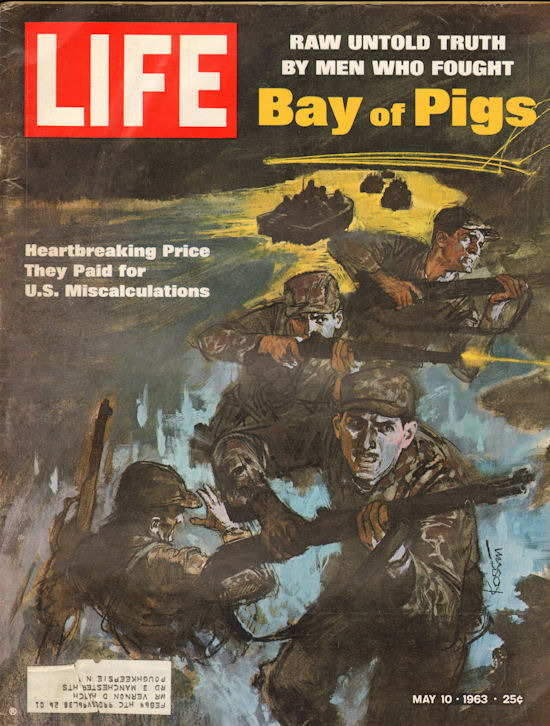
The destruction of El Encanto was part of an extensive campaign to destabilize the island of Cuba. A few days after the terrorist attack, the Bay of Pigs invasion began. The USA public would learn years later that the invasion force had been organized, trained, and paid for by the CIA. The invaders killed and wounded 5,000 Cuban citizens before they exhausted their ammunition and surrendered to Fidel Castro, who led the island’s defenders.
Cubans had no clear idea, even as late as April 1961, that the USA was systematically destabilizing the island and had already finalized plans to invade Cuba and assassinate its leaders.
A few days after the El Encanto firebombing, the invasion-force launched its assault — on Monday, April 17. It included close air-support, a squadron of B-26 bombers, and ships standing off-shore. The assault would come to be called the Bay of Pigs fiasco, mostly because the invaders ran out of ammunition and were forced to surrender.
Fidel himself led the island’s defense; Soviet intelligence informed him a few days in advance of the exact time and place; by some miracle related to our own incompetence, Fidel and his Cuban fighters repulsed the invasion.
Castro’s Cubans managed to capture 1,200 invaders, mostly CIA-trained expatriates, who they later traded for medicine. Afterwards, they begged the Soviet Union to get more involved, because they believed the USA would attack again. Maybe the next time the USA would send more ammo and a bigger air-force, and Cuban defenses wouldn’t hold up.
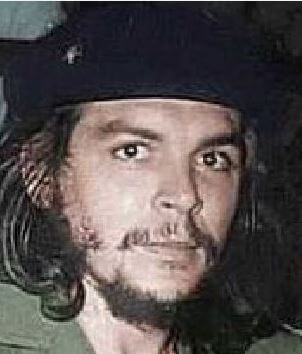
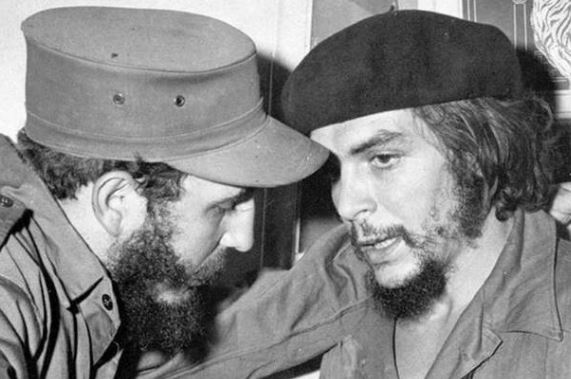
Our government wasn’t too happy about the deal Cuba made with the USSR. The Soviets took advantage of Cuba’s weakness, Che Guevara would later claim. Che told Fidel and the Soviets that the deal was one-sided and not good for Cuba.
The alliance between Cuba and the Russians almost started a nuclear war, because the Soviets insisted on putting nuclear missiles on the island and basing nuclear-tipped submarines in Cuba’s harbors.
The Russians believed that the island could not be successfully defended against a full-on USA invasion using conventional weapons alone. Had a nuclear-missile exchange occurred, neither Florida nor Cuba would be habitable places even today, fifty-four years later. Millions of Cubans and Americans would have died.
Fortunately, deals were made and tensions de-escalated. The Soviets loaded up their weapons and took them home.
For the United States the fight was just beginning. Although the USA promised the Soviet Union that it would not militarily invade Cuba again (rendering nuclear defense unnecessary), it did not promise anything about an embargo. The United States talked and threatened every country in the Western Hemisphere into imposing one. The only country that refused was Mexico.
The USA-led embargo has turned Cuba into a land frozen in time; a time-capsule from the 1950s, which has transformed the island into one of the world’s most sought after tourist destinations. Travel restrictions by the USA make visits by Americans difficult, but not impossible.
The embargo has never ended. It has lasted fifty-four years and turned Cuba into a time-capsule from the 1950s, which in one of the great ironies of world history has propelled Cuba into an elite group of the most-in-demand tourist attractions of modern times.
The Cubans have complained vociferously about the embargo at the United Nations, but they have never fought back in kind; even after we poisoned their sugar; even after we sunk the ships of their trading partners; even after the Bay of Pigs invasion, when we killed and wounded five-thousand Cuban citizens; all they asked was to be left alone.
Che Guevara resigned his Cuban citizenship in October 1965 and left the island never to return. He hoped to inspire revolutions closer to Argentina, his native country, but he also may have believed that his departure would help to take USA pressure off the Cuban people. It didn’t work.
A fifteen-hundred man force trained by the CIA in Guatemala hunted down the beloved hero of the Cuban revolution, shot him in the legs a few times just to hurt him, then they executed him. They cut off his hands and sent them to Fidel Castro. A CIA agent who witnessed the murder has been quoted as saying that Che never cried out in pain before he died. He died as brave as he lived, without fear, the agent said.
Cuba refused to even consider assassinating our leaders, even as we worked overtime in every depraved way we could think of to assassinate theirs; the assassination plots against Fidel Castro are in the public record and make a wicked read, if anyone wants to look them up.
People who visit Cuba will tell anyone who will listen that the Cubans are a friendly, peace-loving people who were brutalized by a ruthless cartel in alliance with powerful crime syndicates; crime syndicates which would years later come to be called the Mafia.
Everyone on the island (90%, anyway) joined in the effort to get rid of the thugs who were abusing the population on a daily basis. People who fought the Batista family and his cartel and were unlucky enough to be captured were routinely tortured, some to their deaths.
The island of Cuba is a kind of unspoiled paradise. May God bless and protect Cuba as the haters try to keep our fight with them going and going and going.
What kind of country keeps an embargo going for 54 years against another country that is no longer a threat?
The only threat Cuba poses to our billionaires is the example it has set; the lessons it has taught the world that it really is possible to create wealth cooperatively and share it; it really is possible to survive an assault by the most militarized and corrupt nation on planet Earth; it really is possible to choose a different path — a path that doesn’t involve capitulation to cartels and billionaires.
Is Cuba perfect? No; not even close. Of course they aren’t perfect. No nation, no individual, no organization that is shunned and impoverished for fifty-four years by a country as powerful and connected as the United States has any chance at all. How would anyone of us in the USA turn out if the full power the United States turned against us?
I will tell you. If you are lucky enough to survive, as Cuba has, you could turn old and sad. Maybe bitter. We have hurt the Cubans far more than they ever hurt us.
It’s time for this fight to be over. It’s time to make amends. Dispatching on Good Friday four men in their seventies to belch out songs about sex with girls before a modestly attended concert crowd isn’t a good way to start.
It’s time for us to say we are sorry, and mean it. It’s time to be friends. It’s clear to visitors that the Cuban people have in their hearts the desire to forgive us.
I believe that many Cubans want to forge their own path without their vision being twisted by the fear of subversion by U.S. spies and agents. They want to have fun and to be our friends; someday — hopefully sooner rather than later — they will.
You have heard that it was said to the men of old, ‘You shall not kill; and whoever kills shall be liable to judgment.’
Jesus
The wars of Israel were the only ‘holy wars’ in history… there can be no more wars of faith. The only way to overcome our enemy is by loving him. Dietrich Bonhoeffer
Those who have waged war in obedience to the divine command (or in conformity with His laws) have represented…the wisdom of government and… put to death wicked men; such persons have by no means violated the commandment, ‘Thou shalt not kill.’ Saint Augustine
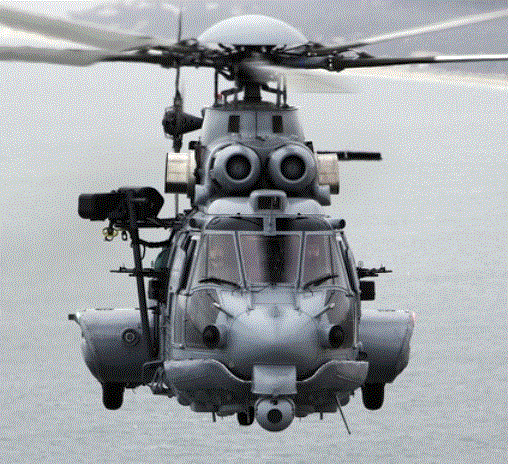
The United States deploys drones like the Scan Eagle and the Predator (which can dispatch Hellfire missiles) to kill people by remote control anywhere in the world.
Readers might notice that the quotes by the three Christians cited above the picture don’t agree about murder. Killing is a moral controversy.
The subject is even more contentious between leaders of religions outside Christianity. It’s a strange thing. In the United States where Christianity is mainstream, pastors sometimes lead the charge towardwar; some endorse capital punishment, so it’s confusing.
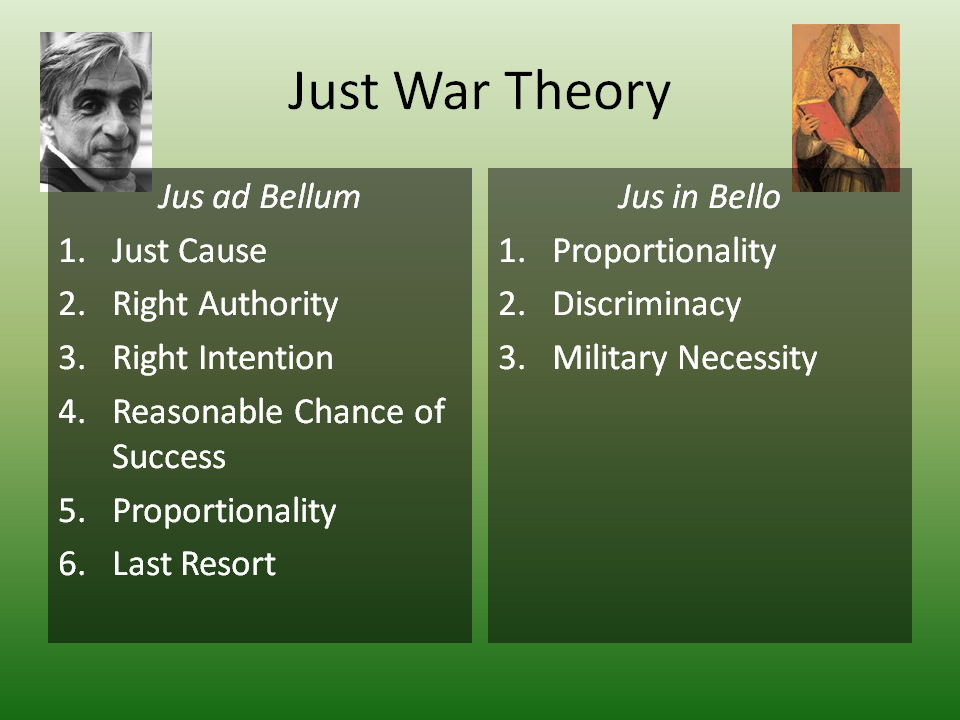
Can killing people be a good thing? The Catholic Church developed Just War doctrines to permit good people to kill the wicked under certain carefully crafted conditions such as proportionality, just cause, and last resort.
From my point of view, ideas of Just War fall under the umbrellas of self-justification, rationalization, and delusion. Will anyone admit the obvious? All countries are ruled by elites, and the USA is no exception.
Elites get to be elite through in-fighting, war, intrigue, and politics. They are, for the most part, desensitized to violence. The morality of religion is of no use to them except when it helps to consolidate and enhance their prestige and power. If a philosophy like Just War helps to alleviate the guilt feelings of soldiers they order into combat, they are fine with it.
Elites are, by process and definition, really good at fighting to maximize their advantages. Over time elites become a law unto themselves and develop their world view and their reasons for doing things, which are usually not well-understood by the average people who serve them.
Who wants to take on people who can really hurt them?
In most places, people go-along with their elites to get along. It’s less stressful and much safer to pretend that average people’s best interests are at the heart of decisions made by the wealthy and the powerful — especially as they negotiate deals, wage wars, and craft treaties.
Who wants to take-on people who can really hurt them should they ever choose to?
For their part, our elites tolerate religion, because in the United States at least Christianity seems to encourage citizens to be docile and compliant. Preachers and pastors encourage their flocks to turn the other cheek and obey authorities.
Christian evangelicals don’t challenge military power, and they generally oppose government policies designed to curb the power of individuals who accumulate vast wealth. Some encourage gun ownership and participation in wars — confusing non-Christians who might be under the impression that Jesus advocated pacifism and non-violence.
In the United States, the wealthy have built a powerful military and have used it to kill many millions of people during the past seventy-five years (the modern era). Much of the killing has occurred during periods when the United States did not formally declare war.
A lot of the killing has taken place under continuing resolutions like the Gulf of Tonkin resolution, which helped to justify the long war in Vietnam.
Another is the AUMF (Authorization for Use of Military Force) — passed by Congress on September 14, 2001 — which provided the legal authority for the United States to use military power in perpetuity against any individual, group, or country who dared threaten it.
Only Barbara Lee(no relation to Billy Lee) of California voted against AUMF, the perpetual war resolution of 14 September 2001. President George W. Bush signed it into law on September 18.
Congressional consent is no longer required to wage war. Military force is now forever justified whenever and wherever the United States is threatened. The Congressional authorization of 2001 makes it easier for the USA to kill people, including American citizens living out of country.
One estimate by The Hill — a news organization whose on-line stories are widely read by members of Congress — places the number of killings by USA drones operating outside of war zones since 2001 at 2,400.
TheBillyLeePontificator.com could not independently confirm the estimate, which one of its editors characterized as “bordering on the ridiculous.”
It defies common sense that high numbers of assassinations of civilians could occur outside of warzones without arousing a profound backlash by people of goodwill, she insisted.
Is she right? Does anyone outside of government really know?
History seems to say it’s possible. Over the years the USA has invaded and tried to overthrow many countries, often under the pretext of retrieving businesses that were seized by their host countries.
In most places, the United States has succeeded — temporarily — like in Iran in 1953 where it secured natural gas and oil reserves; in Guatemala in 1954 when it took back the nationalized United Fruit Company; and in Chile in 1973 when it repossessed certain mines that were producing strategic metals.
The problem for most countries is that after the USA retrieves its property it moves in to take over the country, usually behind the scenes using native-born (and ruthless) dictators loyal to the United States.
USA backed fighters killed and wounded 5,000 Cubans during the failed Bay of Pigs Invasion in 1961. Cuba captured 1,200 who they added to several thousand political detainees in a trade for medicine.
Every once in a while, takeover fails, like in Cuba in 1961 and in Vietnam in 1972. In those countries, strategic resources were never at stake, so the losses didn’t seem to affect our safety or our economic security. Still, after the fights ended, the USA worked overtime to make sure it ruined their economies by deploying embargos and unleashing its leverage over international banking.
The USA ignited recent wars in the Middle East — Kuwait, Iraq, Syria — for various reasons and continues them to this day. The United States fights terrorists in undeclared wars permitted by AUMF resolutions, which allow it to kill enemies anywhere in the world by remote control using un-humaned drones.
It’s pointless to argue whether the killings are justified or moral, smart or stupid. Many families have been ruined by drones and by war. They don’t care about smart or stupid. They just hurt; survivors wonder what might have been were their loved ones allowed to live.
So, how many people have we killed? How many hurt? How many wounded? How many amputees; how many blinded; how many deafened; how many disfigured? How many orphans? How many widows? How many dreams crushed; how many aspirations demolished?
The picture reveals the lethality of Hellfire missile-strikes. The heat cooks flesh off bones of bystanders who get too close.
How many loves-of-a-lifetime have been dashed on America’s battlefields?
Unless God Himself reveals it someday, we will never know, because during the era of Bush-senior and his general, Norman Schwarzkopf (of the renown German family) no one bothered to track body-counts; no one kept statistics on the maimed and crippled.
Our military says it doesn’t do counts. It’s in bad taste. A country like the USA doesn’t count pelts or put notches on rifles; besides, how does anyone collect the names of entire families destroyed in atomic blasts like Hiroshima and Nagasaki?
In those attacks, the genealogy archives of families were obliterated. The files of victims, the records of everyone who knew them, were vaporized.
The directories of the dead in Japan are missing, perhaps forever. Unless resurrected by God, the dead, many of them, are forgotten to the end of time.
The Arlington National Cemetery holds the remains of 400,000 veterans who have served the USA in defense of our way of life. It is a sacred place. A summer job during college privileged me to trim the gravestones of thousands who loved their country enough to serve. A cemetery for those the USA has killed in the modern era, should it ever be built, will be 25 to 150 times larger depending on who collects the dead.
Nevertheless, brave reporters and historians have tried to pull together records where they can find them. I can tell you that the numbers of deaths, executions, and imprisonments in America’s wars are in dispute — with some articles on Wikipedia, for example, frozen in place and fought over by review committees for historical accuracy. The reports are hard reading, disturbing really, because some folks seem to be trying for whatever reasons to understate and misrepresent the carnage.
Despite obvious inaccuracies which defy common sense, the numbers on the internet are the most reliable civilians have. They may perhaps be understated, but they are still large. I’ve included links for those who might want to verify the statistics.
Billy Lee
Notes from the Editorial Board: As everyone knows, the United States is a close ally of Israel. Many prominent Israelis are citizens of the United States, such as former Homeland Security Director, Michael Chertoff. Some folks, like Billy Lee, consider Israel a de-facto fifty-first state of the Union, much like Hawaii, though he admits there are important differences, to be sure.
Billy Lee has pointed out that since 1948 Israel and the United States have cooperated in a dozen or so wars and flare-ups — among them, the War of Independence, the Suez Crisis, the Six Day War, the War of Attrition, the Yom Kippur War, the Lebanon War of 1982, the South Lebanon conflict, the first and second Intifadas, the 2006 Lebanon War, the Gaza War, and various operations like Protective Edge — which were fought to secure Israel’s safety and its autonomy.
The USA has spent trillions of dollars to stabilize the Middle East and prop up with money and weapons governments favorable to our side. It has pumped over two-hundred billion dollars into Israel’s economy alone. How many people have been killed in the wars which erupted? Billy Lee doesn’t know.
He seems to think that an accurate figure for war-related killings by the USA should include in some way the deaths inflicted during the many conflicts in the Middle East where the United States was directly involved. He simply doesn’t have the numbers, so he can’t report them. The numbers may be available to others, but they are not included in his analysis.
A similar concern involves NATO, where the United States, again, is partnering with others in wars and conflicts, and is not the sole actor.
As for other conflicts: Billy Lee has added the following list with links to the statistics. The Editorial Board
The names and numbers of people killed in Japan will never be known. USA bombers obliterated their records in the fires they ignited in the Japanese made-from-wood-and-paper neighborhoods and cities.
The War against Japan deserves special mention.
The names and quantities of people the USA killed in Japan will never be known. The Air Force obliterated their records in the fires they set in the Japanese made-from-wood-and-paper neighborhoods and cities.
Beginning in 1945 sixty-seven Japanese cities of consequence were burned to rubble by incendiary night-time attacks involving hundreds of B-29 Superfortress bombers under the command of USA General Curtis LeMay.
During the first attack against Tokyo in March 1945, Lemay deployed 325 bombers to drop a half-million slow-burning napalmcluster-bombs, which killed at least 150 thousand civilians. His bombing of the capital city continued unabated for three weeks; the fire-bombing of the other sixty-six Japanese cities continued for three more months.
Five cities were held back (protected from attack) until August 1945 to permit General LeMay to decisively demonstrate American atomic fire-power. He annihilated two of them — Hiroshima and Nagasaki — with the atomic bombs named Little Boy and Fat Man.
He spared the three remaining targets, Yokohama (Japan’s second largest city, where I lived from 1952-1954), Niigata, and Kokura — after the Japanese surrendered on August 15, 1945.
Some older readers might remember that Curtis LeMay ran for Vice-President in 1968 on a third-party ticket led by Alabama Governor George Wallace. The two men tried unsuccessfully to derail racial integration in the South, which our Congress had recently mandated.
One of General Douglas MacArthur’s closest aides, Bonner Fellers, described Curtis LeMay’s attacks on Japanese civilians as “the most ruthless and barbaric killings of non-combatants in all history.”
The most conservative estimate of the number of civilians burned alive that I’ve seen in print is 500,000. Some historians have estimated the number to be as high as two million. The Japanese effort to evacuate their cities saved countless lives, but left many millions of women and children homeless, until the cities could be rebuilt after the Japanese surrendered.
Official histories written by the US Air Force claim that ”five months of jellied fire attacks” were ”so destructive” that they ”cremated 65 Japanese cities.” The attacks left ”9.2 million homeless.”
Here are some numbers of interest: atomic bomb attacks in Japan — 225,000 killed; Vietnam War — 3.4 million killed; World War II — 55 million killed; Korean War — 2 million killed; Iraq War — 1 million killed.
This list of wars is necessarily incomplete, because the USA fights secret wars from time to time. In his 1990 book, Freedom in Exile, the Dalai Lama spoke of one such war against the Chinese and admitted taking millions from the USA to support the effort. He claimed that America’s policy was to destabilize and overthrow wherever possible each and every Communist country in the world. Inside the US intelligence establishment, the suppression is called Strategic Strangulation.
This policy was the reason many Communist societies sealed their borders during the Cold War. Some, like North Korea, still do. Military historians have claimed that the United States dropped anthrax bombs on North Korean troops and their Chinese allies in 1954. This biological terror was unleashed after what historian Richard Rhodes says was a program of US bombing against cities and dams in North Korea that killed two million civilians.
General Curtis LeMay agreed. He led the US Strategic Air Command during the bombing of Korea. In 1984 he bragged before the Office of Air Force History, ”Over a period of three years or so, we killed off — what — twenty percent of the population.” It helps to explain why they hate us.
The numbers killed in these secret and not-so-secret wars are argued over; they are not certain or even known — certainly not by civilians who lack security clearances. Mayhem from traumatic wounds is not known.
The consensus seems to be that the total number of human beings killed by the United States since 1940 exceeds ten million. Depending on how it is counted, the number could be far higher. A case can be made that it’s as high as sixty-five million.
In the modern era, the United States has warred against one out of four countries on the earth. I didn’t believe it, until I did the count. Count the number any which way you choose. It’s a big number. And the numbers of wounded and traumatized human beings is certainly enormous, but unknown.
I’d like to think that in the future the United States will resolve its differences with other countries and organizations in a way that doesn’t involve killing people.
The United Nations was established to do just that — peacefully resolve disputes — but the United States runs the place, some say, and others have insisted that the USA is the biggest warmonger on the planet.
It has something to do with its defense industry and the efforts of tycoons to maximize profits for themselves and their shareholders.
I hope it’s not true.
How horrible it is to have so many people killed–And what a blessing that one cares for none of them! Jane Austin, 1811, on the Battle of Albuera
Billy Lee
Postscript: Here is a quotation from wisdom literature, which — who knows? — might help policymakers. I wonder if anyone believes it.
It is by the fear of the LORD that someone turns away from evil. When someone’s ways please the LORD, He makes even their enemies be at peace with them.
I found the passage in the Proverbs of the Bible. See chapter 16.
Che Guevara and Fidel Castro, more than any other two people, were responsible for throwing the Mafia out of Cuba in 1959. White (i.e.non-black) gangsters ran Cuba, some may recall. Watch the second Godfather movie, anyone who doesn’t believe it.
Cuban attorney Fidel Castro and Argentine physician Che Guevara expelled organized-crime bosses from Cuba in 1959. The 1974 movie The Godfather Part Two featuring Al Pacino conveyed some of the dangers these men faced and had to overcome, not only in 1959 but for years after when the CIA and organized-crime joined forces on behalf of the United States to kill them both and undo their revolution.
Race relations were terrible. One-third of Cuba’s six-million people were non-white, poor, and disenfranchised. Beaches were whites-only. Restaurants, clubs, casinos, hotels, and other businesses were off-limits to black families.
Castro racially integrated the Revolution by asking blacks to play prominent roles, which some did — like the military commanders Juan Almeida Bosque and Calixto Garcia. Non-whites made up one-half of the volunteer-soldiers in the Revolutionary Army. Cuba became the first predominately non-black country in the Western Hemisphere to include black people in leadership.
Juan Almeida Bosque stands next to Che Guevara. Juan Almeida was a Havana-born freedom fighter (and popular song-writer) who rose to the rank of General in the Cuban Army. He died on 11 September 2009 at age 82 of heart failure.
In the United States, the civil-rights movement lagged Cuba’s by many years. It was five years after the Cuban Revolution before black Americans got legislation to guarantee their right to move freely in public spaces and to vote. Some think our elites pushed the USA toward racial-integration to undercut propaganda advantages the issue provided the new Cuban government within the international community.
The move toward integration in the USA stalled after James Earl Ray assassinated Martin Luther King on April 4, 1968. One hundred and twenty-five cities erupted into racial violence during that summer. Today, 47 years later, large swaths of the United States of America remain largely segregated. Florida is the most egregious example. Florida owns the distinction for being home to the largest number of white Cuban refugees. It also protects the largest number of racially gated communities in the USA.
But Che had a different attitude than the present-day leaders of the state of Florida. According to historian Jon Lee Anderson, Che Guevara surrounded himself with peasants and black people. He embraced racial, social and intellectual diversity and never let go of this fundamental principle of equality, which undergirded the Cuban Revolution.
Che Guevara, the Cuban doctor-poet, is the one person besides Fidel Castro whose leadership made the Cuban victory possible. An argument can be made — were it not for Che, the Mafia would still run things in Cuba and be stronger internationally than it is now.
It’s possible that without Che and the Cuban Revolution, our elites would not have felt the same urgency to address the problem of racial segregation in the USA, and we would be even more divided today than we still are. It’s possible that the feudal-system in the Americas practiced during the past century would have remained in place.
Anyway, the Cuban Revolution succeeded and the rest, as they say, is history.
”Che” as a child. Ernesto Guevara’s parents were members of Argentina’s ”royal” class.
Ernesto Guevara spent the first twenty-five years of his life preparing for a career in medicine. He traveled the Americas and networked extensively. Through family connections and his personal charisma, Che was able to meet and interact with anyone he chose from the most exalted public figures to the most downtrodden peasants.
Who was Che Guevara? Most Americans have no clue because they don’t read about Che, and television doesn’t do shows about him.
People point out that Che is better known and understood outside the United States. The reason is this: Che thought that the answer to why the people of Cuba, the Caribbean, Central America, and South America were destitute was because powerful people — many of them, citizens of the USA — impoverished poor people on purpose to enrich themselves. It was a simple idea, unacceptable to our elites.
Greed is an easy concept to understand and compelling to anyone who thinks about it for very long. It’s an idea our leaders don’t want ordinary people in the USA to think about too much. The memory of Che Guevara will never be celebrated inside the United States as it is in some other places in the world. In fact, our media has successfully trained most people to forget all about him.
Billionaires, like some members of the Kennedy family, sensed that Che was right (and said so), but they also knew from the inside what it took to create wealth. They understood both the technical and political sides of wealth-creation. Generating and accumulating vast wealth is a complicated, fragile, and sacred process, apparently.
Revolution, they were sure, would screw things up big time.
It took energy, planning and cunning to protect fortunes from governments, but it could be done because governments can be bought for a price. On the other hand, it seemed to the wealthy that protecting their empires from communists, if they ever took over, might be impossible.
Communists believed wealth should be created cooperatively and then shared. It was a point of view opposite to that of our elites who believed wealth was best created by individuals motivated by profit. Riches were to be accumulated to purchase privileges, advantages, and the material pleasures of life for individuals, not society as a whole.
Joseph and Rose Kennedy pose in the lobby of the Colonial Hotel in 1940. Joseph was Ambassador to the Court of Saint James (the United Kingdom). His 23 year old son John would become our 35th President; his 15 year old Bobby would become Attorney General. Ernesto Guevara, 12 at the time, and Fidel Castro, 14, would grow up to confront John Kennedy** and his brother Bobby in the nuclear show-down known as the Cuban Missile Crisis.
The hatred some rich-folks felt for men and women who thought like Che Guevara was visceral. Ted Kennedy described in his book True Compass how his dad Joseph P. Kennedy, Sr. — who made his fortune in movies, then liquor imports — hated communists with a passion that seemed at times unreasonable bordering on insane.
Many wealthy individuals feared that someone who possessed the trustworthiness of a doctor — a physician, for example, who had healthy hair, white teeth and the sparkle of truth in his eyes — might persuade ignorant people to believe pretty much anything.
Che Guevara was that kind of person — a gorgeous communist who believed that any economic system that prevailed because rich people dominated and hurt poor people was an abomination;an evil, which led to a kind of hell-on-earth for just-plain-folks.
Che was dangerous, they decided; truly dangerous.
Che Guevara was a yerba mate tea-drinker.
It’s probably correct to suggest that folks in the USA know very little about Ernesto Guevara Lynch de la Serna because no one in leadership wants to feed Americans information about Che that can be easily understood and digested. Our billionaires would rather we forget all about Ernesto Guevara. I get that.
But a lot of time has passed. Yes, some old people are still left who knew Che. But most who knew him are now dead. Che has passed into the lore of ancient history, he really has.
The United States and Cuba established full diplomatic relations on July 1, 2015. The war between them and us is over. Yes, there are the details of making peace, like the embargo, yet to be unwound. But the war is over, it really is.
Are there hard feelings about how things turned out? Yes, of course there are; on both sides. Some wounds may never heal. War is like that. It’s cruel.
It’s sad that so many got hurt on both sides. But it’s time, we all know it, to allow ourselves to understand better this historical figure, this man, Che Guevara; who he was, what he did, what he stood for, and what he believed.
What follows is a bullet-list of facts we collected about ”Che.” Some facts, encountered for the first time, might surprise some people. Let’s hang onto our hats and keep an open mind. We are all adults here. We can handle the truth if we take the time to breathe deeply and not give in to fear or hate.
[For readers who may want to learn more about modern day Cuba from someone who travels there, click on this link. The Editorial Board]
Che Guevara with his second wife Aleida March. Aleida was an urban guerilla who worked as a courier for the Cuban Revolution. Batista’s secret police referred to her as ”Scarface.” An informer told them she had dog-bite wounds on her face.
Che was a human being — like everyone else. The difference is, he was a rare version of a human being; unusual and unique. His mother and his father, his wives and children have all insisted, Che was special. Aleida, his widow, said he was a perfect man. The people who would eventually murder him hoped to ensure that the world would never see another like him, perhaps to the end of time.
So let’s get started. These glimpses into the personality and skill-set that was ”Che” Ernesto Guevara Lynch de la Serna are in no particular order.
Cuban ”Nico” Antonio Lopez gave Guevara his nickname: ”Che.”
— Ernesto Guevara’s close friend — known to many as the happy Cuban, ”Nico” Antonio Lopez — gave Ernesto his nickname because he thought it was funny that Ernesto always asked for people’s attention by calling out, che! — a Paraquayan Guarani word, which means something like hey you! or better translated perhaps, hey, bro!
It should be mentioned that Nico — ebullient and larger than life — made the initial landing with Che and eighty other fighters near Cabo Cruz lighthouse, which marked the beginning of the military phase of the Cuban Revolution.
During the following week, Batista’s army hunted down and killed 60 members of the landing party. Che, who was shot in the neck, found refuge in a cave. Nico did not survive. Two years later, Che led the survivors and the peasant army he helped build into Havana. The revolution was won.
— Che once worked as a professional photographer. He covered the Second Pan American games in Mexico City in 1955 for Agencia Latina, the Argentine international news agency at the time.
— Che, during his med-school years, flew glider-planes to relax with his uncle Jorge de la Serna.
Che climbed Mexico’s Mt. Popocatepetl three times. He planted the flag of Argentina at its summit in 1956. He was 28 years old.
— Che was an accomplished mountain climber. He climbed Mexico’s Mount Popocatepetl (altitude: 17,900 ft.), three times. He planted the Argentinian national flag at its summit in 1956. He was twenty-eight years old.
— Che, it seems, could walk a tight-rope. He wasn’t afraid of heights, anyway, or of taking risks. A photo exists of him crossing high above a river-chasm spanned only by a connected series of drainage-pipes.
— Che traveled extensively. He took three trips on different routes from south to north through the Americas by horse, motorized-bicycle, motorcycle, truck, bus, train, boat, raft, commercial tanker, cargo-ship, and airplane before his 25th birthday. He even hitch-hiked when necessary.
The hopeless poverty of the common people he met shocked him. Eventually, he would vow to do something to try to change the unfair way things were administered by people of wealth who he also met and spent time with during his journeys.
— Che’s first traveling adventure was during the winter of 1951 at age 22, when he took a job as ship’s nurse and traveled 5,000 miles by tanker along the east-coast (the Atlantic side) of South America making stops along the way from a port in Patagonia in the south to the tiny island nation of Curacao in the north near the coast of Venezuela.
— Che, during extended trips in 1952 and again in 1953, explored the Amazon, Inca and Mayan ruins, and Machu Picchu. He toured copper and titanium mines and visited remote, hard to find leper-colonies where he sometimes stayed for weeks to provide sufferers with needed medical attention.
Che loved archaeology and anthropology almost as much as medicine. He visited Machu Picchu in Peru several times as well as other Inca and Mayan sites. He wrote and published articles in magazines about what he learned.
— Che wrote daily in his diaries and journals for many years. He left behind an extensive and introspective record of his internal world as he developed his point of view and his place in history.
— Che published his first magazine article before age 23. Later, he published research in medical journals.
University of Buenos-Aires Medical School where Che graduated April 11, 1953 at age 25. He specialized in allergy-medicine and pediatrics.
— After graduating from medical school at the University of Buenos-Aires in Argentina, Che completed his internship in Mexico at the Mexico City General Hospital where he worked in the Department of Immunology. He also worked as a researcher at the nearby Pediatric Hospital.
— Che’s second love after medicine was archaeology; he was an expert in the Mayan and Incan civilizations. He visited Palenque and scoured sites at Chichen Itza and Uxmal, which he wrote about extensively. He published articles describing the dig-sites he visited.
— Che vacationed in Miami, Florida for three weeks during his twenties.
— Che was a talented writer and poet. He published several best-selling books during his lifetime. He also authored several unpublished works, which some hope will be published after Fidel Castro and his brother Raul retire from politics.
— Che visited Guatemala in 1954 and witnessed first-hand the CIA overthrow of its popularly elected government. CIA seizure of media enabled it to create in Guatemala an Orwellian aura of inevitability, which disturbed Che and depressed him.
Not to stray too far afield, but psy-ops in Guatemala should be of interest to US citizens for the simple reason that they were coordinated by CIA field officer David Atlee Phillips—later accused by discredited writers and some agency insiders of meeting with Alpha 66 founder Antonio Veciana Blanch and double-agent Lee Harvey Oswald to discuss details of possible assassination plots against both Fidel Castro and John Kennedy.
Anyway, CIA contractors, in a final humiliation, forced the popular President Jacob Arbenz to strip naked in front of reporters before they expelled him from the country. Sickened by the incident, Che wrote: The United States is the enemy of humanity.
— Che’s mom and dad were both members of Argentinian ”royal” families.
Che read constantly from an early age. Released CIA documents noted the depth and diversity of his literary interests.
— According to released CIA documents, Che was unusually well-read, especially in politics, history, philosophy, geography, medicine and psychology. A favorite book was the classic Argentine masterpiece ”El Gaucho Martin Fierro” by Jose Hernandez, published in 1872.
— After high school, Che read the entire 25 volume Contemporary History of the Modern World.
— Che spoke French and Spanish. He had an easy familiarity with English, though he refused to be interviewed using it. He also picked up a limited ability in Swahili, the lingua franca of Africa’s Great Lakes region, when he spent time there on assignment for Cuba. And the Soviet Union provided Che with a tutor who helped him become more proficient in Russian.
— Che was a skilled rugby player and coach. He founded and edited the short-lived (eleven issues) rugby magazine, Tackle.
— Che was a tournament-playing chess enthusiast.
— Che spent his high school years in Cordoba, Argentina, where his family belonged to the exclusive Lawn Tennis Club where Che learned to swim and play tennis.
— Che was a good golfer.
— Che passed a certification exam in civil engineering during high school. His first job after graduating was as a ”soils specialist.” He analyzed soils for road building companies.
— Che’s asthma enabled him to avoid Argentina’s military draft.
— In 1956, Fidel Castro — the well-connected Cuban attorney who belonged to a wealthy land-owning family — shared a cell in a Mexican prison with Che that lasted a month. Fidel and Che — close acquaintances before — bonded; they suffered together as political prisoners.
— After Castro’s release, Che and Calixto Garcia (a black freedom-fighter who would rise to the rank of Brigadier General in the Cuban defense forces) remained in prison for another month.
Che’s uncle, the Argentine ambassador to Cuba, wanted to use his influence to free his nephew but Che refused the help until Mexico agreed to release his friend. In a case of truth-is-stranger-than-fiction, Fidel paid for the two men’s release with funds he unwittingly received from the CIA.
— Fidel soon realized that Guevara could be far more than the physician-poet he had hired to care for his men. On 12 July 1957, Fidel asked Ernesto to command the army he was building. His decision to promote Che created the momentum necessary to secure victory for the Cuban Revolution.
This colorized photo shows a showered and cleaned-up Che following his triumphant entry into Havana, Cuba in January, 1959. He was thirty years old.
— Che was directly responsible for the success of the Cuban Revolution in this way: on 29 December 1958, his battle-group (the Eighth Column) ambushed and de-railed a key armored supply train loaded with weapons, munitions and troop reinforcements belonging to General Fulgencio Batista’s national army. Che and his guerilla fighters then took the city of Santa Clara, which was defended by a force more than ten times the size of their own.
This unexpected loss scared the Cuban dictator who fled the country two days later on New Years Eve (taking an entourage of over two-hundred people and the entire Cuban treasury with him).
On 2 January 1959, Che and his soldiers walked into Havana with their captured weapons and took control of government buildings and military bases without firing a shot. They seized a government that was 1.2 billion dollars in debt and running huge yearly deficits due in part to looting by Batista’s cartel.
— Che published the classic book Guerrilla Warfare in 1961. John Kennedy immediately read it. Based on what he learned, he organized a few weeks later the Green Berets from units of the 77th Special Forces Group, which he renamed the 7th Special Forces Group.
— Che married twice. He fathered one child by his first wife, four by his second.
— After the revolution, Che became the object of a CIA manhunt. Che continued to travel freely because of a disguise he designed that fooled even Fidel Castro and his closest advisors.
— Che felt that Cuba’s relationship with the Soviet Union was one-sided. The Soviets didn’t provide the support in personnel and financial aid needed to offset the international embargo coordinated against Cuba by the United States. Che complained, and it created a flap between the two governments.
— After the Revolution, the new government lowered the age requirement for ministerial service from 35 to 30 and granted Cuban citizenship to Che (who was 30 and Argentinian) so he could legally hold a number of administrative posts. One of the most important was Minister of the Cuban banking system — a position he earned by his reputation for integrity.
Fidel once said that Che Guevara was honest to a fault. True to his reputation, the first thing Dr. Guevara did as Central Bank Administrator was halt the scheduled construction of a new Central Bank complex and use the money saved to build a badly-needed hospital.
— Che, after visiting the Soviet Union, expressed outrage to confidants about the lavish lifestyles of the Russian leaders.
— When Cuba went to rationing after the United States impeded its right to buy food, Che insisted that his family receive the same food-coupons as every other family in Cuba. Despite his efforts, Russian officials later admitted that they smuggled food to his wife, Aleida, when he traveled outside the country.
— Che wrote privately to the Cuban minister of sugar, Orlando Borrego, that he believed — based on his observations of Russian society while visiting there — that the Soviet Union would fall back into Capitalism one day.
— Che returned all gifts showered on him and his family by foreign leaders while serving in Cuba’s ministries. Although the Cuban government provided him with a car, he used it for official duties only. He insisted his family use public transportation.
— When Che entered Havana for the first time, he wore a cast on one of his elbows; he broke it ten days earlier after falling off a wall in the city of Cabaiguan, one of the many towns that fell to his forces before the decisive battle of Santa Clara, which ended the military phase of the revolution.
Che drank yerba mate, a tea popular in Argentina.
— Although Che is often portrayed as a cigar-smoker, and sometimes posed with cigars, he suffered from chronic and severe asthma. He rarely smoked, or drank alcohol, because his health would not permit it.
During the most dangerous phase of the fighting when Che wasn’t sure each day whether he would live or die he did smoke according to at least one credible historian. When victory came, he was hospitalized for pulmonary distress and spent several months recuperating.
— Che was allergic to seafood.
— Che’s favorite beverage was yerba mate, a caffeinated drink brewed from the leaves and twigs of a rainforest tree in the holly family. Popular in Argentina, it was thought to have medicinal properties at the time. Che may have used it to treat his asthma.
— Che was a good swimmer. He used vigorous swimming to help strengthen his lungs.
— The Cuban government gave Che an airplane and a personal pilot to use for government business. He often flew the plane himself because he loved to fly.
— Che taught French to the current president of Cuba, Raul Castro, during their time in the Sierra Maestra, before the Revolution was won.
— Alberto Korda took the iconic photo above of Che (by which the world now identifies him) on March 5, 1960. It followed the state memorial service for the one-hundred people who died in the terrorist attack on the French freighter La Coubre in Havana Harbor the previous day. Two-hundred people were severely injured.)
Because Americans were napalming sugar-cane fields and sugar refineries to wreck the Cuban economy (one plane had been shot down and the pilot, an American, captured), Fidel Castro in his address to the mourners blamed the CIA for the attack on the French ship while Che Guevara stood next to him wearing the iconic expression on his face that became his brand.
Neither man knew at the time that in 13 months the United States would escalate the conflict by conducting a full-scale military assault on the island of Cuba at the Bay of Pigs.
The CIA continued to attack Cuban shipping through 1964 before international outrage over the killing of the captain and two crew members of a misidentified Spanish freighter — it was also set on fire and almost sunk — brought sufficient pressure on the agency to change its policies.
Che Guevara — a few hours before they killed him.
— In 1967, an 1800 man Bolivian Ranger Force trained in Guatemala by the USA hunted down Che in Bolivia and captured him. A small unit from this force tortured him by firing a half-dozen rounds into his legs, then executed him.
Those who murdered Che reported that he measured 5’8″ and weighed 155 pounds. These numbers are widely repeated on the Internet. The killers cut off his hands and sent them to Fidel Castro, then hid his body among six of his fighters in an unmarked grave. Some have wondered if truth was one of their core-values.
According to the killers, Che would have been seven inches shorter than Fidel, which doesn’t seem to match-up with the many photos of the two men together, including the lead photo in this essay. Based on photos I’ve reviewed, Che appears to be 4 to 5 inches shorter than Fidel, who was 6’3″. After reviewing photographs, my opinion is that Che was 5’10”.
Why Che’s executioners would misrepresent his height is anybody’s guess.
— The woman who fed Che a bowl of soup before his execution, Julia Cortez, said this about his appearance: He was an extraordinarily handsome man. He wasn’t the man depicted to us: black, ugly, evil. His eyebrows, his nose, his mouth — all of his features were perfect.
— Captain Gary Prado of Bolivia asked Che: Why didn’t you give up? Why didn’t you disband your unit and go home when you had the chance? Che answered: Where would I go?
According to Prado, that was Che’s dilemma in Bolivia. He was isolated, shunned by the international community of nations, and trapped. He had no place else to go.
Neill W. MacCaulay, Citadel graduate, Korean War Veteran, and trainer of the Cuban expeditionary force led by Fidel Castro.
— Fidel Castro hired a number of American Korean War veterans — among them Neill W. MacCaulay and Miguel Sanchez — to train his expeditionary force. In 1956, MacCaulay evaluated Che, writing that he was an ”excellent” marksman with ”excellent” discipline, leadership abilities, and physical endurance. The only negative: Che smiled a lot, which MacCaulay felt was an inappropriate facial expression for a guerrilla warrior.
— Neill W. MacCaulay, Jr. entered Havana at Che’s side in his moment of total victory. Years later he would teach Latin-American history at the University of Florida as professor-emeritus. Before he passed in 2007, Professor MacCaulay said in a filmed interview: Che’s troops knew what they were doing. They knew they had a good commander. They had Che, who was top of the line. They trusted him.
As for the victory parade into Havana, Neill said, We were received as liberators; celebrated; I mean people ran out with bottles of rum. People went wild.
— Six years and ten months after the Revolution on 3 October 1965, Che Guevara resigned his post as Minister, his rank of Commander, and his Cuban citizenship. He severed all ties to Castro and the country of Cuba. He followed the lead of every country in the Western Hemisphere except Mexico, which alone among countries resisted pressure from the United States to sever relations. Che turned his back on the protection offered by Castro and the Soviet Union.
No one to my knowledge knows for sure why Che made this break. What we do know is that Castro read Che’s confidential resignation letter on Cuban radio and television, perhaps without Che’s consent, and that two years later almost to the day — October 9, 1967 — Che lay dead in a Bolivian school house.
— Before the Revolution, Che’s fellow ”boot-camp” trainees, in a peer-review conducted by MacCaulay, agreed unanimously that Che possessed the skills and talents required to lead effectively at the highest level. His subsequent performance in the Cuban Revolution confirmed their judgment and propelled Che Guevara into the ranks of legendary warriors like Spartacus and Geronimo, who lost their lives fighting for hopeless causes and changed the world.
Billy Lee
Post Script: Cuba buriedChe Guevara with full military honors on 17 October 1997 after his remains and the remains of six of his fighters were discovered in Bolivia and returned to Santa Clara, the site of the battle he conducted to win the Cuban Revolution. Che’s wife, Aleida, and his children — at the sides Raul and Fidel Castro — grieved in a more private ceremony three month’s earlier in July.
Although the CIA had an agent present and trained and equipped — in Guatemala, of all places — the Bolivian Special Forces unit that killed Guevara, the agency has always insisted it tried to save Che’s life. The President of Bolivia at the time, Rene Barrientos, demanded Che’s execution; it was Bolivia’s war, the CIA argued, and not their call.
They were powerless to save him.
On April 27, 1969, Rene Barrientos died in a helicopter crash. The Editorial Board
Ernesto ”Che” GuevaraSean Connery
— Some say that Sean Connery parodied Che’s personality and adopted one of his ”looks” to create the movie character, James Bond, in the 1960s movie-series.*
Ronald before.Ronald after.
No one ever suggested that Ronald Reagan used plastic surgery to make himself appear more Che-like. But look at Ronald’s before and after pictures. You decide.
* We investigated the assertion that Sean Connery’s James Bond is a caricature of Che Guevara. It turns out Billy Lee said this, and maybe a couple of his imaginary friends. The Editorial Board
Billy Lee’s Acknowledgement: The most important source of information for this essay was Jon Lee Anderson‘s Che Guevara, a Revolutionary Life, published in 1997. The New York Times called it, the complete and definitive biography of Che Guevara.
I cut the disturbing cover off the book in order to read it (it scared me), and willed myself to peer through the negative colors its author used to paint Che’s portrait on its 780 pages. I believe I found the truth Anderson buried there.
Billy Lee
John F. Kennedy, 35th President of the United States. Here is a link to the quote below.
** October 24, 1963 I believe that there is no country in the world…where economic colonization, humiliation and exploitation were worse than in Cuba, in part owing to my country’s policies…. In the matter of the Batista regime, I am in agreement with the first Cuban revolutionaries. That is perfectly clear.
… In any case, the nations of Latin America are not going to attain justice and progress…through communist subversion. They won’t get there by…a Marxist dictatorship.
U.S. President John F. Kennedy
35th President of the United States Assassinated November 22, 1963