
The Cuban revolution was one of the most exciting news events of my childhood. Our family moved to Key West, ninety miles from Cuba, in 1960, shortly after the transfer of power.
My dad’s job was to run HS-1, the Navy jet-helicopter squadron that defended southern Florida from attack by Russian submarines. Some of these subs were hanging-out around Cuba, Dad said, so I took an interest in what was going on there.

People born in the 1960s and later have no easy way to know that U.S. media once portrayed Fidel Castro and Che Guevara as heroes — at least during early phases of their risky and dangerous attempt to unseat the president of Cuba, Fulgencio Batista. The two revolutionaries and ten of their close friends led the volunteers of a resistance they called Movimiento 26 de Julio to success on New Year’s Day 1959 — a month before my eleventh birthday.
To put some context on the Cuban revolution and its significance, recall that the land-mass of Cuba is almost four-fifths the land-mass of Florida. Florida is huge, as anyone who has driven its length or breadth knows. Cuba’s land area is an astonishing 42,426 square miles, which makes it one of the largest islands in the world. Only sixteen islands are larger.
Unlike Florida, Cuba has mountains, which add land area in the vertical direction. Florida lacks mountains. It’s flat. And Cuba is home to four-thousand satellite islands and cays.
Before the revolution, Cuba grew tobacco and sugarcane. Pressures mounted on the country to grow more. By 1959, three out of four men in America used tobacco. Parents weaned their children off mother’s milk and replaced it with sugary cereals like Sugar Pops and Frosted Flakes. USA became the world’s most voracious consumer of sugar.
Americans no longer warred in Europe and Asia. It was time for fun; for new ways to enjoy life. Demand for products of Cuban agriculture grew beyond sugar and tobacco, led by new patterns of consumption in the United States.
To take advantage of the boom in agriculture, non-Cuban farmers and ranchers (most from the USA) began buying-up the island’s arable land. By 1958, foreigners owned three-quarters.
American oil-companies located refineries in Cuba. Pornography was catching-on in America, so businessmen from the USA began producing “dirty movies” and magazines in Cuba to distribute illegally inside the United States. International cartels and American crime-families constructed gambling casinos on Cuban beach-fronts for newly affluent American tourists who were seeking good times in warm weather.
By 1959, Cuba showed first signs of developing into an economic powerhouse. Anyone who has viewed the Godfather movies from the 1970s knows that organized-crime bosses vacationed in Cuba before the revolution; they were in bed with General Batista, the island’s dictator-president.

After final success of the revolution on January 1, 1959, everything changed. Sex-clubs and gambling casinos shut down never to re-open. Land-holders and business owners closed their estates and enterprises to flee the island for safe sanctuaries where they waited for news about what might happen next.
At the same time, a holiday mood swept across the island. New Year’s celebrations in Cuba became ecstatic. Ordinary people in their millions partied like it was 1959 in a kind of happy, helpless disbelief.
No one was sure the revolution would last, but most were grateful to those women and men who gave their lives to liberate them and throw out the hated and feared Batista family and their abusive friends. At one event in mid-January, a million people (one-sixth of the island’s population) gathered to hear Castro speak. It was the largest public demonstration in history up to that time.
For wealthy Cubans, events felt much different. They began flying away by the hundreds, leaving their property with relatives to lie fallow while they waited in the USA and other countries for the new government to collapse and fail.

But by autumn of 1960, despite a covert program of bombings and assassinations by the USA to destabilize the country, Cubans firmly established their revolution. When American oil-refineries refused to process Russian crude, Cuba nationalized them. USA retaliated by unleashing an economic embargo, which remains in-effect (with some changes) to this day. When business owners refused to re-open factories and farms, Cubans opened and operated them themselves.
I remember going to school in Key West with dozens of rich Cuban kids who all hated the revolution. In fact, I never did meet a refugee who liked Castro and his revolution despite obvious benefits he promised (and later delivered) to average islanders who were impoverished at the time.
Come to think of it, I never met a black Cuban refugee either, though blacks and bi-racials made a third of the population. The role of race in the Cuban story begs to be told, but I’m not one to tell it, at least not yet. More research required.
I didn’t live in Cuba.
The only black person I knew was our maid, and she was American. I do know enough to mention that Castro’s close friend and favorite military officer was Juan Almeida Bosque (Havana-born freedom fighter & songwriter) –wildly popular among disenfranchised blacks. Enough said. I included Juan’s picture at the end of this post.
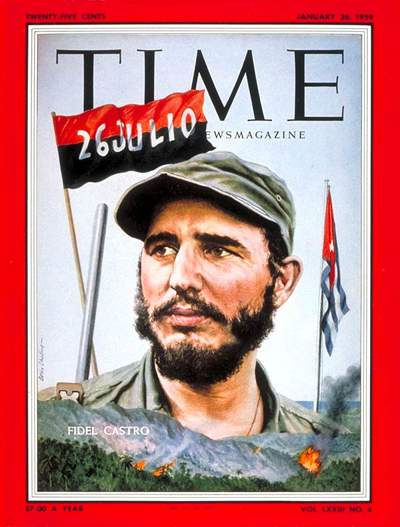
In the American press (which I read voraciously even at tender age of 11 or 12) adulation for the Cuban revolution went on pretty much unabated until USA caught Soviet Union installing missiles on the island, most probably in late 1960 or early 1961. By September, Congress would ban aid to any country that had relations with Cuba.
Later, in early 1962, a family friend and former neighbor, Art Lundahl, discovered nuclear missile-sites and submarine bases under construction during analyses of CIA high-altitude photos. (The British “knighted” Lundahl in 1974 for his discoveries as well as contributions from prior conflicts.)
After these unsettling disclosures, our leaders felt betrayed by Castro, to say the least. President Kennedy in April 1961 permitted CIA to drag USA into the fiasco of the Bay of Pigs invasion. When it backfired — USSR reacted with more military-aid, not less, including 42,000 soldiers, 42 MIG fighters, 42 bombers and, yes, nuclear missiles — the stage was set for the ensuing nightmare of October 1962, now called the Cuban Missile Crisis.
After a couple of nervous (some would say terrifying) weeks — during which Cuba shot down one of our high-tech spy planes — the Soviets offered to remove their nuclear missiles from Cuba if USA removed theirs from Turkey, a country close to Russia. We agreed.
It’s a good thing, because we learned later that operational nuclear weapons had already been deployed on the island — weapons we knew nothing about. According to historian Richard Rhodes, three-megaton hydrogen bombs mounted on SS-4 missiles hid in Cuba’s tropical forests. The missiles when fired could reach Washington D.C and obliterate it. The missiles we photographed were not yet operational, which gave our leaders false confidence.
A preemptive military attack by USA on Cuba would have precipitated nuclear war with the Soviets, according to former Defense Secretary William Perry, who operated a high-tech listening post during the crisis.
Because of anti-Castro hysteria developing in right-wing political circles, government officials told the public only that the Soviet Union and Cuba capitulated to our demands after we promised not to attack them. Full details of the quid-pro-quo weren’t released until years later.
The crisis ended, but both Kennedy and Russian leader Khrushchev did not survive the aftermath. Khrushchev fell from power in a kind of coup by Communist Party leaders on the third anniversary of the missile-crisis. He became depressed and died in 1971 of a heart attack.
Lee Harvey Oswald, former employee of US intelligence, assassinated Kennedy in 1963, almost exactly one year after the crisis and almost exactly two years before Khrushchev fell from power. Within two years of Kennedy’s assassination and coincident with Khrushchev’s fall, Cuba formally adopted Communism.


In those days, magazines like Time, Newsweek and US News and World Report were main sources of in-depth news and analysis for most civilians. It was a time when electronic calculators, computers, IPads, IPhones, and Internet services did not yet exist.
Television news was little more than fifteen minutes of reading headlines interrupted by a few commercials. Half-hour news programs didn’t start until the fall of 1963 — just a few weeks before the Kennedy assassination. Newspapers were important, but many of the best reporters worked for the three newsmagazines, which shared huge readership by today’s standards.
These magazines ran adoring pictures of Cuba’s revolutionary heroes alongside in-depth analyses of all they did and were accomplishing, both before and after 1959. Our country’s pervasive print-media seemed fascinated by the idea of common people overthrowing an invincible dictator tied to alleged gangsters.
This fascination continued for almost two years until day of April 17, 1961, when Americans woke to learn that Cuban exiles who lived in the United States had launched an invasion of their former country to overthrow Fidel Castro. Within days, Castro captured 1200 exiles. He led the Cuban defenders himself. Almost instantly, USA media turned on Fidel and began condemning Cuba’s revolution.

The invasion came as a shock to the general public. No one knew at the time CIA had organized it. No one could understand why Cuban exiles would attack their own country in what was clearly a suicide mission — at least that is what the Bay of Pigs would have become had Castro not shown restraint.
Few civilians outside of government knew then that Castro was in the process of aligning himself with a Communist super-power, the Soviet Union, with whom we were then fighting a vigorous cold war. Apparently, Castro and his advisors felt that in the contest between USA and USSR — where they found themselves toyed-with like a chess-game pawn — USSR was the lesser of two evils.
I remember reading articles in Time magazine about Fidel and feeling thrilled people like him truly walked the earth who weren’t afraid to stand up to gangs we learned years later to call the Mafia and to all those other evil-monopoly-types who corrupted popularly elected governments.
The press in the United States covered Castro and Guevara in much the same way they covered, a few years later, the Beatles during the British Invasion of 1964. I found myself seduced by the good guys verses bad guys dichotomy described in the popular press.
Of course, everything changed after Mr. Lundahl discovered that the new Cuban government was in bed with our nemesis, the Soviet Union. Even today, people forget that Cuba did not become Communist until 1965, three years after the Cuban Missile Crisis. American civilians had no idea that the USSR was trying to get a toehold in the western hemisphere through a military alliance with the Florida-sized island.

As soon as Americans saw photos of missile silos (or whatever those blurry images were that appeared ominously in Time and Life magazine in the fall of 1962), the honeymoon was over. Whatever good-will remained between Americans and Cubans after the Bay of Pigs now officially ended.
Overnight, in the eyes of our media, Cuban heroes became reckless peasants who were in-over-their-heads and playing-with-fire as they entertained what were apparently their Russian suitors, mentors, and friends.
During the missile crisis, from a military base on the island of Key West, my dad shadowed Russian subs.
Navy helicopter squadron HS-1 (de-activated in 1997) was tasked to maintain surveillance on nuclear-armed Russian submarines swarming the Florida Keys. I remember Dad scattering helicopters & other assets around the islands in our area to better protect them from nuclear strikes he believed might actually come.
I remember the military ordering everyone in Key West to fill bathtubs with drinking water and take other precautions to avoid catastrophe should the Russians shut-off our supplies. In those days all fresh-water came through a small above-ground pipe which ran alongside the only highway through the Florida Keys.
Should Soviets cut both water and highway to isolate Key West from the mainland, at least we would have bathtubs of water to drink some folks thought.
Well, everyone knows, the crisis resolved. Neither side fired nuclear missiles.
[ In 1989, the Soviets revealed (and U.S. intelligence confirmed) that 24 locked and loaded nuclear missiles were already installed on the island of Cuba, which America knew nothing about according to historian Richard Rhodes. Had the USA attacked Cuba, advocated by some advisors, a nuclear exchange would have destroyed Florida and much of Southern United States — perhaps reaching even the nation’s capital. The Editors ]
The elites in both USSR and USA sobered some, thankfully, and endeavored to tighten stewardship over these horrific weapons. We haven’t had a nuclear close call (at least any known to the public) since.
What about Cuba?
The United States imposed a naval blockade around the island during the missile-crisis. Under international law, a blockade is considered an act of war, so President Kennedy referred to it as a quarantine.
After it ended, USA resumed the embargo first established in 1960 in response to oil-refinery confiscations. This embargo, with modifications, persists to the present. More about the embargo later.
Meanwhile, within a few years, USA interjected itself into the Vietnam civil war where our French friends and their South Vietnamese allies were suffering a catastrophic defeat at the hands of President Ho Chi Minh and General Giap, charismatic leaders of the North.
United States conducted intensive military operations for eight years in Vietnam before abandoning the South to certain defeat in 1972.
To provide soldiers for this war, a military draft of hundreds-of-thousands of civilians began in the middle 1960s. Young people, especially students, got upset — livid, really.
By the time I started college, a few acquaintances were traveling to Cuba to train in the art of revolution. They went to learn how to challenge and transform the beast in whose belly they thought they lived.
What did the revolutionary leaders of Cuba teach them?
It turns out, Cubans taught them how to work hard to plant and harvest sugarcane. The vanguard told them that no one in a country as wealthy as the United States was going to revolt so why waste their time?
They said that working hard for the benefit of all, not the few, was the way to build a fair and just society. They taught service to society through hard work and good example; they advised students not to take all they could manage to pile-up for their effort but only their fair share to avoid humiliating those weaker and less able than themselves. They advised American visitors to share their wealth instead of sequestering and hoarding it.

Some of my friends were disappointed by the attitude of the Cubans, which they hadn’t expected. But others internalized what they learned and became better for it.
As mentioned earlier, the United States, after the missile-crisis, imposed an embargo that has lasted to the present day. Over the next fifteen years USA sharpened the teeth of its embargo and ratcheted up a covert program of sabotage and assassination to destabilize the island.
By 1975, the draconian features of the embargo were damaging not only Cuba but other countries and a number of international corporations. In 1976 a rogue CIA operative broke the final straw by blowing up Cuban Airways flight 455 killing all seventy-three passengers on board, including elite athletes. It was the first terrorist bombing of a civilian aircraft in our hemisphere.
The harsh conditions of the embargo might have forced the Cubans to their knees, but lobbying by the international community convinced Congress to tinker with the embargo details to make them more humane. Congress made changes to the embargo that enabled Cuba’s survival and ascendancy.
One exemption was permission for the Cubans themselves to buy food and medical supplies. Blocked from selling cigars, agricultural products, and everything else they made to the countries of the Western hemisphere and virtually the entire industrialized-world outside the Soviet-bloc, Cubans decided to enter the medical business.
Leveraging their freedom to buy food and medicine, Cubans opened medical universities and started graduating doctors as fast as they could. They invited students around the world to attend their medical schools. Cuba sent doctors on missions of mercy to needy countries in South America, Africa and anywhere else they were welcome.
Then AIDs broke out, in 1981. A few years later, in 1995, Ebola struck big in the African Congo. Cuban doctors found themselves on the front lines fighting diseases that really scared people.
People began to take notice. Famous people like CNN‘s Ted Turner, Chrysler’s chief executive, Lee Iacocca, and South Africa’s Nelson Mandela made pilgrimages to Cuba to meet its leaders and to spend time hunting and fishing with its dynamic president, Fidel Castro.

Influential people began to show concern for the people of Cuba, because Cubans chose to travel the humanitarian road of healing when other routes were blocked by the embargo and the efforts by the United States to shun and isolate them. To show respect and appreciation, leaders in countries around the world, some in Europe and the affluent West, decided to ignore the USA-led embargo and once again trade with Cuba.
Worried about Cuba’s growing prestige, the United States decided to undermine Cuban medical assistance to other countries by passing a 2006 law to grant automatic citizenship to any Cuban doctor who practices medicine outside Cuba and is able to find their way to one of its embassies.
Cuba’s response since 2006 has been to offer medical training to 30,000 students from 125 countries around the world — who aren’t covered by the act of Congress — even as they continue to add to their own legions of medical professionals.
In the spirit of the adage, when you can’t beat ’em, join ’em, about a thousand Cuban doctors have left foreign service during the past ten years to come to the United States, where they aren’t needed. Sadly, hospitals and licensing agencies inside the USA have been slow to recognize their credentials, according to the New York Times.
Most have taken jobs outside of medicine to keep themselves afloat while they hope for better days. In any event, the effect of the effort by Congress to undermine the Cuban world-healthcare delivery program, though annoying, has been largely unsuccessful.
Despite relentless programs by the USA to thwart everything Cuban, the island — with assistance from the civilized world — has begun to blossom. Today it is blooming into a splay of color and opportunity even the United States cannot ignore.
One indicator is its HDI (Human Development Index) rating, which has risen to 81.5%. Cuba is now in third place behind Canada and the USA in the Western Hemisphere. It stands 44th among the 187 countries on the HDI list; all this improvement in the face of a ruthless 54-year embargo by the United States and its allies.

A princess is emerging onto the world stage, and many countries seem to want to dance with her. The United States, her abuser — the country who told all the others to hate, forsake, and despise her — has found itself the odd-man out.
And the money! The money to be made is enormous. Our elites don’t want to miss the boat. They don’t want the choo-choo train of opportunity to leave them standing at the station, hat in hand.
They plead with princess Cuba. Let’s pretend the past is over and let bygones be bygones. No hard feelings, they insist. Can we visit from time to time?
They bat their lashes and bow their heads. They upturn their eyes and fill them with crocodile tears. They whisper seductively. They implore with outstretched hands.
Do you mind? We’ll build family-friendly casinos on your best beaches. It will be like old times — just the two of us, once more and forever.
Billy Lee
Post Script: The Cuban Revolution was a complex and drawn-out affair. To help readers better understand its twists, turns, detours, course-corrections, intrigues, betrayals, successes and failures, Billy Lee has, as usual, provided links to some good articles. For readers who may want to learn more about modern-day Cuba from someone who travels there, Billy Lee has provided this link. The Editorial Board.

I learned quite a bit of history from this fascinating article. Thanks so much for sharing.
Very informative article. Thanks for sharing.