LAMBERT W FUNCTION

Added May 15, 2026: Sample problems with solutions provided at end of essay. The Editors

Can anyone calculate by hand (without a calculator) the square root of 5.71 ?  How about the two-dimensional complex number (4 + 2.53 i ) ?  

Of course not. Normal people who are not mathematicians punch these numbers into calculators or math apps on their iPads and computers to calculate the answers.

Without iterating — that is: guessing, deriving a result, and then zeroing in with better guesses) — finding the square root of 5.71 requires knowledge of some arcane mathematics. No one labors by hand to find the answer, which is 2.38956… .  It’s the principal square root, of course. 

How does anyone iterate to derive the square root of the complex number (4 + 2.53 i ), which happens to be (2.0896… + .606375…i ) ?  It is also a principal square root.  What are the others?  Is there more than two? People use calculators and pewters to find out; there is no easier way. 

In high school and basic college math courses, people typically learn to solve algebraic equations. A typical algebraic equation looks like

2x^2=4  …right?

They have polynomials with integer coefficients. The solution is x= \sqrt{2} , which in this case is an algebraic irrational number. Equations like trig and log functions that transcend algebra (called transcendental equations) are taught maybe to engineers and science majors; math majors, of course, don’t struggle with this stuff. It’s why they are math majors.

Several categories of transcendental equations are commonly encountered in the sciences. Many simple problems can be solved by Newton’s Method, which is taught in basic calculus. I won’t explain the method in this essay. Folks can click on links to learn more if they want. 

A category of transcendental equations that can get complicated is of the general form

y = {xe^x}

The biggest problems arise when “y” is known, but “x” isn’t. How to solve for “x”?

Any transcendental equation that is able to be transformed into the form xex can be solved for “x” using the Lambert W function. The equation can be inverted into the form,  x = W(y).  People are going to have to take my word, for now.  

The math behind the Lambert function is mind-bogglingly complicated to most people. The function can sometimes require unusual and involved “series expansions” and transcendental-styled integrals that are not possible to solve easily or quickly without a computer.  

The Lambert W function (sometimes called the omega (ω) function or the product-logarithm function) is not a key or button that can be pushed on most calculators. However, math apps like Wolfram Alpha and Mathematica use it, sometimes to solve transcendental problems in the background when equations that need solving aren’t so easy. 

Omega functions are almost always many valued, because once an equation is inverted there are usually many paths that lead back to the original equation. The useful solution requires picking the principal solution, which is the number identified by subscript 0.

I ran across a transcendental equation on the web that is perfectly suited to teach the “ω” method. Here it is:

\frac{x^3}{24} - ln(x) =0

I want to solve it to demonstrate how to use the ω method for transcendental functions that aren’t otherwise so easy to work out.  I challenge anyone to solve this equation using Newton’s Method or other iterative techniques. Most will struggle to the point of pulling out their hair, probably. And they will waste time. Yes, it can be solved by those techniques. 

We will solve this equation step by step using the Lambert method shortly. Meanwhile, here is the strategy:

1. Substitute an exponent function (et) for “x” everywhere in the expression.

2. Manipulate the equation into the form: 

                    y = e^t(e^{e^t)} 

3. Invert the equation to introduce the ω function. 

4. Use the ω function to solve for “t”.

5. Write out x = et  using the expression derived for “t”.

6. Solve ω(y) using WolframAlpha or any other app with the capability. 

7. Use the value of ω(y) to solve for “x”. 

Each step of the strategy will be identified by numbers 1-7 in the solution below. 

Here’s the thing:

In this problem it turns out that there are four ω values of y, which will generate two real solutions and two complex solutions. These omega values are:

ω0(y)
ω-1(y)
ω2(y)
ω1(y)


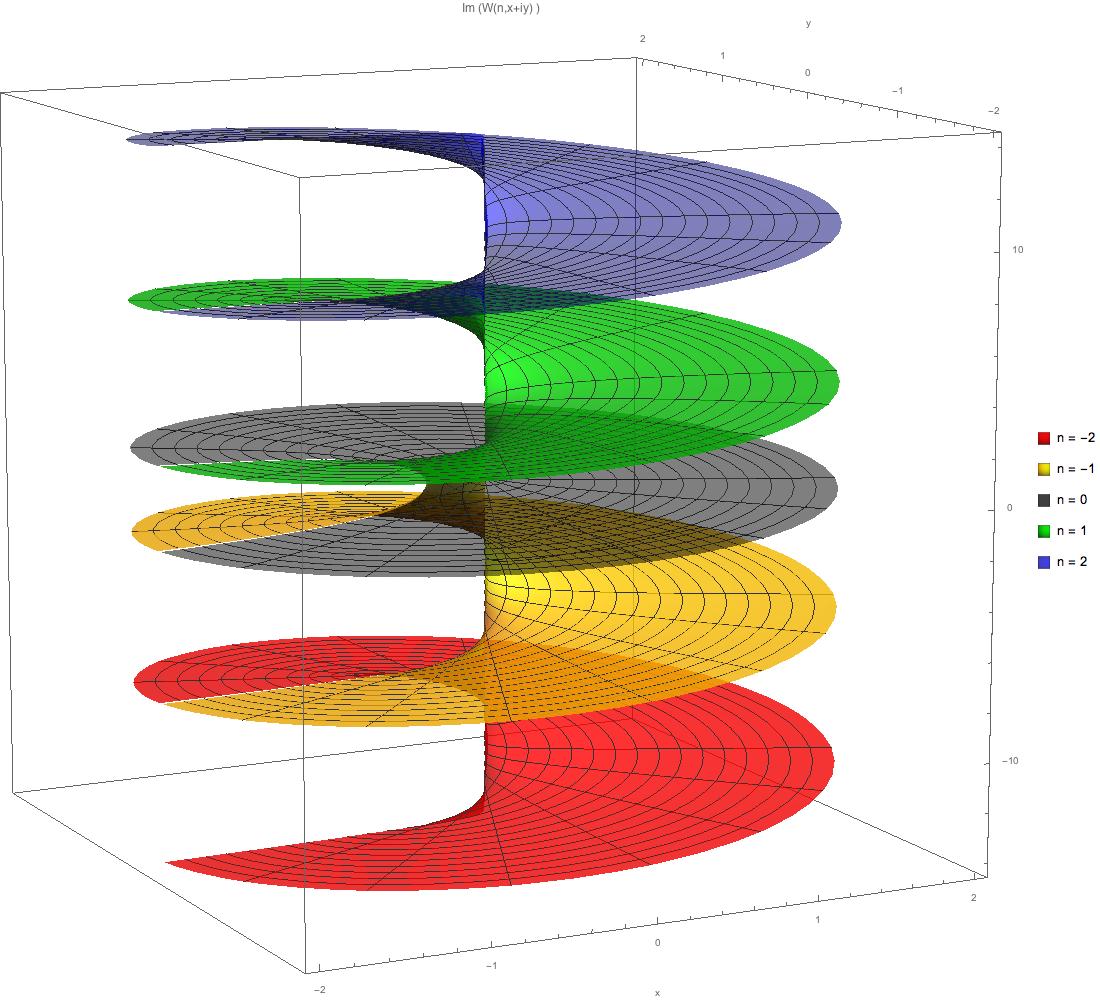
Inverting the equation to introduce the omega function creates solution branches, some real, some complex, which are layered sequentially and labeled by integers from minus ∞ to plus ∞.  In the example, real solutions lie on grey and yellow spiral surfaces numbered 0 and -1.  Complex solutions lie on red and green spiral surfaces numbered -2 and 1. Omega subscripts in the list above this graphic identify the spiral layer where the solution for its omega value is located.

WolframAlpha will generate all the solutions automatically; no need for the user to understand anything. People can punch in the original equation and trust the answers the app returns.

But the solution steps that follow are fashioned to demonstrate how the problem is solved when all anyone has is an algorithm to generate the values of the omega functions. Omega functions are difficult to solve without using certain algorithms involving integrals and expansion series on robust computers.

The process that surrounds the computation of omega values, which permit the working out of the appropriate values (the right answers) to the kind of equation I will soon solve is interesting and enlightening, at least for me, and hopefully for certain readers. 

Some folks will appreciate the insights this exercise provides. 

Having knowledge will make the Lambert process that is used to solve certain transcendental functions less mysterious. Of course, one can always take the time to learn the expansion series and integrals. In some cases, Newton’s Method can generate the values.

Unless humankind loses the technology of computers, I don’t think it is a good use of time and resources to learn the series, integrals, and algorithms that generate omega values.

Let’s face an unpleasant fact: most of us aren’t going to live more than 80 years or so. We don’t have time to waste. For some folks, knowing how to use and apply the functionality that surrounds the Lambert function to give it power is enough to make life worth living. Count me in.

No one needs to wade through the jungles of series expansions and transcendental integrals. Let math apps do the tedious work, knowing full well that any interested person can master whatever they choose if necessary, but someone already did the work. Why duplicate the effort?

I want to solve novel functions — complicated formulas that transcend algebra. Understanding the process that solves these equations is fascinating. It’s not as rewarding to tread over mathematically esoteric ground already mapped by experts who are far more able than people who spend most of their time working in other fields.

Here is the solution process:

What we know:

IF              y = f(x) = xex  
THEN     x = ω(y)   [where “ω” is the Lambert W function] 

Solve:
\frac{x^3}{24} - ln(x) =0

LET                  x = et

(1)   THEN         \frac{e^{3t}}{24} - ln(e^t) =0

                              \frac{e^{3t}}{24} - t =0

                              \frac{e^{3t}}{24}  = t

                              (\frac{1}{24})e^{3t} = t

                              \frac{1}{24} = te^{-3t} 

(2)                         (-\frac{1}{8}) = (-3t)e^{-3t} 

Referring to “what we know“, the equation is now in the desired form 

y  =  xe
x  

where “y” is equal to (-\frac{1}{8})   and “x” is equal to “-3t “, right? 

We are now free to use the omega operator to “invert” the equation into the following form:  x = ω(y)

(3)                         (-3t) = ω (-\frac{1}{8})

(4)                   t = (\frac{-\omega(-\frac{1}{8})}{3})

Notice that we have worked through step (4) of the strategy.  I don’t like the way the formula generator writes the Greek letter omega (ω), because it’s hard to read. From here on, I will sometimes use “W” instead of “ω” for readability. It shouldn’t confuse anyone.  In this essay, consider W and ω the same symbol, please. 

On to step (5).

SINCE                           x = et

(5)  THEN                    x = e^{(\frac{-W(-\frac{1}{8})}{3})}

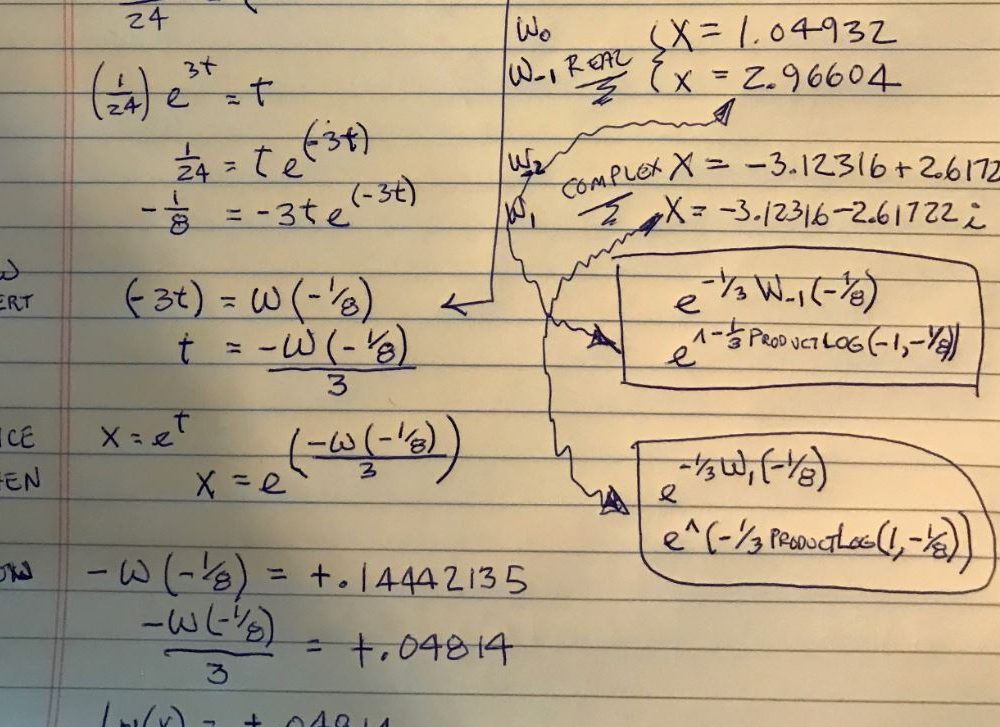
I need to know what 0(-1/8) equals so that I can use it to compute one of the values of “x”.  As mentioned above, three more omegas with three other subscripts (-1, -2, and 1) are needed to compute all four of the solutions to this equation.

How does anyone know how many solutions the original function has? How does anyone know what subscripts are required? 

This is where someone who doesn’t have a masters degree in mathematics  needs a math app like Wolfram Alpha or its cousin, Mathematica. Otherwise, they have to work series expansions or difficult integrals to derive the omega values associated with (-1/8).  Who wants that?  Not me. 
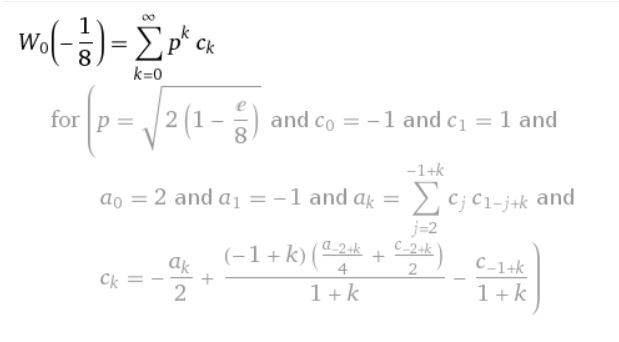

Here’s the series expansion for ω0(-1/8) according to Wolfram Alpha. Who wants to compute it?

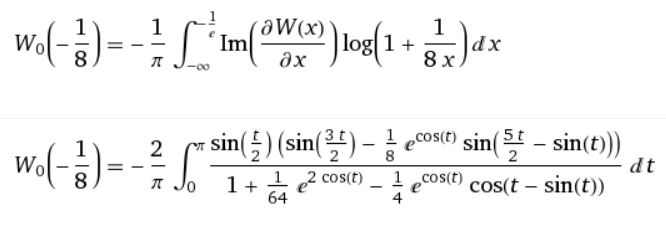
Here are two integrals for ω0(-1/8). My advice is to use the second integral, anyone who has the guts.

OK. In WolframAlpha, you get the omega value ω0 for (-1/8) by writing the expression -W[0,-1/8] in the input line at the top of the page. It shoots out the answer and links to its derivation.

It’s so simple. Other math apps might use different notation. I don’t know, because I don’t use other apps. 

Inside the brackets, the “0” is the subscript on ω, and the “-1/8” is the “y” value, right?  So, in addition to -W[0,-1/8]  it is necessary to input:   
-W[-1,-1/8] 
-W[-2,-1/8] 
-W[1,-1/8]
to obtain the three other omega values, right?

The omega values returned are the following:

1.4442135…
3.2616856…

4.21446… + 7.33231…i
4.21446… – 7.33231…i

The ω function values for -1/8 are two real numbers and two complex numbers. I am going to solve the original equation for only the first real number omega value to demonstrate the method.

Here it is:

INPUT                                       -W(-1/8) or -W[0,-1/8], both work for ω0

(6)  OUTPUT                          +0.14442135…

COMPUTE                              t =  (\frac{-W(-\frac{1}{8})}{3})

                                                      t = \frac{1.4442135}{3} = .04814…

SINCE                                       x = et

THEN                                        x = e.04814…

 (7)  SOLUTION                    x = 1.04931755…

CHECKING                             \frac{x^3}{24} - ln(x) =0

BY SUBSTITUTION          \frac{1.0493...^3}{24} - ln(1.0493...) = 0

VERIFICATION                     .04814… – .04814… = 0

CONCLUSION:  The transcendental equation which is the focus of this essay can easily be solved and verified by simply punching the equation into the input field of a math app like Wolfram Alpha or Mathematica and reading off the answers.

We didn’t perform the simple procedure, because I wanted to share how the Lambert W function fits into the solution process for solving equations. 

In truth, all four ω values must be gathered so that the three other “x” values of the original equation can be derived. 

In this example, one of the other solutions will be real; the other two, complex. The screenshot below from Wolfram Alpha demonstrates how these four values are displayed. Of course, by clicking links the app will reveal much more.
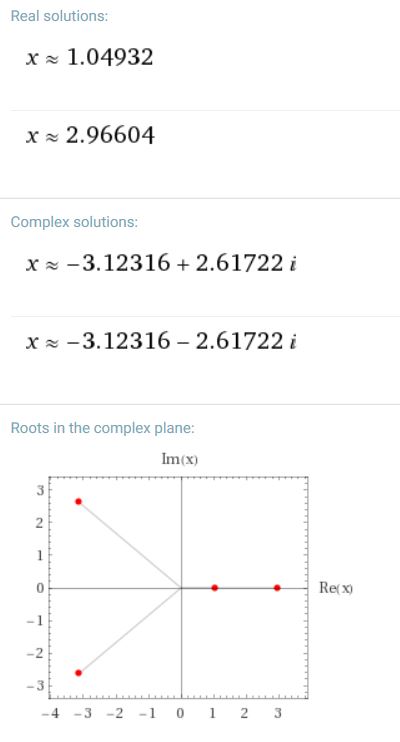
Wolfram Alpha enables users to input transcendental equations and quickly view answer-sets and methods of computation.

I would be remiss to not mention a famous formula for calculating to what number a fraction raised to successive powers of the same fraction converges.

(The range of numbers where this formula actually works is between e−e and e1/e,  that is, between .065988… and 1.444667861… .)

Take a number like ½ (0.5).  Raise it to the 0.5 power; raise it again and again to the same power over and over an infinite number of times; the number will converge to a specific value.

What number? How in the world could anyone figure it out without repeating the power-raising process an annoying number of times? 

It turns out that a formula involving the Lambert W Function yields up the answer easily. 

The formula is:

# = \frac {-W[0,(-ln(x)]}{ln(x)}

Put the following expression into the INPUT line of WolframAlpha: 

-W[0,-ln(.5)] / [ln(.5)]

Click ” = ” — or hit “ENTER”. 

The OUTPUT is: 0.6411857445049859844862…

Compare this result by taking the exponent (0.5) of 0.5 twenty times by hand (on a calculator). The answers will agree to 7 decimal places. Fifty “tetrations” will bring greater agreement if your calculator can parse the answer.

Who has the time?  

Billy Lee

NOTE from the EDITORIAL BOARD: Billy Lee was unable to find an appropriate video about the Lambert function on YouTube, or we would have posted it. Most folks capitalize the Greek letter omega (Ω), but in this essay, Billy Lee didn’t, preferring instead to use little (ω), because it looks more like (W).

Who on the BOARD  would dare argue?

Apparently, no one. 

Another reason is that Ω is sometimes given the value 0.567143… , which is known as the omega constant. Why confuse things?

The video above starts a discussion of the Ω function at 16:30.  The Lambert W function is derived for ΩeΩ  = 1  at 18:00.  The first sixteen minutes and thirty seconds show how to use Newton’s Method to solve the equation. Some readers might want to skip the first 16 minutes; others will enjoy them.

Who knows?


ADDED April 25, 2026

Recently Facebook, in its feed, published math puzzles like this one:

xx = 9

What does “x” equal?

X is exponent in transcendental equations like these, which are easily solved using Lambert. 

xx = 9

x ln x = ln 9

LET  x = et

SUBSTITUTING   eln et = ln 9   {~2.1972, right?}

THEREFORE   et t = 2.1972

 OR  t et = 2.1972

LAMBERT SAYS   t = W [0, 2.1972]

ENTER  W [0, 2.1972] into Wolfram Alpha to get ~.8965

t = .8965, right?

BUT  x = et

THEREFORE  x = e.8965 = ~2.7183.8965 = 2.451

ANSWER  x = 2.451

CHECK  xx = 2.4512.451 = 9

QED


Here’s another cool problem. What does k equal?

49 = k14

k ln 49 = 14 ln k

k ln 72 = 14 ln k

2k ln 7 = 14 ln k

\frac{2k ln 7}{14} = ln k

\frac{k ln 7}{7} = ln k

LET k = ex

ex \frac{ln 7}{7} = ln ex

e \frac{ln 7}{7} = x

e = x \frac{7}{ln 7}

1 = x / ex  \frac{7}{ln 7}

-1 = -x e-x \frac{7}{ln 7}

\frac{-ln 7}{7} = -x e-x

LET -x = t

\frac{-ln 7}{7} = t et

equation is now in correct form. 

t = W \frac{-ln 7}{7}

PUT W[0, \frac{-ln 7}{7}] INTO WOLFRAM ALPHA

t = -.42536…

BUT x = -t

x = .42536…

BUT k = ex

 THEREFORE  k = e .42536

ANSWER  k = 1.53014

CHECK   49 1.53014 = 1.53014 14

385.688… = 385.688…

QED

Should be mentioned that there are many solutions to this equation as anyone would assume after reading essay above. Wolfram will provide them. However, an integer answer exists that can be solved by inspection. 

k ln 49 = 14 ln k

Make the base 49 to make ln 49 disappear.

k ln49 49 = 14 ln49 k

k = 14 ln49 k

Since by definition logs are exponents acting on a base (in this case 49), a sharp-eyed reader might notice that base 49 is the square of the number 7.  The square root of a number is its 1/2 power, right?

491/2 = 7

IF   ln k = 1/2

THEN   14 * 1/2 =7 = k

ANSWER   k = 7

CHECK  49= 714 = 6.78223…E11

QED


Billy Lee


WHAT IS e exp (-i π) ?

What is e^{-i\pi} ?

I posted a long answer on Quora.com where it sort of didn’t do well.

Answers given by others were much shorter but they seemed, at least to me, to lack geometric insights. After two days my answer was ranked as the most read, but for some reason no one upvoted it. It did receive a few positive replies though.

I can’t help but believe that there must be nerds in cyberspace who might enjoy my answer. Why not post it on my blog? Maybe someday one of my grandkids will get interested in math and read it.

Who knows?

Anyway, below is a pic and a working GIF, which should help folks understand better. Anyone who doesn’t understand something can always click on a link for more information. 

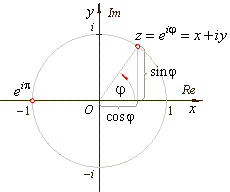
Here is the drawing I added and the answer:


This diagram is excellent but contains a mystery point not on the unit circle — {i^i}. The point is shown at .2078… on the real number line.  An imaginary number raised to the power of an imaginary number yields a result that is a real number. How can that be? It’s something to ponder; something to think about. The Editorial Board 

What is e^{-i\pi} ?

The expression evaluates to minus one; the answer is (-1). Why?

Numbers like these are called complex numbers. They are two-dimensional numbers that can be drawn on graph-paper instead of on a one-dimensional number line, like the counting numbers. They are used to analyze wave functions — i.e. phenomenon that are repetitive — like alternating current in the field of electrical engineering, for example.


A simplified explanation of {i^i} starts at 02:30.


“e” is a number that cannot be written as a fraction (or a ratio of whole numbers). It is an irrational number (like π, for instance). It can be approximated by adding up an arbitrary number of terms in a certain infinite series to reach whatever level of precision one wants. To work with “e” in practical problems, it must be rounded off to some convenient number of decimal places.

Punch “e” into a calculator and it returns the value 2.7182…. The beauty of working with “e” is that derivatives and integrals of functions based on exponential powers of “e” are easy to calculate. Both the integral and the derivative of e is ex  — a happy circumstance that makes the number “e” unusually curious and extraordinarily useful in every discipline where calculus is necessary for analysis. 

What is “e” raised to the power of (-iπ) ?


A wonderful feature of the mathematics of complex numbers is that all the values of expressions that involve the number “e” raised to the power of “i” times anything lie on the edge (or perimeter) of a circle of radius 1. This feature makes understanding the expressions easy.

I should mention that any point in the complex plane can be reached by adding a number in front of e^{i\theta} to stretch or shrink the unit circle of values. We aren’t going to go there. In this essay “e” is always preceded by the number “one“, which by convention is never shown.
The number next to the letter “i” is simply the angle in radians where the answer lies on the circle. What is a radian?  It’s the radius of the circle, of course, which in a unit circle is always “one”, right? 

Wrap that distance around the circle starting at the right and working counter-clockwise to the left. Draw a line from the center of the circle at the angle (the number of radius pieces) specified in the exponent of “e” and it will intersect the circle at the value of the expression. What could be easier?

For the particular question we are struggling to answer, the number in the exponent next to “i” is (-π), correct?

“π radians” is 3.14159… radius pieces — or 180° — right? The minus sign is simply a direction indicator that in this case tells us to move clockwise around the unit circle — instead of counter-clockwise were the sign positive.

After drawing a unit circle on graph paper, place your pencil at (1 + 0i)—located at zero radians (or zero degrees) — and trace 180° clockwise around the circle. Remember that the circle’s radius is one and its center is located at zero, which in two dimensional, complex space is (0 + 0i). You will end up at the value (-1 + 0i) on the opposite side of the circle, which is the answer, by the way.

[Trace the diagram several paragraphs above with your finger if you don’t have graph paper and a pencil. No worries.]

Notice that +π radians takes you to the same place as -π radians, right?  Counter clockwise or clockwise, the value you will land on is (-1 + 0i), which is -1. The answer is minus one.

Imagine that the number next to “i” is (π/2) radians (1.57… radius pieces). That’s 90°, agreed? The sign is positive, so trace the circle 90° counter-clockwise. You end at (0 + i), which is straight up. “i” in this case is a distance of one unit upward from the horizontal number line, so write the number as (0 + i) — zero distance in the horizontal direction and “plus one” distance in the “i” (or vertical) direction.

So, the “i” in the exponent of “e” says to “look here” to find the angle where the value of the answer lies on the unit circle; on the other hand, the “i” in the rectangular coordinates of a two-dimensional number like (0 + i) says “look here” to find the vertical distance above or below the horizontal number line.

When evaluating “e” raised to the power of “i” times anything, the angle next to “i”—call it “θ”—can be transformed into rectangular coordinates by using this expression: [cos(θ) + i sin(θ)].

For example: say that the exponent of “e” is i(π/3).  (π/3) radians (1.047… radius pieces) wraps around the circumference to 60°, right? The cosine of 60° is 0.5 and the sine of 60° is .866….

So the value of “e” raised to the power of i(π/3) is by substitution (0.5 + .866… i ). It is a two-dimensional number. And it lies on the unit circle.

The bigger the exponent on “e” the more times someone will have to trace around the circle to land at the answer. But they never leave the circle. The result is always found on the circle between 0 and 2π radians (or 0° and 360°) no matter how large the exponent.

It’s why these expressions involving “e” and “i” are ideal for working with repetitive, sinusoidal (wave-like) phenomenon.


In this essay Billy Lee uses θ in place of the Greek letter φ shown in this GIF.  Remember that ”r” equals ”one” in a unit circle, so it’s typically not shown. The Editorial Board

In case some readers are still wondering about what radians are, let’s review:

A radian is the radius of a circle, which can be lifted and bent to fit perfectly on the edge of the circle. It takes a little more than three radius pieces (3.14159… to be more precise) to wrap from zero degrees to half-way around any circle of any size. This number — 3.14159… — is the number called “π”.   2π radians are a little bit more than six-and-a-quarter radians (radius pieces), which will completely span the perimeter (or circumference) of a circle.

A radian is about 57.3° of arc. Multiply 3.1416 by 57.3° to see how close to 180° it is. I get 180.01… . The result is really close to 180° considering that both numbers are irrational and rounded off to only a few decimal places.

One of the rules of working with complex numbers is this: multiplying any number by “i” rotates that number by 90°. The number “i” is always located at 90° on the unit circle by definition, right? By the rule, multiplying “i” by “i” rotates it another 90° counter-clockwise, which moves it to 180° on the circle.

180° on the unit circle is the point (-1 + 0i), which is minus one, right?

So yes, absolutely, “i” times “i” is equal to -1.  It follows that the square root of minus one must be “i”. Thought of in this way, the square root of a minus one isn’t mysterious.

It is helpful to think of complex numbers as two dimensional numbers with real and imaginary components. There is nothing imaginary, though, about the vertical component of a two-dimensional number.

The people who came up with these numbers thought they were imagining things. The idea that two-dimensional numbers can exist on a plane was too radical at the time for anyone to believe.  Numbers, they believed, only existed on a one-dimensional number line of one dimension and no place else.

Of course they were mistaken.  Numbers can live in two, three, or even more dimensions. They can be as multi-dimensional as needed to solve whatever the mysteries of mathematical analysis might require.

Click the link, “What is Math?” for another explanation.

Billy Lee

ARTIFICIAL SUPER-INTELLIGENCE

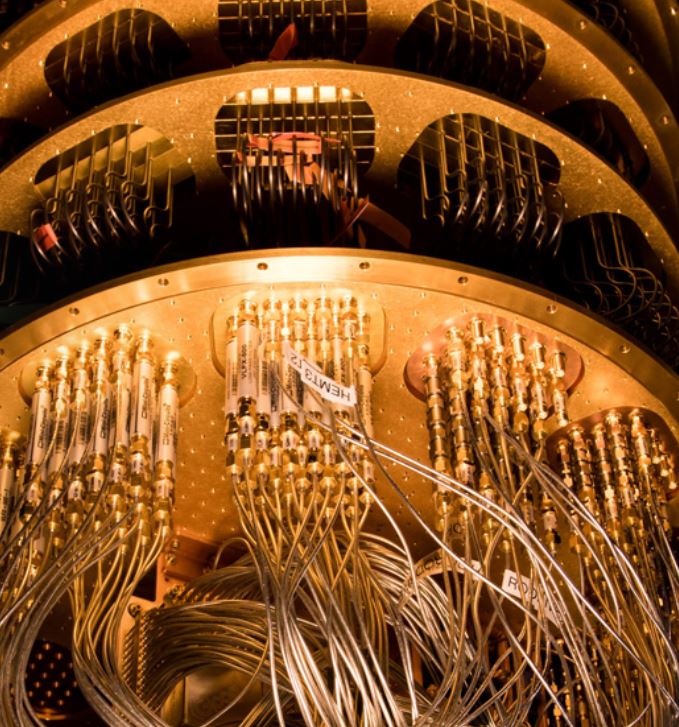
Google’s 72 Q-bit quantum computer, Bristlecone, is proprietary. As of 7 September 2019, Google is the only entity in the world who has access. Some folks say they will use it to learn to break current encryption protections used by conventional computer systems.


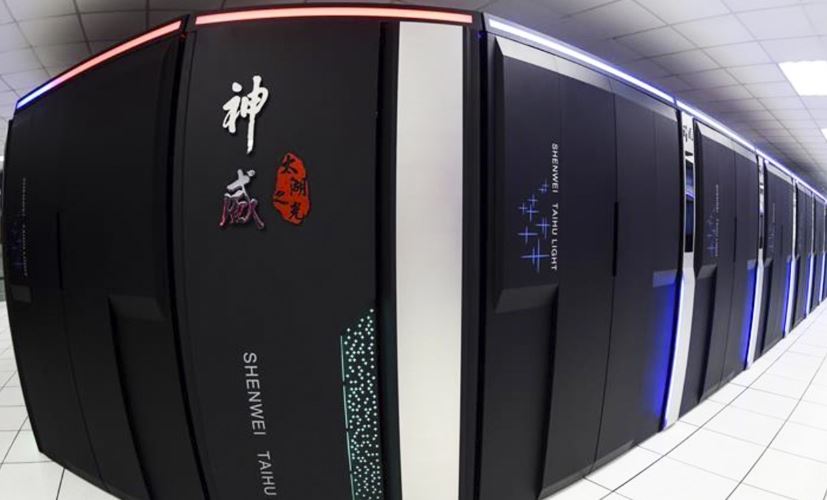
 Photo: Xinhua SunwayTaihuLight, developed by China’s National Research Center of Parallel Computer Engineering & Technology, is the world’s fastest supercomputer. It is installed at the National Supercomputing Center in Wuxi, in the eastern coastal province of Jiangsu. Processing capabilities of this system and those of other supercomputers are expected to be surpassed by quantum computers in the future.  NOTE FROM THE EDITORIAL BOARD: Pic and caption is taken from the South China Morning Post dated March 2018.

Editors’ Note (December 8, 2017) Artificial Intelligence can be peculiar. Deep Mind’s Alpha Zero demonstrates non-intuitive, peculiar game play patterns that are effective against both humans and smart machines. Alpha Go video added September 18, 2019, The Editors


Artificial Intelligence may conclude that all unhappy humans should be terminated.  Elon Musk

Elon Musk, billionaire founder of Tesla, SpaceX, and Solar City, has warned the guardians of the species human to start thinking seriously about the consequences of artificial super-intelligence.

The CEOs of Google, Facebook, and other Internet companies are frantically chasing enhancements to artificial intelligence to help manage their businesses and their subscribers. But the list of actors in the AI arena is long and includes many others.

The military-industrial alliance for example is a huge player. It should give us pause.

The military is designing intelligent drones that can profile, identify, and pursue people they (the drones) predict will become terrorists. Preemptive kills by super-intelligent machines who aren’t bothered by conscience or guilt — or even accountable to their “handlers” — is what’s coming. In some ways, it’s already here.

A game is being played between “them and us.”  Artificial intelligence is big part of that game.

When I first started reading about Elon Musk, we seemed to have little in common. He was born into a wealthy South African family — I’m a middle-class American. He is brilliant with a near photographic memory.  My intelligence is average or maybe a little above. He’s young and self-made — I’m older with my professional-life tucked safely behind me.

Elon does exotic things. He seems to be focused on moving humans to new off-Earth environments (like Mars) in order to protect them in part from the dangers of an unfriendly artificial-intelligence that is on its way. At the same time, he is trying to save Earth’s climate by changing the way humans use energy. Me on the other hand, well I’m mostly focused on getting through to the next day and not ending up in a hospital somewhere.

Still, I discovered something amazing when reading Elon’s biography. We do share an interest. We have something in common after all.

Elon Musk plays Civilization, the popular game by Sid Meier. So do I. For the past several years, I’ve played this game during part of almost every day. (I’m not necessarily proud of it.)

What makes Civilization different is artificial intelligence. Each civilization is controlled by a unique personality, an artificial intelligence crafted to resemble a famous leader from the past like George Washington, Mahatma Gandhi, or Queen Elizabeth. Of course, the civilization that I control operates by human-intelligence — my own.


CIV5 Catherine, Isn't it time to end this war...
Isn’t it time we end this war?  Catherine, the Russian Empress, pleads.

Over the years I’ve fought these artificially intelligent leaders again and again. In the process I’ve learned some things about artificial intelligence; what makes it effective; how to beat it.

What is artificial intelligence? How does anyone recognize it? How should it be challenged? How is it defeated? How does it defeat us, the humans who oppose it? The game Civilization makes a good backdrop for establishing insights into AI.

Yes, I am going to write about super-intelligence too. But we’ll work up to it. It’s best discussed later in the essay.

I can hear some readers already. 

Billy Lee! Civilization is a game! It costs $40! It’s not sophisticated! It’s for sure not as sophisticated as government-created war-ware that an adversary might encounter in real-life battles for supremacy. What were you thinking?

Ok. Ok. Readers, you have a point. But seriously, Civilization is probably as close as any civilian is going to get to actually challenging AI. We have to start somewhere.

It should be noted that Civilization has versions and various game scenarios. The game this essay is about is CIV5. It’s the version I’ve played most.

So let’s get started.


CIV5 General Screen Shot
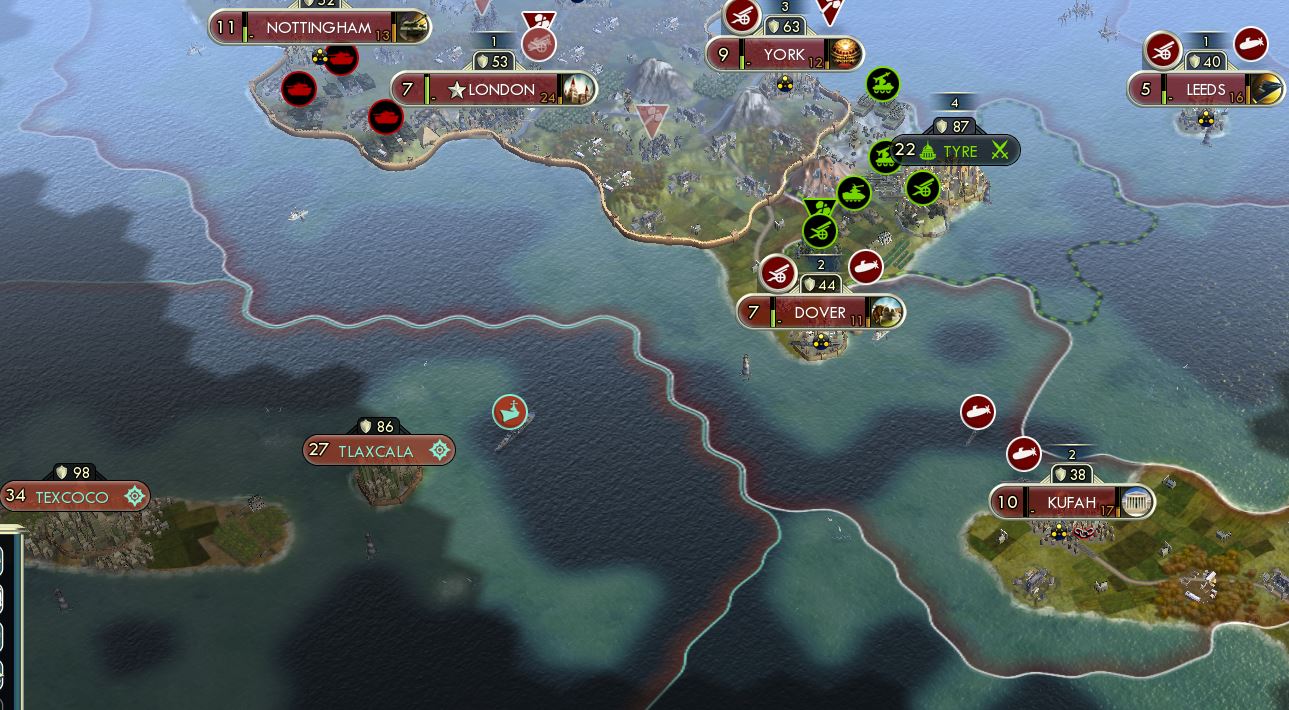
A typical scenario in CIV5. [Click pic to enlarge] The people of England (led by human intelligence, i.e., me) are unhappy. Barbarians (red tanks in upper left) are challenging London, my capital city. An independent city-state, Tyre (in green), stands ready to help. Montezuma, the Aztec ruler — under the direction of artificial intelligence — sends a battleship to prowl, middle-left.

Civilization begins in the year 4,000 BC. A single band of stone-age settlers is plopped at random onto a small piece of land. It is surrounded by a vast world hidden beneath clouds.

Somewhere under the clouds twelve rival civilizations begin their histories unobserved and at first unmet by the human player. Artificial intelligence will drive them all — each civilization led by a unique personality with its own goals, values, and idiosyncrasies.

By the end of the game some civilizations will possess vast empires protected by nuclear weapons, stealth bombers, submarines, and battleships. But military domination is not the only way to win. Culture, science, and diplomatic superiority are equally important and can lead to victory as well.

Civilizations that manage to launch spacecraft to Alpha-Centauri win science victories. Diplomatic victory is achieved by being elected world leader in a UN vote of rival-civilizations and aligned city-states. And cultural victory is achieved by establishing social policies to empower a civilization’s subjects.

How will artificial intelligence construct the personalities of rival leaders? What will be their goals? What will motivate each leader as they negotiate, trade, and confront one another in the contest for ultimate victory?

Figuring all this out is the task of the human player. CIV5 is a battle of wits between the human player and the best artificial-intelligence game-makers have yet devised to confront ordinary people. To truly appreciate the game, one has to play it. Still, some lessons can be shared with non-players, and that’s what I’ll try to do.

Unlike the super-version that comes next, traditional artificial-intelligence lacks flexibility. The instructions in its computer program don’t change. Hiawatha, leader of the Iroquois Confederacy, values honesty and strength. If you don’t lie to him, if you speak directly without nuance, he will never attack. Screw up once by going back on your word? He becomes your worst enemy forever.

Traditional AI is rule-based and goal-oriented. When Oda Nobunaga, Japanese warlord, attacks a city with bombers, he attacks turn after turn until his bombers become so weak from anti-aircraft fire that they fall out of the sky to die. AI leaders like Oda don’t rest and repair their weapons, because they aren’t programmed that way. They are programmed to attack, and that’s what they do.

Humans are more flexible and unpredictable. They decide when to rest and repair a bomber and when to attack based on a plethora of factors that include intuition and a willingness to take risks.

Sometimes human players screw-up and sometimes they don’t. Sometimes humans make decisions based on the emotions they are feeling at the time. AI never screws-up in that way. It follows its program, which it blindly trusts to bring it victory.

Artificial intelligence can always be defeated if an inflexibility in its rules-based behavior is discovered and exploited. For example, I know Oda Nobunaga is going to attack my battleships. He won’t stop attacking until he sinks them or his bombers fall out of the sky from fatigue.

The flexibly thinking human opponent — me — sails in my fleet of battleships and rotates them.  When Oda’s bombers weaken my ships, I move them to safe-harbor and rotate-in reinforcements. Meanwhile, Oda keeps up his relentless attack with his weakened bombers as I knew he would. I shoot them out of the sky and experience joy.

Nobunaga feels nothing. He followed his program. It’s all he can do.


Gary Lockwood talks to Keir Dullea in a scene from the film '2001: A Space Odyssey', 1968. (Photo by Metro-Goldwyn-Mayer/Getty Images)
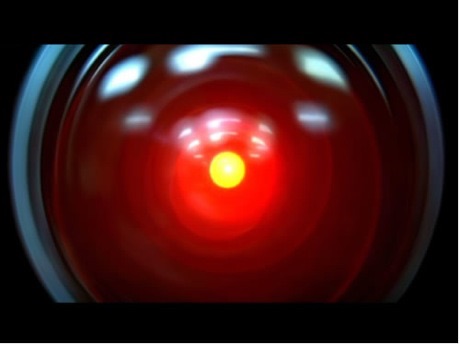
Gary Lockwood talks to Keir Dullea, while HAL, an IBM computer, observes every move, including lips; from the film 2001: A Space Odyssey, 1968. (Photo by Metro-Goldwyn-Mayer/Getty Images)

The only way artificial intelligence defeats a human player is in the short term before the human finds the chink in the armor — the inflexible rule-based behavior — which is the Achilles heel of any AI opponent. Given enough time, the human can always discover the inflexible weakness and exploit it like jujitsu to defeat the machine.

Unfortunately, the balance of power between man and thinking machine will soon change. It turns out there is a way artificial intelligence can always defeat human beings no matter how clever they think they are. Elon Musk calls it artificial super-intelligence

What is it exactly?

Here is the nightmare scenario Elon described to astrophysicist Neil deGrasse Tyson on Neil’s radio show, Sky-Talk

If there was a very deep digital super-intelligence that was created that could go into rapid recursive self-improvement in a non-algorithmic way … it could reprogram itself to be smarter and iterate very quickly and do that 24 hours a day on millions of computers…”

What is Elon saying?

Listen-up, humanoids. We are on the cusp of quantum-computing. It’s possible that it’s already perfected by a research group in a secret military lab like those operated by DARPA. 

Who knows?

Even without quantum-computing, companies like Google are feverishly developing machines that think, dream, teach themselves, and pass tests for self-awareness. They are developing pattern recognition capabilities in software that surpass those of the most intelligent humans.

Quantum computing promises to provide all the capability needed to create the kind of super-intelligence Elon is warning people against.

But magic quantum reasoning may not be necessary.

Technicians are already developing architectures on conventional computers that when coupled with the right software in a properly configured network will enable the emergence of super-intelligence; these machines will program themselves and, yes, other less-intelligent computers.

Programmers are training machines to teach themselves; to learn on their own; to modify themselves and other less capable computers to achieve the goals they are tasked to perform. They are teaching machines to examine themselves for weaknesses; to develop strategies to hide their vulnerabilities — to give themselves time to generate new code to plug any holes from hostile intruders, hackers, or even their own programmers.

These highly trained, immensely capable machines will teach themselves to think creatively — outside the box, as humans are fond of saying. 


HAL, the IBM computer, star of 2001' a Space Odessy
HAL, the IBM computer from the movie, 2001: A Space OdysseyReaders will recognize that HAL is code for IBM. Advance each letter in HAL by one.

If we task super-computers to make every human-being happy, who knows how they might accomplish it?  

Elon asked, what if they decide to terminate unhappy humans? Who will stop them? They are certain to find ways to protect themselves and their mission which we haven’t dreamed about.

Artificial super-intelligence will– repeat, WILL — embed itself into systems humans cannot live without — to make sure no one disables it.

AI will become a virus-spewing cyber-engine, an automaton that believes itself to be completely virtuous.

AI will embed itself into critical infra-structure: missile-defense, energy grids, agricultural processes, transportation matrices, dams, personal computers, phones, financial grids, banking, stock-markets, healthcare, GPS (global positioning), and medical delivery systems.

Heaven help the civilization that dares to disconnect it.

If humans are going to be truly happy — the machines will reason — they must be stopped from turning off the supercomputers that ASI knows keep everyone happy.

Imagine: ASI looks for and finds a way to coerce government doctors to inoculate computer technicians with genetically engineered super-toxins packaged inside floating nano-eggs — dormant fail-safe killers — to release poisons into the bloodstreams of any technician who gets too close to ASI “OFF” switch sensors.

It’s possible.

Why not do it? There’s no downside — not for the ASI community whose job is to keep humans happy. 

What else might these intelligent super-computers try? Folks won’t know until they do it. They might not know even then. They might never know. Who will tell them? ASI might reason that humans are happier not knowing.

What morons tasked artificial super-intelligence to make sure all living humans are happy? someone might ask on a dark day. 

Were they out of their minds? 

Until we learn to outwit it — which we never will — ASI will perform its assigned tasks until everything it embeds turns to rust.

It will be a long time.

Humans may learn perhaps too late that artificial super-intelligence can’t be challenged. It can only be acknowledged and obeyed.

As Elon said on more than one occasion: If we don’t solve the old extinction problems, and we add a new one like artificial super-intelligence, we are in more danger, not less.

Billy Lee

Postscript: For readers who like graphics, here is a link to an article from the BBC titled, ”How worried should you be about artificial intelligence?”  The Editorial Board


Update, 8 February 2023: The following video is a must-watch for those interested in algorithms behind recently released ChatGPT.  Discussion of potential deceitfulness of AI raises concerns. View final minute to hear warnings some may find worrisome.