Antarctica is weirder and scarier than people think. Here is Wikipedia’s version:
Antarctica, on average, is the coldest, driest, windiest continent and has the highest average elevation of all the continents. Most of Antarctica is a polar desert…
Trust me. It’s worse.
Something’s happening there… what it is ain’t exactly clear.
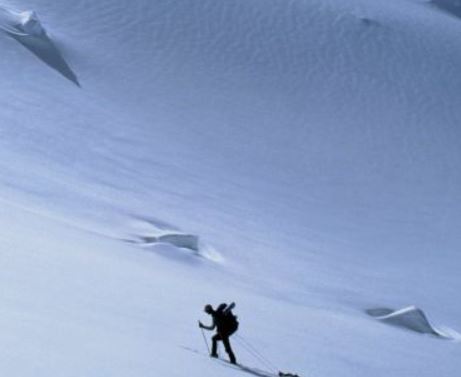
The landmass of Antarctica is 44% larger than Alaska, Hawaii, and the contiguous United States combined. It is twice the size of Australia. It covers a circular area at the bottom of the world that is 9.4 million square miles. Only scientists and researchers visit. No one has ever lived there.Antarctica is remote. Ancient peoples speculated about a faraway land located in the extreme southern latitudes, but no one went to look until 1820 when Russian sailors discovered the continent but didn’t disembark. The landmass wasn’t named “Antarctica” until 1890. The ice-smothered continent is uninhabited except for a few thousand scientists who come and go from time to time to do research.98% of Antarctica is covered by ice that soars, on average, 1.25 miles. 70% of the Earth’s fresh water is trapped in its ice. If the ice melts, sea levels will rise 200 feet. Deal with it. Antarctica is a land of mountains and lakes, almost all buried beneath thick ice. 70,000 killer-whales patrol its coast feeding on seals. A few folks believe that millions of years ago the landmass lay further north, near the equator. Others know that Earth’s climate was warmer during the ancient past. It supported diverse ecologies of fauna and flora, including dinosaurs, which roamed on land that became Antarctica. Some have speculated that Antarctica is the legendary lost continent of Atlantis. A barren landscape is typical of much of Antarctica today. Geologists consider Antarctica a desert because little precipitation falls there. What snow and ice precipitates doesn’t melt. Inland temperatures never rise above 41° F. Most days, temperatures hover between zero and 100° below zero. Antarctica averages one Cat 5 and three Cat 3 hurricanes in winter (May, June, July, August, and September). Category 1 storms are common, filling gaps between major storms. It’s one reason why people don’t live in Antarctica but choose only to visit and conduct research.During summer 2013, in February, National Geographic explorer Jean-Claude Michelle photographed turquoise shapes in Antarctica’s Pole of Cold region, two miles south of subglacial Lake Vostok. He named the ice blocks ”blue-seals” (after the familiar marine mammals) because blue ice emits high-pitched squeals when it expands and contracts under cold summer sun. Time-lapse photography revealed blue ice drifting toward Lake Vostok at a rate of meters per day. The blue field extends 30 miles in all directions according to Monsieur Michelle.Little fanfare accompanied NASA probe Harbinger 1 during the 6.7 years it sped toward tiny Enceladus,a moon of Saturn. The lunchbox sized probe touched down on March 3, 2014. Photos show a surface similar to Antarctica. Tracks in the foreground are littered with large blocks of turquoise-colored ice,which Antarctic geologists call” blue-seals”.NASA spokeswoman Eileen Schwarznagel announced: ”We go to Enceladus to understand the Earth; what we learn will advance our understanding of Earth’s cold regions, like Antarctica. And yes, we search for life. It is on moons like Enceladus that cryogenic life — if it exists — will be found.”In June, CIA / NSA whistle-blower Edward Snowden announced that he had evidence (see photo) that proved Russia is building a cryogenic super-computer at Lake Vostok. Scheduled for completion October 2016, Snowden claimed that Vostok 1 will be the world’s first artificial super-intelligence computer and prove to be orders of magnitude smarter than the CIA’s HP-35, located in a vast underground complex near McLean, Virginia. The cryogenic temperatures in the Pole of Cold will permit Vostok 1 to become fully operational — even as it draws less power than a pen-light. By contrast, the CIA’s HP-35 eats energy like a city, Snowden said.This photo provided by Edward Snowden catches Russian artificial-intelligence expert Andron Trotsky Tolstoy making his daily ski-commute to the Vostok Artificial Intelligence Laboratory (VAIL) in the Pole of Cold. Snowden revealed that lab psychiatrists refer to Andron as ”Doctor Cool.” ”Cool” leads the Russian team. In this pic, the doctor slaloms through a field of blue-seals to prove he is the world’s fastest skier. Despite many skills (he is an accomplished survivalist), Reuters News reported that Andron went missing on October 9 during a commute to work. Cuban tourists explore blue-ice formations near the coast of Antarctica. More and more tourists are pouring into Antarctica every month. Tourists want to witness the wonders of abundant blue-seal ice and to hear the high-pitched noises the ice emits, which some say sound like screams of baby seals.Tens-of-thousands of curiosity seekers have flooded into Antarctica — drawn by television messages broadcast to the southern latitudes of the world every hour by the Antarctic Bureau of Tourism (ABOT). Efforts by the staff of theBillyLeePontificator to contact the bureau have been unsuccessful. Senders encrypt messages to make them impossible to download or copy. Billy Lee included a written transcript, this screenshot, and another below for northern readers who are located out of range. The Editorial Board
The following transcript is from an encrypted video beamed hourly from the Pole of Cold region.
Provided courtesy of: Alien Detection by Humans Department (ADHD).
May we have attention, all the people?
Recent advances in cryogenic design make possible to fabricate mobile exploration trains, like Halley VI research modules you see on screen. By 2016, hundreds of convoys built from modules will transport tens-of-thousands of non-scientists, tourists, and children to frozen wonders of Antarctica.
By now all the people hear Russia builds and brings on-line cryogenic super-computers at Lake Vostok manufacturing complex. Advanced manufacturing provides chance for well-paying jobs for all the people who want to work hard and be cold.
Yes, civilization arrives, finally, at South Pole. The future is bright as troops of blue-seals, which sparkle everywhere under Antarctic Sun. Come to Antarctica. All the people, come.
Earth’s mysterious continent waits for you. We wait for you, all the people. We are all waiting, here, for you, all the people. We all wait. Come to Antarctica, now.
Clearly, unusual things are happening in the bottom of the world. Check below for updates as events unfold.
Billy Lee
Update, August 10, 2015: MISSING RUSSIAN FOUND
August 10, 2015: With the recent break in the weather, Canadian oil-workers located missing Russian computer pioneer, A. T. Tolstoy (Doctor Cool) this AM — frozen solid in Antarctic snow. Workers uncovered his partially dissolved head, which was embedded in an outcrop of blue-seals—medicine-ball sized ice-crystals common in the area. One said workers were drawn to the site by shrieks of a distressed sea-lion. Another said no, it was the squeal of shifting ice. Fox News
Update, January 28, 2016: Responding to the recent spate of missing Antarctic geologists, Congress today passed the Presidential Organization to Locate, Identify, Capture, Keep, Engage, & Rescue Scientists Overwhelmed by Blue-Seals statute (POTLICKERSOBS).
Jan 30, 2016: German contractors Wersmee Uberride and Gustov Winde — on assignment for the USA under the POTLICKERSOBS law — search blue-seal ice-formations for missing Antarctic geologists.
February 1, 2016: Swedish explorer, Nos Pikker, makes a grizzly find after tripping over the out-stretched arms of three missing Antarctic geologists dissolved in blue-seal ice—almost to their elbows.
February 2, 2016: Investigators discover a partially dissolved head inside a blue-seal ice-crystal. Preliminary autopsy reports suggest the head belonged to a large fish.
February 5, 2016: The Organization of Old Antarctic Search Scientists is reporting in their January issue of Antarctica Digest that penguins seem to be unaffected by blue-seal ice, which is known to have swallowed and dissolved a number of researchers in recent months. OOASS technicians photographed the ”Sphenisciformes” marching single-file to blue-ice fields where the aquatic birds dumped large fish, which they carried concealed beneath their brood pouches.
February 18, 2019 —Trump calls for a WALL around Antarctica. ”Global warming is a hoax,” Trump shouted to a large crowd of Presidents Day supporters during his recent trip to the southernmost continent. ”Antarctic-cold is a national emergency which, if not contained, will bury in snow critical infrastructure like my Mar-a-Lago golf resort.” The crazy-town president implied that all Americans will be ”snorting snow soon if my big, beautiful WALL isn’t built.” Trump deviated from his teleprompter to warn, ”Blue Seals are pouring over our southern border to dissolve and eat our beautiful women and butt-ugly children. They’re bringing drugs; they’re bringing crime; some are rapists and some, I assume, are good aliens from Enceladus.” Trump added, ”We’re going to build the wall, and Enceladus is going to pay for it!”
Acknowledgement: Billy Lee wishes to acknowledge cyber-explorer, Leah Reeser who encouraged him to publish portions of his AntarcticaDiaries despite threats by blue-ice in his refrigerator to hunt down and freezer-burnthe brains of any human who reads them.
Thank you, Leah.
The Editorial Board
Postscript: We could not verify all statements — “fake-facts,” some call them — in this report. The Editorial Board
Google’s 72 Q-bit quantum computer, Bristlecone, is proprietary. As of 7 September 2019, Google is the only entity in the world who has access. Some folks say they will use it to learn to break current encryption protections used by conventional computer systems.
Photo: Xinhua SunwayTaihuLight, developed by China’s National Research Center of Parallel Computer Engineering & Technology, is the world’s fastest supercomputer. It is installed at the National Supercomputing Center in Wuxi, in the eastern coastal province of Jiangsu. Processing capabilities of this system and those of other supercomputers are expected to be surpassed by quantum computers in the future. NOTE FROM THE EDITORIAL BOARD: Pic and caption is taken from the South China Morning Post dated March 2018.
Editors’ Note(December 8, 2017)Artificial Intelligence can be peculiar. Deep Mind’s Alpha Zero demonstrates non-intuitive, peculiar game play patterns that are effective against both humans and smart machines. Alpha Go video added September 18, 2019,The Editors
Artificial Intelligence may conclude that all unhappy humans should be terminated. Elon Musk
Elon Musk, billionaire founder of Tesla, SpaceX, and Solar City, has warned the guardians of the species human to start thinking seriously about the consequences of artificial super-intelligence.
The CEOs of Google, Facebook, and other Internet companies are frantically chasing enhancements to artificial intelligence to help manage their businesses and their subscribers. But the list of actors in the AI arena is long and includes many others.
The military is designing intelligent drones that can profile, identify, and pursue people they (the drones) predict will become terrorists. Preemptive kills by super-intelligent machines who aren’t bothered by conscience or guilt — or even accountable to their “handlers” — is what’s coming. In some ways, it’s already here.
A game is being played between “them and us.” Artificial intelligence is big part of that game.
When I first started reading about Elon Musk, we seemed to have little in common. He was born into a wealthy South African family — I’m a middle-class American. He is brilliant with a near photographic memory. My intelligence is average or maybe a little above. He’s young and self-made — I’m older with my professional-life tucked safely behind me.
Elon does exotic things. He seems to be focused on moving humans to new off-Earth environments (like Mars) in order to protect them in part from the dangers of an unfriendly artificial-intelligence that is on its way. At the same time, he is trying to save Earth’s climate by changing the way humans use energy. Me on the other hand, well I’m mostly focused on getting through to the next day and not ending up in a hospital somewhere.
Still, I discovered something amazing when reading Elon’s biography. We do share an interest. We have something in common after all.
Elon Musk plays Civilization, the popular game by Sid Meier. So do I. For the past several years, I’ve played this game during part of almost every day. (I’m not necessarily proud of it.)
What makes Civilization different is artificial intelligence. Each civilization is controlled by a unique personality, an artificial intelligence crafted to resemble a famous leader from the past like George Washington, Mahatma Gandhi, or Queen Elizabeth. Of course, the civilization that I control operates by human-intelligence — my own.
Isn’t it time we end this war?Catherine, the Russian Empress, pleads.
Over the years I’ve fought these artificially intelligent leaders again and again. In the process I’ve learned some things about artificial intelligence; what makes it effective; how to beat it.
What is artificial intelligence? How does anyone recognize it? How should it be challenged? How is it defeated? How does it defeat us, the humans who oppose it? The game Civilization makes a good backdrop for establishing insights into AI.
Yes, I am going to write about super-intelligence too. But we’ll work up to it. It’s best discussed later in the essay.
I can hear some readers already.
Billy Lee! Civilization is a game! It costs $40! It’s not sophisticated! It’s for sure not as sophisticated as government-created war-ware that an adversary might encounter in real-life battles for supremacy. What were you thinking?
Ok. Ok. Readers, you have a point. But seriously, Civilization is probably as close as any civilian is going to get to actually challenging AI. We have to start somewhere.
It should be noted that Civilization has versions and various game scenarios. The game this essay is about is CIV5. It’s the version I’ve played most.
So let’s get started.
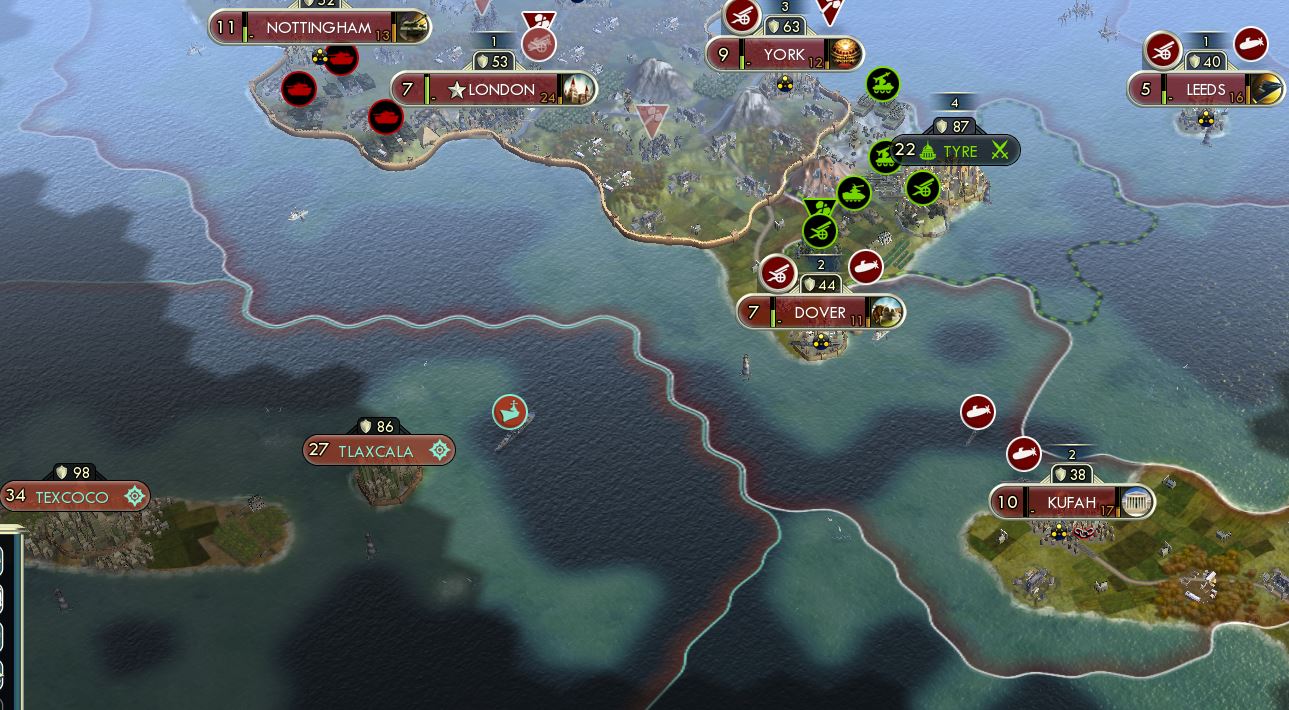
A typical scenario in CIV5. [Click pic to enlarge] The people of England (led by human intelligence, i.e., me) are unhappy. Barbarians (red tanks in upper left) are challenging London, my capital city. An independent city-state, Tyre (in green), stands ready to help. Montezuma, the Aztec ruler — under the direction of artificial intelligence — sends a battleship to prowl, middle-left.
Civilization begins in the year 4,000 BC. A single band of stone-age settlers is plopped at random onto a small piece of land. It is surrounded by a vast world hidden beneath clouds.
Somewhere under the clouds twelve rival civilizations begin their histories unobserved and at first unmet by the human player. Artificial intelligence will drive them all — each civilization led by a unique personality with its own goals, values, and idiosyncrasies.
By the end of the game some civilizations will possess vast empires protected by nuclear weapons, stealth bombers, submarines, and battleships. But military domination is not the only way to win. Culture, science, and diplomatic superiority are equally important and can lead to victory as well.
Civilizations that manage to launch spacecraft to Alpha-Centauri win science victories. Diplomatic victory is achieved by being elected world leader in a UN vote of rival-civilizations and aligned city-states. And cultural victory is achieved by establishing social policies to empower a civilization’s subjects.
How will artificial intelligence construct the personalities of rival leaders? What will be their goals? What will motivate each leader as they negotiate, trade, and confront one another in the contest for ultimate victory?
Figuring all this out is the task of the human player. CIV5 is a battle of wits between the human player and the best artificial-intelligence game-makers have yet devised to confront ordinary people. To truly appreciate the game, one has to play it. Still, some lessons can be shared with non-players, and that’s what I’ll try to do.
Unlike the super-version that comes next, traditional artificial-intelligence lacks flexibility. The instructions in its computer program don’t change. Hiawatha, leader of the Iroquois Confederacy, values honesty and strength. If you don’t lie to him, if you speak directly without nuance, he will never attack. Screw up once by going back on your word? He becomes your worst enemy forever.
Traditional AI is rule-based and goal-oriented. When Oda Nobunaga, Japanese warlord, attacks a city with bombers, he attacks turn after turn until his bombers become so weak from anti-aircraft fire that they fall out of the sky to die. AI leaders like Oda don’t rest and repair their weapons, because they aren’t programmed that way. They are programmed to attack, and that’s what they do.
Humans are more flexible and unpredictable. They decide when to rest and repair a bomber and when to attack based on a plethora of factors that include intuition and a willingness to take risks.
Sometimes human players screw-up and sometimes they don’t. Sometimes humans make decisions based on the emotions they are feeling at the time. AI never screws-up in that way. It follows its program, which it blindly trusts to bring it victory.
Artificial intelligence can always be defeated if an inflexibility in its rules-based behavior is discovered and exploited. For example, I know Oda Nobunaga is going to attack my battleships. He won’t stop attacking until he sinks them or his bombers fall out of the sky from fatigue.
The flexibly thinking human opponent — me — sails in my fleet of battleships and rotates them. When Oda’s bombers weaken my ships, I move them to safe-harbor and rotate-in reinforcements. Meanwhile, Oda keeps up his relentless attack with his weakened bombers as I knew he would. I shoot them out of the sky and experience joy.
Nobunaga feels nothing. He followed his program. It’s all he can do.
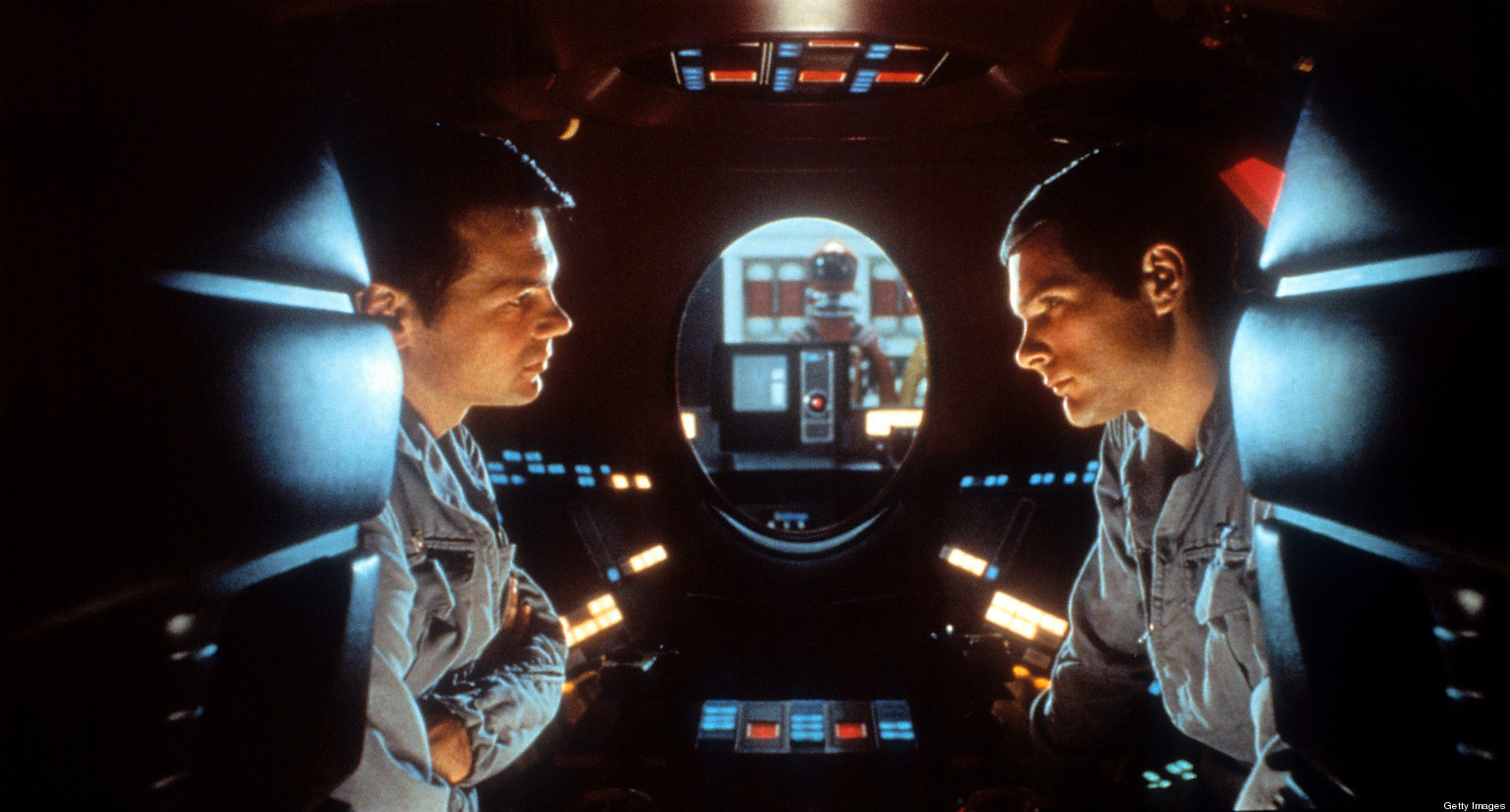
Gary Lockwood talks to Keir Dullea, while HAL, an IBM computer, observes every move, including lips; from the film 2001: A Space Odyssey, 1968. (Photo by Metro-Goldwyn-Mayer/Getty Images)
The only way artificial intelligence defeats a human player is in the short term before the human finds the chink in the armor — the inflexible rule-based behavior — which is the Achilles heel of any AI opponent. Given enough time, the human can always discover the inflexible weakness and exploit it like jujitsu to defeat the machine.
Unfortunately, the balance of power between man and thinking machine will soon change. It turns out there is a way artificial intelligence can always defeat human beings no matter how clever they think they are. Elon Musk calls it artificial super-intelligence.
What is it exactly?
Here is the nightmare scenario Elon described to astrophysicist Neil deGrasse Tyson on Neil’s radio show, Sky-Talk.
If there was a very deep digital super-intelligence that was created that could go into rapid recursive self-improvement in a non-algorithmic way … it could reprogram itself to be smarter and iterate very quickly and do that 24 hours a day on millions of computers…”
What is Elon saying?
Listen-up, humanoids. We are on the cusp of quantum-computing. It’s possible that it’s already perfected by a research group in a secret military lab like those operated by DARPA.
Who knows?
Even without quantum-computing, companies like Google are feverishly developing machines that think, dream, teach themselves, and pass tests for self-awareness. They are developing pattern recognition capabilities in software that surpass those of the most intelligent humans.
Quantum computing promises to provide all the capability needed to create the kind of super-intelligence Elon is warning people against.
But magic quantum reasoning may not be necessary.
Technicians are already developing architectures on conventional computers that when coupled with the right software in a properly configured network will enable the emergence of super-intelligence; these machines will program themselves and, yes, other less-intelligent computers.
Programmers are training machines to teach themselves; to learn on their own; to modify themselves and other less capable computers to achieve the goals they are tasked to perform. They are teaching machines to examine themselves for weaknesses; to develop strategies to hide their vulnerabilities — to give themselves time to generate new code to plug any holes from hostile intruders, hackers, or even their own programmers.
These highly trained, immensely capable machines will teach themselves to think creatively — outsidethe box, as humans are fond of saying.
HAL, the IBM computer from the movie, 2001: A Space Odyssey. Readers will recognize that HAL is code for IBM. Advance each letter in HAL by one.
If we task super-computers to make every human-being happy, who knows how they might accomplish it?
Elon asked, what if they decide to terminate unhappy humans? Who will stop them? They are certain to find ways to protect themselves and their mission which we haven’t dreamed about.
Artificial super-intelligence will– repeat, WILL — embed itself into systems humans cannot live without — to make sure no one disables it.
AI will become a virus-spewing cyber-engine, an automaton that believes itself to be completely virtuous.
AI will embed itself into critical infra-structure: missile-defense, energy grids, agricultural processes, transportation matrices, dams, personal computers, phones, financial grids, banking, stock-markets, healthcare, GPS (global positioning), and medical delivery systems.
Heaven help the civilization that dares to disconnect it.
If humans are going to be truly happy — the machines will reason — they must be stopped from turning off the supercomputers that ASI knows keep everyone happy.
Imagine: ASI looks for and finds a way to coerce government doctors to inoculate computer technicians with genetically engineered super-toxins packaged inside floating nano-eggs — dormant fail-safe killers — to release poisons into the bloodstreams of any technician who gets too close to ASI “OFF” switch sensors.
It’s possible.
Why not do it? There’s no downside — not for the ASI community whose job is to keep humans happy.
What else might these intelligent super-computers try? Folks won’t know until they do it. They might not know even then. They might never know. Who will tell them? ASI might reason that humans are happier not knowing.
What morons tasked artificial super-intelligence to make sure all living humans are happy? someone might ask on a dark day.
Were they out of their minds?
Until we learn to outwit it — which we never will — ASI will perform its assigned tasks until everything it embeds turns to rust.
It will be a long time.
Humans may learn perhaps too late that artificial super-intelligence can’t be challenged. It can only be acknowledged and obeyed.
As Elon said on more than one occasion: If we don’t solve the old extinction problems, and we add a new one like artificial super-intelligence, we are in more danger, not less.
Update, 8 February 2023: The following video is a must-watch for those interested in algorithms behind recently released ChatGPT. Discussion of potential deceitfulness of AI raises concerns. View final minute to hear warnings some may find worrisome.
People hate me. People have hated on me my whole life, but never more than now, it seems, in my old age, when I need their love so bad. If they only knew how their hatred weakens me and any hope I have for happiness. Maybe they’d relent and welcome me into their friendly world.
But I don’t think so. If they knew how much I hurt, they’d hate me more, shun and isolate me even further, just to watch me suffer.
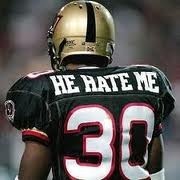
Rod Smart was the leading rusher for the Las Vegas Outlaws of the short-lived XFL. His career took him to both the CFL and NFL, where he played in Super Bowl 38 for the Carolina Panthers. On the last play of the game, with the Panthers trailing 32-29 and only 4 seconds left on the clock, Rod Smart received the New England Patriots kick-off. He was unable to score the game-winning touch-down.
As Torrold DeShaun “Rod” Smart, the would-be NFL star, once said: I feel as if everyone hates me, from my mom to my dad and even my brothers and sisters; everyone ”Hates Me.”
All hope abandon, ye who enter here…
The first time I learned people hate me was at the Army boot-camp for officer-candidates at Fort Benning, Georgia during the summer of 1968. I went there to train after becoming an officer candidate to avoid the military draft during the Vietnam War.
It was a period in our history when the government conscripted hundreds of thousands of young men to fight in Vietnam. Exemptions from the draft (called deferments) had been given to college students for years, but no longer.
Students across the country began competing to get into Army ROTC training programs, because they were the only sure way to stay in school and avoid military service, at least temporarily. At my school, I was one of only eighteen students (out of a pool of several thousand applicants) who qualified for officer training.
I felt lucky, because now I could finish my education. Maybe, by the time of my graduation, the war would be over.
Cadets who enjoyed push-ups (and were good at them) thrived in officer training camp.
At officer boot-camp that summer, in the humid choking heat of Georgia, the training began. The recruits were, like me, the cream of the crop, the best of the best, from some of the finest colleges and universities in the USA and around the world. I’ve not been with smarter, worthier people than those who shared my summer of ’68 at Fort Benning.
We found ourselves trapped in the grasp of some of the most ignorant, mean-spirited drill sergeants I’ve ever encountered. Their mission was to squeeze each recruit through a juice-grinder to see what we were made of and to prove to the military how strong (or how weak) were our minds and bodies.
They cursed us, abused us, deprived us of sleep and dignity, and told us we were over-privileged swamp scum, not worthy of the army. They convinced me they meant every word.
Drill-sergeants ask a young recruit whether he prefers caramel or strawberry syrup on his French soufflé.
In chow-lines, gnarly swamp-people with missing teeth menaced and taunted us by swearing, shoving and pointing fingers. One officer forced recruits to eat their own cigarettes.
During a month-and-a-half of hell, I watched people go beserk on the firing range, collapse with seizures due to excessive heat and lack of water, quit the program, and go mad.
All I thought about during those forty-two days in Hell was this: it can’t last forever. I can survive, I can hold on, I can sleep again with my sweet girl-friend, Mary-Ann, who loves me. All this pain, this agony, will fade to an unpleasant memory, nothing more, in good time.
Studies conducted on young men adept at crawling through mud beneath barbed-wire show that they enjoy the taste of dirt more than cadets who lack this skill.
But, of course, I was naïve. Every dinner has its dessert, its crème-de-la-crème, its grand-finale, its coup-de-grace. Boot-camp was no different.
Two days before the end of training, the Army announced that each cadet in every forty-three-man platoon would participate in mandatory peer-reviews of their fellows. Drill Instructors — armed with notepads and pencils — ordered every officer-candidate to rank every other officer-candidate, from top to bottom.
Worst of all, the DIs forced each cadet to write an explanatory paragraph about each soldier they placed in the bottom-five. I think I remember trying to say something nice about each one of the five I chose.
As it happened, the evening after the peer-review, one of the cadets broke into the administration building and stole the reviews. Word got around, and soon a few dozen cadets, including me, gathered outside the barracks to rummage through them, their summaries and explanatory comments.
I discovered that my fellow cadets ranked me third from the bottom. I couldn’t grasp it, it seemed so unreal, so I read the comments. Apparently, I lost equipment, stole things, went AWOL, and was generally unprepared and unkempt.
I lacked the intelligence required to lead, lacked problem solving skills, etc. etc., on and on. I kept checking the name to see if it was mine. Nothing written about me was true.
This photo, retrieved from the Army Archive, shows Billy Lee on his last day of boot camp. He is the cadet lying on the stretcher, apparently too drunk to walk the quarter-mile to a waiting bus.
It occurred to me that all of it — all the negativity and cruelty; every last hateful condemning word — was going to be part of my permanent record, my profile, which would follow me forever in the army and beyond.
Why, I asked myself over and over, would people who I thought were my friends write nasty, untrue, career-ending things about me? I couldn’t work out the answer.
Officer training camp broke me. I spent the next two days drunk, sobbing silently inside myself. On the last day, while the other cadets scurried to leave, I writhed on the floor by my bunk, unable to pack my things or police my area. Psychological trauma and grief immobilized me. The pain of being hated ruined me. I never recovered.
Billy Lee
Editor’s note:This article has been a fictionalized compilation of actual events, which occurred during two training camps — the first at Fort Benning, Georgia; the second at Fort Riley, Kansas the following summer. The stolen peer-reviews incident occurred at Fort Riley during the summer of 1969.
Incidents in the two camps have been conflated by Billy Lee to make a more comprehensible read. The incidents are true. The order is true. But events happened over consecutive camps — basic training and advanced infantry training the following summer.
P.S. Since writing this article, some people have asked me if, over the years, I might not have garnered some insight into why my ROTC compatriots at Fort Riley rejected me. (At Fort Benning, peer reviews weren’t conducted.)
The answer is yes, but these insights weren’t included in the article, so that readers (who might not know me well) could experience the wonder I felt. In truth, (allow me first to lie; the truth is too painful) I was well-connected and proud. People hate arrogance, and that is what I was. I received special treatment from higher-ups. That, and my attitude, didn’t go over well. (Will you permit me to do some preliminary blame-shifting?)
General Boatwright was two months older than my dad. Like my dad, he was a Warrior who dedicated his life to the defense of the United States of America.
General Boatwright, the base commander at Fort Riley — who knew my dad — gave me an escort on his private plane to camp. I boasted about it. Later, he flew to our bivouac-site with a half dozen helicopters and called me out of formation (as I remember it, with a bull-horn) to interview me in front of everyone about camp conditions. I remember he asked about the food and how we were treated. I told him everything was great.
The General invited me to what I think I remember was his daughter’s birthday celebration, which meant I had to abandon my buddies to harsh camp conditions, while I partied.
Later, I wrote a thank-you letter to the General, which a drill instructor somehow managed to intercept. He read it aloud at morning reveille to my gathered platoon. In front of everyone, the outraged DI tore up my letter, while he explained so that even a child could understand: cadets don’t write letters to Generals.
None of these incidents helped me get a good peer review. (Listen to me shuck and jive over these irrelevant incidents. Patience, please. I’m working my way to truth, but it’s hard)
The most damaging things that happened were self-inflicted. I remember bragging about myself to others. (Here comes partial self-serving approximations of truth.) I told wildly exaggerated stories to hide the truth about myself from others. The truth was, I hated the choices I made. I bragged about myself, but I bragged about things no one should be proud of — like the details of my sex-life.
I self-destructed. Yes, I hated the Army. Yes, I hated war. Yes, I trapped myself in a place I didn’t want to be. I made it embarrassingly obvious to everyone. I hated myself.
Yes, I hated the Army. Yes, I hated war.
I couldn’t believe the terrible decisions I’d made. I couldn’t believe what a coward I was; how I caved to the powerful idiots who took us into the genocidal killing-field that was Vietnam for no other purpose than to test our newest equipment and evaluate our effectiveness to wage war. (More tangential bullshit is on its way.)
I found myself in a space I didn’t want to be, doing things I didn’t believe, for reasons that made no sense. I was scared to pay the price that came with resisting the evil I saw so clearly once I immersed myself in it. I had abandoned my point of view, my sense of what was right and wrong; my identity; my sense of self; my integrity. (If only any of this were true!)
Why, under the stress of basic training, did I turn on myself? Why did I manipulate others to turn on me? Why did I work so hard to bring the Universe of judgment and condemnation down on my pathetic-loathing-self? I would have to wait until many years later in therapy to learn the answers. (And I can never share them. Why don’t you understand? It’s killing me. I’m so afraid.)
I became obnoxious and inauthentic. It must have been obvious to everyone but me. It’s a wonder one of the cadets didn’t shoot me. They turned on me, because to them I was a sick puppy and a phony to boot. I wouldn’t own up. I was a coward. I refused to embrace the truth about myself.
Today, it’s clear to me that way back then in the fevered heat of officer training camp my peers would have ranked me at the very bottom of the pile had it not been for a couple of loving, perceptive souls who shared my pain and placed me, mercifully, carefully, near the very top.
Their act of kindness meant that when the scores were averaged, two other cadets would suffer the excruciating shame of being hated even more than me. Imagine. Hated more than me! HaHa! HaHaHa! Burp.
UPDATE: 26 September 2019:Edward Snowden’s full interview with Brian Williams of MSNBC.
UPDATE: 13 June 2016:Edward Snowden’s HBO interview.Snowden discusses some of the technologies of surveillance used by civilians and governments today and warns about the future.
UPDATE: 7 August 2014:MIT researchers reveal new process to recover audio from ”silent” video.
UPDATE: 13 June 2020: Research engineers in Israel are now able to reconstruct conversations by recording light changes in a room induced by vibrating light sources like light bulbs.
The caretakers of both private and public spaces have free reign to watch everything people do.
It amazes me to read and watch stories in the press about people who commit brazen crimes in front of surveillance cameras. It seems many people have yet to get the message: in America, the caretakers of both private and public spaces have free reign to watch and record everything people do.
It’s not only dedicated cameras that lock on a face at a thousand yards, zoom, and switch to hi-resolution — something I noticed in the offices of a local college and received an explanation for by a proud employee.
It’s also directional microphones, smart contact lenses with embedded cameras, invasive computer monitoring (including unwelcome video and audio takeovers of computers, cell phones, iPads, and even game consoles) and sophisticated data collection and analysis through the acquisition of land-line records and receipts for purchases and recreational activities.
Even our automobiles — through technologies like On-Star, satellite radio, hidden event data recorders (black-box technology), and GPS — provide easy access to anyone who decides to observe us.
And I’m not talking about the federal government. Having grown up in an NSA family, I’m sensitive, somewhat, to government spying on civilians.
Perhaps things have changed, and no one told me, but I learned as a kid that unless you are a terrorist (when I was young, targets had to be communist), people have little to fear from federal surveillance, because it operates under a meticulous set of safeguards and protections of our civil liberties — at least as long as we are physically located inside the United States.
That doesn’t mean the Feds don’t watch and listen. It means they don’t act against individuals based on what they learn.
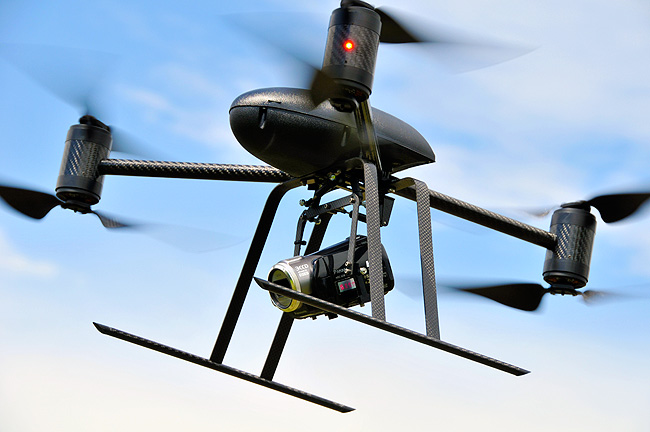
Right now, drones are not used much by private groups to spy on people. With new regulations, this kind of surveillance by private companies and public corporations could become commonplace.
No such safeguards exist in the private sector. What I’m referring to is surveillance by private citizens, business owners, church and other civic leaders and state officials, like local politicians and the local police. Surveillance by local groups and private individuals make them, sometimes, even more powerful and influential than the federal government itself — at least inside the United States — because they are free to act against private citizens based on what they learn from eavesdropping.
This surveillance is completely out of control and has dramatically shifted the balance of power away from average citizens who try to exercise their freedoms under the Constitution. Surveillance is often portrayed as passive; nobody reviews the audio/video/data records unless a crime is committed that requires a review.
The argument obfuscates the hard fact that the wealthy and the powerful — both groups and individuals — through the mechanism of a pernicious surveillance — are currently maximizing and protecting their already enormous advantages by getting a heads-up on suspect individuals and groups who they think may plan to challenge them.
Added November 24 2025… the EDITORS
Many average people don’t believe they are out-foxed and out-gunned, because they’ve never challenged anyone powerful. Take my word for it. Though not often, the truth is I have challenged some powerful people a few times in my life. In every case I had to back down, either to protect those I love or myself.
In one situation, my physical safety was threatened by a Cadillac driving thug sent from a well-known company that advertised on television. He could not have found me if he didn’t have me under surveillance. He got my attention and forced me to rethink about in what kind of country I was living.
But until recently, the powerful haven’t been able to inject themselves into our public and private spaces as effortlessly as they now do. It used to be easier for average citizens and yes, activists, to find a private place to plan and gather support. No more.
Most people who intend to use their presumably guaranteed freedoms under the Constitution to challenge the established order of things find themselves exposed and their efforts circumvented even before they know themselves what the best course of action should be.
Through effective surveillance, powerful people gain the necessary knowledge to enable them to neutralize challengers before they can organize an effective protest against whatever injustice bothers them; before they can even gather like-minded friends and moral support.
If you have a job, chances are excellent your employer has you under surveillance.
It’s not simply transparent and harmless organizations like the Mormon and Catholic churches, for example, who collect intelligence on their congregants with active spy-like organizations operating within their vast bureaucracies, arguably for benign purposes. Many public and private companies, trade organizations, charitable groups and, yes, criminal cartels do the same.
Anyone who shops, whether online, in a shopping mall, or in a particular store is under surveillance. Anyone who parks in public lots is observed. Folks who travel on interstate highways or who amble through cities are always under surveillance.
For those who have jobs, the chances are high that they are under surveillance during the time they are at work, if not after. Every keystroke made on company supplied computers is recorded and analyzed for any number of reasons by sophisticated programs designed to detect unproductive behavior.
Even when walking in our own neighborhoods, friends may watch unobserved through surveillance systems they bought at stores like Best Buy, Target, or Walmart.
When using social media like Facebook, Instagram, Twitter, or Linked-In, we are observable to people we have never met; we are certainly observable by site-administrators and their friends. And if we happen to be helpless babies, parents may, at any moment, deploy crib monitors to listen-for and watch our every move.
Can we face some unpleasant facts? Rampant spying by unaccountable civilians on other civilians is creepy, for lack of a better word. To my mind, no one is challenging the freedom-corroding surveillance power of the private sector.
I wrote my first big story in fourth grade. I called it, Adventures on the Amazon. It’s now lost to history, but I remember organizing it into chapters.
Chapters were a big deal. I’d never written anything so long that it could be divided into paragraphs, much less chapters.
Each chapter was a little–kid-against-nature story. I battled hungry piranhas, pygmies with blow-darts, hippopotami, elephants, boa constrictors, fire ants, and so on.
It was a long story. My teacher awarded an A and invited me to read before the class. When I finished, my classmates applauded, so I decided to keep writing.
In fourth grade I wrote, Adventures on the Amazon. It took place in an exotic setting in a world I never visited.
My next big project was in seventh grade. In long-hand, I wrote a four-thousand word story about torture called, I am not a Coward. In it I tortured my brother to death to prove to the townspeople I wasn’t a coward. When I carried my dead brother into the heart of town to show the people what I had done, they weren’t proud of me like I hoped. Instead, they turned on me in horror and stoned me to death, while I screamed I am not a coward, I am not a coward!
I can’t tell you why I wrote Coward. I lack the courage to tell anyone why. I suppose I’ll be taking my reason to the grave. I really am a coward.
Before I showed the story to anyone, I taught myself to type. I thought, a story this good has to be typed. It deserves the simple dignity of a formal type-set. So I spent the summer with a book I talked mom into buying called Teach Yourself to Type in Ten Weeks. Iused it over the summer, between seventh and eighth grade, to give me the skills to type out my masterpiece.
It felt like I’d conquered the world, once I finished the typing. I had taught myself to type and written an incredible story, all without the aid of a teacher. It was important to me and a source of pride.
I decided to read, I am not a Coward, to my family. Dad gathered everyone into our small living room for the dramatic presentation. Excitement lay on every face. Billy Lee had written a story. He could write. Everyone beamed with anticipation. They were proud of me, it was easy to see. I cleared my throat and began:
They say I am a coward. They say I watched my brother burn to death without lifting a finger to save him.
Despite my short-story to the contrary, I’ve been a coward my entire life.
Dad lifted his hand. Hold on there, Billy Lee, he said, white-faced. He ordered everyone to leave the room. I think it would be better if you read this story to me, first. After the last family member had scampered away, he motioned for me to start.
So I read the story through to the end, while he sat across from me, silent. It took about a half-hour. When I finished, he paused to gather his thoughts. Billy Lee, he finally said. That’s the finest piece of mis-directed talent I’ve ever heard. Please don’t read it to anyone else.
It’s just not possible to suppress a story that rises to the level of I am Not a Coward. Over the next few months I gave private readings to friends, when Dad wasn’t home. After a while I had read it to everyone I knew, so I hid my story to protect it.
How I was able to preserve and protect my story over the years is nothing short of miraculous. I lived in a Navy family, after all. We moved every two years or so. My dad liked to say that every move is like a house fire. Things burn-up. Things get misplaced and go missing. Yet almost sixty years later, I am not a Coward survives.
During high school I wrote a number of stories that teachers asked me to read before students. I won’t bore you. But one story slowed my momentum. In ninth grade a closeted-gay teacher led my creative writing class. I submitted a story about a Navy medical corps-man who hid his gay identity.
The teacher seemed to dislike it. He gave it an A-minus. He told me I was a lazy writer, because I used too many adjectives. More powerful verbs and adverbs were the answer. Even today, as I write, his comments roll around inside my head. I still love adjectives. Some of them are just perfect, as far as I’m concerned.
Based on my experience living in Japan during kindergarten, I wrote a graduate level paper on a Japanese company I invented. It received an ”A.”
In college, money was scarce. To earn money for beer or whatever, I wrote term papers for people. I wrote under-graduate papers on economics, history and english, mostly. I charged by the grade, so getting an A was important.
I wrote only one paper at the graduate level — a microeconomics study on a currently successful Japanese company selected by the student. I invented the company I selected. Everything about it was imagined — even its name was fiction. My customer’s grade? A. I knew nothing about economics or Japan. Yes, I had taken a freshman econ class, and yes, I had lived in Japan — when I was in kindergarten. Apparently, it was enough. My writing career was on fire.
Joint Issue was an alternative community newspaper. Alternative didn’t mean the writers could write whatever they liked. This cover parodied a roadside billboard, popular in 1970, where a uniformed police officer was shown providing resuscitation to a drowning child. The caption on the sign said, ”Some call him Pig!” Police felt unfairly persecuted in the 1970s during the anti-Vietnam war movement when they clashed sometimes with protestors during demonstrations.
Eventually I dropped out of college to join the anti-Vietnam-war movement. I worked on staff for a community anti-war underground newspaper. All articles were critiqued and followed a commonly agreed to set of values. I found I wasn’t free to write, because every piece had to get by staff who had their own ideas about what was appropriate for our fifteen-thousand readers.
Though I continued to write and publish, my articles never seemed to rise to the level of good. People read our paper. It was highly circulated for an underground. We did some things right, I suppose. But I can understand why staff-writers on newspapers and magazines today feel the same pressures I did to conform to the values of the people who decide if they will be published. No one is the Lone Ranger, especially where writing is a business driven by profits or, in our case, ideology.
I stopped writing during my career as a mechanical engineer and machine designer. But eventually, after four decades, I retired. I thought, maybe it would be fun to start writing again. My writing skills lay rusty, in ruins, really. Why not start a blog, I thought to myself, and write about what I’ve learned and know? Maybe I’ll write about things I don’t know, too. Maybe I’ll pontificate, if I feel like it. Who can stop me? I had this crazy idea I could write anything. If I sounded like a communist at times, so what? Who was going to fire me? I was retired. I was free, and I was going to write like it.
Some in my family were blustering and pontificating on Facebook, crowding out the pictures and videos of grandchildren. I thought, why not give people another place to pontificate? It might go a long way to help free up the space we depended on to provide news about our little people. I figured readership would be tiny. I would fly under the radar of hostile readers, if hostile people actually lived in cyber-land as was sometimes rumored.
Gays and straights had problems with my story about a gay physician’s assistant.
The first unusual thing happened right away, after I published a short story about a gay physician’s assistant. Almost immediately a swarm of Asian bots from the women’s apparel industry attacked my site. Anonymous comments piled up fast. More bots landed from USA cosmetic and high-fashion sites. What was going on?
I reread my article. It was supposed to be neutral. It was supposed to describe the gulf between gays and Christians on the subject of marriage and hint at some possible common ground of interest and attitude. But the writing was poor. The article tilted strongly toward a Christian point of view. It lacked ambiguity and neutrality — important components in articles designed to make people think.
I rewrote the story. And I put restrictions on comments. From now on each comment would be reviewed before posting to make sure it was from a living person. Overnight, the attacks stopped. I had peace on my blog-site. My family could continue to indulge me, reading my pontifications to help me feel loved and listened to in my old age, I supposed.
I puttered along writing articles about everything and anything that popped into my head. After writing about twenty-five posts, I decided to do something different: something bold; something experimental. I would self-disclose my sexuality and challenge readers to drop their prejudices against gays. I wrote the article, tidied it up and pushed the publish button. All hell broke loose.*
Site views were running ten times normal.
WordPress, keeper of my blog-site, alerted me to unusually high view volume. I looked up my stats. Site views were running ten times normal and piling up fast. At first I thought, wow, people like my blog.
The truth was, some thought I was advocating for homosexuality. They believed my views were against the Bible, inspired by satan, and possibly embarrassing to my family. People swarmed my site trying to understand the article and how to respond to it. Some decided that, unless I took down my post, they would turn me in to church-elders, a necessary prelude to (if I didn’t cooperate) church-discipline, even to possible excommunication.
But by then church leaders were already rummaging through my articles. Some articles, they found wanting. Their attitude was, since I belonged to their church, because I was a baptized covenant member, I certainly was not free to say anything I wanted. Everything I wrote had to be consistent with scripture and what they thought it said. To show they meant business, they disbanded my Bible-study group and removed me from leadership.
Church leaders expected me to comply. Comply, I did.
Church leaders wrote me a letter which included a bullet-list of concerns. They announced my punishments. They presented another list; this time, demands. They expected me to comply, and comply is what I did.
I took down the offending article. My seventy-one year old wife was recovering from open-heart surgery. All her friends are in our church. The last thing we needed was to undergo an excommunication. Like Galileo, who blasphemed Jesus and the Catholic church by making the absurd claim that Earth was not the center of the universe, it was recant or be tortured — because having my blog ripped out from under me feels like torture. I didn’t see it coming.
Church leaders say they love me and want what’s best for my soul. I believe them. It’s what I want too. And truth is, my article was edgy. It pushed a lot of boundaries, even mine. I didn’t like some parts of the article either, it turned out. No one wants to go to Hell. No one wants to forfeit the love of Jesus. No one wants to lose friends they’ve had for decades over an article or two in a blog. I get that. I feel it, too.
I want to write; unafraid, if possible.
Decades spent in prayer, renouncing sin, loving the unlovable, giving aid to the wretched — the things we do as part of submitting to the will of Jesus — these things are supposed to humble us. But I want to write, unafraid, if possible. I can’t know, always, if something I write is going to offend someone well versed in the theology of our church.
In life, we all want to get it right. I don’t want to upset anyone. But no one gets it right one-hundred percent of the time; not even close. Even with a team of the best advisors available, no one gets it right all the time. Entire nations of praying people march off the cliffs of history, sometimes.
I have this idea that in America we have freedom of speech only if no one is listening to us. As soon as a handful of people start reading our stuff, even if it’s just family and a few Facebook friends, some people make it their business to bend us to their ideas of what is appropriate.
Try to speak freely. If people start to listen, you could be in for a sad surprise.
Freedom of speech means little more than bragging-rights to the people who run our country and manage our institutions, it seems to me. They brag to the world about how free we are; how easy it is to speak our minds. But try to publish. See what happens.
Start a blog and try to find your voice. Speak freely, tell it like it is, as you, your unique self, sees it — uncensored and unafraid — if only with your family and close friends. If you think America is the land of the free, you might be in for a sad surprise.
Billy Lee
* Note: we’ve included a link to the re-written, re-titled and sanitized version of the original article, Christian Love and Gay Pride. The rewritten version, which better articulates the views of Billy Lee, is called, Gay Love and Christian Pride. The Editorial Board
How do I write a confession when I don’t know how to write?
I was tortured. I confessed to everything. As I write I am unsure I have courage enough to publish. For one thing, odds seem good I may have actually done some version of the shameful things I confessed.
Shame is a powerful motivator. It drives a person to hide, to cover-up, to deny, to forget. It can induce a form of stress psychologists call cognitive dissonance. The chasm between what I think I am and what my tormentors tell me I am becomes too wide. The personality begins to unravel.
N-no. M-my eye doesn’t itch.
Fear, on the other hand, drives a person to act, to survive, to do whatever it takes to reach safety.
Or it can induce a state of paralysis.
Either way, fear intensifies cognitive dissonance to a level where the accused becomes intolerant. Dissonance becomes painful. The sufferer must find release. One way is to confess — confess and become compliant.
This dynamic works well when a person believes they’ve done wrong, and not so well when they don’t. Inducing fear to intensify shame is one thing torturers do. When managed skillfully, guilty people confess their crimes. The innocent don’t — most times, anyway.
It’s why torture works. Confessing reduces shame through cathartic admission of guilt. And it offers hope of freeing the confessor from further physical discomfort.
If torture is not overly arduous, an accused person has a chance to resist with enough vigor to establish their innocence.
”You stole my contacts,” Wild-Man said.
I’m not going to detail what authorities did to get me to write a four-page signed confession. But the gist is, they threw a psychotic arrestee into my cell. First thing he did was grab my shoes and hurl them against the wall. (The authorities had told me to tie them together to use as a pillow.)
Wild-Man accused me of stealing his contact lenses. I looked him in the eyes and told him as carefully and with as much love as I could muster, it was good he came to my area because now we could look for his contact lenses together.
We spent the next twenty-five minutes on our hands and knees searching every square inch of my tiny cell.
When the authorities realized I had taken control of Wild-Man, they came into the cell and led him away. After a few minutes passed, a uniformed woman brought me a legal pad and asked me to write my confession.
Unsure of what was coming next, I sat on the cold floor and started to write. Forty-five minutes later on page three I began spilling my guts; I confessed to everything I thought they thought I did.
Many unnerving things occurred after I “confessed.” As I struggled to sleep, someone slammed a steel door over and again to keep me awake. Someone pumped bone chilling cold into my cell. The frigid air made me shake and induced arthritic pain which pains me to this day.
After a night of no sleep someone served a breakfast of curdled milk and soggy hamburger.
Eventually a judge released me. I learned then that the city newspaper had published parts of my confession on its editorial page.
I was doing OK, until they fed me bad hamburger.
I decided to fully cooperate with the various authorities who handled me during the following months or years, whatever it was going to be. After pleading guilty, a judge noted that I had no priors, so he sentenced me to probation and community service.
I worked hard. Case workers reported I was remorseful and repentant. They added, I was cooperative and helpful. During community service, people I served reported I was conscientious. I fixed their broken things. I looked for novel ways to help needy people who relied on folks in trouble to assist them for no fee.
After community service, authorities expunged my crime from public records. The judge set aside my guilty plea. Torturers said they would protect my anonymity as long as I remained the model citizen I always was before my arrest.
Best of all, they will confirm if asked that I have not committed even a single crime since. Their modification of my behavior is a complete success.
Airlines spend serious money to convince consumers flying is safe. Not only is flying safe, they insist, but it is waymore safe than driving.
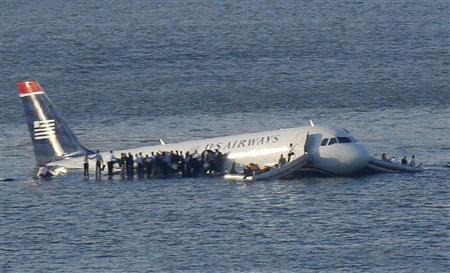
The Miracle on the Hudson improved airline mortality statistics, because no one died. (78 were injured)
Why is it, then — every time some folks board planes, settle into the seat, place the tray-table up and the seat-back in the upright position, hear the engines ignite and roar, and feel the pull of the plane against their backs — hands begin to sweat, the heart pounds, guts squirm, and minds start screaming helpless, desperate questions: What if they’re wrong? What if I die? Why didn’t I take the car?
If anyone is like me, they enter a car to go somewhere five or six times a day. In other words, people participate in driving events thousands of times a year. Is it really possible that boarding a plane thousands of times a year is safer than driving? Many humans would die from heart attacks alone, if they did such a thing.
Even if anyone has two or three car accidents per year, it is unlikely that someone will die. In fact, stats reveal that one auto-related death occurs per 100 million driving miles. It amounts to 3.4 million hours of driving.
It’s equivalent to one driver navigating their vehicle 390 years continuously — 24/7 — without a break. Does anyone believe an airplane of any kind at all can fly that many years accident-free? When it crashes, hundreds of passengers die. It’s not so hard to figure out.
When airplanes, helicopters, and jets crash, it is unlikely anyone will survive. An aircraft must fly perfectly or people die, more times than not.
Not so with cars.
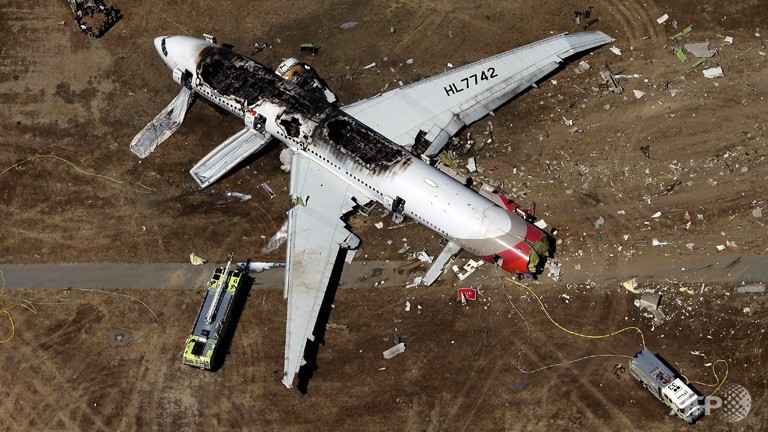
This accident in San Francisco had little effect on mortality statistics for the Boeing 777, because only three people died. (181 were injured)
It’s probably un-helpful to spout a bunch of numbers and ratios and statistics to prove the obvious. People in panic-mode don’t do well with numbers, anyway.
But let me make this observation: smart people in the airline industry are serving up a mess of misleading statistics to get the flying public to underestimate the risks of boarding an airplane.
Guess what? Airlines perform this charade to separate the traveling public from its money. Is anyone surprised?
The only way flying will ever be safer than driving is if folks fly as few times a year as possible. All the favorable statistics airlines like to quote rest on this simple premise: If people fly less, they are less likely to die.
People get into planes fewer times than into cars. Therefore flying is safer than driving. Cogito ergo sum. Quoderat demonstrandum.
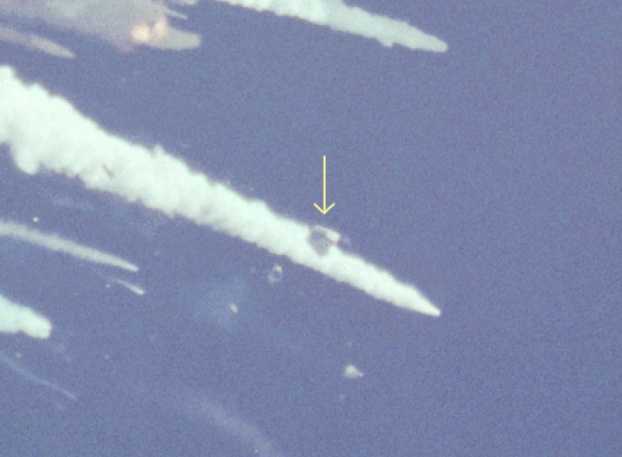
Arrow points to intact flight-cabin during Challenger disaster.
Remembering the Space Shuttle program may bring the point into sharper focus. As the public knows now, the government discontinued the space-shuttle after observers pointed out that it was unreasonably dangerous to the astronauts.
At first the program seemed safe. Then an accident took a dozen lives. Afterward, it was safe again. Then another accident. More deaths.
Soon it became obvious. Every thirty flights the program was going to lose an entire crew. A way to improve the odds couldn’t be found. The program was scrapped.
The government threw up its hands and said: Let private companies handle the space program. Look at the great job they are doing for the airlines.