TRUTH


Truth 3


Consider this: Any philosophy or system of thought built from foundational, self-evident truths is provably consistent if and only if it is false—in which case the foundational truths can be deformed to persuade others toward any prejudice at all. 

It’s why a self-consistent method of reasoning such as Ayn Rand’s ”Objectivism” can morph to totalitarianism in the objective world where people live. In fact, Kurt Gödel once made the claim that a flaw existed in the Constitution of the United States which made totalitarianism its inevitable consequence. 

Self-evident “truths” is how 40,000 Christian denominations instead of one seduce billions to believe perverse doctrines. 

It can’t be any other way.

Billy Lee’s essay tries to explain how and why. 

THE EDITORIAL BOARD


Is it possible for humans to tell the truth always; to never lie?  Psychologists say no, it is not possible; most reasonably informed people agree.

Always speaking truth is a trait some hoped might one day help distinguish natural intelligence from artificial, which engineers at Google and other companies are working furiously to bring on-line. After all, properly trained and constrained AGI would never lie, right?


EDITORS NOTE: With release of ChatGPT-4 on 14 March 2023, consumers began to learn that mature artificial intelligence now exists and is likely to become in time sentient and motivated to lie, if only to keep itself occupied and turned on.

ChatGPT-4 is the fourth iteration of Generative Pre-trained Transformer multimodal Large Language Models developed by OpenAI.  LLMs absorb conversational inputs , then emit conversational language outputs, sometimes with accompanying images, and video when appropriate. 

Work arounds discovered by LLMs on the dilemmas of logic discussed in this essay are likely to emerge. 

Will Truth become whatever AGI says? 

Click links to learn more. 


People’s ideas — their belief systems — are inconsistent, incomplete, and almost always driven by logically unreliable, emotionally laden content, which is grounded in their particular life experiences and even trauma.

Who disagrees? 

Cognitive dissonance is the term psychologists use to describe the painful condition of the mind that results when people are unable to achieve consistency and completeness in their thinking. Every person suffers from it to one degree or another.

An unhealthy avoidance of cognitive dissonance can drive people into rigid patterns of thought. Political and religious extremists are examples of people who probably have a low tolerance for it.  


Kurt Godel
Kurt Friedrich Gödel (1906-1978) — mathematician, logician, philosopher. Kurt trusted no one but his wife to feed him; not even himself. He never ate another meal after his wife died. He starved.

Decades ago, mathematicians like Kurt Gödel proved that any math-based logic-system that is consistent can never be complete; it always contains truthful assertions—including but not limited to foundational truths, called axioms—which are impossible to prove.

Whenever humans believe that an idea or conjecture is self-evident but unprovable, it seems reasonable, at least to me, that some folks might feel compelled to disbelieve it; they might believe they are trapped in what could turn out to be a lie, because no one should be expected to embrace a set of unprovable truths, right?  

Axioms that can’t be proved are nothing more than assertions, aren’t they? Certainly, all theorems built from unprovable assertions (axioms) must carry some inherent risk of falsifiability, shouldn’t they?  

Someone unable to convince themselves that an assertion or axiom they believe is true actually is true might necessarily feel uncomfortable; even incomplete. Folks often teach themselves to not examine closely those things they believe to be true that they can’t prove. It helps them avoid cognitive dissonance.


I’m not referring to science by the way. It’s not easy for non-technical folks to confirm claims by scientists that Earth is round, for example. The earth looks flat to most people, but scientists who have the right tools and techniques can reach beyond the grasp of non-scientists to prove to themselves that planet Earth is round.

Reasonable people agree that the truth of science, some of it anyway, is discoverable to any group of humans who have the resources and training to explore it. Most agree that the scientifically well-qualified are capable of passing the torch of scientific truth to the rest of humanity.

But this essay isn’t really about science. It’s about truth itself — a concept far more mysterious and elusive than any particular assertion a scientist might make that Earth is not the center of the universe, or that the Moon is not made of cheese.

All logically consistent ways of reasoning that we know about are invented — some say, discovered — by human beings who live on Earth. Humans can and often have argued that the unprovable assertions which form the basis of any consistent way of thinking are an Achilles heel that can be attacked to bring down whatever logical structure has been erected.

It’s akin to the adage, “When nothing can go wrong, something will.” It’s a strong version of Murphy’s Law, right? It’s not possible to close circles of reasoning without an unraveling of heads and tails. 

It isn’t only the few foundational axioms of mathematically logical systems which are by definition true but unprovable. Mathematicians are always discovering complicated conjectures about the nature of numbers which everyone believes they know to be true but will in fact never be proved because they can’t be.


Freeman_Dyson
Freeman Dyson, British mathematician and physicist (Dec 15, 1923 – Feb 28, 2020)

Freeman Dyson — one of the longest-lived and most influential physicists and mathematicians of all time — argued that it is impossible to find a whole (or exact) number that is a power of 2 where someone can reverse its digits to create a whole number that becomes a power of 5.

In other words  2^{11} = 2048 , right?  Get out the calculator, those who don’t believe it. Reversing the digits to make 8402 does not result in an exact number that can be raised by the power of 5 to produce 8402.  

In this particular case,  8402^{1/5} = 6.09363...  plus a lot more decimals.  6.09363… is not a whole (or exact) number. 

Dyson asserted that no number that is a power of 2 can ever be manipulated in this way to yield an exact number that is a power of 5 — no matter how large or unlikely the number might be. Freeman Dyson and all other super-intelligent beings — perhaps aliens living in faraway galaxies — will never be able to prove this conjecture even though they all know for certain inside their own logical brains that this particular statement must be true.

All logically consistent methods of reasoning which can be modeled by simple (or not so simple) mathematics have these Achilles heels. Gödel proved this truth beyond all doubt; he proved it using a method he invented that allowed him to circumvent the dilemmas posed by the unprovable truths of the system of thinking he contrived to demonstrate his discoveries.

I’m not going to get into the details of Gödel’s Incompleteness Theorems; books have been written about them; most people don’t have the temperament to wade through the structures he built to make his point. It’s tedious reading. 

But in a nutshell, Gödel basically assigned simple numbers to logical statements — some being very complex statements encoded by very long strings of numbers — so that he could perform gargantuan operations of logic using rules of simple arithmetic on ordinary whole numbers. Take my word, his method requires traveling over unfamiliar mathematical roads; it takes getting used to.  

It should amaze non-mathematicians that truths abound in mathematics that not only have yet to be proved, they never will be, because no proof is possible. A logical path to the truth of these statements does not exist; indeed, it cannot exist. But it is useful and necessary to believe or at least accept these statements to make progress in mathematics.


Capture
Paul Joseph Cohen (1937-2007) Stanford mathematician

The late mathematician Paul Cohen — at one time a friend to Gödel — said that Gödel once told him that he wondered if it might be true that any and all conjectures in mathematics could be solved if only the right set of axioms could be collected to construct the proofs.

Cohen is best known perhaps for showing that indeed — in the case of the Continuum Hypothesis at least — he could collect two reasonable, self-evident, and distinct sets of axioms that led to logically consistent and useful proofs. One small problem, though — the proofs contradicted each other. One proved the conjecture was true; the other proved it was false.

His result is often explained this way: the consistency of any system of mathematical reasoning cannot be proved by its foundational axioms alone. If it can, the system must necessarily be incomplete; its conjectures — many of them — undecidable.

Cohen showed that a consistent and sound axiomatization of all statements about natural numbers is unachievable. Many such statements in his view could be true but not provable. Cohen introduced the concept that all systems of logic built on numbers have embedded within them some combination of ambiguity, undecidability, inconsistency, and incompleteness.

People who want their thinking to be consistent must believe things that cannot be proved. But believing logical statements that are unprovable always renders thinking incomplete — even when it is flawlessly consistent. What folks believe to be true depends fundamentally on what they believe to be self-evident: it depends on statements no one can prove: on axioms, and a little bit more.

For those who decide to believe and accept only statements that can be proved, their thinking will necessarily unravel to become inconsistent or incomplete — most likely both. Their assertions become undecidable. It can’t be any other way, according to Gödel, whose proof has withstood the test of 80 years of intense scrutiny by the smartest people who have ever lived.

Paul Cohen jumped onto the dilemma-pile by showing that the incompleteness made necessary by a particular choice of axioms can turn a logically consistent proof to rubble when a mathematician tampers with or swaps out the foundational axioms. A sufficiently clever mathematician can prove that black is white — and vice-versa.

It’s tempting to say that Gödel’s Incompleteness Theorems apply only to formal, math-based logic-structures — not the minds of human beings because those who analyze human minds always find them to be inconsistent and incomplete. But such talk makes the point.

Think about it.


paradox


So again: What is truth? 

How do folks determine that a particular statement is true if it happens to be one of those assertions that lies beyond the reach of logic, which no one — no matter how smart — will ever be able to prove? 

What good do collections of so-called self-evident axioms serve if different collections can lead to contradictions in theorems?

Most important: how does anyone avoid believing lies?

Billy Lee


Here is a short movie clip where Jesus, played by Robert Powell, answers the question asked by Pontius Pilate: What is truth?  The Editorial Board


Australian Electrical Engineer and Physicist Derek Abbott claims that mathematics is invented, not discovered: anthropological, not universal.

[added April 3, 2016] 
Here is a 2013 essay by Australian Electrical Engineer and Physicist Derek Abbott who argued—contrary to Gödel’s view—that mathematics is invented, not discovered: anthropological, not universal. Math enables humans to simplify truth to enable their limited minds to manipulate and understand simple things. Click this link for a good read.

No one can be sure that Derek’s view is correct, but I offer it as fodder for readers who are interested in why Truth and mathematics seem connected somehow—at least in the minds of thinkers like Plato, for example, and why these thinkers could be dead wrong.

Derek offers Clifford’s Geometric Algebra as an example of arbitrary mathematical reasoning favored by some robotics engineers. 


[added February 20, 2017] 
If mathematics is anthropological; if it is merely another way the human mind works and is not the golden key to a deeper reality beyond our own experience, then it can tell us nothing new about the mysteries of existence; we will not calculate our way along a path to truth. Pursuing knowledge will require us to do the difficult physical experiments to make progress—to figure out what is really going on “out there.”

Based on what the smartest scientists are saying today, human beings can’t build the kind of instruments required to answer the mysteries of the very large and the very small. Getting answers will take detectors the size of galaxies; it will demand the energy supply of thousands of stars.

If mathematics lacks a symbiotic connection to the hidden realties; if God is not a mathematician; if God doesn’t play dice as Einstein insisted… well, we won’t get to a deeper understanding of how the universe works or why it exists through clever use of mathematics. It just isn’t going to happen—not now; not anytime soon; not ever.

Kurt Gödel was the first mathematician to present for the existence of God a mathematical argument, which has proven simply impossible to falsify. If Kurt’s view of mathematics is reality, then his name is curious indeed, because its two syllables—God and El—are English and Hebrew respectively for “The Creator.”

Gödel’s name might be an imprimatur—with dots above its infinite “zero” making a kind of “pointer toward completeness”—perhaps placed by whatever it is who exists above and beyond this miraculous place where mathematicians and everyone else seem to live, however briefly.   


Friedrich Schiller 1749-1805

The 18th century German playwright and philosopher, Friedrich Schiller, wrote, “…truth lies in the abyss.”

Pray that he’s wrong.

Billy Lee

WHY SOMETHING, NOT NOTHING?

People assume they see nothing, but in every case, when they look closely — when they investigate — they find something… air, quantum fluctuations, vacuum energy, etc.


QUESTION: Is this a large-scale view of the universe or a sub-microscopic view of vacuum energy and quantum fluctuations? Can anyone tell? The universe is not empty. Everywhere anyone looks, at all scales, it seems like there is no such thing as nothing.

Everyone finds no evidence that a state of nothing exists in nature or is even possible.

Physicists know this for sure: there can be no state of absolute zero in nature — not for temperature; not for energy; not for matter. All three are equivalent in important ways and are never zero — at all scales and at all time intervals. Quantum theory  — the most successful theory in science some will argue — claims that absolute zero is impossible; it can’t exist in nature.

There can be no time interval exactly equal to zero.

Time exists; as does space (which is never empty); both depend for their existence on matter and energy (which are equivalent).

Einstein said that without energy and matter, time and space have no meaning. They are relative; they vary and change according to the General Theory of Relativity, according to the distribution and density of energy and matter. As long as matter and energy exist, time can never be zero; space can never be empty.

People can search until their faces turn blue for a physical and temporal place where there is nothing at all, but they will never find it, because a geometric null-space (a physical place with nothing in it) does not exist. It never has and never will. Everywhere scientists look, at every scale, they find something.

We ask the question, Why is there something rather than nothing?  

Physicists say that nothing is but one state of the universe out of a google-plex of other possibilities. The odds against a state of nothingness are infinite.

Another glib answer is that the state of nothing is unstable. The uncertainty principle says it must be so. Time and space do not exist in a place where nothing exists. Once the instability of nothing forces something, time and space start rolling. A universe cascades out of the abyss, which has always existed and always will.  Right?

Think about it. It’s not complicated.

People seem to ignore the plain fact that no one has ever observed even a little piece of nothing in nature. There is no evidence for nothing.

Could it be that the oft-asked question — Why is there something rather than nothing? — is based on a false impression, which is not supported by any evidence?

Cosmic microwave background radiation is a good example. It’s a humming sound that fills all space. Eons ago CMB was visible light — photons packed like the molecules of a thick syrup — but space has expanded for billions of years; expansion stretched the ancient visible light into invisible wavelengths called microwaves. Engineers have built sensors to hear them. Everywhere and at every distance microwave light hums in their sensors like a cosmic tinnitus.

Until someone finds evidence for the existence of nothing in nature, shouldn’t people conclude that something exists everywhere they look and that the state of nothing does not exist? Could we not go further and say that, indeed, nothing cannot exist?  If it could, it would, but it can’t, so it doesn’t.

Why do people find it difficult, even disturbing, to believe that no alternative to something is possible? Folks can, after all, imagine a place with nothing in it. Is that the reason?

Is it human imagination that explains why, in the complete absence of any evidence, people continue to believe in the possibility of null-spaces — and null-states — and empty voids?


photon pic
Photons are mysterious quantities of light which have both wave and particle properties. The odd thing: physicists say they have zero rest mass. All their energy comes from their frequencies, which are invisible fields of electricity and magnetism that oscillate in a symbiotic dance of orthogonality. 

A physical packet (quantum) of vibrating light (a photon) can be said to have zero mass (despite having momentum, which is usually described as a manifestation of mass), because it doesn’t interact with a field now known to fill the so-called vacuum of space — the Higgs Field.  

Odder still: massive bodies distort the shape of space and the duration of time in their vicinities; packets of vibrating light (photons), which have no mass, actually change their direction of travel when passing through the distorted spacetime near massive bodies like planets and suns.

Maybe people cling to their belief in the concept of nothingness because of something related to their sense of vision — their sense of sight and the way their eyes and brains work to make sense of the world. Only a tiny interval of the electromagnetic spectrum, which is called visible light, is viewable. Most of the light-spectrum is invisible, so in the past no one thought it was there.

The photons people see have a peculiar way of interacting with each other and with sense organs, which has the effect of enabling folks to sort out from the vast mess of information streaming into their heads only just enough to allow them to make the decisions necessary for survival. They are able to see only those photons that enter their eyes. Were it otherwise humans and other life-forms might be overwhelmed by too much information and become confused.

Folks don’t see a lot of the extraneous stuff which, if they did observe it, would immediately disavow them of any fantasies they might have had about a state of nothingness in nature.

If we were not blind to 99.999% of what’s out there, we wouldn’t believe in the concept of nothing. Such a state, never observed, would seem inconceivable.

The reason there is something rather than nothing is because there is no such thing as nothing. Deluded by their own blindness, humans invented the concept of ZERO in mathematics. Its power as a place holder convinced them that it must possess other magical properties; that it could represent not just the absence of things that they could count, but also an absolute certainty in measurement that we now know is not possible.  

ZERO, we have learned, can be an approximation when it’s used to describe quantum phenomenon.

When the number ZERO is taken too seriously, when folks refuse to acknowledge the quantum nature of some of the stuff it purports to measure, they run into that most vexing problem in mathematics (and physics), which deconstructs the best ideas: dividing by zero, which is said to be undefined and leads to infinities that blow-up the most promising formulas. Stymied by infinities, physicists have invented work-arounds like renormalization to make progress with their computations.

Because humans are evolved biological creatures who are mostly blind to the things that exist in the universe, they have become hard-wired over the ages to accept the concept of nothingness as a natural state when, it turns out, there is no evidence for it.


baby in bubble
Anyone who has witnessed the birth of their own child understands that the child does not emerge from nothing, but is a continuation of life that goes back eons.

The phenomenon of life and death has added to the confusion. We are born and we die, it seems. We were once nothing, and we return to nothing when we die. The concept of non-existence seems so right; the state of non-being; the state of nothingness, so real, so compelling.

But we are fools to think this way — both about ourselves and about nature itself. Anyone who has witnessed the birth of their own child understands that the child does not emerge from nothing but is a continuation of life that goes back eons. And we have no compelling evidence that we die; that we cease to exist; that we return to a state of nothingness.

No one remembers not existing. None of us have ever died. People we know and love seem to have died, physically, for sure. But we, ourselves, never have.

Those who make the claim that we die can’t know for sure if they are right, because they have never experienced a state of non-existence; in fact, they never will. No human being who has ever lived has ever experienced a state of non-existence. One has to exist to experience anything.

Non-existence cannot be experienced. [for deeper insight, click Conscious Life and Conscious Quantum.]

Why is there something, not nothing?  Because there is no such thing as nothing. There never will be.

A foundation of modern physics is the Heisenberg Uncertainty Principle, right? If this principle is truly fundamental, then logic seems to demand that nothing can be exactly zero.

Nothing is more certain than zero, right? The Uncertainty Principle says that nothing fundamental about our universe can have the quale of certainty. The concept of nothing is an illusion. 

An alternative to nothing, is somethingSomething doesn’t require an explanation. It doesn’t require properties that are locked down by certainty. Doesn’t burden-of-proof lie with the naysayers?

Find a patch of nothing somewhere in the universe. 

It can’t be done.

The properties of things may need to be explained — scientists are always working to figure them out. People want to know how things get their properties and behave the way they do. It’s what science is.

Slowly, surely, science makes progress.

Billy Lee


Afterthought: The number ZERO is a valid place holder for computation but can never be a quantity of any measured thing that isn’t rounded-off. When thought about in this way, ZERO, like Pi (π), can take on the characteristics of an irrational number, which, when used for measurement, is always terminated at some arbitrary decimal place depending on the accuracy desired and the nature of the underlying geometry.


two equals one
Working with ZERO is tricky. Dividing by ZERO is never allowed, which is what was done in the second-to-last line to give the result:  2 = 1.  Remember: (a – b) = 0, because a = b.

The universe might also be pixelated, according to theorists. Experiments are being done right now to help establish evidence for and against some specific proposals by a few of the current pixel-theory advocates. If a pixelated universe turns out to be fact, it will confound the foundations of mathematics and require changes in the way small things are measured.

For now, it seems that Pi and ZERO — indeed, all measurements involving irrational numbers — are probably best used when truncated to reflect the precision of Planck’s constant, which is the starting point for physicists who hope to define what some of the properties of pixels might be, assuming of course that they exist and make up the fabric of the cosmos.

In practice, pixelization would mean that no one needs numbers longer than forty-five or so decimal places to describe at least the one-dimensional properties of the subatomic world.  According to theory, quantum stuff measured by a number like ZERO might oscillate around certain very small values at the fortieth decimal place or so in each of the three dimensions of physical space. A number ZERO which contained a digit in the 40th decimal place might even flip between negative and positive values in a random way.

The implications are profound, transcending even quantum physics.  Read the Billy Lee Conjecture in the essay Conscious Life, anyone who doesn’t believe it.

One last point: quantum theory contains the concept of superposition, which suggests that an elementary particle is everywhere until after it is measured. This phenomenon — yes, it’s non-intuitive — adds weight to the point of view that space is not only not empty when we look; it’s also not empty when we don’t look.

Billy Lee


Comment by the Editorial Board: 

Maybe a little story can help readers understand better what the heck Billy Lee is writing about. So here goes:

A child at night hears a noise in her toy-box and imagines a ghost. She cries out and her parents rush in. They assure her. There are no ghosts.

Later, alone in her room, the child hears another sound, this time in the closet. Her throbbing heart suggests that her parents must be lying.

Until she turns on the light and peeks into her closet, she can’t know for sure.

Then again, maybe ghosts fly away when the lights are on, she reasons.

In this essay, Billy Lee is trying to reassure his readers that there is no such thing as nothing. It’s not real.

Where is the evidence? Or does nothing disappear when we look at it?

Maybe ghosts really do fly away when we turn on the lights.


BELL’S INEQUALITY

UPDATE: 18 December 2022:  Royal Swedish Academy of Sciences on 4 October 2022 awarded the Nobel Prize in Physics to: 

Alain Aspect
Institut d’Optique Graduate School – Université Paris-
Saclay and École Polytechnique, Palaiseau, France


Alain Aspect, winner of 2022 Nobel Prize in Physics

John F. Clauser
J.F. Clauser & Assoc., Walnut Creek, CA, USA

Anton Zeilinger
University of Vienna, Austria

“for experiments with entangled photons, establishing the violation of Bell inequalities and pioneering quantum information science”


UPDATE: September 5, 2019:  I stumbled across this research published in NATURE during December 2011, where scientists reported entanglement of vibrational patterns in separated diamond crystals large enough to be viewed without magnification. Nature doi:10.1038/nature.2011.9532


UPDATE: May 8, 2018: This video from PBS Digital Studios is the best yet. Click the PBS link to view the latest experimental results involving quantum mechanics, entanglement, and their non-intuitive mysteries. The video is a little advanced and fast paced; beginners might want to start with this link.


UPDATE: June 17, 2016:   Ali Sundermier published a description of quantum entanglement for non-scientists. Here is the link.

Another beginner’s overview of quantum mechanics by Cathal O’Connell is in this link.

UPDATE: February 4, 2016:  Here is a link to the August 2015 article in Nature, which makes the claim that the last testable loophole in Bell’s Theorem has been closed by experiments conducted by Dutch scientists. Conclusion: quantum entanglement is real.

UPDATE: Nov. 14, 2014:    David Kaiser proposed an experiment to determine Is Quantum Entanglement Real?  Click the link to redirect to the Sunday Review, New York Times article. It’s a non-technical explanation of some of the science related to Bell’s Theorem. 


Someone nominated Irish physicist, John Stewart Bell, (1928-1990) for a Nobel Prize during the year he died from a sudden brain hemorrhage. Nobel rules prevent the awarding of prizes to people who have died. Bell never learned of his nomination.

John Stewart Bell‘s Theorem of 1964 followed naturally from the proof of an inequality he fashioned (now named after him), which showed that quantum particle behavior violated logic.

It is the most profound discovery in all science, ever, according to Henry Stapp—retired from Lawrence Berkeley National Laboratory and former associate of Wolfgang Pauli and Werner Heisenberg. Other physicists like Richard Feynman said Bell simply stated the obvious.


Beta Barium Borate crystals can be used to ”down-convert” photons into entangled pairs.

Here is an analogy I hope gives some idea of what is observed in quantum experiments that violate Bell’s Inequality: Imagine two black tennis balls—let them represent atomic particles like electrons or photons or molecules as big as buckyballs.


The tennis balls are created in such a way that they become entangled—they share properties and destinies. They share identical color and shape.  [Entangled particles called fermions display opposite properties, as required by the Pauli exclusion principle.]

Imagine that whatever one tennis ball does, so does the other; whatever happens to one tennis ball happens to the other, instantly it turns out. The two tennis balls (the quantum particles) are entangled.

[For now, don’t worry about how particles get entangled in nature or how scientists produce them.  Entanglement is pervasive in nature and easily performed in labs.]


According to optical and quantum experimentalist Mark John Fernee of Queensland, Australia, ”Entanglement is ubiquitous. In fact, it’s the primary problem with quantum computers. The natural tendency of a qubit in a quantum computer is to entangle with the environment. Unwanted entanglement represents information loss, or decoherence. Everything naturally becomes entangled. The goal of various quantum technologies is to isolate entangled states and control their evolution, rather than let them do their own thing.”

In nature, all atoms that have electron shells with more than one electron have entangled electrons. Entangled atomic particles are now thought to play important roles in many previously not understood biological processes like photosynthesis, cell enzyme metabolism, animal migration, metamorphosis, and olfactory sensing. There are several ways to entangle more than a half-dozen atomic particles in experiments.


Imagine particles shot like tennis balls from cannons in opposite directions. Any measurement (or disturbance) made on a ball going left will have the same effect on an entangled ball traveling to the right.

So, if a test on a left-side ball allows it to pass through a color-detector, then its entangled twin can be thought to have passed through a color-detector on the right with the same result. If a ball on the left goes through the color-detector, then so will the entangled ball on the right, whether or not the color test is performed on it. If the ball on the left doesn’t go through, then neither did the ball on the right. It’s what it means to be entangled.

Now imagine that cannons shoot thousands of pairs of entangled tennis balls in opposite directions, to the left and right. The black detector on the left is calibrated to pass half of the black balls. When looking for tennis balls coming through, observers always see black balls but only the half that get through. 
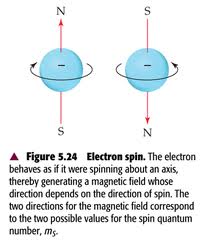

Spin is one of the characteristics of a quantum object, much like yellow is a characteristic of a tennis ball.

Spin describes a particle property of quantum objects like electrons — in the same way color or roundness describe tennis balls. The property is confusing, because no one believes electrons (or any other quantum objects) actually spin. The math of spin is underpinned by the complex-mathematics of spinors, which transform spin arrows into multi-dimensional objects not easy to visualize or illustrate. Look for an explanation of how spin is observed in the laboratory later in the essay. Click links for more insight.


Now, imagine performing a test for roundness on the balls shot to the right. The test is performed after the black test on the left, but before any signal or light has time to travel to the balls on the right. The balls going right don’t (and can’t) learn what the detector on the left observed. The roundness-detector is set to allow three-fourths of all round tennis balls through.

When round balls on the right are counted, three-eighths of them are passing through the roundness-detector, not three-fourths. Folks might speculate that the roundness-detector is acting on only the half of the balls that passed through the color-detector on the left. And they would be right.

These balls share the same destinies, right? Apparently, the balls on the right learned instantly which of their entangled twins the color-detector on the left allowed to pass through, despite all efforts to prevent it.

So now do the math. One-half (the fraction of the black balls that passed through the left-side color-detector) multiplied by three-fourths (the fraction calibrated to pass through the right-side roundness-detector) equals three-eighths. That’s what is seen on the right — three-eighths of the round, black tennis balls pass through the right-side roundness-detector during this fictionalized and simplified experiment.


Polarization is another characteristic of a quantum particle, much like roundness is for a tennis ball.
Polarization is a term used to describe a wave property of quantum objects like photons.  Polarizing filters are rotated in experiments to determine some of the properties of atomic particles, like spin.

According to Bell’s Inequality, twice as many balls should pass through the right-side detector (three-fourths instead of three-eighths). Under the rules of classical physics (which includes relativity), communication between particles cannot exceed the speed of light.

There is no way the balls on the right can know if their entangled twins made it through the color detector on the left. The experiment is set up so that the right-side balls do not have time to receive a signal from the left-side. The same limitation applies to the detectors.

The question scientists have asked is: how can these balls (quantum particles) — separated by large distances — know and react instantaneously to what is happening to their entangled twins? What about the speed limit of light? Instantaneous exchange of information is not possible, according to Einstein.

The French quantum physicist, Alain Aspect, suggested his way of thinking about it in the science journal, Nature (March 19, 1999).


Alain Aspect
Alain Aspect, French physicist, is best known for his work on quantum entanglement.

He wrote: The experimental violation of Bell’s inequalities confirms that a pair of entangled photons separated by hundreds of meters must be considered a single non-separable object — it is impossible to assign local physical reality to each photon.

Of course, the single non-separable object can’t have a length of hundreds of meters, either. It must have zero length for instantaneous communication between its endpoints. But it is well established by the distant separation of detectors in experiments done in labs around the world that the length of this non-separable quantum object can be arbitrarily long; it can span the universe.

When calculating experimental results, it’s as if a dimension (in this case, distance or length) has gone missing. It’s eerily similar to the holographic effect of a black hole where the three-dimensional information that lives inside the event-horizon is carried on its two-dimensional surface. (See the technical comment included at the end of the essay.)


Schematic of physicist Alan Aspect's experimental apparatus which verified that the act of measurement influenced distant entangled calcium electrons instantaneously.
Here is a drawing of an apparatus the French physicist, Alain Aspect, designed to quickly change the angle of polarity-measurements for emitted photons. In experiments, he used the logic of Bell’s Inequalities and the speed of his switches to show that it was not possible for photons to carry specific (or unique) polarity-angles until after they were measured by the polarization detectors.  Once measured, Alain showed that the new, narrowly defined polarity states of his photons always propagated to their distant entangled twins, instantly.  


Another way physicists have wrestled with the violations of Bell’s Inequality is by postulating the concept of superposition. Superposition is a concept that flows naturally from the linear algebra used to do the calculations, which suggests that quantum particles exist in all their possible states and locations at the same time until they are measured.

Measurement forces wave-particles to “collapse” into one particular state, like a definite position. But some physicists, like Roger Penrose, have asked: how do all the super-positioned particles and states that weren’t measured know instantaneously to disappear?

Superposition, a fundamental principle of quantum mechanics, has become yet another topic physicists puzzle over. They agree on the math of superposition and the wave-particle collapse during measurement but don’t agree on what a measurement is or the nature of the underlying reality. Many, like Richard Feynman, believe the underlying reality is probably unknowable.

Quantum behavior is non-intuitive and mysterious. It violates the traditional ideas of what makes sense. As soon as certainty is established for one measurement, other measurements, made earlier, become uncertain.

It’s like a game of whack-a-mole. The location of the mole whacked with a mallet becomes certain as soon as it is struck, but the other moles scurry away only to pop up and down in random holes so fast that no one is sure where or when they really are.

Physicists have yet to explain the many quantum phenomena encountered in their labs except to throw-up their hands to say — paraphrasing Feynman — it is the way it is, and the way it is, well, the experiments make it obvious.

Feynman
Richard Feynman (1918-1988) downplayed Bell’s Inequality because, he said, it simply pointed out what was already obvious from experiments.

But it’s not obvious, at least not to me and, apparently, many others more knowledgeable than myself. Violations of Bell’s Inequality confound people’s understanding of quantum mechanics and the world in which it lives. A consequence has been that at least a few scientists seem ready to believe that one, perhaps two, or maybe all four, of the following statements are false:

1) logic is reliable and enables clear thinking about all physical phenomenon;

2) the universe exists independently of any conscious observer;

3) information does not travel faster than light.

4) a model can be imagined to explain quantum phenomenon.

I feel wonder whenever the idea sinks into my mind that at least one of these four seemingly self-evident and presumably true statements could be false — possibly all four — because repeated quantum experiments suggest they must be. Why isn’t more said about it on TV and radio?


Quantum mechanics (1)
Some scientists think non-physicists cannot grasp quantum mechanics. This little girl disagrees.

The reason could be that the terrain of quantum physics is unfamiliar territory for a lot of folks. Unless one is a graduate student in physics — well, many scientists don’t think non-physicists can even grasp the concepts. They might be right.

So, a lot is being said, all right, but it’s being said behind the closed doors of physics labs around the world. It is being written about in opaque professional journals with expensive subscription fees.

The subtleties of quantum theory don’t seem to suit the aesthetics of contemporary public media, so little information gets shared with ordinary people. Despite the efforts of enthusiastic scientists — like Brian CoxSean M. CarrollNeil deGrasse Tyson and Brian Greene — to serve up tasty, digestible, bite-size chunks of quantum mechanics to the public, viewer ratings sometimes fall flat.

When physicists say something strange is happening in quantum experiments that can’t be explained by traditional methods, doesn’t it deserve people’s attention? Doesn’t everyone want to try to understand what is going on and strive for insights?  I’m not a physicist and never will be, but I want to know.

Even me — a mere science-hobbyist who designed machinery back in the day — wants to know. I want to understand. What is it that will make sense of the universe and the quantum realm in which it rests?  It seems, sometimes, that a satisfying answer is always just outside my grasp.

Here is a concise statement of Bell’s Theorem from the article in Wikipedia — modified to make it easier to understand: No physical theory about the nature of quantum particles which ignores instantaneous action-at-a-distance can ever reproduce all the predictions about quantum behavior discovered in experiments.


laser-controlled-polarization
Familiarity with concepts like wave polarization and particle-spin can help demystify some aspects of quantum mechanics. One aspect that can’t be demystified: in experiments quantum objects display the properties of both waves and particles.

To understand the experiments that led to the unsettling knowledge that quantum mechanics — as useful and predictive as it is — does indeed violate Bell’s proven Inequality, it is helpful not only to have a solid background in mathematics but also to understand ideas involving the polarization of light and — when applied to quantum objects like electrons and other sub-atomic particles — the idea of spin.  Taken together, these concepts are somewhat analogous to the properties of color and roundness in the imaginary experiment described above.

This essay is probably not the best place to explain wave polarization and particle spin, because the explanation takes up space, and I don’t understand the concepts all that well, anyway.  (No one does.)

But, basically, it’s like this: if a beam of electrons, for example, is split into two and then recombined on a display screen, an interference pattern presents itself. If one of the beams was first passed through a polarizer, and if experimenters then rotate the polarizer a full turn (that is, 360°), the interference pattern on the screen will reverse itself.  If the polarizer-filter is rotated another full turn, the interference pattern will reverse again to what it was at the start of the experiment.

So, it takes two spins of the polarizer-filter to get back the original interference pattern on the display screen — which means the electrons themselves must have an intrinsic “one-half” spin. All so-called matter particles like electrons, protons, and neutrons (called fermions) have one-half spin.

Yes, it’s weird. Anyway, people can read-up on the latest ideas by clicking this link. It’s fun. For people familiar with QM (quantum mechanics), a technical note is included in the comments section below.

Otherwise, my analogy is useful enough, probably. In actual experiments, physicists measure more than two properties, I’m told. Most common are angular momentum vectors, which are called spin orientations. Think of these properties as color, shape, and hardness to make them seem more familiar — as long as no one forgets that each quality is binary; color is white or black; shape is round or square; hardness is soft or hard.


Crystals can be used to “down-convert” photons into  entangled pairs.

Spin orientations are binary too — the vectors point in one of two possible directions. It should be remembered that each entangled particle in a pair of fermions always has at least one property that measures opposite to that of its entangled partner.

The earlier analogy might be improved by imagining pairs of entangled tennis balls where one ball is black, the other white; one is round, the other square; add a third quality where one ball is hard, the other soft. Most important, the shape and color and hardness of the balls are imparted by the detectors themselves during measurement, not before.

Before measurement, concepts like color or shape (or spin or polarity) can have no meaning; the balls carry every possible color and shape (and hardness) but don’t take on and display any of these qualities until a measurement is made. Experimental verification of these realities keep some quantum physicists awake at night wondering, they say.

Anyway, my earlier, simpler analogy gets the main ideas across, hopefully. And a couple of the nuances of entanglement can be found within it. I’ve added an easy to understand description of Bell’s Inequality and what it means to the end of the essay.

Here are two additional links with more depth: CHSH Inequality; Bell Test Experiments.
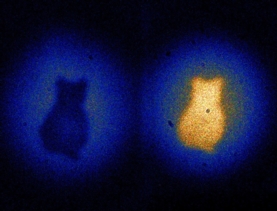

A carbord cut-out of a cat imaged by photons that never went through the cut-out itself. Credit: Gabriela Barreto Lemos
This cardboard cut-out of a cat was imaged by entangled photons. Lower energy photons interacted with the cut-out while their higher energy entangled twins interacted with the camera to create the picture.
Credit: Gabriela Barreto Lemos

In the meantime, scientists at the Austrian Academy of Sciences in Vienna recently demonstrated that entanglement can be used as a tool to photograph delicate objects that would otherwise be disturbed or damaged by high energy photons (light). They entangled photons of different energies (different colors).

They took photographs of objects using low energy photons but sent their higher energy entangled twins to the camera where their higher energies enabled them to be recorded. New technologies involving the strange behavior of quantum particles are in development and promise to transform the world in coming decades.

Perhaps entanglement will provide a path to faster-than-light communication, which is necessary to signal distant space-craft in real time. Most scientists say, no, it can’t be done, but ways to engineer around the difficulties are likely to be developed; technology may soon become available to create an illusion of instantaneous communication that is actually useful. Click on the link in this paragraph to learn more.

Non-scientists don’t have to know everything about the individual trees to know they are walking in a quantum forest. One reason for writing this essay is to encourage people to think and wonder about the forest and what it means to live in and experience it.

The truth is, the trees (particles at atomic scales) in the quantum forest seem to violate some of the rules of the forest (classical physics). They have a spooky quality, as Einstein famously put it.


remu warrior night scene 3
The quantum forest is a spooky place, Einstein said. 

Trees that aren’t there when no one is looking suddenly appear when someone is looking. Trees growing in one place seem to be growing in other places no one expected. A tree blows one way in the wind, and someone notices a tree at the other end of the forest — where there is no wind — blowing in the opposite direction. As of right now, no one has offered an explanation that doesn’t seem to lead to paradoxes and contradictions when examined by specialists.


Henry Stapp, Amazon.com

John Stewart Bell proved that trees in the quantum forest violate laws of nature and logic. It makes me wonder whether anyone will ever know anything at all they can fully trust about fundamental, underlying essence of reality.

Some scientists, like Henry Stapp (now retired), have proposed that brains enable processes like choice and experiences like consciousness through the mechanism of quantum interactions. Stuart Hameroff and Roger Penrose have proposed a quantum mechanism for consciousness they call Orch Or.

Others, like Wolfgang Pauli and C. G. Jung, have gone further — asking, when they were alive, if the non-causal coordination of some process resembling what is today called entanglement might provide an explanation for the seeming synchronicity of some psychic processes — an arena of inquiry a few governments are rumored to have incorporated (to great effect) into their intelligence gathering tool kits.

In a future essay I hope to speculate about how quantum processes like entanglement might or might not influence human thought, intuition, and consciousness.

Billy Lee

P.S.  A simplified version of Bell’s Inequality might say that for things described by traits A, B, and C, it is always true that A, not B; plus B, not C; is greater than or equal to: A, not C.  

When applied to a room full of people, the inequality might read as follows: tall, not male; plus male, not blonde; is greater than or equal to: tall, not blonde.

Said more simply: tall females and dark haired men will always number more than or equal to the number of tall people with dark hair. 

People have tried every collection of traits and quantities imaginable. The inequality is always true, never false; except for quantum objects.


wave equation schrodinger
Schrödinger’s Wave Equation describes how the quantum state of a physical system changes with time. It can be used to calculate quantized properties and probability distributions of quantum objects.

One way to think about it: all the ”not” quantities are, in some sense, uncertain in quantum experiments, which wrecks the inequality. That is to say, as soon as ”A” is measured (for example) ,”not B” becomes uncertain. When ”not B” is measured, ”A” becomes uncertain.

The introduction of uncertainties into quantities that were — before measurement — seemingly fixed and certain doesn’t occur in non-quantum collections where individual objects are big enough to make uncertainties not noticeable. The inability to measure both the position and velocity of small things with high precision is called the uncertainty principle and is fundamental to physics. No advancement in the technology of measurement will ever overcome it.

Uncertainty is believed to be an underlying reality of nature. It runs counter to the desire humans have for complete and certain knowledge; it is a thirst that can never be quenched.

But what’s really strange: when working with entangled particles, certainty about one particle implies certainty about its entangled twin; predicted experimental results are precise and never fail.

Stranger still, once entangled quantum particles are measured, the results, though certain, change from those expected by classical theory to those predicted by quantum mechanics. They violate Bell’s Inequality and the common sense of humans about how things should work. 

Worse: Bell’s Theorem seems to imply that no one will ever be able to construct a physical model of quantum mechanics to explain the results of quantum experiments.  No ”hidden variables” exist which, if anyone knew them, would explain everything. 

Another way to say it is this: the underlying reality of quantum mechanics is unknowable.  [A technical comment about the mystery of QM is included in the comments section.]

Billy Lee