Here is an excerpt from a 1975 resume about my experience in the nuclear power industry:
Engineering Technician at Ingersoll-Rand Company. Designed and serviced pumps and condensers for nuclear power plants; assisted engineers on service calls; toured and worked inside nuclear power plants; trained in construction and operation of nuclear power plants.
I didn’t last long at Ingersoll-Rand before they fired me for incompetence. But during the six months before my meltdown they sent me inside nuclear power plants to learn how to operate and maintain the pumps and condensers used to move and cool liquids inside the plants. Under the supervision of licensed nuclear engineers I learned how to inspect and fix pumps — some of them the size of little houses.
The plant executives had the habit of inviting visiting engineers and technicians to lunch, where their supervisors would present short overviews of plant operation, describe safety features, and speculate about the future of nuclear energy in the United States.
They promised that the government planned to approve the construction of a thousand nuclear power plants by the year 2000. The facilities would be “fail-safe” due to their many redundant safety features. As it turned out, their enthusiasm was misguided.
As of today, 438 nuclear power plants have been built in the entire world. The United States operates 61. The safety record is abysmal.
The Three Mile Island Nuclear Power Plant in Pennsylvania suffered a partial meltdown in March 1979 — twelve days after Michael Douglas released the movie China Syndrome. The meltdown catapulted the movie to international success as people struggled to understand what happened. After the accident, cancer rates within ten miles of the plant increased 64% according to a team of Columbia University researchers.
Currently, there are 30 operating nuclear reactors at 12 generating stations on 11 sites in the Great Lakes basin. Almost all are located on the banks of our great fresh-water lakes. Radioactive waste-products are stored in cooling-ponds at each of these sites yards away from the purest fresh-water on planet Earth.
Highly radioactive, spent-fuel rods are collected and dry-stored at Chicago’s Lake Michigan Zion facility, which experts warned in 2015 pose risks not only to the Great Lakes but to the entire region. The lethal dry-storage facility and the contaminated ponds at power-plants located on the shores of the Great Lakes grow in size and radioactivity year after year after year.
Editors note: On 25 October 2016, Energy Solutions announced that the Zion plant is 88% shut down and that all of its high radiation fuel rods are now contained inside an on-site ISFSI (Independent Spent Fuel Storage Installation) where they will remain until someone figures out what to do with them. The entire facility is scheduled for closure by January 1, 2027 at a cost of 1 billion dollars.
We are one earthquake away from catastrophic contamination of up to ten percent of the world’s freshwater supply.
31 people died at the Russian Chernobyl Nuclear Power Plant in April 1986. Today the number of deaths stands at nearly 100,000. The plant released 400 times the radioactive material of the bomb dropped by the USA on the Japanese city of Hiroshima. Authorities evacuated the city; it remains uninhabited. Click this link for a drone-video of the site.Fukushima Nuclear Power Plant in Japan experienced catastrophic failure during the March 3, 2011 tsunami, which swept away nearly 20,000 people. The accident irradiated over 300 workers and killed six. The site will never recover.
Editor’s Note added 3-11-2021: The Japanese government announced this week that 3,775 people died during the past decade from health problems caused by what officials now admit was a “triple meltdown” at Fukushima. 41,000 remain forced to live outside their hometowns.
Several districts near the plant continue to be off-limits to everyone. The government hopes to decommission the power plant by 2051.
The ruined facility houses 900 tons of highly radioactive debris and 1.2 million tons of radioactive water that must be removed and isolated before the plant can be safely closed. The coronavirus pandemic slowed progress at the site, according to NHK News.
Anyway, after the lectures — which were accompanied by short films and slide presentations — executives opened the sessions for questions from the audience. I was one of those nerds who believed they were serious so I did ask a lot of questions. (I was a pontificator even then).
I asked: What is the half-life of the radioactive waste produced in this plant? Where is waste stored? How much of it will this plant produce over the next 30 years? What happens during an earthquake? How are meltdowns prevented? What are the consequences of operator errors? What happens when the plant gets old and comes to the end of its useful life?
It wasn’t long before my supervisor called me into his office and advised me to keep my questions to myself and do my job better. But it was not to be. I learned a life lesson: when the boss tells you to be quiet and just do your job — hold on to your hat. It’s too late. You will be fired as soon as the permissions and the paperwork are done.
Maybe I was incompetent. I don’t know. After being fired I went into counseling for depression. I re-entered MSU and studied mathematics and electrical engineering. I ended up designing machinery — mostly in the food and beverage industry — until I retired six years ago in 2008.
Everyone uses tear-spout coffee lids on foam coffee cups. Folks drink their coffee without removing the lid. Yeah, I designed the first one and the tooling to produce it; it was a team effort, of course. Everyone buys orange juice and milk cartons with tamper-proof safety caps. Yeah. I did those too. I share a patent, which proves it.
What am I most proud of? I didn’t design a damn thing on that Fukushima disaster, which is contaminating the Pacific Ocean and its fish stocks, perhaps to the end of time.
Billy Lee
NOTE from the EDITORIAL BOARD:In May 2019, HBO released its award nominated series on the Chernobyl disaster of April 25, 1986. The producers speculate that up to 93,000 Russian citizens died in the aftermath from radiation poisoning. The video below is a promo of the series.
Sensing involves seeing, hearing, feeling, smelling, and tasting, right? It’s the traditional five senses that most folks learned about in elementary school a long time ago.
Scientists added complexity to the number and capabilities of the senses in modern times to include “modalities” like sense of place, pain, balance, temperature, vibration, and awareness of chemical concentrations — like salt and carbon dioxide— inside the body.
All this complexity pushes readers into deep weeds, which I am going to avoid in this essay. It will work just as well not to needlessly bewilder people.
Never mind that certain life forms like birds can sense the earth’s magnetic field, or that sharks can sense the electrical activity in living prey. Many ways of sensing the universe are possible. This essay deals with those most familiar to humans.
Until humans developed the technologies of modern science, sensing (and making sense of what was sensed through the mental process of reasoning) was how people formed ideas about what the universe is. But there was a big problem.
Senses told us the sun looked yellow, thunder sounded loud, rocks felt hard, roses smelled sweet, and almonds tasted bitter.
The problem should now be obvious.
These qualities don’t exist in the universe. They are hallucinations of brains created when organs like the eye, ear, skin, nose, and tongue interact with elements of the universe which, in themselves, share none of these qualities.
Qualities like these don’t exist in the physical universe. They are hallucinations of living brains.
These hallucinations are inaccessible to all but the living organism who experiences them. They are unique and not detectable by others, in this sense: people can ask others if they see the same yellow color they see. When they say yes, they can decide to take them at their word, or not.
It is not possible to prove that they are telling the truth. In fact it’s not possible for anyone to answer truthfully, because no one can know how anyone but themself experiences the color yellow.
The interaction of sense organs, like eyes, with electromagnetic radiation is selective. Only a limited range of frequencies will stimulate the retina of the eye, for example, to emit the necessary electric and chemical messaging the brain uses to construct the hallucination called vision.
Some of the radiation falling into the eye does not interact with any sensing organ and remains undetected. In fact, the human eye can detect only wavelengths of light between 15 and 35 millionths of an inch long (400 to 900 nanometers).
Note to the non-technical :A nanometer is a billionth of a meter, which is written as a decimal point followed by eight zeroes and a one — i.e. .000000001. In engineering shorthand it’s written as 1E-9 meters. Humans see wavelengths of light that are 400 to 900 times longer. Scientists and engineers usually work in meters, not inches. The Editorial Board.
This narrow range is transformed by structures in the retina into messaging the brain can use. Wavelengths up to a thousand times longer (one thirty-second of an inch) are able to be felt as heat.
To the rest of the light spectrum, humans are completely blind. This spectrum includes light with wavelengths as long as sixty miles (called radio waves) down to wavelengths of light called gamma rays, which are many millions of times smaller than the wavelength of violet, the shortest wavelength human eyes can detect.
One reason people (and other life) see and feel a limited range of frequencies is because the energy of the sun that is able to penetrate Earth’s atmosphere to reach its surface lies in this limited band. The rest is blocked.
Of the sun’s energy that is able to reach Earth’s surface, 43% is in the narrow visible spectrum people can see. 49% is in the form of heat, which can be felt. Ultra-violet light — which some insects see — makes up 7%. Life on Earth evolved to sense light at wavelengths able to reach its surface.
The other parts of the light spectrum — like X-ray and gamma light — are deflected or absorbed by the nitrogen and oxygen in the atmosphere. Only 1% of the sun’s energy that manages to reach Earth’s surface lies in these high frequency bands.
A great deal of the light that reaches Earth from outside the solar system falls into the range of low-energy radio frequencies to which all Earth-life is completely blind. Radio-frequency light-waves are long and fuzzy. The sun produces mostly higher frequency light. Radio-waves seem to be unnecessary to the survival of life on Earth.
An ability to sense radio waves makes no impact on living things; it provides no survival advantages. Yes, on Earth intelligent life-forms (i.e. humans) have learned to amplify and convert radio light into sound to communicate and entertain themselves over large distances.
Scientists continue to search for evidence that far away life, should it exist, might share the same aptitude for communication. So far, the search has found nothing — no evidence for any kind of life whatever.
The image of light formed by the mind is fantastic — which means it is useful to the organism that sees the image, but the image doesn’t contain many (or any) clues about the external physical phenomenon that triggered its creation.
There is nothing even remotely similar between the color yellow (or any other color) and the electromagnetic radiation that oscillates trillions of times per second to ignite the mechanisms of vision.
There is nothing even remotely similar between the color yellow (or any other color) and electromagnetic radiation oscillating trillions of times per second.
The hard solid feeling of rock has nothing in common with the silicon atoms from which rock is made and whose nuclei are separated from one another by spaces many thousands of times their size. Nor does it have anything in common with the hundreds of different molecules which make up the nearby skin and nerve cells — themselves many millions of times larger than silicon atoms and separated from them by large distances.
The feeling of hard solid and the color yellow exist in my mind. I am sure of it. But can I find, for example, the color yellow in your mind?
The answer is no. A brain surgeon might probe a part of someone’s brain, and they report seeing yellow. But if she examines the area of the probe, she has no chance of discovering the color yellow. She will never find it.
My experience with the color yellow is subjective. If you tell me you also experience yellow, I believe you, because you are like me, and it seems reasonable that we will experience things in the same way.
But if you were asked to prove you see yellow the way I see it, you couldn’t do it.
Not only colors, but sounds, feelings, smells and tastes will vanish without a trace once life is gone. So again, the question: What, exactly, is the Universe?
If life disappears from the universe it will take the color yellow with it. Only the electromagnetic radiation that triggered the hallucination of the color yellow will remain.
Since the radiation can no longer be detected, seen, or experienced by any conscious observer, what is it exactly? Not only colors, but sounds, feelings, smells, and tastes will vanish without a trace once life is gone.
So again, I ask: What exactly is the universe?
Gas Sensor
Let’s “look” at scientific inquiry for the answer. What does science do? Science examines the universe quantitatively and avoids the qualitative and subjective attributes the senses provide. Or it at least tries to.
Science designs detectors to find as much discoverable phenomenon as it can — phenomenon human biological senses can’t discern or aren’t sensitive enough to experience.
But someone has to ask: Aren’t these detectors nothing more than enhanced sensors augmented by gauges and dials to increase the precision of measurement? And don’t living, conscious human-beings use their senses and their brains to make sense of the information the detectors provide? What has anyone gained by science?
The scientist’s tool of choice is mathematics, because it dramatically reduces the fuzziness — the subjectivity — of the senses, and replaces qualities like the color yellow and the feeling hard solid with measurables like oscillations per second and pounds per square inch; that is, with attributes that can be measured by all observers and which, presumably, exist independently of a conscious mind.
Mathematics uses logic and simplified representations of objects and forces to create symbolic models. Certain operations can be performed on these models to reveal non-intuitive relationships among the simplified variables.
Ok… again, have we gained anything? Or does mathematics force a sacrifice of information and detail to simplify understanding? Are we closer to knowing what the universe is, or farther away? Can the best sensors and the most sophisticated mathematics really get humans closer to understanding what the universe is?
One surprise that mathematics has revealed: telescopes and other sensors show that too much gravity is at work in the universe for the amount of matter and energy scientists see. 85% of the matter that must be out there can’t be seen.
More shocking: 95% of the energy and matter that the theory of gravity says must be out there, no one has ever observed. Physicists don’t know what this invisible matter and energy is, or even where it is — though some scientists believe it is evenly distributed throughout the cosmos. They call it dark matter and dark energy.
I don’t want to scare anyone, but the universe is mysterious, and no one understands it. Two questions I’m grappling with:
2 – Is Consciousness powerless to interact with the universe in ways that change it?
Consciousness may exist independently of any individual conscious-being.
These are serious questions.
If the answers to these questions are yes, then consciousness is not necessary for the universe to exist, and the understanding of what the universe really is will probably never be complete — certainly not for humans. Consciousness is something that evolved over billions of years and will someday be missing once again.
The universe won’t notice or care. Conscious life — like humans — can think about the universe all they want. They will never change it. This is the current popular view, is it not?
But the answers to these questions could be no. And it might be possible to prove it.
Consciousness might be something human beings plug into and even share.
If the answers turn out to be no, the implications are profound.
No means the physical universe may have evolved from consciousness, not the other way around.
No means conscious humans may have the ability to completely understand the universe and make sense of it someday.
No means that consciousness may exist independently of any individual conscious-being.
No might mean consciousness is something human beings plug into and even share.
No might mean God exists, and — though our bodies die — we never will.
When I was 4 years old, our family lived in Japan.
I have a vivid memory of a dark night when the maid took my brother and me out for a rendezvous with our parents. We stood on concrete steps outside a brick building waiting for them to show up.
The neon sign emitted a bright glow of colors. I’d never seen anything like it.
Beneath the starless sky, almost at eye level, a neon sign emitted a glow of colors. I’d never seen anything like it. I asked our Japanese maid what it was. It’s television, she said.
The year was 1952. Four years earlier, the first television stations in the United States started to broadcast. But Japan then was a primitive, conquered country. It would be years before television arrived. Our maid didn’t know what she was looking at. Neither did I. For me televisions continued to be bright neon signs for quite some time.
True regular commercial television network programming did not begin in the U.S. until 1948. During that year legendary conductor Arturo Toscanini made his first of ten TV appearances conducting the NBC Symphony Orchestra;Texaco Star Theater, starring comedian Milton Berle, became television’s first hit show. Since the 1950s, television has been the main medium for molding public opinion.
[Not to digress into weeds that might choke a winding river, but during World War II, Italian composer Arturo Toscanini’s daughter Wally Castelbarco (friend to Russian-born actress Marianned Pistohlkors) and Allen Dulles (CIA director, 1953-1961) engaged in a ”forbidden” sexual affair in Bern, Switzerland (check the correct location and dates). President Kennedy fired Dulles after the failed 1961 Bay of Pigs invasion of Cuba. Following Kennedy’s murder in 1963, Allen Dulles sat on the Warren Commission. He died from complications of flu in 1969. Wally is the woman at the far left standing next to her parents.]
Like almost everyone else in America, our family missed the first seven years of broadcast television, including Toscanini’s series. I was born in San Diego in 1948, the year commercial television made its debut. At the time, Americans owned 45,000 television sets — three-quarters of them in the New York City area. (Americans owned 44 million radios.) In San Diego, what few televisions there were lay locked, most of them, behind laboratory doors.
Mom and Dad didn’t buy our first television until 1955. I was seven. By then we were living in Bethesda, Maryland where Dad worked for the National Security Agency. At the time, no one knew the NSA existed. It was television, many years later, that brought the secret agency to the public’s attention.
Touching the television could get you sent to your room, or worse.
Our first television looked a lot like the one pictured above. It was a magical box that, at first, we were not allowed to touch. Touching the television got us sent to our rooms, or worse. Dad delivered a painful nip with his finger to the back of any hand that dared to touch the keen knobs that controlled the TV’s mysterious features. But eventually, especially when Dad wasn’t around, the rest of the family, myself included, became adept at the controls.
The television-set broadcast two channels crisp and clear and one channel with a lot of “snow.” The picture was always black and white, and the stations went dead after 11:30 PM. Of course, we were all in bed well before then. Our parents wouldn’t dream of staying up later. They worked, after all.
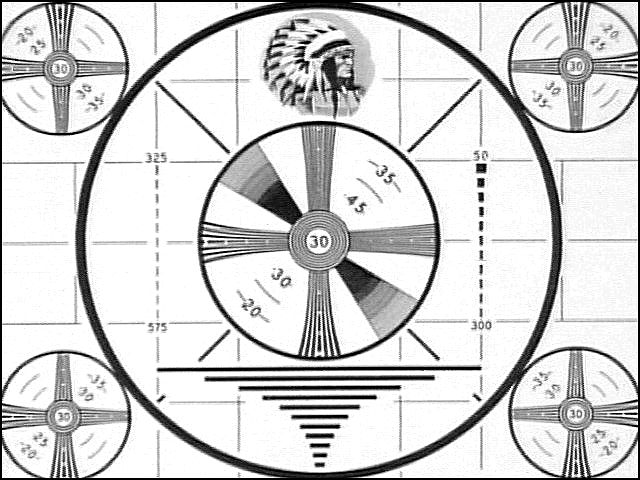
After 11:30 PM each television station would display a graphic like the ones below and issue forth a loud hum or ringing noise. Sometimes I got up way too early and would observe these mysterious symbols and their humming on all three channels. They reminded me of what we might see and hear if Russia attacked us with atomic rockets.
After hours, mysterious symbols hummed on all three channels.
Our favorite shows were on early Saturday morning. In addition to cartoons like Mighty Mouse, we watched The Lone Ranger, the Howdy Doody Show, Buffalo Bill, and Captain Kangaroo.
On weekdays after school, we rushed home to watch the Mickey Mouse Club starring Annette Funicello. I loved Annette completely. She was the only female Mouseketeer to have boobs.
Annette Funicello
Next to Marilyn Monroe — who everybody knew about but no one had ever seen (she wasn’t allowed on television) — Annette Funicello was the most desirable female on planet Earth at that time. But, by fourth grade, a terrible tragedy struck. Though not reported by television or newspapers (kids didn’t read newspapers, anyway), every child somehow learned that Annette had died from bubblegum asphyxiation — a tragedy to rival the Kennedy assassination years later.
Much later — in college during the 1960s — we learned Annette Funicello didn’t die. Media reported that she was alive and well and living somewhere in California.
The knowledge helped to ameliorate the pain of other deaths that were reported in the newspapers and on television back then — John and Bobby Kennedy; Martin Luther King; Malcolm X; Otis Redding; Jimi Hendrix; Janis Joplin; Marilyn Monroe; Che Guevara — and many others. Maybe it was possible, just possible — we hoped against hope — someday, someway — we would learn that these unusual people didn’t die, either.
By my third-grade year, the biggest event in everyone’s lives was the night Elvis Presley appeared on television for the first time — on the Ed Sullivan Show. Everyone — adults and kids alike — dropped everything to see Elvis. Words cannot express how huge this event was in the history of America. Those who didn’t have a television went out and found one. The entire country watched.
Everyone knew about the controversial movements Elvis Presley made with his legs and hips — they were reported in all the magazines and newspapers — but no one could imagine what these moves actuallylooked like. We needed television to show us.
Elvis Presley, 1956
And what did television do? In a spectacle that would be repeated again and again for decades after, television dropped the ball and disappointed its huge viewing audience. The camera focused on Presley’s face and upper body. No one saw his infamous lower-body machinations. After all the psychic energy invested by everyone to finally learn the secrets of this unusual man’s success, television left us wondering.
Elvis sang a song that night we had all heard many times before on the radio: Hound Dog. Seeing the song performed — not just hearing it, like on the radio — was exciting enough to make most everyone forget about what they had missed.
You ain’t nothing but a hound dog — cryin’ all the time. You ain’t nothing but a hound dog — cryin’ all the time. You ain’t never caught a rabbit, and you ain’t no friend of mine. When they said you was high class, well that was just a lie. When they said you was high class, well that was just a lie. You ain’t never caught a rabbit, and you ain’t no friend of mine.
No one who experienced the magic of his television appearance could imagine in their darkest nightmare that someday Elvis would die, too.
On a brighter note: advertising revenue for the show set an all-time record; viewership set an all-time high. It seemed clear to all that television was here to stay.
People seem to think that mathematics is something special — a kind of magic language that when tinkered with properly makes it possible for mortals to unravel mysteries about the universe hitherto known only by God.
I see it differently. Mathematics isn’t a language per se. Although mathematics can be (and is) explained by language, math itself is a collection of rules and symbols that makes it possible to avoid the encumbrances, flourishes, and ambiguities of language. It accomplishes this feat by defining things and their relationships in strictly limited — but important — ways.
Math involves symbols and rules that aren’t explained inside the equations. It is the lackof words that gives math its mysterious and magical reputation. But once everything is defined and understood, applying the contrived but logical rules of mathematics enables folks to manipulate equations to uncover previously hidden and non-intuitive relationships among the things they have defined.
What am I saying exactly? I am saying that it is possible to use words alone to describe the process of solving and manipulating an equation, which can lead to insights into the relationship of the things in the equations. But these words will make the process of computation cumbersome, impractical, and confusing.
Spoken language contains noise and nuances that interfere with the manipulation of carefully defined relationships between narrowly defined variables. Yes, the no-nonsense logic and bare bones precision of mathematics as well as the reduction of things to a few carefully chosen attributes enables mathematicians to apply rules to discover consequences that might otherwise remain undiscovered.
But the tightness of mathematical construction makes it a tool which is almost useless for describing and analyzing many subtle yet vivid experiences of a conscious mind — like beauty, the feel of an orgasm, or the experience of grief. For these realities of conscious experience, mathematics has a reputation for being irrelevant.
Spoken language gives conscious humans the messy modeling mechanism they need to connect with each other to share and understand the more nuanced experiences of life. The messiness and ambiguity of spoken language makes the unique intimacies of human communication possible. Mathematics, despite its elegance, doesn’t do intimacy well.
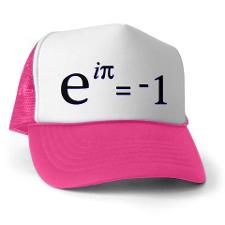
The Euler Identity, illustrated above, is sometimes presented as an example of the mysterious power of mathematics. But if anyone takes the time to think about it, what does the equation say? It says that minus one plus one equals zero.
The explanation is easy. -1can be rewritten as eraised to the power of i times π because of simple rules, which place on a circle of radius 1 all the values of eraised to the ith power times anything.
The number that sits next toi is the angle in radians where the result lies, right? In this case, an angle of π radians (180°) takes the value 1 (at 0°, or 0 radians)to half-way around the circle to the value -1.
Easy… , right?
Despite the reputation of equations for precision, it turns out that physicists and other scientists struggle to make mathematics match the results of real-world measurements. It has to do with the problem of scales, mostly.
The electrical force is a trillion times a trillion times a trillion times greater than the force of gravity at the scale of electrons and protons. At the scale of quarks, it’s one-hundred-thousand times greater still.
It’s one example.
The non-technical public is unaware for the most part that astronomical observations involving the movement of stars, planets, and other celestial bodies — or the results of observations made of the subatomic world (no matter how carefully contrived) — fail as often as not to provide results sufficiently in agreement with mathematics to be of any practical use until they are massaged a little.
Fudge-factors are a big component of doing real science. People have won Nobel prizes for inventing fudge-factor protocols to fix things.
They claim to have good reasons for all the tinkering; it’s complicated down there among the quarks or up there, among the quasars; there are nuances and messiness and ambiguity in the underlying reality of nature that no one can see or fully understand — not now; not anytime soon; perhaps not ever.
At subatomic scales, a tangled mess of virtual particles — which come into and out of existence more or less spontaneously — often gets the blame for the mismatch between mathematical elegance and the cold reality of experimental results.
On the scale of the universe, dark matter and energy (which have yet to be detected or observed) are sometimes blamed for anomalies. Click on the link in this paragraph to learn more.
It’s possible that no system involving mathematics can be contrived by humans to bring the satisfaction of knowing everything for certain; nothing we are able to invent will bring a tranquil end to the pain of cognitive dissonance that seems to drive our species to wonder and explore to find the satisfying answer.
On the other hand, perhaps mathematics is more complex and goes further than we know. Methods may yet be discovered to make mathematics and physics match-up with better accuracy and precision.
Recent work by Cohl Furey and others on numbers known as octonions is showing tantalizing hints that internal properties like the force and charge of particles and their external manifestations like mass and spin are connected in peculiar ways that might be described by a more fully developed mathematics.
Dixon algebra (a combination of four division algebras) is a tool that people are using to collaborate in the search for a path forward. So far, success eludes them. Some experts are hopeful, but many express skepticism.
The more deeply people travel into the complexities of mathematics and science the more elusive truth seems to become; perhaps God is not a mathematician; maybe Einstein was right when he said, God does not play at dice.
A die is cast into the lap, yes, but its decision is from the LORD, according to an old proverb of Solomon.
Can it really be true that understanding the world is beyond the limitations of all life on the earth — beyond the abilities of the most brilliant minds that have lived or ever will live?
Is it possible that the universe cannot be understood by any conscious life anywhere in the universe for all time?