A PERSONAL HISTORY OF TELEVISION, PART ONE

When I was 4 years old, our family lived in Japan.

I have a vivid memory of a dark night when the maid took my brother and me out for a rendezvous with our parents. We stood on concrete steps outside a brick building waiting for them to show up.


The neon sign emitted a bright glow of colors. I’d never seen anything like it.

Beneath the starless sky, almost at eye level, a neon sign emitted a glow of colors. I’d never seen anything like it. I asked our Japanese maid what it was.  It’s television, she said.

The year was 1952. Four years earlier, the first television stations in the United States started to broadcast. But Japan then was a primitive, conquered country. It would be years before television arrived. Our maid didn’t know what she was looking at. Neither did I.  For me televisions continued to be bright neon signs for quite some time.

Here is an excerpt from Wikipedia:

True regular commercial television network programming did not begin in the U.S. until 1948. During that year legendary conductor Arturo Toscanini made his first of ten TV appearances conducting the NBC Symphony Orchestra; Texaco Star Theater, starring comedian Milton Berle, became television’s first hit show. Since the 1950s, television has been the main medium for molding public opinion.


[Not to digress into weeds that might choke a winding river, but during World War II, Italian composer Arturo Toscanini’s daughter  Wally Castelbarco (friend to Russian-born actress Marianned Pistohlkors) and Allen Dulles (CIA director, 1953-1961) engaged in a ”forbidden” sexual affair in Bern, Switzerland (check the correct location and dates).  President Kennedy fired Dulles after the failed 1961 Bay of Pigs invasion of Cuba.  Following Kennedy’s murder in 1963, Allen Dulles sat on the Warren Commission. He died from complications of flu in 1969. Wally is the woman at the far left standing next to her parents.]


Like almost everyone else in America, our family missed the first seven years of broadcast television, including Toscanini’s series. I was born in San Diego in 1948, the year commercial television made its debut. At the time, Americans owned 45,000 television sets — three-quarters of them in the New York City area. (Americans owned 44 million radios.)  In San Diego, what few televisions there were lay locked, most of them, behind laboratory doors.

Mom and Dad didn’t buy our first television until 1955. I was seven.  By then we were living in Bethesda, Maryland where Dad worked for the National Security Agency. At the time, no one knew the NSA existed. It was television, many years later, that brought the secret agency to the public’s attention. 


old television
Touching the television could get you sent to your room, or worse.

Our first television looked a lot like the one pictured above. It was a magical box that, at first, we were not allowed to touch. Touching the television got us sent to our rooms, or worse. Dad delivered a painful nip with his finger to the back of any hand that dared to touch the keen knobs that controlled the TV’s mysterious features. But eventually, especially when Dad wasn’t around, the rest of the family, myself included, became adept at the controls.

The television-set broadcast two channels crisp and clear and one channel with a lot of “snow.” The picture was always black and white, and the stations went dead after 11:30 PM. Of course, we were all in bed well before then. Our parents wouldn’t dream of staying up later. They worked, after all.

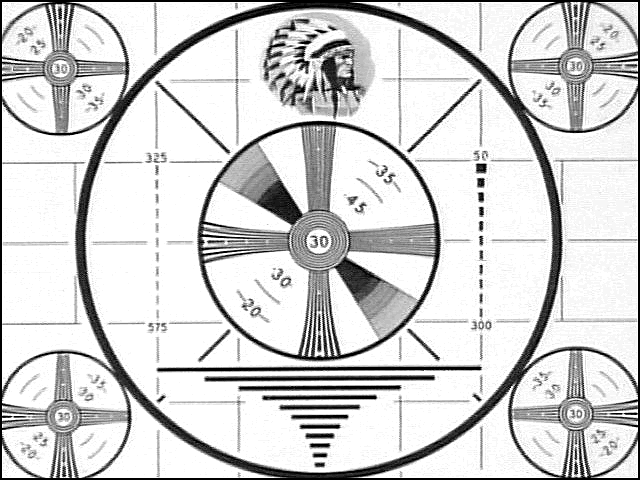
After 11:30 PM each television station would display a graphic like the ones below and issue forth a loud hum or ringing noise.  Sometimes I got up way too early and would observe these mysterious symbols and their humming on all three channels. They reminded me of what we might see and hear if Russia attacked us with atomic rockets.

off air television
After hours, mysterious symbols hummed on all three channels.

off air


Our favorite shows were on early Saturday morning. In addition to cartoons like Mighty Mouse, we watched The Lone Ranger, the Howdy Doody Show, Buffalo Bill, and Captain Kangaroo.  

On weekdays after school, we rushed home to watch the Mickey Mouse Club starring Annette Funicello. I loved Annette completely. She was the only female Mouseketeer to have boobs.


Annette funicello 2
Annette Funicello

Next to Marilyn Monroe — who everybody knew about but no one had ever seen (she wasn’t allowed on television) — Annette Funicello was the most desirable female on planet Earth at that time. But, by fourth grade, a terrible tragedy struck. Though not reported by television or newspapers (kids didn’t read newspapers, anyway), every child somehow learned that Annette had died from bubblegum asphyxiation — a tragedy to rival the Kennedy assassination years later.

Much later — in college during the 1960s — we learned Annette Funicello didn’t die. Media reported that she was alive and well and living somewhere in California.

The knowledge helped to ameliorate the pain of other deaths that were reported in the newspapers and on television back then — John and Bobby Kennedy; Martin Luther King; Malcolm X; Otis Redding; Jimi Hendrix; Janis Joplin; Marilyn Monroe; Che Guevara — and many others. Maybe it was possible,  just possible — we hoped against hope — someday, someway — we would learn that these unusual people didn’t die, either.

By my third-grade year, the biggest event in everyone’s lives was the night Elvis Presley appeared on television for the first time — on the Ed Sullivan Show. Everyone — adults and kids alike — dropped everything to see Elvis. Words cannot express how huge this event was in the history of America. Those who didn’t have a television went out and found one. The entire country watched.

Everyone knew about the controversial movements Elvis Presley made with his legs and hips — they were reported in all the magazines and newspapers — but no one could imagine what these moves actually looked like. We needed television to show us.


Elvis 1956
Elvis Presley, 1956

And what did television do? In a spectacle that would be repeated again and again for decades after, television dropped the ball and disappointed its huge viewing audience. The camera focused on Presley’s face and upper body. No one saw his infamous lower-body machinations. After all the psychic energy invested by everyone to finally learn the secrets of this unusual man’s success, television left us wondering.

Elvis sang a song that night we had all heard many times before on the radio: Hound Dog. Seeing the song performed — not just hearing it, like on the radio — was exciting enough to make most everyone forget about what they had missed.

You ain’t nothing but a hound dog — cryin’ all the time. You ain’t nothing but a hound dog — cryin’ all the time. You ain’t never caught a rabbit, and you ain’t no friend of mine. When they said you was high class, well that was just a lie. When they said you was high class, well that was just a lie. You ain’t never caught a rabbit, and you ain’t no friend of mine.

No one who experienced the magic of his television appearance could imagine in their darkest nightmare that someday Elvis would die, too.

On a brighter note: advertising revenue for the show set an all-time record; viewership set an all-time high. It seemed clear to all that television was here to stay.

Billy Lee

WHAT IS MATH?


math with color


People seem to think that mathematics is something special — a kind of magic language that when tinkered with properly makes it possible for mortals to unravel mysteries about the universe hitherto known only by God.

I see it differently. Mathematics isn’t a language per se. Although mathematics can be (and is) explained by language, math itself is a collection of rules and symbols that makes it possible to avoid the encumbrances, flourishes, and ambiguities of language. It accomplishes this feat by defining things and their relationships in strictly limited — but important — ways.


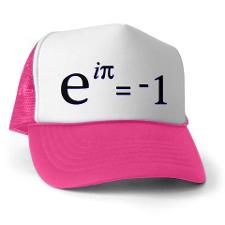
euler formula hatEuler Identity – Khan Academy


Math involves symbols and rules that aren’t explained inside the equations. It is the lack of words that gives math its mysterious and magical reputation. But once everything is defined and understood, applying the contrived but logical rules of mathematics enables folks to manipulate equations to uncover previously hidden and non-intuitive relationships among the things they have defined.

What am I saying exactly? I am saying that it is possible to use words alone to describe the process of solving and manipulating an equation, which can lead to insights into the relationship of the things in the equations. But these words will make the process of computation cumbersome, impractical, and confusing.

Spoken language contains noise and nuances that interfere with the manipulation of carefully defined relationships between narrowly defined variables. Yes, the no-nonsense logic and bare bones precision of mathematics as well as the reduction of things to a few carefully chosen attributes enables mathematicians to apply rules to discover consequences that might otherwise remain undiscovered.

But the tightness of mathematical construction makes it a tool which is almost useless for describing and analyzing many subtle yet vivid experiences of a conscious mind — like beauty, the feel of an orgasm, or the experience of grief. For these realities of conscious experience, mathematics has a reputation for being irrelevant.


euler ring     Euler Identity – Wikipedia


Spoken language gives conscious humans the messy modeling mechanism they need to connect with each other to share and understand the more nuanced experiences of life. The messiness and ambiguity of spoken language makes the unique intimacies of human communication possible. Mathematics, despite its elegance, doesn’t do intimacy well.

The Euler Identity, illustrated above, is sometimes presented as an example of the mysterious power of mathematics. But if anyone takes the time to think about it, what does the equation say?  It says that minus one plus one equals zero.


Complex Plane


The explanation is easy.   -1 can be rewritten as e raised to the power of i times π because of simple rules, which place on a circle of radius 1 all the values of e raised to the ith power times anything.

The number that sits next to i is the angle in radians where the result lies, right?  In this case, an angle of π radians (180°) takes the value 1 (at 0°, or 0 radians) to half-way around the circle to the value -1. 

Easy… , right?

Despite the reputation of equations for precision, it turns out that physicists and other scientists struggle to make mathematics match the results of real-world measurements.  It has to do with the problem of scales, mostly.

The electrical force is a trillion times a trillion times a trillion times greater than the force of gravity at the scale of electrons and protons. At the scale of quarks, it’s one-hundred-thousand times greater still.

It’s one example.

The non-technical public is unaware for the most part that astronomical observations involving the movement of stars, planets, and other celestial bodies — or the results of observations made of the subatomic world (no matter how carefully contrived) — fail as often as not to provide results sufficiently in agreement with mathematics to be of any practical use until they are massaged a little.

Fudge-factors are a big component of doing real science. People have won Nobel prizes for inventing fudge-factor protocols to fix things.

It’s true.

Renormalization, perturbation theory (for phenomenon both small and large), Green’s functions, propagators, Feynman diagrams, and many other adjustments and tweaks make up the contortions and modifications that scientists overlay onto their beautiful equations to make them work.

They claim to have good reasons for all the tinkering; it’s complicated down there among the quarks or up there, among the quasars; there are nuances and messiness and ambiguity in the underlying reality of nature that no one can see or fully understand — not now; not anytime soon; perhaps not ever.

At subatomic scales, a tangled mess of virtual particles — which come into and out of existence more or less spontaneously — often gets the blame for the mismatch between mathematical elegance and the cold reality of experimental results.

On the scale of the universe, dark matter and energy (which have yet to be detected or observed) are sometimes blamed for anomalies. Click on the link in this paragraph to learn more.

It’s possible that no system involving mathematics can be contrived by humans to bring the satisfaction of knowing everything for certain; nothing we are able to invent will bring a tranquil end to the pain of cognitive dissonance that seems to drive our species to wonder and explore to find the satisfying answer.

On the other hand, perhaps mathematics is more complex and goes further than we know. Methods may yet be discovered to make mathematics and physics match-up with better accuracy and precision.

Recent work by Cohl Furey and others on numbers known as octonions is showing tantalizing hints that internal properties like the force and charge of particles and their external manifestations like mass and spin are connected in peculiar ways that might be described by a more fully developed mathematics.

Dixon algebra (a combination of four division algebras) is a tool that people are using to collaborate in the search for a path forward. So far, success eludes them.  Some experts are hopeful, but many express skepticism.

The more deeply people travel into the complexities of mathematics and science the more elusive truth seems to become; perhaps God is not a mathematician; maybe Einstein was right when he said, God does not play at dice.

A die is cast into the lap, yes, but its decision is from the LORD, according to an old proverb of Solomon.

Can it really be true that understanding the world is beyond the limitations of all life on the earth — beyond the abilities of the most brilliant minds that have lived or ever will live?

Is it possible that the universe cannot be understood by any conscious life anywhere in the universe for all time?

If so, it’s time to kneel.

Billy Lee           

SEGREGATION AND THE GATED COMMUNITY

The word community sounds egalitarian to most people. And gated? No word yields a fairer portion of safety to airy openness in the image it conveys to the mind.


Gated community near Orlando, Florida.

Florida is a land flowing with gates and communities. It is a Promised Land of sun, leisure, warm pools, and exclusivity. For the past month Bevy Mae and me have been vacationing inside this paradise at a house in one such community near Naples, Florida. It took three references, photo ID, and all cash up front to get in here.

We are grateful for our good fortune. And we are in a really safe place. But when thinking about the state of affairs which has excluded as many as 94% of all Americans from the possibility of living here — if only for a few weeks — it makes me sick to my stomach.

Of course, if you don’t live here, you can’t be here — not even to drive through.


gated community 2


The compound we live in is huge. While biking in it the other day I was amazed to stumble on another gated community inside ours. It’s blessed by God with a lake and huge houses.

What’s strange is the gated occupants of our community aren’t allowed in their gated community even though their community is inside our community. Apparently, there are layers of gated-ness. I never knew that.

As teenager, I lived two years in Key West, Florida. It was before Civil Rights Act of 1964. It was totally segregated there. The only Negro I ever saw was our maid.

Our housekeeper was an articulate thirty-year-old woman and really beautiful. I liked her a lot and talked with her every chance I got, usually about politics. From her, I learned how difficult life was for black people in Key West at that time — and maybe as important, that a lot of Negroes actually lived on the island. Never knew that, either. Somehow, they managed to keep an extremely low profile. 

She said she supported the incumbent Democrat for Congress who was then running against an upstart Republican — a young guy always on the radio complaining about how rich his opponent was. She liked the Democrat, she said, because he once bought park benches for her neighborhood.


integration segregation


At Key West High School, the powers-that-be were considering the admission of a black kid from a “good” family. His dad was an officer in the U.S. Navy. Over lunch in the school cafeteria, I made the mistake of saying I saw nothing wrong with going to school with “Negroes” (as polite people referred to them).

“What!” some kid yelled. “You want to eat with niggers?”  Soon a crowd gathered. I stood my ground, and no one beat me up. The South was changing, I guess, but only a little.

One thing Key West didn’t have back then — no town did in those days — was gated communities. We had a military base that was gated — I lived on it — but the gates were for security against the hated Communists. We didn’t have terrorists or any other sort of enemies of the state. All that was to come later.

After World War II, the South and some parts of the North enforced segregation with a civilian militia called the Ku Klux Klan. It was a quasi-religious/military-style organization self-tasked with extra-judicial punishments of Negroes who violated the unwritten codes of the South.

I know something about it. My grandfather belonged to the Klan for some years, which he said he regretted. He told me things. Everyone he knew then was in the Klan, and yes, they did things they believed righteous but weren’t. 

If a black family bought a house in a white neighborhood, the militia would burn it down. Sometimes, so as not to smoke-damage nearby homes, the KKK bombed the house; or if white children lived close by, they might burn a cross in the front yard to scare occupants into leaving.

Lynchings — common after the First World War — were, by the 1950s, less common.


Ku Klux Klan


After dozens of documented actions against Negroes — and perhaps hundreds or thousands of undocumented ones — white neighborhoods did not need gates, or walls, or fences to remain segregated.

Eventually, after years of separation, white people who lived in these communities came to believe — many of them — that black people chose not to live next to them, because they preferred “their own kind.”

Terrorism? It didn’t exist in the United States of America in those days. First time I heard the word was in college. Terrorism, then, was always directed at Israel, for some reason, almost always by Palestinians. Reasons why were never clear.

I don’t know what white people say today is the reason black people don’t live in gated communities of Florida. I haven’t vacationed here long enough to learn.

I would bet that in some town somewhere in this huge state a black family probably lives in a gated community. Maybe more than one, right? I can imagine people pointing to those folks as proof of my being uncharitable to the good people of Florida and to people everywhere who live in these spaces.

But it seems plain to me — fifty years after Congress, the President and the Supreme Court declared segregated housing illegal — black people don’t live in these desirable places.

Why is that?

I don’t know.

I met a black man down here the other day. He told me he had been a Marine who helped liberate Kuwait during the first Gulf War.

He cleans the pool.

Maybe, I’ll ask him.

Billy Lee