“C”

NOTE:  The members of the EDITORIAL BOARD are aware that many readers may not have studied physics or astronomy. They might be under the false impression that an article like the one that follows is going to be incomprehensible. 

Nothing could be farther from the truth. Yes, those who have studied Maxwell’s Equations and Einstein’s theories will find his essay a kind of cakewalk. No doubt, eggheads will have issues with some assertions. Submit objections in comments — your head does not have to look like an egg.

WE, THE EDITORS wish to reassure readers — especially those who have yet to study math and science — that they have intelligence and imagination enuf to understand Billy Lee’s basic arguments.

We know Billy Lee. We work with him every day. He talks and tweets a lot but what does he really know? 

Billy Lee likes to share notions with folks who can read. He claims it does no harm. For those who get “high” on science, Billy Lee included videos to make rabbit-hole hopping fun. Don’t be afraid to watch some.

THE EDITORIAL BOARD


UPDATE BY THE EDITORIAL BOARD:  May 15, 2019; Victor T. Toth, the Hungarian software developer, author, and Quora guru of quantum physics wrote, “a photon has no rest mass, but it carries plenty of energy, and it has momentum.  Its stress-energy-momentum tensor is certainly not zero.  So it can be a source of gravity, it has inertia, and it responds to gravity.  […] relativity theory predicts … twice the deflection angle for a photon in a gravitational field than the deflection of a Newtonian particle.”

Almost a century of experiments plus hundreds of upvotes on Quora by physicists seem to validate Victor’s argument. 


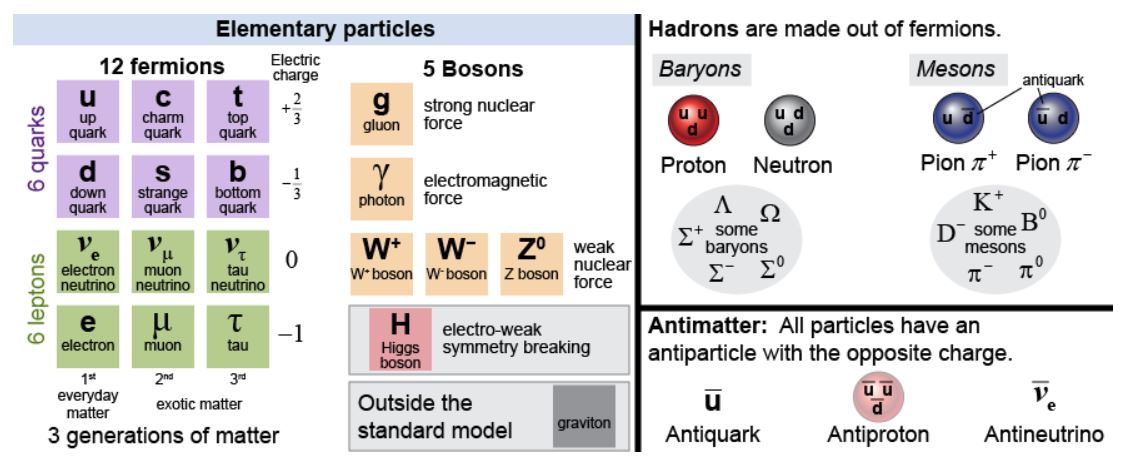
The photon is known to be the only massless, free-moving particle in the Standard Model of physics. Other massless particles are the gluon, the graviton, and of course the Higgs, discovered in 2012 at CERN. Europeans plan to build a Higgs factory to learn more about them. Gluons mediate the strong force. They don’t propagate through empty space.  No one has yet observed even a single graviton. Higgs give fermions like quarks their mass. 

Photons have an electric and magnetic structure. They are electromagnetic pulses of energy that emerge from atoms when electrons drop from a higher energy state to a lower one. When electrons shed energy, a pulse of electromagnetic radiation is emitted — a photon of light.


Click pic for better view in new tab.

Photons of light can be emitted from atoms at different frequencies — colors when wavelengths fall within the narrow range that humans see. These frequencies depend on the energy of electrons, which exist in many differently configured shells (or orbitals) within both atoms and molecules.

Wavelengths of light felt but not seen are called infrared; other invisible frequencies fall into broad categories such as radio waves, microwaves, x-rays, gamma rays and so on — all require instruments to detect.


Electromagnetic radiation is the medium through which humans observe and interact with everything knowable in the universe. Humans live inside an electromagnetic bubble that they are struggling to understand.

One thing most physicists understand is that a disturbing 95% of the energy and mass of the universe comes from a source no one can see. Physicists observe the effects of invisible (dark) matter and invisible (dark) energy by measuring the unusual dynamics of galaxies and by cataloging the physical organization and expansion of the universe itself.


These measurements make no sense unless folks assume that a lot of gravitationally interacting stuff is out there which no one has yet observationally confirmed. The missing mass is not debris or dark stars. The most exaggerated conjectures about how much mass and energy is scattered among the stars won’t come anywhere near enough to explain forces that make galaxies behave strangely.

Dark matter and energy don’t seem to be electromagnetic. Dark matter, if it exists, interacts with the mass of two-trillion galaxies and seems to refract their emitted light. Humans are blind to all of it.

Scientists postulate matter they call WIMPS, MACHOS, axions, and erebons.  Each has a few properties necessary to make the universe work as observed, but none have all the required properties except perhaps erebons, if Roger Penrose’s Conformal Cyclic Cosmology (CCC) is someday verified.

Other candidates for dark matter? — why not sterile neutrinos, GIMPs, and SIMPs

Space-saturating foam of micro-sized black holes is another idea some have proposed. The problem is that theorists believe tiny black holes might be too stable to radiate electromagnetic waves or gravity waves.

Micro-holes lie in a sort of crevice of invisibility — unobservable by LIGO and LISA style gravity-wave sensors, yet too massive for current and future particle-colliders like CERN to create. 

Because micro-holes don’t radiate light at any frequency, light telescopes will never find them. No imagined interaction of micro-holes is able to generate gravity-waves with enough disruptive power in spacetime to be detected. The nature of physics seems to suggest that no technology can be developed to confirm or deny the black-hole foam idea. 

Perhaps the same dilemma faces dark matter detection. We know it exists, but physics says we can never find it. It will always lie just outside our reach doing its work in an invisible universe no one will ever see. 

Worse, not one of the proposed forms of “dark” matter has ever been observed or identified. It is likely that no experiment currently scheduled will detect dark matter, which many physicists believe is “out there” and makes maybe four parts out of five of all the matter in the universe.

It’s an incredible paradox for conscious humans to live in a universe where they are blind to almost every important thing that is happening within and around them.

Humanoids are like fish which spend their lives swimming in streams buried deep inside caves. Spelunkers like me know that certain species of cave fish have no eyes. They lack all ability to see their world — as do we, it seems. As intelligent as people are, they don’t yet build sensors capable of confirming their notions about what the universe might actually be at large scales or small.  

Oh well…  someday maybe new discoveries will make our predicament evaporate away.  The universe will reveal itself to humans, as we knew it would. Our dream to fully understand reality will come true.

Some day.

Scientists have sensible mathematics to show that if electromagnetic particles are massless, they must travel at an upper limit, called c.  Over decades, folks decided that this constant is the speed of a photon in a vacuum; they decided that photons have no internal rest mass and travel in vacuum at a speed limit — the speed of light.

The truth might be more mysterious. No one knows what the upper limit of “c” is, because no one knows with certainty that space is truly empty or that massless particles exist.

When physicists say that certain particles are massless, they sometimes mean that they don’t interact with the Higgs Field, which is known to give mass to fermions, like quarks. They don’t mean they don’t have energy, specifically kinetic energy, which is a form of inertial mass, right? They also aren’t saying photons don’t interact gravitationally. They do, in a special way described by the geodesics of spacetime in Einstein’s General Relativity. 

More on this idea later. 


British physicist Brian Cox wrote in his book  Why Does E = mc2 ?  that the question about whether photons have rest mass is not yet settled.

It’s true that more than a few reasonable people seem to believe that photons traveling freely in the vacuum of space are massless. If they truly are then the permittivity constant “ε” in Maxwell’s equation can be established for electro-magnetic particles (like photons).


The formula below is used to calculate the speed of a massless electromagnetic particle; it is thought to be a maximum speed.


For now, ignore the μ term. It is the permeability (resistance) of vacuum to infusion by a magnetic field, which is determined by experiment. It is sometimes called the magnetic constant.

Epsilon (ε} is the permittivity (resistance) of vacuum to an electric field. It is sometimes called the electric constant.

c” is the so-called ”universal speed limit.” It is called the lightspeed constant

These three numbers — μ, ε, and — help to define the maximum velocity of an electromagnetic wave, which most people believe is the archetypal photon (of light). They assume that the photon packet travels at the maximum allowable speed in a vacuum.

A problem with this view is that no one has proved that space is free; or that space has no weight; or that photons have no rest mass; or that undiscovered particles formed from forces other than electricity and magnetism don’t exist. A few scientists have said that there might be no such things as free space or massless photons. It is also possible that space presents less resistance to other phenomenon yet to be discovered.

The idea that ”dark” matter and energy must exist to make the universe behave the way it does is compelling to many physicists. If true, it is possible — though light travels nearly 300 million meters-per-second — it is not traveling at the maximum speed of a generic, massless particle. The electric constant (ε) might need to be adjusted.

A decrease in the permittivity (resistance) of space (ε) — made obvious by inclusion of vast number of photons in the cosmic microwave background  — drives ”ε” to be smaller and ”c” to be larger, right? 

New particles, dark and as yet undiscovered, might do the same. The consequences could be significant.

Determining the upper speed of a massless particle requires a form of circular reasoning that is currently based on the measurement of the velocity of photons in a vacuum, which is called the speed of light.

The measured velocity of light in a vacuum is now an established constant of nature with a fixed value that doesn’t change regardless of the frame of reference. Modern labs have measured both the frequencies and wavelengths of various colors of light; multiplying the two numbers together always yields the same result — the speed of light.

Knowing the speed of light permits physicists to establish a value for ε by working backwards in the wave equation to solve for the electric permittivity of space. The value of “ε” falls easily from Maxwell’s Equations to a precision of 12 places.

It can’t be any other way. But is it the right way?

Here’s the problem: Physicists have measured mass in photons during experiments at the linear accelerator lab at Stanford University, SLAC.

In superconductors, photon mass has been measured to be as high as 1.2 eV.

Photon mass has been observed in wave guides and in plasmas.

Fact is, photons have inertial mass, which is a measure of their energy as calculated from their wavelengths or frequencies. In relativity theory, energy and mass are measured in the same units, electron-volts, because in the theory, mass and energy are equivalent. 


Click this link to view CLOSER TO TRUTH interview with Raphael Bousso.

Cosmologist, Raphael Bousso, believes that empty space has weight, which is a measure of the cosmological constant, which is a measure of dark energy.

Space seems to be saturated like a sponge with something that gives it energy or force or weight if you will. The weight of empty space determines the size of the universe and some of its fundamental laws. Universes beyond our own with different weights of space can be larger or smaller and obey different rules.

Most physicists agree that photons become massive when they travel through transparent materials like glass, where they slow down by as much as 40%.

The problem is that these observations conflict with both the Heisenberg and the Schrodinger view of quantum mechanics, which is the most tested and confirmed model physicists have. Modern ideas seem to work best when photon mass is placed on the energy side of the mass-energy column. Otherwise, the presence of internal mass suggests that photons can be restrained to a defined size, which drives their momentums to infinity.

The truth is that it is not possible to prove that photons are massless. The stress-energy-momentum tensor in Einstein’s equation of General Relativity implies that photons can be both the source and the object of gravity.  I’m referring to this tensor as “mass” and leaving it there for others to dispute. A rabbit hole for courageous readers to explore is the concept of pseudotensor, which this essay will avoid. 

It is also not true that a photon can never be at rest either.  Lab techs do unusual things with photons during experiments with lasers and superconductors — including slowing photons down and even stopping some (with supercooled helium-4).  Right?

Another problem is the electromagnetic nature of light. The electric part of a light-wave carries enough energy to move an electron up and down. The magnetic part carries the same energy but its motion creates a force that pushes electrons outward in the same direction as the light. It’s why light-sails work in space. Oscillating magnetic fields push light forward. Otherwise, light might stand in one place and simply jiggle. But is light-speed the best magnetic fields can do? 

Electromagnetism could be irrelevant in the search for an upper speed limit “c“, because “c” might prove to be the result of an unknown set of particles with properties outside the current boundaries of the Standard Model. 

Massless particles, — undiscovered ones anyway — might not be electromagnetic. Humans might be biologically unfit to detect them; unable to measure their properties. 

For those who might be rolling their eyes, remember that physicists claim that 95% of the mass and energy required to make the universe behave the way it does is missing. They call the missing stuff “dark” because they can’t find it. Excuse me should anyone catch me rolling my eyes. 

Some theorists have speculated that “dark photons” might exist to help fill in the gaps. The popular TV show How the Universe Works actually repeated the idea in an episode of its latest series. The writers were probably referring to axions, which some physicists propose are similar to photons except that they have mass and are slower moving.

Photons are bosons. They are force carriers for electrons, correct?

Maybe folks should try to accept the notion that nothing in physics prevents bosons like photons from having mass or from taking on mass when they whiz over and through atoms and molecules (in glass and water, for example) where some physicists conjecture, they stimulate the release of polaritons in their wake. Jiggling electrons that lack the energy to jump states emit polaritons, which seem to add enough equivalent mass to photons to slow them down. Think of polaritons as light-matter wavelets

Massive, gravitationally interacting photons are not required to be “dark.”  If photons are the dark matter, axions are unnecessary to solve certain problems both in cosmology and the Standard Model.  No experiment will find them.

I mentioned that three other particles are presumed to be massless: the gluon, the graviton, and the Higgs boson. 

To review, the gluon is not easily observed except in particle colliders where it lives briefly before decaying into other particles; it is confined among the protons and neutrons in the nuclei of atoms. The graviton, on the other hand, has never been observed. The Higgs boson was discovered in 2012. CERN plans to build a Higgs factory someday to explore its properties.

The only particle available to physicists right now that enables them to establish the permittivity of space and compute the velocity of massless particles is the photon.

That’s it.

If the photon has internal mass, i.e., rest mass, everything changes.


Let’s hop into a rabbit hole for a moment and go back a step: What if massless, non-electromagnetic particles mediate entanglement, for example? Wherever paired electrons are found, entanglement rules, right?

Everyone knows that entanglement violates laws of logic and physics. No one can make sense of it.

What if massless non-electromagnetic particles entangle the electromagnetic particles of the subatomic world? If they travel a thousand or ten-thousand times the speed of light, they will present an illusion over short planetary scales that entanglement is instantaneous. No instrument or lab will detect the difference.

What are the consequences if massless non-electromagnetic particles travel at a billion times the speed of light? Maxwell’s equations won’t apply to particles like these. 

Because it seems that speeds of subatomic particles like photons are able to increase as their masses approach zero, it is possible that “c” could be orders of magnitude faster than the speed of a photon — that is, the speed of light — if it turns out that photons harbor tiny but significant rest masses.

I’m not advocating this notion. Let’s crawl out of the rabbit hole. I’m suggesting only that such a state of affairs is possible, because the assumption that photons at rest are massless — that internal mass of photons is always zero — though reasonable and desirable to justify models, is not yet settled according to some physicists.

And there is, of course, the phenomenon of entanglement which no one can explain.

Here’s speculation that should blow the mind of any thinking person: Could photons, if shown to have internal mass, be the stuff that make the galaxies move in the non-intuitive ways they do?

Yes, some physicists argue that the upper limit on the internal (rest mass) of a photon must be less than 10-52 kilograms, which is about 5.6E-17 eV for folks who think that way. (Multiply mass by the speed of light twice to make the conversion and divide by 1.60218E-19 Joules per eV.)

5.6E-17 eV doesn’t seem like much mass at all until folks realize that the minimum number of photons in the universe might be as high as 1090.   This number is ten billion times the number of atoms in the universe. It means that the internal mass contribution from photons alone could easily exceed 1038 kilograms if the upper limit proposed by some is used to perform the calculation.

Do the math, anyone who doesn’t believe it.

Guess what?

Prepare for a letdown.

Based on the conjectured eVs, the mass of all material in the visible universe is in the neighborhood of 1053  kilograms. The video below will help the reader understand how this value and others are calculated. The mass of the visible universe turns out to be 1,000 trillion times more than the conjectured internal mass of all photons.


Think about it.

Is it enough mass to account for the galaxy anomalies seen by astrophysicists?  To any reasonable mind the answer is obviously, no. But this conclusion is not the end of the story. 


Those who study astronomy know that the outer stars in galaxies seem to move at roughly the same speed as the inner. Yet the galaxies aren’t flying apart.

By way of contrast, the planets in solar systems like ours travel slower the farther away they orbit from their sun.  If Neptune orbited as fast as Earth, it would fly away into deep space.

A recalibration to account for the internal mass of photons of light (which seems to always be discounted) does not at first blush offer the gravitational heft that astrophysicists require to make everything on galactic scales fall into place.

The cosmic background radiation — which is nothing more than photons that decoupled close to the beginning of time — saturates the universe like vinegar in a sponge, right?  It is distributed evenly across all space for as far as human-built instruments can see.

The CMB makes an annoying hum in radio telescopes no matter their focus or where they point. Photons with tiny internal masses or no mass at all will have no influence on the understanding by astrophysicists of how the universe behaves.

Neutrinos, which seem to oscillate between three (or perhaps four) as yet undetermined massive states, might at times take on values below the actual mass-value of photons — if photons turn out to be more massive than most believe. The laws of physics require that neutrinos less massive than massive photons, should they exist, must travel superluminally (faster than light).  Agreed?

Several “discredited” observations have reported faster-than-light neutrinos, including the unexpected outcome of the infamous OPERA experiment, which inspectors eventually blamed on a loose fiber-optic cable that was ever-so-slightly longer than it should have been.  

OK.  It seems reasonable.  Who can argue?

Scientists who believe that superluminal neutrinos actually exist don’t speak up, perhaps out of fear for their careers. They probably couldn’t get their opinions published anyway, right?

Click pic for better view in new tab.

Crackpot ideas that later prove valid is how science sometimes works. It’s how science has become the mess that it is — a chaos of observations that can’t make sense out of 95% of what is going on all around; a plethora of experimental results that don’t quite match the work of theorists.

The super-brilliant people who paint the mathematical structures of ultimate reality rely on physicists to smear their masterworks with the muds of perturbation, renormalization, and a half dozen other incomprehensible substrates to get the few phenomenon folks think they understand to look right and make sense. Theory and experiment don’t seem to match-up as well as some folks think they should more times than not.

A minor recalibration based on the acceptance of photons as quantum objects with tiny, almost unmeasurable masses will not change ideas about the nature of the universe and what is possible, because the upper-bound on photon masses might be undervalued — perhaps by a factor of billions.


Theorists like Nima Arkani-Hamed work on abstract geometries called amplituhedrons to salvage notions of massless particles while simplifying calculations of scattering probabilities in quantum mechanics. It seems to me like hopeless adventures doomed to fail. But in fairness so did Columbus’s exploration for new worlds.

To be a serious candidate for dark matter, a typical microwave photon should have an average mass of nearly .05 eV (electron volts), which is about 9 x 10-38 kilograms. If multiplied by the number of photons ( 1090 ), the photon masses add almost miraculously to become 85% of the theoretical mass of the universe.

(1E90)*(9E-38) = 9E52.  (9E52) / .85 = 1E53 kg. 

It’s the same number conjectured by dark-matter advocates. 

To qualify for dark matter means that a typical or average photon must have close to one ten-millionth of the mass of an electron.

Only then does everything fall into place like it should.

Pull out the calculator, anyone who doesn’t believe it.


Einstein, in his famous 1905 paper on special relativity, showed that mass is equivalent to the energy of an object divided twice by a constant, which is “c” squared, right?

Later, he added a second term to the internal energy of a particle which is its inertial energy, pc2 . Simplified, this term equals hf for a massless photon. The total energy of any object is the square root of the sum of its internal energy and its inertial energy. 

E = \sqrt {(mc^2)^2 + (pc)^2}

If Einstein is taken at his word, then the inertial mass of a photon is a function of its characteristic frequency — i.e. the inertial mass of a photon is equal to 

\frac{hf}{c^2}

where “h” is the Planck constant and “c” is the speed of light. The internal mass, should any exist, can be discounted. 

An argument can be made from Einstein’s equations that the mass of a photon might be \sqrt {2} times larger. A factor of 1.414… won’t change the argument. It strengthens the point but is, in the end, not important enough to include in an article that is already overly long. Curious readers can review the reasoning in my essay General & Special Relativity

If the average photon has an inertial mass of .05 eV, it requires that — all else being equal — the combined photon energy in a non-expanding universe would lie in the range of infrared light, a frequency in this case of 12E12 Hz, which is sometimes referred to as far-infrared.

(Set equivalent-mass equal to .05 eV (8.9E-38 kilograms) and solve for frequency.) The frequency approaches the lower energy microwave part of the light spectrum. 

Note:  For perspective, one eV is the energy (or mass equivalent) of a near-infrared photon of frequency 242E12 Hz, which approaches from below the higher-energy visible-light part of the light spectrum. 

The mass equivalence of the inertial energy of 1E90 infrared photons is sufficient to hold the universe together to prevent runaway expansion caused by repulsion due to the gravity constant Λ in Einstein’s equation for General Relativity. 

Do the math.

I know what some people might be thinking: Didn’t the 29 May 1919 solar eclipse, which enabled observers to confirm Einstein’s theory of General Relativity, demonstrate that photons lack internal mass?  Didn’t Eddington’s experiment prove wrong Newton’s idea that photons, which he called corpuscles, were massive objects? 

Maybe. Maybe not.  Maybe internal mass isn’t necessary. There is enough energy in the inertial term of Einstein’s equation to yield the required mass.

Unlike massive particles where internal energy far outweighs inertial energy, for photons, inertial energy is dominant. Even if science admits to a small amount of internal mass in photons, it is their inertial energy that dominates.

I found a good mathematical argument for light mass on Quora by Kyle Lochlann, an academic in relativity theory. Here is the link:

PHOTON MASS

Be sure to read comments to his answer — especially those who find math incomprehensible, which might be nearly everyone who reads my blog. 

After all, Newton’s theory of gravity predicted that the light from stars would deflect near the Sun at only half what Eddington’s experiment clearly showed. Eddington’s eclipse proved Einstein’s theory — the geodesics of spacetime bend in the presence of massive objects like stars.

Many concluded that photons followed the geodesics of spacetime, because photons lacked mass equivalence of any kind. Newton erred about pretty much everything involving gravity and light, some said.  

But their conclusion can’t be right, can it? Doesn’t their conclusion ignore what the math of Einstein’s formulas actually says?


Won’t it make more sense to say that the geodesics of spacetime constrain and overwhelm whatever internal and inertial mass photons might possess?  Doesn’t it make more sense to convert the frequency-related inertial energy of photons to mass to better explain their behavior near objects like the Sun? 

Evidence exists that light-mass is a thing and that it matters. Einstein included a mass-equivalence term for light in his tensors for general relativity. Frank Wilczek, MIT Nobel laureate, is famous for insisting that the mass of anything at all is its energy content. The energy of light is in its frequency, its momentum, which is a measure of its mass. 

It’s true that light does not seem to interact with the Higgs field. Nevertheless, the energy of light seems to interact gravitationally with ordinary matter. The interaction is not measurable when photon numbers are small. When photon numbers are huge, perhaps it is.  

A single photon in the presence of the Sun has no chance. When 10E90 photons saturate a space that is almost entirely devoid of matter, photons can shape a universe — especially when their number is 10 billion times the number of atoms. 

It seems possible, at least to me.

According to data gathered by the NASA WMAP satellite, ordinary matter in the observable universe amounts to a little more than 1/4 of a neutron per cubic meter of space. It amounts to 253.33E6 electron-volts of mass. Everything else WMAP observed was “cold dark matter” and “dark energy”.

How many .05 eV photons does it take to flood a cubic meter of space with enough mass-equivalence to reduce the mass-energy of 1/4 of a neutron to 15% of the total? How many photons are required to sum to 85% of the energy WMAP attributed to “cold dark matter”? It turns out that the number is 34 billion photons per cubic meter. 

The question is: how many photons are there? 

The observable universe has an estimated volume in the neighborhood of 1E80 cubic meters, right? Yes, it might be as much as 4 times that number. 

The lower-bound number of photons in the observable universe is 1E90. It might be ten times more.

It turns out that the number photons per cubic meter in the universe must be somewhere close to 25 billion.  25 is pretty darn close to 34. Since all the numbers are estimates with large margins of error, it’s possible that everything will fall into place as it should if and when the statistics of the universe are ever known with precision.

Could photons of light might be the “cold” dark matter everyone is searching for?

A single neutron has no chance when it is bathed in 136 billion .05 eV photons, which surround and envelop it on all sides from every direction. It makes a kind of quantum scale Custer’s Last Stand for random neutrons, right? 

When scientists look at the universe today, they see an accelerating expansion. They see in the cosmic background radiation photons that have slipped from infrared into longer, less energetic microwave wavelengths which no longer have enough mass-equivalence to hold the universe together.

As light stretches into longer and longer wavelengths through interaction mechanisms such as Compton scattering and other processes (like the push of “dark energy” or the less popular gravitational tug of parallel universes), light frequencies and energies diminish.

Eventually, when the total of all light falls below an average frequency of 12E12, the equivalent mass of the 1E90 primordial photons loses its grip; it becomes unable to hold the universe together.

Near the beginning of time when photons were orders-of-magnitude higher in frequency than now, their stronger gravitationally-equivalent-masses pulled together the structures astronomers study today, like stars and galaxies.


But now scientists seem to be witnessing a runaway expansion of the universe. Light has stretched and dimmed into the microwave and radio-wave frequencies where its mass-equivalence is unable to hold together the universe as it once was.

Because we can’t detect it, isn’t it possible that dark energy and dark matter don’t exist? That is to say, the idea that dark matter and energy are necessary to account for observations is no more than a conjecture made necessary by a misbehaving universe of unusual galaxies. But direct observational evidence for dark matter and energy is the part of the conjecture that is missing. No one has ever seen any.

What astronomers are observing instead is faraway galaxies that existed billions of years ago when the mass-equivalent energy of photons was greater than it is now.

The intact universe of galaxies seen in the night sky today, which is photographed with high-resolution space-borne telescopes, is not up to date in any sense at all, except that it is the view of an ancient past that goes back almost to the beginning of time depending on how deep into space anyone looks.

Everyone who cares about astronomy knows it’s true.

To qualify as a candidate for dark matter means that a photon must have close to one ten-millionth of the mass of an electron. It seems like a reasonable ratio, right?

In the Standard Model, only neutrinos are less massive than electrons. No one knows what the mass of each of the three “flavors” of neutrinos is, but when added they are less than 0.12 eV — about 2.4 times the equivalent-mass of infrared photons and about one four-millionth of the mass of electrons. It seems possible to me that the mass of at least one of the flavors of neutrinos will be less than the conjectured equivalent-mass of an infrared photon packet.

Neutrons and protons are, by contrast, 2,000 times “heavier” than electrons.

I am asking working physicists to reexamine estimates that claim the mass of a photon can be no more than trillions of times less than the mass of an electron.

The claim can be found at the back of articles in science journals as well as in blogs across the internet. For me, the idea seems ridiculous on its face. The energy-equivalent mass of photons varies with frequency, but only the lowest energy radio wave photons can hope to approach the low equivalent-mass estimated in the latest publications.

Scientists might want to revisit the mass of a photon and the methodology of its measurement. The stakes are high, and science doesn’t have many options. Hope — like the energy of ancient photons — is fading.


Science would be served best if scientists started from scratch to reexamine every assumption and lab procedure. The search for dark matter has become an expensive and compulsive quest that seems futile, at least to me. Several costly experiments have reached disappointing dead ends, which are reviewed in the “VICE on HBO” video located near the start of this essay.

What if photons of light really are the dark matter, which is hiding in plain sight waiting to be discovered by anyone who dares to look at the problem with fresh eyes?

What if the delay between the observations of the CMB (cosmic microwave background) and the structure of the universe is a natural disconnect in time and space that misleads folks to believe that mass must be “out there”, when it has in fact long since dissipated?

From another perhaps opposite perspective, what if photons are instead stimulating emissions from virtual particles as they travel at fantastic speeds through the vastness of space? What if these emissions add mass to photons sufficient to bring them to the “dark matter” threshold, as they do in materials like glass?

Such a state of affairs would imply that not all photons travel the same speed in the so-called vacuum of “empty” space. It is a heretical idea, for sure — a can of worms, perhaps to some, but hey! — you can catch a lot of fish with a can of worms.

A photon is a packet of electromagnetic oscillations built-up from many frequencies. Superposition of these frequencies adds to give a photon its characteristic frequency from which its equivalent mass can be calculated. Right?

Use imagination to think of the many ways a higher “speed limit” that is mandated by the existence of massive photons might work to stimulate the interest of a space-traveling civilization to explore the universe, which ordinary folks begin to understand is more accessible, more reachable than anyone thought possible.

Consider the number of inexplicable phenomena that would make sense if particles thought to have zero internal mass don’t really exist, and photons, gluons, gravitons, and Higgs bosons aren’t the only ones.

Recalibration might save a lot of time and effort in the search for the putative missing energy and mass of the universe.

Should “dark” particles exist whose internal mass is less than that of photons, they will likely move at superluminal speeds that make them difficult to track. To influence stars, their number would have to dwarf photons. Such an idea strains credulity.

A counterproposal by Roger Penrose speculates that dark matter particles might have the mass of the eye of a flea; he calls them “erebons.” These particles are electromagnetically invisible, but their huge masses relative to other particles in the Standard Model make them gravitationally compelling.

Erebons decay; evidence for their decay should be showing up in data collected by LIGO detectors.

So far persuasive evidence for erebons has not been found.


For scientists and explorers, the access-barrier to a universe shaped and configured by massive photons will most certainly shrink — perhaps thousands to millions of times.

The stars and galaxies that people believed were unreachable might finally fall within our grasp.

Or — perhaps less optimistically and more cynically — the mass-equivalent energy of 1E90 photons might by now be so severely degraded that nothing can save a universe that has already come undone and flown away into an abyss that humans will never see.

The radiation-evidence from a catastrophe of disintegrating galaxies that has already occurred won’t reach Earth-bound viewers for perhaps billions of years.

Should humans survive, our progeny — many millions or billions of years from now — may “see” in the vastness of space a cold and diminished radio-wave radiation that hums in a soul-less vacuum devoid of galaxies and visible light.  Microwave light will by then be nothing more than a higher-pitched, prehistoric memory.

Roger Penrose says that the fluid dynamics of an exhausted universe devoid of matter will become indistinguishable from the singularity that gave its start. A new universe will ignite from the massless, radiation-ashes of the old.

The idea is called Conformal Cyclic Cosmology — or CCC

Human-nature forces us to want to know more; most folks want to search for and find the answers to the questions that will determine the fate of all life on Earth and in the vast stretches of spacetime that remain beyond our reach.

Is the universe within our grasp, or has it already disintegrated?

We search for truth to set ourselves free.

Billy Lee

FINE-STRUCTURE CONSTANT

What is the fine-structure constant?


Many smart physicists wonder about it; some obsess over it; a few have gone mad. Physicists like the late Richard Feynman said that it’s not something any human can or will ever understand; it’s a rabbit-hole that quantum physicists must stand beside and peer into to do their work; but for heaven’s sake don’t rappel into its depths. No one who does has ever returned and talked sense about it.

I’m a Pontificator, not a scientist. I hope I don’t start to regret writing this essay. I hope I don’t make an ass of myself as I dare to go where angels fear to tread.

My plan is to explain a mystery of existence that can’t be explained — even to people who have math skills, which I am certain most of my readers don’t. Lack of skills should not trouble anyone, because if anyone has them, they won’t understand my explanation anyway.

My destiny is failure. I don’t care. My promise, as always, is accuracy. If people point out errors, I fix them. I write to understand; to discover and learn.

My recommendation to readers is to take a dose of whatever medicine calms their nerves; to swallow whatever stimulant might ignite electrical fires in their brains; to inhale, if necessary, doctor-prescribed drugs to amplify conscious experience and broaden their view of the cosmos. Take a trip with me; let me guide you. When we’re done, you will know nothing about the fine-structure constant except its value and a few ways curious people think about it.

Oh yes, we’re going to rappel into the depths of the rabbit-hole, I most certainly assure you, but we’ll descend into the abyss together. When we get lost (and we most certainly will) — should we fall into despair and abandon our will to fight our way back — we’ll have a good laugh; we’ll cry; we’ll fall to our knees; we’ll become hysterics; we’ll roll on the soft grass we can feel but not see; we will weep the loud belly-laugh sobs of the hopelessly confused and completely insane — always together, whenever necessary.


spelunkers-caving-rabbit-hole-fine-structure
We will get lost together. This rabbit-hole is the Krubera Cave of Abkhazia land. It is the deepest cave in the world. Notice the tiny humans, for scale.

Isn’t getting lost with a friend what makes life worth living? Everyone gets lost eventually; it’s better when we get lost together. Getting lost with someone who doesn’t give a care; who won’t even pretend to understand the simplest things about the deep, dark places that lie miles beyond our grasp; that lie beneath our feet; that lie, in some cases, just behind our eyeballs; it’s what living large is all about.

Isn’t it?


Well, for those who fear getting lost, what follows is a map to important rooms in the rather elaborate labyrinth of this essay. Click on subheadings to wander about in the caverns of knowledge wherever you will. Don’t blame me if you miss amazing stuff.  Amazing is what hides within and between the rooms for anyone to discover who has the serenity to take their time, follow the spelunking Sherpa (me), and trust that he (me) will extricate them eventually — sane and unharmed.  

1 — Complex Numbers, Probabilities, and Vectors
2 — Elementary particles
3 — Coupling constants
4 — Irrational numbers and music 
5 — Gravity and Relativity 
6 — Fine Structure: What is it, exactly?
7 — Mystic and numerology secrets of 137
8 — Why alpha (α)?
9 — Twelve whys for alpha (α) 
10 — Deepest mystery 
11 — Summary
12 — Avoiding the rabbit hole


Anyway, relax. Don’t be nervous. The fine-structure constant is simply a number — a pure number. It has no meaning. It stands for nothing — not inches or feet or speed or weight; not anything. What can be more harmless than a number that has no meaning?

Well, most physicists think it reveals, somehow, something fundamental and complicated going on in the inner workings of atoms — dynamics that will never be observed or confirmed, because they can’t be. The world inside an atom is impossibly small; no advance in technology will ever open that world to direct observation by humans.

What physicists can observe is the frequencies of light that enormous collections of atoms emit. They use prisms and spectrographs. What they see is structure in the light where none should be. They see gaps — very small gaps inside a single band of color, for example. They call it fine structure.

The Greek letter alpha (α) is the shortcut folks use for the fine-structure constant, so they don’t have to say a lot of words. The number is the square of another number that can have (and almost always does have) two or more parts — a complex number. Complex numbers have real and imaginary parts; math people say that complex numbers are usually two dimensional; they must be drawn on a sheet of two dimensional graph paper — not on a number line, like counting numbers always are.

Don’t let me turn this essay into a math lesson; please, …no. We can’t have readers projectile vomiting or rocking to the catatonic rhythms of a panic attack. We took our medicines, didn’t we? We’re going to be fine.

I beg readers to trust; to bear with me for a few sentences more. It will do no harm. It might do good. Besides, we can get through this, together.

Like me, you, dear reader, are going to experience power and euphoria, because when people summon courage; when they trust; when they lean on one another; when — like countless others — you put your full weight on me; I will carry you. You are about to experience truth, maybe for the first time in your life. Truth, the Ancient-of-Days once said, is that golden key that unlocks our prison of fears and sets us free.

Reality is going to change; minds will change; up is going to become down; first will become last and last first. Fear will turn into exhilaration; exhilaration into joy; joy into serenity; and serenity into power. But first, we must inner-tube our way down the foamy rapids of the next ten paragraphs. Thankfully, they are short paragraphs, yes….the journey is do-able, peeps. I will guide you.

The number (3 + 4i) is a complex number. It’s two dimensional. Pick a point in the middle of a piece of graph paper and call it zero (0 + 0i). Find a pencil — hopefully one with a sharp point. Move the point 3 spaces to the right of zero; then move it up 4 spaces. Make a mark. That mark is the number (3 + 4i). Mathematicians say that the “i” next to the “4” means “imaginary.” Don’t believe it.

They didn’t know what they were talking about, when first they worked out the protocols of two-dimensional numbers. The little “i” means “up and down.” That’s all. When the little “i” isn’t there, it means side to side. What could be more simple?

Draw a line from zero (0 + 0i) to the point (3 + 4i). The point is three squares to the right and 4 squares up. Put an arrow head on the point. The line is now an arrow, which is called a vector. This particular vector measures 5 squares long (get out a ruler and measure, anyone who doesn’t believe).

The vector (arrow) makes an angle of 53° from the horizontal. Find a protractor in your child’s pencil-box and measure it, anyone who doubts. So the number can be written as (5∠53), which simply means it is a vector that is five squares long and 53° counter-clockwise from horizontal. It is the same number as (3 + 4i), which is 3 squares over and 4 squares up.

The vectors used in quantum mechanics are smaller; they are less than one unit long, because physicists draw them to compute probabilities. A probability of one is 100%; it is certainty. Nothing is certain in quantum physics; the chances of anything at all are always less than certainty; always less than one; always less than 100%.


multiply-complex-numbers-fine-structure
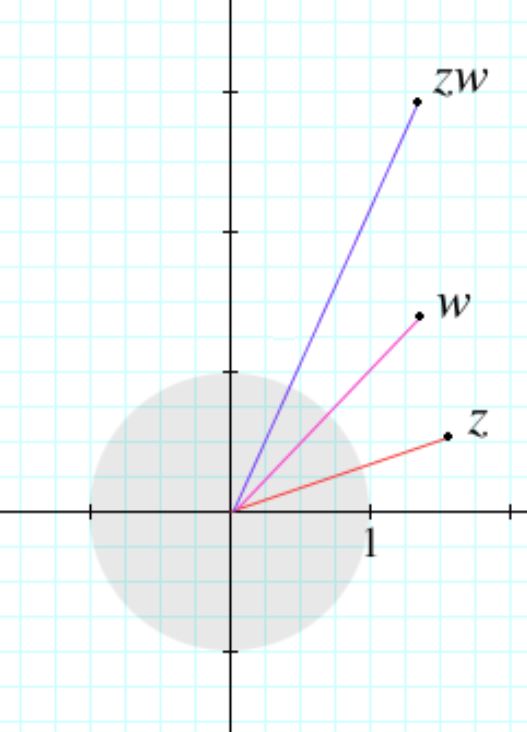
To multiply the vectors Z and W, add their angles and multiply their lengths. The vector ZW is the result; its overall length is called its amplitude. When both vectors Z and W are shorter than the side of one square in length, the vector ZW will become the shortest vector, not the longest (as it is in this example), because multiplying fractions together always results in a fraction that is less than the fractions that were multiplied. Right? To calculate what is called the probability density, simply multiply the length of the amplitude vector by itself, which will shrink it further, because its length (called its magnitude) is always a fraction that is less than one in quantum probability problems. This operation is called ‘’the Born Rule” where the magnitude of an amplitude is squared; it reduces a two-dimensional complex number to a one-dimensional unit-less number, which is — as said before — a probability. Experiments with electrons and photons must be performed to reveal interaction amplitude values; when these numbers are squared, the fine structure constant is the result. The probability density is a constant. That by itself is amazing.

Using simple rules, a vector that is less than one unit long can be used in the mathematics of quantum probabilities to shrink and rotate a second vector, which can shrink and rotate a third, and a fourth, and so on until the process of steps that make up a quantum event are completed. Lengths are multiplied; angles are added. The rules are that simple. The overall length of the resulting vector is called its amplitude.

Yes, other operations can be performed with complex numbers; with vectors. They have interesting properties. Multiplying and dividing by the “imaginary” i rotates vectors by 90°, for example. Click on links to learn more. Or visit the Khan Academy web-site to watch short videos. It’s not necessary to know how everything works to stumble through this article.

The likelihood that an electron will emit or absorb a photon cannot be derived from the mathematics of quantum mechanics. Neither can the force of the interaction. Both must be determined by experiment, which has revealed that the magnitude of these amplitudes is close to ten percent (.085424543… to be more exact), which is about eight-and-a-half percent.

What is surprising about this result is that when physicists multiply the amplitudes with themselves (that is, when they “square the amplitudes“) they get a one-dimensional number (called a probability density), which, in the case of photons and electrons, is equal to alpha (α), the fine-structure constant, which is .007297352… or 1 divided by 137.036… .

Get out the calculator and multiply .08524542 by itself, anyone who doesn’t believe. Divide the number “1” by 137.036 to confirm.

From the knowledge of the value of alpha (α) and other constants, the probabilities of the quantum world can be calculated; when combined with the knowledge of the vector angles, the position and momentum of electrons and photons, for example, can be described with magical accuracy — consistent with the well-known principle of uncertainty, of course, which readers can look up on Wikipedia, should they choose to get sidetracked, distracted, and hopelessly lost.

Magical” is a good word, because these vectors aren’t real. They are made up — invented, really — designed to mimic mathematically the behavior of elementary particles studied by physicists in quantum experiments. No one knows why complex vector-math matches the experimental results so well, or even what the physical relationship of the vector-math might be (if any), which enables scientists to track and measure tiny bits of energy.

To be brutally honest, no one knows what the “tiny bits of energy” are, either. Tiny things like photons and electrons interact with measuring devices in the same ways the vector-math says they should. No one knows much more than that.

And no one knows the reasons why. Not even the late Richard Feynman knew why the methods of quantum chromodynamics (QCD) and the methods of quantum electrodynamics (QED) — which he invented and for which he won a Nobel Prize in 1965 — worked.

What is known is that the strong force of QCD is 137 times stronger than the electromagnetic force of QED — inside the center of atoms. Multiply the strong force by (α) to get the EM force.  No one knows why.

There used to be hundreds of tiny little things that behaved inexplicably during experiments. It wasn’t only tiny pieces of electricity and light. Physicists started running out of names to call them all. They decided that the mess was too complicated; they discovered that they could simplify the chaos by inventing some new rules; by imagining new particles that, according to the new rules, might never be observed; they named them quarks.

By assigning crazy attributes (like color-coded strong forces) to these quarks, they found a way to reduce the number of elementary particles to seventeen; these are the stuff that makes up the so-called Standard Model. The model contains a collection of neutrons and muons; and quarks and gluons; and thirteen other things — researchers made the list of subatomic particles shorter and a lot easier to organize and think about.

Some particles are heavy, some are not; some are force carriers; one — the Higgs — imparts mass to the rest. The irony is this: none are particles; they only seem to be because of the way we look at and measure whatever they really are. And the math is simpler when we treat the ethereal mist like a collection of particles instead of tiny bundles of vibrating momentum within an infinite continuum of no one knows what.


feynman-diagram
Feynman diagrams help physicists think about what’s going on without getting bogged down in the mathematical details of subatomic particle interactions. View video below for more details. Diagram protocols start at 12:36 into the video. 

Physicists have developed protocols to describe them all; to predict their behavior. One thing they want to know is how forcefully and in which direction these fundamental particles move when they interact, because collisions between subatomic particles can reveal clues about their nature; about their personalities, if anyone wants to think about them that way.

The force and direction of these collisions can be quantified by using complex (often three-dimensional) numbers to work out between particles a measure during experiments of their interaction probabilities and forces, which help theorists to derive numbers to balance their equations. These balancing numbers are called coupling constants.


The fine-structure constant is one of a few such coupling constants. It is used to make predictions about what will happen when electrons and photons interact, among other things. Other coupling constants are associated with other unique particles, which have their own array of energies and interaction peculiarities; their own amplitudes and probability densities; their own values. One other example I will mention is the gravitational coupling constant.

To remove anthropological bias, physicists often set certain constants such as the speed of light (c), the reduced Planck constant () , the fundamental force constant (e), and the Coulomb force constant (4πε) equal to “one”. Sometimes the removal of human bias in the values of the constants can help to reveal relationships that might otherwise go unnoticed.

The coupling constants for gravity and fine-structure are two examples.

{\alpha}_g = m_e^2  for gravity;

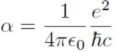
\alpha = e^2  for fine-structure.

These relationships pop-out of the math when extraneous constants are simplified to unity.

Despite their differences, one thing turns out to be true for all coupling constants — and it’s kind of surprising. None can be derived or worked out using either the theory or the mathematics of quantum mechanics. All of them, including the fine-structure constant, must be discovered by painstaking experiments. Experiments are the only way to discover their values.

Here’s the mind-blowing part: once a coupling constant — like the fine-structure alpha (α) — is determined, everything else starts falling into place like the pieces of a puzzle.

The fine-structure constant, like most other coupling constants, is a number that makes no sense. It can’t be derived — not from theory, at least. It appears to be the magnitude of the square of an amplitude (which is a complex, multi-dimensional number), but the fine-structure constant is itself one-dimensional; it’s a unit-less number that seems to be irrational, like the number π.

For readers who don’t quite understand, let’s just say that irrational numbers are untidy; they are unwieldy; they don’t round-off; they seem to lack the precision we’ve come to expect from numbers like the gravity constant — which astronomers round off to four or five decimal places and apply to massive objects like planets with no discernible loss in accuracy. It’s amazing to grasp that no constant in nature, not even the gravity constant, seems to be a whole number or a fraction.

Based on what scientists think they know right now, every constant in nature is irrational. It has to be this way.

Musicians know that it is impossible to accurately tune a piano using whole numbers and fractions to set the frequencies of their strings. Setting minor thirds, major thirds, fourths, fifths, and octaves based on idealized, whole-number ratios like 3:2 (musicians call this interval a fifth) makes scales sound terrible the farther one goes from middle C up or down the keyboard.


Jimi Hendrix, a veteran of the US Army’s 101st Airborne Division, rose to mega-stardom in Europe several years before 1968 when it became the American public’s turn to embrace him after he released his landmark album, Electric Ladyland. Some critics today say that Jimi remains the best instrumentalist who has ever lived. Mr. Hendrix achieved his unique sound by using non-intuitive techniques to tune and manipulate string frequencies. Some of these methods are described in the previous link. It is well worth the read.

No, in a properly tuned instrument the frequencies between adjacent notes differ by the twelfth root of 2, which is 1.059463094…. . It’s an irrational number like “π” — it never ends; it can’t be written like a fraction; it isn’t a ratio of two whole numbers.

In an interval of a major fifth, for example, the G note vibrates 1.5 times faster than the C note that lies 7 half-steps (called semitones) below it. To calculate its value, take the 12th root of two and raise it to the seventh power. It’s not exactly 1.5. It just isn’t.

Get out the calculator and try it, anyone who doesn’t believe.


[Note from the Editorial Board: a musical fifth is often written as 3:2, which implies the fraction 3/2, which equals 1.5. Twelve half-notes make an octave; the starting note plus 7 half-steps make 8. Dividing these numbers by four makes 12:8 the same proportion as 3:2, right? The fraction 3/2 is a comparison of the vibrational frequencies (also of the nodes) of the strings themselves, not the number of half-tones in the interval.

However, when the first note is counted as one and flats and sharps are ignored, the five notes that remain starting with C and ending with G, for example, become the interval known as a perfect fifth. It kind of makes sense, until musicians go deeper; it gets a lot more complicated. It’s best to never let musicians do math or mathematicians do music. Anyone who does will create a mess of confusion, eight times out of twelve, if not more.]


An octave of 12 notes exactly doubles the vibrational frequency of a note like middle C, but every note in between middle C and the next higher octave is either a little flat or a little sharp. It doesn’t seem to bother anyone, and it makes playing in large groups with different instruments possible; it makes changing keys without everybody having to re-tune their instruments seem natural — it wasn’t as easy centuries ago when Mozart got his start.

The point is this:

Music sounds better when everyone plays every note a little out of tune. It’s how the universe seems to work too.

Irrationality is reality. It works just fine.

As for gravity, it works in part because space-time seems to curve and weave in the presence of super-heavy objects. No particle has ever been found that doesn’t follow the curved space-time paths that surround massive objects like our Sun.


Notice the speed of the hands of the clocks and how they vary in space-time. Clocks slow down when they are accelerated or when they are immersed in the gravity of a massive object, like the star at the center of this GIF. Click on it for a better view.

Even particles like photons of light, which in the vacuum of space have no mass (or electric charge, for that matter) follow these curves; they bend their trajectories as they pass by heavy objects, even though they lack the mass and charge that some folks might assume they should to conduct an interaction.

Massless, charge-less photons do two things: first, they stay in their lanes — that is they follow the curved currents of space-time that exist near massive objects like a star; they fall across the gravity gradient toward these massive objects at exactly the same rate as every other particle or object in the universe would if they found themselves in the same gravitational field.

Second, light refracts in the dielectric of a field of gravity in the same way it refracts in any dielectric—like glass, for example. The deeper light falls into a gravity field, the stronger is the field’s refractive index, and the more light bends. 

Measurements of star-position shifts near the edge of our own sun helped prove that space and time are curved like Einstein said and that Isaac Newton‘s gravity equation gives accurate results only for slow moving, massive objects.

Massless photons traveling from distant stars at the speed of light deflect near our sun at twice the angle of slow-moving massive objects. The deflection of light can be accounted for by calculating the curvature of space-time near our sun and adding to it the deflection forced by the refractive index of the gravity field where the passing starlight is observed. 


In the exhilaration of observations by Eddington during the eclipse of 1919 which confirmed Einstein’s general theory, Einstein told a science reporter that space and time cannot exist in a universe devoid of matter and its flip-side equivalent, energy. People were stunned, some of them, into disbelief. Today, all physicists agree.

The coupling constants of subatomic particles don’t work the same way as gravity. No one knows why they work or where the constants come from. One thing scientists like Freeman Dyson have said: these constants don’t seem to be changing over time.

Evidence shows that these unusual constants are solid and foundational bedrocks that undergird our reality. The numbers don’t evolve. They don’t change.

Confidence comes not only from data carefully collected from ancient rocks and meteorites and analyzed by folks like Denys Wilkinson, but also from evidence uncovered by French scientists who examined the fossil-fission-reactors located at the Oklo uranium mine in Gabon in equatorial Africa. The by-products of these natural nuclear reactors of yesteryear have provided incontrovertible evidence that the value of the fine-structure constant has not changed in the last two-billion years. Click on the links to learn more.

Since this essay is supposed to describe the fine-structure constant named alpha (α), now might be a good time to ask: What is it, exactly? Does it have other unusual properties beside the coupling forces it helps define during interactions between electrons and photons? Why do smart people obsess over it?

I am going to answer these questions, and after I’ve answered them we will wrap our arms around each other and tip forward, until we lose our balance and fall into the rabbit hole. Is it possible that someone might not make it back? I suppose it is. Who is ready?

Alpha (α) (the fine-structure constant) is simply a number that is derived from a rotating vector (arrow) called an amplitude that can be thought of as having begun its rotation pointing in a negative (minus or leftward direction) from zero and having a length of .08524542…. . When the length of this vector is squared, the fine-structure constant emerges.

It’s a simple number — .007297352… or 1 / 137.036…. It has no physical significance. The number has no units (like mass, velocity, or charge) associated with it. It’s a unit-less number of one dimension derived from an experimentally discovered, multi-dimensional (complex) number called an amplitude.

We could imagine the amplitude having a third dimension that drops through the surface of the graph paper. No matter how the amplitude is oriented in space; regardless of how space itself is constructed mathematically, only the absolute length of the amplitude squared determines the value of alpha (α).

Amplitudesand probability densities calculated from them, like alpha (α) — are abstract. The fine-structure constant alpha (α) has no physical or spatial reality whatsoever. It’s a number that makes interaction equations balance no matter what systems of units are used.

Imagine that the amplitude of an electron or photon rotates like the hand of a clock at the frequency of the photon or electron associated with it. Amplitude is a rotating, multi-dimensional number. It can’t be derived. To derive the fine structure constant alpha (α), amplitudes are measured during experiments that involve interactions between subatomic particles; always between light and electricity; that is, between photons and electrons.

I said earlier that alpha (α) can be written as the fraction “1 / 137.036…”. Once upon a time, when measurements were less precise, some thought the number was exactly 1 / 137.

The number 137 is the 33rd prime number after zero; the ancients believed that both numbers, 33 and 137, played important roles in magic and in deciphering secret messages in the Bible. The number 33 was Christ’s age at his crucifixion. It was proof, to ancient numerologists, of his divinity.

The number 137 is the value of the Hebrew word, קַבָּלָה (Kabbala), which means to receive wisdom.

In the centuries before quantum physics — during the Middle Ages  — non-scientists published a lot of speculative nonsense about these numbers. When the numbers showed up in quantum mechanics during the twentieth century, mystics raised their eyebrows. Some convinced themselves that they saw a scientific signature, a kind of proof of authenticity, written by the hand of God.

That 137 is the 33rd prime number may seem mysterious by itself. But it doesn’t begin to explain the mysterious properties of the number 33 to the mathematicians who study the theory of numbers. The following video is included for those readers who want to travel a little deeper into the abyss.


Numerology is a rabbit-hole in and of itself, at least for me. It’s a good thing that no one seems to be looking at the numbers on the right side of the decimal point of alpha (α) — .036 might unglue the too curious by half.

Read right to left (as Hebrew is), the number becomes 63 — the number of the abyss

I’m going to leave it there. Far be it for me to reveal more, which might drive innocents and the uninitiated into forests filled with feral lunatics.

Folks are always trying to find relationships between α and other constants like π and e. One that I find interesting is the following:

\frac{1}{\alpha}  =  {4{\pi^3} + \pi^2 + \pi}

Do the math. It’s mysterious, no?

Well, it might be until someone subtracts

\frac{9}{\pi^9}

which brings the result even closer to the experimentally determined value of α. Somehow, mystery diminishes with added complexity, correct? Numerology can lead to peculiar thinking e times out of π.  Right?


fine-structure-constant-triangle
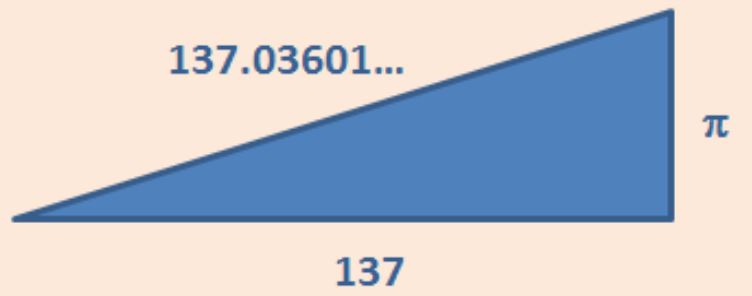
People’s fascination with the fine-structure constant has led to many unusual insights, such as this one, found during an image search on the web. The hypotenuse is 137.036015… .

The view today is that, yes, alpha (α) is annoyingly irrational; yet many other quantum numbers and equations depend upon it. The best known is:

e=\sqrt{2hc\epsilon\alpha} .

What does it mean?

It means that the electric charge of an electron is equal to the square root of a number.

What number?

Well… it is a number that is two times the Planck constant (h); times the speed of light constant (c); times the electric constant (ε); times the fine-structure constant (α).

Why?

No one knows.

These constants (and others) show up everywhere in quantum physics. They can’t be derived from first principles or pure thought. They must be measured.

As technology improves, scientists make better measurements; the values of the constants become more precise. These constants appear in equations that are so beautiful and mysterious that they sometimes raise the hair on the back of a physicist’s head.

The equations of quantum physics tell the story about how small things that can’t be seen relate to one another; how they interact to make the world we live in possible. The values of these constants are not arbitrary. Change their values even a little, and the universe itself will pop like a bubble; it will vanish in a cosmic blip.

How can a chaotic, quantum house-of-cards depend on numbers that can’t be derived; numbers that appear to be arbitrary and divorced from any clever mathematical precision or derivation?

What is going on?

How can it be?

The inability to solve the riddles of these constants while thinking deeply about them has driven some of the most clever people on Earth to near madness — the fine-structure constant (α) is the most famous nut-cracker, because its reciprocal (137.036…) is so very close to the numerology of ancient alchemy and the kabbalistic mysteries of the Bible.

What is the number alpha (α) for? Why is it necessary? What is the big deal that has garnered the attention of the world’s smartest thinkers? Why is the number 1 / 137 so dang important during the modern age, when the mysticism of the ancient bards has been largely put aside?

Well, two reasons come immediately to mind. Physicists are adamant; if α was less than 1 / 143 or more than 1 / 131, the production of carbon inside stars would be impossible. All life we know is carbon-based. The life we know could not arise.

The second reason? If alpha (α) was less than 1 / 151 or more than 1 / 124, stars could not form. With no stars, the universe becomes a dark empty place.

Conscious life got lucky. The fine-structure constant (α) sits smack-dab in the middle of a sweet spot that makes a cosmos full of stars and life possible; perhaps inevitable.


fundamental-constants
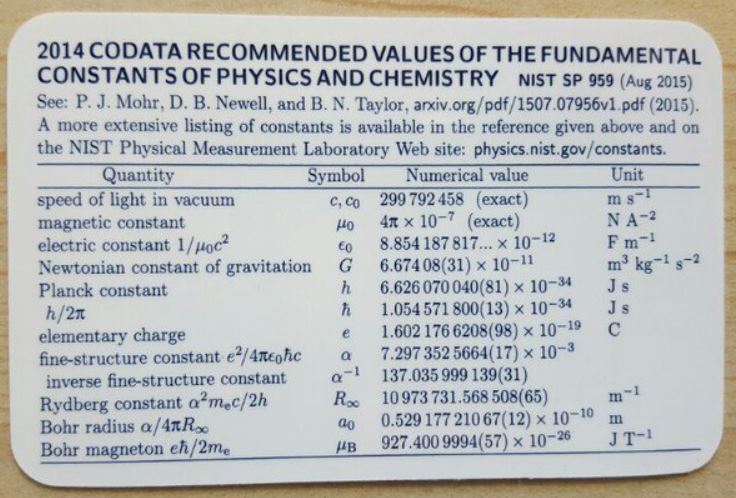
These are the values of some of the fundamental constants mentioned in this essay. Plug them into formulas to confirm they work, any reader who enjoys playing with their calculator. It’s clear that these numbers make no precisional sense; their values don’t correspond to anything one might find on any list of rational numbers. It’s possible that they make no geometric sense, either. If so, then God is not a mathematician. 

Without mathematics, humans have no hope of understanding the universe.

Yet, here we are wrestling against all the evidence; against all the odds that the mysteries of existence will forever elude us. We cling to hope like a drowning sailor at sea, praying that the hour of rescue will soon come; we will blow our last breath in triumph; humans can understand. Everything is going to fall into place just as we always knew it would.

It might surprise some readers to learn that the number alpha (α) has a dozen explanations; a dozen interpretations; a dozen main-stream applications in quantum mechanics.

The simplest hand-wave of an explanation I’ve seen in print is that depending on ones point of view,  “α” quantifies either the coupling strength of electromagnetism or the magnitude of the electron charge. I can say that it’s more than these, much more. 

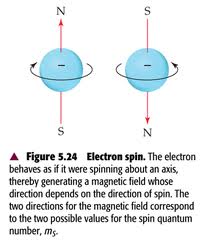
One explanation that seems reasonable on its face is that the magnetic-dipole spin of an electron must be interacting with the magnetic field that it generates as it rushes about its atom’s nucleus. This interaction produces energies which — when added to the photon energies emitted by the electrons as they hop between energy states — disrupt the electron-emitted photon frequencies slightly.

This jiggling (or hopping) of frequencies causes the fine structure in the colors seen on the screens and readouts of spectrographs — and in the bands of light which flow through the prisms that make some species of spectrographs work.

OK… it might be true. It’s possible. Nearly all physicists accept some version of this explanation.

Beyond this idea and others, there are many unexplained oddities — peculiar equations that can be written, which seem to have no relation to physics, but are mathematically beautiful.

For example: Euler’s number, “e” (not the electron charge we referred to earlier), when multiplied by the cosine of (1/α), equals 1 — or very nearly. (Make sure your calculator is set to radians, not degrees.) Why? What does it mean? No one knows.

What we do know is that Euler’s number shows up everywhere in statistics, physics, finance, and pure mathematics. For those who know math, no explanation is necessary; for those who don’t, consider clicking this link to Khan Academy, which will take you to videos that explain Euler’s number.


What about other strange appearances of alpha (α) in physics? Take a look at the following list of truths that physicists have noticed and written about; they don’t explain why, of course; indeed, they can’t; many folks wonder and yearn for deeper understanding:

1 — One amazing property about alpha (α) is this: every electron generates a magnetic field that seems to suggest that it is rotating about its own axis like a little star. If its rotational speed is limited to the speed of light (which Einstein said was the cosmic speed limit), then the electron, if it is to generate the charge we know it has, must spin with a diameter that is 137 times larger than what we know is the diameter of a stationary electron — an electron that is at rest and not spinning like a top. Digest that. It should give pause to anyone who has ever wondered about the uncertainty principle. Physicists don’t believe that electrons spin. They don’t know where their electric charge comes from.

2 — The energy of an electron that moves through one radian of its wave process is equivalent to its mass. Multiplying this number (called the reduced Compton wavelength of the electron) by alpha (α) gives the classical (non-quantum) electron radius, which, by the way, is about 3.2 times that of a proton. The current consensus among quantum physicists is that electrons are point particles — they have no spatial dimensions that can be measured. Click on the links to learn more.

3 — The physics that lies behind the value of alpha (α) requires that the maximum number of protons that can coexist inside an atom’s nucleus must be less than 137.

Think about why. 

Protons have the same (but opposite) charge as electrons. Protons attract electrons, but repel each other. The quarks, from which protons are made, hold themselves together in protons by means of the strong force, which seems to leak out of the protons over tiny distances to pull the protons together to make the atom’s nucleus. 

The strong force is more powerful than the electromagnetic force of protons; the strong force enables protons to stick together to make an atom’s nucleus despite their electromagnetic repulsive force, which tries to push them apart.

An EM force from 137 protons inside a nucleus is enough to overwhelm the strong forces that bind the protons to blow them apart. 

Another reason for the instability of large nuclei in atoms might be — in the Bohr model of the atom, anyway — the speed that an electron hops about is approximately equal to the atomic number of the element times the fine-structure constant (alpha) times the speed of light. 

When an electron approaches velocities near the speed of light, the Lorentz transformations of Special Relativity kick in. The atom becomes less stable while the electrons take on more mass; more momentum. It makes the largest numbered elements in the periodic table unstable; they are all radioactive.

The velocity equation is V = n * α * c .  Element 118 — oganesson — presumably has some electrons that move along at 86% of the speed of light.  [ 118 * (1/137) * (3E8) ]   86% of light-speed means that relativistic properties of electrons transform to twice their rest states.

Uranium is the largest naturally occurring element; it has 92 protons. Physicists have created another 26 elements in the lab, which takes them to 118, which is oganesson.

When 137 is reached (most likely before), it will be impossible to create larger atoms. My gut says that physicists will never get to element 124 — let alone to 137 — because the Lorentz transform of the faster moving electrons grows by then to a factor of 2.3. Intuition says, it is too large. Intuition, of course, is not always the best guide to knowledge in quantum mechanics.

Plutonium, by the way — the most poisonous element known — has 94 protons; it is man-made; one isotope (the one used in bombs) has a half-life of 24,000 years. Percolating plutonium from rotting nuclear missiles will destroy all life on Earth someday; it is only a matter of time. It is impossible to stop the process, which has already started with bombs lost at sea and damage to power plants like the ones at Chernobyl and at Fukushima, Japan. (Just thought I’d mention it since we’re on the subject of electron emissions, i.e beta-radiation.)

4 — When sodium light (from certain kinds of streetlamps, for example) passes through a prism, its pure yellow-light seems to split. The dark band is difficult to see with the unaided eye; it is best observed under magnification.


sodium-lamp-spectrum


The split can be measured to confirm the value of the fine-structure constant. The measurement is exact. It is this “fine-structure” that Arnold Sommerfeld noticed in 1916, which led to his nomination for the Nobel Prize; in fact Sommerfeld received eighty-four nominations for various discoveries. For some reason, he never won.


graphene-matrix


5 — The optical properties of graphene — a form of carbon used in solid-state electrical engineering — can be explained in terms of the fine-structure constant alone. No other variables or constants are needed.

6 — The gravitational force (the force of attraction) that exists between two electrons that are imagined to have masses equal to the Planck-mass is 137.036 times greater than the electrical force that tries to push the electrons apart at every distance. I thought the relationship should be the opposite until I did the math.

It turns out that the Planck-mass is huge — 2.176646 E-8 kilograms (the mass of the egg of a flea, according to a source on Wikipedia). Compared to neutrons, atoms, and molecules, flea eggs are heavy. The ratio of 137 to 1 (G force vs. e force) is hard to explain, but it seems to suggest a way to form micro-sized black holes at subatomic scales. Once black holes get started their appetites can become voracious.

The good thing is that no machine so far has the muscle to make Planck-mass morsels. Alpha (α) has slipped into the mathematics in a non-intuitive way, perhaps to warn folks that, should anyone develop and build an accelerator with the power to produce Planck-mass particles, they will have — perhaps inadvertently — designed a doomsday seed that could very well grow-up to devour Earth, if not the solar system and beyond.

7 — Alpha (α) is hidden inside the coupling constants of the electroweak theory, which unified the theories of the weak interaction and electromagnetism.

8 — The Standard Model of particle physics contains 20 or so parameters that cannot be derived; they must be experimentally discovered. One is the fine-structure constant (α), which is one of four constants that help to quantify interactions between electrons and photons.

9 — The speed of light is 137 times greater than the speed of “orbiting” electrons in hydrogen atoms. The electrons don’t actually “orbit.” They do move around in the sense of a probability distribution, though, and alpha (α) describes the ratio of their velocities to the cosmic speed limit of light. (See number 3 in this list for a description of element 118 — oganesson — and the velocity of some of its electrons.)

10 — The energy of a single photon is precisely related to the energy of repulsion between two electrons by the fine-structure constant alpha (α). Yes, it’s weird. How weird? Set the distance between two electrons equal to the wavelength of any photon. The energy of the photon will measure 137.036 times more than the repulsive force between the electrons. Here’s the problem. Everyone thinks they know that electron repulsion falls off exponentially with distance, while photon energy falls off linearly with wavelength. In these experimental snapshots, photon energy and electron repulsive energy are locked. Photons misbehave depending on how they are measured, right? The anomaly seems to have everything to do with the geometric shape of the two energy fields and how they are measured. Regardless, why “α”?


11 — The charge of an electron divided by the Planck charge — the electron charge defined by natural units, where constants like the speed of light and the gravitational constant are set equal to one — is equal to \sqrt{\alpha} . This strange relationship is another indicator that something fundamental is going on at a very deep level, which no one has yet grasped.


(\frac{q_e}{q_p})^2 = \alpha

The Planck relation and Planck’s law might provide additional insights for readers who want to know more.

12 — Some readers who haven’t toked too hard on their hash-pipes might remember from earlier paragraphs that the “strong force” is what holds quarks together to make protons and neutrons. It is also the force that drives protons to compactify into a solid atomic nucleus.

The strong force acts over short distances not much greater than the diameter of the atom’s nucleus itself, which is measured in femtometers. At this scale the strong force is 137 times stronger than the electromagnetic force, which is why protons are unable to push themselves apart; it is one reason why quarks are almost impossible to isolate.  Why 137?  No one has a clue.


Now, dear reader, I’m thinking that right now might be a good time to share some special knowledge — a reward for your courage and curiosity. We’ve spelunked together for quite a while, it seems. Some might think we are lost, but no one has yet complained.

Here is a warning and a promise. We are about to descend into the deepest, darkest part of the quantum cave. Will you stay with me for the final leg of the journey?  I  know the way.  Do you believe it?  Do you trust me to bring you back alive and sane?

In the Wikipedia article about α, the author writes, In natural units, commonly used in high energy physics, where ε0 = c = h/2π = 1, the value of the fine-structure constant is:

\alpha=\frac{e^2}{4\pi}

Every quantum physicist knows the formula. In natural units e = .302822…. 

Remember that the units collapse to make “α” a dimensionless number. Dimensional units don’t go away just because the values used to calculate the final result are set equal to “1”, right? Note that the value above is calculated a little differently than that of the Planck system — where 4πε is set equal to “1”.  

As I mentioned, the value for “α” doesn’t change. It remains equal to .0073…, which is 1 / 137.036…. What puzzles physicists is, why?

What is the number 4π about? Why, when 4π is stripped away, does there remain only “α” — the mysterious number that seems to quantify a relationship of some kind between two electrons?

Well… electrons are fermions. Like protons and neutrons they have increments of 1/2 spin. What does 1/2 spin even mean?

It means that under certain experimental conditions when electrons are fired through a polarized disc they project a visible interference pattern on a viewing screen. When the polarizing disc is rotated, the interference pattern on the screen changes. The pattern doesn’t return to its original configuration until the disc is rotated twice — that is, through an angle of 720°, which is 4π radians.

Since the polarizer must be spun twice, physicists reason that the electron must have 1/2 spin (intrinsically) to spin once for every two spins of the polarizer. Yes, it makes no sense. It’s crazy — until it isn’t.

What is more insane is that an irrational, dimensionless number that cannot be derived by logic or math is all that is left. We enter the abyss when we realize that this number describes the interaction of one electron and one photon of light, which is an oscillating bundle of no one knows what (electricity and magnetism, ostensibly) that has no mass and no charge.

All photons have a spin of one, which reassures folks (because it seems to make sense) until they realize that all of a photon’s energy comes from its so-called frequency, not its mass, because light has no mass in the vacuum of space. Of course, photons on Earth don’t live in the vacuum of space. When photons pass through materials like glass or the atmosphere, they disturb electrons in their wake. The electrons emit polaritons, which physicists believe add mass to photons and slow them down.

Polaritons can be thought of as light-matter waves

The number of electrons in materials and their oscillatory behavior in the presence of photons of many different frequencies determine the production intensity of polaritons. It seems to me that the relationship cannot be linear, which simply means that intuition cannot guide predictions about photon behavior and their accumulation of mass in materials like glass and the earth’s atmosphere. Everything must be determined by experiment.

Theories that enable verifiable predictions about photon mass and behavior might exist or be on the horizon, but I am not connected enough to know. So check it out.

Anyway… frequency is the part of Einstein’s energy equation that is always left out because, presumably, teachers feel that if they unveil the whole equation they won’t be believed — if they are believed, their students’ heads might explode. Click the link and read down a few paragraphs to explore the equation.

In the meantime, here’s the equation:

E=\sqrt{m^2c^4+(hf)^2}

When mass is zero, energy equals the Planck constant times the frequency. It’s the energy of photons. It’s the energy of light.

Photons can and do have any frequency at all. A narrow band of their frequencies is capable of lighting up our brains, which have a strange ability to make sense of the hallucinations that flow through them.

Click on the links to get a more detailed description of these mysteries.

What do physicists think they know for sure?

When an electron hops between its quantum energy states it can emit and absorb photons of light. When a photon is detected, the measured probability amplitude associated with its emission, its direction of travel, its energy, and its position are related to the magnitude of the square of a multi-dimensional number. The scalar (α) is the probability density of a measured vector quantity called an amplitude.

When multi-dimensional amplitudes are manipulated by mathematics, terms emerge from these complex numbers, which can’t be ignored. They can be used to calculate the interference patterns in double-slit experiments, for one thing, performed by every student in freshman physics.

The square root of the fine-structure constant matches the experimentally measured magnitude of the amplitude of electron/photon interactions — a number close to .085. It means that the vector that represents the dynamic of the interaction between an electron and a photon gets “shrunk” during an interaction by almost ten percent, as Feynman liked to describe it.

Because amplitude is a complex (multi-dimensional) number with an associated phase angle or direction, it can be used to help describe the bounce of particles in directions that can be predicted within the limitations of the theory of quantum probabilities.

Square the amplitude, and a number (α) emerges — the one-dimensional, unit-less number that appears in so many important quantum equations: the fine-structure constant.

Why? It’s a mystery. It seems that few physical models that go beyond a seemingly nonsensical vision of rotating hands on a traveling clock can be conjured forth by the brightest imaginations in science to explain the why or how.

The fine-structure constant, alpha (α) — like so many other phenomenon on quantum scales — describes interactions between subatomic particles — interactions that seem to make no intuitive sense. It’s a number that is required to make the equations balance. It just does what it does. The way it is — for now, at least — is the way it is. All else is imagination and guesswork backed by some very odd math and unusual constants.

By the way (I almost forgot to mention it): α is very close to 30 times the ratio of the square of the charge of an at-rest electron divided by Planck’s reduced constant.

Anyone is welcome to confirm the calculation of what seems to be a fairly precise ratio of electron charge to Planck’s constant if they want. But what does it mean?

What does it mean?

Looking for an answer will bury the unwary forever in the rabbit hole.


I’m thinking that right now might be a good time to leave the abyss and get on with our lives. Anyone bring a flashlight?

Follow me. And please — hurry.

Billy Lee

10001001.0000100100110111001111000011111000000111111

0.00000001110111100011111

WHY SOMETHING, NOT NOTHING?

People assume they see nothing, but in every case, when they look closely — when they investigate — they find something… air, quantum fluctuations, vacuum energy, etc.


QUESTION: Is this a large-scale view of the universe or a sub-microscopic view of vacuum energy and quantum fluctuations? Can anyone tell? The universe is not empty. Everywhere anyone looks, at all scales, it seems like there is no such thing as nothing.

Everyone finds no evidence that a state of nothing exists in nature or is even possible.

Physicists know this for sure: there can be no state of absolute zero in nature — not for temperature; not for energy; not for matter. All three are equivalent in important ways and are never zero — at all scales and at all time intervals. Quantum theory  — the most successful theory in science some will argue — claims that absolute zero is impossible; it can’t exist in nature.

There can be no time interval exactly equal to zero.

Time exists; as does space (which is never empty); both depend for their existence on matter and energy (which are equivalent).

Einstein said that without energy and matter, time and space have no meaning. They are relative; they vary and change according to the General Theory of Relativity, according to the distribution and density of energy and matter. As long as matter and energy exist, time can never be zero; space can never be empty.

People can search until their faces turn blue for a physical and temporal place where there is nothing at all, but they will never find it, because a geometric null-space (a physical place with nothing in it) does not exist. It never has and never will. Everywhere scientists look, at every scale, they find something.

We ask the question, Why is there something rather than nothing?  

Physicists say that nothing is but one state of the universe out of a google-plex of other possibilities. The odds against a state of nothingness are infinite.

Another glib answer is that the state of nothing is unstable. The uncertainty principle says it must be so. Time and space do not exist in a place where nothing exists. Once the instability of nothing forces something, time and space start rolling. A universe cascades out of the abyss, which has always existed and always will.  Right?

Think about it. It’s not complicated.

People seem to ignore the plain fact that no one has ever observed even a little piece of nothing in nature. There is no evidence for nothing.

Could it be that the oft-asked question — Why is there something rather than nothing? — is based on a false impression, which is not supported by any evidence?

Cosmic microwave background radiation is a good example. It’s a humming sound that fills all space. Eons ago CMB was visible light — photons packed like the molecules of a thick syrup — but space has expanded for billions of years; expansion stretched the ancient visible light into invisible wavelengths called microwaves. Engineers have built sensors to hear them. Everywhere and at every distance microwave light hums in their sensors like a cosmic tinnitus.

Until someone finds evidence for the existence of nothing in nature, shouldn’t people conclude that something exists everywhere they look and that the state of nothing does not exist? Could we not go further and say that, indeed, nothing cannot exist?  If it could, it would, but it can’t, so it doesn’t.

Why do people find it difficult, even disturbing, to believe that no alternative to something is possible? Folks can, after all, imagine a place with nothing in it. Is that the reason?

Is it human imagination that explains why, in the complete absence of any evidence, people continue to believe in the possibility of null-spaces — and null-states — and empty voids?


photon pic
Photons are mysterious quantities of light which have both wave and particle properties. The odd thing: physicists say they have zero rest mass. All their energy comes from their frequencies, which are invisible fields of electricity and magnetism that oscillate in a symbiotic dance of orthogonality. 

A physical packet (quantum) of vibrating light (a photon) can be said to have zero mass (despite having momentum, which is usually described as a manifestation of mass), because it doesn’t interact with a field now known to fill the so-called vacuum of space — the Higgs Field.  

Odder still: massive bodies distort the shape of space and the duration of time in their vicinities; packets of vibrating light (photons), which have no mass, actually change their direction of travel when passing through the distorted spacetime near massive bodies like planets and suns.

Maybe people cling to their belief in the concept of nothingness because of something related to their sense of vision — their sense of sight and the way their eyes and brains work to make sense of the world. Only a tiny interval of the electromagnetic spectrum, which is called visible light, is viewable. Most of the light-spectrum is invisible, so in the past no one thought it was there.

The photons people see have a peculiar way of interacting with each other and with sense organs, which has the effect of enabling folks to sort out from the vast mess of information streaming into their heads only just enough to allow them to make the decisions necessary for survival. They are able to see only those photons that enter their eyes. Were it otherwise humans and other life-forms might be overwhelmed by too much information and become confused.

Folks don’t see a lot of the extraneous stuff which, if they did observe it, would immediately disavow them of any fantasies they might have had about a state of nothingness in nature.

If we were not blind to 99.999% of what’s out there, we wouldn’t believe in the concept of nothing. Such a state, never observed, would seem inconceivable.

The reason there is something rather than nothing is because there is no such thing as nothing. Deluded by their own blindness, humans invented the concept of ZERO in mathematics. Its power as a place holder convinced them that it must possess other magical properties; that it could represent not just the absence of things that they could count, but also an absolute certainty in measurement that we now know is not possible.  

ZERO, we have learned, can be an approximation when it’s used to describe quantum phenomenon.

When the number ZERO is taken too seriously, when folks refuse to acknowledge the quantum nature of some of the stuff it purports to measure, they run into that most vexing problem in mathematics (and physics), which deconstructs the best ideas: dividing by zero, which is said to be undefined and leads to infinities that blow-up the most promising formulas. Stymied by infinities, physicists have invented work-arounds like renormalization to make progress with their computations.

Because humans are evolved biological creatures who are mostly blind to the things that exist in the universe, they have become hard-wired over the ages to accept the concept of nothingness as a natural state when, it turns out, there is no evidence for it.


baby in bubble
Anyone who has witnessed the birth of their own child understands that the child does not emerge from nothing, but is a continuation of life that goes back eons.

The phenomenon of life and death has added to the confusion. We are born and we die, it seems. We were once nothing, and we return to nothing when we die. The concept of non-existence seems so right; the state of non-being; the state of nothingness, so real, so compelling.

But we are fools to think this way — both about ourselves and about nature itself. Anyone who has witnessed the birth of their own child understands that the child does not emerge from nothing but is a continuation of life that goes back eons. And we have no compelling evidence that we die; that we cease to exist; that we return to a state of nothingness.

No one remembers not existing. None of us have ever died. People we know and love seem to have died, physically, for sure. But we, ourselves, never have.

Those who make the claim that we die can’t know for sure if they are right, because they have never experienced a state of non-existence; in fact, they never will. No human being who has ever lived has ever experienced a state of non-existence. One has to exist to experience anything.

Non-existence cannot be experienced. [for deeper insight, click Conscious Life and Conscious Quantum.]

Why is there something, not nothing?  Because there is no such thing as nothing. There never will be.

A foundation of modern physics is the Heisenberg Uncertainty Principle, right? If this principle is truly fundamental, then logic seems to demand that nothing can be exactly zero.

Nothing is more certain than zero, right? The Uncertainty Principle says that nothing fundamental about our universe can have the quale of certainty. The concept of nothing is an illusion. 

An alternative to nothing, is somethingSomething doesn’t require an explanation. It doesn’t require properties that are locked down by certainty. Doesn’t burden-of-proof lie with the naysayers?

Find a patch of nothing somewhere in the universe. 

It can’t be done.

The properties of things may need to be explained — scientists are always working to figure them out. People want to know how things get their properties and behave the way they do. It’s what science is.

Slowly, surely, science makes progress.

Billy Lee


Afterthought: The number ZERO is a valid place holder for computation but can never be a quantity of any measured thing that isn’t rounded-off. When thought about in this way, ZERO, like Pi (π), can take on the characteristics of an irrational number, which, when used for measurement, is always terminated at some arbitrary decimal place depending on the accuracy desired and the nature of the underlying geometry.


two equals one
Working with ZERO is tricky. Dividing by ZERO is never allowed, which is what was done in the second-to-last line to give the result:  2 = 1.  Remember: (a – b) = 0, because a = b.

The universe might also be pixelated, according to theorists. Experiments are being done right now to help establish evidence for and against some specific proposals by a few of the current pixel-theory advocates. If a pixelated universe turns out to be fact, it will confound the foundations of mathematics and require changes in the way small things are measured.

For now, it seems that Pi and ZERO — indeed, all measurements involving irrational numbers — are probably best used when truncated to reflect the precision of Planck’s constant, which is the starting point for physicists who hope to define what some of the properties of pixels might be, assuming of course that they exist and make up the fabric of the cosmos.

In practice, pixelization would mean that no one needs numbers longer than forty-five or so decimal places to describe at least the one-dimensional properties of the subatomic world.  According to theory, quantum stuff measured by a number like ZERO might oscillate around certain very small values at the fortieth decimal place or so in each of the three dimensions of physical space. A number ZERO which contained a digit in the 40th decimal place might even flip between negative and positive values in a random way.

The implications are profound, transcending even quantum physics.  Read the Billy Lee Conjecture in the essay Conscious Life, anyone who doesn’t believe it.

One last point: quantum theory contains the concept of superposition, which suggests that an elementary particle is everywhere until after it is measured. This phenomenon — yes, it’s non-intuitive — adds weight to the point of view that space is not only not empty when we look; it’s also not empty when we don’t look.

Billy Lee


Comment by the Editorial Board: 

Maybe a little story can help readers understand better what the heck Billy Lee is writing about. So here goes:

A child at night hears a noise in her toy-box and imagines a ghost. She cries out and her parents rush in. They assure her. There are no ghosts.

Later, alone in her room, the child hears another sound, this time in the closet. Her throbbing heart suggests that her parents must be lying.

Until she turns on the light and peeks into her closet, she can’t know for sure.

Then again, maybe ghosts fly away when the lights are on, she reasons.

In this essay, Billy Lee is trying to reassure his readers that there is no such thing as nothing. It’s not real.

Where is the evidence? Or does nothing disappear when we look at it?

Maybe ghosts really do fly away when we turn on the lights.


BELL’S INEQUALITY

UPDATE: 18 December 2022:  Royal Swedish Academy of Sciences on 4 October 2022 awarded the Nobel Prize in Physics to: 

Alain Aspect
Institut d’Optique Graduate School – Université Paris-
Saclay and École Polytechnique, Palaiseau, France


Alain Aspect, winner of 2022 Nobel Prize in Physics

John F. Clauser
J.F. Clauser & Assoc., Walnut Creek, CA, USA

Anton Zeilinger
University of Vienna, Austria

“for experiments with entangled photons, establishing the violation of Bell inequalities and pioneering quantum information science”


UPDATE: September 5, 2019:  I stumbled across this research published in NATURE during December 2011, where scientists reported entanglement of vibrational patterns in separated diamond crystals large enough to be viewed without magnification. Nature doi:10.1038/nature.2011.9532


UPDATE: May 8, 2018: This video from PBS Digital Studios is the best yet. Click the PBS link to view the latest experimental results involving quantum mechanics, entanglement, and their non-intuitive mysteries. The video is a little advanced and fast paced; beginners might want to start with this link.


UPDATE: June 17, 2016:   Ali Sundermier published a description of quantum entanglement for non-scientists. Here is the link.

Another beginner’s overview of quantum mechanics by Cathal O’Connell is in this link.

UPDATE: February 4, 2016:  Here is a link to the August 2015 article in Nature, which makes the claim that the last testable loophole in Bell’s Theorem has been closed by experiments conducted by Dutch scientists. Conclusion: quantum entanglement is real.

UPDATE: Nov. 14, 2014:    David Kaiser proposed an experiment to determine Is Quantum Entanglement Real?  Click the link to redirect to the Sunday Review, New York Times article. It’s a non-technical explanation of some of the science related to Bell’s Theorem. 


Someone nominated Irish physicist, John Stewart Bell, (1928-1990) for a Nobel Prize during the year he died from a sudden brain hemorrhage. Nobel rules prevent the awarding of prizes to people who have died. Bell never learned of his nomination.

John Stewart Bell‘s Theorem of 1964 followed naturally from the proof of an inequality he fashioned (now named after him), which showed that quantum particle behavior violated logic.

It is the most profound discovery in all science, ever, according to Henry Stapp—retired from Lawrence Berkeley National Laboratory and former associate of Wolfgang Pauli and Werner Heisenberg. Other physicists like Richard Feynman said Bell simply stated the obvious.


Beta Barium Borate crystals can be used to ”down-convert” photons into entangled pairs.

Here is an analogy I hope gives some idea of what is observed in quantum experiments that violate Bell’s Inequality: Imagine two black tennis balls—let them represent atomic particles like electrons or photons or molecules as big as buckyballs.


The tennis balls are created in such a way that they become entangled—they share properties and destinies. They share identical color and shape.  [Entangled particles called fermions display opposite properties, as required by the Pauli exclusion principle.]

Imagine that whatever one tennis ball does, so does the other; whatever happens to one tennis ball happens to the other, instantly it turns out. The two tennis balls (the quantum particles) are entangled.

[For now, don’t worry about how particles get entangled in nature or how scientists produce them.  Entanglement is pervasive in nature and easily performed in labs.]


According to optical and quantum experimentalist Mark John Fernee of Queensland, Australia, ”Entanglement is ubiquitous. In fact, it’s the primary problem with quantum computers. The natural tendency of a qubit in a quantum computer is to entangle with the environment. Unwanted entanglement represents information loss, or decoherence. Everything naturally becomes entangled. The goal of various quantum technologies is to isolate entangled states and control their evolution, rather than let them do their own thing.”

In nature, all atoms that have electron shells with more than one electron have entangled electrons. Entangled atomic particles are now thought to play important roles in many previously not understood biological processes like photosynthesis, cell enzyme metabolism, animal migration, metamorphosis, and olfactory sensing. There are several ways to entangle more than a half-dozen atomic particles in experiments.


Imagine particles shot like tennis balls from cannons in opposite directions. Any measurement (or disturbance) made on a ball going left will have the same effect on an entangled ball traveling to the right.

So, if a test on a left-side ball allows it to pass through a color-detector, then its entangled twin can be thought to have passed through a color-detector on the right with the same result. If a ball on the left goes through the color-detector, then so will the entangled ball on the right, whether or not the color test is performed on it. If the ball on the left doesn’t go through, then neither did the ball on the right. It’s what it means to be entangled.

Now imagine that cannons shoot thousands of pairs of entangled tennis balls in opposite directions, to the left and right. The black detector on the left is calibrated to pass half of the black balls. When looking for tennis balls coming through, observers always see black balls but only the half that get through. 


Spin is one of the characteristics of a quantum object, much like yellow is a characteristic of a tennis ball.

Spin describes a particle property of quantum objects like electrons — in the same way color or roundness describe tennis balls. The property is confusing, because no one believes electrons (or any other quantum objects) actually spin. The math of spin is underpinned by the complex-mathematics of spinors, which transform spin arrows into multi-dimensional objects not easy to visualize or illustrate. Look for an explanation of how spin is observed in the laboratory later in the essay. Click links for more insight.


Now, imagine performing a test for roundness on the balls shot to the right. The test is performed after the black test on the left, but before any signal or light has time to travel to the balls on the right. The balls going right don’t (and can’t) learn what the detector on the left observed. The roundness-detector is set to allow three-fourths of all round tennis balls through.

When round balls on the right are counted, three-eighths of them are passing through the roundness-detector, not three-fourths. Folks might speculate that the roundness-detector is acting on only the half of the balls that passed through the color-detector on the left. And they would be right.

These balls share the same destinies, right? Apparently, the balls on the right learned instantly which of their entangled twins the color-detector on the left allowed to pass through, despite all efforts to prevent it.

So now do the math. One-half (the fraction of the black balls that passed through the left-side color-detector) multiplied by three-fourths (the fraction calibrated to pass through the right-side roundness-detector) equals three-eighths. That’s what is seen on the right — three-eighths of the round, black tennis balls pass through the right-side roundness-detector during this fictionalized and simplified experiment.


Polarization is another characteristic of a quantum particle, much like roundness is for a tennis ball.
Polarization is a term used to describe a wave property of quantum objects like photons.  Polarizing filters are rotated in experiments to determine some of the properties of atomic particles, like spin.

According to Bell’s Inequality, twice as many balls should pass through the right-side detector (three-fourths instead of three-eighths). Under the rules of classical physics (which includes relativity), communication between particles cannot exceed the speed of light.

There is no way the balls on the right can know if their entangled twins made it through the color detector on the left. The experiment is set up so that the right-side balls do not have time to receive a signal from the left-side. The same limitation applies to the detectors.

The question scientists have asked is: how can these balls (quantum particles) — separated by large distances — know and react instantaneously to what is happening to their entangled twins? What about the speed limit of light? Instantaneous exchange of information is not possible, according to Einstein.

The French quantum physicist, Alain Aspect, suggested his way of thinking about it in the science journal, Nature (March 19, 1999).


Alain Aspect
Alain Aspect, French physicist, is best known for his work on quantum entanglement.

He wrote: The experimental violation of Bell’s inequalities confirms that a pair of entangled photons separated by hundreds of meters must be considered a single non-separable object — it is impossible to assign local physical reality to each photon.

Of course, the single non-separable object can’t have a length of hundreds of meters, either. It must have zero length for instantaneous communication between its endpoints. But it is well established by the distant separation of detectors in experiments done in labs around the world that the length of this non-separable quantum object can be arbitrarily long; it can span the universe.

When calculating experimental results, it’s as if a dimension (in this case, distance or length) has gone missing. It’s eerily similar to the holographic effect of a black hole where the three-dimensional information that lives inside the event-horizon is carried on its two-dimensional surface. (See the technical comment included at the end of the essay.)


Schematic of physicist Alan Aspect's experimental apparatus which verified that the act of measurement influenced distant entangled calcium electrons instantaneously.
Here is a drawing of an apparatus the French physicist, Alain Aspect, designed to quickly change the angle of polarity-measurements for emitted photons. In experiments, he used the logic of Bell’s Inequalities and the speed of his switches to show that it was not possible for photons to carry specific (or unique) polarity-angles until after they were measured by the polarization detectors.  Once measured, Alain showed that the new, narrowly defined polarity states of his photons always propagated to their distant entangled twins, instantly.  


Another way physicists have wrestled with the violations of Bell’s Inequality is by postulating the concept of superposition. Superposition is a concept that flows naturally from the linear algebra used to do the calculations, which suggests that quantum particles exist in all their possible states and locations at the same time until they are measured.

Measurement forces wave-particles to “collapse” into one particular state, like a definite position. But some physicists, like Roger Penrose, have asked: how do all the super-positioned particles and states that weren’t measured know instantaneously to disappear?

Superposition, a fundamental principle of quantum mechanics, has become yet another topic physicists puzzle over. They agree on the math of superposition and the wave-particle collapse during measurement but don’t agree on what a measurement is or the nature of the underlying reality. Many, like Richard Feynman, believe the underlying reality is probably unknowable.

Quantum behavior is non-intuitive and mysterious. It violates the traditional ideas of what makes sense. As soon as certainty is established for one measurement, other measurements, made earlier, become uncertain.

It’s like a game of whack-a-mole. The location of the mole whacked with a mallet becomes certain as soon as it is struck, but the other moles scurry away only to pop up and down in random holes so fast that no one is sure where or when they really are.

Physicists have yet to explain the many quantum phenomena encountered in their labs except to throw-up their hands to say — paraphrasing Feynman — it is the way it is, and the way it is, well, the experiments make it obvious.


Feynman
Richard Feynman (1918-1988) downplayed Bell’s Inequality because, he said, it simply pointed out what was already obvious from experiments.

But it’s not obvious, at least not to me and, apparently, many others more knowledgeable than myself. Violations of Bell’s Inequality confound people’s understanding of quantum mechanics and the world in which it lives. A consequence has been that at least a few scientists seem ready to believe that one, perhaps two, or maybe all four, of the following statements are false:

1) logic is reliable and enables clear thinking about all physical phenomenon;

2) the universe exists independently of any conscious observer;

3) information does not travel faster than light.

4) a model can be imagined to explain quantum phenomenon.

I feel wonder whenever the idea sinks into my mind that at least one of these four seemingly self-evident and presumably true statements could be false — possibly all four — because repeated quantum experiments suggest they must be. Why isn’t more said about it on TV and radio?


Quantum mechanics (1)
Some scientists think non-physicists cannot grasp quantum mechanics. This little girl disagrees.

The reason could be that the terrain of quantum physics is unfamiliar territory for a lot of folks. Unless one is a graduate student in physics — well, many scientists don’t think non-physicists can even grasp the concepts. They might be right.

So, a lot is being said, all right, but it’s being said behind the closed doors of physics labs around the world. It is being written about in opaque professional journals with expensive subscription fees.

The subtleties of quantum theory don’t seem to suit the aesthetics of contemporary public media, so little information gets shared with ordinary people. Despite the efforts of enthusiastic scientists — like Brian CoxSean M. CarrollNeil deGrasse Tyson and Brian Greene — to serve up tasty, digestible, bite-size chunks of quantum mechanics to the public, viewer ratings sometimes fall flat.

When physicists say something strange is happening in quantum experiments that can’t be explained by traditional methods, doesn’t it deserve people’s attention? Doesn’t everyone want to try to understand what is going on and strive for insights?  I’m not a physicist and never will be, but I want to know.

Even me — a mere science-hobbyist who designed machinery back in the day — wants to know. I want to understand. What is it that will make sense of the universe and the quantum realm in which it rests?  It seems, sometimes, that a satisfying answer is always just outside my grasp.

Here is a concise statement of Bell’s Theorem from the article in Wikipedia — modified to make it easier to understand: No physical theory about the nature of quantum particles which ignores instantaneous action-at-a-distance can ever reproduce all the predictions about quantum behavior discovered in experiments.


laser-controlled-polarization
Familiarity with concepts like wave polarization and particle-spin can help demystify some aspects of quantum mechanics. One aspect that can’t be demystified: in experiments quantum objects display the properties of both waves and particles.

To understand the experiments that led to the unsettling knowledge that quantum mechanics — as useful and predictive as it is — does indeed violate Bell’s proven Inequality, it is helpful not only to have a solid background in mathematics but also to understand ideas involving the polarization of light and — when applied to quantum objects like electrons and other sub-atomic particles — the idea of spin.  Taken together, these concepts are somewhat analogous to the properties of color and roundness in the imaginary experiment described above.

This essay is probably not the best place to explain wave polarization and particle spin, because the explanation takes up space, and I don’t understand the concepts all that well, anyway.  (No one does.)

But, basically, it’s like this: if a beam of electrons, for example, is split into two and then recombined on a display screen, an interference pattern presents itself. If one of the beams was first passed through a polarizer, and if experimenters then rotate the polarizer a full turn (that is, 360°), the interference pattern on the screen will reverse itself.  If the polarizer-filter is rotated another full turn, the interference pattern will reverse again to what it was at the start of the experiment.

So, it takes two spins of the polarizer-filter to get back the original interference pattern on the display screen — which means the electrons themselves must have an intrinsic “one-half” spin. All so-called matter particles like electrons, protons, and neutrons (called fermions) have one-half spin.

Yes, it’s weird. Anyway, people can read-up on the latest ideas by clicking this link. It’s fun. For people familiar with QM (quantum mechanics), a technical note is included in the comments section below.

Otherwise, my analogy is useful enough, probably. In actual experiments, physicists measure more than two properties, I’m told. Most common are angular momentum vectors, which are called spin orientations. Think of these properties as color, shape, and hardness to make them seem more familiar — as long as no one forgets that each quality is binary; color is white or black; shape is round or square; hardness is soft or hard.


Crystals can be used to “down-convert” photons into  entangled pairs.

Spin orientations are binary too — the vectors point in one of two possible directions. It should be remembered that each entangled particle in a pair of fermions always has at least one property that measures opposite to that of its entangled partner.

The earlier analogy might be improved by imagining pairs of entangled tennis balls where one ball is black, the other white; one is round, the other square; add a third quality where one ball is hard, the other soft. Most important, the shape and color and hardness of the balls are imparted by the detectors themselves during measurement, not before.

Before measurement, concepts like color or shape (or spin or polarity) can have no meaning; the balls carry every possible color and shape (and hardness) but don’t take on and display any of these qualities until a measurement is made. Experimental verification of these realities keep some quantum physicists awake at night wondering, they say.

Anyway, my earlier, simpler analogy gets the main ideas across, hopefully. And a couple of the nuances of entanglement can be found within it. I’ve added an easy to understand description of Bell’s Inequality and what it means to the end of the essay.

Here are two additional links with more depth: CHSH Inequality; Bell Test Experiments.


A carbord cut-out of a cat imaged by photons that never went through the cut-out itself. Credit: Gabriela Barreto Lemos
This cardboard cut-out of a cat was imaged by entangled photons. Lower energy photons interacted with the cut-out while their higher energy entangled twins interacted with the camera to create the picture.
Credit: Gabriela Barreto Lemos

In the meantime, scientists at the Austrian Academy of Sciences in Vienna recently demonstrated that entanglement can be used as a tool to photograph delicate objects that would otherwise be disturbed or damaged by high energy photons (light). They entangled photons of different energies (different colors).

They took photographs of objects using low energy photons but sent their higher energy entangled twins to the camera where their higher energies enabled them to be recorded. New technologies involving the strange behavior of quantum particles are in development and promise to transform the world in coming decades.

Perhaps entanglement will provide a path to faster-than-light communication, which is necessary to signal distant space-craft in real time. Most scientists say, no, it can’t be done, but ways to engineer around the difficulties are likely to be developed; technology may soon become available to create an illusion of instantaneous communication that is actually useful. Click on the link in this paragraph to learn more.

Non-scientists don’t have to know everything about the individual trees to know they are walking in a quantum forest. One reason for writing this essay is to encourage people to think and wonder about the forest and what it means to live in and experience it.

The truth is, the trees (particles at atomic scales) in the quantum forest seem to violate some of the rules of the forest (classical physics). They have a spooky quality, as Einstein famously put it.


remu warrior night scene 3
The quantum forest is a spooky place, Einstein said. 

Trees that aren’t there when no one is looking suddenly appear when someone is looking. Trees growing in one place seem to be growing in other places no one expected. A tree blows one way in the wind, and someone notices a tree at the other end of the forest — where there is no wind — blowing in the opposite direction. As of right now, no one has offered an explanation that doesn’t seem to lead to paradoxes and contradictions when examined by specialists.


Henry Stapp, Amazon.com

John Stewart Bell proved that trees in the quantum forest violate laws of nature and logic. It makes me wonder whether anyone will ever know anything at all they can fully trust about fundamental, underlying essence of reality.

Some scientists, like Henry Stapp (now retired), have proposed that brains enable processes like choice and experiences like consciousness through the mechanism of quantum interactions. Stuart Hameroff and Roger Penrose have proposed a quantum mechanism for consciousness they call Orch Or.

Others, like Wolfgang Pauli and C. G. Jung, have gone further — asking, when they were alive, if the non-causal coordination of some process resembling what is today called entanglement might provide an explanation for the seeming synchronicity of some psychic processes — an arena of inquiry a few governments are rumored to have incorporated (to great effect) into their intelligence gathering tool kits.

In a future essay I hope to speculate about how quantum processes like entanglement might or might not influence human thought, intuition, and consciousness.

Billy Lee

P.S.  A simplified version of Bell’s Inequality might say that for things described by traits A, B, and C, it is always true that A, not B; plus B, not C; is greater than or equal to: A, not C.  

When applied to a room full of people, the inequality might read as follows: tall, not male; plus male, not blonde; is greater than or equal to: tall, not blonde.

Said more simply: tall females and dark haired men will always number more than or equal to the number of tall people with dark hair. 

People have tried every collection of traits and quantities imaginable. The inequality is always true, never false; except for quantum objects.


wave equation schrodinger
Schrödinger’s Wave Equation describes how the quantum state of a physical system changes with time. It can be used to calculate quantized properties and probability distributions of quantum objects.

One way to think about it: all the ”not” quantities are, in some sense, uncertain in quantum experiments, which wrecks the inequality. That is to say, as soon as ”A” is measured (for example) ,”not B” becomes uncertain. When ”not B” is measured, ”A” becomes uncertain.

The introduction of uncertainties into quantities that were — before measurement — seemingly fixed and certain doesn’t occur in non-quantum collections where individual objects are big enough to make uncertainties not noticeable. The inability to measure both the position and velocity of small things with high precision is called the uncertainty principle and is fundamental to physics. No advancement in the technology of measurement will ever overcome it.

Uncertainty is believed to be an underlying reality of nature. It runs counter to the desire humans have for complete and certain knowledge; it is a thirst that can never be quenched.

But what’s really strange: when working with entangled particles, certainty about one particle implies certainty about its entangled twin; predicted experimental results are precise and never fail.

Stranger still, once entangled quantum particles are measured, the results, though certain, change from those expected by classical theory to those predicted by quantum mechanics. They violate Bell’s Inequality and the common sense of humans about how things should work. 

Worse: Bell’s Theorem seems to imply that no one will ever be able to construct a physical model of quantum mechanics to explain the results of quantum experiments.  No ”hidden variables” exist which, if anyone knew them, would explain everything. 

Another way to say it is this: the underlying reality of quantum mechanics is unknowable.  [A technical comment about the mystery of QM is included in the comments section.]

Billy Lee