“C”

NOTE:  The members of the EDITORIAL BOARD are aware that many readers may not have studied physics or astronomy. They might be under the false impression that an article like the one that follows is going to be incomprehensible. 

Nothing could be farther from the truth. Yes, those who have studied Maxwell’s Equations and Einstein’s theories will find his essay a kind of cakewalk. No doubt, eggheads will have issues with some assertions. Submit objections in comments — your head does not have to look like an egg.

WE, THE EDITORS wish to reassure readers — especially those who have yet to study math and science — that they have intelligence and imagination enuf to understand Billy Lee’s basic arguments.

We know Billy Lee. We work with him every day. He talks and tweets a lot but what does he really know? 

Billy Lee likes to share notions with folks who can read. He claims it does no harm. For those who get “high” on science, Billy Lee included videos to make rabbit-hole hopping fun. Don’t be afraid to watch some.

THE EDITORIAL BOARD


UPDATE BY THE EDITORIAL BOARD:  May 15, 2019; Victor T. Toth, the Hungarian software developer, author, and Quora guru of quantum physics wrote, “a photon has no rest mass, but it carries plenty of energy, and it has momentum.  Its stress-energy-momentum tensor is certainly not zero.  So it can be a source of gravity, it has inertia, and it responds to gravity.  […] relativity theory predicts … twice the deflection angle for a photon in a gravitational field than the deflection of a Newtonian particle.”

Almost a century of experiments plus hundreds of upvotes on Quora by physicists seem to validate Victor’s argument. 


The photon is known to be the only massless, free-moving particle in the Standard Model of physics. Other massless particles are the gluon, the graviton, and of course the Higgs, discovered in 2012 at CERN. Europeans plan to build a Higgs factory to learn more about them. Gluons mediate the strong force. They don’t propagate through empty space.  No one has yet observed even a single graviton. Higgs give fermions like quarks their mass. 

Photons have an electric and magnetic structure. They are electromagnetic pulses of energy that emerge from atoms when electrons drop from a higher energy state to a lower one. When electrons shed energy, a pulse of electromagnetic radiation is emitted — a photon of light.


Click pic for better view in new tab.

Photons of light can be emitted from atoms at different frequencies — colors when wavelengths fall within the narrow range that humans see. These frequencies depend on the energy of electrons, which exist in many differently configured shells (or orbitals) within both atoms and molecules.

Wavelengths of light felt but not seen are called infrared; other invisible frequencies fall into broad categories such as radio waves, microwaves, x-rays, gamma rays and so on — all require instruments to detect.


Electromagnetic radiation is the medium through which humans observe and interact with everything knowable in the universe. Humans live inside an electromagnetic bubble that they are struggling to understand.

One thing most physicists understand is that a disturbing 95% of the energy and mass of the universe comes from a source no one can see. Physicists observe the effects of invisible (dark) matter and invisible (dark) energy by measuring the unusual dynamics of galaxies and by cataloging the physical organization and expansion of the universe itself.


These measurements make no sense unless folks assume that a lot of gravitationally interacting stuff is out there which no one has yet observationally confirmed. The missing mass is not debris or dark stars. The most exaggerated conjectures about how much mass and energy is scattered among the stars won’t come anywhere near enough to explain forces that make galaxies behave strangely.

Dark matter and energy don’t seem to be electromagnetic. Dark matter, if it exists, interacts with the mass of two-trillion galaxies and seems to refract their emitted light. Humans are blind to all of it.

Scientists postulate matter they call WIMPS, MACHOS, axions, and erebons.  Each has a few properties necessary to make the universe work as observed, but none have all the required properties except perhaps erebons, if Roger Penrose’s Conformal Cyclic Cosmology (CCC) is someday verified.

Other candidates for dark matter? — why not sterile neutrinos, GIMPs, and SIMPs

Space-saturating foam of micro-sized black holes is another idea some have proposed. The problem is that theorists believe tiny black holes might be too stable to radiate electromagnetic waves or gravity waves.

Micro-holes lie in a sort of crevice of invisibility — unobservable by LIGO and LISA style gravity-wave sensors, yet too massive for current and future particle-colliders like CERN to create. 

Because micro-holes don’t radiate light at any frequency, light telescopes will never find them. No imagined interaction of micro-holes is able to generate gravity-waves with enough disruptive power in spacetime to be detected. The nature of physics seems to suggest that no technology can be developed to confirm or deny the black-hole foam idea. 

Perhaps the same dilemma faces dark matter detection. We know it exists, but physics says we can never find it. It will always lie just outside our reach doing its work in an invisible universe no one will ever see. 

Worse, not one of the proposed forms of “dark” matter has ever been observed or identified. It is likely that no experiment currently scheduled will detect dark matter, which many physicists believe is “out there” and makes maybe four parts out of five of all the matter in the universe.

It’s an incredible paradox for conscious humans to live in a universe where they are blind to almost every important thing that is happening within and around them.

Humanoids are like fish which spend their lives swimming in streams buried deep inside caves. Spelunkers like me know that certain species of cave fish have no eyes. They lack all ability to see their world — as do we, it seems. As intelligent as people are, they don’t yet build sensors capable of confirming their notions about what the universe might actually be at large scales or small.  

Oh well…  someday maybe new discoveries will make our predicament evaporate away.  The universe will reveal itself to humans, as we knew it would. Our dream to fully understand reality will come true.

Some day.

Scientists have sensible mathematics to show that if electromagnetic particles are massless, they must travel at an upper limit, called c.  Over decades, folks decided that this constant is the speed of a photon in a vacuum; they decided that photons have no internal rest mass and travel in vacuum at a speed limit — the speed of light.

The truth might be more mysterious. No one knows what the upper limit of “c” is, because no one knows with certainty that space is truly empty or that massless particles exist.

When physicists say that certain particles are massless, they sometimes mean that they don’t interact with the Higgs Field, which is known to give mass to fermions, like quarks. They don’t mean they don’t have energy, specifically kinetic energy, which is a form of inertial mass, right? They also aren’t saying photons don’t interact gravitationally. They do, in a special way described by the geodesics of spacetime in Einstein’s General Relativity. 

More on this idea later. 


British physicist Brian Cox wrote in his book  Why Does E = mc2 ?  that the question about whether photons have rest mass is not yet settled.

It’s true that more than a few reasonable people seem to believe that photons traveling freely in the vacuum of space are massless. If they truly are then the permittivity constant “ε” in Maxwell’s equation can be established for electro-magnetic particles (like photons).


The formula below is used to calculate the speed of a massless electromagnetic particle; it is thought to be a maximum speed.


For now, ignore the μ term. It is the permeability (resistance) of vacuum to infusion by a magnetic field, which is determined by experiment. It is sometimes called the magnetic constant.

Epsilon (ε} is the permittivity (resistance) of vacuum to an electric field. It is sometimes called the electric constant.

c” is the so-called ”universal speed limit.” It is called the lightspeed constant

These three numbers — μ, ε, and — help to define the maximum velocity of an electromagnetic wave, which most people believe is the archetypal photon (of light). They assume that the photon packet travels at the maximum allowable speed in a vacuum.

A problem with this view is that no one has proved that space is free; or that space has no weight; or that photons have no rest mass; or that undiscovered particles formed from forces other than electricity and magnetism don’t exist. A few scientists have said that there might be no such things as free space or massless photons. It is also possible that space presents less resistance to other phenomenon yet to be discovered.

The idea that ”dark” matter and energy must exist to make the universe behave the way it does is compelling to many physicists. If true, it is possible — though light travels nearly 300 million meters-per-second — it is not traveling at the maximum speed of a generic, massless particle. The electric constant (ε) might need to be adjusted.

A decrease in the permittivity (resistance) of space (ε) — made obvious by inclusion of vast number of photons in the cosmic microwave background  — drives ”ε” to be smaller and ”c” to be larger, right? 

New particles, dark and as yet undiscovered, might do the same. The consequences could be significant.

Determining the upper speed of a massless particle requires a form of circular reasoning that is currently based on the measurement of the velocity of photons in a vacuum, which is called the speed of light.

The measured velocity of light in a vacuum is now an established constant of nature with a fixed value that doesn’t change regardless of the frame of reference. Modern labs have measured both the frequencies and wavelengths of various colors of light; multiplying the two numbers together always yields the same result — the speed of light.

Knowing the speed of light permits physicists to establish a value for ε by working backwards in the wave equation to solve for the electric permittivity of space. The value of “ε” falls easily from Maxwell’s Equations to a precision of 12 places.

It can’t be any other way. But is it the right way?

Here’s the problem: Physicists have measured mass in photons during experiments at the linear accelerator lab at Stanford University, SLAC.

In superconductors, photon mass has been measured to be as high as 1.2 eV.

Photon mass has been observed in wave guides and in plasmas.

Fact is, photons have inertial mass, which is a measure of their energy as calculated from their wavelengths or frequencies. In relativity theory, energy and mass are measured in the same units, electron-volts, because in the theory, mass and energy are equivalent. 


Click this link to view CLOSER TO TRUTH interview with Raphael Bousso.

Cosmologist, Raphael Bousso, believes that empty space has weight, which is a measure of the cosmological constant, which is a measure of dark energy.

Space seems to be saturated like a sponge with something that gives it energy or force or weight if you will. The weight of empty space determines the size of the universe and some of its fundamental laws. Universes beyond our own with different weights of space can be larger or smaller and obey different rules.

Most physicists agree that photons become massive when they travel through transparent materials like glass, where they slow down by as much as 40%.

The problem is that these observations conflict with both the Heisenberg and the Schrodinger view of quantum mechanics, which is the most tested and confirmed model physicists have. Modern ideas seem to work best when photon mass is placed on the energy side of the mass-energy column. Otherwise, the presence of internal mass suggests that photons can be restrained to a defined size, which drives their momentums to infinity.

The truth is that it is not possible to prove that photons are massless. The stress-energy-momentum tensor in Einstein’s equation of General Relativity implies that photons can be both the source and the object of gravity.  I’m referring to this tensor as “mass” and leaving it there for others to dispute. A rabbit hole for courageous readers to explore is the concept of pseudotensor, which this essay will avoid. 

It is also not true that a photon can never be at rest either.  Lab techs do unusual things with photons during experiments with lasers and superconductors — including slowing photons down and even stopping some (with supercooled helium-4).  Right?

Another problem is the electromagnetic nature of light. The electric part of a light-wave carries enough energy to move an electron up and down. The magnetic part carries the same energy but its motion creates a force that pushes electrons outward in the same direction as the light. It’s why light-sails work in space. Oscillating magnetic fields push light forward. Otherwise, light might stand in one place and simply jiggle. But is light-speed the best magnetic fields can do? 

Electromagnetism could be irrelevant in the search for an upper speed limit “c“, because “c” might prove to be the result of an unknown set of particles with properties outside the current boundaries of the Standard Model. 

Massless particles, — undiscovered ones anyway — might not be electromagnetic. Humans might be biologically unfit to detect them; unable to measure their properties. 

For those who might be rolling their eyes, remember that physicists claim that 95% of the mass and energy required to make the universe behave the way it does is missing. They call the missing stuff “dark” because they can’t find it. Excuse me should anyone catch me rolling my eyes. 

Some theorists have speculated that “dark photons” might exist to help fill in the gaps. The popular TV show How the Universe Works actually repeated the idea in an episode of its latest series. The writers were probably referring to axions, which some physicists propose are similar to photons except that they have mass and are slower moving.

Photons are bosons. They are force carriers for electrons, correct?

Maybe folks should try to accept the notion that nothing in physics prevents bosons like photons from having mass or from taking on mass when they whiz over and through atoms and molecules (in glass and water, for example) where some physicists conjecture, they stimulate the release of polaritons in their wake. Jiggling electrons that lack the energy to jump states emit polaritons, which seem to add enough equivalent mass to photons to slow them down. Think of polaritons as light-matter wavelets

Massive, gravitationally interacting photons are not required to be “dark.”  If photons are the dark matter, axions are unnecessary to solve certain problems both in cosmology and the Standard Model.  No experiment will find them.

I mentioned that three other particles are presumed to be massless: the gluon, the graviton, and the Higgs boson. 

To review, the gluon is not easily observed except in particle colliders where it lives briefly before decaying into other particles; it is confined among the protons and neutrons in the nuclei of atoms. The graviton, on the other hand, has never been observed. The Higgs boson was discovered in 2012. CERN plans to build a Higgs factory someday to explore its properties.

The only particle available to physicists right now that enables them to establish the permittivity of space and compute the velocity of massless particles is the photon.

That’s it.

If the photon has internal mass, i.e., rest mass, everything changes.


Let’s hop into a rabbit hole for a moment and go back a step: What if massless, non-electromagnetic particles mediate entanglement, for example? Wherever paired electrons are found, entanglement rules, right?

Everyone knows that entanglement violates laws of logic and physics. No one can make sense of it.

What if massless non-electromagnetic particles entangle the electromagnetic particles of the subatomic world? If they travel a thousand or ten-thousand times the speed of light, they will present an illusion over short planetary scales that entanglement is instantaneous. No instrument or lab will detect the difference.

What are the consequences if massless non-electromagnetic particles travel at a billion times the speed of light? Maxwell’s equations won’t apply to particles like these. 

Because it seems that speeds of subatomic particles like photons are able to increase as their masses approach zero, it is possible that “c” could be orders of magnitude faster than the speed of a photon — that is, the speed of light — if it turns out that photons harbor tiny but significant rest masses.

I’m not advocating this notion. Let’s crawl out of the rabbit hole. I’m suggesting only that such a state of affairs is possible, because the assumption that photons at rest are massless — that internal mass of photons is always zero — though reasonable and desirable to justify models, is not yet settled according to some physicists.

And there is, of course, the phenomenon of entanglement which no one can explain.

Here’s speculation that should blow the mind of any thinking person: Could photons, if shown to have internal mass, be the stuff that make the galaxies move in the non-intuitive ways they do?

Yes, some physicists argue that the upper limit on the internal (rest mass) of a photon must be less than 10-52 kilograms, which is about 5.6E-17 eV for folks who think that way. (Multiply mass by the speed of light twice to make the conversion and divide by 1.60218E-19 Joules per eV.)

5.6E-17 eV doesn’t seem like much mass at all until folks realize that the minimum number of photons in the universe might be as high as 1090.   This number is ten billion times the number of atoms in the universe. It means that the internal mass contribution from photons alone could easily exceed 1038 kilograms if the upper limit proposed by some is used to perform the calculation.

Do the math, anyone who doesn’t believe it.

Guess what?

Prepare for a letdown.

Based on the conjectured eVs, the mass of all material in the visible universe is in the neighborhood of 1053  kilograms. The video below will help the reader understand how this value and others are calculated. The mass of the visible universe turns out to be 1,000 trillion times more than the conjectured internal mass of all photons.


Think about it.

Is it enough mass to account for the galaxy anomalies seen by astrophysicists?  To any reasonable mind the answer is obviously, no. But this conclusion is not the end of the story. 


Those who study astronomy know that the outer stars in galaxies seem to move at roughly the same speed as the inner. Yet the galaxies aren’t flying apart.

By way of contrast, the planets in solar systems like ours travel slower the farther away they orbit from their sun.  If Neptune orbited as fast as Earth, it would fly away into deep space.

A recalibration to account for the internal mass of photons of light (which seems to always be discounted) does not at first blush offer the gravitational heft that astrophysicists require to make everything on galactic scales fall into place.

The cosmic background radiation — which is nothing more than photons that decoupled close to the beginning of time — saturates the universe like vinegar in a sponge, right?  It is distributed evenly across all space for as far as human-built instruments can see.

The CMB makes an annoying hum in radio telescopes no matter their focus or where they point. Photons with tiny internal masses or no mass at all will have no influence on the understanding by astrophysicists of how the universe behaves.

Neutrinos, which seem to oscillate between three (or perhaps four) as yet undetermined massive states, might at times take on values below the actual mass-value of photons — if photons turn out to be more massive than most believe. The laws of physics require that neutrinos less massive than massive photons, should they exist, must travel superluminally (faster than light).  Agreed?

Several “discredited” observations have reported faster-than-light neutrinos, including the unexpected outcome of the infamous OPERA experiment, which inspectors eventually blamed on a loose fiber-optic cable that was ever-so-slightly longer than it should have been.  

OK.  It seems reasonable.  Who can argue?

Scientists who believe that superluminal neutrinos actually exist don’t speak up, perhaps out of fear for their careers. They probably couldn’t get their opinions published anyway, right?
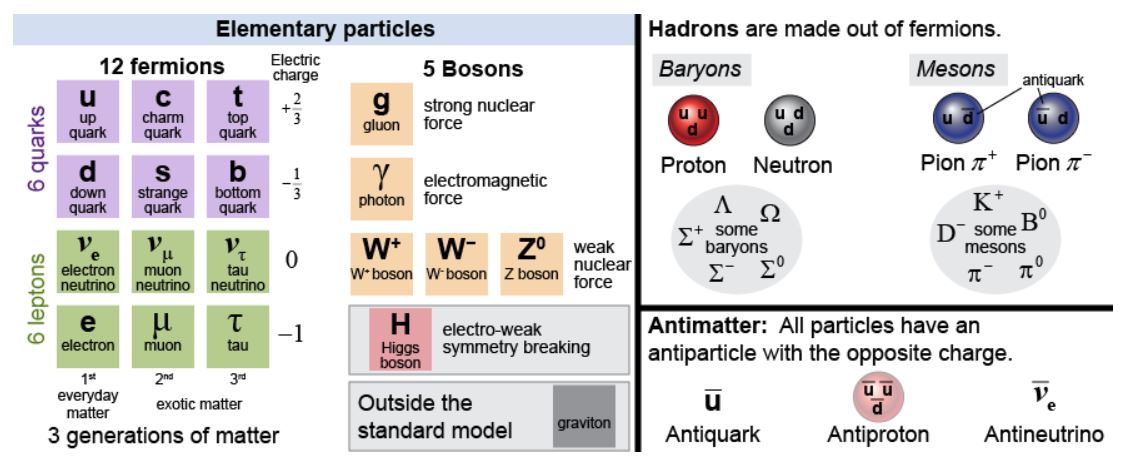

Click pic for better view in new tab.

Crackpot ideas that later prove valid is how science sometimes works. It’s how science has become the mess that it is — a chaos of observations that can’t make sense out of 95% of what is going on all around; a plethora of experimental results that don’t quite match the work of theorists.

The super-brilliant people who paint the mathematical structures of ultimate reality rely on physicists to smear their masterworks with the muds of perturbation, renormalization, and a half dozen other incomprehensible substrates to get the few phenomenon folks think they understand to look right and make sense. Theory and experiment don’t seem to match-up as well as some folks think they should more times than not.

A minor recalibration based on the acceptance of photons as quantum objects with tiny, almost unmeasurable masses will not change ideas about the nature of the universe and what is possible, because the upper-bound on photon masses might be undervalued — perhaps by a factor of billions.


Theorists like Nima Arkani-Hamed work on abstract geometries called amplituhedrons to salvage notions of massless particles while simplifying calculations of scattering probabilities in quantum mechanics. It seems to me like hopeless adventures doomed to fail. But in fairness so did Columbus’s exploration for new worlds.

To be a serious candidate for dark matter, a typical microwave photon should have an average mass of nearly .05 eV (electron volts), which is about 9 x 10-38 kilograms. If multiplied by the number of photons ( 1090 ), the photon masses add almost miraculously to become 85% of the theoretical mass of the universe.

(1E90)*(9E-38) = 9E52.  (9E52) / .85 = 1E53 kg. 

It’s the same number conjectured by dark-matter advocates. 

To qualify for dark matter means that a typical or average photon must have close to one ten-millionth of the mass of an electron.

Only then does everything fall into place like it should.

Pull out the calculator, anyone who doesn’t believe it.


Einstein, in his famous 1905 paper on special relativity, showed that mass is equivalent to the energy of an object divided twice by a constant, which is “c” squared, right?

Later, he added a second term to the internal energy of a particle which is its inertial energy, pc2 . Simplified, this term equals hf for a massless photon. The total energy of any object is the square root of the sum of its internal energy and its inertial energy. 

E = \sqrt {(mc^2)^2 + (pc)^2}

If Einstein is taken at his word, then the inertial mass of a photon is a function of its characteristic frequency — i.e. the inertial mass of a photon is equal to 

\frac{hf}{c^2}

where “h” is the Planck constant and “c” is the speed of light. The internal mass, should any exist, can be discounted. 

An argument can be made from Einstein’s equations that the mass of a photon might be \sqrt {2} times larger. A factor of 1.414… won’t change the argument. It strengthens the point but is, in the end, not important enough to include in an article that is already overly long. Curious readers can review the reasoning in my essay General & Special Relativity

If the average photon has an inertial mass of .05 eV, it requires that — all else being equal — the combined photon energy in a non-expanding universe would lie in the range of infrared light, a frequency in this case of 12E12 Hz, which is sometimes referred to as far-infrared.

(Set equivalent-mass equal to .05 eV (8.9E-38 kilograms) and solve for frequency.) The frequency approaches the lower energy microwave part of the light spectrum. 

Note:  For perspective, one eV is the energy (or mass equivalent) of a near-infrared photon of frequency 242E12 Hz, which approaches from below the higher-energy visible-light part of the light spectrum. 

The mass equivalence of the inertial energy of 1E90 infrared photons is sufficient to hold the universe together to prevent runaway expansion caused by repulsion due to the gravity constant Λ in Einstein’s equation for General Relativity. 

Do the math.

I know what some people might be thinking: Didn’t the 29 May 1919 solar eclipse, which enabled observers to confirm Einstein’s theory of General Relativity, demonstrate that photons lack internal mass?  Didn’t Eddington’s experiment prove wrong Newton’s idea that photons, which he called corpuscles, were massive objects? 

Maybe. Maybe not.  Maybe internal mass isn’t necessary. There is enough energy in the inertial term of Einstein’s equation to yield the required mass.

Unlike massive particles where internal energy far outweighs inertial energy, for photons, inertial energy is dominant. Even if science admits to a small amount of internal mass in photons, it is their inertial energy that dominates.

I found a good mathematical argument for light mass on Quora by Kyle Lochlann, an academic in relativity theory. Here is the link:

PHOTON MASS

Be sure to read comments to his answer — especially those who find math incomprehensible, which might be nearly everyone who reads my blog. 

After all, Newton’s theory of gravity predicted that the light from stars would deflect near the Sun at only half what Eddington’s experiment clearly showed. Eddington’s eclipse proved Einstein’s theory — the geodesics of spacetime bend in the presence of massive objects like stars.

Many concluded that photons followed the geodesics of spacetime, because photons lacked mass equivalence of any kind. Newton erred about pretty much everything involving gravity and light, some said.  

But their conclusion can’t be right, can it? Doesn’t their conclusion ignore what the math of Einstein’s formulas actually says?


Won’t it make more sense to say that the geodesics of spacetime constrain and overwhelm whatever internal and inertial mass photons might possess?  Doesn’t it make more sense to convert the frequency-related inertial energy of photons to mass to better explain their behavior near objects like the Sun? 

Evidence exists that light-mass is a thing and that it matters. Einstein included a mass-equivalence term for light in his tensors for general relativity. Frank Wilczek, MIT Nobel laureate, is famous for insisting that the mass of anything at all is its energy content. The energy of light is in its frequency, its momentum, which is a measure of its mass. 

It’s true that light does not seem to interact with the Higgs field. Nevertheless, the energy of light seems to interact gravitationally with ordinary matter. The interaction is not measurable when photon numbers are small. When photon numbers are huge, perhaps it is.  

A single photon in the presence of the Sun has no chance. When 10E90 photons saturate a space that is almost entirely devoid of matter, photons can shape a universe — especially when their number is 10 billion times the number of atoms. 

It seems possible, at least to me.

According to data gathered by the NASA WMAP satellite, ordinary matter in the observable universe amounts to a little more than 1/4 of a neutron per cubic meter of space. It amounts to 253.33E6 electron-volts of mass. Everything else WMAP observed was “cold dark matter” and “dark energy”.

How many .05 eV photons does it take to flood a cubic meter of space with enough mass-equivalence to reduce the mass-energy of 1/4 of a neutron to 15% of the total? How many photons are required to sum to 85% of the energy WMAP attributed to “cold dark matter”? It turns out that the number is 34 billion photons per cubic meter. 

The question is: how many photons are there? 

The observable universe has an estimated volume in the neighborhood of 1E80 cubic meters, right? Yes, it might be as much as 4 times that number. 

The lower-bound number of photons in the observable universe is 1E90. It might be ten times more.

It turns out that the number photons per cubic meter in the universe must be somewhere close to 25 billion.  25 is pretty darn close to 34. Since all the numbers are estimates with large margins of error, it’s possible that everything will fall into place as it should if and when the statistics of the universe are ever known with precision.

Could photons of light might be the “cold” dark matter everyone is searching for?

A single neutron has no chance when it is bathed in 136 billion .05 eV photons, which surround and envelop it on all sides from every direction. It makes a kind of quantum scale Custer’s Last Stand for random neutrons, right? 

When scientists look at the universe today, they see an accelerating expansion. They see in the cosmic background radiation photons that have slipped from infrared into longer, less energetic microwave wavelengths which no longer have enough mass-equivalence to hold the universe together.

As light stretches into longer and longer wavelengths through interaction mechanisms such as Compton scattering and other processes (like the push of “dark energy” or the less popular gravitational tug of parallel universes), light frequencies and energies diminish.

Eventually, when the total of all light falls below an average frequency of 12E12, the equivalent mass of the 1E90 primordial photons loses its grip; it becomes unable to hold the universe together.

Near the beginning of time when photons were orders-of-magnitude higher in frequency than now, their stronger gravitationally-equivalent-masses pulled together the structures astronomers study today, like stars and galaxies.


But now scientists seem to be witnessing a runaway expansion of the universe. Light has stretched and dimmed into the microwave and radio-wave frequencies where its mass-equivalence is unable to hold together the universe as it once was.

Because we can’t detect it, isn’t it possible that dark energy and dark matter don’t exist? That is to say, the idea that dark matter and energy are necessary to account for observations is no more than a conjecture made necessary by a misbehaving universe of unusual galaxies. But direct observational evidence for dark matter and energy is the part of the conjecture that is missing. No one has ever seen any.

What astronomers are observing instead is faraway galaxies that existed billions of years ago when the mass-equivalent energy of photons was greater than it is now.

The intact universe of galaxies seen in the night sky today, which is photographed with high-resolution space-borne telescopes, is not up to date in any sense at all, except that it is the view of an ancient past that goes back almost to the beginning of time depending on how deep into space anyone looks.

Everyone who cares about astronomy knows it’s true.

To qualify as a candidate for dark matter means that a photon must have close to one ten-millionth of the mass of an electron. It seems like a reasonable ratio, right?

In the Standard Model, only neutrinos are less massive than electrons. No one knows what the mass of each of the three “flavors” of neutrinos is, but when added they are less than 0.12 eV — about 2.4 times the equivalent-mass of infrared photons and about one four-millionth of the mass of electrons. It seems possible to me that the mass of at least one of the flavors of neutrinos will be less than the conjectured equivalent-mass of an infrared photon packet.

Neutrons and protons are, by contrast, 2,000 times “heavier” than electrons.

I am asking working physicists to reexamine estimates that claim the mass of a photon can be no more than trillions of times less than the mass of an electron.

The claim can be found at the back of articles in science journals as well as in blogs across the internet. For me, the idea seems ridiculous on its face. The energy-equivalent mass of photons varies with frequency, but only the lowest energy radio wave photons can hope to approach the low equivalent-mass estimated in the latest publications.

Scientists might want to revisit the mass of a photon and the methodology of its measurement. The stakes are high, and science doesn’t have many options. Hope — like the energy of ancient photons — is fading.


Science would be served best if scientists started from scratch to reexamine every assumption and lab procedure. The search for dark matter has become an expensive and compulsive quest that seems futile, at least to me. Several costly experiments have reached disappointing dead ends, which are reviewed in the “VICE on HBO” video located near the start of this essay.

What if photons of light really are the dark matter, which is hiding in plain sight waiting to be discovered by anyone who dares to look at the problem with fresh eyes?

What if the delay between the observations of the CMB (cosmic microwave background) and the structure of the universe is a natural disconnect in time and space that misleads folks to believe that mass must be “out there”, when it has in fact long since dissipated?

From another perhaps opposite perspective, what if photons are instead stimulating emissions from virtual particles as they travel at fantastic speeds through the vastness of space? What if these emissions add mass to photons sufficient to bring them to the “dark matter” threshold, as they do in materials like glass?

Such a state of affairs would imply that not all photons travel the same speed in the so-called vacuum of “empty” space. It is a heretical idea, for sure — a can of worms, perhaps to some, but hey! — you can catch a lot of fish with a can of worms.

A photon is a packet of electromagnetic oscillations built-up from many frequencies. Superposition of these frequencies adds to give a photon its characteristic frequency from which its equivalent mass can be calculated. Right?

Use imagination to think of the many ways a higher “speed limit” that is mandated by the existence of massive photons might work to stimulate the interest of a space-traveling civilization to explore the universe, which ordinary folks begin to understand is more accessible, more reachable than anyone thought possible.

Consider the number of inexplicable phenomena that would make sense if particles thought to have zero internal mass don’t really exist, and photons, gluons, gravitons, and Higgs bosons aren’t the only ones.

Recalibration might save a lot of time and effort in the search for the putative missing energy and mass of the universe.

Should “dark” particles exist whose internal mass is less than that of photons, they will likely move at superluminal speeds that make them difficult to track. To influence stars, their number would have to dwarf photons. Such an idea strains credulity.

A counterproposal by Roger Penrose speculates that dark matter particles might have the mass of the eye of a flea; he calls them “erebons.” These particles are electromagnetically invisible, but their huge masses relative to other particles in the Standard Model make them gravitationally compelling.

Erebons decay; evidence for their decay should be showing up in data collected by LIGO detectors.

So far persuasive evidence for erebons has not been found.


For scientists and explorers, the access-barrier to a universe shaped and configured by massive photons will most certainly shrink — perhaps thousands to millions of times.

The stars and galaxies that people believed were unreachable might finally fall within our grasp.

Or — perhaps less optimistically and more cynically — the mass-equivalent energy of 1E90 photons might by now be so severely degraded that nothing can save a universe that has already come undone and flown away into an abyss that humans will never see.

The radiation-evidence from a catastrophe of disintegrating galaxies that has already occurred won’t reach Earth-bound viewers for perhaps billions of years.

Should humans survive, our progeny — many millions or billions of years from now — may “see” in the vastness of space a cold and diminished radio-wave radiation that hums in a soul-less vacuum devoid of galaxies and visible light.  Microwave light will by then be nothing more than a higher-pitched, prehistoric memory.

Roger Penrose says that the fluid dynamics of an exhausted universe devoid of matter will become indistinguishable from the singularity that gave its start. A new universe will ignite from the massless, radiation-ashes of the old.

The idea is called Conformal Cyclic Cosmology — or CCC

Human-nature forces us to want to know more; most folks want to search for and find the answers to the questions that will determine the fate of all life on Earth and in the vast stretches of spacetime that remain beyond our reach.

Is the universe within our grasp, or has it already disintegrated?

We search for truth to set ourselves free.

Billy Lee

RISK

Everyone wants to live as long as possible, right? Well, maybe not everyone.

Someone confided in me that their nightmare was they wouldn’t die; they would never get respite from an existence that terrified them, that depressed them, that hurt them, that disappointed and discouraged them; that humiliated them; that abused them; that made them wish they were never born.

Another friend confessed that she wished she had never been born because she was afraid to die. The certainty of death made living not worth the trouble. Anxiety about the end of life robbed her of joy. She found that she was unable to kick back and relax, because dark angels circled just outside her field of vision; one day, she was certain, the angels were going to pounce. The end would be brutal.

I remember hearing a story about a young mother who lay dying while her family knelt at her bedside. A scene of sweet-sorrow unfolded as the woman struggled to breathe in the presence of loved-ones. A worried husband, anxious toddlers, her parents, and a few close friends sang hymns to reassure and cast comfort. They clung to one another united by the belief that God would carry momma gently to heaven in his caring arms.

Momma didn’t experience death that way. She bolted up, away from her pillow. She stared wild-eyed at something behind her visitors; something no one saw.

She screamed. No! No! No! 

Momma dropped off the bed, slammed to the floor, and rolled onto her back making a loud crack — like a toppled refrigerator. She stared at the ceiling, face frozen, eyes open; crazed, except that now she was dead and too heavy for anyone to move.


Steve McQueen died at age 50 from cardiac arrest at a cancer treatment facility in Mexico in 1980. He made thirty movies; many were blockbusters.

Some people love life and don’t want to leave. I remember Steve McQueen, an actor from yesteryear who had everything to live for. He was a happy race-car enthusiast, a leading man in movies, incredibly handsome, kind, and grateful for every blessing his wonderful life showered on him.

He got cancer. Stateside doctors told him he had no chance. Death was certain. He traveled to Mexico to seek out a cancer recovery center he learned about from friends.

I remember hearing him weep during a radio interview because, he said, the medical director had saved his life. He thanked him again and again. He couldn’t say it enough. I felt touched. He loved life; his gratitude seemed to resonate with the voices of the angels. I would have gladly traded places with him.

Two days later, the newspapers and television news shows reported that he died. What went through his mind when he finally realized that his life wasn’t going to turn out the way he planned?

For people who seek death, death is easy to find — if they have the courage to face what comes after; if the pain of living exceeds the risks of non-existence or the risks of being reborn as someone new or the possibility of falling into the pits of Hell or wherever they imagine might lie the alternative to the pain of life on Earth. Relief is as close as the closeted gun, the nearest bridge, the bottle of medicine in the bathroom cabinet.

I feel bad for people who have been ruined, I do. Far more people kill themselves than are killed by others. No one believes it, but it’s true.

I don’t want to dwell on the ruined, because another class of people — a smaller group, I sometimes wonder — want to live.


The man shown in this pic (from 2011) was active and working at age 106. He and hundreds like him have been the subject of scientific studies about human longevity. They are kind and gentle people who enjoy life by all accounts; they wish only to live as long as possible.

These are the folks who never suffer from depression; experience a major illness; spend time in hospital or prison; lose a child or spouse; worry about the sparkle of a crooked tooth or the part on their head of radiant hair. They don’t worry about any lack of symmetry that might render them unattractive — or about getting their way in life, because they always do.

I want to talk about the powerful, beautiful, effective people who everyone seems to want to be. I want to talk about the happy people like Steve McQueen who will always chase a fantasy, because they want to live in the worst, most desperate way.

I want to talk about the people who freeze themselves in the hope that in a benevolent future they will be thawed, and life will continue; I want to talk about the people who take 150 pills a day to prevent every ailment and strengthen every sinew.

I want to talk about the brilliant, optimistic people who expect that if they can just figure things out the right way, life awaits them for as long as they want it.  It’s all up to them. They will find a way to make life last; to achieve an eternal success, because they always have.

Is it time for a reality check?

Is this a good time to reveal some truths? — shocking truths, perhaps, for a few readers?  I want to predict our futures — all of our futures — as separate individuals with private lives; and as a species — a species anthropologists describe by the Latin words, homo sapiens, (smart people), which they use among themselves to differentiate you and me from all the other groups of living things we rarely notice or even think about.

Let’s smarten up for a few moments and defend our reputation among the kingdoms of the animals and the plants. Let’s think about best case scenarios for survival and whether we can make our dreams come true.

One statistic to keep in mind that is easily verified (and it might startle some readers): two-thirds of all deaths are not caused by aging.

So let’s move on.

Who wants to start with species survival? Who would rather address the riddle about how to lengthen an individual life?

Ok, the responses I think I hear in my head are nearly unanimous. People want to know how they themselves can live longer, correct?  People want to know how long they will live when everything is set right.

So, why not start with a best case scenario for individuals?  I promise to address the issues of survival for homo sapiens later, after a few paragraphs more.

Here are some simple, best-case-scenario assumptions:

Assume that disease is eradicated. We reach a state under the protections of ObamaCare (or maybe Trump-Care, who knows?) where no one dies in hospital anymore; all diseases have cures and can be prevented; in fact, disease is eliminated from the face of the earth — no bacterial or viral infections; no malevolent genes gone haywire; no Alzheimer’s or mental impairments; no more skin rashes or herpes or warts or annoying ear-wax that morphs into septic brain infections.

Disease is gone. Now take another step. Make a leap of faith. Assume that the genetics of aging is solved and that no one grows old. No one deteriorates. Skin does not wrinkle; no more age spots or rotting teeth; loss of hair and muscle-mass becomes a thing of the past. Aches and pains and constipation and diarrhea and acid reflux — what be them? They gone!

Our long medical nightmare is over, to paraphrase the words of President Gerald Ford on the night he pardoned Dick Nixon so that no prosecutor could ever charge and convict him for being a crook and throwing an election.

OK. What now become the odds for our survival?  How long can one person expect to live?  I think everyone can see, there’s something we didn’t consider; one thing no one thought of; a missing piece in the puzzle of living-large that is going to leap up and grab each of us sooner or later — unless we live bundled by bubble-wrap in a bunker, miles below the surface of the earth. We all know what it is, right?

It happens when we bike on a country road, and a candy-coking cell-talker in a Corvette runs us over. It happens when we climb Mount Everest (just to cross it off our bucket-list) and whoops! someone in the group forgot to tie their shoelaces. People see a video on the evening news — dead people buried in snow.

It happens when flying an airplane — a flock of geese smashes the windscreen. The pilot gets sucked out the opening — shredded by shards of glass.

We visit an amusement park to thrill ourselves on a ride that throws us upside down and — oops again! — an unscheduled stop; a mechanical malfunction. Two hours later, rescued, we’re vegetables. Homo sapiens don’t do well hanging upside down for long periods.

Yes, the one thing no one counted on is accidents.


Accidents kill a lot of people every single day. And nothing is going to change that fact unless people decide to live in virtual reality and never get off the couch to go outdoors or walk their dog.

What exactly are the statistics of accidents?

Well, every year one person in a thousand dies in a screw-up by somebody, usually themselves. It doesn’t sound like much, but for the person who dies it’s one death too many. Anyone who expects to live 25,000 years should perform a statistical analysis to see what the chances are they will live that long.

Why guess?

The way the math works is this: figure the chances of living deadly-accident-free for one year (it’s 999/1000), then multiply this number by itself for each year of life.

Save time by using the exponent key on a calculator to enter years, anyone who doesn’t want to spend a week multiplying the same number over and over 25,000 times. The result will give the chances for survival over a span of that many years. Try some other numbers to make comparisons.

The bottom line is this: no one has any realistic hope at all of living more than 10,000 years or so. Of the seven billion humans alive today, only one in 22,000 can expect to live to the age 10,000.

A mere 2,000 people out of 7,000,000,000 will survive to see year 15,000. There’s a small chance (one in ten) that a solitary person might make it to 25,000 years, but they will be an outlier; a statistical anomaly. Who wants to be an anomaly?  Not me.

In most cases; under the most realistic scenarios, the chances are that everyone alive today is going to be dead at age 25,000 because of accidents alone. They will die healthy though. It might be consolation for some.

No one will make it to year 25,000. That’s my bet. It’s not going to happen 90% of the time. 

Accidents happen.

OK. Now that everybody knows that our individual situation is hopeless, what about the survival of our species — the human race (for those who disdain the scientific term, homo sapiens)?


Not sure why this video, but it’s pretty good, so let’s go with it. 


I am sorry to report that the survival odds for our species are actually far worse than the odds for our survival as individuals. This depressing fact means that we can totally ignore the individual survival scenario we just took so much effort to describe. If our species dies-off early, individuals are going to die early too.

How can this terrible situation be possible? It seems so unfair.

I’ve been reading the book Global Catastrophic Risks — a collection of essays edited by Nick Bostrom and Milan M. Cirkovic — first published nine years ago (in 2008) when species survival was more certain than it is now. These brilliant men collected essays written by other forward-thinking geniuses who describe in delirious detail thirteen (or so) existential threats to the survival of humans. Some readers might want to review the list.

1 – Systems-based risks and failures

2 – Super-volcanism

3 – Comets and asteroids

4 – Supernovae, gamma-ray bursts, solar flares, and cosmic rays

5 – Climate change

6 – Plagues and pandemics

7 – Artificial intelligence

8 – Social collapse

9 – Nuclear War

10 – Nuclear Terrorism

11 – Biotechnology

12 – Nanotechnology

13 – Totalitarianism

The authors argue that certain scenarios involving these threats will create an inevitable cascade of events that lead to the melt-down of civilization and a kill-strike against the human-species. I decided to assign a 1 in 10,000 chance of occurrence to each of these 13 catastrophes and crunch the numbers to understand how much danger people on Earth might be facing.

What I discovered scared me.


A super-volcano eruption in Toba, Indonesia 70,000 years ago reduced the population of humans on Earth to less than 4,000. Volcanoes that we know about today, like the one under Yellowstone National Park, might be larger and more dangerous.  

For one thing, it’s not possible to know if 1 in 10,000 is an optimistic or pessimistic assessment of each of these risks. Nuclear war might be 1 in 100; climate change — 1 in 50; asteroids — 1 in 50,000; supernovae — 1 in 100,000,000; artificial intelligence — 1 in 10.

Who knows?

Can humans survive 10,000 years without a pandemic or nuclear war? No one knows.

Experts resort to heuristics, which erupt from biases even they don’t know they carry. I suppose a gut-check by an expert has more validity than a seat-of-the-pants guess by a pontificator. I will give you that. But the irony is that no matter who is right, no one will know because we are all going to die.

Evidence in the fossil and genetic record already shows that at least three human-like species are known to have come and gone during the past several 100,000 years or so, including Neanderthals and Denisovans. Extinction of intelligent, human-like species happens more often than not — 3 out of 4 times, maybe more if scientists continue to dig and look.

Number-crunching shows that if my 1 in 10,000 or so years risk assessments are anywhere close to being realistic, humans have no more than a 1 in 4 chance to avoid extinction during the next 1,000 years. Our chance to survive approaches zero as the number of years reaches into the realm of 5,000 years and beyond.

Humans have recorded their stories for 5,000 years. Some call these stories, history. Sometime during the next 5,000 years, history will end unless humans lower the odds of these catastrophes to much less than 1 in 10,000.


We are truly stupid — dumber than earthworms — to refuse to make the effort to increase our survival prospects by lowering these probabilities, these ratios, to one-in-one-hundred-thousand or better still, one-in-a-million or even better, one-in-one-hundred million. Why not one-in-a-gazillion?

How? It’s the big question.

Reducing odds of catastrophe is the most important thing. It’s urgent. Failure seals our fate.

We search the heavens. No one seems to be broadcasting from out there. Maybe it’s something simple like Miyake events, which some argue make communication infrastructure near stars impossible to sustain.  

What science hears is silence… and tiny chirps, yes, but not from crickets.

Doomsday clocks? 

They’re ticking.

Billy Lee

RENORMALIZATION

I have a lot to say about renormalization; if I wait until I’ve read everything I need to know about it, my essay will never be written; I’ll die first; there isn’t enough time.

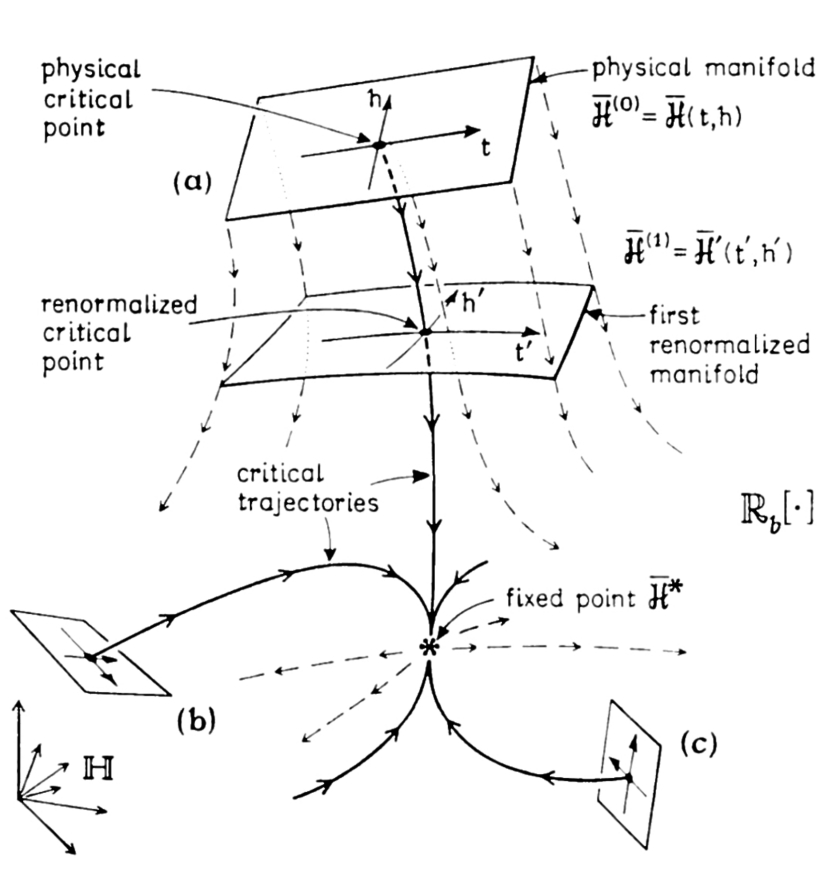
Click this link and the one above to read what some experts argue is the why and how of renormalization. Do it after reading my essay, though.


Our guess is that this graphic will be incomprehensible to the typical reader of Billy Lee’s blog. So, don’t worry about it. Billy Lee isn’t going to explain it, anyway. More important things need to be told that everyone can understand, and they will. The Editorial Board

There’s a problem inside the science of science; there always has been. Facts don’t match the mathematics of theories people invent to explain them. Math seems to remove important ambiguities that underlie all reality.

People noticed the problem as soon as they started doing science. The diameter of a circle and its circumference was never certain; not when Pythagoras studied it 2,500 years ago or now; the number π is the problem; it’s irrational, not a fraction; it’s a number with no end and no pattern — 3.14159…forever into infinity.

More confounding, π is a number which transcends all attempts by algebra to compute it. It is a transcendental number that lies on the crossroads of mathematics and physical reality — a mysterious number at the heart of creation because without it the diameters, surface areas, and volumes of spheres could not be calculated with arbitrary precision. 


For a circle, either the circumference or the diameter can be rational (written as a fraction) but not both. Perfect circles and spheres cannot exist in nature. Why?  ”π” is irrational. It can’t be written like a fraction —  a ratio — where one integer divides another.

The diameter of a circle must be multiplied by π to calculate its circumference; and vice-versa. No one can ever know everything about a circle because the number π is uncertain, undecidable, and in truth unknowable. 

Long ago people learned to use the fraction 22 / 7 or, for more accuracy, 355 / 113These fractions gave the wrong value for π but they were easy to work with and close enough to do engineering problems.

Fast forward to Isaac Newton, the English astronomer and mathematician, who studied the motion of the planets. Newton published Philosophiæ Naturalis Principia Mathematica in 1687. I have a modern copy in my library. It’s filled with formulas and derivations. Not one of them works to explain the real world — not one.

Newton’s equation for gravity describes the interaction between two objects — the strength of attraction between Sun and Earth, for example, and the resulting motion of Earth. The problem is the Moon and Mars and Venus, and many other bodies, warp the space-time waters in the pool where Earth and Sun swim. No way exists to write a formula to determine the future of such a system.


This simple three-body problem cannot be solved using a single equation. It’s not so simple. More than three bodies makes systems like these much harder to work with.

In 1887 Henri Poincare and Heinrich Bruns proved that such formulas cannot be written. The three-body problem (or any N-body problem, for that matter) cannot be solved by a single equation. Fudge-factors must be introduced by hand, Richard Feynman once complained. Powerful computers combined with numerical methods seem to work well enough for some problems. 

Perturbation theory was proposed and developed. It helped a lot. Space exploration depends on it. It’s not perfect, though. Sometimes another fudge factor called rectification is needed to update changes as a system evolves. When NASA lands probes on Mars, no one knows exactly where the crafts are located on its surface relative to any reference point on the Earth.

Science uses perturbation methods in quantum mechanics and astronomy to describe the motions of both the very small and the very large. A general method of perturbations can be described in mathematics. 

Even when using the signals from constellations of six or more Global Positioning Systems (GPS) deployed in high earth-orbit by various countries, it’s not possible to know exactly where anything is. Beet farmers out west combine the GPS systems of at least two countries to hone the courses of their tractors and plows.

On a good day farmers can locate a row of beets to within an eighth of an inch. That’s plenty good, but the several GPS systems they depend on are fragile and cost billions per year. In beet farming, an eighth inch isn’t perfect, but it’s close enough.

Quantum physics is another frontier of knowledge that presents roadblocks to precision. Physicists have invented more excuses for why they can’t get anything exactly right than probably any other group of scientists. Quantum physics is about a hundred years old, but today the problems seem more insurmountable than ever.


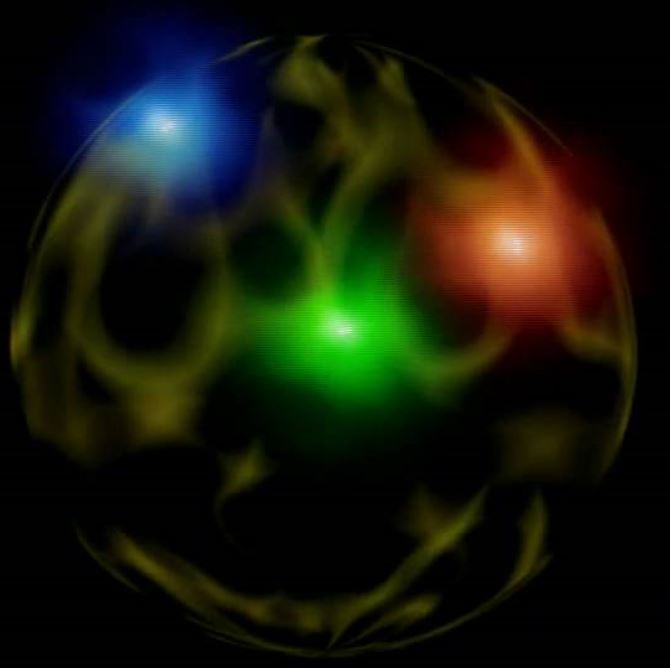
The sub-atomic world seems to be smeared and messy. Vast numbers of particles — virtual and actual — makes the use of mathematics problematic. This pic is an artist’s conception. Concepts such as ”looks like” have no meaning at sub-atomic scales, because small things can’t be resolved by any frequency of light that enables them to be visualized realistically by humans.

Insurmountable?

Why?

Well, the interaction of sub-atomic particles with themselves combined with, I don’t know, their interactions with swarms of virtual particles might disrupt the expected correlations between theories and experimental results. The mismatches can be spectacular. They sometimes dwarf the N-body problems of astronomy.

Worse — there is the problem of scales. For one thing, electrical forces are a billion times a billion times a billion times a billion times stronger than gravitational forces at sub-atomic scales. Forces appear to manifest themselves according to the distances across which they interact. It’s odd.

Measuring the charge on electrons produces different results depending on their energy. High energy electrons interact strongly; low energy electrons, not so much. So again, how can experimental results lead to theories that are both accurate and predictive? Divergent amplitudes that lead to infinities aren’t helpful.

An infinity of scales pile up to produce troublesome infinities in the math, which tend to erode the predictive usefulness of formulas and diagrams. Once again, researchers are forced to fabricate fudge-factors. Renormalization is the buzzword for several popular methods.

Probably the best-known renormalization technique was described by Shinichiro Tomonaga in his 1965 Nobel Prize speech. According to the view of retired Harvard physicist Rodney Brooks, Tomonaga implied that  …replacing the calculated values of mass and charge, infinite though they may be, with the experimental values… is the adjustment necessary to make things right, at least sometimes. 

Isn’t such an approach akin to cheating? — at least to working theorists worth their salt?  Well, maybe… but as far as I know results are all that matter. Truncation and faulty data mean that math can never match well with physical reality, anyway. 

Folks who developed the theory of quantum electrodynamics (QED) used perturbation methods to bootstrap their ideas to useful explanations. Their work produced annoying infinities until they introduced creative renormalization techniques to chase them away.

At first physicists felt uncomfortable discarding the infinities that showed up in their equations; they hated introducing fudge-factors. Maybe they felt they were smearing theories with experimental results that weren’t necessarily accurate. Some may have thought that a poor match between math, theory, and experimental results meant something bad; they didn’t understand the hidden truth they struggled to lay bare.

Philosopher Robert Pirsig believed the number of possible explanations scientists could invent for phenomena were in fact unlimited. Despite all the math and convolutions of math, Pirsig believed something mysterious and intangible like quality or morality guided human understanding of the Cosmos. An infinity of notions he saw floating inside his mind drove him insane, at least in the years before he wrote his classic Zen and the Art of Motorcycle Maintenance.

The newest generation of scientists aren’t embarrassed by anomalies. They “shut up and calculate.” Digital somersaults executed to validate their work are impossible for average people to understand, much less perform. Researchers determine scales, introduce “cut-offs“, and extract the appropriate physics to make suitable matches of their math with experimental results. They put the horse before the cart more times than not, some observers might say.


Apologists say, no. Renormalization is simply a reshuffling of parameters in a theory to prevent its failure. Renormalization doesn’t sweep infinities under the rug; it is a set of techniques scientists use to make useful predictions in the face of divergences, infinities, and blowup of scales which might otherwise wreck progress in quantum physics, condensed matter physics, and even statistics. From YouTube video above.

It’s not always wise to question smart folks, but renormalization seems a bit desperate, at least to my way of thinking. Is there a better way?

The complexity of the language scientists use to understand and explain the world of the very small is a convincing clue that they could be missing pieces of puzzles, which might not be solvable by humans regardless how much IQ any petri-dish of gametes might deliver to brains of future scientists.

It’s possible that humans, who use language and mathematics to ponder and explain, are not properly hardwired to model complexities of the universe. Folks lack brainpower enough to create algorithms for ultimate understanding.

People are like the first Commodore 64 computers (remember?) who need upgrades to become more like Sunway TaihuLight or Cray XK7 Titan super-computers to have any chance at all.

Perhaps Elon Musk’s Neuralink add-ons will help someday. 


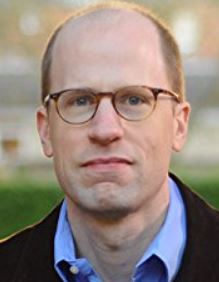
Nick Bostrom, author of SUPERINTELLIGENCE – Paths, Dangers, Strategies

The smartest thinkers — people like Nick Bostrom and Pedro Domingos (who wrote The Master Algorithm) — suggest artificial super-intelligence might be developed and hardwired with hundreds or thousands of levels — each  loaded with trillions of parallel links —  to digest all meta-data, books, videos, and internet information (a complete library of human knowledge) to train armies of computers to discover paths to knowledge unreachable by puny humanoid intelligence.

Super-intelligent computer systems might achieve understanding in days or weeks that all humans working together over millennia might never acquire. The risk of course is that such intelligence, when unleashed, might enslave us all.

Another downside might involve communication between humans and machines. Think of a father — a math professor — teaching calculus to the family cat. It’s hopeless, right? 

The founder of Google and Alphabet Inc., Larry Page, who graduated from the same school as one of my sons, is perfecting artificial super-intelligence. He owns a piece of Tesla Motors, started by Elon Musk of SpaceX.

Imagine an expert in AI & quantum computation joining forces with billionaire Musk who possesses the rocket launching power of a country. Right now, neither is getting along, Elon said. They don’t speak. It could be a good thing, right? 

What are the consequences?

Entrepreneurs don’t like to be regulated. Temptations unleashed by unregulated military power and AI attained science secrets falling into the hands of two men — nice men like Elon and Larry appear to be — might push humanity in time to unmitigated… what’s the word I’m looking for?

I heard Elon say he doesn’t like regulation, but he wants to be regulated. He believes super-intelligence will be civilization ending. He’s planning to put a colony on Mars to escape its power and ensure human survival.


Elon Musk

Is Elon saying he doesn’t trust himself, that he doesn’t trust people he knows like Larry? Are these guys demanding governments save Earth from themselves?

I haven’t heard Larry ask for anything like that. He keeps a low profile. God bless him as he collects everything everyone says and does in cyber-space. 

Think about it.

Think about what it means.

We have maybe ten years, tops; maybe less. Maybe it’s ten days. Maybe the worst has already happened, but no one said anything. Somebody, think of something — fast.

Who imagined that laissez-faire capitalism might someday spawn an airtight autocracy that enslaves the world?

Ayn Rand?

Humans are wise to renormalize their aspirations — their civilizations — before infinities of misery wreck Earth and freeless futures emerge that no one wants.

Billy Lee 

AFTERLIFE

To readers who cling to religious beliefs and ancient scriptures to keep themselves sane and inoculated against despair, I caution — please avoid this essay, if anyone can; if faith is fragile and belief not deeply rooted, why not watch a YouTube video or play a computer game?

What sense is there in exploring ways of thinking (and being) that might push the personality to unravel; that might introduce dissonance into the deepest recesses of the mind; that might, for example, induce lunatics — like  suicidal lemmings — to throw themselves off cliffs of certainty into the swarming froth of oceans that want only to swallow them whole, to drown them in unfamiliar worlds of sea monsters and dark, incomprehensible dangers; to flood their lungs with the knowledge that every true thing they’ve ever learned is a lie?

Some of the smartest folks who have ever lived believe that we cannot die. No one dies; everyone lives — forever.

Some of these people would say that every person reading this essay right now is living in an afterlife; it’s an afterlife that began a very long time ago and will continue, in one form or another, forever.

OK. I warned you. Let’s get on with it.

First, some caveats. Paragraphs of caveats. The evidence seems overwhelming: all scripture in all religions was written long ago by savants who lacked — by today’s standards — education.

Scripture writers knew almost nothing about almost everything, except for those experiences unique to their personal histories, which they sometimes wrote about. Old texts written by ignorant (but smart) men are the parchment scrolls that religions always use as the foundational pillars of their creeds, doctrines, and world views.

It turns out that almost all religions promote the belief in an afterlife; the problem is that their ideas about afterlife make no sense; they don’t stand up under the scrutiny of a dispassionate examination by scholars using the methodology of science.

The Jesus of Christianity said He was God — imagine that. He was born to save the world, not judge it (as so many haters hoped he would), and to demonstrate to all the earth the sacred truth of the Bible, which says plainly that God is love.

The problem is, Jesus didn’t write anything down. A few of his male friends quoted what he said in short tracts they wrote, which were gathered together decades later into a collection that is now referred to as the Four Gospels of the New Testament.

We have to take their word. They were ordinary people; working people. They lacked credentials. Their little books, from a scholar’s perspective, are primitive and clumsily written. Their stylistic errors give their writing authenticity to a modern eye, but their understanding of theology seems confused, child-like, and kind of messy.

The value of the Gospels comes from the effort of the authors to quote from memory the amazing things Jesus said. Given the ignorance of the writers, their quotations have a miraculous lucidity, which adds weight to what they left to history.

The person who saved the New Testament for the scholar’s ear is the apostle Paul, a contemporary of Jesus whose letters make up the largest part of the volume of the New Testament; they delivered the credibility demanded by the cynical eyes of intellectuals and sceptics of all eras.

Paul was a bonafide biblical scholar — he trained under Gamaliel — and was arguably the greatest theologian who ever lived. He met Christ only once — on the road to Damascus. It was a few years after the resurrection.  Paul was — along with many others at the time — on a mission from Rome to identify Christians; to arrest and turn them over to authorities for execution.

Paul’s encounter with Jesus left him blind. When his eyesight returned, he spent several years preparing. He then turned his learning and skills to the spread and growth of the new religion, which  at the time was called THE WAY. Under Paul’s guidance, Christianity became a spectacular success during his lifetime. Today it is the world’s largest religion.

Since for me, Jesus is God, I don’t take any other religions seriously, though the non-Christian scriptures I’ve read are interesting — much of the writing is admittedly intelligent and enlightened.

Paul wrote many of the foundational documents of the new religion — considered by scholars today to be the most sophisticated Scriptural literature ever written. According to Paul (and other writers), what was unique about Jesus was that he claimed to have a personal knowledge of the afterlife, which he backed up by demonstrating an ability to heal people of intractable ailments and by bringing folks presumed to be dead back to life. The afterlife was real, at least for Him.

What is also puzzling — Jesus’s friends and family didn’t seem to grasp fully what He was talking about, most of the time. His closest friends (the Bible calls them disciples) followed their shepherd around like a flock of sheep, by most accounts, because feats of magic mesmerized them. His explanations were incomprehensible — right through to his crucifixion and resurrection.

Even after His resurrection, friends remained mystified. During meetings they expressed a joyful disbelief. After all, no one could survive crucifixion. Once the process started, it was a one way journey into Hell.

Survival was something that didn’t happen. Jesus’s friends couldn’t understand. Modern folks can’t help but garble what they think they know about what His friends thought they heard and saw.

If those closest to Jesus couldn’t grasp His Truth, why should modern people expect to do any better? Isn’t it a bit unrealistic to expect a modern person to have more insight than Jesus’s closest confidantes — his family and friends — who lived with him for many years and knew Him best?

Anyway, this essay is about the afterlife; it’s about what some discerning people think about it, how it might work, how people may want to plan for it, and how to protect ourselves from any consequences of not understanding it properly; of not taking it seriously.

This essay is going to unnerve some readers; especially Christians who are under the mistaken impression that they have everything figured out, because they once read and memorized John 3:16, for example, and they pray everyday.

I am probably going to take a few readers into an unfamiliar landscape — one that Jesus could not have described to primitive people. I don’t want to alarm anybody. Some readers might experience fear; a few may wobble off-balance as they feel the ground shake beneath their feet.

My intent is to strengthen the resolve of believers to make whatever changes are necessary to secure the future of humanity. Jesus said that he came to save the world, not judge it. He suffered on the cross so that those who belong to Him won’t burn in Hell, which is our destiny apart from the love of a friend who has the desire and courage to rescue us.

Jesus said that God is love, and that all people are evil. Humans — everyone of us — are haters, whether we are able to admit it or not. Wherever it is that God lives, it is no place for ordinary people; it’s off-limits to haters. People can’t live where God lives, unless they are born again into a new life that reshapes who they are at their core.

People, many of them, hate the very idea of God. They have no fear of the consequences of God’s love for the orphan and widow, the oppressed and downtrodden, the crippled and the malformed, the prisoner and the tortured, the blind and the deaf, the possessed and the mentally tormented. 

They have no fear of hell — though the reality of hell lies on every side, they don’t see it. It doesn’t exist. It’s not something they feel compelled to fix. In modern minds —  most minds, probably — the idea of hell is an absurdity; it can’t exist.

To be literally true, what Jesus is quoted by his friends to have said must make sense and be aligned with the reality we observe when people look up into a night sky full of stars or gaze into a drop of pond water teaming with microscopic life.

It can’t be any other way.

His words will always align with the facts we know to be true, which we discover sometimes by doing science; by living life; by suffering; by knowing people. If they don’t, then we’re missing something — I would argue that it’s always something important.

Jesus spoke truth to people who thought stars were the light of Heaven shining through pin holes in a tarp that covered the night sky; to them, mental illness was demon possession; ailments were caused by sin. Jesus cured the anguished; healed the broken; he spoke gently, with compassion and loving sorrow in his heart; but it was frustrating, possibly exasperating; it wore him down sometimes.

In AD 30, truth sounded like lunacy to most people because everyone was ignorant and worse; people were evil — every single one. No one knew what was real and what was pretend. Everyone was crazy, by modern standards. Rulers executed people for speaking truth, and today some still do. Every thinking person knows it’s true.

OK. Enough caveats, already. I want now to move away from the religion of two-thousand years ago and move boldly toward the understanding of reality that the disciplines of the sciences provide. I want to explain what very smart people (some of whom do not think of themselves as religious) imagine is the afterlife, how it might work, why it’s important, and how culture and society might be better fashioned to give every person the best chance to live  free of despair and suffering.

Although this part of the essay will abandon religion and embrace science, the intent is not to cause believers to stumble; it is to wake believers from a slumber that threatens to make them impotent before the challenges to faith that are devouring America and many other parts of the modern world.

I want readers to think about how these ideas resonate with the words of Jesus — with His Truth — which is at odds as often as not with the religions of today, which by their works alone war with God’s love for human beings; war with Earth where all people live; war with the plants and animals that God gave people to comfort and protect with enlightened stewardship.

This essay offers a speculative view of science that aligns with the words of Jesus as quoted by the people who knew him best. It is very possibly dead wrong.

How could it not be? The smartest people not only don’t know what exactly is true, but truth itself, some humans have argued, might be unknowable. To his friends Jesus said, no, that’s not quite right — you will know the truth; and the truth will set you free.

Set us free from what?  Well, maybe religion, for one thing — and, hopefully, the fear of death, for another.

Speculation about truth by a pontificator? Well, readers can believe it or not. If faith is fragile, my advice is to stop right here. Hasn’t everyone read enough? Does anyone really want to learn anything new?

Who would ever endeavor to move out of their comfort zone? Does anyone believe that fate is certain; that the future of humankind might depend on how people behave, how they organize themselves, how they treat the most miserable among them, how they lift up the lowest rung of people, who Christ loves?

Some of the smartest psychologists, philosophers, and scientists — Nobel Prize winner Erwin Schrödinger who discovered the quantum wave equation was among the first — agree that it’s possible that consciousness might be a fundamental and foundational property of the universe. The smartest human ever, John von Neumann, wrote technical papers about it. Taking this view helped him to resolve many of the most aggravating paradoxes of quantum theory. Follow-on research by other brilliant scientists revealed that the problems of understanding consciousness seemed to become less daunting, as well.

I have written several essays about conscious-life and the sciences, which take readers on wild rides into the weeds of contemporary knowledge. These essays, some of them, are mind-blowing masterpieces that rummage through the garbage bins of modern science.

Click links at the end of this essay to take in more background and deeper understanding. Trust me. It will be fun.

This essay will gloss past the technical details of the science of life (because they can be found in related essays on this site). But I can begin by reminding readers that Schrödinger (and now others) believed conscious-life was something people plugged into, much like folks today plug their televisions into a cable box or connect their computers into a wireless modem for internet access.

People who think like Schrödinger are convinced that consciousness is imbibed by life forms; it’s something life-forms drink like living water; it isn’t located inside brains, although it is most likely processed there, possibly by dedicated but as yet not understood structures like the claustrumor in tiny, sub-cellular structures called microtubules. No one knows.

When a computer breaks down and is dumped in the recycle bin, the internet doesn’t stop broadcasting. Cable news doesn’t stop when a television breaks down either. People buy a new computer, a new television; they keep watching; they keep playing.

Consciousness doesn’t stop when a human body dies. It keeps broadcasting — from its source. When a baby is born, it is thought by some to be hooked into this foundational consciousness that the universe itself depends on to exist and continue; like a child connected to her mother by placenta and umbilical cord, life continues uninterrupted; conscious life continues; life goes on.

Another way to think about it: imagine that people are swimmers in an ocean of consciousness — the ocean doesn’t depend on them. Swimmers who submit to the waves and the undertow and the currents — which together are too overwhelming to be controlled by anyone — find themselves floating along; sometimes they are tossed by the waves; sometimes the current pulls them in a direction they don’t want to go; sometimes the undertow sucks them under. Those who don’t fight the ocean do its will — automatically.

Whether they are living or dying, joy-riding or hanging-on terrified, the drowning swimmer rides the ocean and does its bidding. Those who fight — who depend on their own strength and will — exhaust themselves against the surf and drown in a frantic fit of futility, washed up on a random sandbar like rotting seaweed, separated from the sea and baking into dust under a blazing sun.

What happens when we die?  Jesus said that our bodies count for nothing. If I’m understanding Him and properly applying the views of Schrödinger (and others), then our bodies have no value except as temporary storage devices for a piece of consciousness that is not, it turns out, entangled at birth with the foundational consciousness of the universe.

When the umbilical cord is cut, the newborn gets disconnected somehow. The mother expels the placenta, and the baby cries. Getting re-entangled might be a physical process that can preserve our lives and tie our destiny to that part of reality that is eternal and foundational. The Apostle Paul called entanglement reconciliation in his second letter to the Corinthians.

People who aren’t accustomed to thinking this way, might find it unnatural and unusual. Take a few on-line courses in quantum mechanics to absolve these notions, anyone who is experiencing them. Read some of the related essays in the list at the end of this post.

When Jesus said to people more primitive than us that he was the way, the truth, and the life — that no one can come to God except through Him — maybe he might better have described a concept like entanglement to a modern audience. Who really knows?  Even modern people don’t understand physics; not most of them anyway.

Jesus did say: Because I live, you also will live. Someday you will realize that I am in my Father, and you are in me, and I am in you.

I know this: If consciousness is foundational to the physical reality of our universe; if — as Neumann argued in a technical paper — process operators he named I, II, & III are required to bring forth the universe we observe, then the consciousness that makes us feel alive must be entangled (or reconciled, as Paul put it) with one of these operators to enable anyone to survive and persist past the death of their body.

Can anyone imagine a scenario where tiny bubbles of conscious-life that were never able to successfully entangle themselves to God might be regurgitated at death into new persons, as some eastern religions profess?  It would be a better fate than going to Hell, right? Maybe not.

In a world where most people live in deprivation and physical suffering, it is almost certain that a bubble of conscious-life that once occupied the body of a billionaire, for example, would by chance alone come to rest more often than not in a body debilitated by malnutrition, parasites, and disease.

If people thought that they were going to be born again physically into circumstances dictated by the statistics of a random distribution, they might not be so enamored by the privilege and prerogatives of power and wealth. Laissez-faire systems, capitalism and oligarchy, might be feared like the ancients feared Hell.

Maybe people — if they knew that they were going to be regurgitated into the world they expended their lives to build — would take more time to think seriously about what to do with orphans and widows, the oppressed and downtrodden, the crippled and the malformed, the prisoner and the tortured, the blind and the deaf, the possessed and the mentally tormented, because after all, in that universe — in that place where there is no Christ — it’s who they will be someday, chances are, in the afterlife.

Billy Lee

RESURRECTION

So much to say; so little time. And dangerous. Imagine. When my essay is done, God will know for sure, should I get it wrong. What are the chances my essay will get it exactly right? Not good.

Jesus, before he died, said he had much more to share, but the ancient people he messaged couldn’t handle it. We know it’s true. Two thousand years ago people were more ignorant and intolerant than even today. The Holy Spirit, Jesus said, would lead modern people into all truth, but it would be done gently, gracefully, and in God’s good time. 

Jesus said that he came to save the world, not judge it; the last thing he said before crucifixion took him was this: It is accomplished. 

Greek: τετελεστα  (te-TEL-es-ta)


What was accomplished?

I’m not a theologian; I’m a pontificator. It means I have no credentials. Readers will not find a single group of humans anywhere on Earth who will vouch for me.

I know this: people are scared to die. Most feel like Otis Redding, who released his version of the soul classic A Change is Gonna Come during Christmas season 1964:

It’s been too hard living, oh my
And I’m afraid to die.
I don’t know what’s up there
Beyond the clouds.

Jesus sweat blood; he begged God to find another way. It wasn’t to be.

My dear wife, a geriatric nurse, gave care to hundreds of people who died as she comforted them. I’ve watched three people die — my mom and dad and my wife’s dad. Bevy Mae will disagree, but the word that describes death for me is horror.

Death has a finality to it that seems to rob life of all meaning. My dad was a heroic figure. His life as a Navy pilot was an adventure. People loved him. In death, it counted for nothing. Death robbed his life of context. That’s how I experienced it. Total loss. No redeeming virtues; no comfort.

My mother’s death was worse. Her mouth dropped open. When I leaned over to kiss her goodbye, I smelled death. It ruined memory. For a few moments I hated God.

Beverly’s dad collapsed in his downstairs bathroom. We slept upstairs during a visit. He fell on the medical-alert pendant he wore around his neck. It pierced his chest; he bled out before we reached him. My wife spent hours cleaning up her father’s blood. Some of it seeped into the floor boards beyond her reach.

When I looked into the faces of the dead, one thing was sure. People, once they’re gone, don’t come back. Death is final.

Jesus died in a storm during an earthquake. The violence and damage done terrified people. 

One of the military commanders on scene insisted that Jesus must be the “Son of God”, because the geologic violence that occurred during the execution proved it. 

To tamp down hysteria, Pontius Pilate, the governor, blocked access to the grave with a huge rock — which he ordered sealed — and he posted a guard to protect against gawkers and grave robbers. During an inspection a few days later, the tomb was found empty. Linen burial-strips lay in a pile.

Jesus eluded capture but was able to speak to hundreds of people, including members of his family. His brother, James, wrote a short, adulatory book about him, which was included in the canon of the New Testament many years later. In it he cautioned people to not doubt — something he did during his brother’s life. Until the resurrection, he didn’t know what to think about his controversial sibling.

Pastors sometimes say that people who don’t believe in the resurrection are not really Christians. The Bible says that all who call on the name of the LORD will be saved, so what difference does it make?

Jesus said it is accomplished before his resurrection took place — days before. It seems  impossible for a modern person to believe that a dead person is able to be brought back to life by any process anyone can imagine.

What amazes me is that folks don’t believe the simple things Jesus said, which are counter-intuitive, perhaps, but easily confirmed by anyone who chooses to live life outside their comfort zone.

Jesus said that rich people don’t go to heaven, for example, unless God arranges a miraculous intervention. One might think Christians would be shedding their money like dead skin. Yet some pastors preach that prosperity and wealth are an indicator of God’s favor for anyone who makes a confession of faith.  

A pastor’s wife once told me she had never visited anyone in prison. Jesus advised people to visit not only prisoners, but the sick and the shunned, the poor and disabled — even the lowest rung of people in society — to show God’s love by sharing their lives; by being with those who are beat down by times of trouble. Who does this?

I’ve met Christians who home-school their kids and live in gated, sometimes all-white neighborhoods where they wall themselves off like nuns in a convent; they do mission trips, yes — highly organized and scheduled; usually once each year for a week to ten days. It doesn’t seem to be either right or enough, at least to me.

Christ said that men who look at women with lust are adulterers; the punishment for some forms of adultery during Bible times was death.

It’s not unusual to hear Christian men complain that they are trapped in a web of pornography, which some feel helpless to resist. How can anyone obey Jesus and honor his suffering, they reason, while they themselves spend hours each day committing adultery online, or however they manage it?

I can go on. The list is endless. Christians want to be good, but they can’t.

No one avoids guilt; no one sidesteps shame. People seem to contort their minds to think pretty much whatever they want. The easy stuff they ignore, when it’s inconvenient. The difficult stuff — like grounding their faith in the resurrection of Christ Jesus — they take on without effort, because it doesn’t involve suffering to tell other “believers” that they believe it too. Suffering is what everyone is trying to avoid.

Jesus bled-out on a cross; I won’t have to, they imagine. But Jesus said that unless we eat his flesh and drink his blood, we have no life in us. What did he mean by it?

The Bible says most of his followers deserted him after he said it. But Matthew — maybe the most prominent disciple; the New Testament begins with his tract — quoted Jesus to say that followers would find in Him rest for their souls.

My yoke is easy and my burden is light, Jesus said.  

Folks whose heads are above water — who once suffocated in the quicksand of sin and were rescued — know exactly what Jesus meant. To live, they sometimes find themselves suffering to do what’s right. It’s inconvenient, but it leads to a better way of being. Poverty, not wealth, is a sign of the cross. It is a seal that binds us to Christ and his destiny.

Suffering along side of Christ, even in the midst of our own self-inflicted carnage, is a path that can lead to resurrection; to a life that lasts; to a life that has meaning. Suffering to help set the world right — to set ourselves right — can be a reminder of God’s promise to rescue us; to place us into a life that will last; into a place Jesus called Paradise

Folks who hold fast to the cross of Jesus; who drink His blood; who share His agony are never alone. Jesus said he came to save his own from the ruin that comes from dying evil. It’s a promise He doesn’t break. All other paths lead not only to suffering, but separation from God.

Loving people; aligning our aspirations with Christ’s destiny — which is to love and rescue others; to stand ready to die to ourselves, should it ever become necessary — are among the things Jesus might have meant when he said: 

I am the way, the truth, and the life. No one can come to God except through me.

Billy Lee

There’s a time I would go to my brother, oh my.
I asked my brother, ”Will you help me please?”, oh my oh my.
He turned me down and then I ask my dear mother, oh.
I said ”Mother!”
I said ”Mother! I’m down on my knees.”
            ————————
So tired, so tired of standing by myself
And standing up alone.
A change has gotta come.
 
(excerpts by Otis Redding)
 
 .