UPDATE, JUNE 15, 2020:  Today, the Supreme Court of the United States ruled that discrimination against gay and transgender workers is unconstitutional. Gays and transgender people are now protected by federal law, which forbids discrimination.
UPDATE, JUNE 26, 2015: Today, the Supreme Court of the United States approved the right of any two unrelated adults to marry. This article, written one year ago for both gay and straight Christians, remains relevant because it addresses issues of Christian marriage.
I’ve noticed (how could anyone not notice?) that some folks use the Bible to browbeat people who are gay. Every once in a while, not often, people are surprised to learn that persons leading the charge against gays are gay themselves. And people — sometimes — know. Somehow, folks who have the courage to self-disclose become the target of people who are working through their self-loathing by bullying. It can become a heart-wrenching spectacle.
I’m old enough to remember years ago when Anita Bryant, the former Florida orange juice spokesperson, led a national crusade against gays. Her followers’ approach to the issue of homosexuality was to show up to Gay Pride events with signs reading, you are all going to hell.
In the midst of one of her anti-gay campaigns her marriage fell apart. The media reported, apparently in error, that her husband was gay. One reporter, who knew better, reported her husband was a homo-sapien.
Some folks who have found themselves on the receiving end of hostile condemnation have complained that Christians are rude and insensitive. I remember one kid complaining on TV about the awful treatment his gay parents received from Christians during a parade they attended. It hurt, he said.
Anyway, the Bible is clear, isn’t it?
God judges people with the same mercy (or lack of mercy) they show others, to paraphrase Jesus. Somewhere in the Bible is the promise that when our ways please God, enemies make peace with us.
Didn’t Jesus call folks to be peacemakers and witnesses of his love for all people? It must be possible to love gay people without scaring them half to death and humiliating them.
I’ve been thinking: why not write about a few well-known passages in the Bible that seem to address the issues of gay love and share a few insights? It seems to be a subject on a lot of people’s minds these days.
Of course, I’m not a theologian. I’m a pontificator, right? These ideas are my opinions, subject to change if anyone points out their errors.
Mostly, I’m asking questions about certain Bible verses to try to help people think about ways churches can make the road to Christ an easier walk for gay folks and those who love them.
It’s a sensitive subject in some churches, my own included. I hope people don’t take my word for anything except to get their thinking started. Maybe some will talk with others they know and trust who might have a similar interest.
This article speaks to straight Christians, mostly, whose ideas about sexuality may possibly be shaped more by prejudice and ignorance than by what is written in the Bible. I hope gay Christians will join the discussion. If any are reading now, insights are important. Submit comments at the end of the article, anyone who cares.

In the USA we have the LGBT acronym. It stands for lesbian, gay, bi-sexual, transgender. Some folks are adding “Q” for questioning; various other letters are sometimes added to include related like-minded groups.
Fair enough.
I think the LGBTQ acronym is appropriate for secular discussions of sexuality. It is a shield of unity for folks who are struggling to cope with the pain of society’s prejudice and bigotry.
But for Christians, it seems to me, gay sexuality discouraged by the Bible is more narrowly defined — transgender issues are not mentioned, for one thing.
Gay sex is described in graphic terms only in the Old Testament — a collection of books written thousands of years ago; it recalls for us that men who ”lay with men in the same way they lay with women” were put to death in Old Testament times in the same way as adulterers and those who practiced six other categories of sexual activity.
Oddly, under Old Testament law, a man who committed adultery could escape execution if his sex partner was the wife of either his uncle or brother. He suffered the curse of childlessness, instead.
Should a man sleep with a menstruating woman, both were punished by being cut-off from their people.
And for those who didn’t get the message that sexual sin was serious, the book of Deuteronomy reveals that newly-wed women discovered to be non-virgins were executed and their marriages annulled.
Punishments for sexual sins thousands of years ago during Old Testament times were severe.

In the entire Bible (66 books, 31,102 verses, over 727,000 words) little is written on the subject of gay sex or relationships — on gay sex: a dozen or so verses in nine or so books — on gay relationships: one interesting story in the book of Samuel about the love relationship of David with King Saul’s son, Jonathan.
The Bible says their love was more deeply felt than the love between a man and a woman. In this story, at least, it seems the Bible permitted two men to love one another. But it doesn’t seem to suggest, at least to me, that the love shared by David and Jonathan had a sexual dimension.
Some Christian leaders have written that homosexual activity is among the worst sins people commit. How is it then that homosexual activity is not mentioned in the Ten Commandments, the bedrock moral teaching of the Bible? How is it that Christ himself never mentioned it?
And if all sin — any sin — separates people from God, how can any particular sin be judged worse than any other, unless folks are speaking in a secular sense? And if they speak in a secular sense, aren’t they obligated to remember that, in America at least, people have protected rights to believe or not believe pretty much anything they want when it comes to religion or any other subject?
It’s something called freedom, and it applies to both Christians and non-Christians.

In this article I am writing to Christians, both gay and straight. And in this context, I have to admit that a fair reading of the Bible reveals that the handful of writers who addressed the issue said plainly that sex between men was sin. Those who submit themselves to Christ Jesus have an obligation, as everyone does, to repent and leave this life of sin, as Jesus advised the famous woman caught in the act of adultery.
The woman’s accusers planned to kill her. Jesus saved her life and set her free.
Fomenting hysteria and supporting anti-gay political movements are unseemly for Christian churches, especially in light of the small number of verses about gay-sex in the Bible.
Churches better serve God when they transform themselves into safe places for gay men and women who belong to Christ to worship and enjoy the friendships to which they are entitled as members of the Christian community.
A gay Christ-professing man or woman should never be afraid to lose friends or face church discipline for being true to themselves and others, even as their process of sanctification is ongoing.
[Sanctification is a technical term used by theologians to refer to the process whereby the LORD, over the lifetime of a believing sinful person, transforms that person to holiness. The process is not finished until after the believer dies and Christ presents them holy and spotless before God, the Father. The Editors]
It might be helpful to consider this: in contrast to its paucity of gay-sex verses, the Bible contains hundreds of condemnations of hetero-sexual activity including, but not limited to, masturbation, fornication, adultery, rape, and prostitution. I mention these because an important theme in the Bible is that sexual ”impurity” separates people from God. Some leaders claim it impacts marriages and leads to consequences like divorce.
Depending on the translation, the word, homosexuality, appears only once (or twice) in the Bible — in the New Testament. In one passage, the writer explains that the law of God is good when it is used properly. He says the law is made to guide breakers of the law, like those who practice homosexuality, to cite one group among eleven listed in the verse.
The Old Testament passages that warn men to avoid sex with other men are the basis of the New Testament passages just mentioned. Were it not for the sensitivity of some, these verses might go unnoticed.
The passages were written three thousand years ago — before modern medicine and antibiotics; before innovators invented condoms or even soap. If modern society lacked doctors, medicines, condoms, and soap, wouldn’t it make sense to caution men (and women) to avoid unprotected sex with multiple partners?

Many Christian leaders, perhaps most of them, say, no. It has nothing to do with health. The reason for prohibition is to promote sanctity of marriage between one man and one woman.
But the Old Testament was written when powerful men — many of them Bible heroes — took hundreds, sometimes many hundreds, of wives and concubines. Many less-powerful men in ancient societies couldn’t marry because powerful rulers reduced numbers of available women.
An argument can be made that polygamy increased temptation in ancient times for single men to couple. But there were risks. Those who practiced gay sex risked their health and lives. Effective treatment against infection was non-existent.
In the same way, powerful men who practiced polygamy were themselves at risk for sexually transmitted disease should their wives submit themselves to other men. Adultery became a capital crime punished by pulverizing offending women with rocks until they died.
The rise of HIV/AIDs in modern times is a reminder of what gay men suffered during bygone Old Testament eras. Most folks agree that sex in ancient times, despite its pleasures, always posed downside risks. Many of these risks have been mitigated in modern times.
It should be easy to understand why leaders of ancient civilizations took a keen interest in protecting vulnerable, often ignorant, people from harming themselves. These concerns sometimes migrated into their written documents, like those dozen verses found in nine books of the Bible.

What about Sodom and Gomorrah? This famous story is found in the Book of Genesis, written about 3,000 years ago. It is the basic text in the Bible used to justify the suppression of gays in many parts of the world. It’s time to take a closer look.
What, exactly, happened in the ancient city of Sodom?
According to the story in the Bible, the LORD appeared to Abraham in the form of three men. They discussed the town of Sodom. Abraham, fearing for the lives of the innocent, argued that destroying the city was not just. The three men agreed. They would not destroy the city, they said, if they found as few as ten good men.
The LORD went to Sodom, this time in the form of two angels. They entered Sodom, where the men living there threatened them with rape, presumably because they were beautiful.
I don’t want to get into the complexities of Christian theology (because I’m not a theologian, and it’s a sensitive subject), but permit me to point out that some believe the three men who discussed Sodom with Abraham were the Holy Trinity; that is the Father, Son, and Holy Spirit; the Triune God as it were, of Christian orthodoxy.
Later, according to this view, the LORD entered Sodom in the form of the two angels mentioned earlier, who personified — or perhaps were — Christ Jesus and the Holy Spirit. God the Father remained, presumably, at a safe distance outside the city, because some say the nature of his Holiness would have brought instant death to any sinner who looked at Him.
All the men living in Sodom, young and old, turned out to see the angels. Their reaction was not to welcome the representatives of the living God, but to attack the house where they were staying to gain access to rape them.
If you were God, what would you do? If the angels were brothers, is there anyone who would stand by and just let things happen? Of course not. God blinded the attackers to enable the angels and their host family to escape; He ignited a volcano and buried the city of Sodom under its ashes.
My question is this: was it the homosexuality of some of the men in Sodom that upset God? Or was it the predatory sexual appetites of all the men of Sodom for two of God’s most trusted messengers?
Certainly the attack provoked God’s sense of justice, and it became personal, because the men of Sodom threatened to degrade and possibly kill the two essential envoys God would ultimately task to redeem humanity. In fact, according to the view I described earlier, the men of Sodom attacked God Himself, a stupid thing for anyone to try.
There is a lot here to think about. The men of Sodom went to war against God, and God taught them the painful lesson that he protects his own, some of whom, presumably, lived in Sodom’s vicinity and had become its victims, much as God’s envoys almost had. Can there be any doubt, after reading this story, that God will defend those who belong to him?
It might be helpful to pause for a moment to say a few words about angels. The Bible describes angels as being neither male nor female; they don’t procreate or marry. They don’t have sexual relations.
It’s not that their sexuality is ambiguous. They don’t have a sexual identity! They are not sexual beings. To paraphrase Jesus, there is no sex (marriage or giving in marriage) in heaven.
Keeping the words of Jesus in mind, it seems reasonable to believe that most will agree that subjecting an angel to a sexual assault rises to the level of a horrible crime punishable, in this case at least, by death.

According to the Bible account, all the men in Sodom, both young and old, participated in this outrage. It means that some of the men could not have been homosexuals. In fact, the majority were not, if anyone chooses to use their common sense to read the passage.
Can any reasonable person extrapolate that all men from then until the end of time stand condemned, because they, like the men of Sodom, want to have sex with people they’ve only just met and don’t really know?
I’m not sure. Maybe. Yet some use this story to condemn only the men who were gay, and not only that, they condemn all gay men for all time. It doesn’t seem fair.
In fact it’s not fair; it’s not even biblical. The prophet Ezekiel gives the reasons for Sodom’s destruction in chapter sixteen of his eponymous book and explains clearly that other cities were worse in God’s eyes than Sodom, including, of all cities, the City of Peace: Jerusalem. And he predicts that God will someday restore both Sodom and Jerusalem; and he explains why. Click on the link and read the chapter, anyone who doesn’t believe it.
Ok, readers. Maybe it’s time for a break. Take some deep breaths. Inhale through the nose. Exhale through the mouth. Exhale slowly. Good. Good. OK, then. Let’s move on.
May I now, please, be allowed to pose another question, this time from the New Testament? May I humbly ask if it is possible, just possible, that another Scripture passage is being misread by some possibly gay-intolerant Christians?
Many of us are familiar with the words written by Paul where he says of humanity, God gave them over to shameful lusts. Even their women exchanged natural sexual relations for unnatural ones.
I’ve heard Christians say that this passage refers to lesbianism. But let’s slow down and think for a minute. Doesn’t it seem reasonable — wouldn’t the passage make better sense — if the shameful and unnatural relations Paul condemns are between the women and their husbands? Doesn’t the passage, when read properly, reflect the conservative attitude of Paul, who wrote it, and the attitudes of early Christians as recorded in other non-biblical texts?
Isn’t this view consistent with the passage Paul wrote exhorting married couples to keep their marriage beds pure and undefiled? Can there be any doubt that early Christians believed — based on their reading of passages in the Old Testament — that certain sexual acts were unclean and defiling, regardless of who performed them?

After all, the early Christian Church permitted only missionary-position style sex to heterosexual couples who the Church itself married — and then solely for the purpose of producing offspring. Sex was of course forbidden to anyone not married.
In fact, sex was forbidden even to those who were married if they served the Church in any leadership position whatsoever — this according to the 33rd Canon of the Council of Elvira in AD 306. This conservative view has been the traditional position of the Catholic Church for centuries.
By this difficult — some might say impossible — standard, many congregants of the forty-thousand Christian denominations in the world today might be standing before God guilty of sexual rebellion and in need of forgiveness.
Straight Christians, many of them it seems, are in the same sexual predicament as their gay brothers and sisters.
What are we to do? How do we avoid Hell? One thing Christians might do is try to understand this simple idea: straight people are in the same sexual sin-boat as gay people. Of course, they are. Think about it.
Straight people want biblically-forbidden sex like almost everyone else. They are tempted to act out their unbiblical sexual proclivities, many of them, within their marriages and against God’s will — if we adopt the Church’s historically orthodox and conservative position on sexuality, which admonishes Christians to keep their marriage beds pure and undefiled.
But those who belong to Christ Jesus are united by him, according to Scripture, into one holy people. Yes, each of us is self-condemned by our own behavior, even by our own unbiblical sexual behavior inside our marriages, if the view of the New Testament writer and the Catholic Church is fully accepted.
When studying the Bible, people learn that everyone — all of us; gay and straight — once we submit our lives to Christ are made righteous before God by Jesus’s death in our place on the cross.
The Old Testament death sentence for sexual sins is endured by Jesus alone who reconciles each person to God. Then, over time, God’s Holy Spirit transforms all into a people worthy to spend eternity in heaven.
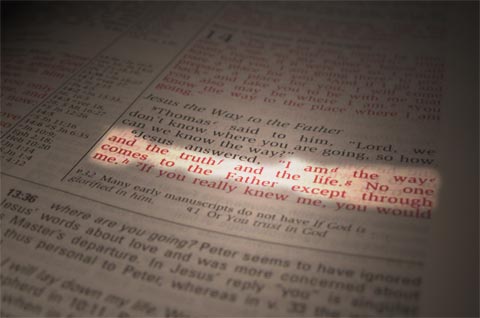
And this is my view. The Bible plainly says that Christ Jesus provided a way out of our dilemma. Jesus really is the way, the truth and the life, as he said. As the Word of God, Jesus has the authority to both fulfill Scripture and to meet its demand for justice through his sacrificial death on a Roman cross.
This concept of grace is a central theme of the Bible. It is repeated twice; once in the Old Testament (Psalm 32) and once in the New Testament (Romans 4):
Blessed are those whose transgressions are forgiven, whose sins are covered. Blessed are those whose sin the Lord will never count against them.
Who are the people the Bible talks about, whose sins are covered? They are me and you and everyone we know.
Jesus brings the concept of forgiveness and grace to Scripture and offers hope to the fallen; hope to those who once faced execution for their sexual behavior. And Jesus, through his Holy Spirit, gives us the ability to treat our marriage partners with the honor, dignity, and respect owed anyone who belongs to God.
The Bible says people will someday live in a time when the law of God is written on their hearts. I really believe that time is now.

The law is no longer written on stone, unless it is our hearts that are stone. We know in our hearts — where the law lives — we must love more our wives and husbands, our gay sons and daughters, our gay sisters and brothers, mothers and fathers, and especially our gay neighbors.
Shouldn’t we be praying for each other, that Jesus will give people the strength and grace to endure the sexual suffering they are sure to face in this life on Earth?
We know full well (because Jesus told us) that there is no sex (marriage and giving in marriage) in Heaven. This fact alone should give folks comfort, because it means no one will be taking their sexual identity with them.
All who enter Heaven will be free of sexual sin and sexual suffering. People will enter as brothers and sisters of Jesus, in complete victory over sins that once separated them on Earth. We will enter Heaven celebrating freedom. Everyone, even the most sexually-imprisoned, has this hope, in Christ Jesus.
This much folks should know. Love pleases God more than hate. They should know that tolerance and inclusion please God more than intolerance and exclusion, because the Bible says, God is love.
But those who belong to Christ Jesus know something more. If we honestly face our past and examine our hearts, we know that God loved us first, before we even knew who He really was, while we were still numbering ourselves — many of us — among the most God-hating people on Earth.
Don’t folks have a duty to love those who are like what they used to be — ignorant of who God is and ignorant, even, of who they themselves are? Of course they do. It’s difficult, because most want to forget the past and move on. No one wants to be reminded that everyone is trapped in a quicksand of sin; that absent Christ Jesus they have no hope of rescue.
Can Christians move on without first offering out-stretched hands to fallen friends? Some can be found within our churches. They are sexual sinners like us.
And just like us, they always will be.

I hope that Christians have love enough to accept their gay brothers and sisters in the name of Christ Jesus; that they have the wisdom to see that we share the same daily struggle against sin; that we have the presence of mind to beg Jesus to lift us out of the muddy waters of sin, together if necessary; to wash us clean with His blood that he shed for us in suffering.
Pray that the LORD forgives us, accepts us, and loves us unconditionally, which is nothing more than everything we’ve ever wanted.
Billy Lee
Post Script: The story behind the publication of this article is told in Writing Free. The Editorial Board
Random Reads:

LAST GASPS

AFTERLIFE

TOP TWEETS

47 TONS

DEGENERACY