DISARMING CHRISTIANS

WARNING from the Editorial Board

Readers who dislike reading opinions they don’t share might want to consider reading something else. The essay below may not be suitable for rigid thinkers. Readers who enjoy rallies where angry crowds chant lock her up! lock her up! and USA! USA! are doubly cautioned.

Billy Lee believes that all religions and all governments — including our own — are crafted by elites to enhance their power. Religion and government sometimes work together like good cops and bad cops to maintain the order of society by both reassuring and intimidating those few citizens who may sometimes feel reluctant to cooperate.

Billy Lee thinks that all economic systems, whatever label they may carry, are nothing more than variations on slavery. One possible exception is democratic communalism — a system that has been thoroughly discredited.

Systems where wealth is shared more or less equally are no longer taken seriously, at least in the United States, because our elites want nothing to do with them. It’s a reason why our leaders have strangled Cuba with an embargo for 55 years with no end in sight.

Income equality is not one of their core values. Everyone knows that alpha-males don’t share well; they fully intend to take everything they can until the end of time. Billionaires rule. They always have. Some historians say that Alexander the Great was worth 304 billion in today’s dollars. Alexander reigned in 330 BC when a billion dollars was considered real money.

Fortunately, this essay isn’t about economics. Who wants to get all depressed about stuff they don’t understand and can’t do anything about?  No, this post was written to address a much deeper problem — the takeover of our country by lunatics.

Billy Lee is suggesting that the conservative evangelical church in America is infested with men who are pushing a political agenda that might very well be opposed to the vision of Christ Jesus, the Son of God, who they say they serve; indeed their aim seems to be to acquire political power; some prominent males have recently bragged that they made a deal with our newly elected president to help them better impose their will on America and the world.

According to Billy Lee, these leaders hope to guide the citizens of the United States into accepting a Christian form of what has all the appearances of a kind of Sharia Law. The president-elect promised Jerry Falwell Jr. and Franklin Graham that he will help them; he is on-board.

Falwell, who attended the recent GOP convention, described during his speech a deal he made with Trump to repeal the 1954 law that forbids tax-exemptions to church groups who finance the campaigns of political candidates aligned with their pet projects, favored laws, and constitutional preferences. In return, Falwell promised to help deliver the presidency.

The Editorial Board

(The Board wants our readers to know that the churches pictured in this essay were designed and built by members of Billy Lee’s family.)


DISARMING CHRISTIANS

Let me begin by saying my hope is that the Bible verses below will provide readers with some context for the observations and insights that will follow.

Politically conservative evangelical leaders believe that every word in the Bible is literally true; the Bible is inerrant and doctrinally pure; anyone who doesn’t bow before the concept of biblical inerrancy is a heretic and opposed to God.

Evangelical pastors cannot be ordained in almost every denomination in the United States unless they sign legal documents that swear allegiance to inerrancy as one of their core beliefs.

Yes, many who sign these documents have their own definitions of what inerrancy actually means. Pastors argue with one another all the time about it. Some sign what they call “conscience clauses” to keep them out of trouble with meddling denominational titans and even their own parishioners.

But enough inside baseball.

The fact is, I too believe the Bible is inerrant. Just to make sure readers understand, I’m not a theologian; I’m not a pastor or an elder or a deacon either; I’m a pontificator — a lowly pontificator. I don’t even belong to a church. I go to church. My wife makes me.

But I haven’t signed any dotted lines. I once wrote — a couple years ago when I actually was a communicant member of a church — about the subject of inerrancy, which I hope readers will revisit. In it I asked this question:

Where does this idea about ”inerrancy” of Scripture come from since the Bible was written by men and gently hides mankind’s many prejudices and ignorant ideas about history and science? If Scripture is inerrant—and I believe it is—its truth must come from God alone. God makes Scripture true, even when human logic, common sense, and evidence seem to speak otherwise.

I would argue that my support of inerrancy gives me the right to challenge other Christians; to argue that the separation of church and state is necessary and essential if we are to protect our freedoms from conservative politicians posing as clerics, who are busy seizing control of churches and denominations in backwoods America.

It’s not just the backwoods. These political fights are going on in cities and college towns, urban centers and sophisticated suburbs. I side with reasonable people who don’t believe they have all the answers. I side with tolerant, open-minded thinkers who are kind to people who have been ostracized and hated because they don’t fit certain stereotypical molds that conservatives seem to favor.

I certainly don’t think of myself as a heretic or a trouble-maker. In fact, I would like to believe that I am in submission to the will of Christ Jesus; I know I have experienced the forgiveness of my sins and the healing power of God’s love. God has given me gifts, which I treasure.



Anyway, it’s time to get on with this essay. Is there a better way to start than by quoting Bible verses? As is the convention in many Bibles, words in red represent the spoken words of Jesus. Sometimes I use the color purple to call attention to Scripture I hope readers won’t overlook. Hold on tight, everyone. I am about to take readers on a wild ride. Here goes:

Leviticus 17:10  I will set my face against [anyone] who eats blood, and I will cut them off from my people.

Leviticus 7:27  Anyone who eats blood must be cut off from their people.

Leviticus 19:27  … Do not cut your bodies for the dead or put tattoo marks on yourselves. I am the Lord.

Deuteronomy 25:11  If two men are fighting and the wife of one […] seizes [the other] by his private parts, you shall cut off her hand. Show her no pity.

Psalm 118:11  They surrounded me on every side, but in the name of the Lord I cut them down.

Isaiah 9:17  …everyone is ungodly and wicked, every mouth speaks folly.

Isaiah 29:20  The ruthless will vanish, the mockers will disappear, and all who have an eye for evil will be cut down — those who with a word make someone out to be guilty, who ensnare the defender in court and with false testimony deprive the innocent of justice.

Isaiah 53:12  … he poured out his life unto death and was numbered with the transgressors. For he bore the sin of many and made intercession for the transgressors.

Daniel 2:34-45  While you were watching, a rock was cut out, but not by human hands.  … It will crush all those kingdoms and bring them to an end, but it will itself endure forever. This is the meaning of the vision of the rock cut out of a mountain, but not by human hands…

Hosea 6:5  …I killed you with the words of my mouth…

Luke 22:33-38  But [Peter] replied, Lord, I am ready to go with you to prison and death. Jesus answered, I tell you, Peter, before the rooster crows today, you will deny three times that you know me.

Then Jesus asked them, When I sent you without purse, bag or sandals, did you lack anything? Nothing, they answered.

He said to them, But now if you have a purse, take it, and also a bag; and if you don’t have a sword, sell your cloak and buy one. For it is written: ‘And he was numbered with the transgressors’, and I tell you that this must be fulfilled in me. Yes, what is written about me is reaching its fulfillment.

The disciples said, See Lord, here are two swords.

That’s enough!  Jesus replied.

John 6:53-59   Jesus said to them, I tell you, unless you eat the flesh of the Son of Man and drink his blood, you have no life in you. Whoever eats my flesh and drinks my blood has eternal life, and I will raise them up at the last day. For my flesh is real food and my blood is real drink. … He said this while teaching in the synagogue….

John 6:66  From this time forward many of his disciples turned back and no longer followed him.

John 12:47  I did not come to judge the world, but to save it.

John 16:2  …the time is coming when anyone who kills you will think they are offering a service to God.

John 16:8  When [the Holy Spirit] comes, he will prove the world to be in the wrong about sin and righteousness and judgment: about sin, because people do not believe in me; about righteousness, because I am going to the Father, where you can see me no longer; and about judgment, because the prince of this world [Satan] now stands condemned.

I have much more to say to you, more than you can bear. But when the Spirit of truth comes, he will guide you into all the truth.


jesus-tomb
The Rock-Cut Tomb of Jesus is located in the East Talpiot neighborhood — three miles south of the Old City — in East Jerusalem. The body of Jesus has never been found.

John 20:1  …while it was still dark, Mary Magdalene went to the tomb and saw that the stone [rock] had been removed…

1 Peter 2:16  Live as free people, but do not use your freedom as a cover-up for evil; live as God’s slaves.

OK. We’ve collected enough Bible verses to start a Hallelujah cacophony. Readers must by now have a lot of questions. Don’t worry. Hundreds of thousands of people have made careers answering questions about the Bible. Answers abound.

One obvious question is this: the Bible seems to forbid the eating of blood; if drinking blood gets one cut-off from God’s people; if it results in a kind of excommunication, why does Jesus insist that anyone who wants to live must drink his blood or die?

How does anyone drink the blood of Jesus, anyway? What does it mean — it must be true — what Jesus said; does this death cure work? Is his promise — that eternity lives inside his blood and that we must drink it to live — inerrant?

Here’s another question: Is everyone wicked? Really? Every single person? Is everyone a fool? Does everyone speak “folly”? Is there no one that anyone can trust? Even oneself?

How about this: Will folks who label people they hate with a single word — words like crooked (Hillary) or lying (Ted) or corrupt (____) or fraudulent (____) or dishonest (____) or hypocritical (____) or dumb (____) or killer (____) or guilty as hell (fill in the blank, those who dare) — will they really be cut down?

Will the ruthless vanish and mockers disappear? Really? Does anyone believe these promises of the Bible? Do haters and mockers ever truly fall?

Here’s a good one: the title of this essay is called, Disarming Christians. Disarming is a nice word, right?  It means charming or beguiling or winsome. Imagine meeting charming, beguiling, winsome Christians. It would be kind of nice wouldn’t it?

Disarming can also mean taking away someone’s weapons of war. Christians are armed to the teeth with weapons of war, some of them. They carry guns in open-carry states; some carry concealed weapons with special licenses that permit them to bring guns into schools, libraries, and government buildings — even churches.

But let’s not talk about right-now. Let’s not talk about today. Let’s talk about those yesterdays long ago when the deadliest weapon a civilian could carry was a sword.

Jesus must have thought his disciples were unarmed. At the end, just before He was arrested and crucified, he told them to sell their coats and buy swords. Lo and behold, the whole lot of them were carrying weapons, it turned out. 

See Lord, they said. Here are two swords right here!  They might have added, How lucky we won’t have to sell our coats, stop what we’re doing and make the hard walk to buy swords from a bronze-smithy.

The followers of Jesus were already transgressors. He lived among them just as Isaiah 53:12 (in the list above) said He would. No one needed to be told by Jesus to be bad.

It didn’t matter whether anyone knew or not. In fact, Peter used his sword to hack the ear off a youngster named Malchus — the servant of the High Priest. It’s about as low as a follower of Jesus could go, unless denying Christ three times when He needed him most counts for anything.

The Bible says we are free but warns us to not use our freedom as a license to hurt people in ways we would never hurt ourselves, even when we are able to hide bad behavior to avoid corrupting those who are always watching.

Really? Does the Bible mean to say that people can’t, as the old joke goes, pray to God for bicycles but when they realize God doesn’t work that way, steal them instead and pray for forgiveness? — in Jesus’s Holy Name of course.

Evangelical political operators, as they always do, lobbied the public during the election to vote against the Christian presidential candidates and go with the one person who has no history with any church — the one who refused to divulge his health records, his taxes, or his foreign entanglements.

These operatives urged followers of Christ Jesus to vote for a man who married three women — two, by the way, grew up in prominent, communist families from countries once hostile to the USA.

Trump made a deal with evangelicals; he made them an offer they couldn’t refuse. My essay Satan Surrender sorts through some aspects of the arrangement.


Jesus said: I was born for one purpose; to bear witness to the truth. Everyone on the side of truth hears my voice. Pilate asked him the famous question: What is truth? He didn't answer. Hours later, the Romans executed him. British actor Robert Powell portrayed Jesus in the 1976 television mini-series Jesus of Nazareth, which won many awards.
Jesus said: I was born for one purpose; to bear witness to the truth. Everyone on the side of truth hears my voice.  Pilate asked Him the famous question: What is truth?  He didn’t answer. (Click link to view video.) Hours later, the Romans executed the Christ. British actor Robert Powell portrayed Jesus in the 1976 television mini-series Jesus of Nazareth, which won many awards.

Peter believed he was Christ’s most loyal supporter; his most devoted disciple. Jesus once called him Satan and told him that he was unreliable. Peter may have been crude, possibly foul-mouthed; some Bible writers portrayed him as impulsive and on occasion violent.

It seems to me that the conservative evangelical church in America is a lot like Peter. Jesus will build his kingdom; he will someday make a spectacular entrance onto the world stage, which he promised to do 2,000 years ago.

I think the date is still on. I don’t think we’ve been stood up. Christ Jesus is on his way. But Peter came to a bad end according to some accounts, and the conservative evangelical church and its blind-guides will as well if folks don’t wake up and make changes.

One change we can make is to turn off television whenever possible. People must know that most shows are unwatchable for those who struggle to live a holy and righteous life. People watch OAN and FOX; they visit internet web-sites like Breitbart, etc. Is it any wonder that many in the land of the free and the home of the brave are suffering from a psychosis of evil?

Perhaps the answer to my earlier question about the blood of Christ Jesus is to ask another question: Is His blood so holy and precious — powerful to save — that any other blood is poison by comparison, even defiling to the sensibilities of an Almighty God?

The sacred life of Jesus and the fearful agony of its end — suffered on the cross of a Roman executioner — brought a flood of life into the dark world of sinners, who Jesus said God loves more than Him; God gave His Son over to a crucifixion, of all things — to settle scores for all time for the terrible things we’ve done against Him and against each other.

Let’s face hard facts: people sometimes do bad things for which they deserve to die. Everyone it seems has someone who wants them dead; everyone is hated by someone; and everyone at one time or another hates enough to kill. That’s reality as I see it anyway.

In my mind, after years of reading the Bible and listening to sermons, I have developed some fantasies. Sometimes I imagine things that could never happen, but imagining their possibility gives me a kind of emotional release.

God forgive me. Sometimes I think I hear Jesus crying out on the cross in a loud voice; he’s yelling at me: Kill me, he screams. Eat my flesh; eat my clotted blood; hurl your hate; do it now! I’m bleeding out and time is short….

Jesus’ head falls forward. He is quiet, and I am witness to the horror of hatred satiated and injustice served. His face in death is unrecognizable. I recoil at the thought of God; that He could unleash such terror against a righteous man.

God forgive me. More hallucinations. Jesus slurs his words and looks past me into the storm. Strike me until your hate is spent; strike until you exhaust yourself and can no longer lift your arms or even stand; fall into the mud and blood at my feet and eat your fill. Make yourself sick on your hate. It is finished.

My mind is a whirlwind, a tornado of confusion. Nothing seems real. Do you not see? Jesus is whispering, rasping. The wind howls. Thunder whipsaws the cross like a pendulum. His voice is a death rattle, I can barely hear. Everything is accomplished.

A soldier shoots out of nowhere and plunges a spear into Jesus’s stomach. The soldier twists the blade and yanks hard. He doesn’t look. He walks past and pulls at his vest for cover against the hail.

Your sins are forgotten! 

Did Jesus shout to a man who wouldn’t look at him? Sins forgotten. Or was he shouting at me? Was it the soldier snapping like a feral dog maybe at us both?  I couldn’t tell. The blood from Jesus’s wound pounds on me like a waterfall as I writhe in the mud and the rain.

Yell louder, I can’t hear, I scream back, because the storm is raging and I can’t hear myself above the thunder and the rain. I forgive you, I think I hear Him calling.

My mind is in fever. I don’t know what is real or if I’m in delirium. Is Jesus dead or not? Yes, he’s dead; of course he is. But I hear him hacking into the howl.

Get up! Yes, he is yelling loud, like a young man; a warrior. Now I hear him clearly. Find the brother and sister you hate; find the mother and father you despise — who like strangers lusted and misused you — who stripped you naked and beat you; find them; find them all; find the wicked people who ruined your life and forgive them.

I stagger to my feet. The rain is violent. It cleans my body completely. I look up at Jesus. His body is clean as well. His eyes are glazed by death. He doesn’t breathe. Water runs down his face and off the soles of his feet.

I turn and look into the storm. I’m cold. The temperature has dropped, and I’m really, really cold.  Find a way to love, I hear him murmur. Find a way to love the world we gave you; find a way to love everything in it including yourself, because we made you from the mud you puked in.

I want you to live, I say. He doesn’t hear. How could he? He’s dead. I love you, I say, under my breath.

The way, the truth, and the life — it’s what he said he was — sweet words everyone pretended to believe. No one knew what He was talking about.

I look up at Jesus for the last time. Death has a look that is best described by the word, horror. But Jesus looks like an angel in flight with his arms outstretched and his body washed clean by the storm. He is more beautiful in death than he ever was in life. 

You’re free, Jesus, I say at last.

You’re free. Spread your wings and soar. Fly away to wherever your heart lives, to whoever your heart loves.

You’re free.

Billy Lee

Post Script by the Editorial Board:

Knowing our writer the way we do, the Editorial Board has strongly admonished and chastised Billy Lee. We explained that his fantasy encounter with Jesus wasn’t an appropriate ending for an essay about disarming Christians.

It’s not good enough, we told him. It doesn’t meet the high standards of the Pontificator. We insisted that he give Jesus the last word — not the fantasy Jesus that swims in his head, but the real Jesus; the Jesus of history and the Bible.

Here is what he picked — something Jesus said — from Christian scripture, John 16:33.  

I have told you these things, so that in me you may have peace. In this world you will have trouble. But take heart! I have overcome the world.

Jesus is the Christ — the lamb of God who takes away the sins of the world, Billy Lee insists. It sounds like words he stole from somewhere. 

It’s true.

With any luck at all, maybe this time Billy Lee got it right, for once.

Who knows?
BAD THINGS

When a foreigner resides among you in your land, do not mistreat them. The foreigner residing among you must be treated as your native-born. Love them as yourself, for you were foreigners in Egypt. I am the Lord your God. Leviticus 19: 33-34

Follow the way of love and eagerly desire gifts of the Spirit, especially prophecy.
1 Corinthians 14: 1

Dad could tell the future. He was a Navy pilot who took off and landed on aircraft carriers, sometimes at night. His time to defend America was long ago. Aircraft carriers were then new to war, and pilots crashed their planes and helicopters a lot. Until the kinks got worked out over a period of many years, the Navy lost about one out of four pilots to mishaps at sea.

Dad predicted a number of crashes. Soon the pilots in his squadron wouldn’t fly if he got a “bad feeling.” His commanders respected him. Over time, good fitness reports and promotions led him to command an anti-submarine, jet-helicopter squadron during the Cuban Missile Crisis. Afterward, the Navy rated his squadron (HS-1) the safest combat aviation group on America’s east coast. Not one man was lost during his command.

Dad went with his feelings; when he got that “bad feeling”, he always flew the mission himself, or led it, rather than risk the lives of his men. Dad rose rapidly in the ranks, holding many important positions, not only in the Navy but also at the NSA (National Security Agency). Near the end of his career, a president appointed him to lead another intelligence agency not known to the public.

Navy fliers I talked with who knew dad said he was the best pilot in the United States Navy. He could fly anything under any conditions. Navy officers don’t lie. It’s against their Code of Conduct. Of course, I believed every word.

My dad was fearless to the very end of his ninety-one years of life. He once ate a half pound of spoiled cheese, because it was a gift, and he refused to embarrass the giver. The cheese smelled the way cheese smells when it has been ripened at the bottom of an army latrine; I almost threw up from the stench, but dad gulped it down like porterhouse steak. He grabbed the cheese with both hands, tore it in half, and inhaled a deep breath to savor the aroma. I was amazed that the rancid mess didn’t instantly kill him.

Today, many people seem to be having apocalyptic fears. People I don’t know well, who seem normal, have told me about vivid dreams they have had about good and bad things. Sometimes their visions trouble them. The thought has crossed my mind that a lot of folks are teetering on the edge of insanity. It’s sad and troubling.

The election added a lot of stress to people’s lives, did it not?  Election tampering by foreign intelligence agencies ran rampant and was obvious to anyone who was paying attention. The United States has an unfortunate reputation for election tampering in other countries, which goes back many decades; our recent election seemed to give other countries a golden opportunity for pay-back, which some inflicted brazenly — perhaps as a warning for us to back-off; to stand-down. Who knows?
Anyway, the election is done; Trump won; Hillary won the popular vote but lost the electoral college. In the countryside of Pennsylvania, Wisconsin, Ohio, and Michigan (among other states) Trump won by huge margins never before seen in the free world, ever. His biggest leads came in districts with electronic voting machines. These margins overwhelmed the leads racked up by Democrats in urban areas.

It was a strange election that lasted a very long time. Many “unprecedented” things happened during the contest that no one in America has ever experienced before. Is it any wonder that some people feel unhinged by an outcome that makes no statistical sense; by an outcome no one saw coming?

Republicans now control the entire federal government; they control enough state governments to enable easy passage of amendments to the Constitution, should the GOP decide to change America in that way.

Some people want to know: what’s coming next; what sudden shocks might rock their world?

How would I know?

Yes, I took the time to compile a list of bad things that could happen. Yes, it may have been a waste of time; maybe my effort might have been better spent helping the poor.


(FILES): These recent file photos show the ten Republican presidential candidates who will appear August 6, 2016 on Fox News for the first US presidential debate of the 2016 Republican primary cycle. Top row from left: Billionaire real-estate tycoon Donald Trump; former Florida governor Jeb Bush; Wisconsin Governor Scott Walker; Florida Senator Marco Rubio; former Arkansas governor Mike Huckabee. Bottom row from left: Retired neurosurgeon Ben Carson; Kentucky Senator Rand Paul; Texas Senator Ted Cruz; New Jersey Governor Chris Christie; and Ohio Governor John Kasich. AFP PHOTO / Files
With GOP leaders like these, what things could possibly go bad?

It’s possible that none of the bad things in the list below will happen. Maybe some will. My contribution to understanding the future is simply to point out things that have a chance of happening, which people may not have considered, or yet read about, or even shared (if they have thought about them).

My blog is read by not very many people; stilI, I felt compelled to write these “heads-up” warnings to help any curious humans (or bots) who might accidentally stumble onto my essay; to open the eyes of the few and the lucky, so that they might better understand what’s coming next; to inoculate some of them — especially the people I love — against the despair that can overwhelm any one of us when we find ourselves ambushed by the bad things in our future.

So here is my list of BAD THINGS. I might add to it from time to time if my imagination runs amok, or freaked-out people tell me scary stuff.

Here it is:

— The First Family refuses to live in the White House.

— Blacks and women start disappearing from news shows, replaced by white men.

— Athletes and entertainers step forward to confess: yes, they voted for Trump.

— Evidence emerges: The birth certificate was faked. Congress starts an investigation.

— The Civil Rights Act of 1964 is overturned.

— The military draft of young people is resurrected.

— The USA drops a neutron bomb on a city for the very first time.

— The United Nations disbands.

— Russia reestablishes its control over Eastern Europe.

— The Philippines makes a military alliance with China.

— Donald Trump resigns.

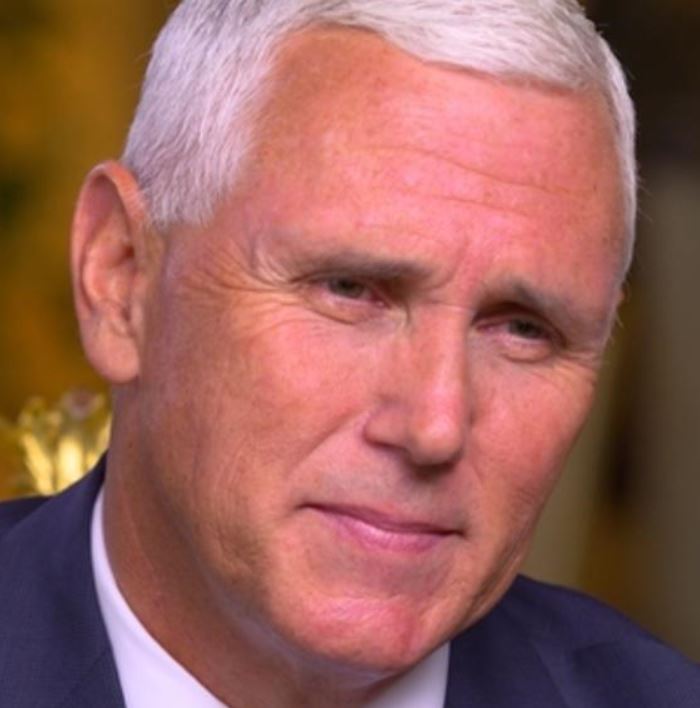
— Mike Pence becomes president.

— A hot year kills hundreds of millions.

— Many popular foods become unavailable.

— The president’s wife reveals that he is gay.

— The Mueller investigators reveal that the new president is an agent of the Russian government — hand-picked by Paul Manafort.

— A major volcanic eruption inside the USA kills hundreds of thousands.

— The Post Office is privatized.

— The Veterans Administration is privatized.

— Social Security is privatized.

— Medicare is privatized.

— Prisons are privatized.

— Public education is privatized.

— Tax deductions are eliminated, raising taxes on the poor and middle-class.

— Inheritance taxes are eliminated, locking-in a permanent aristocracy.

Unlawful assembly is redefined: three or more unrelated people who gather in a public space for any purpose other than private discourse shall be guilty of a misdemeanor, unless they have in their possession a permit signed by the president of the United States.

— A 1954 law denying tax exemptions to churches who endorse politicians is repealed.

— Church attendance plummets.

— Charitable giving plummets.

— Inflation rises to 22% per year.

— The banking system collapses.

— Stock markets close.

— Congress declares misdemeanor unlawful assembly a felony.

— The WALL is retooled to restrain fleeing Americans.

— The Constitution is amended to eliminate all forms of naturalization to block any pathway to citizenship for children bred by foreigners. 

— An insect species is destroyed by a gene-driver released from an unregulated lab.

— Chipmunks are rendered extinct by a second gene-driver accident.

— Internet access is placed under federal regulation.

SCOTUS hands over abortion policy to the states.

— SCOTUS rules that businesses have a constitutional right to choose who can buy their products and services, and who cannot.

— State governments add lithium to city water supplies to raise the spirits of unhappy citizens.

— Congress mandates that electronic nano-chips be injected into the buttocks of every person to help ICE track, identify, and differentiate people’s movements and immigration status.

— Congress declares that felony unlawful assembly is ”from this time forward” a capital offense.

— The 2020 election is postponed until ”we can figure out just what the hell is going on.”

— GOP controlled state legislators amend the constitution to fight terrorism; they rescind the Bill of Rights.

Cruel and unusual punishment replaces baseball as our country’s most popular spectator sport.

Selfies by folks jumping off bridges and skyscrapers go viral on social media.

 Billy Lee

NO GOOD DEED…

Disclaimer by the Editorial Board:  The following story, No Good Deed… is a work of fiction by Billy Lee.  Events and persons depicted in the story exist only in the imagination of the writer and have no connection to living persons or actual events.


Christmas bulbs in a row


The old woman ahead of me in the checkout lane at the grocery sat in a battery-operated three-wheeler and struggled to move her purse off her wrist into the front basket. She couldn’t do it and gave up. She was grossly overweight; she couldn’t maneuver — her fat arms were black and blue right down to her fingernails. Diabetes, I thought.

I wondered if I should help, but she soon stopped and let the purse dangle where it was, on her wrist. It was a bad angle. It would be awkward for me to reach for it; and besides, it was her purse, a personal item she might try to defend. It was a good bet she fought this fight every time she shopped. No big deal. Let it go.

It was her own cart that she sat in, from the looks of it. She probably had used it for years. Held together by duct tape and bubble gum, it was dirty; a yellowed eggnog color; depressing to look at.

The cashier at the register — a black college-aged girl — finished the tally; the old woman sitting in the beat-up cart fumbled unsuccessfully to open her purse; the line of shoppers behind us continued to grow. It was busy. It was Christmas. I was in a hurry. What the heck… I reached over to the card reader and inserted my card. I’ll get this, I said. Merry Christmas.

The old lady looked up at me and said, thank you.

You look like you have enough to worry about, I said, beaming. We’ll make it one less thing.

Yes, she said. I worry about so many things these days. She fell silent and looked down. Something drippy fell from her mottled face into her lap. The eyes of the young black woman working the cash-register grew large and began to sparkle from tears, which she tried to hold back.

She would tell me later she had just immigrated from Ghana, Africa. She has stories, that girl, I would think to myself. The African regained her composure and gathered the old lady’s items.

As the cashier and myself exchanged a sympathetic look, the old woman with the black and blue arms and drippy face reached for a button on her cart and sped away. She didn’t remember to collect her receipt. I don’t think she felt embarrassed. Maybe she thought I might change my mind; make her pay for her own groceries, or something.

The cashier rang up my stuff. It was all good. I started to get that warm glow one gets when they’ve done something for someone, especially a stranger.

A melodic accent from somewhere out of Africa interrupted my reverie, Oh, look! Here is a bag of things. Are they yours? I think I forgot to give them to that person.

We checked the contents against the old woman’s receipt. Yup, they weren’t mine.

The cashier grabbed the bag and ran down the long aisle of the store to search for an old woman driving a beat-up mobility scooter with a missing bag of groceries. The folks in line behind me started to stir. A few threw unfriendly looks in my direction. My warm feeling turned to heat, then dread.

The cashier returned; she hadn’t found the customer. Since I had the receipt, I decided to take the groceries. If the old lady returned, she would be unable to convince anyone the groceries were hers, I reasoned.

I began to worry. It was Christmas. Undercover cops — temporaries with little training or empathy — lurked pretty much everywhere. They loved to patrol the parking lots, someone once told me.

What if store security decided to stop the old lady in the busy lot? What if they intercepted her before she could rendezvous with whoever was driving her home? Maybe she lived alone nearby, and there was no one to escort her. Minus the receipt, they might arrest her for shoplifting.

They might already have her in a little room somewhere, hidden from the public, to interrogate her. That’s why we couldn’t find her. I loosened my collar as my mind began to race. I felt sweat bead on the top of my head.

She would notice — under the intense pressure of  questioning — one bag of groceries was missing. And she couldn’t produce the receipt. He took it, she’d realize. It was the old man!  I could hear her screaming. She was cursing me — the old codger who had stood behind her and had the audacity to jump into her business for no good reason.

Of course she had the money to pay for everything, she screamed at the SWAT team as they held her down; as they restrained her. Of course she did. She didn’t need that smelly stranger’s credit card. And he stole a bag of her groceries! Arrest him!  It was he, the grey-beard, who robbed her; it was he who took her receipt; it was he who confused her — and the cashier!  He got her arrested. It was he, he, he — an old FART! — not her!

I imagined her anguish. By now she must realize that she would spend Christmas in prison; behind bars; isolated; alone; cold; away from family and a warm fire in the hearth — for I just knew she had no money for lawyers or bail.

I thought I could hear her weeping. I could hear her, but I would never be able to find her. No one else could hear her cries for mercy, no one would ever step forward to defend her and confirm her story. Take her out of here, I heard the arresting officer boom. Thief! 

My parting words to the cashier were short enough. I hurried to my car and drove out of the busy parking lot, quickly, furtively. I cast a side-long glance into my rear-view mirror. No flashing lights. No siren. An old red van with a tree tied on top pulled up behind me.

It was Christmas; the most wonderful time of the year.

Billy Lee


Christmas bulbs in a row

CUBA

The Cuban revolution was one of the most exciting news events of my childhood. Our family moved to Key West, ninety miles from Cuba, in 1960, shortly after the transfer of power. 

My dad’s job was to run HS-1, the Navy jet-helicopter squadron that defended southern Florida from attack by Russian submarines.  Some of these subs were hanging-out around Cuba, Dad said, so I took an interest in what was going on there. 


Che Guevara, Argentine physician, and his Cuban friend, attorney Fidel Castro, enjoy a happy moment. Their joy in victory gave way to worry as two super-powers — the USSR and the USA — fought to take control of their revolution.

People born in the 1960s and later have no easy way to know that U.S. media once portrayed Fidel Castro and Che Guevara as heroes — at least during early phases of their risky and dangerous attempt to unseat the president of Cuba, Fulgencio Batista. The two revolutionaries and ten of their close friends led the volunteers of a resistance they called Movimiento 26 de Julio to success on New Year’s Day 1959 — a month before my eleventh birthday.

To put some context on the Cuban revolution and its significance, recall that the land-mass of Cuba is almost four-fifths the land-mass of Florida. Florida is huge, as anyone who has driven its length or breadth knows. Cuba’s land area is an astonishing 42,426 square miles, which makes it one of the largest islands in the world. Only sixteen islands are larger.

Unlike Florida, Cuba has mountains, which add land area in the vertical direction. Florida lacks mountains. It’s flat. And Cuba is home to four-thousand satellite islands and cays.

Before the revolution, Cuba grew tobacco and sugarcane. Pressures mounted on the country to grow more. By 1959, three out of four men in America used tobacco. Parents weaned their children off mother’s milk and replaced it with sugary cereals like Sugar Pops and Frosted Flakes. USA became the world’s most voracious consumer of sugar.

Americans no longer warred in Europe and Asia.  It was time for fun; for new ways to enjoy life. Demand for products of Cuban agriculture grew beyond sugar and tobacco, led by new patterns of consumption in the United States.

To take advantage of the boom in agriculture, non-Cuban farmers and ranchers (most from the USA) began buying-up the island’s arable land. By 1958, foreigners owned three-quarters.

American oil-companies located refineries in Cuba. Pornography was catching-on in America, so businessmen from the USA began producing “dirty movies” and magazines in Cuba to distribute illegally inside the United States. International cartels and American crime-families constructed gambling casinos on Cuban beach-fronts for newly affluent American tourists who were seeking good times in warm weather.  

By 1959, Cuba showed first signs of developing into an economic powerhouse.  Anyone who has viewed the Godfather movies from the 1970s knows that organized-crime bosses vacationed in Cuba before the revolution; they were in bed with General Batista, the island’s dictator-president.


Cuban-Revolution-in-Color-Photos-January-1959-1
It was difficult for most Cubans to believe that young revolutionaries of the July 26th movement had overthrown the hated and feared Batista cartel. Some thought the revolution would be short-lived.

After final success of the revolution on January 1, 1959, everything changed. Sex-clubs and gambling casinos shut down never to re-open. Land-holders and business owners closed their estates and enterprises to flee the island for safe sanctuaries where they waited for news about what might happen next. 

At the same time, a holiday mood swept across the island. New Year’s celebrations in Cuba became ecstatic. Ordinary people in their millions partied like it was 1959 in a kind of happy, helpless disbelief.

No one was sure the revolution would last, but most were grateful to those women and men who gave their lives to liberate them and throw out the hated and feared Batista family and their abusive friends. At one event in mid-January, a million people (one-sixth of the island’s population) gathered to hear Castro speak. It was the largest public demonstration in history up to that time.

For wealthy Cubans, events felt much different. They began flying away by the hundreds, leaving their property with relatives to lie fallow while they waited in the USA and other countries for the new government to collapse and fail. 


Che Guevara and Aleida March Cuba revolution
Aleida March worked in the Cuban Revolutionary Courier Service (rebel post office for classified communications). A few months after the revolution was won, she married Che Guevara and bore him four children.

But by autumn of 1960, despite a covert program of bombings and assassinations by the USA to destabilize the country, Cubans firmly established their revolution. When American oil-refineries refused to process Russian crude, Cuba nationalized them. USA retaliated by unleashing an economic embargo, which remains in-effect (with some changes) to this day. When business owners refused to re-open factories and farms, Cubans opened and operated them themselves.   

I remember going to school in Key West with dozens of rich Cuban kids who all hated the revolution. In fact, I never did meet a refugee who liked Castro and his revolution despite obvious benefits he promised (and later delivered) to average islanders who were impoverished at the time.  

Come to think of it, I never met a black Cuban refugee either, though blacks and bi-racials made a third of the population. The role of race in the Cuban story begs to be told, but I’m not one to tell it, at least not yet. More research required.  

I didn’t live in Cuba.  

The only black person I knew was our maid, and she was American. I do know enough to mention that Castro’s close friend and favorite military officer was Juan Almeida Bosque (Havana-born freedom fighter & songwriter) –wildly popular among disenfranchised blacks. Enough said. I included Juan’s picture at the end of this post.


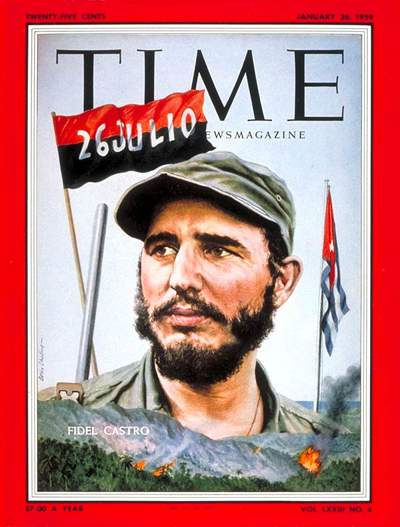
fidel castro on time magazine cover
Fidel Castro was generally praised in US media until analysts discovered Soviet nuclear missiles in Cuba.

In the American press (which I read voraciously even at tender age of 11 or 12) adulation for the Cuban revolution went on pretty much unabated until USA caught Soviet Union installing missiles on the island, most probably in late 1960 or early 1961. By September, Congress would ban aid to any country that had relations with Cuba.

Later, in early 1962, a family friend and former neighbor, Art Lundahl, discovered nuclear missile-sites and submarine bases under construction during analyses of CIA high-altitude photos. (The British “knighted” Lundahl in 1974 for his discoveries as well as contributions from prior conflicts.)

After these unsettling disclosures, our leaders felt betrayed by Castro, to say the least.  President Kennedy in April 1961 permitted CIA to drag USA into the fiasco of the Bay of Pigs invasion. When it backfired — USSR reacted with more military-aid, not less, including 42,000 soldiers, 42 MIG fighters, 42 bombers and, yes, nuclear missiles — the stage was set for the ensuing nightmare of October 1962, now called the Cuban Missile Crisis

After a couple of nervous (some would say terrifying) weeks — during which Cuba shot down one of our high-tech spy planes — the Soviets offered to remove their nuclear missiles from Cuba if USA removed theirs from Turkey, a country close to Russia. We agreed.

It’s a good thing, because we learned later that operational nuclear weapons had already been deployed on the island — weapons we knew nothing about. According to historian Richard Rhodes, three-megaton hydrogen bombs mounted on SS-4 missiles hid in Cuba’s tropical forests. The missiles when fired could reach Washington D.C and obliterate it. The missiles we photographed were not yet operational, which gave our leaders false confidence.

A preemptive military attack by USA on Cuba would have precipitated nuclear war with the Soviets, according to former Defense Secretary William Perry, who operated a high-tech listening post during the crisis. 

Because of anti-Castro hysteria developing in right-wing political circles, government officials told the public only that the Soviet Union and Cuba capitulated to our demands after we promised not to attack them. Full details of the quid-pro-quo weren’t released until years later.

The crisis ended, but both Kennedy and Russian leader Khrushchev did not survive the aftermath. Khrushchev fell from power in a kind of coup by Communist Party leaders on the third anniversary of the missile-crisis. He became depressed and died in 1971 of a heart attack. 

Lee Harvey Oswald, former employee of US intelligence, assassinated Kennedy in 1963, almost exactly one year after the crisis and almost exactly two years before Khrushchev fell from power. Within two years of Kennedy’s assassination and coincident with Khrushchev’s fall, Cuba formally adopted Communism.


Cuba is a mountainous country with close to 80% of the land area of Florida.
Cuba is a mountainous country with 80% the landmass of Florida.


life magazine turns on fidel castro in june 1961
After capturing 1,200 Cuban exiles who fought under CIA direction during the Bay of Pigs invasion, Fidel Castro found himself condemned by Life Magazine, which led the media charge against him in its June 2, 1961, edition. Notice photo-shopped grey tooth. 


In those days, magazines like Time, Newsweek and US News and World Report were main sources of in-depth news and analysis for most civilians. It was a time when electronic calculators, computers, IPads, IPhones, and Internet services did not yet exist. 

Television news was little more than fifteen minutes of reading headlines interrupted by a few commercials. Half-hour news programs didn’t start until the fall of 1963 — just a few weeks before the Kennedy assassination. Newspapers were important, but many of the best reporters worked for the three newsmagazines, which shared huge readership by today’s standards.

These magazines ran adoring pictures of Cuba’s revolutionary heroes alongside in-depth analyses of all they did and were accomplishing, both before and after 1959. Our country’s pervasive print-media seemed fascinated by the idea of common people overthrowing an invincible dictator tied to alleged gangsters. 

This fascination continued for almost two years until day of April 17, 1961, when Americans woke to learn that Cuban exiles who lived in the United States had launched an invasion of their former country to overthrow Fidel Castro. Within days, Castro captured 1200 exiles. He led the Cuban defenders himself. Almost instantly, USA media turned on Fidel and began condemning Cuba’s revolution.


bay of pigs prisoners held in sports palace
Cuba held 1,200 CIA-trained fighters after the Bay of Pigs fiasco. By the time the invaders exhausted their ammunition and were captured, they killed or wounded over 5,000 native Cubans. These POWs are being held in one of the island’s sports-arenas. Former Navy Commander James Donovan — played by Tom Hanks in Steven Spielberg’s 2015 Bridge of Spies movie — negotiated their release and release of an additional 8500 civilians in exchange for medical supplies.  

The invasion came as a shock to the general public. No one knew at the time CIA had organized it. No one could understand why Cuban exiles would attack their own country in what was clearly a suicide mission — at least that is what the Bay of Pigs would have become had Castro not shown restraint.

Few civilians outside of government knew then that Castro was in the process of aligning himself with a Communist super-power, the Soviet Union, with whom we were then fighting a vigorous cold war.  Apparently, Castro and his advisors felt that in the contest between USA and USSR — where they found themselves toyed-with like a chess-game pawn — USSR was the lesser of two evils.

I remember reading articles in Time magazine about Fidel and feeling thrilled people like him truly walked the earth who weren’t afraid to stand up to gangs we learned years later to call the Mafia and to all those other evil-monopoly-types who corrupted popularly elected governments. 

The press in the United States covered Castro and Guevara in much the same way they covered, a few years later, the Beatles during the British Invasion of 1964. I found myself seduced by the good guys verses bad guys dichotomy described in the popular press.

Of course, everything changed after Mr. Lundahl discovered that the new Cuban government was in bed with our nemesis, the Soviet Union. Even today, people forget that Cuba did not become Communist until 1965, three years after the Cuban Missile Crisis. American civilians had no idea that the USSR was trying to get a toehold in the western hemisphere through a military alliance with the Florida-sized island.


cuba missile installations
Government-analyst and family friend, the late Sir Arthur Lundahl, discovered nuclear-missiles in Cuba during a routine review of spy-plane photos.

As soon as Americans saw photos of missile silos (or whatever those blurry images were that appeared ominously in Time and Life magazine in the fall of 1962), the honeymoon was over. Whatever good-will remained between Americans and Cubans after the Bay of Pigs now officially ended.

Overnight, in the eyes of our media, Cuban heroes became reckless peasants who were in-over-their-heads and playing-with-fire as they entertained what were apparently their Russian suitors, mentors, and friends.

During the missile crisis, from a military base on the island of Key West, my dad shadowed Russian subs.    

Navy helicopter squadron HS-1 (de-activated in 1997) was tasked to maintain surveillance on nuclear-armed Russian submarines swarming the Florida Keys. I remember Dad scattering helicopters & other assets around the islands in our area to better protect them from nuclear strikes he believed might actually come.

I remember the military ordering everyone in Key West to fill bathtubs with drinking water and take other precautions to avoid catastrophe should the Russians shut-off our supplies. In those days all fresh-water came through a small above-ground pipe which ran alongside the only highway through the Florida Keys. 

Should Soviets cut both water and highway to isolate Key West from the mainland, at least we would have bathtubs of water to drink some folks thought. 

Well, everyone knows, the crisis resolved. Neither side fired nuclear missiles.  

[ In 1989, the Soviets revealed (and U.S. intelligence confirmed) that 24 locked and loaded nuclear missiles were already installed on the island of Cuba, which America knew nothing about according to historian Richard Rhodes. Had the USA attacked Cuba, advocated by some advisors, a nuclear exchange would have destroyed Florida and much of Southern United States — perhaps reaching even the nation’s capital. The Editors ] 

The elites in both USSR and USA sobered some, thankfully, and endeavored to tighten stewardship over these horrific weapons. We haven’t had a nuclear close call (at least any known to the public) since.

What about Cuba?

The United States imposed a naval blockade around the island during the missile-crisis.  Under international law, a blockade is considered an act of war, so President Kennedy referred to it as a quarantine

After it ended, USA resumed the embargo first established in 1960 in response to oil-refinery confiscations. This embargo, with modifications, persists to the present. More about the embargo later.

Meanwhile, within a few years, USA interjected itself into the Vietnam civil war where our French friends and their South Vietnamese allies were suffering a catastrophic defeat at the hands of President Ho Chi Minh and General Giap, charismatic leaders of the North.

United States conducted intensive military operations for eight years in Vietnam before abandoning the South to certain defeat in 1972.  

To provide soldiers for this war, a military draft of hundreds-of-thousands of civilians began in the middle 1960s. Young people, especially students, got upset — livid, really. 

By the time I started college, a few acquaintances were traveling to Cuba to train in the art of revolution. They went to learn how to challenge and transform the beast in whose belly they thought they lived. 

What did the revolutionary leaders of Cuba teach them?


cuba car
After the USA blockade (quarantine) and embargo, many Cubans preserved their US made automobiles. Some are now collectibles worth six figures.

It turns out, Cubans taught them how to work hard to plant and harvest sugarcane. The vanguard told them that no one in a country as wealthy as the United States was going to revolt so why waste their time?

They said that working hard for the benefit of all, not the few, was the way to build a fair and just society. They taught service to society through hard work and good example; they advised students not to take all they could manage to pile-up for their effort but only their fair share to avoid humiliating those weaker and less able than themselves.  They advised American visitors to share their wealth instead of sequestering and hoarding it.  


Che_Guevara_June_2,_1959 a few months after the revolution
Che Guevara, some years after the revolution. Che was executed by Bolivian soldiers in 1967, four years after the Kennedy assassination and four years before a heart attack killed Nikita Khrushchev.

Some of my friends were disappointed by the attitude of the Cubans, which they hadn’t expected. But others internalized what they learned and became better for it.

As mentioned earlier, the United States, after the missile-crisis, imposed an embargo that has lasted to the present day. Over the next fifteen years USA sharpened the teeth of its embargo and ratcheted up a covert program of sabotage and assassination to destabilize the island.

By 1975, the draconian features of the embargo were damaging not only Cuba but other countries and a number of international corporations.  In 1976 a rogue CIA operative broke the final straw by blowing up Cuban Airways flight 455 killing all seventy-three passengers on board, including elite athletes. It was the first terrorist bombing of a civilian aircraft in our hemisphere.

The harsh conditions of the embargo might have forced the Cubans to their knees, but lobbying by the international community convinced Congress to tinker with the embargo details to make them more humane. Congress made changes to the embargo that enabled Cuba’s survival and ascendancy.

One exemption was permission for the Cubans themselves to buy food and medical supplies. Blocked from selling cigars, agricultural products, and everything else they made to the countries of the Western hemisphere and virtually the entire industrialized-world outside the Soviet-bloc, Cubans decided to enter the medical business.  

Leveraging their freedom to buy food and medicine, Cubans opened medical universities and started graduating doctors as fast as they could. They invited students around the world to attend their medical schools. Cuba sent doctors on missions of mercy to needy countries in South America, Africa and anywhere else they were welcome. 

Then AIDs broke out, in 1981. A few years later, in 1995, Ebola struck big in the African Congo. Cuban doctors found themselves on the front lines fighting diseases that really scared people.

People began to take notice. Famous people like CNN‘s Ted Turner, Chrysler’s chief executive, Lee Iacocca, and South Africa’s Nelson Mandela made pilgrimages to Cuba to meet its leaders and to spend time hunting and fishing with its dynamic president, Fidel Castro.  


castro in old age talking to Brazil's President Dilma Rousseff
Brazil’s President, Dilma Rousseff, chats with Fidel Castro. Fidel has outlived his enemies, and is now retired. Editor’s Note — added 18 September 2018:  Fidel passed on 25 November 2016 at age 90. Two months earlier, on 31 August 2016, Dilma Rousseff became the first democratically elected female President in the world to be impeached and removed from office. 

Influential people began to show concern for the people of Cuba, because Cubans chose to travel the humanitarian road of healing when other routes were blocked by the embargo and the efforts by the United States to shun and isolate them. To show respect and appreciation, leaders in countries around the world, some in Europe and the affluent West, decided to ignore the USA-led embargo and once again trade with Cuba. 

Worried about Cuba’s growing prestige, the United States decided to undermine Cuban medical assistance to other countries by passing a 2006 law to grant automatic citizenship to any Cuban doctor who practices medicine outside Cuba and is able to find their way to one of its embassies.

Cuba’s response since 2006 has been to offer medical training to 30,000 students from 125 countries around the world — who aren’t covered by the act of Congress — even as they continue to add to their own legions of medical professionals.

In the spirit of the adage, when you can’t beat ’em, join ’em, about a thousand Cuban doctors have left foreign service during the past ten years to come to the United States, where they aren’t needed. Sadly, hospitals and licensing agencies inside the USA have been slow to recognize their credentials, according to the New York Times. 

Most have taken jobs outside of medicine to keep themselves afloat while they hope for better days. In any event, the effect of the effort by Congress to undermine the Cuban world-healthcare delivery program, though annoying, has been largely unsuccessful.

Despite relentless programs by the USA to thwart everything Cuban, the island — with assistance from the civilized world — has begun to blossom. Today it is blooming into a splay of color and opportunity even the United States cannot ignore.  

One indicator is its HDI (Human Development Index) rating, which has risen to 81.5%.  Cuba is now in third place behind Canada and the USA in the Western Hemisphere. It stands 44th among the 187 countries on the HDI list; all this improvement in the face of a ruthless 54-year embargo by the United States and its allies. 


Juan Bosque, one of Castro's closest friends and most powerful generals, passed away on September 11, 2009. He was 82.
Juan Almeida Bosque, Castro’s close friend and favored General, passed away on 11 September 2009 from heart failure. He was 82.

A princess is emerging onto the world stage, and many countries seem to want to dance with her. The United States, her abuser — the country who told all the others to hate, forsake, and despise her — has found itself the odd-man out.

And the money! The money to be made is enormous. Our elites don’t want to miss the boat. They don’t want the choo-choo train of opportunity to leave them standing at the station, hat in hand. 

They plead with princess Cuba. Let’s pretend the past is over and let bygones be bygones. No hard feelings, they insist. Can we visit from time to time? 

They bat their lashes and bow their heads. They upturn their eyes and fill them with crocodile tears. They whisper seductively. They implore with outstretched hands.

Do you mind?  We’ll build family-friendly casinos on your best beaches. It will be like old times — just the two of us, once more and forever.

Billy Lee

Post Script:  The Cuban Revolution was a complex and drawn-out affair. To help readers better understand its twists, turns, detours, course-corrections, intrigues, betrayals, successes and failures, Billy Lee has, as usual, provided links to some good articles. For readers who may want to learn more about modern-day Cuba from someone who travels there, Billy Lee has provided this link The Editorial Board. 


Hannabanilla Lake in the Escambray Mountains, Cuba.
Hanabanilla Lake in the Escambray Mountains, Cuba. In 1961, the United States planned to use the Escambray Mountains as a base of operations for a counter-revolution after a successful landing-assault at the Bay of Pigs. The plan depended on defections by Cuban military officers, assassinations of key political leaders and support from the indigenous population, none of which materialized. 

YEAR ONE

[A New Year’s Message to our readers from the Editorial Board]

January 17, 2015 marks the first anniversary of the Billy Lee Pontificator. During the past year we published more than fifty posts on over thirty topics of interest to Billy Lee — like economics, history, humor, politics, religion, gay rights, literature, race, music, culture, technology, science and many others.


Billy Lee celebrates his blog’s one-year anniversary.

WordPress, our blog-site administrator, reported in year-end statistical summaries that readers clicked on Billy Lee’s Pontifications 7,000 times.

Although some people might consider the number small compared to the tens-of-thousands of hits received each day by commercial web-sites, Billy Lee prefers to compare his numbers to what he might expect were his articles posted on the front of his refrigerator with little door-magnets.

It’s unlikely that more than a handful of visitors to his kitchen would take the time to read even a few of his posts during the year. Measured this way, it is clear to the Editorial Board that the Billy Lee Pontificator has been a spectacular success.

Billy Lee sometimes tells people he started his blog to entertain and inform readers. Not true. We know him. We work with him. He created his blog, because he needed a reservoir for his crazy ideas.

Billy intends to leave behind a public anthology of utter nonsense to his loved ones. He is convinced that the heart-palpitations he experiences every time he writes will kill him someday, probably prematurely. He doesn’t want to leave an empty legacy of a wasted life.

But let us face some harsh realities. Writing a blog is agonizing, thankless work. A famous person once said: no one who blogs is ever happy (or famous). Bloggers can sometimes suffer criticism, but more often than not, people ignore them. And it hurts.

The public seems not to care about bloggers and the useless self-indulgent crap they write. Blogsters who believe in what they do (and that includes Billy Lee) writhe beneath the stab-wounds of rejection every time they push the publish-button and sit glued to their computers to wait anxiously for their site-stats to dribble-in.

Most of the time the numbers confirm their worst fears — they really do suck at what they do. They bleed. They suffer. And everyone knows they self-inflict their own self-righteous agonies.

No one does it better than Billy Lee. Only when a blogger stops blogging, does the bleeding stop. Billy Lee has suffered and bled for twelve months now. Yes, he bleeds, but no, he’s never bled-out.  

It seems that more and more blogsters are abandoning their sites and moving on to other meaningless projects. We hope Billy Lee never does. As boring and irrelevant as he is, we still want our paychecks!  Stand up, Billy Lee. Keep on blogging!

Sincerest Regards,

The Editorial Board

P.S.  One more thing. Some readers may have heard the news by now. Security guards arrested Billy Lee during his speech last night at the “New Year’s Eve Homage to Year One” Gala and Ball. The Board hosted the plaid T-shirt affair at the exclusive Rubber Chicken Dinner Club in Metamora.

Billy Lee has apologized.  

Guess what?

We don’t care! 

A transcript of his remarks is reproduced below.


happy new year smiley face year oneHelloooo, everybody!  Happy New Year!

(burps loudly, spills drink)

(audience applause)

I’m Billy Lee, the Pontificator, and I’m drunk as a skunk!

(Audience laughter, applause)

What’s my New Year’s Resolution for 2015?  Who wants to know?  Yeah?  Oh yeah? You’re all a bunch of gnarly swamp rabbits…That’s what I think!  I’ll pickle ur… Whoaaa!  Easy big fella.  Not you. Not you.

(Scattered laughter.  Room quiets)

Ok, Ok… it’s an easy one, my comrades.  Hold on.  I’ll tell ya.  I’ll tell ya.  

(Stares wildly into the room)

I resolve… I resolve… in two-thousand one five… to be sexy all the time!  Two – oh – one – five!  I be sexy all de time. Yeah!  

(hiccups, burps, takes a drink)  

(gasps from audience, a few catcalls)

I resolve to be of good cheer, most of the year, and for god sakes don’t tell ’em I’m qu…

(stumbles, grabs podium)

Don’t tell ’em I’m qu…

(twirls a 360 and throws drink glass, shattering it)

Don’t tell ’em I’m qu…

(falls into microphone setting off loud reverb)

Don’t tell ’em I’m qu…

(sprawls onto stage floor, face down, butt in the air)

don’t tell ’em… don’t tell ’em…

(scattered screams, folks covering their ears, expressions of outrage in audience)

Note to our readers Let’s just say, things escalated.  Billy Lee decided to belt out a slurred and soggy rendition of Take Me to Church. He demanded that male volunteers come up on stage to kiss him on the lips.

Some in the audience rioted. People began throwing things, including chairs and salt shakers. Finally, marshals stormed in to escort Billy Lee out of the building. He was hand-cuffed and dragged. He began bawling like a baby. Some say he mouthed the words, worship like a dog! worship like a dog! as the marshals threw him into the paddy-wagon.

An hour or so later, members of the Editorial Board — they shall remain unnamed — posted Billy Lee’s bond, and all of us, together, asked that he submit his formal remarks — in writing — today. We demanded that he include an apology.

Billy Lee complied. We have attached his written “homage” (an e-mail) below.  The Editorial Board.


January 1, 2015

To: the Billy Lee Pontificator Editorial Board

May I offer my profoundest apologies to anyone I offended last night by my outrageous behavior, inappropriate comments, and lewd singing? I am so sorry.

I am so ashamed.

I know it’s the tradition for people to drink small amounts of alcohol on New Year’s Eve, but last night I clearly exceeded the reasonable and customary limits of insobriety.

Under the influence of what some said was “excessive” consumption of liquor, it seems I offended both the gay community and those Christians in the audience who prefer to drive gays to suicide. For this, I am truly sorry. I said and sang stuff I didn’t mean.

My question to the board members is this: Can you forgive me? Or will you use my weakness as your excuse to torment, humiliate, scandalize, censor, and shun me?

Your silence seems to speak for itself. You forgive me. And you torment, humiliate, scandalize, censor, and shun me. Thank you so very much.

Let me reassure you. I am not myself gay, nor have I ever been. Do you believe me? Again, your silence speaks for itself.

You don’t believe me. I feel it.

And you shun me. I feel that, too. Ok, then. Now that it’s settled, can we move on?

And again, may I prodigiously apologize for playing the fool and making you hate me?

I am grateful for each of you: for each member of our illustrious Editorial Board and the over-weighted bureaucracy that supports you and makes up the backbone of the Pontificator team.

Thank you to the staff of sycophants, apple polishers, and suck-ups who inspire all of us to do our best work.

And thanks also to our black janitor and the two sluts who hang out in the parking-lot before work every morning. Thank you to everyone.

It is now my pleasure to present my homage to our first year and to discuss many of the articles I wrote that might have enriched all our lives had you taken the time to read them.

It’s no secret to me that you didn’t read my articles. Yet you call yourselves the “Editorial Board” !!! The only thing you edit is your paychecks. I’ve caught more than one of you erasing “ones” and “twos” and writing in “eights” and “nines”. It’s not right, people. Can’t you see that?

Well, enough apologies. I’m admonished and chastised. I get it. And no. I’m not dropping my pants, so you can spank me. It’s enough, already, Editorial Board!  Let’s move on to my Homage to Year One! 

I’ve included the following written transcript of the remarks I would have made last night had I not been drunk. And I made some changes to more accurately express my feelings after your reaction to last night’s sorry debacle and my role in it.  

By the way, I’m thrilled to reveal the five most read Pontificator articles for 2014. Can you guess?  They are… (May we have the envelope, please?  Drum roll…)

1 – Sensing the Universe

2 – The Church and the Gay People

3 – Is Something Wrong with America?

4 – Gay Love and Christian Pride

5 – Capitalism and Income Inequality

Since you’re reading this report in your e-mail, Editorial Board, click on the links and read all five, right now!

The best article of 2014 (and far and away my favorite) is Bell’s Inequality. It packs a huge wallop for those who dig science. Not to totally pander to science freaks, but a close second is Conscious Life.  Site stats say few people have read them. I know the Editorial Board didn’t read them.

Read them now!  

Our best (worst) day of the year was May 3rd, when church leaders — alarmed by my famous Gay Love post — swarmed our site and eventually shut it down — for six weeks!

I never suffered emotionally in my life like I did during those weeks — they turned into months!  Details of that unnerving fiasco are described and preserved in Writing Free.

Of course, I can’t expect any of you to read it. It’s 2,000 words. It has paragraphs!

Many people told me the post they liked best was Hearing Loss. It is a true account of real-life exchanges between me and my hill-billy wife, Beverly Mae. It is always good for giddy guffaws and lots of laughs. Next July, when you are all taking your six-week vacations, why not set one week aside to read it, Editorial Board?!

Another funny post, at least to me: Why Do Humans like Music?  I belly-laugh every time I revisit it. It’s that good. You wouldn’t know!!!

I don’t know how many of you Board members know this, but The Billy Lee Pontificator got it’s start, believe it or not, from a desire to showcase an article I wrote titled, Horemheb, Exodus Pharaoh?  I loved that essay. I loved the title. Wow. Horemheb, Exodus Pharaoh? Really? Everybody will read that one!

To my amazement, and through the tears of self-humiliation, I discovered — after I published it on my blog-site — Horemheb needed a re-write. Some family members may remember how much the re-writing of Horemheb dragged-on during its prolonged infancy on Facebook, before I blog-published it. It’s why we hired our Editorial Board team.

Maybe someday some of the Editors might want to read Horemheb to see if I missed something. If it’s not inconvenient or too much trouble, Editorial Board!!!

Anyway, sloppy execution of my article, Horemheb, led to the policy elucidated on our Billy Lee Process Page, best summarized as follows: re-write it ’till it’s right.  People hate the policy, but I like it. In my bad heart, I know it’s right. And since my Editorial Board — yes, that’s you! — won’t spell check my stuff, I have no choice.

To sum-up: I can’t say I enjoyed my first year blogging, but I’m proud of the articles I wrote. I’m glad some people say they read them — even if my Editorial Board refuses. I regret the controversies, but it’s how we stay alive, stay engaged and grow. Does anyone agree?  

And yes!  I’m not gay. 

Billy Lee  

LOSING MY RELIGION

The entertainment industry learned a long time ago that the way to appeal to the most people is to embrace ambiguity.

Ambiguity permits each consumer to put their own meaning on the art they buy; on music, paintings, theater, books, movies, shows, personalities, and stars.

Ambiguity, when combined with strictly enforced copyright laws — like those of the United States — can help establish a large paying audience, huge money, and wide-spread exposure and influence.


No facial expression is more ambiguous or popular than that of Mickey Mouse. It is vigorously protected by copy-right law.

People like to feel they are part of something bigger than themselves. Ambiguity promotes mass participation in cultural processes. This mass participation can alleviate the ennui of alienation for many people.


Elvis presley sweatyElvis Presley created mass hysteria in the USA. Some religious people thought his first name was a scrambled version of the word, Evils.
Elvis Presley created mass hysteria in the USA. Some religious people thought his first name was a scrambled version of the word, Evils.

Elvis Presley sang, you ain’t nothing but a hound dogWhat did he mean by it? No one knows, and everyone knows.

The same is true with Bob Dylan who sang, Hey Mr. Tambourine man, play a song for me. In the jingle-jangle morning I’ll come following you.  No one knows what he was singing about. Yet everyone can tell you what he meant.

The ambiguity of these two artists — one from the nineteen-fifties, one from the nineteen-sixties — permitted both to accumulate the largest fan bases ever, until the Beatles.


beatles black and white
John Lennon once said the Beatles were more popular than Jesus.

The Beatles established an ambiguous sexual identity by wearing their hair long — unusual at the time. They deluged their fans with ambiguous lyrics such as, yeah, you’ve got that something, I think you’ll understand, When I’ll say that something, I wanna hold your hand and hey Jude, don’t make it bad, take a sad song and make it better.  No one knows for sure what they meant, but everyone knows what those lyrics meant to themselves when they first heard them.


jesus-wearing-the-thorn-of-crowns
Robert Powell, actor, Jesus of Nazareth, 1977.

Jesus presents ambiguities about himself which have attracted the largest following of worshippers in world history. The most obvious ambiguity is the concept of the Trinity.  Is Jesus God, or not?  No one knows. Everyone knows.


trinity light show
The Trinity is the central ambiguity of Christianity. God is somehow a combination of person, spirit, and creator.

The concept of the Trinity presents the central ambiguity of Christianity. It has drawn the attention of a spiritually hungry world for two thousand years. It confounds us with a dilemma of logic and meaning which to this day fuels the faith-wars of Christians who, in their quest for certainty, have segregated themselves into over 40,000 denominations.

Every attempt to define the Trinity, to remove its ambiguity and establish certainty, seems to result in a new denomination, a new religion.


white dove with olive branch
The Holy Spirit is sometimes portrayed as a white dove. The olive branch recalls the dove who gave Noah the evidence that the great flood (of judgment) was over.

Of course, many other ambiguities in the Bible have spawned controversies.  Abortion isn’t mentioned in the Bible — and homosexuality is barely mentioned — yet both have divided countless churches.  Gifts of the Holy Spirit — which are discussed at length in the Bible and should be non-controversial to believers — have divided churches. Some denominations discount gifts altogether, in contradiction to Scripture.

In the 21st century, those Christians who detest ambiguity and worship certainty war with one another in a kind of theater of the absurd. 40,000 denominations?

Really?

Instead of embracing a small amount of ambiguity to unify Christians, a few leaders advocate from time to time certainties of thought and Bible interpretation which divide the faithful. Unity is the last thing these modern Christians seem to want. They lust for certainty.


particle debris in cylcotron certainty uncertainty
Certainty is not foundational, according to quantum physics.

Certainty is not biblical, it’s not Christian, it’s not even Jesus. Jesus didn’t stone the woman caught having sex with her married boyfriend, though the logic of the law demanded it. He reasoned with her, encouraged her, and forgave her. He wasn’t logical. He wasn’t dogmatic. He admonished the woman and gave her hope. He acted with all the stupidity and uncertainty of true love, based on a relationship with a messy human being who would never be certain of anything.

The most unambiguous statement Jesus made was this: Here I am!  I stand at the door and knock. If anyone hears my voice and opens the door, I will come in and eat with that person, and they with me. 

No one knows for sure what Jesus was talking about when he made this statement. Yet everyone seems to know for sure what he meant. As unambiguous as the statement is, it can’t be literally true today.

No modern person has ever opened their front door and found Jesus standing on the front porch. Not one. Jesus’s meaning is uncertain. To different people, his words mean different things.

For Jesus, his statement had a meaning known to him, but it seems reasonable that his meaning might have nuances depending on the specific person he was talking to. And Jesus was talking to a lot of people, it turned out.


Praying-Defnding-the-Christian-faith-e1349305115650 faith
The amount of faith required to access Heaven is small, but uncertain.

The Bible plainly says that we are saved by faith. But no one has perfect faith.

So how much faith does it take to get into Heaven?

Jesus said the amount of faith required to do anything was on the order of a grain of mustard seed, about the size of the period at the end of this sentence. How many people have this much faith? Not very many, it turns out. It’s not possible for us to be certain about the quantity of faith required to enter heaven. The amount is small, but uncertain.

In their demand for certainty, many churches fight over doctrine. They fight, because they are populated by people. If history is a guide, we can say with certainty that people love to fight.

One of the amazing things Jesus said was this: God is kind to the wicked and the ungrateful.  As someone who has been wicked and ungrateful pretty much everyday of my life (and not proud of it), I love pondering those words. They give me assurance, not certainty, that God will be more gentle with me than I deserve.


galleon boat depart
God protects the boat and the people it leaves behind in the harbor.

Recently, my church friends, God love them, voted to leave our mainstream denomination to join a conservative denomination of the South, born in the Confederacy of the civil war. People unwilling to get on the boat for unchartered waters face the danger of becoming spiritually adrift. They face an uncertainty that might result in the loss of their religion.

I am one of those who have to face the unpleasant decision to get on that boat or face the dangers of remaining on shore. It’s not a good choice for me. My health has suffered under the stress of a change in my old age I didn’t see coming. The good part is this: people who love Jesus are in the departing boat and on the shore. And Jesus is protecting both the boat and the land it leaves behind.


communion
Sharing a meal with Jesus, and being reassured by him that everything will be set right someday, is a central hope of most Christians.

The comfort Christians enjoy is Jesus, himself, in their homes, eating with them and sharing their life. That’s it. Jesus is all there is for those of us who suffer in this life, and he’s enough. Inside our private spaces, Jesus reasons with us, encourages us, forgives us, admonishes us, and gives us hope. He helps us endure and embrace the will of God, which is almost never our own.

Billy Lee

Postscript: On July 1, 2015 Billy Lee resigned his church and aligned himself with a non-denominational congregation.  The Editorial Board.

RACISM

In 1958 when I was a fourth grader our family moved to Quonset Point, Rhode Island where my dad was soon promoted to lead HS-11, one of the Navy jet-helicopter squadrons defending the east coast from attack by Russian submarines.

We moved to Quonset Point with some trepidation because Hoskins Park — the housing project for military families in those days (now sold, redeveloped, and renamed Wickford Point) — had a long waiting list; we didn’t know where we would live or if we could afford off-base housing.

As it turned out, we got a lucky break. A Navy Lieutenant — who was a Negro — moved his family into Hoskins Park. Some white officers found out and decided their families weren’t going to live in non-segregated housing. As a result, vacancies popped-up, and we got in; we moved-in next door to the Negro officer and his family.


In 1958, my family moved to Quonset Point, Rhode Island. Inexpensive on-base housing was overcrowded. We didn’t know where we would live, or if we could afford to live anywhere.

Lieutenant Brown, his wife and two daughters, lived in the two-story, condo-style apartment on the other side of a thin concrete wall from us.

Despite the custom that white and black families didn’t fraternize in those days, eventually I had encounters, conversations, and interactions with all the members of the Brown family.

Over time, I came to understand how traumatized they were, each in their own way, living in a country that, basically, isolated and mistreated them.


Guess-Whos-Coming-to-Dinner
My parents accepted an invitation to the Brown’s for dinner — an event that had all the drama of the movie, Guess Who’s Coming to Dinner, released nine years later, in 1967.

One encounter involved my parents. The Browns invited them for dinner to get acquainted, and after agonizing about it, Mom and Dad accepted.  I think Dad wanted to check them out; to make sure his kids would be “safe” living next door.

After the meal, Dad reported that the Lieutenant’s wife, Jean (Alston), was a good cook, but he couldn’t shake a queasy feeling in his stomach, which spoiled his appetite. He had never interacted with negroes, except servants (everyone called black people negroes in the 1950s); he certainly had not eaten food at the same table. And, unlike my dad, Mr. Brown was a graduate of the Naval Academy.

In that sense, the lieutenant kind of outranked him. According to dad, Academy graduates favored one another and worked hard to help each other achieve promotions. They put non-Academy graduates (like dad) to great disadvantage in the competition for rank, which was fierce inside the Navy.

A black Academy graduate presented a dilemma. Brown was a graduate of the elite Naval Academy with all its privileges and protections; at the same time, he belonged to a race that was, to put it politely, undervalued both by the Navy and the country at large. It was unfamiliar terrain for dad and made him uncomfortable. I remember my parents writing a thank-you note to the Brown’s for their hospitality but as far as I know, they didn’t return an invitation.

Another incident occurred a few weeks later that changed the way I thought about people and what they sometimes go through. It happened on a day when my fourth-grade teacher decided to punish me for violation of good-citizenship. I sassed her, she claimed, because I insisted — in a loud voice before classmates — she couldn’t tell me what to do! She wasn’t my parent!

In my mind, it made sense. To show how wrong I was, she kept me after school to clean the blackboard. She forced me to practice my reading. I left school an hour late.

When I arrived home, I saw Billie — Lieutenant Brown’s sixth-grade daughter — standing on her porch a few feet from ours, crying, and shifting back and forth on her feet in a puddle of — I took a second look to be sure — her own pee. I couldn’t believe it; I didn’t know what to say or do. I ran inside our condo to tell mom.

I wish I could say that Mom brought Billie into our place, helped her clean-up, and gave her a secure place to wait until her mom got home with a key. But mother did nothing like that. Instead, she became animated and began to marvel about how such an embarrassing calamity could befall a sweet girl like Billie. I became annoyed. Why didn’t she ask us?  I interrupted. We would have let her use our bathroom!

Maybe she was afraid to ask, mom said. Maybe she was afraid we would say, no.

So afraid she let her stomach burst? I yelled.


Little Rock 9 segregation racism black suffering
1957. Daisy Bates tries to enter Central High in Little Rock, Arkansas. President Eisenhower sent the 101st Airborne Division to rescue her and eight other students from angry whites. It was the following year that our family moved to Quonset Point, Rhode Island.

Some weeks after, I stood alone in the playground behind our building when Billie walked up. We didn’t speak but sat down together on the ground to draw pictures in the gray clay beneath us — clay the housing complex we shared was built on.

It didn’t seem right to sit with someone and not talk but I couldn’t think of anything to say. Billie was a couple of years older. We had little in common, it seemed. We concentrated for a while, in silence, on our art.

Then, she looked up. She fixed her eyes on mine. I didn’t look away. I tried to hold her gaze. Finally, she whispered. She said simply, I hate being colored.

I felt the blood drain from my face. Hate was a bad word. We didn’t use the word hate in our family.

To hear Billie whisper, hate, about herself — hate about something she had no control over or responsibility for, which she couldn’t change, wish away, or escape — upended my internal world. In that moment, the ground shifted beneath my feet.

Somehow, hearing her speak those words — and the mental image I had created in my memory of the day she danced in a pool of her own urine — conflated in my mind. As Billie waded ankle-deep in her own bodily fluids, I heard her screaming.  I hate being colored!!!  I hate it!!  I hate it!  I hate it. 

In my imagination, I took my place beside her. I raged against God and all the earth for making her colored; for allowing white people to be so insensitive, so mean, so un-caring, so ill-tempered, so prejudiced. 

—————

Billie’s father supervised a motor-pool near, but outside, the Quonset Point military base. According to friends of my mom, he was some kind of gas-station attendant. One warm day, he saw me playing outside and asked if I wanted to take a ride with him in his new convertible. I said sure.

He said he wanted to show me something. He was in charge of something and wanted to show me what it was. He wanted to show me what he did. At his work. 

I thought, this is a crazy request. After all, I didn’t know what my own dad did. He’d never taken me to work or showed me anything having to do with what he was about when he wasn’t home.

So, I climbed into Mr. Brown’s convertible, top down, and off we went. It turned out that he was good at small talk. I listened happily to his resonant voice and enjoyed the sun and warm breezes as we rambled along. We passed through some old guard shacks, a few barbed-wire-topped chain-link fences, and entered an area so remote and wild, it was hard to believe we were still in Rhode Island.

We drove through a dense grove of trees and up onto a hill. Mr. Brown slowed the car and stopped. The sun blazed into the open convertible. Look, he said. He frowned, then nudged my shoulder and pointed. Look down there. 


M113a
There were more military vehicles under Navy Lieutenant Brown’s command than I imagined there were cars in the entire world.  This photo of a military motor-pool in a western state reminds me of what I saw in Rhode Island.

Below us for as far as my eyes could see, in a valley that stretched to the very edge of Earth, sat thousands of green and gray trucks and jeeps; armored personnel carriers and tanks; military vehicles of every stripe and size, all neatly parked in long straight lines. As a naive fourth grader, I found the view hard to take in. There lay spread below us more vehicles than I imagined existed in the entire world. 

It was the second time a member of the Brown family stunned me. I was speechless. Then I said, you’re in charge of all of those trucks?  Navy Lieutenant Brown smiled, sadly, I thought, then looked at me like Billie had.

I am, he said.

Billy Lee

Editor’s Postscript:  This story is grounded in the memories of a fourth grader of events that occurred almost sixty years ago. The make of Mr. Brown’s car and the nature of the installation visited may or may not be accurate. 

After writing this article, Billy Lee learned that Mr. Brown, sadly, passed away on May 22, 2012, at age 85 from cancer. After reading old press releases, he discovered that historian Robert J. Schneller had published a book in 2005 about Mr. Brown’s experiences at the Naval Academy called Breaking the Color Barrier. In 1949, it turns out, Midshipman Brown became the school’s first black graduate. 

Unknown to Billy Lee, Wesley Brown had become an historical figure. Billy Lee has asked the Editors to add biographical notes to his post.

In 1958, neither Billy Lee nor Mr. Brown’s neighbors knew that the young Naval officer owned the distinction of being the first black midshipman to graduate from the Naval Academy. In the racial climate of the 1950’s, an achievement like Mr. Brown’s would have been seen as the exception that proved the rule: Negroes were inferior. It would have been bad taste in polite society to call attention to Lieutenant Brown’s achievement. 

None of Wesley’s neighbors, Billy Lee recalls, had any idea of the hell he went through to become a Naval officer. In any event, white people in 1958 were so blinded by racism that they would have thought, had they known: Wesley’s accomplishment was of no consequence; it was not worth mentioning or even thinking about. 

It’s hard to believe now, but white Americans in 1958 didn’t know their country had a race problem.


esley Brown was the first black graduate of the Naval Academy. During his four years at the Academy, where he studied engineering, he lived alone. He said he didn't want a roommate. I believe he yearned for one, but no one would share a room with him. Wesley was gracious and had too much class to call attention to the racism of his mates who were the best and brightest young men in the USA at that time. Prevented by racists from joining the Academy choir, he joined the track team where an upperclassman, the future President Jimmy Carter, befriended him.
Wesley Brown was the first black graduate of the Naval Academy.  Because no white midshipmen would share a room with him, he lived alone during the four years it took to earn his engineering degree. When classmates blocked his admission to the academy choir, Wesley joined the cross-country track team where future President and upperclassman, Jimmy Carter, befriended him.

wesley brown


Wesley Brown became the first black American to survive the racial hazing at the Naval Academy and graduate. I knew him to be a happy person with a charitable attitude toward all people. He was a kind and gentle neighbor who, during the year of 1958, made me feel good each time I saw or spent time with him.

His wife, Jean (Alston), led our church choir and taught me to sing. We did a television show under her direction. His daughter, Willetta (Billie), transformed my view of the world with a single sentence. I read somewhere that Carol, the youngest daughter, did well in life.

After our families parted ways, Wesley’s family grew to include sons. Eventually, Wesley Brown and Jean divorced; Wesley married Crystal Malone in 1963. He rose to the rank of Lieutenant Commander before retiring in 1969 to pursue other interests.

As my story tells, it was racism in the Navy that made it possible for me to know the Browns. Midshipman Wesley Brown changed America for the better. He suffered to accomplish it, but he kept his pain to himself and his closest friends.

I am proud to say that once, I knew Wesley Brown and he knew me.

Billy Lee