This essay is going to be a little short of words compared to most on The Pontificator. Brevity will relieve friends who might read my essays to be polite or feign interest. I wish I had more readers like them, but most who read I will never meet. I don’t know what they love or hate.
I know this. If the GOP retains its lockdown on all branches of the government after Tuesday’s “election”, the Confederates will have won their Civil War. It took 150 years, but they will have won. Donald Trump is a modern Jefferson Davis — the first president of the new Confederacy.
Trump is bigger than Jefferson Davis. Like Davis, the president works for a coalition of revolutionaries who despise democracy. They support a modern version of slavery, on which they pin the heroic title of Capitalism, right?
They are eager to kill to protect it. It’s why they are rabid Second Amendment advocates; it’s why they harass and threaten liberals on-line, on the phone, in the press, in the churches, and inside state legislatures.
It’s a system where everyone works for the wealthy to manipulate and exploit ignorant people who actually believe they are going to be rich and powerful oligarchs themselves, someday. All that is required is to work hard and prepare, prepare, prepare.
Sure, that works. Ask any brick layer or steel worker. Ask an auto worker. Ask a teacher or a nurse or a restaurant busboy. It isn’t going to happen.
Get real.
The only chance working people will ever have to earn high incomes is if rich people share the wealth by paying fair wages and taxes, which is the opposite of what they decided to do when they rushed through the recent “tax cuts.”
About 90% of the cuts went to the one-percent, right? Of course, the poor can buy lottery tickets. Lottery tickets sometimes work, don’t they? Doesn’t everyone in the USA have someone in their family who has won millions in the lottery? The lottery has been going strong since the early 1970s — almost fifty years. It must be working, because more people play the lottery than ever before.
Divide hard-working folks — who after long days at work don’t have the time or energy to think things through — with any number of issues that make no sense. The classic issue is abortion, of course. It always is.
Any woman can secure an abortion. It only takes two inexpensive pills or a boyfriend who has watched a couple how-to videos on the dark web. The only political question is whether abortions are going to be legal and safe or illegal and risky.
Legality or Constitutionality makes no difference to desperate women, but it might mean that a few unfortunates will spend time in prison away from their families should they get caught. Fear of prison increases anxiety, but it won’t stop a female impregnated by a man she hates. She will abort.
It’s been this way since the beginning of history. Before the process of abortion was known, women took their unwanted babies into the mountains to be eaten by wolves and crows.
The president has promised to punish women who have abortions. Judge Kavanaugh, the drunk sex addict and party animal who terrorized Dr. Ford during an alcoholic rut, promised Senator Susan Collins that he won’t overturn Roe v. Wade. He made the promise to secure her vote.
As the president likes to say, “We’ll see what happens.”
There are so many other fabricated issues; so many “scary” people — immigrant rapists, immigrant invaders, gays and their spouses, black political candidates, Mexicans who vote, socialist doctors, Obama and his ACA, Muslim terrorists, Muslims who aren’t terrorists, native Americans who don’t live in houses or apartments who want to vote, unindicted Hillary and her co-conspirators, lying reporters, homeless people, immigrant children who must be separated from parents and confined in cages, angry mobs of Democrats, and on and so on…. The list of imagined “terrible people” who everyone must fear is as long as America itself.
It’s a white supremacist’s wet-dream — burning crosses with any number of “horrible” people duck-taped to the raging firewood. Ethnic and cultural cleansing of “evil” Americans seems to give supremacists a certain cathartic release. It’s what lynching and castrating were all about decades ago.
Read Trump supporter twitter feeds, anyone who doesn’t believe it. They will terrify the uninitiated. It’s always pics of automatic weapons, Confederate and American flags, photos of prominent progressives with target-crosses on their faces, and a little blurb about how much the tweeter hates liberals and loves Jesus and President Trump. Often a Bible verse is added for righteous measure.
People who hate gravitate toward demagogues. The USA has enough haters to elect Nazis to every office in the land. On Tuesday, those of us who have a different opinion of right and wrong are going to find out who is right and who is wrong.
Are we going down like lemmings off a cliff into the maelstrom below? Will Americans drink the Kool-Aid of a Jim Jones sociopath?
We will soon know the truth about our country — if the Russians (or the Republicans who own the voting machines) don’t manipulate the results, as some in our intelligence agencies say they have already. In Texas early voters report that some machines are flipping votes for certain candidates. It’s a bad sign of problems to come on voting day.
Reality Winner is the incarcerated NSA worker who exposed voter fraud in the 2016 presidential election. She is serving a five year sentence.
NSA worker Reality Winner is in prison with no access to media, reporters, phones, or computers for a reason, right? Once people lose confidence in the integrity of the electoral process, the alternative is Civil War. We did that once. The war turned into a bloody mess that destroyed a generation of Americans. It’s a war that continues to be fought.
What if a miracle happens? What if the election is fair?
What happens if suppressed voters manage to get to the polls to cast provisional ballots when necessary?
What if all votes are counted; no one tampers with the computers nor the voting machines; everyone stays in line and votes until midnight if necessary in those states where the GOP disrupts minority voting to make it as difficult as humanly possible?
What then?
What if the GOP is thrown out and the Democrats take control of the Senate and the House of Representatives? It seems like a hopeless pipedream, but stranger things have happened.
The president will question the accuracy of the count, of course, and a countdown to revolution will begin by alt-right fanatics who are itching for a fight. They’ve already killed a dozen Jewish people inside a Temple in Pittsburg; they’ve threatened the lives of the most influential Democrats in the country — including two presidents. Right?
Does anyone think that white supremacists are going to end their bloody rampage short of total victory or defeat? Winning is going to be as problematic as losing, unfortunately.
An added burden is that everyone who has an ounce of political sense knows that the president is working with Russian and Israeli mafias to lockdown the country. We are going to become Russia with our own Vladimir Putin if certain oligarchs get their way.
Anyone who isn’t afraid has a false confidence reminiscent of passengers on the Titanic or the Jews who waited eagerly for the Nazis to cleanse them with warm showers.
Are Americans out of their minds? This election shouldn’t be close.
How can evangelicals support the GOP? An impeachment victory by Democrats will ensure that Mike Pence, a sincere Christian by all accounts, will replace a president who had no history of association with any church or group of believers until he made his convenient Faustian covenant with Jerry Falwell, Jr. and Franklin Graham.
NOTE BY EDITORIAL BOARD: On August 25, 2020 Jerry Falwell accepted a $10.5 million severance package from Liberty University to step down. Like Adam in the Garden of Eden, he blamed his wife for the sex scandals that followed him pretty much everywhere during his tenure.
We can impeach and remove our demented president. Some Democrats say Mike Pence will be worse. But sensible people must know that his hand on the nuclear button will be a safer hand, because he isn’t completely crazy like the Donald. Who can’t see it?
Is this lunacy what Americans want? Is this insanity what our brothers and sisters in arms fought and died for in all the wars we’ve won to keep freedom alive?
I don’t think so.
We’ll find out soon enough.
This election is a litmus test. Pray that all of us on both sides can survive and endure the results, which are sure to change America for good or ill.
I guess I should start by saying, sorry. Forgive me for enraging self-righteous Christians who might stumble over this essay and actually read it.
God help me if I nudge anyone to suicide by confronting them with certain sins, which they are simply unable to overcome.
Some Christians point to themselves to show the unfaithful — even those who don’t ask — that Christ Jesus forgives them. He might not forgive other people, sure, because some sins are too grave; unforgivable. But their own sins, well, Jesus forgives them.
I watched a church-congregation change denominations because their members thought its leaders didn’t sufficiently punish a pastor who married his daughter to the woman she loved.
A leader of this congregation published a piece in a widely read magazine to claim that homosexuality was one of the worst sins anyone could commit. The leader got into it, into the details; it was scary to read.
The article scared me, at least. Let’s put it that way.
I don’t want to frighten anyone. My purpose is to challenge modern folks, who claim they are trying to imitate Christ, to soberly examine themselves and make winsome changes.
Why?
Well, I’m a sinner, church friends will tell you — I have a lot to work on, they say. I have a history of showing anger and being judgmental — unsuitable for anyone who claims to walk with Christ, right?
It’s comforting to know that Saint Peter got angry as did John the Baptist and other Bible heroes. Jesus is working on me; my temper seems to diminish as aging overtakes me.
Decades depending on Christ to keep my head above water has taught me that everyone seems to find themselves up-to-their-eyeballs in sin most every day. It takes a tremendous level of self-deception to even breathe sometimes.
Other Christians seem to believe they have overcome many of their basest sins and are serving Christ effectively. I don’t remember ever feeling that way; sometimes I wonder if I’m heaven-material.
Christ has strengthened me against youthful propensity for sexual-sin and temper-tantrums, true. Some might say I back-slide, but it’s been a while. Jesus has somehow made me better than I was, I think.
It’s true.
Some victories might be the result of aging and lowered levels of testosterone.
It doesn’t exactly seem so. It feels like loss of whatever it was that once made me feel like a man. Maybe it’s medicines. Older folks like me, some anyway, take meds each day just to keep going.
For some strange perhaps misguided reason (sour-grapes?), I started asking questions with enthusiasm of clear conscience about activities of celebrity-style Christians. I asked: would Christian heroes of the Bible do things Christians do who live today inside the United States?
Jesus portrayed as a child in the 1977 television mini-series, Jesus of Nazareth.
5 – Would Jesus drive a Cadillac or Tesla? Or take Uber?
6 – Would the disciplesself-medicate with tranquilizers and anti-depressants?
7 – Would John, brother of Jesus, defend the Second Amendment, repeal Obama Care, build border walls, lower taxes on billionaires, or maybe defend politicians and preachers?
Readers might think of some other behaviors unique to the modern world. Are there really any good reasons to argue whether the seven peculiar behaviors in my list are sins? Isn’t it true that sin is not always easily described though it does seem pervasive; without help, humans fall, right?
Many who commit sin rationalize to keep themselves sane. Why not respect their process? Why not provide space for folks to grow spiritually and love Christ? No church does tolerance well — at least none I know. Mistakes get made. Some get hurt. Others feel betrayed.
Jesus patches things up, right? He finds ways to forgive, teach, love, and bind wounds. He makes holiness possible.
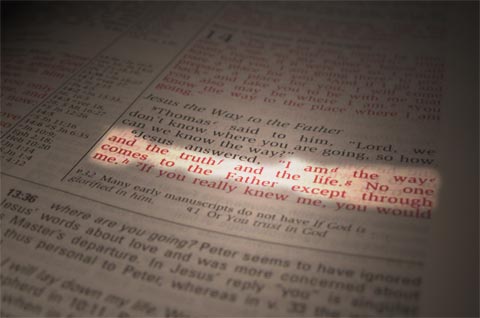
Jesus said he was the way, the truth, and life itself.
Does anyone have hope apart from the love of Christ crucified and unharmed?
[A New Year’s Message to our readers from the Editorial Board]
January 17, 2015 marks the first anniversary of the Billy Lee Pontificator. During the past year we published more than fifty posts on over thirty topics of interest to Billy Lee — like economics, history, humor, politics, religion, gay rights, literature, race, music, culture, technology, science and many others.
Billy Lee celebrates his blog’s one-year anniversary.
WordPress, our blog-site administrator, reported in year-end statistical summariesthat readers clicked on Billy Lee’s Pontifications 7,000 times.
Although some people might consider the number small compared to the tens-of-thousands of hits received each day by commercial web-sites, Billy Lee prefers to compare his numbers to what he might expect were his articles posted on the front of his refrigerator with little door-magnets.
It’s unlikely that more than a handful of visitors to his kitchen would take the time to read even a few of his posts during the year. Measured this way, it is clear to the Editorial Board that the Billy Lee Pontificator has been a spectacular success.
Billy Lee sometimes tells people he started his blog to entertain and inform readers. Not true. We know him. We work with him. He created his blog, because he needed a reservoir for his crazy ideas.
Billy intends to leave behind a public anthology of utter nonsense to his loved ones. He is convinced that the heart-palpitations he experiences every time he writes will kill him someday, probably prematurely. He doesn’t want to leave an empty legacy of a wasted life.
But let us face some harsh realities. Writing a blog is agonizing, thankless work. A famous person once said: no one who blogs is ever happy (or famous). Bloggers can sometimes suffer criticism, but more often than not, people ignore them. And it hurts.
The public seems not to care about bloggers and the useless self-indulgent crap they write. Blogsters who believe in what they do (and that includes Billy Lee) writhe beneath the stab-wounds of rejection every time they push the publish-button and sit glued to their computers to wait anxiously for their site-stats to dribble-in.
Most of the time the numbers confirm their worst fears — they really do suck at what they do. They bleed. They suffer. And everyone knows they self-inflict their own self-righteous agonies.
No one does it better than Billy Lee. Only when a blogger stops blogging, does the bleeding stop. Billy Lee has suffered and bled for twelve months now. Yes, he bleeds, but no, he’s never bled-out.
It seems that more and more blogsters are abandoning their sites and moving on to other meaningless projects. We hope Billy Lee never does. As boring and irrelevant as he is, we still want our paychecks! Stand up, Billy Lee. Keep on blogging!
Sincerest Regards,
The Editorial Board
P.S. One more thing. Some readers may have heard the news by now. Security guards arrested Billy Lee during his speech last night at the “New Year’s Eve Homage to Year One” Gala and Ball. The Board hosted the plaid T-shirt affair at the exclusive Rubber Chicken Dinner Club in Metamora.
Billy Lee has apologized.
Guess what?
We don’t care!
A transcript of his remarks is reproduced below.
Helloooo, everybody! Happy New Year!
(burps loudly, spills drink)
(audience applause)
I’m Billy Lee, the Pontificator, and I’m drunk as a skunk!
(Audience laughter, applause)
What’s my New Year’s Resolution for 2015? Who wants to know? Yeah? Oh yeah? You’re all a bunch of gnarly swamp rabbits…That’s what I think! I’ll pickle ur… Whoaaa! Easy big fella. Not you. Not you.
(Scattered laughter. Room quiets)
Ok, Ok… it’s an easy one, my comrades. Hold on. I’ll tell ya. I’ll tell ya.
(Stares wildly into the room)
I resolve… I resolve… in two-thousand one five… to be sexy all the time! Two – oh – one – five! I be sexy all de time. Yeah!
(hiccups, burps, takes a drink)
(gasps from audience, a few catcalls)
I resolve to be of good cheer, most of the year, and for god sakes don’t tell ’em I’m qu…
(stumbles, grabs podium)
Don’t tell ’em I’m qu…
(twirls a 360 and throws drink glass, shattering it)
Don’t tell ’em I’m qu…
(falls into microphone setting off loud reverb)
Don’t tell ’em I’m qu…
(sprawls onto stage floor, face down, butt in the air)
don’t tell ’em… don’t tell ’em…
(scattered screams, folks covering their ears, expressions of outrage in audience)
Note to our readers: Let’s just say, things escalated. Billy Lee decided to belt out a slurred and soggy rendition of Take Me to Church. He demanded that male volunteers come up on stage to kiss him on the lips.
Some in the audience rioted. People began throwing things, including chairs and salt shakers. Finally, marshals stormed in to escort BillyLee out of the building. He was hand-cuffed and dragged. He began bawling like a baby. Some say he mouthed the words, worship like a dog! worship like a dog! as the marshals threw him into the paddy-wagon.
An hour or so later, members of the Editorial Board — they shall remain unnamed — posted BillyLee’s bond, and all of us, together, asked that he submit his formal remarks — in writing — today. We demanded that he include an apology.
Billy Lee complied. We have attached his written “homage” (an e-mail) below. The Editorial Board.
January 1, 2015
To: the Billy Lee Pontificator Editorial Board
May I offer my profoundest apologies to anyone I offended last night by my outrageous behavior, inappropriate comments, and lewd singing? I am so sorry.
I am so ashamed.
I know it’s the tradition for people to drink small amounts of alcohol on New Year’s Eve, but last night I clearly exceeded the reasonable and customary limits of insobriety.
Under the influence of what some said was “excessive” consumption of liquor, it seems I offended both the gay community and those Christians in the audience who prefer to drive gays to suicide. For this, I am truly sorry. I said and sang stuff I didn’t mean.
My question to the board members is this: Can you forgive me? Or will you use my weakness as your excuse to torment, humiliate, scandalize, censor, and shun me?
Your silence seems to speak for itself. You forgive me. And you torment, humiliate, scandalize, censor, and shun me. Thank you so very much.
Let me reassure you. I am not myself gay, nor have I ever been. Do you believe me? Again, your silence speaks for itself.
You don’t believe me. I feel it.
And you shun me. I feel that, too. Ok, then. Now that it’s settled, can we move on?
And again, may I prodigiously apologize for playing the fool and making you hate me?
I am grateful for each of you: for each member of our illustrious Editorial Board and the over-weighted bureaucracy that supports you and makes up the backbone of the Pontificator team.
Thank you to the staff of sycophants, apple polishers, and suck-ups who inspire all of us to do our best work.
And thanks also to our black janitor and the two sluts who hang out in the parking-lot before work every morning. Thank you to everyone.
It is now my pleasure to present my homage to our first year and to discuss many of the articles I wrote that might have enriched all our lives had you taken the time to read them.
It’s no secret to me that you didn’t read my articles. Yet you call yourselves the “Editorial Board” !!! The only thing you edit is your paychecks. I’ve caught more than one of you erasing “ones” and “twos” and writing in “eights” and “nines”. It’s not right, people. Can’t you see that?
Well, enough apologies. I’m admonished and chastised. I get it. And no. I’m not dropping my pants, so you can spank me. It’s enough, already, Editorial Board! Let’s move on to my Homage to Year One!
I’ve included the following written transcript of the remarks I would have made last night had I not been drunk. And I made some changes to more accurately express my feelings after your reaction to last night’s sorry debacle and my role in it.
By the way, I’m thrilled to reveal the five most read Pontificator articles for 2014. Can you guess? They are… (May we have the envelope, please? Drum roll…)
Since you’re reading this report in your e-mail, Editorial Board, click on the links and read all five, right now!
The best article of 2014 (and far and away my favorite) is Bell’s Inequality. It packs a huge wallop for those who dig science. Not to totally pander to science freaks, but a close second is Conscious Life. Site stats say few people have read them. I know the Editorial Board didn’t read them.
Read them now!
Our best (worst) day of the year was May 3rd, when church leaders — alarmed by my famous Gay Love post — swarmed our site and eventually shut it down — for six weeks!
I never suffered emotionally in my life like I did during those weeks — they turned into months! Details of that unnerving fiasco are described and preserved in Writing Free.
Of course, I can’t expect any of you to read it. It’s 2,000 words. It has paragraphs!
Many people told me the post they liked best was Hearing Loss. It is a true account of real-life exchanges between me and my hill-billy wife, Beverly Mae. It is always good for giddy guffaws and lots of laughs. Next July, when you are all taking your six-week vacations, why not set one week aside to read it, Editorial Board?!
Another funny post, at least to me: Why Do Humans like Music? I belly-laugh every time I revisit it. It’s that good. You wouldn’t know!!!
I don’t know how many of you Board members know this, but The Billy Lee Pontificator got it’s start, believe it or not, from a desire to showcase an article I wrote titled, Horemheb, Exodus Pharaoh? I loved that essay. I loved the title. Wow. Horemheb, Exodus Pharaoh? Really? Everybody will read that one!
To my amazement, and through the tears of self-humiliation, I discovered — after I published it on my blog-site — Horemheb needed a re-write. Some family members may remember how much the re-writing of Horemheb dragged-on during its prolonged infancy on Facebook, before I blog-published it. It’s why we hired our Editorial Board team.
Maybe someday some of the Editorsmight want to read Horemheb to see if I missed something. If it’s not inconvenient or too much trouble, Editorial Board!!!
Anyway, sloppy execution of my article, Horemheb, led to the policy elucidated on our Billy Lee Process Page, best summarized as follows: re-write it ’till it’s right. People hate the policy, but I like it. In my bad heart, I know it’s right. And since my Editorial Board — yes, that’s you! — won’t spell check my stuff, I have no choice.
To sum-up: I can’t say I enjoyed my first year blogging, but I’m proud of the articles I wrote. I’m glad some people say they read them — even if my Editorial Board refuses. I regret the controversies, but it’s how we stay alive, stay engaged and grow. Does anyone agree?
The entertainment industry learned a long time ago that the way to appeal to the most people is to embrace ambiguity.
Ambiguity permits each consumer to put their own meaning on the art they buy; on music, paintings, theater, books, movies, shows, personalities, and stars.
Ambiguity, when combined with strictly enforced copyright laws — like those of the United States — can help establish a large paying audience, huge money, and wide-spread exposure and influence.
No facial expression is more ambiguous or popular than that of Mickey Mouse. It is vigorously protected by copy-right law.
People like to feel they are part of something bigger than themselves. Ambiguity promotes mass participation in cultural processes. This mass participation can alleviate the ennui of alienation for many people.
Elvis Presley created mass hysteria in the USA. Some religious people thought his first name was a scrambled version of the word, Evils.
Elvis Presley sang, you ain’t nothing but a hound dog. What did he mean by it? No one knows, and everyone knows.
The same is true with Bob Dylan who sang, Hey Mr. Tambourine man, play a song for me. In the jingle-jangle morning I’ll come following you. No one knows what he was singing about. Yet everyone can tell you what he meant.
The ambiguity of these two artists — one from the nineteen-fifties, one from the nineteen-sixties — permitted both to accumulate the largest fan bases ever, until the Beatles.
John Lennon once said the Beatles were more popular than Jesus.
The Beatles established an ambiguous sexual identity by wearing their hair long — unusual at the time. They deluged their fans with ambiguous lyrics such as, yeah, you’ve got that something, I think you’ll understand, When I’ll say that something, I wanna hold your hand… and hey Jude, don’t make it bad, take a sad song and make it better. No one knows for sure what they meant, but everyone knows what those lyrics meant to themselves when they first heard them.
Jesus presents ambiguities about himself which have attracted the largest following of worshippers in world history. The most obvious ambiguity is the concept of the Trinity. Is Jesus God, or not? No one knows. Everyone knows.
The Trinity is the central ambiguity of Christianity. God is somehow a combination of person, spirit, and creator.
The concept of the Trinity presents the central ambiguity of Christianity. It has drawn the attention of a spiritually hungry world for two thousand years. It confounds us with a dilemma of logic and meaning which to this day fuels the faith-wars of Christians who, in their quest for certainty, have segregated themselves into over 40,000 denominations.
Every attempt to define the Trinity, to remove its ambiguity and establish certainty, seems to result in a new denomination, a new religion.
The Holy Spirit is sometimes portrayed as a white dove. The olive branch recalls the dove who gave Noah the evidence that the great flood (of judgment) was over.
Of course, many other ambiguities in the Bible have spawned controversies. Abortion isn’t mentioned in the Bible — and homosexuality is barely mentioned — yet both have divided countless churches. Gifts of the Holy Spirit — which are discussed at length in the Bible and should be non-controversial to believers — have divided churches. Some denominations discount gifts altogether, in contradiction to Scripture.
In the 21st century, those Christians who detest ambiguity and worship certainty war with one another in a kind of theater of the absurd. 40,000 denominations?
Really?
Instead of embracing a small amount of ambiguity to unify Christians, a few leaders advocate from time to time certainties of thought and Bible interpretation which divide the faithful. Unity is the last thing these modern Christians seem to want. They lust for certainty.
Certainty is not foundational, according to quantum physics.
Certainty is not biblical, it’s not Christian, it’s not even Jesus. Jesus didn’t stone the woman caught having sex with her married boyfriend, though the logic of the law demanded it. He reasoned with her, encouraged her, and forgave her. He wasn’t logical. He wasn’t dogmatic. He admonished the woman and gave her hope. He acted with all the stupidity and uncertainty of true love, based on a relationship with a messy human being who would never be certain of anything.
The most unambiguous statement Jesus made was this: Here I am! I stand at the door and knock. If anyone hears my voice and opens the door, I will come in and eat with that person, and they with me.
No one knows for sure what Jesus was talking about when he made this statement. Yet everyone seems to know for sure what he meant. As unambiguous as the statement is, it can’t be literally true today.
No modern person has ever opened their front door and found Jesus standing on the front porch. Not one. Jesus’s meaning is uncertain. To different people, his words mean different things.
For Jesus, his statement had a meaning known to him, but it seems reasonable that his meaning might have nuances depending on the specific person he was talking to. And Jesus was talking to a lot of people, it turned out.
The amount of faith required to access Heaven is small, but uncertain.
The Bible plainly says that we are saved by faith. But no one has perfect faith.
So how much faith does it take to get into Heaven?
Jesus said the amount of faith required to do anything was on the order of a grain of mustard seed, about the size of the period at the end of this sentence. How many people have this much faith? Not very many, it turns out. It’s not possible for us to be certain about the quantity of faith required to enter heaven. The amount is small, but uncertain.
In their demand for certainty, many churches fight over doctrine. They fight, because they are populated by people. If history is a guide, we can say with certainty that people love to fight.
One of the amazing things Jesus said was this: God is kind to the wicked and the ungrateful. As someone who has been wicked and ungrateful pretty much everyday of my life (and not proud of it), I love pondering those words. They give me assurance, not certainty, that God will be more gentle with me than I deserve.
God protects the boat and the people it leaves behind in the harbor.
Recently, my church friends, God love them, voted to leave our mainstream denomination to join a conservative denomination of the South, born in the Confederacy of the civil war. People unwilling to get on the boat for unchartered waters face the danger of becoming spiritually adrift. They face an uncertainty that might result in the loss of their religion.
I am one of those who have to face the unpleasant decision to get on that boat or face the dangers of remaining on shore. It’s not a good choice for me. My health has suffered under the stress of a change in my old age I didn’t see coming. The good part is this: people who love Jesus are in the departing boat and on the shore. And Jesus is protecting both the boat and the land it leaves behind.
Sharing a meal with Jesus, and being reassured by him that everything will be set right someday, is a central hope of most Christians.
The comfort Christians enjoy is Jesus, himself, in their homes, eating with them and sharing their life. That’s it. Jesus is all there is for those of us who suffer in this life, and he’s enough. Inside our private spaces, Jesus reasons with us, encourages us, forgives us, admonishes us, and gives us hope. He helps us endure and embrace the will of God, which is almost never our own.
Billy Lee
Postscript: On July 1, 2015 Billy Lee resigned his church and aligned himself with a non-denominational congregation. The Editorial Board.
People hate me. People have hated on me my whole life, but never more than now, it seems, in my old age, when I need their love so bad. If they only knew how their hatred weakens me and any hope I have for happiness. Maybe they’d relent and welcome me into their friendly world.
But I don’t think so. If they knew how much I hurt, they’d hate me more, shun and isolate me even further, just to watch me suffer.
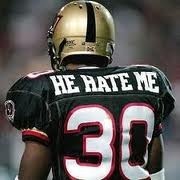
Rod Smart was the leading rusher for the Las Vegas Outlaws of the short-lived XFL. His career took him to both the CFL and NFL, where he played in Super Bowl 38 for the Carolina Panthers. On the last play of the game, with the Panthers trailing 32-29 and only 4 seconds left on the clock, Rod Smart received the New England Patriots kick-off. He was unable to score the game-winning touch-down.
As Torrold DeShaun “Rod” Smart, the would-be NFL star, once said: I feel as if everyone hates me, from my mom to my dad and even my brothers and sisters; everyone ”Hates Me.”
All hope abandon, ye who enter here…
The first time I learned people hate me was at the Army boot-camp for officer-candidates at Fort Benning, Georgia during the summer of 1968. I went there to train after becoming an officer candidate to avoid the military draft during the Vietnam War.
It was a period in our history when the government conscripted hundreds of thousands of young men to fight in Vietnam. Exemptions from the draft (called deferments) had been given to college students for years, but no longer.
Students across the country began competing to get into Army ROTC training programs, because they were the only sure way to stay in school and avoid military service, at least temporarily. At my school, I was one of only eighteen students (out of a pool of several thousand applicants) who qualified for officer training.
I felt lucky, because now I could finish my education. Maybe, by the time of my graduation, the war would be over.
Cadets who enjoyed push-ups (and were good at them) thrived in officer training camp.
At officer boot-camp that summer, in the humid choking heat of Georgia, the training began. The recruits were, like me, the cream of the crop, the best of the best, from some of the finest colleges and universities in the USA and around the world. I’ve not been with smarter, worthier people than those who shared my summer of ’68 at Fort Benning.
We found ourselves trapped in the grasp of some of the most ignorant, mean-spirited drill sergeants I’ve ever encountered. Their mission was to squeeze each recruit through a juice-grinder to see what we were made of and to prove to the military how strong (or how weak) were our minds and bodies.
They cursed us, abused us, deprived us of sleep and dignity, and told us we were over-privileged swamp scum, not worthy of the army. They convinced me they meant every word.
Drill-sergeants ask a young recruit whether he prefers caramel or strawberry syrup on his French soufflé.
In chow-lines, gnarly swamp-people with missing teeth menaced and taunted us by swearing, shoving and pointing fingers. One officer forced recruits to eat their own cigarettes.
During a month-and-a-half of hell, I watched people go beserk on the firing range, collapse with seizures due to excessive heat and lack of water, quit the program, and go mad.
All I thought about during those forty-two days in Hell was this: it can’t last forever. I can survive, I can hold on, I can sleep again with my sweet girl-friend, Mary-Ann, who loves me. All this pain, this agony, will fade to an unpleasant memory, nothing more, in good time.
Studies conducted on young men adept at crawling through mud beneath barbed-wire show that they enjoy the taste of dirt more than cadets who lack this skill.
But, of course, I was naïve. Every dinner has its dessert, its crème-de-la-crème, its grand-finale, its coup-de-grace. Boot-camp was no different.
Two days before the end of training, the Army announced that each cadet in every forty-three-man platoon would participate in mandatory peer-reviews of their fellows. Drill Instructors — armed with notepads and pencils — ordered every officer-candidate to rank every other officer-candidate, from top to bottom.
Worst of all, the DIs forced each cadet to write an explanatory paragraph about each soldier they placed in the bottom-five. I think I remember trying to say something nice about each one of the five I chose.
As it happened, the evening after the peer-review, one of the cadets broke into the administration building and stole the reviews. Word got around, and soon a few dozen cadets, including me, gathered outside the barracks to rummage through them, their summaries and explanatory comments.
I discovered that my fellow cadets ranked me third from the bottom. I couldn’t grasp it, it seemed so unreal, so I read the comments. Apparently, I lost equipment, stole things, went AWOL, and was generally unprepared and unkempt.
I lacked the intelligence required to lead, lacked problem solving skills, etc. etc., on and on. I kept checking the name to see if it was mine. Nothing written about me was true.
This photo, retrieved from the Army Archive, shows Billy Lee on his last day of boot camp. He is the cadet lying on the stretcher, apparently too drunk to walk the quarter-mile to a waiting bus.
It occurred to me that all of it — all the negativity and cruelty; every last hateful condemning word — was going to be part of my permanent record, my profile, which would follow me forever in the army and beyond.
Why, I asked myself over and over, would people who I thought were my friends write nasty, untrue, career-ending things about me? I couldn’t work out the answer.
Officer training camp broke me. I spent the next two days drunk, sobbing silently inside myself. On the last day, while the other cadets scurried to leave, I writhed on the floor by my bunk, unable to pack my things or police my area. Psychological trauma and grief immobilized me. The pain of being hated ruined me. I never recovered.
Billy Lee
Editor’s note:This article has been a fictionalized compilation of actual events, which occurred during two training camps — the first at Fort Benning, Georgia; the second at Fort Riley, Kansas the following summer. The stolen peer-reviews incident occurred at Fort Riley during the summer of 1969.
Incidents in the two camps have been conflated by Billy Lee to make a more comprehensible read. The incidents are true. The order is true. But events happened over consecutive camps — basic training and advanced infantry training the following summer.
P.S. Since writing this article, some people have asked me if, over the years, I might not have garnered some insight into why my ROTC compatriots at Fort Riley rejected me. (At Fort Benning, peer reviews weren’t conducted.)
The answer is yes, but these insights weren’t included in the article, so that readers (who might not know me well) could experience the wonder I felt. In truth, (allow me first to lie; the truth is too painful) I was well-connected and proud. People hate arrogance, and that is what I was. I received special treatment from higher-ups. That, and my attitude, didn’t go over well. (Will you permit me to do some preliminary blame-shifting?)
General Boatwright was two months older than my dad. Like my dad, he was a Warrior who dedicated his life to the defense of the United States of America.
General Boatwright, the base commander at Fort Riley — who knew my dad — gave me an escort on his private plane to camp. I boasted about it. Later, he flew to our bivouac-site with a half dozen helicopters and called me out of formation (as I remember it, with a bull-horn) to interview me in front of everyone about camp conditions. I remember he asked about the food and how we were treated. I told him everything was great.
The General invited me to what I think I remember was his daughter’s birthday celebration, which meant I had to abandon my buddies to harsh camp conditions, while I partied.
Later, I wrote a thank-you letter to the General, which a drill instructor somehow managed to intercept. He read it aloud at morning reveille to my gathered platoon. In front of everyone, the outraged DI tore up my letter, while he explained so that even a child could understand: cadets don’t write letters to Generals.
None of these incidents helped me get a good peer review. (Listen to me shuck and jive over these irrelevant incidents. Patience, please. I’m working my way to truth, but it’s hard)
The most damaging things that happened were self-inflicted. I remember bragging about myself to others. (Here comes partial self-serving approximations of truth.) I told wildly exaggerated stories to hide the truth about myself from others. The truth was, I hated the choices I made. I bragged about myself, but I bragged about things no one should be proud of — like the details of my sex-life.
I self-destructed. Yes, I hated the Army. Yes, I hated war. Yes, I trapped myself in a place I didn’t want to be. I made it embarrassingly obvious to everyone. I hated myself.
Yes, I hated the Army. Yes, I hated war.
I couldn’t believe the terrible decisions I’d made. I couldn’t believe what a coward I was; how I caved to the powerful idiots who took us into the genocidal killing-field that was Vietnam for no other purpose than to test our newest equipment and evaluate our effectiveness to wage war. (More tangential bullshit is on its way.)
I found myself in a space I didn’t want to be, doing things I didn’t believe, for reasons that made no sense. I was scared to pay the price that came with resisting the evil I saw so clearly once I immersed myself in it. I had abandoned my point of view, my sense of what was right and wrong; my identity; my sense of self; my integrity. (If only any of this were true!)
Why, under the stress of basic training, did I turn on myself? Why did I manipulate others to turn on me? Why did I work so hard to bring the Universe of judgment and condemnation down on my pathetic-loathing-self? I would have to wait until many years later in therapy to learn the answers. (And I can never share them. Why don’t you understand? It’s killing me. I’m so afraid.)
I became obnoxious and inauthentic. It must have been obvious to everyone but me. It’s a wonder one of the cadets didn’t shoot me. They turned on me, because to them I was a sick puppy and a phony to boot. I wouldn’t own up. I was a coward. I refused to embrace the truth about myself.
Today, it’s clear to me that way back then in the fevered heat of officer training camp my peers would have ranked me at the very bottom of the pile had it not been for a couple of loving, perceptive souls who shared my pain and placed me, mercifully, carefully, near the very top.
Their act of kindness meant that when the scores were averaged, two other cadets would suffer the excruciating shame of being hated even more than me. Imagine. Hated more than me! HaHa! HaHaHa! Burp.
UPDATE, JUNE 15, 2020: Today, the Supreme Court of the United States ruled that discrimination against gay and transgender workers is unconstitutional. Gays and transgender people are now protected by federal law, which forbids discrimination.
UPDATE, JUNE 26, 2015:Today, the Supreme Court of the United States approved the right of any two unrelated adults to marry. This article, written one year ago for both gay and straight Christians, remains relevant because it addresses issues of Christian marriage.
I’ve noticed (how could anyone not notice?) that some folks use the Bible to browbeat people who are gay. Every once in a while, not often, people are surprised to learn that persons leading the charge against gays are gay themselves. And people — sometimes — know. Somehow, folks who have the courage to self-disclose become the target of people who are working through their self-loathing by bullying. It can become a heart-wrenching spectacle.
I’m old enough to remember years ago when Anita Bryant, the former Florida orange juice spokesperson, led a national crusade against gays. Her followers’ approach to the issue of homosexuality was to show up to Gay Pride events with signs reading, you are all going to hell.
In the midst of one of her anti-gay campaigns her marriage fell apart. The media reported, apparently in error, that her husband was gay. One reporter, who knew better, reported her husband was a homo-sapien.
Some folks who have found themselves on the receiving end of hostile condemnation have complained that Christians are rude and insensitive. I remember one kid complaining on TV about the awful treatment his gay parents received from Christians during a parade they attended. It hurt, he said.
Anyway, the Bible is clear, isn’t it?
God judges people with the same mercy (or lack of mercy) they show others, to paraphrase Jesus. Somewhere in the Bible is the promise that when our ways please God, enemies make peace with us.
Didn’t Jesus call folks to be peacemakers and witnesses of his love for all people? It must be possible to love gay people without scaring them half to death and humiliating them.
I’ve been thinking: why not write about a few well-known passages in the Bible that seem to address the issues of gay love and share a few insights? It seems to be a subject on a lot of people’s minds these days.
Of course, I’m not a theologian. I’m a pontificator, right? These ideas are my opinions, subject to change if anyone points out their errors.
Mostly, I’m asking questions about certain Bible verses to try to help people think about ways churches can make the road to Christ an easier walk for gay folks and those who love them.
It’s a sensitive subject in some churches, my own included. I hope people don’t take my word for anything except to get their thinking started. Maybe some will talk with others they know and trust who might have a similar interest.
This article speaks to straight Christians, mostly, whose ideas about sexuality may possibly be shaped more by prejudice and ignorance than by what is written in the Bible. I hope gay Christians will join the discussion. If any are reading now, insights are important. Submit comments at the end of the article, anyone who cares.
In the USA we have the LGBTacronym. It stands for lesbian, gay, bi-sexual, transgender. Some folks are adding “Q” for questioning; various other letters are sometimes added to include related like-minded groups.
Fair enough.
I think the LGBTQ acronym is appropriate for secular discussions of sexuality. It is a shield of unity for folks who are struggling to cope with the pain of society’s prejudice and bigotry.
But for Christians, it seems to me, gay sexuality discouraged by the Bible is more narrowly defined — transgender issues are not mentioned, for one thing.
Gay sex is described in graphic terms only in the Old Testament — a collection of books written thousands of years ago; it recalls for us that men who ”lay with men in the same way they lay with women” were put to death in Old Testament times in the same way as adulterers and those who practiced six other categories of sexual activity.
Oddly, under Old Testament law, a man who committed adultery could escape execution if his sex partner was the wife of either his uncle or brother. He suffered the curse of childlessness, instead.
Should a man sleep with a menstruating woman, both were punished by being cut-off from their people.
And for those who didn’t get the message that sexual sin was serious, the book of Deuteronomy reveals that newly-wed women discovered to be non-virgins were executed and their marriages annulled.
Punishments for sexual sins thousands of years ago during Old Testament times were severe.
The Bible contains 66 books, 31,102 verses, and over 727,000 words.
In the entire Bible (66 books, 31,102 verses, over 727,000 words) little is written on the subject of gay sex or relationships — on gay sex: a dozen or so verses in nine or so books — on gay relationships: one interesting story in the book of Samuel about the love relationship of David with King Saul’s son, Jonathan.
The Bible says their love was more deeply felt than the love between a man and a woman. In this story, at least, it seems the Bible permitted two men to love one another. But it doesn’t seem to suggest, at least to me, that the love shared by David and Jonathan had a sexual dimension.
Some Christian leaders have written that homosexual activity is among the worst sins people commit. How is it then that homosexual activity is not mentioned in the Ten Commandments, the bedrock moral teaching of the Bible? How is it that Christ himself never mentioned it?
And if all sin — any sin — separates people from God, how can any particular sin be judged worse than any other, unless folks are speaking in a secular sense? And if they speak in a secular sense, aren’t they obligated to remember that, in America at least, people have protected rights to believe or not believe pretty much anything they want when it comes to religion or any other subject?
It’s something called freedom, and it applies to both Christians and non-Christians.
Neither do I condemn you. Go now and leave this life of sin.
In this article I am writing to Christians, both gay and straight. And in this context, I have to admit that a fair reading of the Bible reveals that the handful of writers who addressed the issue said plainly that sex between men was sin. Those who submit themselves to Christ Jesus have an obligation, as everyone does, to repent and leave this life of sin, as Jesus advised the famous woman caught in the act of adultery.
The woman’s accusers planned to kill her. Jesus saved her life and set her free.
Fomenting hysteria and supporting anti-gay political movements are unseemly for Christian churches, especially in light of the small number of verses about gay-sex in the Bible.
Churches better serve God when they transform themselves into safe places for gay men and women who belong to Christ to worship and enjoy the friendships to which they are entitled as members of the Christian community.
A gay Christ-professing man or woman should never be afraid to lose friends or face church discipline for being true to themselves and others, even as their process of sanctificationis ongoing.
[Sanctification is a technical term used by theologians to refer to the process whereby the LORD, over the lifetime of a believing sinful person, transforms that person to holiness. The process is not finished until after the believer dies and Christ presents them holy and spotless before God, the Father. The Editors]
It might be helpful to consider this: in contrast to its paucity of gay-sex verses, the Bible contains hundreds of condemnations of hetero-sexual activity including, but not limited to, masturbation, fornication, adultery, rape, and prostitution. I mention these because an important theme in the Bible is that sexual ”impurity” separates people from God. Some leaders claim it impacts marriages and leads to consequences like divorce.
Depending on the translation, the word, homosexuality, appears only once (or twice) in the Bible — in the New Testament. In one passage, the writer explains that the law of God is good when it is used properly. He says the law is made to guide breakers of the law, like those who practice homosexuality, to cite one group among eleven listed in the verse.
The Old Testament passages that warn men to avoid sex with other men are the basis of the New Testament passages just mentioned. Were it not for the sensitivity of some, these verses might go unnoticed.
The passages were written three thousand years ago — before modern medicine and antibiotics; before innovators invented condoms or even soap. If modern society lacked doctors, medicines, condoms, and soap, wouldn’t it make sense to caution men (and women) to avoid unprotected sex with multiple partners?
I don’t know of a single religion that advocates executing non-virgin women who marry, even though a verse in Deuteronomy seems to demand it. Execution has outlived itself. In the USA religious freedom means that extreme religious views have little chance to become law.
Many Christian leaders, perhaps most of them, say, no. It has nothing to do with health. The reason for prohibition is to promote sanctity of marriagebetween one man and one woman.
But the Old Testament was written when powerful men — many of them Bible heroes — took hundreds, sometimes many hundreds, of wives and concubines. Many less-powerful men in ancient societies couldn’t marry because powerful rulers reduced numbers of available women.
An argument can be made that polygamy increased temptation in ancient times for single men to couple. But there were risks. Those who practiced gay sex risked their health and lives. Effective treatment against infection was non-existent.
In the same way, powerful men who practiced polygamy were themselves at risk for sexually transmitted disease should their wives submit themselves to other men. Adultery became a capital crime punished by pulverizing offending women with rocks until they died.
The rise of HIV/AIDs in modern times is a reminder of what gay men suffered during bygone Old Testament eras. Most folks agree that sex in ancient times, despite its pleasures, always posed downside risks. Many of these risks have been mitigated in modern times.
It should be easy to understand why leaders of ancient civilizations took a keen interest in protecting vulnerable, often ignorant, people from harming themselves. These concerns sometimes migrated into their written documents, like those dozen verses found in nine books of the Bible.
The story of Sodom is used to justify suppression of gays in many parts of the world. What does the story actually say?
What about Sodom and Gomorrah? This famous story is found in the Book of Genesis, written about 3,000 years ago. It is the basic text in the Bible used to justify the suppression of gays in many parts of the world. It’s time to take a closer look.
What, exactly, happened in the ancient city of Sodom?
According to the story in the Bible, the LORD appeared to Abraham in the form of three men. They discussed the town of Sodom. Abraham, fearing for the lives of the innocent, argued that destroying the city was not just. The three men agreed. They would not destroy the city, they said, if they found as few as ten good men.
The LORD went to Sodom, this time in the form of two angels. They entered Sodom, where the men living there threatened them with rape, presumably because they were beautiful.
I don’t want to get into the complexities of Christian theology (because I’m not a theologian, and it’s a sensitive subject), but permit me to point out that some believe the three men who discussed Sodom with Abraham were the Holy Trinity; that is the Father, Son, and Holy Spirit; the Triune God as it were, of Christian orthodoxy.
Later, according to this view, the LORD entered Sodom in the form of the two angels mentioned earlier, who personified — or perhaps were — Christ Jesus and the Holy Spirit. God the Father remained, presumably, at a safe distance outside the city, because some say the nature of his Holiness would have brought instant death to any sinner who looked at Him.
All the men living in Sodom, young and old, turned out to see the angels. Their reaction was not to welcome the representatives of the living God, but to attack the house where they were staying to gain access to rape them.
If you were God, what would you do? If the angels were brothers, is there anyone who would stand by and just let things happen? Of course not. God blinded the attackers to enable the angels and their host family to escape; He ignited a volcano and buried the city of Sodom under its ashes.
My question is this: was it the homosexuality of some of the men in Sodom that upset God? Or was it the predatory sexual appetites of all the men of Sodom for two of God’s most trusted messengers?
Certainly the attack provoked God’s sense of justice, and it became personal, because the men of Sodom threatened to degrade and possibly kill the two essential envoys God would ultimately task to redeem humanity. In fact, according to the view I described earlier, the men of Sodom attacked God Himself, a stupid thing for anyone to try.
There is a lot here to think about. The men of Sodom went to war against God, and God taught them the painful lesson that he protects his own, some of whom, presumably, lived in Sodom’s vicinity and had become its victims, much as God’s envoys almost had. Can there be any doubt, after reading this story, that God will defend those who belong to him?
It might be helpful to pause for a moment to say a few words about angels. The Bible describes angels as being neither male nor female; they don’t procreate or marry. They don’t have sexual relations.
It’s not that their sexuality is ambiguous. They don’t have a sexual identity! They are not sexual beings. To paraphrase Jesus, there is no sex (marriage or giving in marriage) in heaven.
Keeping the words of Jesus in mind, it seems reasonable to believe that most will agree that subjecting an angel to a sexual assault rises to the level of a horrible crime punishable, in this case at least, by death.
All the men in Sodom, both gay and straight, participated in the crime against God’s envoys. It turned into a war the men had no chance to win.
According to the Bible account, all the men in Sodom, both young and old, participated in this outrage. It means that some of the men could not have been homosexuals. In fact, the majority were not, if anyone chooses to use their common sense to read the passage.
Can any reasonable person extrapolate that all men from then until the end of time stand condemned, because they, like the men of Sodom, want to have sex with people they’ve only just met and don’t really know?
I’m not sure. Maybe. Yet some use this story to condemn only the men who were gay, and not only that, they condemn all gay men for all time. It doesn’t seem fair.
In fact it’s not fair; it’s not even biblical. The prophet Ezekiel gives the reasons for Sodom’s destruction in chapter sixteen of his eponymous book and explains clearly that other cities were worse in God’s eyes than Sodom, including, of all cities, the City of Peace: Jerusalem. And he predicts that God will someday restore both Sodom and Jerusalem; and he explains why. Click on the link and read the chapter, anyone who doesn’t believe it.
Ok, readers. Maybe it’s time for a break. Take some deep breaths. Inhale through the nose. Exhale through the mouth. Exhale slowly. Good. Good. OK, then. Let’s move on.
May I now, please, be allowed to pose another question, this time from the New Testament? May I humbly ask if it is possible, just possible, that another Scripture passage is being misread by some possibly gay-intolerant Christians?
Many of us are familiar with the words written by Paul where he says of humanity, God gave them over to shameful lusts. Even their women exchanged natural sexual relations for unnatural ones.
I’ve heard Christians say that this passage refers to lesbianism. But let’s slow down and think for a minute. Doesn’t it seem reasonable — wouldn’t the passage make better sense — if the shameful and unnatural relations Paul condemns are between the women and their husbands? Doesn’t the passage, when read properly, reflect the conservative attitude of Paul, who wrote it, and the attitudes of early Christians as recorded in other non-biblical texts?
Isn’t this view consistent with the passage Paul wrote exhorting married couples to keep their marriage beds pure and undefiled? Can there be any doubt that early Christians believed — based on their reading of passages in the Old Testament — that certain sexual acts were unclean and defiling, regardless of who performed them?
Saint Dominic’s Catholic Church, San Francisco, California
After all, the early Christian Church permitted only missionary-position style sex to heterosexual couples who the Church itself married — and then solely for the purpose of producing offspring. Sex was of course forbidden to anyone not married.
In fact, sex was forbidden even to those who were married if they served the Church in any leadership position whatsoever — this according to the 33rd Canon of the Council of Elvira in AD 306. This conservative view has been the traditional position of the Catholic Church for centuries.
By this difficult — some might say impossible — standard, many congregants of the forty-thousand Christian denominations in the world today might be standing before God guilty of sexual rebellion and in need of forgiveness.
Straight Christians, many of them it seems, are in the same sexual predicament as their gay brothers and sisters.
What are we to do? How do we avoid Hell? One thing Christians might do is try to understand this simple idea: straight people are in the same sexual sin-boat as gay people. Of course, they are. Think about it.
Straight people want biblically-forbidden sex like almost everyone else. They are tempted to act out their unbiblical sexual proclivities, many of them, within their marriages and against God’s will — if we adopt the Church’s historically orthodox and conservative position on sexuality, which admonishes Christians to keep their marriage beds pure and undefiled.
Jesus brings forgiveness and grace to Scripture and offers hope to people overwhelmed by sexual suffering who once faced execution for their sexual behavior.
But those who belong to Christ Jesus are united by him, according to Scripture, into one holy people. Yes, each of us is self-condemned by our own behavior, even by our own unbiblical sexual behavior inside our marriages, if the view of the New Testament writer and the Catholic Church is fully accepted.
When studying the Bible, people learn that everyone — all of us; gay and straight — once we submit our lives to Christ are made righteous before God by Jesus’s death in our place on the cross.
The Old Testament death sentence for sexual sins is endured by Jesus alone who reconciles each person to God. Then, over time, God’s Holy Spirit transforms all into a people worthy to spend eternity in heaven.
And this is my view. The Bible plainly says that Christ Jesus provided a way out of our dilemma. Jesus really is the way, the truth and the life, as he said. As the Wordof God, Jesus has the authority to both fulfill Scripture and to meet its demand for justice through his sacrificial death on a Roman cross.
This concept of grace is a central theme of the Bible. It is repeated twice; once in the Old Testament (Psalm 32) and once in the New Testament (Romans 4):
Blessed are those whose transgressions are forgiven, whose sins are covered. Blessed are those whose sin the Lord will never count against them.
Who are the people the Bible talks about, whose sins are covered? They are me and you and everyone we know.
Jesus brings the concept of forgiveness and grace to Scripture and offers hope to the fallen; hope to those who once faced execution for their sexual behavior. And Jesus, through his Holy Spirit, gives us the ability to treat our marriage partners with the honor, dignity, and respect owed anyone who belongs to God.
The Bible says people will someday live in a time when the law of God is written on their hearts. I really believe that time is now.
The law is written on our hearts.
The law is no longer written on stone, unless it is our hearts that are stone. We know in our hearts — where the law lives — we must love more our wives and husbands, our gay sons and daughters, our gay sisters and brothers, mothers and fathers, and especially our gay neighbors.
Shouldn’t we be praying for each other, that Jesus will give people the strength and grace to endure the sexual suffering they are sure to face in this life on Earth?
We know full well (because Jesus told us) that there is no sex (marriage and giving in marriage) in Heaven. This fact alone should give folks comfort, because it means no one will be taking their sexual identity with them.
All who enter Heaven will be free of sexual sin and sexual suffering. People will enter as brothers and sisters of Jesus, in complete victory over sins that once separated them on Earth. We will enter Heaven celebrating freedom. Everyone, even the most sexually-imprisoned, has this hope, in Christ Jesus.
This much folks should know. Love pleases God more than hate. They should know that tolerance and inclusion please God more than intolerance and exclusion, because the Bible says, God is love.
But those who belong to Christ Jesus know something more. If we honestly face our past and examine our hearts, we know that God loved us first, before we even knew who He really was, while we were still numbering ourselves — many of us — among the most God-hating people on Earth.
Don’t folks have a duty to love those who are like what they used to be — ignorant of who God is and ignorant, even, of who they themselves are? Of course they do. It’s difficult, because most want to forget the past and move on. No one wants to be reminded that everyone is trapped in a quicksand of sin; that absent Christ Jesus they have no hope of rescue.
Can Christians move on without first offering out-stretched hands to fallen friends? Some can be found within our churches. They are sexual sinners like us.
And just like us, they always will be.
God loved us first, before we even knew who He was.
I hope that Christians have love enough to accept their gay brothers and sisters in the name of Christ Jesus; that they have the wisdom to see that we share the same daily struggle against sin; that we have the presence of mind to beg Jesus to lift us out of the muddy waters of sin, together if necessary; to wash us clean with His blood that he shed for us in suffering.
Pray that the LORD forgives us, accepts us, and loves us unconditionally, which is nothing more than everything we’ve ever wanted.
Billy Lee
Post Script: The story behind the publication of this article is told in Writing Free. The Editorial Board
I wrote my first big story in fourth grade. I called it, Adventures on the Amazon. It’s now lost to history, but I remember organizing it into chapters.
Chapters were a big deal. I’d never written anything so long that it could be divided into paragraphs, much less chapters.
Each chapter was a little–kid-against-nature story. I battled hungry piranhas, pygmies with blow-darts, hippopotami, elephants, boa constrictors, fire ants, and so on.
It was a long story. My teacher awarded an A and invited me to read before the class. When I finished, my classmates applauded, so I decided to keep writing.
In fourth grade I wrote, Adventures on the Amazon. It took place in an exotic setting in a world I never visited.
My next big project was in seventh grade. In long-hand, I wrote a four-thousand word story about torture called, I am not a Coward. In it I tortured my brother to death to prove to the townspeople I wasn’t a coward. When I carried my dead brother into the heart of town to show the people what I had done, they weren’t proud of me like I hoped. Instead, they turned on me in horror and stoned me to death, while I screamed I am not a coward, I am not a coward!
I can’t tell you why I wrote Coward. I lack the courage to tell anyone why. I suppose I’ll be taking my reason to the grave. I really am a coward.
Before I showed the story to anyone, I taught myself to type. I thought, a story this good has to be typed. It deserves the simple dignity of a formal type-set. So I spent the summer with a book I talked mom into buying called Teach Yourself to Type in Ten Weeks. Iused it over the summer, between seventh and eighth grade, to give me the skills to type out my masterpiece.
It felt like I’d conquered the world, once I finished the typing. I had taught myself to type and written an incredible story, all without the aid of a teacher. It was important to me and a source of pride.
I decided to read, I am not a Coward, to my family. Dad gathered everyone into our small living room for the dramatic presentation. Excitement lay on every face. Billy Lee had written a story. He could write. Everyone beamed with anticipation. They were proud of me, it was easy to see. I cleared my throat and began:
They say I am a coward. They say I watched my brother burn to death without lifting a finger to save him.
Despite my short-story to the contrary, I’ve been a coward my entire life.
Dad lifted his hand. Hold on there, Billy Lee, he said, white-faced. He ordered everyone to leave the room. I think it would be better if you read this story to me, first. After the last family member had scampered away, he motioned for me to start.
So I read the story through to the end, while he sat across from me, silent. It took about a half-hour. When I finished, he paused to gather his thoughts. Billy Lee, he finally said. That’s the finest piece of mis-directed talent I’ve ever heard. Please don’t read it to anyone else.
It’s just not possible to suppress a story that rises to the level of I am Not a Coward. Over the next few months I gave private readings to friends, when Dad wasn’t home. After a while I had read it to everyone I knew, so I hid my story to protect it.
How I was able to preserve and protect my story over the years is nothing short of miraculous. I lived in a Navy family, after all. We moved every two years or so. My dad liked to say that every move is like a house fire. Things burn-up. Things get misplaced and go missing. Yet almost sixty years later, I am not a Coward survives.
During high school I wrote a number of stories that teachers asked me to read before students. I won’t bore you. But one story slowed my momentum. In ninth grade a closeted-gay teacher led my creative writing class. I submitted a story about a Navy medical corps-man who hid his gay identity.
The teacher seemed to dislike it. He gave it an A-minus. He told me I was a lazy writer, because I used too many adjectives. More powerful verbs and adverbs were the answer. Even today, as I write, his comments roll around inside my head. I still love adjectives. Some of them are just perfect, as far as I’m concerned.
Based on my experience living in Japan during kindergarten, I wrote a graduate level paper on a Japanese company I invented. It received an ”A.”
In college, money was scarce. To earn money for beer or whatever, I wrote term papers for people. I wrote under-graduate papers on economics, history and english, mostly. I charged by the grade, so getting an A was important.
I wrote only one paper at the graduate level — a microeconomics study on a currently successful Japanese company selected by the student. I invented the company I selected. Everything about it was imagined — even its name was fiction. My customer’s grade? A. I knew nothing about economics or Japan. Yes, I had taken a freshman econ class, and yes, I had lived in Japan — when I was in kindergarten. Apparently, it was enough. My writing career was on fire.
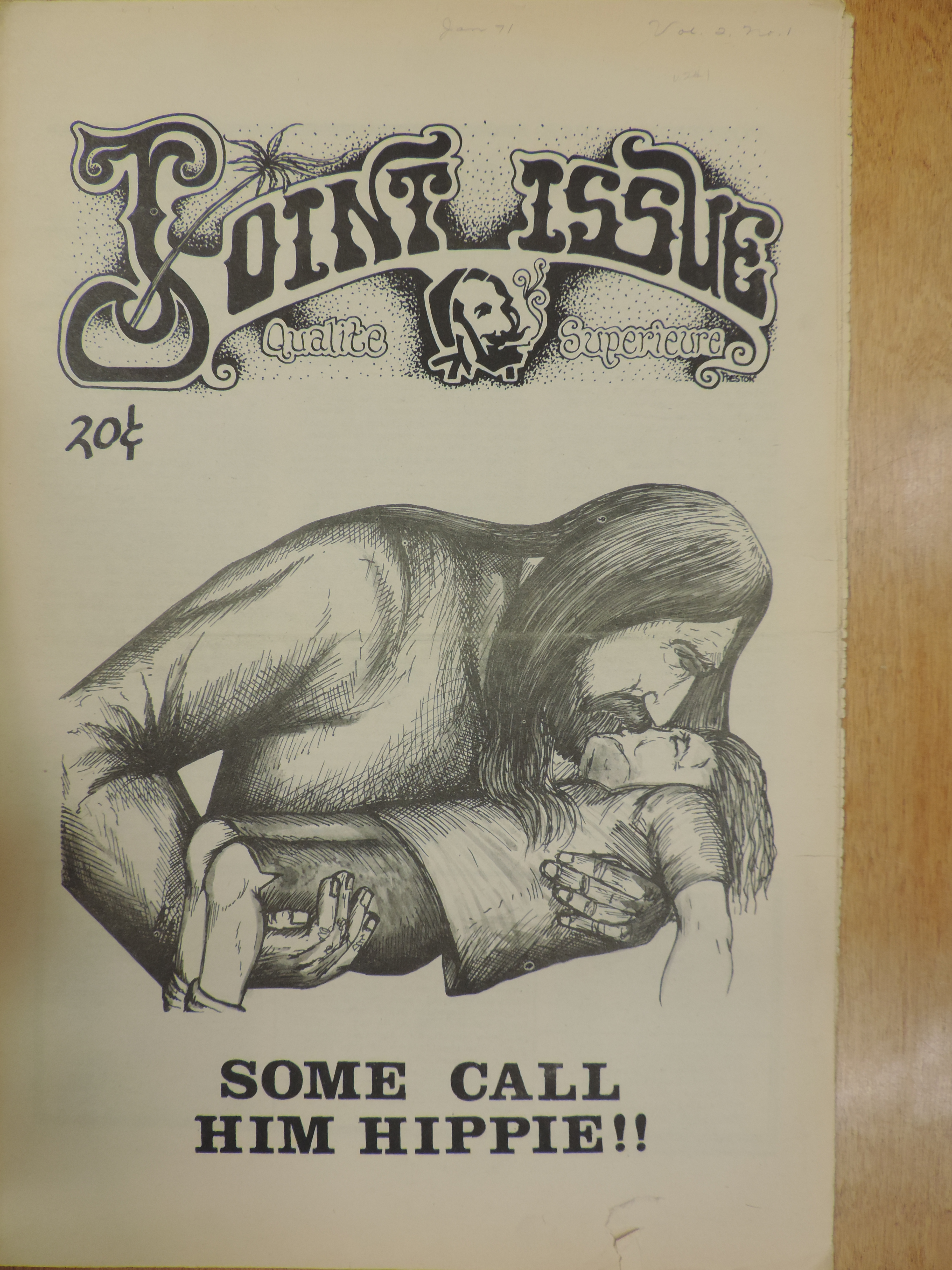
Joint Issue was an alternative community newspaper. Alternative didn’t mean the writers could write whatever they liked. This cover parodied a roadside billboard, popular in 1970, where a uniformed police officer was shown providing resuscitation to a drowning child. The caption on the sign said, ”Some call him Pig!” Police felt unfairly persecuted in the 1970s during the anti-Vietnam war movement when they clashed sometimes with protestors during demonstrations.
Eventually I dropped out of college to join the anti-Vietnam-war movement. I worked on staff for a community anti-war underground newspaper. All articles were critiqued and followed a commonly agreed to set of values. I found I wasn’t free to write, because every piece had to get by staff who had their own ideas about what was appropriate for our fifteen-thousand readers.
Though I continued to write and publish, my articles never seemed to rise to the level of good. People read our paper. It was highly circulated for an underground. We did some things right, I suppose. But I can understand why staff-writers on newspapers and magazines today feel the same pressures I did to conform to the values of the people who decide if they will be published. No one is the Lone Ranger, especially where writing is a business driven by profits or, in our case, ideology.
I stopped writing during my career as a mechanical engineer and machine designer. But eventually, after four decades, I retired. I thought, maybe it would be fun to start writing again. My writing skills lay rusty, in ruins, really. Why not start a blog, I thought to myself, and write about what I’ve learned and know? Maybe I’ll write about things I don’t know, too. Maybe I’ll pontificate, if I feel like it. Who can stop me? I had this crazy idea I could write anything. If I sounded like a communist at times, so what? Who was going to fire me? I was retired. I was free, and I was going to write like it.
Some in my family were blustering and pontificating on Facebook, crowding out the pictures and videos of grandchildren. I thought, why not give people another place to pontificate? It might go a long way to help free up the space we depended on to provide news about our little people. I figured readership would be tiny. I would fly under the radar of hostile readers, if hostile people actually lived in cyber-land as was sometimes rumored.
Gays and straights had problems with my story about a gay physician’s assistant.
The first unusual thing happened right away, after I published a short story about a gay physician’s assistant. Almost immediately a swarm of Asian bots from the women’s apparel industry attacked my site. Anonymous comments piled up fast. More bots landed from USA cosmetic and high-fashion sites. What was going on?
I reread my article. It was supposed to be neutral. It was supposed to describe the gulf between gays and Christians on the subject of marriage and hint at some possible common ground of interest and attitude. But the writing was poor. The article tilted strongly toward a Christian point of view. It lacked ambiguity and neutrality — important components in articles designed to make people think.
I rewrote the story. And I put restrictions on comments. From now on each comment would be reviewed before posting to make sure it was from a living person. Overnight, the attacks stopped. I had peace on my blog-site. My family could continue to indulge me, reading my pontifications to help me feel loved and listened to in my old age, I supposed.
I puttered along writing articles about everything and anything that popped into my head. After writing about twenty-five posts, I decided to do something different: something bold; something experimental. I would self-disclose my sexuality and challenge readers to drop their prejudices against gays. I wrote the article, tidied it up and pushed the publish button. All hell broke loose.*
Site views were running ten times normal.
WordPress, keeper of my blog-site, alerted me to unusually high view volume. I looked up my stats. Site views were running ten times normal and piling up fast. At first I thought, wow, people like my blog.
The truth was, some thought I was advocating for homosexuality. They believed my views were against the Bible, inspired by satan, and possibly embarrassing to my family. People swarmed my site trying to understand the article and how to respond to it. Some decided that, unless I took down my post, they would turn me in to church-elders, a necessary prelude to (if I didn’t cooperate) church-discipline, even to possible excommunication.
But by then church leaders were already rummaging through my articles. Some articles, they found wanting. Their attitude was, since I belonged to their church, because I was a baptized covenant member, I certainly was not free to say anything I wanted. Everything I wrote had to be consistent with scripture and what they thought it said. To show they meant business, they disbanded my Bible-study group and removed me from leadership.
Church leaders expected me to comply. Comply, I did.
Church leaders wrote me a letter which included a bullet-list of concerns. They announced my punishments. They presented another list; this time, demands. They expected me to comply, and comply is what I did.
I took down the offending article. My seventy-one year old wife was recovering from open-heart surgery. All her friends are in our church. The last thing we needed was to undergo an excommunication. Like Galileo, who blasphemed Jesus and the Catholic church by making the absurd claim that Earth was not the center of the universe, it was recant or be tortured — because having my blog ripped out from under me feels like torture. I didn’t see it coming.
Church leaders say they love me and want what’s best for my soul. I believe them. It’s what I want too. And truth is, my article was edgy. It pushed a lot of boundaries, even mine. I didn’t like some parts of the article either, it turned out. No one wants to go to Hell. No one wants to forfeit the love of Jesus. No one wants to lose friends they’ve had for decades over an article or two in a blog. I get that. I feel it, too.
I want to write; unafraid, if possible.
Decades spent in prayer, renouncing sin, loving the unlovable, giving aid to the wretched — the things we do as part of submitting to the will of Jesus — these things are supposed to humble us. But I want to write, unafraid, if possible. I can’t know, always, if something I write is going to offend someone well versed in the theology of our church.
In life, we all want to get it right. I don’t want to upset anyone. But no one gets it right one-hundred percent of the time; not even close. Even with a team of the best advisors available, no one gets it right all the time. Entire nations of praying people march off the cliffs of history, sometimes.
I have this idea that in America we have freedom of speech only if no one is listening to us. As soon as a handful of people start reading our stuff, even if it’s just family and a few Facebook friends, some people make it their business to bend us to their ideas of what is appropriate.
Try to speak freely. If people start to listen, you could be in for a sad surprise.
Freedom of speech means little more than bragging-rights to the people who run our country and manage our institutions, it seems to me. They brag to the world about how free we are; how easy it is to speak our minds. But try to publish. See what happens.
Start a blog and try to find your voice. Speak freely, tell it like it is, as you, your unique self, sees it — uncensored and unafraid — if only with your family and close friends. If you think America is the land of the free, you might be in for a sad surprise.
Billy Lee
* Note: we’ve included a link to the re-written, re-titled and sanitized version of the original article, Christian Love and Gay Pride. The rewritten version, which better articulates the views of Billy Lee, is called, Gay Love and Christian Pride. The Editorial Board